










































































Article Contents:
- Why you should buy wooden floor skirting
- Which wooden floor skirting to buy: what the choice depends on
- What material is best to buy wooden skirting from
- Oak skirting
- Beech skirting
- Solid wood skirting board
- When to choose natural shade and when to choose paintable
- Standard profile (45–70 mm)
- Wide wooden skirting (80–100 mm)
- Tall wooden skirting (100–120 mm and above)
- What size is best for an apartment
- What size is best for a house
- Natural Wood
- White wooden skirting board
- For painting
- Under the floor level
- Matching doors and trims
- Under laminate
- Under parquet
- For engineered board
- For solid wood
- For quartz vinyl in a warm interior
- For Apartments
- For Home
- living room
- for the bedroom
- For the hallway
- For Kitchen
- Which wooden floor skirting is better to buy?
- What is better to buy: wooden skirting or MDF?
- What height of wooden skirting to choose?
- Is it worth buying wide wooden skirting?
- Is wooden skirting suitable for laminate flooring?
- Which wooden skirting to choose for an apartment?
- Which wooden skirting to choose for a house?
- Can I buy wooden skirting for painting?
- How to match wooden skirting to doors and architraves?
- Where to buy wooden floor skirting?
- How much does wooden floor skirting cost?
- Which wooden skirting suits a classic interior?

When the renovation is almost complete and the floor is laid, the moment arrives that many underestimate: choosing skirting. This is where the decision either completes the interior with impeccable results or turns all the effort into an unfinished picture without a frame. If you want to buy wooden floor skirting—it's not just a question of price per linear meter. It's a matter of profile height, wood species, finish, combination with flooring, doors, and the overall atmosphere of the space. Let's break it all down so you make the choice once and remain satisfied for years to come.
Select wooden floor skirting right now:
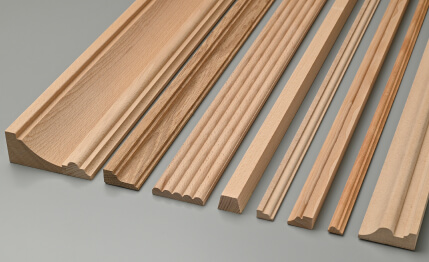
- solid wood baseboard — oak, beech, various profiles
- all floor skirting — full assortment
- moldings, cornices, and baseboards — related solid wood products
- Solid Wood Items — complete catalog



Why you should buy wooden floor skirting
There are materials that simply exist in an interior, and there are materials that shape it. Wooden skirting is definitely in the second category. When you decide to buy a wooden floor skirting, you are not just choosing a decorative strip by the wall. You are choosing the finishing touch that connects the floor and walls into a single whole, giving the room completeness and character.
Natural wood has a unique property - it is alive. It has texture, pattern, depth. This cannot be achieved with plastic or even quality MDF: no artificial material can provide that visual sense of nobility that arises when looking at a carefully sanded oak profile. Wooden skirting organically combines with parquet, engineered board, solid board - it is not an insert in a wooden interior, but its continuation.
Good compatibility with doors and architraves is another weighty argument. If wooden doors with wooden architraves are installed in the house, wooden floor skirting completes the unified style. This solution works in classic, modern classic, Scandinavian style, eco-interiors. That is why more and more people, thinking about renovation, immediately look for where to buy wooden floor skirting as part of a comprehensive solution.
Wooden skirting is suitable both for an apartment with a ceiling height of 2.7 meters and for a country house with ceilings of three meters and above. The height range is wide: from neat 45–60 mm to status 100–120 mm. And in each case, the solid wood works precisely, confidently, beautifully.




Which wooden floor skirting to buy: what the choice depends on
This is the most important question to ask yourself before going to the catalog. How to choose a wooden floor skirting is a task in which several factors are involved simultaneously, and none can be ignored.
Type of premises. An apartment in a new building and a country house with wooden flooring are different scenarios. In an apartment, neatness and lightness are often important; in a house - richness of the profile and compliance with the overall concept of the wooden interior. For the hallway, where the skirting is often touched, the density of the wood species is important. For the bedroom - aesthetics and subtlety of the profile. For the living room - status and height.
Wall height. This is the basic rule: the higher the ceiling, the higher the skirting board. For ceilings up to 2.7 m, profiles 60–70 mm high work comfortably. For ceilings 2.8–3.0 m, 80–100 mm are appropriate. For rooms with ceilings from 3.0 m and above — 100–120 mm. If you break this proportion and install a small skirting board in a tall room, the lower part of the wall will visually fall off.
Floor covering. Parquet, engineered board, solid wood, laminate, quartz vinyl — each has its own texture and shade. A wooden floor skirting board should either match the tone of the covering or consciously contrast with it. Chaotic mismatch looks like an accident, not design.
Interior style. Classic and modern classic require a figured profile with a heel or soft transitions. Minimalism and Scandinavian style — straight, laconic. Eco-style and wooden house — natural shade with emphasized texture.
Is a skirting board for painting needed? If the walls are white and the doors are white — it's logical to take a wooden skirting board for painting, which will become part of the monochrome image. If you want to preserve the natural shade of the wood — take a skirting board with a varnish or oil coating.
Understanding which wooden skirting board is better to buy for a specific interior means answering all these questions. Then the choice is made once, without redoing.
Our factory also produces:
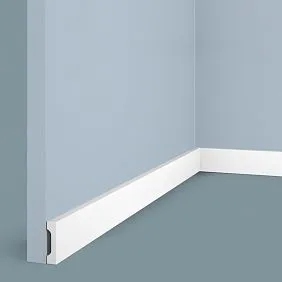
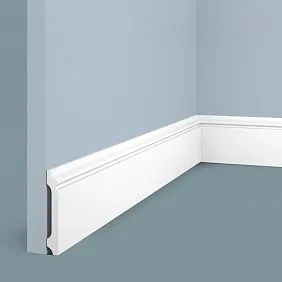

What material is better to buy a wooden skirting board from?
Get Consultation
Oak skirting board
Oak is a symbol of reliability and nobility in the world of wooden products. Buying a wooden floor skirting board made of oak means choosing durability: the density of oak wood reaches 700–800 kg/m³, making it resistant to mechanical damage. Oak is not afraid of vacuum cleaner touches, furniture moving, or accidental impacts—it withstands all of this without noticeable marks.
The texture of oak with characteristic medullary rays creates a unique visual effect. No MDF or film can replicate the lively play of pattern that real solid wood provides. An oak skirting board looks equally good in its natural shade, tinted to resemble walnut or wenge, or painted white.
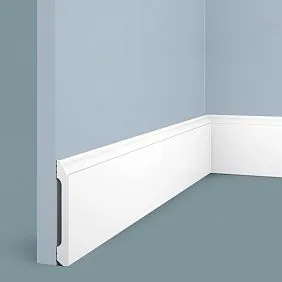
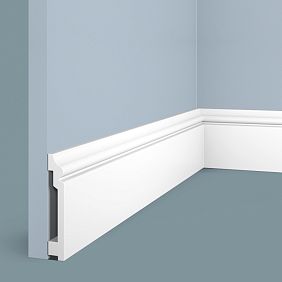
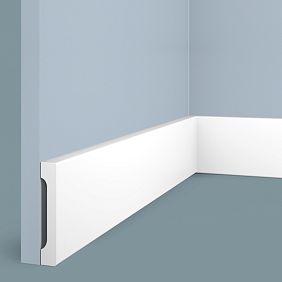
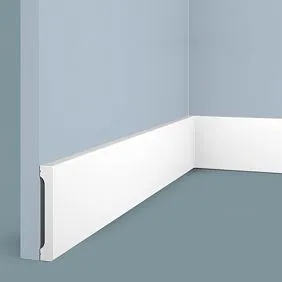
Wooden skirting board made of solid oak and beech — STAVROS catalog
Beech skirting board
Beech is slightly lighter and finer-grained in structure than oak. If oak is aristocratic severity, then beech is warm, cozy elegance. Buying a wooden floor skirting board made of beech is especially appropriate if the floor is made of light-colored boards or if the interior is designed in warm neutral tones.
Beech is perfect for painting: its uniform fine-pored structure provides an even, flawless coating without the wood grain showing through the paint. This is why most wooden skirting boards for painting are made of beech. Its moisture resistance is slightly lower than that of oak, so for the kitchen and hallway, it is better to choose a finish with varnish or oil.
Solid wood skirting board
The term solid wood means a product made from a single piece of wood—unlike veneered or glued constructions. Buying a wooden skirting board made of solid wood means getting a product with natural depth of pattern across the entire cross-section. If it gets scratched or the finish wears off—it is enough to sand and re-varnish it. No veneer layer will peel off, no film will come loose.
Solid wood products are a long-term investment. If MDF skirting boards are replaced with every renovation, then Skirting made of solid wood it lives as long as parquet: for decades.
When to choose a natural shade and when to choose one for painting
A natural shade is chosen when you want to emphasize the wooden character of the interior: parquet, solid wood doors, wooden architraves. Here, the skirting board should continue the wood theme and be a part of it.
A skirting board for painting is chosen when the walls and doors are white and unity of lines is needed; when you want the skirting board to be an invisible element; when the interior style is neoclassical or modern classic with white moldings.
View wooden skirting boards for painting and in natural shades
How to choose the size: tall, wide, or standard
Size is not just a number on a label. It is an architectural decision that affects the proportions of the entire room.
Standard profile (45–70 mm)
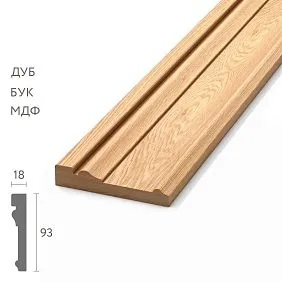
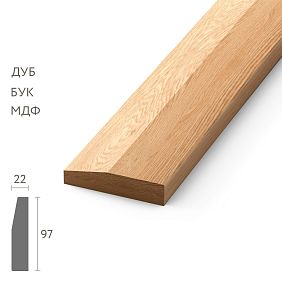
Suitable for rooms with ceilings up to 2.7 m, modern apartments, studios, rooms with a light minimalist interior. It does not overload the space, does not consume the wall, but still performs all its functions — covers the gap, protects the base, creates a neat horizontal line. The standard 60 mm profile is ideal for a bedroom, children's room, or study where comfort and tranquility are important.
Wide wooden skirting board (80–100 mm)
This is already a noticeable accent. It's worth buying a wide wooden skirting board if the ceiling height is from 2.8 m and you want the skirting board to become part of the room's architectural image — not just a strip. A wide skirting board visually organizes the lower part of the wall, sets the horizontal, and makes the interior more substantial and prestigious.
In living rooms and formal corridors Wide wooden skirting board for the floor looks especially good — it creates a sense of classical architecture even in modern housing.
Tall wooden skirting board (100–120 mm and above)
Buying a tall wooden skirting board is a strong design decision. Such skirting boards are installed in rooms with ceiling heights from 3.0 m, in country houses, in representative spaces. They create monumentality and completeness. The tall profile is especially effective paired with wooden wall moldings and ceiling cornices — the entire vertical of the room begins to work as a unified architectural statement.
Which size is better for an apartment
For a standard apartment with 2.7 m ceilings, the optimal choice is a 60–80 mm profile. This is neither too little nor too much. An 80 mm profile gives a bit more weight and status, 60 mm — lightness and modernity.
Which size is better for a house
For a country house with ceilings of 2.9–3.2 m, a range of 80–120 mm is recommended. The higher the ceiling, the higher the skirting board should be — otherwise the lower part of the room will look empty. A 100–120 mm skirting board in a house with high ceilings looks natural and organic.
Popular size solutions:
- Wide wooden skirting board for the floor — 80–100 mm
- High profile for large rooms — 100–120 mm
- Neat option for apartments — 60–70 mm
- Baseboard for doors and architraves — selection by profile
Which color and finish to choose
The color of a wooden floor baseboard is the point where interior logic should prevail over random choice.
Natural wood
Natural oak or beech shade is a universal and fail-safe choice. It works in classic, modern classic, Scandinavian, and eco-style. Only one thing is important: the baseboard shade should echo the floor shade. It doesn't have to match exactly—it's enough for them to be from the same tonal family.
White wooden baseboard
Buying a white wooden floor skirting board is relevant in several scenarios: white or light gray walls, white doors, neoclassical or Scandinavian style. White skirting makes the space more airy and emphasizes the geometry of the room. At the same time, unlike MDF, a white wooden skirting board can be repainted or restored—the material lives in it.
For painting
A skirting board for painting is not just an unfinished product. It is a base for any color. It is sold already sanded and primed or in its raw form for self-preparation. How to properly prepare and paint is covered in detail in the article on painting a wooden skirting board.
To match the floor color
Harmony between the floor and skirting board color is a classic designer technique. It creates a sense of monolithic floor plane. You should select not from photos on a screen, but from live samples: place the skirting board on the floor and evaluate it in real lighting.
To match doors and architraves
This is a professional approach: skirting boards, architraves, and doors made from the same wood species and in the same shade create an architectural unit. Wooden Solid wood casings paired with a wooden skirting board—this is a level of finishing that is immediately visible.
For which floor coverings is it worth buying a wooden skirting board
Under laminate
Laminate today comes in a wide range of shades—from light ash to dark wenge. Buying a wooden skirting board for laminate is more appropriate than taking a plastic one to match: natural material gives the laminated floor a sense of authenticity. This works especially well when laminate imitates parquet or plank flooring—a wooden skirting board completes the illusion. It's important to remember the expansion gap: laminate is a floating floor covering, and the skirting board should not pinch it.
Under parquet
Parquet and wooden skirting board are a natural pairing. Classic solid oak parquet requires an oak skirting board. This rule isn't strict, but it's logical: the materials match in character, texture, and aesthetics. Buying a wooden skirting board for parquet means finishing the installation with a unified language.
Under engineered wood
Engineered wood is a veneer of valuable wood on a stabilized base. Its veneer can be oak, ash, walnut. For it, a wooden skirting board of the same wood species as the veneer is ideal. When selecting, it's important to match not only the color but also the degree of gloss finish—matte to matte, semi-matte to semi-matte.
Under solid wood
Solid wood plank is the most natural floor covering. A wooden skirting board for the floor in such a situation is the only appropriate choice. Neither plastic nor MDF with film will provide the desired feel. Only solid wood to solid wood.
Under quartz vinyl in a warm interior
Quartz vinyl itself is an artificial material, but if it's chosen in a warm wood texture, a wooden skirting board can elevate the entire concept. This is appropriate when the interior is designed in warm natural tones and the wooden skirting board harmonizes with the furniture and doors.
Where is it best to use wooden skirting boards: apartment, house, rooms
For an apartment
Buying a wooden skirting board for an apartment means choosing a material that will outlast several renovations. In an apartment with a classic or modern-classic interior, wood is always appropriate. It does not become outdated, does not yellow over time, and does not need replacing every 5 years. For a standard apartment with ceilings 2.6–2.7 m high, the optimal choice is: a 60–80 mm profile, oak or beech, in a natural shade or paintable.
For Home
In a country house, a wooden skirting board is almost a mandatory element. Especially if the house has wooden floors, stairs, doors. with a classic profile creates a sense of solidity, reliability. In a house, it is not decoration for decoration's sake, but an organic continuation of the material language of the entire building. With ceilings 2.9–3.2 m high, profiles of 100–120 mm are chosen.
For the living room
The living room is the main room, and here it is worth choosing a skirting board with an expressive profile. A tall wooden skirting board 80–100 mm creates an architectural belt, separates the floor from the wall, and gives the room a solemn feel. Paired with wooden moldings and cornices, it creates a cohesive interior.
For the bedroom
In the bedroom, intimacy and warmth are important. A wooden skirting board in a natural shade, a 60–70 mm profile, with a soft matte finish is just what you need. Wood creates a feeling of a living, breathing surface nearby. For the bedroom, it is better to choose beech or light oak.
For the hallway
The hallway is the highest-traffic area. Here, baseboards are most often bumped by vacuum cleaners, shoe boxes, and bags. This is exactly where maximum durability is needed: buying an oak wooden baseboard for the hallway is the right solution. Dense oak will withstand the load without dents or chips.
For the kitchen
In the kitchen, moisture resistance is important. Wooden baseboards are possible here but require mandatory varnish coating—reliable, in 2–3 layers. Oil is not suitable for the kitchen: it does not protect against splashes like varnish does. If the kitchen borders the dining area, the baseboard should be uniform throughout the entire space.
Wooden baseboard or MDF: which is better to buy
This question arises for everyone, and the answer depends on the task. If the interior is designed with natural materials—parquet, wooden doors, solid wood furniture—the choice is obvious: only solid wood baseboard. MDF here will look like a fake next to the original.
| Parameter | Wooden skirting board | MDF skirting board |
|---|---|---|
| Material | Natural solid wood (oak, beech) | Pressed wood fiberboard |
| Texture | Living, unique, with a natural pattern | Uniform, without a natural pattern |
| Durability | 30–50 years with proper care | 10–15 years, replace if damaged |
| Painting | Can be painted, repainted, restored | For painting, but without restoration |
| Price | Higher | Below |
| Weight | Heavier, installation requires preparation | Lighter, installation is simpler |
| Application | Classic, modern classic, wooden house | Modern minimalism, budget renovation |
| Uniqueness | Each product is unique | Standardized production |
If the interior is modern, laconic, with laminate and painted walls, MDF is quite appropriate. It is geometrically stable, does not dry out, and provides a smooth surface for painting. But for an apartment in a classic style, for a house with wooden floors, for interiors where naturalness and durability are important, the question of wooden baseboard or MDF is always resolved in favor of wood. MDF is a compromise. Solid wood is the result.
Mistakes when buying wooden floor skirting boards
Experience shows: most mistakes when buying wooden floor skirting boards occur not due to ignorance, but due to haste. Here are the most common ones.
Too low profile. If you buy a 40 mm skirting board for a room with 3-meter ceilings, it will look like a thin strip lost against the wall. Rule: the height of the skirting board should match the scale of the room.
Buying without considering doors and architraves. Wooden skirting board is part of a unified architectural ensemble. If the doors are oak, the architraves are solid wood, and the skirting board is beech of a different shade, unity will not be achieved. First decide on the overall concept, then select the details to match it.
Ignoring the floor shade. They buy a skirting board from a photo on a screen, but in reality the shade turns out cooler, darker, or warmer. Always look at live samples next to the flooring under the same lighting that will be in the room.
Choosing based only on price. The cheapest wooden skirting board is usually made from damp solid wood, without proper processing, prone to cracking. Saving here results in replacement within a year or two. Drying and processing quality are key parameters.
Profile mismatch with style. An ornate classic profile looks out of place in a minimalist interior. A straight, concise baseboard in a classic living room is also a miss. The profile should speak the same language as the interior.
Purchasing without a margin. During installation, cuts, corners, and joints are inevitable. Purchase material with a 10–15% margin from the calculated footage.
Where to buy wooden floor baseboard and what to check before ordering
Before placing an order, check the following:
- Profile — whether it matches the interior style
- Height — whether it matches the ceiling height and room scale
- Solid wood species — oak or beech depending on operating conditions
- Wood moisture content — a quality solid wood skirting board should have a moisture content of 8±2%
- Finish — lacquer, oil, or for painting
- Length — standard length 2000–2500 mm, calculate the perimeter with a margin
- Compatibility with interior — match with moldings and cornices, architraves and battens
The cost of solid wood floor skirting boards starts from 1,600–2,000 rubles per linear meter and depends on the wood species, profile height, complexity of shape, and type of finish. This is the price for quality that will last for decades.
What to view together with wooden skirting board:
- Solid wood skirting boards — full assortment
- Moldings and cornices — related products
- Solid wood casings — for doorways
- molding and trim from solid wood — for slatted panels and decor
View prices and buy wooden floor skirting on STAVROS
Frequently asked questions
Which wooden floor skirting is best to buy?
For most interiors, the best choice will be oak or beech solid wood skirting with a height of 70–80 mm and a profile that matches the style of the room. Oak is for high-traffic areas and classic design; beech is for light, warm interiors and for painting.
What is better to buy: wooden skirting or MDF?
If the interior features natural wood materials — parquet, doors, solid wood furniture — only solid wood skirting will achieve the desired result. MDF is suitable for modern minimalist interiors with laminate and painted walls.
What height of wooden skirting should I choose?
Base your choice on ceiling height: up to 2.7 m — 60–70 mm; 2.7–2.9 m — 80 mm; 2.9–3.2 m — 100 mm; above 3.2 m — 120 mm or more.
Is it worth buying a wide wooden skirting board?
Yes, if the ceiling height allows — from 2.8 m. Wide Wooden Skirting Board It gives the room architectural weight and a sense of prestige. In living rooms and spacious hallways, it's an excellent solution.
Is a wooden skirting board suitable for laminate flooring?
Yes. A wooden skirting board for laminate flooring is one of the best options for warm interiors. It gives the artificial covering a sense of naturalness. The main thing is to attach it only to the wall, without pressing the skirting board against the laminate.
Which wooden skirting board to choose for an apartment?
For an apartment with ceilings 2.6–2.7 m — a 60–80 mm profile, oak or beech. For an apartment in a classic style — a shaped profile with a heel. For a modern apartment — a straight, laconic profile.
Which wooden skirting board to choose for a house?
For a house with ceilings 2.9–3.2 m — a 100–120 mm profile. Preferably made of oak or hardwoods. Read more in the article. Wooden floor skirting board: how to choose for apartment and house.
Can you buy wooden skirting board for painting?
Yes. Skirting board for painting is made from beech — its fine-pored structure gives a perfectly smooth surface. Primer is needed before painting. Detailed instructions are in the article Painting wooden skirting boards.
How to choose wooden skirting board to match doors and architraves?
The best option is the same wood species and the same manufacturer. If the doors are oak, the skirting board should also be oak of the same tone. Architraves and skirting boards made of solid wood from one manufacturer guarantee matching shade and profile.
Where to buy wooden floor skirting board?
On the STAVROS website — direct manufacturer of solid wood products. Delivery across all of Russia, including Moscow and Saint Petersburg. Buy wooden floor skirting board available online with profile selection and consultation
How much does a wooden floor skirting board cost?
The price of a solid wood floor skirting board starts from 1,600 rubles per linear meter. The cost depends on the wood species, profile height, complexity of the shape, and type of finish. This is a long-term investment: solid wood lasts for decades without replacement.
Which wooden skirting board is suitable for a classic interior?
For classic interiors, you need a shaped profile with a heel or soft curves, 80–100 mm in height, made of oak in a tinted or natural shade. View options — solid wood skirting board for a classic interior.
About the Company
STAVROS is a Russian manufacturer of architectural products made from solid oak and beech. Wooden skirting boards, moldings, cornices, architraves, slats, and millwork — everything is produced on modern equipment while adhering to high quality standards. Each product undergoes multi-stage control: from wood selection and drying to final sanding and packaging.
STAVROS works with private clients and designers, provides delivery throughout Russia — from Moscow and St. Petersburg to regional centers. All products from the catalog are available for online order with professional consultation on selection. Choosing STAVROS means choosing natural material, precise profiles, and confidence in the result. buy wooden baseboard for floor — means making your interior complete once and for all.