










































































Article Contents:
- When to buy wooden slats for the wall
- How a decorative solid wood slat differs from a regular one
- Where to use decorative wooden slats
- Wooden slats behind the sofa
- Reiki in the TV zone
- Slats in the hallway
- Slats in the bedroom at the headboard
- Wooden slats for cafes, restaurants, commercial interiors
- How to choose the size of wooden slats
- Which material to choose: solid wood or MDF
- Solid wood slats
- MDF slats
- Wooden slats, moldings, or battens: what to choose for the task
- How to combine slats with other wooden interior elements
- Mistakes when choosing and installing wooden slats
- How to calculate the number of slats: a practical guide
- Wooden wall decor: slats as part of a larger system
- Where to buy wooden slats for the wall
- FAQ: Answers to the Most Important Questions
- About the company

Wooden slats on the wall are one of the few decorative techniques that work equally well in a modern apartment, a country house, and a restaurant. But there is a big gap between "saw it on Instagram" and "understand exactly what to buy." This article bridges that gap: here you'll find specifics on selection, size, material, calculation, and purchase.




When it's worth buying wooden slats for the wall
Before discussing selection parameters, it's worth figuring out the question "do I even need slats?" Not every interior requires this solution — but there are situations when buying wooden slats for the wall is the most precise answer to a specific task.
The first and most common situation is an accent wall behind the sofa. A living room with white walls and a sofa against the far wall: everything is neat, everything is neutral, but there's nothing for the eye to latch onto. Vertical slats behind the sofa instantly create a focal point, requiring neither wallpaper, art objects, nor furniture rearrangement. The wall gains character — warm, textured, lively.
The second situation is the TV area. A TV on a white wall is a functional solution but lacks architecture. Slats allow you to create a backdrop that makes the TV area well-thought-out: the vertical rhythm frames the screen, creates depth behind it, and turns the appliance into part of the interior composition.
The third is the hallway. Narrow walls, piers, a zone with a mirror or console. The hallway rarely receives enough attention in design, yet it is what forms the first impression. Wooden wall slat on one of the hallway walls — a cost-effective and striking way to make the entrance to the apartment memorable.
The fourth is the wall at the head of the bed in the bedroom. The headboard wall is the main wall in the bedroom, which you look at every morning and every evening. Slats here replace an expensive bed headboard or complex painting — and at the same time create a feeling of a deliberately designed space.
The fifth is the study. A workspace where slats on the wall behind the desk create a professional background for video calls and simultaneously make the study more "substantial" and focused.
The sixth is a commercial interior. Cafe, restaurant, boutique, beauty salon, showroom, hotel. Here wooden planks on the wall they work as an atmosphere tool: natural wood creates warmth, the rhythm of the slats forms dynamics, and the overall image of the space becomes memorable.
The seventh is zoning open-plan layouts. Slats on a fragment of a wall or as a semi-transparent partition mark the boundary of zones without physical separation — a functional and aesthetic technique at the same time.




How a decorative solid wood slat differs from a regular one
This question needs to be addressed immediately — and addressed honestly. Because the difference is fundamental, and it is precisely the misunderstanding of this difference that leads to disappointments.
A regular construction batten is lumber. It is produced for auxiliary construction tasks: lathing, counter-batten, base for plaster, mounting support. Dimensions are calibrated according to GOST for structural needs. The surface is as it comes from sawing: there may be snags, roughness, unstable density. Knots, cracks, uneven geometry — all of this is normal for a construction material intended to be hidden.
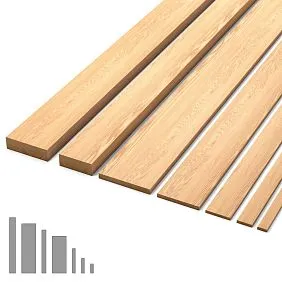
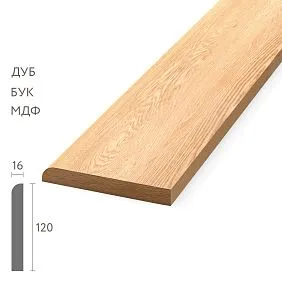
Decorative wooden strip — is an interior product made of solid wood with specific aesthetic parameters. Treated, sanded surface. Precise cross-section geometry. Stable grain pattern. Properly selected wood species. This product is designed to be looked at — and that is its fundamental difference.
Additionally, a decorative batten must systematically work with other finishing elements. Solid wood battens on the wall acquire their full value only when they are coordinated in wood species, tone, and texture with wooden skirting board, cornice, moldings, door casings. A construction batten does not fit into such a system — even with the same paint, it will look alien due to surface unevenness and geometry instability.
Dimensional stability is also important. A decorative batten made of properly dried solid wood practically does not change geometry with fluctuations in humidity and temperature — this is crucial for a wall where battens are placed tightly or with a fixed gap. A construction batten made of raw wood can warp in a month — and then the rhythmic row will turn into a wavy surface.
Our factory also produces:


Where to use decorative wooden battens
Get Consultation
Wooden battens behind the sofa
An accent wall in the living room is an area that works constantly: it is looked at from any point in the room. Wooden slats behind the sofa — one of the most popular and at the same time most versatile decorative techniques of the last decade. Why does it work?
First, vertical slats visually raise the ceiling: the eye follows the lines upward, making the space seem taller. Second, the rhythmic alternation of slats and gaps creates a play of shadows that changes throughout the day with shifting lighting — this is living decor, not a static picture. Third, natural wood adds warmth and texture to the wall that no paint or wallpaper can replicate.
For a living room, slats are usually mounted from floor to ceiling: this creates the most convincing architectural effect. The cross-section is medium, 20–30 mm wide and 15–20 mm thick. The gap between slats ranges from 30 to 60 mm depending on the effect: a frequent gap creates the feeling of a solid wooden field, a rare one creates a light rhythm.
Reiki in the TV zone
The TV zone is a special case. Here, slats are not just decor but also a functional background that "absorbs" the TV, making it an organic part of the wall rather than a piece of equipment hanging in emptiness. Wooden slats for the TV zone are chosen slightly darker than the main walls — a dark background contrasts with the screen and reduces eye strain during viewing.
An important nuance: slats in the TV zone should not be too bright in pattern. A pronounced fiber texture behind the screen will distract the eye. Here, wood with a smooth, calm pattern works better — beech with tinting or oak with a coating that "calms" the texture.
The horizontal version of slats in the TV zone is a rarer but very effective technique. Horizontal lines visually widen the wall and add dynamics — creating a cinematic feel, which is organic for the TV zone.
Reiki in the hallway
The hallway is a small, often narrow space with limited decoration possibilities. Slats work especially well here precisely because they don't require much space: they are mounted directly on the wall, don't take up space, but radically change the perception.
Wooden slats for hallway are often chosen in light tones — to avoid narrowing an already small space. A narrow section (15–20 mm) with a moderate step (40–60 mm) gives a delicate rhythm without overload. The combination of slats with a mirror works well: a mirror framed with wooden slats or integrated into the plane of a slatted wall is a strong design technique.
Slats in the bedroom at the headboard
The wall behind the bed headboard is the surface you look at in the first seconds of waking up and the last minutes before sleep. It sets the tone for the entire room. wooden slats for the bedroom in this area — a way to create a warm, cozy background without loud gestures.
The optimal option for the bedroom is slats of a medium tone: not too dark (so as not to overwhelm), not too light (so there is expressiveness). Natural oil without tinting or delicate tinting in gray-beige tones are classic solutions. Section — thin or medium, step — moderate.
An interesting technique: slats are mounted not to the full height of the wall, but only in the headboard area — from the floor to a height of about 120–140 cm, that is, just up to the level of the bed's 'cap'. This creates a clear decorative panel behind the bed without the need to panel the entire wall.
Wooden slats for cafe, restaurant, commercial interior
Commercial interior is a special story. Here, slats work as a tool for 'packaging' the atmosphere: they create the image of the establishment that the guest reads instantly. Wooden slats for cafe In light tones — Scandinavian coziness, naturalness, "honest cuisine." Dark slats with a brushed texture — the atmosphere of a bistro or loft-style gastronomic establishment. The frequent rhythm of thin slats — Japanese aesthetics, composure, minimalism.
Wooden slats for a restaurant With a concept of "haute cuisine" or wine pairing — dark oak, pronounced texture, a rare step with wide shadows between the slats. This creates a feeling of intimacy, privacy, a special place.
How to choose the size of a wooden slat
The size of a wooden slat is not just width and thickness. It is a combination of three parameters: slat width, slat thickness, and the gap between slats. It is the ratio of these three numbers that determines the final visual effect.
| Task | Recommended cross-section | Spacing between slats |
|---|---|---|
| Accent wall in the living room | 20–30 × 15–20 mm | 30–60 mm |
| Narrow corridor/entrance hall | 15–20 × 10–15 mm | 40–60 mm |
| TV zone | 20–25 × 15 mm | 25–40 mm |
| Bedroom, headboard | 20–30 × 15 mm | 40–50 mm |
| Cafe/restaurant, atmospheric interior | 25–40 × 20 mm | 30–60 mm |
| Classic interior with moldings | 20–30 × 15 mm | 40–60 mm |
| Country house, rustic | 30–50 × 20–25 mm | 40–80 mm |
The width of the slat determines how much it "reads" as a separate element. A thin slat (15–20 mm) creates a light, delicate rhythm — the eye glides across the wall without pausing. A wider slat (30–50 mm) is already an independent accent, each slat is noticeable and significant.
The thickness of the slat affects the depth of the shadow. The thicker the slat, the more pronounced the shadow falls into the gap with side lighting — creating volume and depth. Thin slats are almost flat under frontal lighting. This is important to consider when designing lighting: side light from spotlights or track lights maximizes the volume of the slatted wall.
The spacing between slats — the ratio of slat width to gap width — creates the character of the rhythm. Equal spacing (slat = gap) is classic and balanced. Slat narrower than gap creates a light, airy effect. Slat wider than gap creates a dense, rich pattern.
The height of the wall determines the length of the slat and affects the perception of the vertical. With a ceiling of 2.5 m, slats from floor to ceiling work as a full architectural element. With a ceiling of 3.5 m and higher, the same slats need to be made slightly more massive in cross-section — otherwise they will "get lost" in the height.
Calculation of the number of slats: divide the length of the wall (in mm) by the sum of the slat width and gap width. Add 10% for trimming and possible defects. This is your minimum footage. Multiply the number of slats by the height of the wall to get the total linear length in meters.
Which material to choose: solid wood or MDF
As with other wooden linear products, a solid wood slat and an MDF slat are two different products for different tasks.
Solid wood slats
An array is a living texture, a natural pattern of fibers, the warmth of a natural material. Decorative louvers from solid wood are good when the wall should look like natural wood — with an individual pattern, depth of texture, and a sense of the material.
Oak as a material for slats is dense, with an expressive pattern, with a characteristic "mirror-like" quality on the radial cut. Oak slats with a clear oil finish are a classic of decorative molding, equally suitable in modern interiors and classics. Beech is more uniform in texture, softer in color, and takes tinting and painting well.
An important property of solid wood: it "breathes." With proper treatment and normal operating conditions (room humidity 40–60%), solid wood slats retain their shape for decades and do not lose their aesthetic qualities. A scratch on solid wood can be sanded out. The finish can be renewed. The color can be changed. It is a durable material that can be restored.
MDF slats
MDF is a homogeneous medium-density board without a natural pattern. Its main advantage is geometric stability and an ideal surface for painting. MDF slats lack individuality in texture but provide a perfectly smooth, uniform surface that looks flawless when painted in a solid color.
For walls where slats need to be painted the same color as the wall or a contrasting color (white slats on a dark background, black slats on a light background), MDF is the optimal choice. It is more economical, easier to work with, and lighter in weight. solid wood items At STAVROS, both options are available for most molding products, including slats.
Practical rule of thumb for selection:
-
If you want natural texture, oil, wax, or tinting — choose solid wood.
-
If you want a matte finish in a specific color, choose MDF.
-
If you want light weight and easy installation for a large area, MDF is more convenient.
-
If you want a product with the value of natural wood, only solid wood will do.
Wooden slats, moldings, or trim: what to choose for your task
This is a question that arises for everyone who starts learning about wooden linear decor. Slats, moldings, trim — they sound similar, but in reality they are different tools with different visual effects.
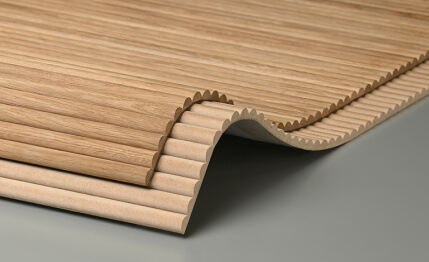
Slats are about rhythm and verticality. Their strength lies in repetition: one slat means nothing, ten slats create a pattern. Slats give the wall structure, divide it into vertical stripes, and create a play of shadows. Wooden boards in interior — is about texture, rhythm, and depth.
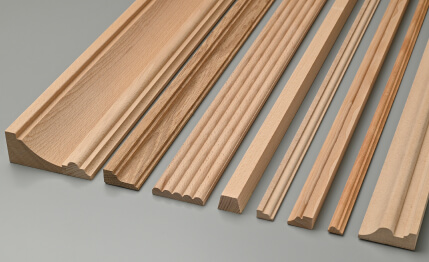
Moldings are about frames and geometry. A molding creates a rectangular or square decorative panel on the wall: a frame that makes the surface look like classic paneling. Wooden moldings — is about classic style, order, and architectural detailing. They require precise proportions and accurate horizontal and vertical installation.
Wooden molding — is a thin profile used as an overlay decorative element in joints, on flat surfaces, as fluting on door or panel surfaces. Trim is a more delicate tool than a slat: it doesn't create its own rhythm but rather 'finishes' other elements.
wooden cornice completes the top line of the wall. Wooden baseboard — the bottom one. The slats occupy the space between them. Together, these three elements create a complete architectural "frame" for the wall.
If you want a modern interior, choose slats: they are versatile, concise, and work well without additional decor.
If you want classic or neoclassical style, choose moldings in combination with slats or instead of them: they create a more academic look.
If you need fine-tuning of existing decor or finishing joints, choose layout strips.
How to combine slats with other wooden interior elements
Slats are part of a system, not a standalone element. When they work surrounded by coordinated wooden details, the effect multiplies. Let's look at the main combinations.
Slats + baseboard. The most basic combination. Wooden baseboard made from the same species and in the same tone as the slats — this is the bottom "frame" for the slatted wall. Visually, the slats rest on the baseboard, giving the wall a finished look. Without a baseboard, the slats seem to "hover" above the floor.
Slats + cornice. The top "frame". wooden cornice Along the perimeter of the ceiling, the slats intercept from above, creating an architectural "stop." Slats from floor to cornice form a system that looks like a professional design solution, not a DIY craft.
Slats + moldings. A combination for classic and neoclassical interiors. Moldings create a horizontal belt or decorative frames on the walls, while slats fill the space inside the frames or in side areas. This is a complex but very expressive system.
Slats + decorative beams. If beams are installed on the ceiling, Wooden beamsthe slats on the walls create a perpendicular response: the horizontal at the top and the vertical at the bottom form a unified wooden system. This is especially organic in country houses and restaurants in the country or chalet style.
Slats + furniture. A wall with slats should "converse" with the furniture. Classic Furniture made of wood against a slatted wall is a cohesive theme. Modern Furniture with wooden details also works. Furniture without a single wooden note against a plank wall is a disconnect that needs to be compensated for with color or textiles.
Mistakes in choosing and installing wooden slats
Experience is the best teacher, but others' mistakes are cheaper. Let's break down eight typical miscalculations.
Slats that are too wide for a small room. A 50 mm wide slat in a 15 sq.m room with a 2.5 m ceiling will look like a shed lining. The scale of the product must match the scale of the room.
Step too frequent. When the gap between the slats is less than their width, the wall turns into a solid wooden plane — the rhythm and play of shadow, for which it was all started, are lost. Maintain a slat/gap ratio of at least 1:1.
Ceiling height not considered. Too light slats with a high ceiling "dissolve." Too massive slats with a low ceiling feel oppressive. Select the cross-section considering the height.
Joint with baseboard not thought out. If the slats are simply cut at the floor without adjoining the baseboard, it results in a messy technological gap. Correct: either the slats go behind the baseboard, or the baseboard is mounted over the slats.
Slats are not connected to furniture, doors, or other elements. A slatted wall in a room where everything else is from a different style and material looks like a random decision. The wall should be part of the system.
Construction slat instead of decorative. Already discussed above. Let's add: a construction slat under varnish looks like a construction slat under varnish — no coating will fix the unevenness of the surface and randomness of the texture.
Quantity not calculated in advance. Ordered "approximately" — got a shortage in the middle of the wall or an unclear remainder. Calculate precisely: wall length ÷ (slat width + step) × wall height + 10% reserve.
Finish coating not chosen before installation. Painting slats after installation is significantly more difficult than before. Gaps are covered unevenly, unpainted areas remain in corners. Professional approach: coat slats with oil or paint before installation, after installation only touch up the joints.
How to calculate the number of slats: practical guide
Before placing an order, four numbers are needed:
-
Wall length in mm — L
-
Slat width in mm — W
-
Gap width between slats in mm — G
-
Wall height in mm — H
Formula for number of slats: N = L ÷ (W + G)
Round to the nearest whole number.
Total linear footage: P = N × H (in mm), convert to meters.
Add 10% for trimming: P_final = P × 1.1
Example: wall 4000 mm long, height 2600 mm, slat 25 mm, gap 40 mm.
N = 4000 ÷ (25 + 40) = 4000 ÷ 65 ≈ 62 slats.
P = 62 × 2600 = 161,200 mm = 161.2 m + 10% = about 177 m of linear footage.
If the slats are supplied in lengths of 2.5 m: 177 ÷ 2.5 = 71 slats in pieces.
This simple calculation takes five minutes and completely eliminates unpleasant surprises during installation.
Wooden wall decor: slats as part of a large system
Wooden wall decor — is a broader concept than just slats. It includes all elements of wooden decor on vertical surfaces: slats, moldings, trims, beams, architraves, panels. And when we talk about solid wood millwork for interiors, it is precisely this system that is meant.
Slats occupy a special place in this system: they are simultaneously the most democratic (in terms of cost) and the most striking (in terms of visual result) element. By repeating one simple profile, a complex decorative effect is created. It's not expensive — it's smart.
A professional design project where slats are organically integrated into the overall system of wooden decor together with cornices, baseboards, moldings, and beams — this is not a renovation. This is interior architecture. And you can start with one accent wall.
Where to buy wooden slats for the wall
If needed Decorative wooden lamination — it is not a building material, but an interior product made of solid wood — it is best to look for them in the section of linear products, where the slat is presented as part of a decorative system, not as lumber.
In the solid wood trim STAVROS slat RK-001 is a basic product with a rectangular cross-section made of solid wood, with a treated surface, in an unpainted version for self-finishing. Next to it is the entire range of related elements for creating a complete decorative system.
What you get when ordering wooden boards on the wall At Stavros:
-
solid oak slats with a treated surface;
-
precise cross-section geometry — stable rhythm during installation;
-
unpainted version for any finish coating;
-
ability to order the required length;
-
full range of related linear elements in one catalog;
-
delivery throughout Russia, pickup from Moscow and St. Petersburg;
-
expert consultation on size, spacing, and system selection.
FAQ: answers to the most important questions
Which wooden slats are best to choose for a wall?
It depends on the task. For a modern interior — a narrow cross-section of 20–25 mm with a moderate spacing, light or neutral finish. For a country house or restaurant — a wider cross-section of 30–40 mm with a pronounced texture. Decorative wooden strip RK-001 in the STAVROS catalog is a universal product for most interior tasks.
How does a decorative slat differ from a regular construction slat?
A decorative solid wood slat is an interior product with a finished surface, precise geometry, and stable grain. A construction slat is lumber for hidden structural tasks. Buying a construction slat for wall decor means getting an uneven result that no coating can fix.
Can wooden slats be used in an apartment?
Yes, and very successfully. For standard apartments, a cross-section of 15–25 mm with a spacing of 30–50 mm is recommended. Light wood or a neutral tone finish is the best choice for urban interiors. buying wooden slats for the wall for an apartment — one of the most budget-friendly and at the same time striking design solutions.
What spacing should be between slats on a wall?
Optimal: the gap equals the width of the slat or slightly wider. This creates a balance between slats and empty space, where both the rhythm is visible and the shadow plays. For a denser effect: the gap is half the slat width. For a light, airy effect: the gap is twice the slat width.
Are wooden slats suitable for a TV zone?
Yes, and it's one of the best solutions for a TV zone. Slats create a textured background that "absorbs" the TV and makes it part of the wall. A dark or neutral coating tone is recommended — it reduces eye strain while watching.
What to pair wooden slats with in the interior?
The ideal system: slats + Wooden baseboard bottom + wooden cornice on top + Wooden moldings if necessary. Additionally — Wooden beam on the ceiling to continue the wooden theme vertically.
Where to buy solid wood slats for the wall?
In the STAVROS molding products section: Rail RK-001 — a solid wood product with a treated surface. Nearby: cornices, baseboards, moldings, beams to create a complete decor system. Delivery across Russia, pickup from Moscow and St. Petersburg.
About the Company
STAVROS is a Russian manufacturer of wooden millwork decor and furniture components made from solid oak and beech, with a full-cycle production facility. The range includes slats, cornices, moldings, baseboards, trims, beams, brackets, legs, frames, and decorative accessories. All products are supplied unfinished, ready for any final finish. Custom orders by specifications are available. Delivery across Russia, with pickup from Moscow and St. Petersburg. Special terms for designers, planners, and furniture manufacturers.