Article Contents:
- Short answer: first check the working area of the end, then compare one full-size template NPU-098 with a completely smooth facade
- What is NPU-098 and how this task differs from general island finishing
- NPU-098 500 × 155 × 15 mm: which characteristics are important specifically for the island
- The width of 500 mm sets the scale of the entire composition
- The height of 155 mm leaves a lot of free plane on the end — if positioned correctly
- This is precisely an overlay, not a molding and not a frame
- Why this topic differs from existing materials about kitchen islands and slatted panels
- First, determine not the size of the end face, but its clean decorative field
- How to calculate side margins
- Example with an end face of 900 × 850 mm: what dry geometry shows and what it does not show
- What to do after the calculation
- Lower boundary and plinth: why a too-low NPU-098 quickly loses its decorative meaning
- Center of the clean decorative field
- Sockets, switches, and USB modules are more important than symmetry
- How to transfer the axis to the finished facade and not turn a fitting into installation
- Horizontal NPU-098 next to a vertical slatted wall: when rhythms complement each other
- Why the smooth end between the rails and NPU-098 is important
- When the NPU-098 horizontal becomes redundant
- Why you need to compare two finished mockups: "one NPU-098" and "fully smooth"
- How to compare correctly
- Why a second volumetric template at 15 mm is needed
- The countertop overhang changes not only the vertical offset but also the scale of the end
- The plinth can either support the overlay or make the bottom too heavy
- When one NPU-098 works without an additional molding frame
- Why a frame can worsen the finished end
- If kitchen fronts are framed, NPU-098 should continue their logic, not create a third system
- If kitchen fronts are handleless, the carved overlay becomes more noticeable
- Side lighting makes the 15 mm relief significantly more expressive
- A smooth end is not an unfinished surface by default
- A functional end cannot be turned into a decorative one just because there is free space on it
- What to check before ordering
- Can NPU-098 be installed on the end next to a sink or cooking zone
- 15 mm relief and passage around the island: when thickness becomes a practical problem
- If a furniture front opens nearby, check the trajectory before installation
- It is better to keep the NPU-098 orientation horizontal
- When the slat wall stays as a background, and when it is better to change the island's own finish
- When the slat wall stays as a background, and when it is better to change the island's own finish
- Can NPU-098 be used on an already painted end
- Can NPU-098 be painted in the facade color after installation
- Caring for carved relief in the kitchen: when 15 mm does not interfere, and when a smooth end is more practical
- When a horizontal ornament truly "balances" vertical slats
- The distance from the island to the slat wall changes perception, but there is no universal number
- If the slats are wooden and the island is painted, NPU-098 can be a bridge only through color, not through material
- If the slats are painted in the island's color, NPU-098 may become an unnecessary third layer
- If the kitchen is neoclassical, one overlay may be more precise than many frames
- In a minimalist kitchen, NPU-098 must pass a stricter test
- Decision table: 1 × NPU-098 or 0
- Practical algorithm: how to check NPU-098 on a finished kitchen island in one evening
- What to measure before ordering
- Decision tree
- Island end 900 mm, slatted wall behind it, end completely smooth
- Same end 900 mm, but with an outlet on the side
- Island end faces bar stools
- When to consider horizontal overlays instead of changing the whole concept
- When slatted panels for the island itself are a different but more logical path
- Can NPU-098 be installed on a radius end of a kitchen island?
- What to do if the end is clad with porcelain stoneware or stone?
- Can NPU-098 be installed on a separate removable decorative panel rather than on the island body?
- If an island has two identical open ends, is NPU-098 needed on each?
- Do I need to buy a spare NPU-098?
- Can NPU-098 be placed above the geometric center of the end?
- What to do if the island is slightly asymmetrical due to the countertop overhang?
- Can NPU-098 be mounted on top of a door that opens as a service hatch?
- Do I need to account for the 15 mm thickness if there is a lot of space around the island?
- Can NPU-098 be placed on the end if there is already a decorative bracket under the countertop nearby?
- If NPU-098 seems too small on a 1400 mm end, should I buy two?
- Can NPU-098 be used on an island if there is no slatted wall nearby?
- Do I need to exactly match the color of NPU-098 on other kitchen parts?
- Can I first buy NPU-098 and then decide where to install it?
- If the overlay matches the facade color and is almost invisible from the front, does it make sense?
- Can NPU-098 be installed after the kitchen is already fully assembled?
- How can I tell if NPU-098 really improved the island?
- Can NPU-098 be used on the end of an island in a commercial kitchen or cafe?
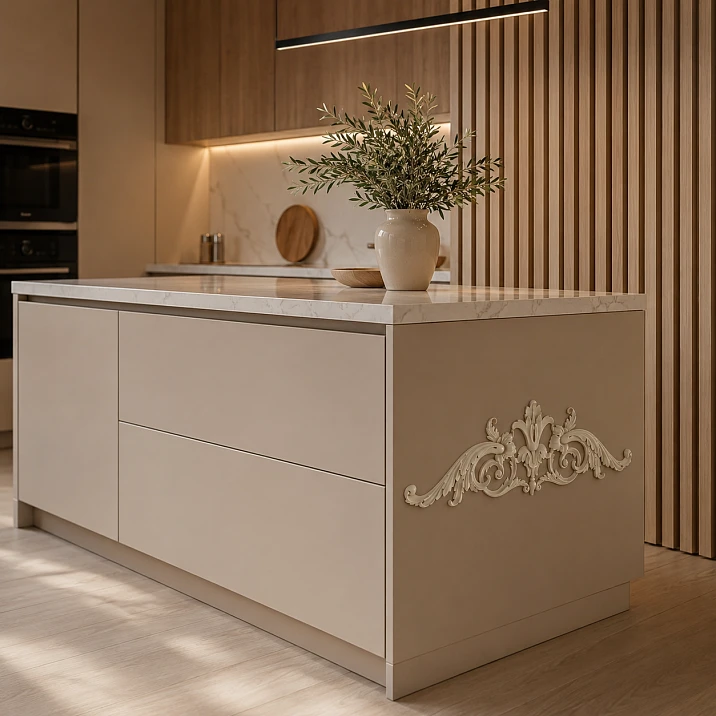
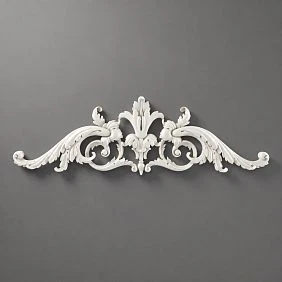
Short answer: first check the working area of the end, then compare one full-size NPU-098 template with a completely smooth facade
On a finished kitchen island, NPU-098 makes sense not because the end is "empty," but if one horizontal carved overlay truly improves the proportions of that particular surface. For the article, we fix one product and one size: carved decorative overlay NPU-098 made of polyurethane, 500 × 155 × 15 mm. Current STAVROS price is 5,130 RUB per piece.
The dimensions here can be interpreted unambiguously. In the category of horizontal polyurethane overlays, STAVROS specifies:
-
A — width;
-
B — height;
-
C — thickness.
For NPU-098 this means:
-
horizontally, the product occupies 500 mm;
-
vertically — 155 mm;
-
protrudes up to 15 mm from the base plane.
This is more important than the general question of whether molding is suitable for a kitchen. On the island, three things need to be checked at once.
The first is the frontal scale. A 500 mm ornament should have enough calm space on the left and right. If the end is too narrow, NPU-098 will be squeezed between the edges.
The second is the vertical zone. 155 mm of height cannot be assessed without the countertop, base, sockets, utility panels, and possible legroom. Geometrically, the overlay may fit, but compositionally or operationally it may be unsuccessful.
The third is the 15 mm depth. On a fixed end, this is not a collision risk for sliding doors, as with a wardrobe, but the relief still needs to be checked where people pass, bar stools stand, bags brush against, or the facade is regularly wiped.
Therefore, the commercial result of the article is very simple:
1 × NPU-098 for 5,130 ₽ — if the full-size template of 500 × 155 mm fits comfortably in a clean decorative field, the 15 mm relief does not fall into the active contact zone, and the horizontal ornament improves the composition next to the slat wall.
0 × NPU-098 — if the smooth end already works as a visual pause between the island and the active slats, if the overlay is squeezed between the countertop and the base, or if it complicates operation.
That is, the task is not to “find a place for the purchased molding.” First, you need to prove that this particular product is needed for the end.
After checking the dimensions, you can buy carved decorative overlay NPU-098 made of polyurethane in the only truly needed quantity.




What is NPU-098 and how does this task differ from general island finishing
Our factory also produces:
NPU-098 500 × 155 × 15 mm: which characteristics matter specifically for the island
The STAVROS card confirms one size of NPU-098 — 500 × 155 × 15 mm, polyurethane material, price 5,130 ₽, and application on furniture facades, accent wall panels, door frames, and other decorative compositions. The card also provides a drawing and a 3D model.
For a kitchen island, this data should be read not as an advertising list, but as design constraints.
Get Consultation
The width of 500 mm sets the scale of the entire composition
This is not a small point rosette. NPU-098 occupies half a meter horizontally and forms an independent center of the end face.
If the working field of the end face is 550–600 mm, the overlay almost fills it in width and may look too cramped.
If the field is 850–1000 mm, more calm side space appears.
But there is no universal "ideal percentage." Width is needed for a full-size fitting.
A height of 155 mm leaves a lot of free surface on the end — if positioned correctly
On a regular island, the side height is significantly more than 155 mm. Therefore, physically, NPU-098 is usually easier to find a place for than compositionally.
The problem starts when the end has:
-
a high plinth;
-
a pronounced countertop overhang;
-
the rosette;
-
handle;
-
ventilation grille;
-
a service door;
-
a decorative horizontal division.
Then the useful field becomes smaller than the overall dimension.
A thickness of 15 mm makes the template three-dimensional, not just flat.
In a photograph, 15 mm is easy to underestimate. On the actual end face, the relief casts a shadow and protrudes into the passage.
Therefore, for a final decision, not only a paper rectangle of 500 × 155 mm is needed, but also a second test — a volumetric mock-up showing 15 mm from the facade plane.
This is precisely an overlay, not a molding and not a frame.
NPU-098 is a separate decorative overlay. It is not required to:
-
outline the end face;
-
repeat the facade contour;
-
connect with the molding;
-
form a rectangular frame;
-
cover the edge of the countertop.
In this article, we consider it as one independent horizontal accent.
If you want to compare other products of the same type, the logical next step would be the section polyurethane decorative overlays, not the molding catalog.
Why this topic differs from existing materials about the kitchen island and slat panels
STAVROS already has large articles about slat panels for the kitchen island. They answer the questions:
-
what to clad the island itself with;
-
which material to choose;
-
what rhythm of slats to use;
-
how to combine slat panels with facades;
-
where to place panels on a straight or radius island.
This is a different intent.
Here the initial situation is the opposite:
-
the island is already smooth;
-
its end face is not planned to be closed with slats;
-
the slat wall is already nearby or behind the island;
-
the buyer is considering one specific NPU-098;
-
the main choice is to add one ornament or keep the smooth surface.
Such differentiation is also important for the reader. They do not need a repeated guide to PAN-001, PAN-003, or slat panel materials. They need to make a purchase decision for one overlay for 5,130 rubles.
If general information specifically about the slat cladding of the island is needed, it is logical to read it separately. And this article remains narrow: NPU-098 on a finished smooth end face next to a slat wall.
End face geometry: working field, axis, and position between the countertop and the plinth
First, determine not the size of the end face, but its clean decorative field
The main geometric mistake is taking the overall width and height of the island as the ready area for decor.
The end face may have functional exceptions:
-
the tabletop overhang;
-
base;
-
end handle;
-
socket;
-
ventilation grille;
-
service cover;
-
seam between panels;
-
place where the chair goes;
-
passage next to the facade.
Therefore, it is useful to introduce two concepts.
Wgross — total visible width of the end face.
Hgross — total visible height of the end face.
But for NPU-098, more important:
Wwork — clean width where a decorative overlay can actually be placed.
Hwork — clean height after excluding all functional zones.
Only against these values does it make sense to compare 500 × 155 mm.
How to calculate side margins
If NPU-098 is centered on the clean decorative field:
Eside = (Wwork − 500) / 2
This is not a standard, but a way to see the scale.
Approximate table:
| Clean end width | Free after 500 mm | When centered on left and right |
|---|---|---|
| 600 мм | 100 мм | 50 мм |
| 700 мм | 200 мм | 100 мм |
| 800 мм | 300 мм | 150 мм |
| 900 мм | 400 мм | 200 мм |
| 1000 мм | 500 мм | 250 мм |
| 1200 мм | 700 мм | 350 мм |
What does this table show?
On a 600 mm field, NPU-098 takes up almost the entire available horizontal space. Even if it physically fits, only 50 mm remains on each edge. For a rich carved pattern, this can look cramped.
At 800–900 mm, there is noticeable breathing room, and the overlay is perceived as an independent centerpiece rather than a detail fitted "flush."
At 1200 mm, a single NPU-098 becomes a relatively compact local accent. This is not bad, but its role changes.
This is why the question cannot be answered with just the phrase "the end is wider than 500 mm — so it fits."
Example with an end of 900 × 850 mm: what dry geometry shows and what it does not show
Let's take an example that works well for a preliminary mockup:
the island end is 900 × 850 mm.
If we assume the entire surface is free and NPU-098 is placed exactly at the geometric center, we get:
By width:
900 − 500 = 400 mm
That is:
200 mm on the left and right.
By height:
850 − 155 = 695 mm
That is:
347.5 mm on the top and bottom.
On paper, everything looks very spacious.
But this calculation cannot be turned into an installation diagram.
Why?
Because the actual 850 mm may include:
-
the section under the countertop;
-
base;
-
a technological gap;
-
the shadow gap;
-
baseboard;
-
the area where the toe of the shoe hits.
Therefore, the geometric center of the entire rectangle may be lower or higher than the visually correct position.
What to do after calculation
-
Mark the actual lower boundary of the plinth.
-
Mark the actual lower plane of the countertop.
-
Exclude sockets and service elements.
-
Obtain the actual height Hwork.
-
Only then choose the vertical axis of NPU-098.
Therefore, the example of 900 × 850 mm is useful for assessing scale, but does not replace inspection of the finished island.
Between the countertop and NPU-098, a 'regulatory gap' is not needed, but a visually and operationally safe zone is.
You cannot invent a universal number:
-
50 mm;
-
80 mm;
-
100 mm;
-
150 mm.
STAVROS does not set the mandatory kitchen setback from the countertop for NPU-098.
Therefore, the solution is built differently.
Three things need to be checked.
1. The overlay should not look pressed against the countertop.
If the top of the relief almost touches the bottom line of the countertop, the ornament is perceived as a random "blob under the edge."
A visual pause is needed.
2. It should not fall into the zone of regular dirt and contact.
The end near the countertop may receive:
-
splashes;
-
hand marks;
-
hitting with dishes;
-
touching with bags.
The closer the carved relief is to an actively used work area, the more difficult the maintenance.
3. The countertop overhang changes the light.
If the countertop protrudes, it creates a shadow on the upper part of the end.
NPU-098 under a large overhang can visually "sink" into the shadow.
Therefore, the template should be viewed under real lighting.
Lower edge and plinth: why a too-low NPU-098 quickly loses its decorative meaning
On a finished island, the lower part of the facade often receives more operational load.
There are:
-
shoes;
-
robot vacuum brush;
-
mop;
-
chair legs;
-
bags;
-
children's toys.
If NPU-098 is lowered too much, the large horizontal ornament falls into the zone of constant contact.
Compositionally, it begins to compete with the base.
If the base is dark and the overlay is placed directly above it, the eye merges two different horizontal elements into one heavy bottom.
Therefore, the position should be assessed not by the principle of "it fits," but by its role in the overall geometry of the island.
When to center NPU-098 across the entire end, and when across the clean furniture field.
There are two different centers.
Geometric center of the entire end face.
Suitable if:
-
End face is symmetrical;
-
No sockets;
-
No side handle;
-
Base is neutral;
-
Countertop does not have a strong asymmetrical overhang.
Center of the pure decorative field
This is often more correct on a finished kitchen.
For example:
-
Socket is on the right;
-
Seam runs on the left;
-
a large overhang on top;
-
a high plinth at the bottom.
Then NPU-098 is better centered on the remaining calm plane, rather than on the mathematical center of the entire panel.
But the offset should look deliberate. If the overlay shifts to the side only because 'there was space left,' the result may look like a mistake.
Sockets, switches, and USB modules are more important than symmetry
Electrical outlets are often placed on the ends of kitchen islands.
If near the intended NPU-098 there is:
-
socket;
-
a USB module;
-
a backlight switch;
-
control unit;
-
a service button,
The decor should not:
-
block access;
-
interfere with the fork;
-
create a tight gap;
-
hinder the replacement of the mechanism;
-
visually blend with the functional block.
Sometimes a single socket completely changes the solution.
If, to preserve the symmetry of NPU-098, it has to be placed too close to the electrical wiring, it is better to leave the end smooth.
How to transfer the axis to a finished facade without turning the fitting into installation
On an already assembled kitchen, it is useful to separate the layout marking from the marking for permanent fastening. The first stage does not require holes, strong glue, or pencil scratches on the finished surface.
A practical sequence is as follows:
-
Find the center of the clean work area, not the entire body.
-
Place two small temporary marks on the painter's tape — at the top and bottom.
-
Connect them with a conditional vertical axis.
-
On the NPU-098 template, also mark the center.
-
Align the two axes and temporarily secure the template.
-
Look at the island from the main viewing angle.
-
Only after the position is approved, transfer the permanent markings using a method compatible with the facade finish.
This order is useful for another reason: if after the first frame it turns out that the overlay should be raised by 30–50 mm or slightly shifted due to an outlet, no competing lines will remain on the facade.
If the surface is glossy, lacquered, or sensitive to adhesive tape, first test the temporary material on an inconspicuous area. Not all painter's tape can be considered automatically safe for any coating.
How to check NPU-098 next to a slat wall: rhythm and two layouts instead of guesses
Horizontal NPU-098 next to a vertical slat wall: when rhythms complement each other
The adjacent slat wall already creates a pronounced vertical rhythm and therefore itself serves as an active background. NPU-098, on the contrary, is elongated horizontally. This contrast can produce a good balance.
A horizontal overlay can "calm down" a frequent vertical if:
-
the island end is wide enough;
-
the NPU-098 itself is placed calmly and symmetrically;
-
the slats do not extend onto the island end;
-
there are no several other horizontal details on the facade;
-
the decor color is not too contrasting.
Then the composition reads as an interaction of two systems:
vertical wall slats → smooth end pause → horizontal carved NPU-098.
This is stronger than mechanically continuing the vertical rhythm of slats on every surface.
Why the smooth end between the slats and NPU-098 matters
If the entire island is also covered with slats, NPU-098 starts to compete with the texture of the base.
On the smooth end, it gets its own field.
That's why the new theme is not about "gluing molding over a slatted panel." Here, the end should remain a calm base.
The smooth field serves two functions:
-
separates the ornament from the frequent rhythm;
-
allows the 500-millimeter overlay to be read as a whole.
When the horizontal NPU-098 becomes redundant
If the island already has:
-
a long horizontal handle;
-
a pronounced shadow profile;
-
a contrasting countertop line;
-
decorative baseboard;
-
a horizontal insert;
-
a bar shelf,
then NPU-098 adds another horizontal line.
Then the question changes. It no longer "calms the vertical slats," but competes with the island's own lines.
In such a situation, a smooth end often looks stronger.
Why compare two ready-made layouts: "one NPU-098" and "fully smooth"
For this article, the main comparative test is extremely simple.
There is no need to make five decorative schemes.
Two are enough:
Option A — one NPU-098 500 × 155 mm on the end.
Option B — the end without molding.
Why is this enough?
Because the buyer's choice is formulated exactly like this: to buy one specific overlay or not to buy it.
If you immediately add:
-
a frame;
-
a second overlay;
-
corner decor;
-
moldings;
-
sockets,
the original task disappears.
How to compare correctly
Take a photo of the island from the same point.
Both frames must show:
-
the entire end;
-
countertop;
-
base;
-
the adjacent rack wall;
-
the nearest kitchen fronts.
After that, compare not "which is richer," but specific features:
-
the end looks more finished or heavier;
-
NPU-098 connects the island to the wall or adds noise;
-
a smooth surface seems empty or provides a useful pause;
-
the ornament does not conflict with the handles;
-
the island remains a cohesive object.
Why a full-size template of 500 × 155 mm is mandatory.
A length of five hundred millimeters on a phone screen and on a real island is perceived completely differently.
A catalog photo does not show:
-
the actual width of your end panel;
-
the height of the plinth;
-
The thickness of the tabletop;
-
the scale of the adjacent wall;
-
the distance to the walkway.
Therefore, a 1:1 template is needed.
What should be on the template.
Minimum:
-
outer rectangle 500 × 155 mm;
-
the central axis;
-
approximate silhouette of the ornament.
It's better not to use just a white strip. The carved pattern is visually denser than a rectangle.
You can print an image of the product at the required scale or roughly darken the ornament areas.
Why a second 3D template at 15 mm
The flat layout is responsible for the composition.
But the real NPU-098 protrudes from the facade.
Therefore, it's useful to make a small 3D mock-up:
-
over the entire area;
-
or at least at several critical points.
It shows:
-
how noticeable the shadow is;
-
whether the overlay will catch on clothing;
-
whether it obstructs passage;
-
whether it is too close to the chair.
At the end of the island, 15 mm usually does not create such a mechanical problem as on a sliding wardrobe door, but the volume cannot be ignored.
Countertop, plinth, and seating: how usage changes the decorative zone
The seating side of the island and the free end are two different scenarios.
A kitchen island can be arranged in different ways.
One end faces a free passage.
The other is located near bar stools or a continuation of the countertop.
NPU-098 is evaluated differently for them.
If the end faces the passage.
Need to check:
-
passage width;
-
accidental touches;
-
bags;
-
child movement;
-
cleaning.
If the passage is spacious, 15 mm may have no practical significance.
If the space is narrow, a large relief at hip or arm level may be uncomfortable.
If there are bar stools nearby.
Then what matters more:
-
knee space;
-
chair movement;
-
backrest;
-
legs;
-
position of the seated person.
Do not place NPU-098 in an area that people regularly bump into.
If the end is to the side of the seating area and does not contact the user, the scenario is different.
If this is an end without seating.
This is the simplest surface for a single NPU-098.
But even there, you need to check the adjacent slat wall and the balance of the entire kitchen.
The countertop overhang changes not only the vertical offset, but also the scale of the end panel.
Islands feature different countertops:
-
flush with the body;
-
with a slight overhang;
-
with a large bar overhang;
-
asymmetric.
A large overhang can visually widen the top of the island.
Then NPU-098, 500 mm wide, is perceived relative not only to the panel, but also to the countertop.
If the countertop is significantly wider than the end panel, a too-small pattern may get lost.
If the overhang is minimal, the same NPU-098 appears larger.
Therefore, the layout must include the entire countertop.
The plinth can either support the overlay or make the bottom too heavy.
The plinth is often separated:
-
the color;
-
depth;
-
material;
-
by a shadow.
This is already a horizontal line.
If NPU-098 is positioned low, a connection of two horizontals forms between it and the plinth.
It can work if:
-
the distance is sufficient;
-
the colors are calm;
-
the bottom of the island is not overloaded.
But if the plinth is dark and NPU-098 is contrasting, the lower half of the island becomes too active.
Then the best option is to raise the overlay or abandon it.
One overlay without a frame: style, color, and light
When one NPU-098 works without an additional molding frame
One of the strong points of NPU-098 in this context is its independence.
If the end face already has good shape and proportions, an additional frame may not be needed at all.
A single overlay looks convincing when:
-
the end face is a solid smooth surface;
-
the ornament is positioned along a clear axis;
-
there is free space around it;
-
the kitchen already has other classical or neoclassical details;
-
The slatted wall nearby adds texture, and the island needs only one accent.
In this case, the NPU-098 serves as the center.
Why a frame can worsen the finished end
A molding frame adds:
-
four lines;
-
angles;
-
additional joints;
-
another scale;
-
a rigid attachment to the perimeter.
If there are already active slats nearby, such a system can make the island too decorative.
A finished kitchen often has modern thin gaps and clean surfaces. A full frame can visually conflict with them more strongly than a single overlay.
When the frame is still more logical.
If the entire interior is built on framed facades and moldings, a single NPU-098 may seem too isolated.
Then it makes sense to compare:
-
one overlay;
-
a full framed composition;
-
a smooth end.
But this is a different purchasing task. You don't need to automatically add molding to NPU-098 just because it is carved.
If the kitchen facades are framed, NPU-098 should continue their logic, not create a third system.
The kitchen may already have:
-
paneled doors;
-
framed facades;
-
milling;
-
classic handles.
In such a kitchen, NPU-098 is easier to fit stylistically.
But another problem arises: the end of the island may become too busy compared to the fronts.
Before purchasing, you need to ask:
what the end currently lacks — relief or precisely the center?
If the facades are already framed, one NPU-098 can provide the center without adding another frame.
If the end also has milling, you need to check whether the overlay fits too tightly into the existing pattern.
If the kitchen facades are handleless, the carved overlay becomes more noticeable
On a minimalist kitchen with push-to-open or hidden profile, smooth surfaces are especially clean.
In such a context, NPU-098 cannot remain a "small detail."
Even painted in the color of the facade, it introduces a new decorative language.
This is not necessarily bad.
It can become a deliberate contrast between:
-
a modern island;
-
vertical slats;
-
a classic botanical motif.
But such a technique requires a confident layout.
If after adding NPU-098 the kitchen no longer looks cohesive, it is better to keep a smooth end panel.
Color of NPU-098: three strategies for an island next to slats.
Color changes the perception of the 500-millimeter ornament more than it seems.
In the color of the end face.
The calmest option.
Advantages:
-
The relief is read through light and shadow;
-
The island remains whole;
-
The overlay does not turn into a separate spot;
-
The slat wall retains its role as the main textural accent.
For the first mockup, this option should be considered the baseline.
In the color of the slats.
This is a more active way to connect surfaces.
For example, dark wooden slats next to a light island and NPU-098 in a close dark tone.
Plus, the connection is obvious.
The downside is that the ornament becomes very noticeable and can compete with the vertical wall.
Into a standalone contrasting color.
For example:
-
gold;
-
bronze;
-
graphite;
-
a rich brand shade.
This option only makes sense where similar accents already exist.
If NPU-098 is the only metallic or contrasting decor in the kitchen, it may look random.
Side lighting makes the 15 mm relief significantly more expressive.
A flat paper template does not show light and shadow.
The actual NPU-098 has a thickness of up to 15 mm.
If nearby:
-
a window;
-
linear lighting;
-
lights above the island;
-
backlighting of the slatted wall,
then the side light enhances the ornament.
This may change the decision.
During the day, the monochrome overlay seems very calm, but in the evening its relief becomes noticeable.
Therefore, it is better to do the final fitting in two modes:
-
daytime;
-
evening.
A slatted wall with backlighting requires a particularly calm NPU-098.
If every slat or gap between slats is highlighted with light, the background is already very active.
Then a contrasting carved overlay adds a third system:
-
vertical slats;
-
light strips;
-
carved horizontal ornament.
In this case, either NPU-098 in the color of the end face works well, or a complete rejection of it.
A smooth end face is not an unfinished surface by default
This is an important commercial conclusion.
An empty plane can serve a useful function.
It:
-
separates two active zones;
-
lightens a large island;
-
gives the eye a rest;
-
keeps the kitchen looking modern;
-
makes the slat wall more noticeable.
If after removing the template the island looks calmer and more expensive, there is no need to buy NPU-098 just to have something on the end.
0 pieces — a complete solution.
Functional limitations and installation on a finished kitchen
A functional end cannot be turned into a decorative one just because there is free space on it
The end of a kitchen island sometimes looks smooth only in a photo.
In practice, it may be part of a functional system.
Inside the island there may be:
-
dishwasher;
-
wine cabinet;
-
socket block;
-
ventilation;
-
electrical module;
-
water supply;
-
service access;
-
countertop fastening.
If the end panel is removable or opens access to equipment, NPU-098 must not interfere with this maintenance.
Removable service panel.
If the end is periodically removed, the overlay may remain on it only if:
-
it does not cover the fasteners;
-
the additional relief does not hinder removal;
-
the panel can be safely moved.
But if the service involves regular disassembly, it is often wiser not to complicate this surface at all.
Ventilation grille.
NPU-098 should not cover the openings or reduce their working area.
The article does not specify allowable distances: they depend on the specific equipment.
If the equipment manufacturer requires a clear zone, it takes priority over the decorative composition.
Socket group.
Even if NPU-098 physically fits nearby, you need to check the plug and cable.
Beautiful symmetry should not hinder the use of electrical fixtures.
The material of the edge determines the installation technology: "smooth" does not mean identical.
The NPU-098 card confirms application on furniture facades, but the kitchen edge may have very different coatings.
For example:
-
painted MDF;
-
enamel;
-
veneer;
-
plastic;
-
HPL;
-
LDSP (laminated chipboard);
-
acrylic;
-
stone or ceramic cladding;
-
glass.
You cannot assign one adhesive for all these substrates just because the overlay itself is polyurethane.
What to check before ordering
-
What coating is actually on the edge.
-
Can it be safely prepared for bonding.
-
Does the selected mounting compound suit both materials.
-
Does the preparation damage the factory surface.
-
Will the edge be restorable during future dismantling.
If these issues are not resolved, it is too early to buy a decorative overlay.
Why you need to be especially careful with an expensive factory-made facade.
On a finished kitchen, the mistake affects not only the NPU-098 for 5,130 rubles.
Poor installation may require repair or replacement of the end panel.
Therefore, first — a reversible mock-up and confirmation of the technique. Permanent adhesive — at the very end.
Can NPU-098 be installed on the end near the sink or cooking zone?
The word "kitchen" itself does not imply identical usage conditions.
An island can be:
-
only a work surface;
-
with a sink;
-
with a hob;
-
with seating;
-
fully decorative.
The NPU-098 card indicates the properties of the polyurethane product and the possibility of painting, but does not provide a universal instruction for any distance from the sink, steam, hot dishes, or cooking surface.
Therefore, the actual object needs to be assessed.
If the sink is far from the end.
A regular decorative area can be quite calm.
If the end regularly receives splashes.
Need to consider:
-
selected finish;
-
cleaning method;
-
seal tightness of the joint;
-
accessibility of the relief for cleaning.
If there is a cooking surface nearby.
You cannot independently invent "safe centimeters" for decorative polyurethane.
Priority is given to the requirements of the appliance manufacturer, the countertop, and the kitchen designer.
If the overlay falls into a questionable operational zone, it is better to move it or leave the end smooth.
15 mm relief and passage around the island: when thickness becomes a practical problem
On a large free end, 15 mm may seem insignificant.
But if the island stands in a narrow passage, the significance changes.
Especially if people constantly pass by:
-
with a tray;
-
with bags;
-
with bags;
-
with a child's chair;
-
with a vacuum cleaner.
NPU-098 occupies 500 mm in width, so the protrusion is not at a single point, but over a noticeable section.
How to check.
Make a full-scale template.
Ask the person several times:
-
walk past;
-
open the adjacent cabinet;
-
take out a chair;
-
carry a bag;
-
Carry out cleaning.
If the layout is constantly bumped, the real overlay will receive the same load.
When 15 mm is not a problem.
If the end face is located:
-
in a wide passage;
-
away from the seating area;
-
not in the path of movement;
-
not near an opening door,
the relief may not affect operation at all.
That is why there is no point in declaring 15 mm as "too much" or "too little" without a specific room.
If a furniture facade opens nearby, check the trajectory before installation
At the end of the island, a neighboring door may open or a drawer may slide out.
NPU-098 must not fall into:
-
under the handle;
-
into the door's trajectory;
-
into the path of the pull-out basket;
-
under the opening dishwasher.
For a fixed end panel, this is a local but important check.
It is not enough to place the template and look at the closed kitchen.
You need to open everything that moves nearby.
It is better to keep the orientation of NPU-098 horizontal.
The STAVROS category classifies NPU-098 as a horizontal overlay, and A/B/C for this group are decoded as width/height/thickness.
It is in this orientation that the article is considered:
500 mm horizontally × 155 mm vertically × 15 mm in depth.
Rotating the product vertically just because it fits better should not be considered a neutral replacement.
The rotation changes:
-
ornament direction;
-
the connection with the rails;
-
the compositional role;
-
the proportion at the end face.
If the project requires a vertical overlay, it is better to separately select a product designed for such a pattern, or re-check NPU-098 as a non-standard designer composition.
Scale and visibility: why the solution remains "one or zero"
Why one NPU-098 can be better than two and why the quantity should not be increased just to "fill" the...When a slat wall remains a background, and when it is better to change the finish of the island itself
If the slat wall is only being designed, it makes sense to first look slatted panels for walls and understand how active the future background will be.
If the project is based on natural wood, you can separately buy slatted panels and compare their tone with the island facade before choosing the color of NPU-098.
But in this article, slat panels do not become the main product.
Their role is to form a background against which NPU-098 is evaluated.
If a general theme of finishing the island itself with slats is needed, it is better to move to a separate STAVROS article about slat panels for a kitchen island, and here keep the focus on the smooth end.
Can NPU-098 be used on an already painted edge
The very fact that the kitchen is already assembled and painted does not make installation impossible.
But before installation, you need to check:
-
the condition of the coating;
-
adhesion;
-
surface cleanliness;
-
the possibility of marking;
-
adhesive compatibility;
-
the risk of damaging the finish during dismantling.
The polyurethane overlay can be painted, but the decision to paint before or after installation depends on the entire finishing technology and the condition of the finished kitchen.
On an already finished facade, it is often more convenient to first get the desired color on a test sample rather than experiment directly on the island.
Can NPU-098 be painted to match the facade color after installation
This technically depends on the specific coating system.
If the facade is factory-made, matching the shade may be harder than it seems.
Even the same color code can look different due to:
-
the degree of gloss;
-
the primer;
-
the base;
-
the method of application;
-
lighting.
Therefore, for a monochrome composition, it is better to make a test swatch in advance.
If the visual discrepancy is noticeable on the sample, it is better not to expect that it will "disappear" after installation.
Caring for a carved relief in the kitchen: when 15 mm does not interfere, and when a smooth edge is more practical
A kitchen island is a surface that is seen and touched more often than a decorative wall panel.
On a smooth edge, cleaning is simple: the surface is wiped with a single motion.
The carved NPU-098 adds:
-
protrusions;
-
recesses;
-
shadows;
-
edges around which dust can accumulate.
This does not mean it cannot be used in the kitchen. But the decorative effect should be more important than the extra maintenance.
If the island is used intensively.
For example:
-
there are several children in the house;
-
the end is near the passage;
-
cooking is done nearby;
-
people sit nearby;
-
the surface is wiped frequently.
Then you really need to imagine cleaning the relief.
If this is annoying even at the mockup stage, it is better to leave the facade smooth.
If the end face is decorative and has little contact.
In a large kitchen-living room, the end face may be in a quiet zone.
Then one NPU-098 does not create a serious operational load and works primarily visually.
Do not promise universal resistance to any household chemicals.
The product card confirms the material and the possibility of painting, but the specific finish coating determines what can be used to wash the surface.
Therefore, the care routine should match the chosen paint or finish.
When a horizontal pattern truly "balances" vertical slats
This idea does not always work.
The horizontal NPU-098 helps when the end face and the wall are read simultaneously as one composition.
For example:
-
the island stands roughly parallel to the slatted wall;
-
the end face is turned into the room;
-
vertical slats are clearly visible behind it;
-
NPU-098 is placed against a calm, solid background.
Then the eye perceives:
-
the vertical rhythm of the wall;
-
the horizontal of the tabletop;
-
the horizontal decorative center of the end face.
The island looks more stable.
When there is no "balancing" at all.
If the slatted wall is far away, at a different angle, or barely visible together with the end face, NPU-098 should be assessed as an independent furniture decor.
There is no need to justify the purchase with slats that the user barely sees in one frame.
The distance from the island to the slat wall changes perception, but there is no universal number
You cannot write:
if there is less than 1 meter between the island and the wall — NPU-098 is not needed.
There is no such rule.
What matters is something else:
-
whether both surfaces fall within the field of view;
-
how contrasting the slats are;
-
whether there is furniture between them;
-
how the light falls.
If the slat wall is located directly behind the end, the visual interaction is strong.
If it is on the opposite side of the kitchen — weaker.
Therefore, the check is done with a photo from the main viewing point, not by measuring a single distance.
If the slats are wooden and the island is painted, NPU-098 can be a bridge only through color, not through material.
A carved polyurethane overlay does not become wooden just because it is painted in oak color.
Therefore, there is no need to create a false expectation of full material match.
It can support:
-
shade;
-
lightness;
-
contrast;
-
overall style.
But the texture of carved polyurethane and slats made of solid wood or MDF remains different.
This is normal.
It is often better to emphasize the difference than to try to imitate wood on the ornament unnecessarily.
If the slats are painted in the color of the island, NPU-098 may become an unnecessary third layer
Let's imagine:
-
slat wall and island end in the same color;
-
contrasting countertop;
-
the lines are already connected by the palette.
In that case, the connection between objects exists without molding.
NPU-098 adds another relief.
Need to check whether it is really needed.
If the smooth end is already unified with the wall by color, the 0 × NPU-098 solution may be the most cohesive.
If the kitchen is neoclassical, one overlay may be more precise than multiple frames.
In neoclassicism, a balance between clean surfaces and classical ornament is often needed.
The slatted wall provides a modern vertical.
One NPU-098 on the end can add a classical motif without fully turning the island into traditional furniture.
This is especially useful if:
-
facades have light milling;
-
handles are calm;
-
the cornice or other details already contain a classic motif.
Then one overlay works as a point, not as a system.
In a minimalist kitchen, NPU-098 must pass a stricter test
In minimalism, any ornament becomes more noticeable.
If the kitchen is built on:
-
smooth facades;
-
hidden handles;
-
on a thin tabletop;
-
in a neutral palette;
-
in strict slats,
a carved overlay can look like a foreign stylistic quote.
Then the issue is not about size.
Even a perfectly centered NPU-098 can be superfluous.
The layout without it should be considered equally valid, not “unfinished.”
Mistakes that make one NPU-098 worsen the island
Mistake 1: Treating the end as “empty” and automatically filling it.
Why it happens: a smooth surface seems unfinished next to an active slatted wall.
Consequence: the useful visual pause disappears, and the island becomes overloaded.
How to check: compare a photo with and without the template.
How to avoid: consider 0 pieces as a valid option.
Error 2. Only evaluate the overall width of the end face.
Why it occurs: 500 mm is easy to compare with the furniture dimensions.
Consequence: the ornament ends up close to the profile, socket, or edge.
How to check: determine Wwork, not just Wgross.
How to avoid: first subtract the functional zones.
Error 3. Centering NPU-098 across the entire body with an asymmetrical countertop.
Why it occurs: the geometric center seems the most objective.
Consequence: relative to the actual decorative field, the overlay appears shifted.
How to check: draw two axes — of the body and of the clean field.
How to avoid: choose the one that matches the end-face architecture.
Mistake 4. Placing the overlay too close to the countertop.
Why it occurs: the desire to free up the lower area.
Consequence: the decor ends up squeezed under the overhang and in shadow.
How to check: make a full-size mockup together with the countertop line.
How to avoid: assess the upper pause visually, not by a random leftover.
Mistake 5. Lowering the ornament into the leg and cleaning zone.
Why it occurs: the geometric center by height turned out lower than expected.
Consequence: the relief is more often touched and harder to maintain.
How to check: walk past, place a chair, clean with a mockup.
How to avoid: take real usage into account.
Mistake 6. Painting NPU-098 in the color of the slats without checking contrast.
Why it occurs: you want to literally connect the wall and the island.
Consequence: too strong a spot appears on the smooth end.
How to check: make a colored paper mockup.
How to avoid: first compare with a monochrome version.
Mistake 7. Adding a molding frame just because the overlay seems lonely.
Why it occurs: classic decor is associated with frames.
Consequence: the end face gets extra lines near the active slat wall.
How to check: compare a separate NPU-098, a frame composition, and a smooth facade.
How to avoid: do not consider the frame a mandatory part of the product.
Error 8. Ignoring the 15 mm relief.
Why it occurs: in the catalog photo, the ornament is more important.
Consequence: the overlay gets bumped in the passage or near the seating area.
How to check: a volumetric mock-up.
How to avoid: test not only the flat surface but also the depth.
Error 9. Mounting on an unconfirmed coating.
Why it occurs: a "furniture facade" is perceived as a single type of base.
Consequence: adhesion issues or damage to the factory coating.
How to check: determine the material and technology.
How to avoid: agree on the mounting compound for the specific pair of materials.
Mistake 10. Buying two if one seems small.
Why it occurs: the desire to fill a wide end face.
Consequence: two patterns create a repeat, although the problem was in the scale of the model.
How to check: compare with a larger decor or a smooth option.
How to avoid: do not solve the scale by quantity.
From measurements to solution: table, algorithm, and decision tree
Decision table: 1 × NPU-098 or 0
| Condition | What does it mean | Solution |
| The clean field is noticeably wider than 500 mm, and the ornament gets breathing room | The scale is suitable for testing | continue checking |
| NPU-098 almost touches the edges | The facade looks visually cramped | More often 0 or less decor |
| A socket or service area ends up nearby | Function is more important than symmetry | Shift only if it looks intentional, otherwise 0 |
| The 15 mm relief does not interfere in the passage | operational risk is low | continue |
| The relief falls into the leg/chair zone | regular contacts | 0 or another position |
| Vertical slats and horizontal NPU-098 give a clear balance | the composition is enhanced | 1 |
| The slat wall is already very active | additional ornament creates noise | 0 |
| The smooth end looks finished | decor does not add value | 0 |
| NPU-098 in the facade color gives a neat light-and-shadow effect | Calm accent | 1 |
| Two overlays are needed so that it doesn't look empty | The scale of the selected product is questionable | Review the model, do not double it automatically |
Practical algorithm: how to check NPU-098 on a finished kitchen island in one evening
-
Make sure that it is specifically NPU-098 500 × 155 × 15 mm that is being considered.
-
Record the current price and quantity — one piece is needed for the basic scheme.
-
Measure the total width and height of the end face.
-
Mark the plinth, countertop overhang, sockets, handles, and service areas.
-
Determine the pure decorative field Wwork × Hwork.
-
Calculate the side margins relative to 500 mm.
-
Do not assign a vertical offset based on a universal number.
-
Cut out the template 500 × 155 mm.
-
Sketch the approximate silhouette of the ornament.
-
Place the template in the center of the clean field.
-
Photograph the island together with the slat wall.
-
Remove the template and take a second shot from the same point.
-
Compare "1" and "0".
-
If the overlay option wins, add a thickness of 15 mm.
-
Walk nearby, open adjacent facades, place a chair.
-
Turn on the evening light.
-
Check the color option: matching the facade and, if needed, matching the slats.
-
Confirm the end material and the gluing technology.
-
Check that the overlay does not cover the service.
-
Only after that place the order.
This algorithm intentionally does not include a step to 'mandatorily add a frame'. If one NPU-098 already solves the task, additional molding is not needed.
What to measure before ordering
| Parameter | What to record | What it affects |
| Total end width | … mm | original scale |
| Net width Wwork | … mm | side margins relative to 500 mm |
| Overall height | … mm | overall scale |
| Net height Hwork | … mm | 155 mm position |
| Tabletop overhang | actual | top shadow and contacts |
| Base height/depth | actual | bottom composition |
| Sockets and service | Diagram | allowed zone |
| Passage | actual | 15 mm check |
| Bar seating | Yes/No | contact risk |
| facade material | actual | Installation |
| slat color | Sample | color strategy |
| evening light | Photo | Chiaroscuro |
| main viewpoint | Photo | compositional effect |
This table is needed not for the designer's report, but for the buyer before ordering. If several rows are unknown, the layout is not yet ready for the final decision.
choice tree
Is the end face really smooth and not occupied by functional elements?
No → first solve the functional task.
Yes → continue.
Does the clear width allow placing 500 mm without feeling cramped?
No → smaller overlay or 0.
Yes → continue.
Does 155 mm in height fit between the actual upper and lower zones?
No → change position; if the composition breaks — 0.
Yes → continue.
Does the 15 mm volume not interfere with the passage, legs, chair, or adjacent door?
No → 0 or another place.
Yes → continue.
Does the end face look better with NPU-098 next to vertical slats?
No → 0.
Yes → continue.
Is an additional frame needed for completeness?
No → one NPU-098 is a ready-made solution.
Yes → this is already a different compositional task; compare the full frame separately.
Is the installation technology confirmed for the specific facade?
No → do not glue until confirmed.
Yes → you can order one NPU-098.
What to buy together with NPU-098 and what not to add automatically
The main purchase in this article is 1 × NPU-098.
After trying it on, it makes sense to:
-
if necessary, take a look horizontal polyurethane overlays;
-
if NPU-098 does not fit the scale, go to the general section and Buy decorative polyurethane overlays.
No need to automatically buy:
-
four moldings;
-
corner elements;
-
a second NPU-098;
-
the rosette;
-
additional central decor.
Each subsequent element should address a separate task.
If the project extends beyond a single overlay, you can already separately You can buy ready-made stucco matching the Baroque style. Calculate the quantity: linear meters of cornices and moldings, number of rosettes, pilasters, consoles, corner elements. Add a ten to fifteen percent allowance for trimming. and design an entire system.
The buyer also does not need to turn a simple order into a "just in case" set. If after the mockup it turns out that NPU-098 fits, the main specification remains clear: one overlay in the confirmed position. Mounting materials are selected for the specific surface and chosen technology, not as a universal kit for any kitchen facade.
If NPU-098 is to be painted in the color of the island, it is more useful to buy or prepare a finish sample in advance than to add a second decorative element. One small paint swatch will show faster whether the shade and gloss match the factory facade.
If after the fitting you still want "something along the edges," this is a signal not to automatically expand the cart, but to return to the composition. Perhaps the end face needs a frame system as a whole, not NPU-098 as a separate center. Then the original task has already changed and should be considered anew.
Boundary scenarios: where the same NPU-098 leads to different solutions
An island 900 mm on the end face, a slat wall behind it, the end face completely smooth
This is a variant close to the base scenario.
The 500 mm template leaves 200 mm on each side when centered on the total width of 900 mm. If the actual clear field is close to this size, NPU-098 gets enough space for a calm fitting.
The decision is no longer determined by the physical "fits", but by a visual test.
If the horizontal pattern balances the vertical slats and looks like a relief in the facade color rather than a separate applique, one NPU-098 can be a good purchase.
The same 900 mm end, but with an outlet on the side
Now mathematical symmetry ceases to be the main criterion.
You need to account for the plug, cable, and access to the mechanism.
If, after excluding the electrical zone, NPU-098 has to be noticeably shifted, compare:
-
asymmetric position;
-
smooth end;
-
another more compact decor.
Here the result may well be 0 × NPU-098, even though the island width hasn't changed.
This is an example of why the same footprint does not yield the same solution.
The end of the island faces the bar stools.
Even a large free rectangle does not guarantee a suitable scenario.
You need to place a real chair and check:
-
knees;
-
the backrest;
-
movement;
-
the position of the seated person;
-
cleaning.
If people regularly touch the 500 × 155 mm zone, a smooth facade is more practical.
If the end is located to the side of the seating and does not actually participate in contact, one NPU-098 may again be appropriate.
The end is located in a wide passage and is the main view from the living room.
Here the operational risk is lower, and the decorative value is higher.
The large relief is visible from afar, so the following are especially important:
-
precise horizontality;
-
common axis;
-
color;
-
evening light.
For such an end panel, NPU-098 more often makes sense as a single standalone furniture accent.
Minimalist kitchen with a bright slatted wall.
Physically, NPU-098 can fit perfectly.
But if the kitchen is built on smooth surfaces, shadow profiles, and a strict vertical rhythm, the carved ornament can change the entire character of the island.
In this scenario, 0 is not a compromise, but the most consistent design solution.
Alternatives to NPU-098: smaller overlay, slatted facing, or smooth end
What to do if you like NPU-098, but it looks too heavy on the end
Don't try to fix the problem only by adjusting the installation height
There are several alternatives.
Paint it to match the facade color
If the issue is contrast rather than scale, monochrome can make the ornament calmer
Choose a more compact horizontal overlay
If the problem is specifically the 500 × 155 mm size, it's more logical to open the category and compare another product
Move NPU-098 to another smooth surface
For example:
-
side panel of the cabinet;
-
stationary wall insert;
-
console facade;
-
another furniture end panel.
But the new location needs to be checked again.
Leave the island smooth.
If NPU-098 is liked as an object, that doesn't necessarily mean the kitchen island is the best place for it.
When to consider horizontal trims instead of changing the whole concept
NPU-098 is a horizontal polyurethane trim. If the idea of one horizontal accent is right, but the specific 500 × 155 mm doesn't fit, you don't have to change the whole approach.
You can go to the section horizontal polyurethane trims and compare products with a different scale.
When selecting again, the following are checked:
-
width;
-
height;
-
thickness;
-
drawing;
-
position;
-
price.
It cannot be assumed that the new model will automatically fit into the old layout.
When slat panels for the island itself are a different but more logical path
If the problem is not the "empty end" but that the entire island looks too smooth and simple, one NPU-098 may not solve the task.
Then it makes sense to consider slat cladding for the island itself.
This is a different intent:
-
choose a panel;
-
material;
-
rhythm;
-
area;
-
joints;
-
radius;
-
finishing.
On STAVROS, there is a separate article dedicated to slat panels for a kitchen island.
The new article does not compete with it but helps to understand when you don't need to move to full cladding and a single carved accent or even a smooth end is enough.
Final recommendation: one NPU-098 is needed only when it adds a decorative center function to the end face.
For the selected product, the facts are simple:
-
carved decorative overlay NPU-098;
-
polyurethane;
-
500 × 155 × 15 mm;
-
horizontal shape;
-
5,130 ₽ per piece.
But the decision before purchase should consider not the product card, but the finished island.
Ordering 1 × NPU-098 is rational if:
-
the pure decorative field is noticeably larger than 500 × 155 mm;
-
the overlay is not clamped by the countertop, plinth, or edges;
-
15 mm do not fall into the active passage or landing;
-
there is no conflicting socket, handle, or service nearby;
-
the installation technology suits the specific facade;
-
the horizontal ornament indeed improves the composition with the vertical slatted wall;
-
the version with a pattern looks stronger than a completely smooth end.
Ordering 0 × NPU-098 is rational if:
-
the end is needed as a calm pause;
-
the slats already provide enough texture;
-
the ornament is too large or too tight;
-
the relief falls into the contact zone;
-
The installation on the existing surface is questionable;
-
You have to add a frame and a second decor just to justify the first overlay.
The best test before paying takes less time than redoing a finished kitchen: cut out 500 × 155 mm, add a 15 mm thickness, photograph the island next to the slat wall with and without the mock-up, check the passage, and only then order NPU-098 500 × 155 × 15 mm.
FAQ
Can NPU-098 be installed on the radius end of a kitchen island?
The NPU-098 card does not confirm a flexible version of the product. Therefore, a rigid overlay cannot automatically be considered suitable for a radius surface. For a curved end, you first need to confirm the compatibility of the product's shape with the radius or choose another decorative system designed for such a base.
What to do if the end is faced with porcelain stoneware or stone?
Compositionally, NPU-098 can be tried with the same 500 × 155 mm template, but the bonding technology cannot be transferred from painted MDF. You need to confirm the mounting adhesive for the specific stone or ceramic and polyurethane, and also check that the preparation will not damage the face surface.
Can NPU-098 be installed on a separate removable decorative panel rather than on the island body?
This scenario can be considered if the panel itself is a stable base and can be removed without deforming the overlay. Then you need to check the weight, the method of attaching the panel, access to its fasteners, and whether you will constantly have to grab the carved relief by hand during removal.
If an island has two identical open ends, is NPU-098 needed on each?
Not necessarily. Each end is evaluated from its actual viewing angle. If both are equally visible and the project requires symmetry, two overlays can be considered — at the current price, that's 10,260 ₽. If one end is hidden or functionally loaded, mechanically doubling the order is not needed.
Do I need to buy a spare NPU-098?
There is no mandatory percentage of spare for a single finished overlay. Spare makes sense only if the project involves complex custom painting, several identical islands, or if quick future replacement is critical. For a typical single island, it's enough to first calculate the actually required quantity.
Can NPU-098 be placed above the geometric center of the end?
Yes, if such placement is related to the actual composition: the countertop overhang, the plinth, the outlets, and the main line of sight. The geometric center is only a starting point. On the finished island, the visual center may be higher or lower.
What to do if the island is slightly asymmetrical due to the countertop overhang?
Do not automatically align NPU-098 with the outermost edge of the countertop. First, determine which plane is perceived as the end itself: the furniture body or the full dimension with the overhang. Then compare both axes on the template and choose the one that makes the composition intentional.
Can NPU-098 be installed over a door that opens as a service hatch?
Only if the decor does not interfere with opening, fastening, and dismantling of the door itself. If the panel is needed for regular equipment maintenance, additional relief may make operation inconvenient. In such a scenario, a smooth surface is often more practical.
Do we need to account for the 15 mm thickness if there is a lot of space around the island?
Yes, although the risk of collisions is lower. The thickness still affects light and shadow, cleaning, and tactile perception. Therefore, a volumetric mockup is useful even in a spacious kitchen, but the reason for checking is now aesthetic and operational, not the width of the passage.
Can NPU-098 be installed on the end panel if there is already a decorative bracket under the countertop nearby?
Only after a full mockup. The bracket and the overlay are two different carved focal points. They can support each other in a classic composition, or they can compete. The entire end panel needs to be assessed as a whole, not each item separately.
If NPU-098 seems too small on a 1400 mm end panel, should I buy two?
Not automatically. Two identical overlays will create repetition and a new rhythm. First, compare one centered, a larger single decor, and a smooth facade. The scale problem is better solved by choosing a composition, not by simply multiplying the quantity.
Can NPU-098 be used on an island if there is no slatted wall nearby?
Yes. The product card allows furniture facades and other interior compositions. The slatted wall in this article is a specific selection context, not a technical condition of use. Without slats, the overlay should be evaluated relative to the facades, countertop, and overall kitchen style.
Do I need to exactly match the color of NPU-098 on other kitchen details?
No. The color can match the end panel and work only through the relief. Repeating it on handles, cornice, or wall is only necessary if it supports the overall palette. Artificial duplication of an accent can make the interior heavier.
Can I first buy the NPU-098 and then decide where to install it?
Technically, yes, but for a finished kitchen this is not rational. The product costs 5,130 rubles, and a full-size paper template allows you to understand the scale in advance. It is better to first confirm the location and only then purchase the specific overlay.
If the overlay in the color of the facade is almost invisible from the front, does it make sense?
Yes, if under side or evening light the relief creates the desired depth. But if in all real scenarios the NPU-098 practically disappears and does not change the perception of the island, the purchase may be unnecessary. It should be evaluated under real lighting.
Can the NPU-098 be installed after the kitchen is fully assembled?
The fact that the kitchen is finished does not contradict this. First, you need to check access to the end, the condition of the coating, the marking, and the installation technology. For an expensive finished facade, it is especially important not to start with irreversible fastening without a trial template.
How to understand that the NPU-098 really improved the island?
Compare two identical photos — with and without the template — and answer three questions: has a clear compositional axis appeared, has the end become better connected with the slatted wall, and has the island not lost its visual lightness. If there is no positive change, the smooth facade is stronger.
Can the NPU-098 be used on the end of an island in a commercial kitchen or cafe?
The specific operating mode needs to be assessed. In an area with intense impacts, frequent professional cleaning, or requirements for special surfaces, a decorative overlay may be inappropriate. The product card itself does not replace the requirements of a specific commercial facility.