Article Contents:
- Short answer: when to choose ST-001, and when a different size is needed
- What the customer gets when ordering ST-001
- A tabletop is not equal to a finished table
- MDF without an agreed finish is not a finished dining surface
- Start with the outline of the tabletop itself
- Add chairs in the working position
- Open everything that can be opened
- Walk the main routes
- Check by the width of one seat
- Why you cannot choose the number of seats based only on the circumference
- Four seats
- Five seats
- Six seats
- Additional temporary seats
- A circle has no far corners
- The central zone can turn out to be far away
- Laptop work surface
- The kitchen has a separate dining area
- The table is located between the kitchen and the living room
- The room is close to square
- Need a table for socializing
- The table is not used daily at maximum seating capacity
- A colored furniture surface is required
- The kitchen is narrow
- The table stands next to the kitchen unit
- Two or three places are needed daily
- The chairs are large
- The table should be by the window
- The room has complex geometry
- A permanent seating for a large group is needed
- Equipment is constantly on the table
- Large serving items are used
- A spacious dining room requires a larger scale
- The base is already designed for a large tabletop
- Why can't I reduce the finished circle myself
- Why enlargement requires a new calculation
- Non-standard thickness is a separate task
- What you need to know about the underframe
- What to Check
- The main risk
- Legroom
- Why a frame is needed
- Where to place the legs
- Conflict with six places
- Too small platform
- Too large platform
- Uneven platform
- Irregularly shaped platform
- What not to do
- Why a template is needed
- Demountable joint
- Check with a chair
- Don't blindly copy the height of the old table
- Thick mounting frame
- Visual lightness
- Limitation for fasteners
- Edge profile
- Height of the finished table
- Transportation
- Color
- Degree of gloss
- Edge
- Bottom surface
- Connection with the underframe
- Control paint-out
- Family kitchen
- Separate dining room
- Kitchen-living room
- Small conference room
- Office
- Creative studio
- Cafe or restaurant
- Waiting area
- With a ready-made table
- With a kitchen worktop
- With a compact coffee tabletop
- With a solid wood tabletop
- Side overhang relative to the underframe
- Height
- Acceptance
- Mistake 1. Measuring only the free floor space
- Mistake 2. Choosing 1200 mm based on a photo
- Mistake 3. Considering ST-001 a ready-made table
- Mistake 4. Buying a random central base
- Mistake 5. Screwing legs directly to MDF without a frame
- Mistake 6. Placing four legs without considering chairs
- Mistake 7. Not checking the height
- Mistake 8. Using overly long fasteners
- Error 9. Using too short fasteners
- Error 10. Drilling without a depth stop
- Error 11. Not finding the center
- Error 12. Assessing stability by base weight
- Error 13. Not accounting for uneven floor
- Error 14. Ordering finishing after table fabrication
- Error 15. Using sanded workpiece without coating
- Error 16. Coating only the top
- Error 17. Matching color by screen
- Error 18. Not agreeing on gloss
- Error 19. Doing deep milling without checking thickness
- Error 20. Reducing the circle with a hand tool
- Error 21. Increasing the standard size without recalculating the base
- Error 22. Placing the table flush against the wall
- Error 23. Not opening the dishwasher on the mockup
- Error 24. Not checking the refrigerator
- Error 25. Hanging the light fixture before determining the center
- Error 26. Buying chairs that are too wide
- Error 27. Not accounting for armrests
- Error 28. Placing large decor in the center
- Error 29. Using ST-001 as a kitchen worktop
- Error 30. Not checking the delivery route
- Error 31. Carrying the circle by one edge
- Error 32. Storing the worktop with a large unsupported overhang
- Error 33. Starting finishing before acceptance
- Error 34. Ordering a series without a reference sample
- Error 35. Not accounting for cleaning in the cafe
- Error 36. Choosing a base only by style
- Error 37. Mixing different shades of worktop and underframe randomly
- Error 38. Not considering the aprons
- Error 39. Failed to check re-disassembly
- Error 40. Place order without article number
- Check the ST-001 card
- Mark the circle in the room
- Select the base
- Provide mounting platform dimensions
- Agree on the coating
- Get the final configuration
- Confirm delivery
- Can I buy only the tabletop without the underframe?
- What is the size of ST-001?
- What is the diameter of the tabletop?
- What material is ST-001 made of?
- What is the specified sanding quality?
- Is the product supplied as a ready-made table?
- Is the underframe included in the set?
- Are the legs included?
- Is the mounting hardware included?
- Can ST-001 be used without a coating?
- Is ST-001 suitable for enamel?
- Can the tabletop be made white?
- Can it be painted black?
- Can the natural wood look be preserved?
- Is a diameter of 1200 mm suitable for four people?
- Can six people be seated?
- How to calculate the circumference?
- What is the surface area?
- Will ST-001 fit a small kitchen?
- Will it fit an open-plan kitchen-living room?
- Can the table be placed against the wall?
- Will the tabletop work for a conference room?
- Can it be used in a cafe?
- Is ST-001 suitable for a coffee table?
- Can I order a diameter smaller than 1200 mm?
- Can I order a larger diameter?
- Can I reduce ST-001 myself?
- Can the 25 mm thickness be changed?
- Which base should I choose?
- Is a central base better than four legs?
- Can I screw four legs directly to the tabletop?
- Where to place the legs?
- How to check the stability of the central base?
- What fasteners should be used?
- How do I avoid drilling through the tabletop?
- Can the tabletop be glued?
- How to find the center of the circle?
- Do I need to drill holes before painting?
- Can drilling be done after painting?
- How to calculate the height of the finished table?
- Do I need to take the apron into account?
- How to match the table with the chairs?
- How to choose the color?
- Which finish is better: matte or glossy?
- Do I need to cover the underside?
- How to care for the finished ST-001?
- Can hot dishes be placed on it?
- What to do if water gets on the surface?
- Can a cutout be made for a sink?
- Can a cutout be made for cables?
- How to check if the countertop will fit through the door?
- Can it be carried vertically?
- How to store it before installation?
- What to check upon receipt?
- Can I start painting immediately after delivery?
- How long does ST-001 take to produce?
- How to find out the cost?
- What does the final price of the table depend on?
- Can I order only one ST-001?
- What should I send to the manager?
- Is a design project needed?
- Where can I get the drawing?
- How not to confuse ST-001 with another tabletop?
- What to do if 1200 mm doesn't fit?
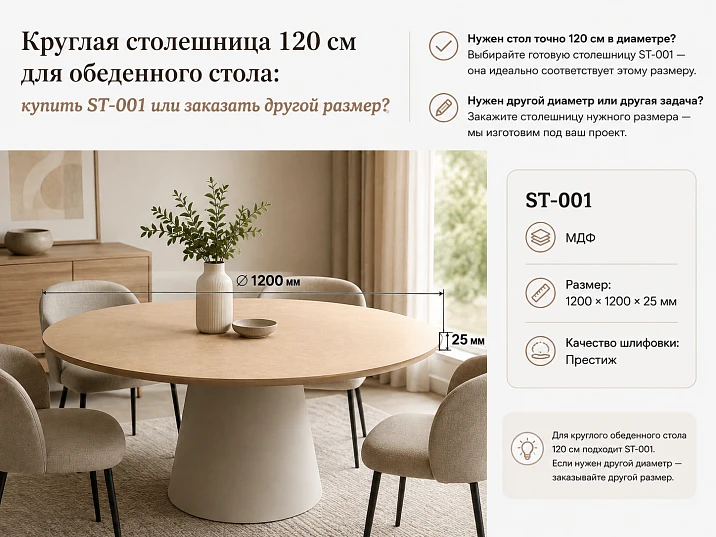
The kitchen is already designed, the space for the table is determined, the chairs are chosen, but the buyer is still unsure: should they buy a round 120 cm tabletop or order a different diameter? On the plan, the 1200 mm circle looks compact. In a real room, the underframe, pulled-out chairs, passage to the kitchen unit, opening doors, and people who need to sit down and stand up freely are added to it.
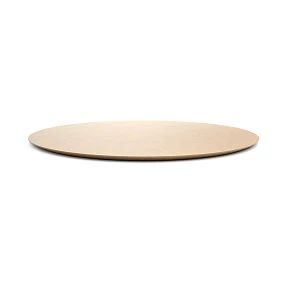
ST-001 answers a specific commercial request. It is a round MDF tabletop measuring 1200 × 1200 × 25 mm, which can be used to create a dining, family, work, or conference table. But the tabletop itself is not a finished table. The base, mounting, and finish coating need to be selected separately and coordinated as a single structure.
The buyer has to make not one, but three decisions. First, whether the 1200 mm diameter really fits the room and the intended number of seats. Second, what underframe or set of legs can stably hold a circle of this size. Third, how to prepare the MDF for daily use so that the color, gloss level, edges, and bottom surface are processed according to the agreed furniture technology.
If all three questions are already resolved, it is reasonable to buy a round 120 cm tabletop in the existing size ST-001. If the room requires a smaller circle, the base is designed for a different mounting area, or the customer needs a larger surface, first clarify the possibility of manufacturing a different size. Reducing the finished ST-001 on site or attaching it to random legs without calculation is not savings, but a source of rework.
Short answer: when to choose ST-001, and when a different size is needed
ST-001 is worth ordering when a circle with a diameter of 1200 mm suits the buyer, there is enough space for the table and chairs, and the underframe can still be matched to the actual dimensions of the tabletop.
A different size should be considered when:
-
the 1200 mm circle blocks main walkways;
-
chairs cannot be freely pulled out;
-
the table must stand in a narrow kitchen;
-
an already purchased underframe is designed for a different tabletop;
-
more seating space is required;
-
the table is used not only for eating but also for constant work;
-
equipment or a large table setting is planned in the center of the surface;
-
diameter of 1200 mm disrupts the proportions of the room;
-
the product does not fit through doors, stairs, or an elevator;
-
the project requires a different edge overhang relative to the base.
The main mistake is choosing the diameter based on a single free spot on the floor. The table does not exist only at the moment when all chairs are pushed in. Its working area includes people moving, seating, serving, opening furniture, and cleaning.




What the customer receives when ordering ST-001
ST-001 is a separate round tabletop. In the standard product item, one should not automatically expect a ready-made underframe, legs, chairs, or universal fasteners.
| Parameter | Confirmed value | Practical Meaning |
|---|---|---|
| Article number | ST-001 | This is the exact article number to be specified in the order and drawing |
| Product type | Round furniture tabletop | This is not a fully assembled table |
| Size | 1200 × 1200 × 25 mm | The diameter is 1200 mm, the thickness is 25 mm |
| Shape | Circle | Need to check the space around the entire circumference |
| Material | MDF | Finish and mounting are coordinated considering the material |
| Sanding quality | «Prestige» | The surface is prepared more thoroughly, but does not replace the final finish |
| Order status | Custom Order | The current deadline is confirmed at the time of ordering |
| Base | Not part of the countertop itself | The underframe or legs are selected separately |
| Fastening | No universal scheme is assigned in the product card | Type, length, and placement are determined by the designer |
| Finish | Coordinated separately | Color and protective properties are chosen before installation |
| Main Scenario | Dining, family, work, or conference table | Purpose affects the base and finish |
| Non-standard diameter | Not confirmed by a standard card | The possibility of a different size must be requested separately |
The size 1200 × 1200 × 25 mm cannot be read as three independent options. The first two values describe the diameter in two directions, the third is the thickness.
Our factory also produces:


A tabletop is not equal to a finished table
By ordering ST-001, the buyer receives the top furniture part. To get a table, a base and a calculated connection are required.
The final set may include:
-
round tabletop;
-
central pedestal;
-
frame with multiple supports;
-
set of furniture legs;
-
mounting plate or apron construction;
-
fasteners;
-
adjustable leveling feet;
-
primer and finish coating;
-
packaging;
-
delivery;
-
assembly.
Which specific elements are needed depends on the chosen scheme. They cannot be added to the invoice automatically just because they are common in tables.
Get Consultation
MDF without an agreed finish is not a finished dining surface
A sanded blank looks smooth and neat, but an everyday dining table comes into contact with dishes, moisture, dirt, and care products. Before use, the surface must receive the finish specified in the project.
Special attention is required for the edge. For a circle, the length of the end line is significant, and it is fully open to view. Uneven ground, insufficient sanding between layers, or an accidental chip will be noticeable around the entire circumference.
Diameter 1200 mm in a real room: we check not only the free circle
The kitchen plan often deceives. On the drawing, the table looks like a circle with a diameter of 1200 mm. Chairs are shown as small conventional symbols, a person is not shown, doors are closed. As a result, the composition seems free.
In real life, the table requires more space.
Start with the outline of the tabletop itself
Mark a circle with a diameter of 1200 mm on the floor. The easiest way is to find the center, measure a radius of 600 mm, and mark several control points.
You can use:
-
painter's tape;
-
paper template;
-
cord;
-
cardboard;
-
thin protective material;
-
temporary markup on the plan at a scale of 1:1.
Do not limit yourself to a 1200 × 1200 mm square. The square shows the maximum dimensions, but it does not help to understand where the rounded edge is and how close the furniture passes to it.
Add chairs in the working position
Place real chairs or make their templates. You need to check at least three positions:
-
The chair is fully pushed in.
-
The chair is pulled out for seating.
-
Another person passes behind the seated person.
If the second and third scenarios are impossible, a free circle on the plan does not yet mean that the table is suitable.
Open everything that can be opened
When marking up, open:
-
cabinet door;
-
drawer;
-
dishwasher;
-
refrigerator;
-
room door;
-
sideboard door;
-
balcony block leaf.
The table may not interfere with closed furniture, but completely block it when in use.
Walk through the main routes
Check the movement:
-
from the entrance to the refrigerator;
-
from the work surface to the table;
-
from the table to the sink;
-
from kitchen to living room;
-
to the balcony;
-
to the window;
-
around seated people.
If you have to turn sideways or ask someone to stand up, the problem won't disappear after purchase.
How many seats can be arranged around a 1200 mm circle
You can't promise a universal number of seats without information about chairs, under-table, and usage scenario. But you can estimate the circumference and check the seating mathematically.
The circumference is calculated using the formula:
L = π × D
For a diameter of 1200 mm:
L ≈ 3.1416 × 1200 ≈ 3770 mm.
These 3770 mm are distributed among all seats. But a person needs not only an edge section. Seat width, elbow space, table access, and no conflict with supports are required.
Check by width of one seat
If the designer preliminarily allocates 600 mm per seat along the circumference, the calculation gives:
3770 / 600 ≈ 6,28.
Mathematically, six sectors can be marked around a circle. This does not mean that any six chairs will necessarily be comfortable. A central pedestal, wide armchairs, armrests, and large table settings can reduce actual capacity.
If a chair requires 700 mm:
3770 / 700 ≈ 5,39.
Then five seats may be more spacious than six.
If four spacious seats are needed:
3770 / 4 ≈ 942 mm per sector.
This option leaves more room for elbows, large chairs, and table settings.
Why the number of seats cannot be chosen based only on the circumference
The circle does not account for:
-
seat shape;
-
armrest width;
-
backrest tilt;
-
leg thickness;
-
table base placement;
-
habit of sitting close to the table;
-
amount of tableware;
-
central dishes;
-
need to work with a laptop;
-
child seats;
-
room features.
Practical testing always beats theoretical numbers. Place real chairs around the paper circle and do a trial seating.
Four seats
Four chairs around ST-001 can be arranged along the main axes or slightly offset relative to the room. This scenario provides larger individual sectors and leaves more freedom for large armchairs.
Five seats
Five seats create a less formal seating arrangement. For this, a central base that does not occupy the leg area is especially important.
Six seats
Six seats require careful selection of chair widths. Supports should not fall between knees, and table settings should not push utensils to the very edge.
Additional temporary seats
Sometimes the table is used daily by four people, and when guests arrive, one or two more chairs are added. This scenario is acceptable if the extra seats are physically checked, not just promised by the furniture seller.
Surface area: how much space a 1200 mm circle provides
The area of a circle is calculated using the formula:
S = π × r²
The radius of ST-001 is 600 mm, or 0.6 m:
S ≈ 3.1416 × 0.6² ≈ 1.13 m².
An area of about 1.13 m² helps compare the tabletop with other options, but does not show how comfortably a rectangular laptop, tray, or serving board will fit.
The circle has no far corners
With a rectangular table, part of the area is in the corners. A round tabletop distributes the edge around the center more evenly. All seats face the central zone, making it easier for people to see each other.
The central zone can be far away
With a radius of 600 mm, an item in the very center is up to 600 mm from the edge. A short person or a child may not always easily reach shared dishes. This point is worth checking when choosing the table setting.
Laptop work surface
If ST-001 is used as a meeting table, lay out templates of laptops, notebooks, and cups. The round shape is convenient for communication, but devices occupy rectangular areas. With a large number of devices, the central part may remain free, while the edges may be overloaded.
ST-001 or another diameter: decision table
| Buyer's situation | What to consider | Why |
|---|---|---|
| Diameter 1200 mm fits together with chairs | ST-001 | The standard card already contains a suitable size |
| Need a compact table for a narrow kitchen | Another, smaller diameter | The occupied area will decrease, and it will be easier to organize a passage |
| Need spacious seating for a large family | Larger size or different shape | 1200 mm may not provide the required area |
| The underframe has already been purchased | First, cross-check it with ST-001 | The mounting platform size may not match |
| A specific non-standard circle is required | Clarify custom manufacturing | The card confirms only 1200 mm |
| A ready-made table is needed | Additionally order the base, fasteners, and finishing | ST-001 — tabletop only |
| The room is almost square | ST-001 can organize the center well | The circle supports equal passages on all sides |
| The room is elongated | Check an oval or rectangular alternative | A large circle can irrationally occupy the width |
| The table stands against the wall | Check whether the meaning of the circle is lost | Part of the seating will be inaccessible |
| A meeting area is planned | ST-001 fits after calculating equipment and walkways | Need to account not only for chairs but also for equipment |
When the diameter is 1200 mm, it is a rational choice
The kitchen has a separate dining area
If the table does not overlap the work triangle, a 1200 mm round table can accommodate family seating without sharp corners. Full-scale layout is especially useful: the kitchen often seems spacious until chairs are installed.
The table is located between the kitchen and the living room
The round shape softens the transition between zones. But the center of the table must align with the logic of the room, not just the center of the free floor.
The room is close to square
In a square dining room, a round table is easier to surround with equal walkways. A rectangular tabletop in such a space sometimes leaves narrow end walkways and excessive side margins.
Need a table for communication
A circle has no pronounced "main" place. People sit around the center and see each other more easily. This is useful for family dinners and small meetings.
The table is not used daily at maximum seating capacity
If usually four people sit at the table, and extra chairs appear only occasionally, a diameter of 1200 mm can be a good compromise.
A colored furniture surface is required
MDF allows building the project around an opaque finish. The tabletop can be color-matched to kitchen fronts, wall panels, the underframe, or a separate piece of furniture — after agreeing on the finishing system.
When to request a smaller size
The kitchen is narrow
A circle with a diameter of 1200 mm takes up the maximum width in all directions. In an elongated kitchen, it can take away the passage even where no one is sitting.
The table is placed next to the kitchen unit
An open dishwasher or an extended drawer requires a free zone. If the circle crosses it, reducing the diameter can solve the problem without changing the entire layout.
Two or three places are needed daily
A large surface will occupy space that is rarely used. A compact diameter may be more convenient for breakfasts and short family meals.
Chairs are large
Armchairs with armrests require more space around the table. Sometimes reducing the tabletop does not help because the chairs themselves take up the main area. Then you need to compare several complete sets.
The table should be by the window
Check the radiator, curtains, and access to the sashes. A 1200 mm circle may block the approach to the window.
The room has complex geometry
A bay window, column, protrusion, or diagonal wall reduces the useful passage. A different diameter sometimes fits significantly more precisely.
When a tabletop larger than 1200 mm is required
Need a permanent seating arrangement for a large group
If many people sit at the table daily, temporary seat compression quickly becomes inconvenient. In such cases, consider a larger tabletop or a different shape.
Equipment is constantly on the table
Laptops, monitors, meeting equipment, and documents require space. The dining seating logic is no longer sufficient here.
Large serving items are used
Large dishes, stands, decorative compositions, and personal utensils can take up almost the entire ST-001. Make a table setting mockup in advance.
A spacious dining room requires a larger scale
A table with a diameter of 1200 mm in a large room may look too compact, especially next to massive chairs and a tall lamp.
The base is already designed for a large tabletop
A too-small top on a wide underframe looks disproportionate and may leave inconvenient access to the supports. Sizes need to be coordinated in both directions.
Can I order ST-001 in a different size?
The standard card confirms one size — 1200 × 1200 × 25 mm. The ability to change the diameter, thickness, or profile should not be considered guaranteed.
If you need a custom MDF tabletop, send a request with specific parameters:
-
required diameter;
-
table purpose;
-
table base model;
-
mounting plate size;
-
expected load;
-
color and finish type;
-
place of use;
-
delivery method;
-
number of items;
-
drawing or sketch.
The manager and designer must confirm whether manufacturing in this configuration is possible. The phrase "make it a bit smaller" is insufficient.
Why you cannot reduce the finished circle yourself
After trimming, the following change:
-
diameter;
-
circle geometry;
-
edge quality;
-
center position;
-
symmetry relative to the base;
-
finishing preparation;
-
distance from the fastener to the edge.
Getting an accurate large-diameter circle with a hand tool on site is difficult. An error of a few millimeters becomes noticeable along the edge line.
Why an increase requires a new calculation
A larger diameter creates a larger edge overhang relative to the base. Requirements for stability, fastening, and rigidity of the entire structure change. You cannot simply scale the circle while keeping the same underframe.
Non-standard thickness is a separate task
Thickness affects:
-
appearance;
-
length of the fasteners;
-
the height of the finished table;
-
edge processing;
-
installation method;
-
connection with the mounting platform.
If a value other than 25 mm is required, it is agreed upon as a new configuration.
Underframe for a 1200 mm round table: structure first, then appearance
A beautiful base may turn out to be uncomfortable or unstable. For ST-001, a table base is required that supports a circle with a diameter of 1200 mm and does not interfere with the legs of seated people.
In the catalog you can buy furniture frames and table bases after checking their dimensions and installation diagram.
What you need to know about the table base
Before ordering, request:
-
full overall dimension;
-
height;
-
the width of the bottom support;
-
size of the top mounting plate;
-
position of holes;
-
material;
-
delivery condition;
-
assembly method;
-
allowable tabletop;
-
fastening recommendations;
-
possibility of floor adjustment.
The very presence of the word "underframe" in the name does not prove compatibility with ST-001.
Central underframe: free edge, but high responsibility for stability
The central base has an obvious advantage: there are fewer supports around the edge that could interfere with knees.
What to check
-
how widely the base rests on the floor;
-
where the center of gravity is;
-
size of the top platform;
-
tabletop overhang;
-
behavior when pressing on the edge;
-
access to fasteners;
-
possibility to disassemble the table for transport;
-
Compatibility of the platform material with MDF.
Main risk
If the lower support is too small, a person leaning on the edge creates a significant moment relative to the center. The table may wobble or become unstable.
Stability cannot be assessed only by the massive appearance of the central column. The entire geometry of the base matters.
Legroom
The central support frees the outer circumference but occupies space under the middle. A wide base can interfere with feet. Conduct a trial seating with real chairs.
Four furniture legs: a familiar scheme that needs to be adapted to a circle
The customer can Buy wooden table legs and assemble the base with an apron or mounting structure.
Simply screwing four legs to the underside of ST-001 at the corners of a conditional square is not enough.
Why a frame is needed
The frame helps:
-
connect the legs together;
-
maintain geometry;
-
distribute the load;
-
create a mounting surface;
-
reduce rocking;
-
set the same position for the supports.
The exact design depends on the project.
Where to place the legs
Positioning too close to the center increases the edge overhang. Too close to the circumference interferes with seated people and may be visible from outside.
You need to build a plan with chairs and leg zones.
Conflict with six seats
Four legs divide space differently than six chairs. Some places will be opposite the supports. Before ordering, compare the angles of the legs with the seating axes.
Three supports: geometrically logical, but not automatically comfortable
Three legs stably rest on a flat surface even with minor floor irregularities. However, for a large dining table, a calculated frame is required.
Check:
-
position of each support;
-
edge overhang;
-
leg zones;
-
rigidity of the top frame;
-
distribution of fasteners;
-
stability under load at the edge.
Do not transfer the design of a small coffee table to ST-001 just because both tabletops are round.
Comparison of bases
| Base | Advantage | Limitation | What to Check |
|---|---|---|---|
| Central underframe | Freer edge for chairs | Requires a wide stable lower base | Reach, floor support, mounting platform |
| Four legs with frame | Clear structural scheme | Legs may obstruct some seats | Aprons, seating angles, rigidity |
| Three supports with frame | Stable contact with the floor | Harder to combine with seating arrangement | Position of supports and top frame |
| Two wide supports | May suit elongated tables | Not always logical for a circle | Symmetry, leg space |
| Metal base | Thin modern geometry possible | Requires precise attachment to MDF | Platform, holes, surface protection |
| Individual underframe | Can be calculated for the project | Requires development and approval | All structural parameters |
Mounting platform size: a number not present in the tabletop name
A diameter of 1200 mm says nothing about the area on which ST-001 rests from below.
Platform too small
It creates a large free overhang. When pressing on the edge, the load concentrates in the mounting area.
Platform too large
It can interfere with knees, be visible from the edge, or conflict with the underside.
Uneven surface
If the base surface is not flat, tightening the fasteners can create stress. The tabletop must rest according to the intended scheme.
Complex-shaped surface
A cross, spokes, or ring distribute fasteners differently. A drawing of the underside with each connection point is needed.
Attaching to MDF: longer does not mean more reliable
The thickness of ST-001 is 25 mm. Fasteners must not reach the visible surface. But you cannot simply subtract a few millimeters and choose a screw by length.
The result is influenced by:
-
mounting platform thickness;
-
washer;
-
the gap;
-
entry depth;
-
diameter;
-
pilot hole;
-
distance to the edge;
-
number of points;
-
direction of load;
-
possibility of disassembly.
What not to do
-
use random long screws;
-
drill without a depth stop;
-
place holes too close to the edge;
-
tighten fasteners until the surface is pressed through;
-
copy the layout from another countertop;
-
attach a heavy underframe to a single central point;
-
use glue as the only load-bearing connection without a design.
Why a template is needed
The mounting template helps:
-
align the center;
-
distribute the holes;
-
maintain symmetry;
-
prevent fasteners from entering an undesirable area;
-
repeat the pattern for serial orders.
Detachable connection
A large table sometimes has to be disassembled for transport. If fasteners repeatedly enter the same spot in MDF, the structure must be designed for such use. The possibility of reassembly is confirmed by the unit manufacturer.
Final table height
The tabletop thickness is part of the total height.
Simplified formula:
Height of the finished table = height of the underframe + thickness of the intermediate mounting structure + 25 mm.
If the top platform is included in the underframe dimensions, it is not added again. Therefore, you need to understand from which point the base height is measured.
Check with a chair
Have a person sit on the chosen chair and temporarily mark the lower plane of the tabletop. Check:
-
whether knees pass freely;
-
whether it is comfortable to place forearms;
-
whether the surface is too high;
-
whether armrests do not press in;
-
whether the chair can be pushed in;
-
whether the height suits children.
Do not blindly copy the height of the old table
The old table could have been uncomfortable. In addition, the new chair has a different seat height.
Thick mounting frame
Even with a normal external height, the lower part of the apron or platform can drop too low and interfere with the legs.
MDF 25 mm thick: what this parameter provides
Thickness affects not only the appearance of the edge.
Visual lightness
A circle with a diameter of 1200 mm at a thickness of 25 mm looks relatively restrained. A massive underframe can make the top appear visually thin, while a light base can emphasize its geometry.
Fastener limitation
The useful fastening depth is less than the full thickness. The exact value is assigned by the designer.
Edge profile
Any additional edge treatment must account for 25 mm. You cannot expect a deep three-dimensional profile if there is not enough material for it.
Height of the finished table
Every millimeter of the top structure is included in the overall dimension.
Transportation
The thin large circle must be moved and stored so as not to create an unsupported overhang. Packaging and handling methods are specified upon ordering.
How to choose a finish for a dining tabletop
ST-001 made of MDF requires a finish suitable for daily use. The color name is only part of the solution.
Color
The tabletop can:
-
match the base;
-
contrast with it;
-
repeat the color of kitchen fronts;
-
support the walls;
-
to come into contact with chairs;
-
to stand out as an independent object.
Degree of gloss
Matte, semi-matte, and glossy surfaces show traces of touch, reflections, and the shape of the circle differently. The sample should be viewed in the lighting of the specific room.
Edge
The end face should be included in the overall finishing map. It is constantly visible and comes into contact with hands, chairs, and clothing.
Bottom surface
The underside cannot be considered unimportant just because it is not visible from above. It is noticeable to seated people and participates in the overall protection of the product.
Interface with the underframe
Hidden mounting areas are treated using a technology compatible with the fastening. A thick layer should not interfere with precise seating.
Control cut-out
Color on a small sample is perceived differently than on a circle with an area of more than one square meter. It is useful to evaluate a large swatch in daylight and evening light.
After the system is approved, you can buy materials for furniture installation and finishing, but each composition is tested for compatibility with the selected primer, finish, and method of use.
Round tabletop for the kitchen: don't confuse it with the kitchen work surface
The query "MDF tabletop for the kitchen" can refer to two different products.
The first is the top of kitchen cabinets, into which the sink and cooktop are installed.
The second is a furniture tabletop for a freestanding dining table.
ST-001 refers to the second scenario. It should not be used automatically:
-
above floor kitchen cabinets;
-
around the sink;
-
as a work surface with a cutout for appliances;
-
instead of a specialized kitchen countertop;
-
in an area of constant direct contact with water without a separate project.
The main purpose is to assemble a standalone table on a calculated base.
Where ST-001 can be used
Family kitchen
A round shape works if it doesn't block work routes. The underframe is chosen so that children and adults can comfortably place their legs.
Separate dining room
ST-001 becomes the center of the room. The lamp, rug, and furniture are placed relative to the table's axis.
Kitchen-living room
The round shape softens the transition between the straight lines of the kitchen unit and the soft seating group. Check the passage between the sofa and chairs.
Small meeting room
All participants face the center. But before ordering, lay out the appliances and check the cables.
Cabinet
The table is suitable for meetings, working with documents, and discussions. For constant computer work, the round shape requires separate organization of equipment.
Creative studio
The surface can be used for samples, fabrics, sketches, and collaborative work. The finish is chosen considering the materials that will come into contact with the table.
Cafe or restaurant
Before serial ordering, one control table is assembled. Stability, cleaning, seating, and coating durability are checked.
Waiting area
ST-001 can serve as a common table if the height and chairs match the scenario. For low upholstered furniture, a different type of table is needed.
What to buy with ST-001
| What to add | Why | When required | What to pay attention to |
|---|---|---|---|
| Underframe | Creates the load-bearing base | For central or ready-made frame scheme | Dimensions, stability, and mounting area |
| Wooden legs | Allow assembling the base with the frame | For a table with multiple supports | Height, cross-section, and placement |
| Apron or frame construction | Connects the legs and distributes the load | When assembling on separate supports | Knee space |
| Mounting elements | Connect the tabletop and the base | For any collapsible design | Length, diameter, and depth |
| Adjustable support feet | Compensate for minor floor irregularities | For a base that allows adjustment | Range and installation method |
| Finishing materials | Create a working furniture surface | Before using ST-001 | Layer compatibility |
| Drawing | Allows checking dimensions | Before purchasing the underframe | Relevance and installation zones |
| Design project | Connects the table to the room | For complex layouts | Real chairs and walkways |
| Delivery | Ensures safe clearance of a 1200 mm circle | For remote orders | Packaging, lifting, and carrying in |
Separate tabletop or full set
Purchasing only ST-001 is suitable for a furniture workshop, designer, or customer who already has a base developed.
The set is needed when the customer wants to get all elements from one coordinated project.
| Purchasing only ST-001 | Purchasing tabletop with base |
|---|---|
| The underframe already exists | The base is selected simultaneously |
| The installation drawing is prepared | The drawing is developed for the entire set |
| The finishing is done by our own workshop | A single color can be coordinated |
| Compatibility is checked by the customer | Compatibility is confirmed before ordering |
| The risk of error is higher with incomplete data | Fewer random mismatches |
How not to confuse ST-001 with similar products
With a ready-made table
A ready-made table already has a base and a structural connection of parts. ST-001 is only the top part.
With a kitchen worktop
ST-001 is intended for a standalone furniture table, not for a cabinet line with a sink.
With a compact coffee table top
The round shape does not make the products interchangeable. The diameter of 1200 mm refers to a full-size table, while small circles serve a different purpose.
With a solid wood tabletop
ST-001 is made of MDF. If a visible natural wood texture is required, other products should be considered.
Side overhang relative to the underframe
If the upper part of the underframe has a nominal diameter B, the uniform overhang is:
V = (1200 − B) / 2.
This is only a geometric value. The admissibility of the overhang is determined by the designer.
Height
If the base has a height H, and a separate mounting part adds M:
H of the finished table = H + M + 25 mm.
A drawing is needed before choosing the fasteners
On the page you can download catalogs and product drawings and use them as a basis for design.
For installation you will need:
- top view;
- bottom view;
- section;
- center location;
- thickness;
- end profile;
- mounting platform of the underframe;
- holes;
- mounting scheme;
- finished height.
If the standard drawing does not show the lower mounting scheme, request additional data.
A design project is needed not only for a beautiful picture
For complex layouts, you can Order a design project for the dining area.
A useful project should contain:
- tabletop contour;
- actual chair dimensions;
- position of seated people;
- open doors;
- main routes;
- table base;
- lighting fixture;
- Outlets;
- carpet;
- final height;
- finish;
- specification.
Visualization without dimensions does not confirm that ST-001 will fit into the room.
Delivery of a circle with a diameter of 1200 mm
The round shape has no protruding corners, but the overall dimensions remain large.
Before ordering, measure:
- width of the entrance door;
- height of the opening;
- corridor;
- the stair landing;
- the elevator;
- turns;
- kitchen door;
- unpacking area.
A diameter of 1200 mm can fit through a wide opening in a vertical position, but additional space is required for turning.
Conditions for receipt are specified in the section Delivery of STAVROS products across Russia.
Acceptance
Before starting finishing, check:
- article number;
- size;
- thickness;
- the material;
- the quality of sanding;
- circle shape;
- edge condition;
- front and bottom surfaces;
- packaging;
- absence of transport damage.
Do not drill, paint, or modify the product until acceptance is complete.
Mistakes that prevent a round tabletop from becoming a convenient table
Mistake 1: Measuring only the free floor space
Chairs and people remain outside the calculation.
Solution: mark out the full working area.
Mistake 2: Choosing 1200 mm based on a photo
A photo does not convey the scale of the room.
Solution: 1:1 mockup.
Error 3. Considering ST-001 a ready-made table
After delivery, there is no basis.
Solution: create a separate specification for the underframe.
Error 4. Buying a random central base
The table wobbles under load on the edge.
Solution: check the bottom base and overhang.
Error 5. Attaching legs directly to MDF without a frame
The supports are not connected to each other.
Solution: develop a frame.
Error 6. Placing four legs without considering chairs
Some people press their knees.
Solution: align the support plan and seating arrangement.
Error 7. Not checking the height
The finished table does not match the chairs.
Solution: calculate all layers of the structure.
Error 8. Using too long fasteners
The screw comes out on the front side.
Solution: assign the length according to the cross-section.
Error 9. Using too short fasteners
The connection does not get the required depth.
Solution: agree on the type of mounting.
Error 10. Drilling without a depth stop
The depth of the holes differs.
Solution: template and controlled technology.
Error 11. Cannot find the center
The underframe shifts relative to the circle.
Solution: mark two mutually perpendicular axes.
Error 12. Assess stability by base mass
A heavy narrow underframe can also be unstable.
Solution: look at the geometry of the support.
Error 13. Not accounting for uneven floor
Table wobbles after assembly.
Solution: check the floor and adjustment.
Error 14. Ordering finishing after table production
Mounting zones are already covered with an unsuitable layer.
Solution: agree on the finish in advance.
Error 15. Using a sanded blank without coating
Surface is not prepared for daily use.
Solution: perform the full finishing cycle.
Error 16. Coating only the top
The edge and bottom remain without coordinated treatment.
Solution: map of all surfaces.
Error 17. Match color by screen
The finished countertop differs from the facades.
Solution: physical color sample.
Error 18. Not agreeing on gloss
The same shade looks different.
Solution: approve color and gloss together.
Error 19. Making deep routing without checking thickness
The profile weakens the edge or looks disproportionate.
Solution: use a confirmed drawing.
Error 20. Reduce the circle with a manual tool
The circle turns out uneven.
Solution: order the required size.
Error 21. Increase the standard size without recalculating the base
The overhang becomes too large.
Solution: new structural calculation.
Error 22. Place the table flush against the wall
Part of the round edge is not used, chairs do not fit.
Solution: check the meaning of the round shape.
Error 23. Cannot open the dishwasher on the layout
The table blocks the kitchen.
Solution: test furniture in the open state.
Error 24. Not checking the refrigerator
The door hits the chair.
Solution: build the opening trajectory.
Error 25. Hanging the light fixture before determining the center
It is shifted relative to the table.
Solution: furniture plan first.
Error 26. Buying chairs that are too wide
The stated number of seats does not fit.
Solution: use actual dimensions.
Error 27. Do not take armrests into account
The chair cannot be pushed in.
Solution: check the height of the table's lower surface.
Error 28. Place large decor in the center
Little space remains for dishes.
Solution: table setting layout.
Error 29. Use ST-001 as a kitchen work surface
The purpose and operating conditions are different.
Solution: apply as the top of a separate table.
Error 30. Not checking the delivery route
The tabletop does not fit through the entrance.
Solution: measure all openings.
Error 31. Moving the circle by one edge
This creates unwanted stress.
Solution: move according to an agreed plan with several people.
Error 32. Storing the tabletop with a large unsupported overhang
The part is positioned incorrectly before installation.
Solution: prepare a flat support.
Error 33. Start finishing before acceptance
Damage is detected too late.
Solution: first inspection and measurement.
Error 34. Order a series without a control sample
The error repeats across the entire batch.
Solution: assemble one table.
Error 35. Not considering cleaning in the cafe
The underframe blocks access to the floor.
Solution: check the operation of the control sample.
Error 36. Choose a base only by style
Decorativeness displaces structural verification.
Solution: first, stability.
Mistake 37. Randomly mixing different shades of the countertop and underframe
The set looks inconsistent.
Solution: one solid color or a deliberate contrast.
Mistake 38. Not accounting for the apron
Knees hit the lower frame.
Solution: build a vertical section.
Mistake 39. Not checking reassembly
When moving, the fastener cannot be reassembled.
Solution: agree on a demountable joint.
Error 40. Cannot place order without an article number
The customer and the manager are discussing different tabletops.
Solution: specify ST-001 and the full size.
When ST-001 suits the customer
This model should be chosen if:
- a round tabletop with a diameter of 1200 mm is needed;
- the room has undergone a full-size check;
- chairs fit in the working position;
- a table base can still be selected;
- the customer needs an MDF tabletop with an opaque finish;
- thickness 25 mm corresponds to the project;
- a mounting unit has been developed;
- delivery is possible;
- the finished table is assembled to order;
- a family, dining, or meeting scenario is required.
When it's better to choose another option
Another size or product is more reasonable if:
- a 1200 mm round table blocks the passage;
- the room is strongly elongated;
- a built-in kitchen work surface is required;
- a visible natural wood grain is needed;
- the already purchased base is incompatible;
- significantly more space is required;
- a smaller breakfast table is needed;
- the buyer does not plan separate finishing;
- there is no way to bring the item in;
- fully finished furniture without assembly is needed.
In the general category, you can choose a countertop of a different size and compare the shape, material, thickness, and purpose.
How to place order ST-001 without missing data
A working specification might look like this:
Countertop ST-001 — 1 pc.
- Size: 1200 × 1200 × 25 mm.
- Material: MDF.
- Grinding quality: "Prestige".
- Purpose: dining / family / conference table.
- Underframe: specify article number or attach drawing.
- Top platform size: ___ mm.
- Base height: ___ mm.
- Finished table height: ___ mm.
- Number of seats: ___.
- Chair model: specify.
- Color: according to the approved sample.
- Degree of gloss: specify.
- Finish system: to be agreed.
- Mounting: according to the working drawing.
- Delivery: city, address, floor, elevator.
- Setback: check the openings.
- Assembly: specify the responsible party.
- Non-standard changes: only after confirmation.
Commercial purchase route on STAVROS
Check the ST-001 card
Verify the size, material, order status, and current price.
Mark the circle in the room
Add chairs, people, aisles, and open doors.
Choose the base
Compare the central under-table and the leg system.
Provide the dimensions of the mounting platform
The manager and the designer need accurate data, not just a photo of the base.
Agree on the covering
Determine the color, gloss, edge, and underside.
Get the final configuration
All individual items must be visible in the invoice.
Confirm the delivery
Check the packaging, transport route, and delivery note.
After approving the full set, you can return to the card and to buy a round 120 cm tabletop.
Frequently asked questions about the round tabletop ST-001
Can I buy only the tabletop without the base?
Yes. ST-001 is sold as a separate furniture tabletop. The base and mounting are selected separately.
What is the size of ST-001?
1200 × 1200 × 25 mm.
What is the diameter of the tabletop?
1200 mm, or 120 cm.
What material is ST-001 made of?
choose MDF.
What grinding quality is specified?
"Prestige".
Is the product supplied as a finished table?
No. A finished table requires a base, mounting, and finishing.
Is the underframe included in the set?
The underframe itself is not part of the ST-001 tabletop. Check individual invoice lines.
Are legs included?
No, unless they are added as a separate line item.
Does it include fasteners?
A universal set for any base is not confirmed. Fasteners are determined by the project.
Can ST-001 be used without a coating?
For full use as a dining surface, an agreed final finish is required.
Is ST-001 suitable for enamel?
MDF is used for opaque furniture finishing, but the specific system is agreed upon with the contractor.
Can the tabletop be made white?
A white opaque finish can be considered. The shade and degree of gloss are approved based on a sample.
Can it be painted black?
A colored opaque finish is possible within the agreed technology.
Can the natural wood appearance be preserved?
ST-001 is made of MDF and does not have a natural wood grain of solid wood. For such an effect, another approved material needs to be considered.
Is a diameter of 1200 mm suitable for four people?
Four seats are usually easier to place freely, but the final result depends on the chairs, underframe, and walkways.
Can six people be seated?
Mathematically, a circle allows marking six sectors, but convenience needs to be verified with real chairs.
How to calculate the circumference?
Multiply the diameter by π. For 1200 mm, it will be approximately 3770 mm.
What is the surface area?
About 1.13 m².
Will ST-001 fit a small kitchen?
Only after full-scale layout with chairs and open furniture.
Will it fit a kitchen-living room?
Yes, if the circle does not block the route between zones.
Can the table be placed against the wall?
It is possible, but part of the circle and seating will become inaccessible. Check whether the round shape is justified.
Will the tabletop work for a conference room?
Yes, after calculating the equipment, number of chairs, and a stable base.
Can it be used in a cafe?
It's possible per the project. For a series, it's better to first assemble a control sample.
Is ST-001 suitable for a coffee table?
A diameter of 1200 mm is too large for most coffee table scenarios, and the height depends on the base. Choose based on your actual soft seating group.
Can I order a diameter smaller than 1200 mm?
The possibility of a non-standard size needs to be confirmed with a manager. The card specifies 1200 mm.
Can I order a larger diameter?
Only after production confirmation and a new base calculation.
Can I reduce ST-001 myself?
Not recommended. You can damage the roundness, edge, and finishing preparation.
Can I change the 25 mm thickness?
Non-standard thickness needs to be agreed upon separately.
Which base should I choose?
The one designed for a 1200 mm round table has a suitable mounting area and ensures stability.
Is a central base better than four legs?
Each option has its advantages. A central base frees up the edge, while legs require a connected frame. The decision is made according to the project.
Can I screw four legs directly to the tabletop?
Without a calculated frame and mounting scheme, this method cannot be considered universal.
Where to place the legs?
The position is determined by the edge overhang, frame construction, and leg zones.
How to check the stability of the central base?
Compare the lower base, height, mounting platform, and behavior under edge load.
What fasteners should be used?
The type and length are assigned by the designer considering the 25 mm thickness and base material.
How to avoid drilling through the tabletop?
Use a working drawing, a depth stop, and confirmed fasteners.
Can the tabletop be glued?
Glue should not be considered a universal replacement for mechanical or other calculated connections.
How to find the center of a circle?
By the intersection of two diameters or by drawing and template.
Do holes need to be drilled before painting?
The sequence is determined by the technology. Mounting operations are preferably coordinated before final finishing.
Can you drill after painting?
Only by a ready-made template with surface protection and depth control.
How to calculate the height of the finished table?
Add the height of the base, additional mounting elements, and 25 mm of the tabletop.
Should the apron be taken into account?
Yes. It can reduce the space for knees.
How to match the table with chairs?
Check the seat height, armrests, width, and the ability to slide the chair in.
How to choose the color?
By a physical sample in the room's lighting.
Is a matte or glossy finish better?
The choice depends on the design and maintenance. Compare large samples, not just images.
Should the underside be covered?
The finish map should cover all intended surfaces, including the underside.
How do I care for the finished ST-001?
Maintenance is determined by the topcoat. Follow the manufacturer's instructions for it.
Can I place hot dishes on it?
Permissibility depends on the coating, not just on MDF. Use the rules of the chosen finishing system.
What should I do if water gets on the surface?
Remove it using a method allowed for the finish. Do not leave the contamination unattended.
Can a cutout be made for the sink?
ST-001 is designed for a separate furniture table. Such a kitchen scenario is not confirmed by a standard card.
Can a cutout be made for cables?
Any holes require a drawing and approval, especially if they affect the structure and finish.
How to check if the countertop will fit through the door?
Compare the diameter and thickness with the openings, turns, and diagonals of the route.
Can it be carried vertically?
The method of moving depends on the packaging and site conditions. Prepare the route in advance.
How to store before installation?
On a flat, protected support according to the supplier's recommendations, without accidental large overhang.
What to check upon receipt?
Article number, size, thickness, material, edge, surfaces, and packaging.
Can I start painting immediately after delivery?
First, complete the acceptance and control check of dimensions.
How long does it take to produce ST-001?
The product is made to order. The current lead time is confirmed when placing the order.
How can I find out the cost?
Check the current configuration and price in the ST-001 product card.
What does the final price of the table depend on?
On the tabletop, underframe, fasteners, finishing, delivery, and assembly.
Can I order only one ST-001?
Terms for ordering a single item are specified in the product card or with a manager.
What should I send to the manager?
Room size, floor plan, chair model, base drawing, color, delivery address, and table purpose.
Is a design project needed?
It is useful if the room is complex, the base is non-standard, or the table is connected to other furniture.
Where can I get a drawing?
In the catalogs and drawings section, or upon request from a STAVROS manager.
How not to confuse ST-001 with another tabletop?
Check the article number, size 1200 × 1200 × 25 mm, and MDF material.
What to do if 1200 mm does not fit?
Do not cut the finished product on site, but request a different size or choose another model.
The diameter should be chosen together with the room, chairs, and base.
ST-001 solves a clear task: it allows you to buy a ready-made round tabletop with a diameter of 1200 mm for self-assembly of a dining, family, work, or conference table. The size is already determined, the material is confirmed, and the surface has a "Prestige" sanding finish. The buyer does not need to search for a random MDF circle and try to achieve precise geometry manually.
But the purchase decision cannot be made based on a single figure of 120 cm. Before ordering, you need to check:
- the full work area together with chairs;
- the number of seats;
- aisles;
- furniture opening;
- type of underframe;
- installation area;
- attachment to MDF with a thickness of 25 mm;
- final height;
- finish;
- delivery access.
If a diameter of 1200 mm passes all checks, ST-001 becomes a rational basis for a custom table. When the circle is too large, too small, or does not match an already purchased base, it is better to request a different configuration rather than rework the finished product.
STAVROS company allows you to link a purchase into a single route: choose ST-001, select a base or legs, get a drawing, agree on finishing materials, and arrange delivery. This approach turns a separate tabletop into a well-thought-out furniture set, rather than a part for which a base and fasteners are sought only after receipt.