Article Contents:
- Turned furniture leg MN-234: five sizes with one cross-section of 86×86 mm
- Why the leg height should be chosen based on the finished furniture, not from a photo
- How to calculate the finished height: a basic formula without invented tolerances
- MN-234 120 mm
- MN-234 250 mm
- MN-234 350 mm
- MN-234 450 mm
- MN-234 740 mm
- Four MN-234 120 mm: how much does a set cost
- When 250 mm is worth checking
- When 250 mm is better to exclude
- Set of four MN-234 350 mm
- Cabinet body 300 mm
- Body 400 mm
- Body 500 mm
- Current set of four
- Example of reverse calculation
- Cost of four MN-234 740 mm
- Beech for opaque finish
- Oak when the wood grain should be visible
- The plinth remains and hangs between the legs
- The plinth is removed, but the body loses rigidity or a finished edge
- Step 1. Is there a target finished height?
- Step 2. Is the body height without legs known?
- Step 3. Is there a separate countertop or top plate?
- Step 4. Is the obtained value close to 120, 250, 350, 450, or 740 mm?
- Step 5. Does the 86×86 mm section fit in the mounting area?
- Step 6. Is the mounting scheme defined?
- Step 7. Are the material and finish selected?
- If the table is fully painted
- If the tabletop is oak and the wood is exposed
- If the tabletop is stone
- The final height of the furniture is not defined
- The cross-section of 86×86 mm conflicts with the body
- The body already has mounting for a different system
- The required height is not available in the series
- Old furniture is being simply "lifted"
- A different style is needed
- The weight and construction of the heavy item are not approved
- 1. Article number
- 2. Size
- 3. Cross-section
- 4. Material
- 5. Preparation
- 6. Quantity
- 7. Relief and edges
- 8. Hardware
- 9. Color coding
- 10. Document retention
- What sizes are available for the MN-234 furniture leg?
- What materials are MN-234 made from?
- Which MN-234 should you buy for a cabinet?
- Will the MN-234 120 mm fit a dresser?
- How does the MN-234 250 mm differ from the 120 mm in final height?
- Why choose MN-234 350 mm?
- How does 350 mm differ from 450 mm?
- Can I buy MN-234 740 mm for a table?
- How to calculate the table height with MN-234 740 mm?
- What happens with a 40 mm tabletop?
- What to choose — oak or beech?
- What is the cross-section size of MN-234?
- Can I order four identical MN-234?
- Do I need to buy a fifth leg as a spare?
- Can I replace old legs with MN-234 without rework?
- What hardware positions does the MN-234 card show?
- Is there MN-234 in oak 740 mm?
- How much do four beech MN-234 120 mm legs cost?
- How much do four oak MN-234 740 mm cost?
- What is the production time for a missing item?
- Can I choose the height only by purpose "table" or "dresser"?
- What to do if the calculation requires a 400 mm leg?
- Where can I see other wooden furniture legs?
- Where can I see legs specifically for a dresser, wardrobe, or cabinet?
- Where can I see wooden table legs?
- What should I check right before payment?
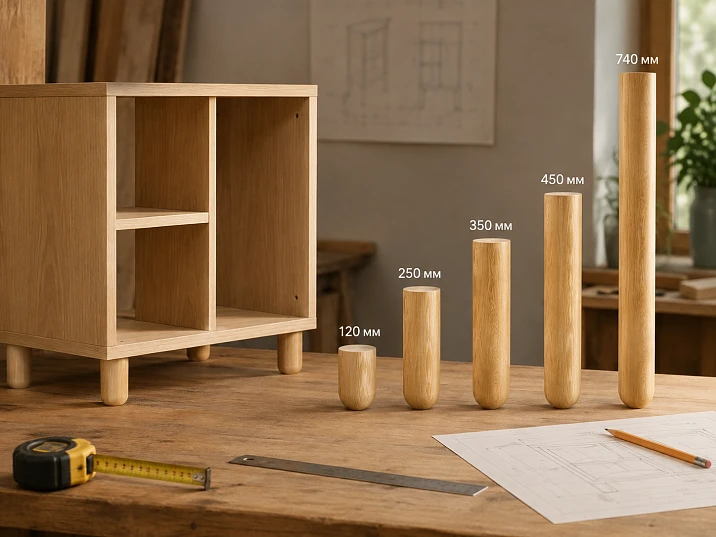
The cabinet drawing already has the body size set at 480 mm. No one is going to change it: the drawers are calculated, the facades are tied to it, and the countertop is chosen. There is only one line that can completely change the proportions of the piece: the height of the support.
For MN-234, this line is not just one. The card offers 120, 250, 350, 450, and 740 mm with a single cross-section of 86×86 mm.
If you pair only the two extreme heights with the 480 mm body, the difference becomes obvious:
-
480 + 120 = 600 mm;
-
480 + 740 = 1220 mm.
These are no longer two versions of the same cabinet. These are pieces of completely different scale and purpose.
Therefore, MN-234 cannot be chosen based on the principle "like the shape — take four pieces." First, you need to obtain the target height of the finished furniture, then subtract from it the already known dimensions of the body, countertop, and structural assembly, and only after that look at which of the five heights of MN-234 fits into the required dimensional chain.
The basic formula looks like this:
finished furniture height = body or countertop height + actual working height of the support + elements of the mounting assembly that actually change the dimensional chain.
The last part is crucial. You cannot automatically add the height of any plate or any fastener to 120, 250, or 740 mm: first, you need to see the specific assembly. Likewise, you cannot assume that the leg is always installed without losing or adding millimeters. Size A from the card is the basis for the calculation, and the final size is confirmed against the furniture drawing and the selected hardware.
If the task has not yet been reduced to a specific model, you can first Buy wooden furniture legs through a general category and compare shapes. But if profile MN-234 is already approved, the main choice within the card is not design, but height.
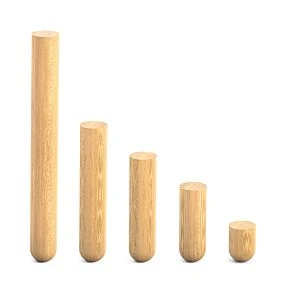
Turned furniture leg MN-234: five sizes with one cross-section of 86×86 mm
The current card MN-234 shows five variants A with the same B and C — 86×86 mm.
| MN-234 | Section | Beech, price at the time of check | Oak, price at the time of check | Status at the time of check |
|---|---|---|---|---|
| 120 мм | 86×86 mm | 1 200 ₽ | 1 630 ₽ | both variants in stock |
| 250 мм | 86×86 mm | 1 970 ₽ | 2 850 ₽ | both variants in stock |
| 350 мм | 86×86 mm | 2 910 ₽ | 4 110 ₽ | both variants in stock |
| 450 мм | 86×86 mm | 3 660 ₽ | 5 190 ₽ | both variants in stock |
| 740 мм | 86×86 mm | 5 540 ₽ | 8 050 ₽ | beech in stock, oak made to order |
For all variants, the card shows the sanding quality "Prestige". In the product settings, beech and oak are available, as well as re-gluing options for enamel and tinting, depending on the selected material and finish.
The main advantage of such a size range is the ability to maintain one turned profile on furniture of different scales. Conventionally, a low cabinet can use 120 or 250 mm, taller custom furniture — 350 or 450 mm, and a dining structure — 740 mm. But these examples are scenarios for testing, not a table of automatic compatibility.
One cross-section of 86×86 mm does not make five heights interchangeable parts. As height increases, the following change:
-
proportion between the body and the support;
-
visual center of gravity;
-
free space under the furniture;
-
position of handles and drawers relative to the user;
-
requirements for the mounting point;
-
final height of the item;
-
perceived bulkiness of the leg itself.
After calculation, you can buy furniture leg MN-234 already in a specific size, rather than leaving just an article number in the request.




Why the leg height should be chosen based on the finished furniture, not from a photo
The photo of MN-234 shows the shape, but hardly helps to understand the scale.
In the product card, the same leg at 120 mm and 740 mm can visually be perceived as one series. In a real item, the difference is:
740 − 120 = 620 mm.
Even neighboring options differ significantly:
-
250 − 120 = 130 mm;
-
350 − 250 = 100 mm;
-
450 − 350 = 100 mm;
-
740 − 450 = 290 mm.
An error of one point in the size series can change the furniture by 100–290 mm in height.
Therefore, the correct selection sequence is:
-
determine the purpose of the item;
-
fix the target finished height;
-
fix the already unchangeable body height;
-
take into account the countertop or top plate if it is not included in the body dimensions;
-
draw the mounting assembly;
-
calculate the required working height of the support;
-
compare the result with 120/250/350/450/740 mm;
-
check the 86×86 mm cross-section on the bottom plane of the body;
-
only after that choose beech or oak and prepare the set.
Thus, the decision "which MN-234 to buy" turns into a dimensional calculation, not a guess based on an interior photo.
Our factory also produces:
How to calculate the finished height: the basic formula without invented assumptions
Let's take the cabinet body with a height of 480 mm.
Get Consultation
MN-234 120 mm
Base amount:
480 + 120 = 600 mm.
MN-234 250 mm
480 + 250 = 730 mm.
MN-234 350 mm
480 + 350 = 830 mm.
MN-234 450 mm
480 + 450 = 930 mm.
MN-234 740 mm
480 + 740 = 1220 mm.
These five numbers are useful not because one of them is necessarily correct. They show a range.
Next, the question is asked: does the top plate fit into the original 480 mm?
If not, and something is added on top, for example, a 30 mm countertop, the base chain becomes:
-
480 + 120 + 30 = 630 mm;
-
480 + 250 + 30 = 760 mm;
-
480 + 350 + 30 = 860 mm;
-
480 + 450 + 30 = 960 mm;
-
480 + 740 + 30 = 1250 mm.
But this is still basic arithmetic, not the final installation size. We need to check whether the fasteners change the actual height and how the leg sits relative to the bottom plane of the cabinet body.
The expert calculation ends not with a sum in the calculator, but with a drawing of the dimensional chain.
MN-234 120×86×86 mm: when to check it for a cabinet, dresser, and low cabinet furniture
The 120 mm option is the lowest in the series.
It does not automatically mean a "leg for a cabinet." But it is logical to start checking with it if the cabinet body already has significant height of its own and only needs to be raised above the floor.
Example: dresser body 720 mm.
Basic:
720 + 120 = 840 mm.
If the top cover already fits into 720 mm, that's one scenario. If a separate 25 mm panel is added on top:
720 + 120 + 25 = 865 mm.
Now compare 840/865 mm with the target height of the project.
Another example is a bedside table with a body of 430 mm:
430 + 120 = 550 mm.
Adding a top piece of 20 mm:
570 mm.
Here, 120 mm is not a "proper leg" but a size that gives a specific result.
Before ordering, you should also check the free space under the body. A height of 120 mm creates a noticeable gap, but compatibility with a specific robot vacuum cannot be guaranteed based on this number alone. What matters for the device is its actual height, protruding sensors, and the ability to pass under the lower structural elements of the furniture.
If the task specifically concerns cabinet furniture, it is convenient to open a selection buy legs for a dresser and compare MN-234 with other models of the same purpose.
Four MN-234 120 mm: how much does a set cost
At the time of checking:
-
beech — 1,200 ₽ per piece;
-
oak — 1,630 ₽.
Four beech ones:
4 × 1 200 = 4 800 ₽.
Four oak ones:
4 × 1 630 = 6 520 ₽.
The price of a complete solution already differs from the price of a single item in the product card, so for budgeting, the required quantity is always calculated.
MN-234 250×86×86 mm: what changes compared to 120 mm
Switching from 120 to 250 mm raises the housing by an additional:
250 − 120 = 130 mm.
One hundred thirty millimeters is not a cosmetic difference.
If the cabinet body is 500 mm:
-
with 120 mm → 620 mm;
-
from 250 mm → 750 mm.
If there is also a separate 30 mm slab on top:
-
650 mm;
-
780 mm.
That is, the same furniture box turns into an object of a different scale.
Visually, a 250 mm support separates the cabinet from the floor more strongly. There is more open space under the furniture, and the leg itself becomes a noticeable part of the composition. The position of handles, top drawers, and the work surface rises relative to the user.
Therefore, in the project, it is useful not just to replace 120 with 250 mm in the specification, but to update the entire facade layout.
When 250 mm is worth checking
-
a low cabinet looks too heavy on 120 mm;
-
the designer wants to make the supports a separate visual element;
-
the target height of the furniture is not achieved with the 120-millimeter version;
-
more open space is required under the cabinet;
-
the same MN-234 profile needs to be paired with another item from a higher series.
When 250 mm is better to exclude
-
the final height already exceeds the design height;
-
the 86×86 mm section turns out to be too large in the lower node;
-
the position of the drawers becomes inconvenient;
-
the leg visually starts to compete with the cabinet;
-
the fastening area is not designed for the selected geometry.
A set of four MN-234 250 mm costs:
-
beech: 4 × 1,970 = 7,880 ₽;
-
oak: 4 × 2,850 = 11,400 ₽.
MN-234 350 mm: an intermediate height that is easy to underestimate
350 mm is often perceived as "the middle between low and high."
For finished furniture, this is a dangerous oversimplification.
Let's take a cabinet with a height of 500 mm:
500 + 350 = 850 mm.
If the top panel of 30 mm is not included in the cabinet:
880 mm.
This could already be the height of a console, vanity table, designer cabinet, or another item — depending on its purpose. But the number 350 mm itself does not assign a function to the furniture.
Another cabinet — 300 mm:
300 + 350 = 650 mm.
Body 400 mm:
750 mm.
Body 600 mm:
950 mm.
With the same leg, a range of 300 mm is achieved only due to different body heights.
Therefore, on MN-234 350 mm, it is especially useful to make a full-size side sketch. The leg is already high enough for its profile to be read entirely, and the body visually "rises" on turned supports.
Set of four MN-234 350 mm
-
beech: 4 × 2,910 = 11,640 ₽;
-
oak: 4 × 4,110 = 16,440 ₽.
If the furniture must have six legs, the cost cannot be derived from this set of four: you need to recalculate the actual quantity.
MN-234 450 mm: first calculate the finished item, then choose the "high leg"
450 mm is an even stronger intervention in proportions.
Let's look at three cases.
Body 300 mm
300 + 450 = 750 mm.
Cabinet 400 mm
400 + 450 = 850 mm.
Cabinet 500 mm
500 + 450 = 950 mm.
If a separate 30 mm tabletop is added on top:
-
780 mm;
-
880 mm;
-
980 mm.
These are three different items by final height.
Therefore, the phrase "we take high furniture legs 450 mm" doesn't solve anything until the cabinet height is specified.
For the 450-mm MN-234, it's important to separately check the visual stability of the composition. This isn't about calculating strength from a photo, but about perception: the square section 86×86 mm and the turned profile become the dominant part of the lower half of the furniture.
Current set of four
-
beech: 14,640 ₽;
-
oak: 20,760 ₽.
At the time of checking, 6 beech 450-mm legs were shown in Saint Petersburg, and 4 oak ones. For a set of four oak legs, the current stock formally suffices for exactly one set, but warehouse data changes, so they need to be re-checked before payment.
MN-234 740×86×86 mm: why this is no longer "just a table leg"
The 740 mm version is the tallest in the series.
It naturally fits into scenarios of tables and tall structures, but one figure of 740 mm doesn't yet tell what the table will be like.
If the tabletop has a thickness of 20 mm:
740 + 20 = 760 mm.
25 mm:
765 mm.
30 mm:
770 mm.
40 mm:
780 mm.
50 mm:
790 mm.
This table is especially useful because the buyer easily looks at the 740 mm leg and mentally takes 740 as the finished table height.
But 740 mm is the size of the support itself. The top plate adds its own thickness. The mounting assembly can change the final chain if the support is installed not as the simplified scheme assumes.
Therefore, before Buy wooden table legs, you first need to record the target height of the tabletop from the floor, then subtract the actual thickness of the top structure.
Example of reverse calculation
A conditional design height to the top surface is required — 770 mm.
Tabletop is 30 mm.
Required base height of the support:
770 − 30 = 740 mm.
Right here, MN-234 740 mm fits the calculation exactly.
If the countertop is 50 mm at the same total height of 770 mm:
770 − 50 = 720 mm.
MN-234 740 mm no longer matches the base chain. You can't just "install it and get 790, the difference is small." You need to either change the total height, or the top structure, or look for another support.
Cost of four MN-234 740 mm
-
beech: 4 × 5,540 = 22,160 ₽;
-
oak: 4 × 8,050 = 32,200 ₽.
At the time of checking, beech 740 mm is shown in stock, oak — made to order.
Large selection table MN-234: what will happen to the same cabinet body
To see the effect of size, let's take several cabinet heights without a separate top plate.
| Cabinet height | +120 mm | +250 mm | +350 mm | +450 mm | +740 mm |
|---|---|---|---|---|---|
| 300 мм | 420 мм | 550 мм | 650 мм | 750 мм | 1040 мм |
| 400 мм | 520 мм | 650 мм | 750 мм | 850 мм | 1140 мм |
| 480 мм | 600 мм | 730 мм | 830 мм | 930 мм | 1220 мм |
| 500 мм | 620 мм | 750 мм | 850 мм | 950 мм | 1240 мм |
| 600 мм | 720 мм | 850 мм | 950 мм | 1050 мм | 1340 мм |
| 720 мм | 840 мм | 970 мм | 1070 мм | 1170 мм | 1460 мм |
The table does not say which furniture "should" have a particular height. It solves a different task: it shows how strongly the selected MN-234 changes the already calculated body.
If the desired final height falls between two options, this is a signal not to round the decision, but to reconsider the body, countertop, joint, or leg model.
Reverse calculation: how to go from target height to the required support
This method is more useful than direct addition when the project already specifies a finished size.
Suppose the desired height of the item is 850 mm.
The body is 500 mm.
There is no separate top plate.
Required support:
850 − 500 = 350 mm.
MN-234 350 mm fits into the basic dimensional chain.
Another example:
target — 850 mm;
body — 400 mm.
850 − 400 = 450 mm.
We get MN-234 450 mm.
Third:
target — 850 mm;
Body — 600 mm.
850 − 600 = 250 mm.
The same finished height can be achieved with three different variants of one series on three different bodies.
This is the practical value of the five heights: the designer can keep the shape of MN-234 rather than change the visual language of the furniture every time the body changes.
MN-234 in beech or oak: choose the species after geometry, not instead of it
Once the required height is determined, a second choice appears — the material.
The MN-234 card offers beech and oak.
The erroneous order looks like this:
"Our body is oak, so we immediately take the oak MN-234, and we'll adjust the height later."
The correct order is the reverse:
-
first determine the required support height;
-
make sure that such a size exists in MN-234;
-
check four or another required quantity;
-
then choose the wood species and finish.
Why?
Because the right wood does not fix the wrong height.
Beech for opaque finish
The STAVROS card and general quality section show the “under enamel” preparation option: lamellas may not be matched by color and pattern, because the natural texture will be covered by an opaque coating.
For furniture that should be:
-
white;
-
graphite;
-
black;
-
colored;
-
fully covering,
beech becomes a logical candidate.
But this is not an automatic rule. The final coating system is determined by the furniture workshop.
Oak, when the wood grain should be visible
For semi-transparent finishes, oak with a noticeable natural texture is interesting.
If the body is veneered with oak, the tabletop is made of oak, or the project already has visible wood, oak MN-234 can continue the material.
But the phrase "oak to oak" is still insufficient.
Need to compare:
-
tone;
-
drawing;
-
direction of fibers;
-
gloss level;
-
porosity;
-
tinting method;
-
adjacent metal or painted parts.
Natural wood does not have to match like printed decor. If the project requires an almost identical shade, a control sample is needed.
Why four legs of one article do not yet mean a ready set
The buyer often considers the task solved when the cart contains:
MN-234 — 4 pcs.
But the set must be unambiguous.
For four identical supports, you need to check:
-
one model MN-234;
-
one height;
-
one cross-section 86×86 mm;
-
one wood species;
-
one sanding quality;
-
one preparation for the chosen finish;
-
identical finish;
-
identical mounting scheme;
-
identical base plates, if provided by the project;
-
identical orientation of the turned profile;
-
sufficient current stock or a single production time.
Example of a normal line:
MN-234 / 350×86×86 mm / beech / Prestige / for enamel / 4 pcs.
This is much more accurate than:
MN-234 — four legs.
If an item has six supports, eight, or another number, the specification changes. You don't need to automatically assume furniture has four legs just because most examples in the catalog show four legs.
How much does a set of four MN-234 cost in all five heights
It is useful to see the cost not of a single leg, but of a typical set of four.
| Height of MN-234 | 4 pcs. beech | 4 pcs. oak |
|---|---|---|
| 120 мм | 4 800 ₽ | 6 520 ₽ |
| 250 мм | 7 880 ₽ | 11 400 ₽ |
| 350 мм | 11 640 ₽ | 16 440 ₽ |
| 450 мм | 14 640 ₽ | 20 760 ₽ |
| 740 мм | 22 160 ₽ | 32 200 ₽ |
The difference between the extreme beech variants:
22 160 − 4 800 = 17 360 ₽.
For oak:
32 200 − 6 520 = 25 680 ₽.
The price increase is related not only to the wood species, but also to the length of the product. Therefore, "which MN-234 is cheaper" is the wrong question if the furniture requires a specific height.
You cannot save money by choosing 250 mm instead of 350 mm if it breaks the dimensional chain.
Buy turned furniture legs in one series for several items: where MN-234 is especially convenient
The five heights have another commercial application — a furniture set.
Let's imagine a room where you need to maintain one character of supports:
-
low cabinet;
-
a dresser;
-
console;
-
a table.
Instead of four different models, you can first check whether MN-234 covers the required heights with different A variants.
For example:
-
pedestal — 120 mm;
-
dresser — 250 mm;
-
console — 350 or 450 mm;
-
table — 740 mm.
This is not a finished recipe. The bodies of a real project have their own dimensions.
The value of the series lies elsewhere: the same cross-section of 86×86 mm and one turned tongue allow building a furniture family by changing the vertical scale.
If you need exactly this approach, it is useful to buy turned furniture legs after comparing the series with neighboring models.
MN-234 120 and 250 mm for one dresser: how to compare proportions without buying two sets
Suppose the dresser has a body of 700 mm.
Option 120:
700 + 120 = 820 mm.
Option 250:
700 + 250 = 950 mm.
The difference is 130 mm.
To see it without buying eight legs, you can make a simple full-size side mockup.
Under the body, mark:
-
a rectangle 120×86 mm;
-
a rectangle 250×86 mm;
-
contour of the turned profile from photo/drawing;
-
the floor line.
Then look at the object at eye level.
On screen, 120 and 250 mm differ by number. At 1:1 scale, it becomes visible how much 250 mm will "lift" the cabinet off the floor.
Such a mockup is especially useful if the furniture is already manufactured and the body cannot be redone.
MN-234 350 and 450 mm for console: 100 mm difference can change the purpose
The console cabinet is 400 mm.
With 350:
750 mm.
From 450:
850 mm.
Let's add a separate top plate of 30 mm:
-
780 mm;
-
880 mm.
The same cabinet can end up in two completely different height scenarios.
Therefore, it's useful for the designer not to write "MN-234 tall" in the specification, but to record:
target height of the object → body size → top plate → required support.
If, after calculation, 410 mm is required, for example, do not round to 450 just because it's the nearest option. You need to reconsider the design or choose a different model.
MN-234 740 mm for a table: five tabletop thicknesses and one important conclusion
Let's summarize the example in a table.
| Tabletop thickness | Base amount with MN-234 740 mm |
|---|---|
| 20 мм | 760 мм |
| 25 мм | 765 мм |
| 30 мм | 770 мм |
| 40 мм | 780 мм |
| 50 мм | 790 мм |
If the tabletop has an under-table frame, apron, mounting plate, or any other component that changes the dimensions, it must be added to the chain separately.
Therefore, the correct formula is:
top mark = position of the lower support + actual geometry of MN-234 + real structure under the tabletop + tabletop thickness.
Do not replace the drawing with a single sum of 740+40.
If the project is indeed calculated for a table, you can open the section Wooden legs for table and compare MN-234 with other tall supports.
Cross-section 86×86 mm: why height is not the only check
Five MN-234 variants maintain the 86×86 mm section.
This is convenient for the buyer, but the bottom plane of the housing must actually accommodate such a support.
Need to check:
-
the width of the mounting area;
-
the distance to the edge of the body;
-
position of the side panel;
-
internal partitions;
-
drawers;
-
guides;
-
existing holes;
-
decorative baseboard;
-
adjacent legs;
-
ability to install the selected fittings.
If the bottom rail of the body has a width, for example, less than the required mounting zone, the beautiful size A does not save the structure.
There is no need to place the support partially "in the air" or shift the fasteners to the edge without a project.
Replacing old legs with MN-234: why matching height is not enough
Suppose the old legs had a height of 120 mm.
The new MN-234 is also 120 mm.
It seems that the replacement is simple.
But you need to check:
-
cross-section of the old support;
-
location of the mounting axis;
-
material of the bottom plate;
-
existing holes;
-
condition of the wood material around the fasteners;
-
mounting method;
-
position of the new support relative to the facade;
-
change in visual overhang.
MN-234 has a cross-section of 86×86 mm. If the old leg was significantly smaller or had a different mounting plate, the holes may not align.
The old markings cannot be considered automatically suitable.
It is especially dangerous to simply re-drill holes next to old ones without assessing distances and base strength.
Furniture fitting MN-234: what the card actually shows
On the current card, in the "Required hardware" block, next to MN-234, the following are listed:
-
metric stud/self-tapping screw M8×60 FUR-001-1;
-
square mounting plate FUR-044;
-
set FUR-012;
-
Round foot pad d=19 mm FUR-021.
This is a useful starting point.
But the following false conclusion cannot be made:
"For any furniture, all four items are always needed in equal quantities."
The exact set depends on the structural assembly. For example, the method of attaching a leg to a solid tabletop, a panel-based body, or a separate mounting frame may differ.
Therefore, before payment, you need to get a line from the designer:
MN-234 / attachment method / hardware / quantity per support.
If the hardware is not yet approved, do not hide this gap behind the phrase "we will select it during installation".
Load: what the website confirms and why this is insufficient for furniture calculation
The FAQ for the STAVROS category states that furniture legs withstand a vertical load of at least 100 kg.
This is a useful initial fact from the manufacturer.
But from it, you cannot derive:
-
the permissible weight of a finished table;
-
the permissible dynamic load;
-
the stability of a tall console;
-
the strength of attachment to a specific slab;
-
permissible lateral moment;
-
the safety of the product when a person leans on it;
-
load-bearing capacity of the entire structure.
Why?
Because the weak point may not be the wooden leg itself, but the joint, tabletop, lower frame, or the placement of supports.
For an ordinary furniture purchase, it is enough to understand: MN-234 is not a decorative trim, but a furniture support. For a responsible load calculation, a design of the entire item is needed.
740 mm and tall furniture: why stability cannot be assessed only by cross-section
The tall MN-234 has the same cross-section of 86×86 mm as the low one.
But increasing the height changes the geometry of the object.
The higher the body is above the floor, the more important are:
-
distance between supports;
-
tabletop width;
-
position of the center of mass;
-
rigidity of connections;
-
presence of aprons or frames;
-
lateral loads;
-
uneven floor.
The article will not specify a minimum distance between legs or a universal table width: this data is not in the MN-234 card.
The correct conclusion is simpler:
740 mm is first checked as part of the table structure, not as a free-standing wooden column.
Robot vacuum and MN-234 120/250 mm: how to check without marketing promises
High supports are often chosen for cleaning under furniture.
But the phrase “120 mm is enough for a robot vacuum” without a specific model is incorrect.
You need to measure:
-
maximum height of the robot;
-
protruding sensors;
-
lower edge of the body;
-
possible crossbars;
-
Hanging elements;
-
carpet;
-
Threshold in the entry zone.
If the bottom plane of the furniture is 120 mm from the floor and the robot has a height of 98 mm, the nominal clearance is 22 mm. However, the presence of a bottom panel, wire, or carpet can change the situation.
250 mm provides significantly more space, but choosing it solely for cleaning may make the furniture too tall.
First the functional need, then the final geometry.
How to choose MN-234 if the body already has a plinth
Sometimes the cabinet is initially designed with a bottom plinth or skirt.
Adding MN-234 can lead to two mistakes.
The plinth remains and hangs between the legs
This can be part of the design, or it can look like a random remnant of an old structure.
The plinth is removed, but the body loses rigidity or a finished edge
It cannot be considered purely decorative without checking.
If the furniture is being remodeled, the function of each bottom part needs to be understood.
A new leg should not automatically replace the plinth as a structural element.
What counts as the body height: a common mistake in the request.
In conversation, "body 500 mm" can mean different things.
Option A: only the side panel without the top cover.
Option B: the body together with the cover.
Option C: from the bottom panel to the top decorative part.
Option D: the facade dimension, which is not equal to the cabinet body at all.
If a manager is simply told "500 mm cabinet, need a 250 leg," the final height may turn out wrong.
Before calculating, the dimension is specified:
Hbody = from which point to which point.
Such discipline matters more than complex formulas.
Quick decision tree for MN-234
Step 1. Is there a target final height?
If not — first determine it.
If yes — continue.
Step 2. Is the body height without legs known?
If not, measure it.
If yes — subtract it from the target height.
Step 3. Is there a separate tabletop or top plate?
If yes, account for its thickness.
Step 4. Is the obtained value close to 120, 250, 350, 450, or 740 mm?
If it matches, check MN-234.
If it is between them — do not round automatically.
Step 5. Does the 86×86 mm cross-section fit in the mounting zone?
If not — look for another support or change the design.
Step 6. Is the mounting scheme determined?
If not — coordinate before ordering.
Step 7. Are the material and finish selected?
After that, you can specify the quantity.
This algorithm is almost always faster than browsing through dozens of photos of furniture legs.
How to order MN-234 for a cabinet or dresser
For low cabinet furniture, it is useful to submit a request with specific dimensions.
Example:
Dresser / body H=720 mm, top plate included in size / target total height 840 mm / preliminary MN-234 120×86×86 mm / 4 pcs. / beech / Prestige / for enamel / fastening per scheme ___.
Or:
Nightstand / body H=480 mm / separate top 20 mm / target 750 mm / required support per base chain 250 mm / MN-234 250×86×86 / 4 pcs.
The second example needs to be rechecked:
480 + 20 + 250 = 750 mm.
This is what a "ready specification" means.
If you need other models of the same purpose, you can look at wooden legs for a stand.
How to order MN-234 for a table
For a table, the request must start with the height of the top surface.
Example:
Table / target top surface height 770 mm / tabletop 30 mm / base support height 740 mm / MN-234 740×86×86 / 4 pcs. / material ___ / fasteners ___.
If there is a frame 40 mm high under the tabletop, which actually adds to the chain, the calculation is already different.
You cannot keep 740 mm and simply "squeeze" the frame between the leg and the tabletop without checking.
This is the difference between furniture calculation and buying a decorative part: every millimeter of the vertical chain contributes to the final size.
What to choose — beech or oak for the table on MN-234 740 mm
The tall leg is noticeable almost entirely, so the material reads more strongly than with a 120-millimeter support under a cabinet.
If the table is fully painted
Beech under enamel can be rational.
If the countertop is oak and the wood is exposed
Oak MN-234 can support the material.
But you need to compare the shade and texture of real samples.
If the countertop is stone
The type of wood for the legs becomes a separate decorative decision. You cannot automatically choose oak just because it is "more premium."
You also need to separately check the mounting design for a heavy countertop. The price of the legs is not proof that they are suitable for any weight of the top plate.
Warehouse and lead time: why the size needs to be checked together with the quantity
At the time of checking, the card shows:
-
120 mm beech — 50 pcs. in St. Petersburg;
-
120 mm oak — 23 pcs.;
-
250 mm beech — 28 pcs.;
-
250 mm oak — 16 pcs.;
-
350 mm beech — 32 pcs.;
-
350 mm oak — 34 pcs.;
-
450 mm beech — 6 pcs.;
-
450 mm oak — 4 pcs.;
-
740 mm beech — 12 pcs.;
-
740 mm oak — made to order.
For a standard set of four, at the time of inspection, all warehouse options, including oak 450 mm, formally allow assembling a set. But for oak 450 mm, the stock is exactly four pieces.
If another customer places an order earlier, the situation will change.
Therefore, availability should be checked at the time of issuing the invoice.
For unavailable items, the product card indicates an average production time of 5–10 business days. In-stock items are shipped from the warehouse after preparation within the time specified on the website.
When to take four, and when to add a fifth leg as a reserve
The fifth support should not appear automatically.
It may be justified if:
-
the object is far away;
-
finishing is complex;
-
a repair reserve is needed;
-
the batch is tinted together;
-
repeat delivery is inconvenient;
-
the furniture is serial and the spare is used for several items.
But for a single cabinet, buying a fifth oak MN-234 740 mm "just in case" is an expensive decision.
First, assess:
-
probability of damage;
-
cost of repeated logistics;
-
storage possibility;
-
probability of future repair;
-
availability of the same configuration.
When it's better not to buy MN-234
MN-234 should not be ordered if at least one critical condition is still unknown.
The final height of the furniture is not determined
Then it's impossible to choose 120/250/350/450/740 meaningfully.
The 86×86 mm cross-section conflicts with the housing
The height may fit, but the mounting area does not.
The housing already has fasteners for a different system
A new drawing is needed, not hope that the holes will match.
The required height is not available in the series.
Do not round.
They are trying to simply "raise" the old furniture.
Raising by 130, 100, or 290 mm changes ergonomics and stability.
A different style is needed
Form MN-234 should be part of the project, not a compromise for the sake of having it.
The mass and construction of the heavy item are not agreed upon
For stone countertops, massive vi
The fact that 350 mm is mathematically "closer" does not make it acceptable. If the target height is fixed, another element of the dimensional chain needs to be changed, or a different support should be selected.
Another example:
target — 760 mm;
The body is 500 mm.
Required:
260 mm.
MN-234 250 mm differs by only 10 mm.
Can this difference be accepted?
The article is not entitled to answer for the designer. For a decorative cabinet, 10 mm may be acceptable, but for mating with a countertop, windowsill, adjacent furniture, or equipment — no.
Therefore, in the request, it is useful to write not "approximately 250", but:
required support per calculation is 260 mm; considering MN-234 250 mm only after confirming the change in total height to ___ mm.
This way the designer, client, and furniture maker see the same solution.
Reverse selection table: which MN-234 is obtained with different cabinets
Assume the top plate is already included in the cabinet size and there are no other height additions.
| Target height | Cabinet 400 mm | Cabinet 500 mm | Housing 600 mm | Housing 700 mm |
|---|---|---|---|---|
| 620 мм | 220 mm — no exact MN-234 | 120 мм | 20 mm — not MN-234 | — |
| 650 мм | 250 мм | 150 mm — no exact | 50 mm — no exact match | — |
| 750 мм | 350 мм | 250 мм | 150 mm — no exact | 50 mm — no exact match |
| 850 мм | 450 мм | 350 мм | 250 мм | 150 mm — no exact |
| 1120 мм | 720 mm — no exact | 620 mm — no exact | 520 mm — no exact match | 420 mm — no exact |
| 1140 мм | 740 мм | 640 mm — no exact match | 540 mm — no exact match | 440 mm — no exact match |
The table is useful precisely because of its empty cells and mismatches.
It shows: MN-234 does not have to fit any cabinet just because the series has five heights.
If the calculation requires 220, 320, 520, or 640 mm, the solution must be found in the design, not by "stretching" the nearest leg.
Four legs for enamel: how to avoid four different shades and gloss levels
When MN-234 is painted with an opaque material, it seems that natural wood no longer matters and each part can be painted separately.
In practice, the uniformity of the set depends not only on the color number.
For four legs, the following must be fixed:
-
one primer;
-
one enamel system;
-
the same surface preparation;
-
number of layers;
-
interlayer treatment;
-
gloss level;
-
application direction;
-
one control sample.
The turned shape creates different reflection angles.
On a flat body, semi-matte enamel may look even, but on MN-234 the profile peaks will produce a more noticeable glare.
Therefore, it is useful to view the control swatch directly next to the body, rather than on a separate rectangular panel.
If the legs are painted by a third-party contractor, it is better to hand them over as a set and label them with a single specification.
The split "two now, two in a week" adds the risk of differences in paint batch, equipment settings, and gloss perception.
Oak MN-234 for tinting: why four identical items won't be four copies
Oak is chosen for visible wood, and wood is naturally variable.
Even four MN-234 of the same article and size may differ:
-
in fiber arrangement;
-
porosity;
-
in tone;
-
reaction of individual sections to the stain;
-
in contrast after varnish or oil.
This is not a reason to declare the parts as different products.
But for furniture where all four legs are clearly visible at the same time, it is useful to do an incoming selection before finishing.
Practical procedure:
-
unpack the set;
-
place the four legs side by side in the correct orientation;
-
identify the most visible sides;
-
assess the natural tone;
-
mark the positions;
-
perform a test coat;
-
only then start finishing the entire batch.
If one leg visually differs sharply, the issue is resolved before installation and final coating.
Acceptance of set MN-234: what to check before the furniture maker starts drilling
Inspection upon receipt should be short but systematic.
1. Article number
All packaging and accompanying data must have MN-234.
2. Size
It cannot be assumed that four identical boxes automatically contain four identical heights.
Verify:
-
120;
-
250;
-
350;
-
450;
-
740 mm.
3. Cross-section
86×86 mm.
4. Material
Beech or oak — the one specified in the order.
5. Preparation
Under enamel or under tinting — according to the project.
6. Quantity
Four, six, or another number as per specification.
7. Relief and edges
Transport damage is easier to notice before painting and installation.
8. Hardware
Checked separately against the approved assembly.
9. Color marking
If the legs already have a finish, compare them together under the same light.
10. Document retention
The order number and configuration are useful for future repairs or a repeat batch.
Acceptance takes less time than fixing furniture after installing a support of incorrect height.
Replacing existing legs: an eight-measurement protocol
If MN-234 is purchased not for new furniture but for remodeling old furniture, it is useful to record eight parameters before disassembly.
-
Current total height of the furniture.
-
Height of the old leg.
-
Size of the body without the old leg.
-
Cross-section of the old support at the point of attachment.
-
Distance from the mounting axis to the two nearest edges.
-
Thickness of the bottom plate.
-
Location of the old holes.
-
Target new height.
After this, you can calculate what will actually happen.
For example:
current leg — 100 mm;
new MN-234 — 250 mm.
The furniture will become higher by approximately:
250 − 100 = 150 mm
in the base scheme, if the mounting points are comparable in height.
This is already a significant change.
The handle, top shelf, and work surface rise by the same 150 mm.
Such a transition cannot be considered merely a "design update."
MN-234 and uneven floors: why a floor glider doesn't replace checking furniture with a level
The card next to MN-234 shows a round foot pad FUR-021.
A floor glider is useful as a contact element with the floor if it is provided by the selected assembly.
But having a floor glider does not mean that four legs automatically compensate for any unevenness.
After assembly, the item is checked:
-
on the actual floor;
-
for diagonal rocking;
-
level;
-
with all supports fully installed.
If the floor has a large difference in height, the furniture maker makes the decision: adjustment, a different foot, a shim, a change to the joint, or another method.
You don't need to file down one wooden MN-234 without a project just because the cabinet wobbles on a specific tile.
The cost of a height error: why calculating first is cheaper than replacing the set later
Let's take oak MN-234 450 mm.
Set of four:
20 760 ₽.
If after assembly it turns out that 350 mm were needed, a new oak set costs:
16,440 ₽ at current prices.
Even without delivery, finishing, and labor, the potential cost of the second set is significant.
For beech 740 mm:
22,160 ₽ for four pieces.
The mistake "740 mm is the finished table height" can lead to buying a new set or reworking the tabletop and underframe.
Therefore, a few minutes of reverse calculation have direct commercial value.
Serial order: if MN-234 is needed not for one item but for ten
In the series with five heights, the B2B scenario is especially interesting.
Suppose a workshop makes:
-
4 cabinets;
-
3 consoles;
-
3 tables.
You cannot first select "MN-234 for the entire collection" and then simply multiply the quantity.
For each type of furniture, its own row is created:
cabinet → body height → MN-234 120/250 → quantity;
console → body → MN-234 350/450 → quantity;
table → tabletop → MN-234 740 → quantity.
Then all rows are combined by identical configurations.
This provides two benefits:
-
purchasing remains transparent;
-
one form links the collection without requiring items to have the same support height.
If oak for tinting is used in the series, it makes sense to agree on the overall finish technology and sample before launching all items.
Final check before the “order” button
Before paying for MN-234, it is useful to go through the list without skipping:
-
the target finished height is known;
-
the body height is measured from clear points;
-
countertop accounted separately, if required;
-
the size of the mounting unit is checked;
-
MN-234 120/250/350/450/740 mm is selected;
-
the 86×86 mm cross-section fits;
-
the material is chosen deliberately;
-
finish is coordinated;
-
quantity confirmed;
-
fasteners determined;
-
foot plate determined;
-
current balance checked;
-
production time for missing items accepted;
-
The cost of the set, not a single leg, is calculated;
-
drawing saved together with specification.
If at least the first six items remain open, it is too early to buy supports.
Summary: which MN-234 to order
MN-234 is convenient not because it exists in five sizes by itself. Its strong point is the ability to select one turned profile for different calculated furniture items.
Short selection scheme:
-
120 mm — check for a low support under an already fairly tall body;
-
250 mm — when you need to raise the body another 130 mm relative to the 120 version;
-
350 mm — for intermediate geometry, where the support already becomes a significant part of the object;
-
450 mm — for a highly raised body and custom designs;
-
740 mm — primarily check in calculations for tables and tall objects.
But the final decision is always based on the formula:
target height − body − top structure − actual node elements = required working support height.
If the result matches one of the five MN-234 and the 86×86 mm section fits the body, you can proceed to material and kit.
Beech is reasonably considered for covering finishes.
Oak — when the natural texture should be visible.
For four supports, the current cost ranges from 4,800 ₽ for beech 120 mm to 32,200 ₽ for oak 740 mm.
The final route is simple: calculation → drawing of the lower node → material → finish → quantity → hardware → availability check → order.
After this check turned furniture leg MN-234 it becomes not a "beautiful support from the catalog", but a specific part of already calculated furniture.
FAQ
What sizes does the furniture leg MN-234 have?
The current card shows five heights: 120, 250, 350, 450, and 740 mm. The cross-section in all these options is 86×86 mm.
What materials are MN-234 made from?
Beech and oak are available in the card.
Which MN-234 should I buy for a cabinet?
First, you need to know the height of the body and the target finished height. For low furniture, checking often starts with 120 or 250 mm, but this is not a universal recommendation.
Will the MN-234 120 mm fit a dresser?
It may fit if the final dimensional chain with the body matches the project and the mounting area accepts a 86×86 mm cross-section.
How does the MN-234 250 mm differ from the 120 mm in final height?
It raises the same body by an additional 130 mm.
Why choose MN-234 350 mm?
When the calculation requires exactly about 350 mm of working support height and the body is designed for such geometry. The type of furniture is not determined by a single leg.
How is 350 mm different from 450 mm?
The difference is 100 mm. On the same cabinet, the finished furniture will be 100 mm higher.
Can I buy MN-234 740 mm for a table?
Yes, MN-234 is available in the table leg category. But first, you need to calculate the tabletop thickness and the entire mounting assembly.
How to calculate the table height with MN-234 740 mm?
In the simplified scheme, the tabletop thickness is added to 740 mm. For example, 740+30=770 mm. The actual chain is confirmed by the design.
What happens with a 40 mm tabletop?
Basically, 740+40=780 mm before accounting for other assembly elements.
What to choose — oak or beech?
If opaque enamel is planned, beech is often considered. If open wood texture is important, oak is considered. The final choice is made based on the actual finish.
What is the cross-section size of MN-234?
86×86 mm.
Can I order four identical MN-234 units?
Yes, if one size, material, and configuration are confirmed in stock or on order. Before payment, the current stock is verified.
Do I need to buy a fifth leg as a spare?
There is no automatic rule. A reserve is justified by logistics, repairs, or a series project.
Can old legs be replaced with MN-234 without rework?
It should not be assumed in advance. The mounting area, holes, and fasteners need to be checked.
Which hardware items does the MN-234 card show?
FUR-001-1, FUR-044, FUR-012, and FUR-021. The exact set for a specific cabinet must be confirmed by a designer or furniture maker.
Is there an MN-234 in oak 740 mm?
Yes, the card shows such a configuration; at the time of checking, it was made to order.
How much do four beech MN-234 120 mm cost?
4,800 ₽ at the card price at the time of checking.
How much do four oak MN-234 740 mm cost?
32 200 ₽.
What is the production time for the missing item?
The card indicates an average production time for custom orders of 5–10 business days.
Can the height be selected only by the purpose "table" or "dresser"?
No. The purpose helps filter models, but the height is selected according to the size chain of the specific furniture.
What to do if the calculation requires a 400 mm leg?
Do not round automatically to 350 or 450 mm. You need to review the cabinet, mounting structure, or another model.
Where can I see other wooden furniture legs?
In the general category of unpainted furniture legs STAVROS.
Where can I see legs specifically for a dresser, wardrobe, or nightstand?
In the corresponding selection by application STAVROS.
Where can I see wooden legs for a table?
In a separate selection of table legs.
What should I check right before payment?
Size, material, quantity, current price, availability, lead time, hardware, finish preparation, and compliance with the cabinet drawing.