










































































Article Contents:
- The window as a focal point: why the curtain rod decides everything
- Why curtains look cheaper if the curtain rod is chosen randomly
- When you specifically need a wooden curtain rod: a list of scenarios
- Interior with wooden doors and baseboards
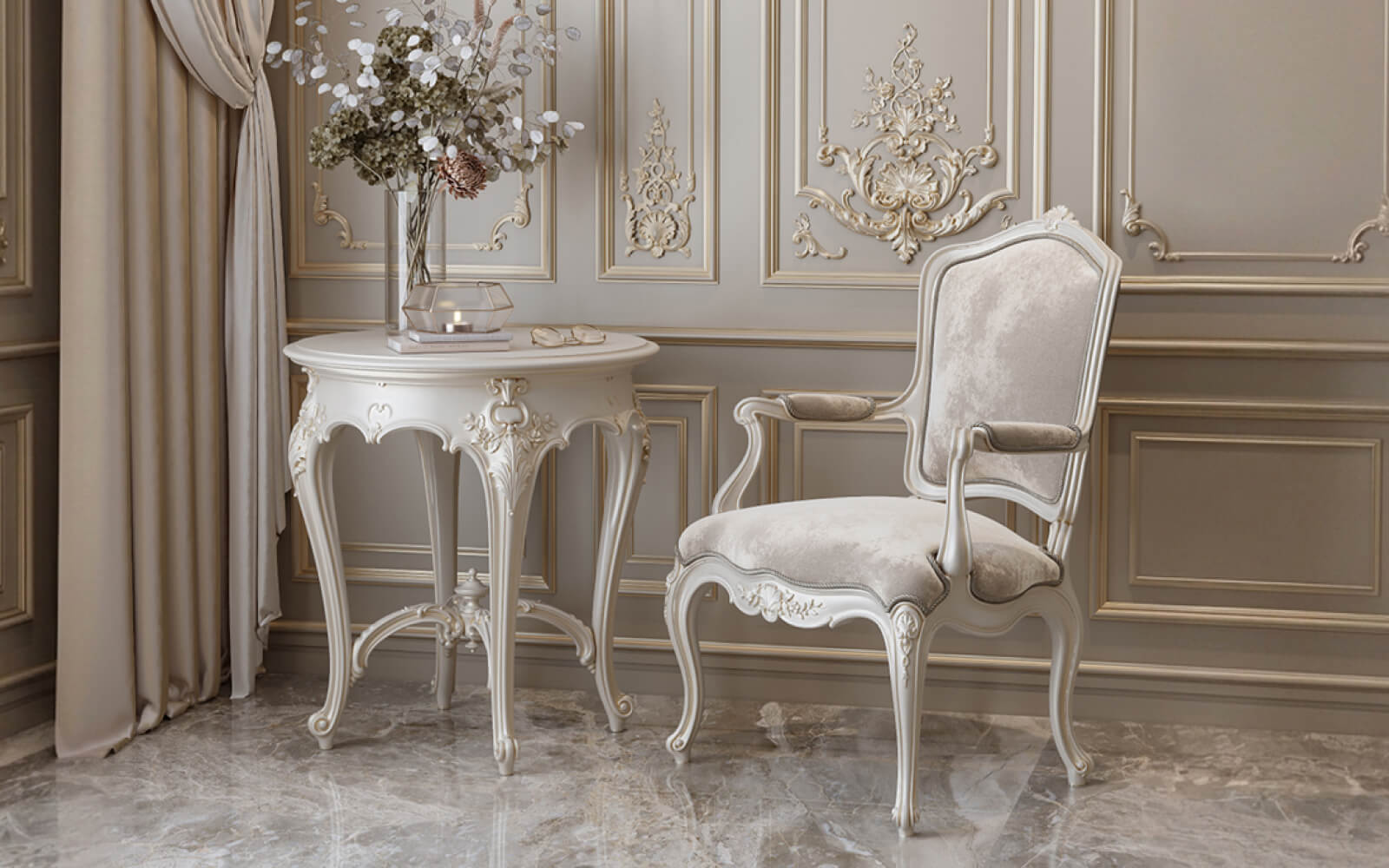
- Classical and Neoclassical Interior
- Country house, cottage, wooden interior
- Bedroom with a warm palette and natural fabrics
- Study with wooden elements
- Curtains as part of the interior composition
- Single or double wooden curtain rod: how to avoid mistakes when buying
- Single curtain rod: when it is the right choice
- Double curtain rod: when it is mandatory
- Selection table
- Wall-mounted wooden curtain rod: why it is often better than ceiling-mounted
- Wall-mounted curtain rod: when it wins
- Ceiling Cornice
- Wooden curtain rod for heavy curtains: reliability without compromise
- What affects the load
- What to consider when choosing a curtain rod for heavy curtains
- Curtain rod with rings: a classic that never goes out of style
- Why rings are beautiful
- Functional advantage
- Where a curtain rod with rings works best
- How to choose the color of a wooden curtain rod: not to match the curtains, but the interior
- Key guidelines for choosing a color
- Color combinations: table
- Curtain rod diameter and visual weight: why scale matters
- How to choose the diameter
- Curtain rod length
- Wooden curtain rod for the living room: the window area as a decorative center
- Mounting height in the living room
- Wooden curtain rod for the bedroom: silence starts with details
- Wooden curtain rod for a country house: organic without compromise
- What to choose for a country house
- What to pair with a wooden curtain rod: a system of wooden decor
- Mistakes when buying a wooden curtain rod: what not to do
- Getting a single-row curtain rod without calculating needs
- Not accounting for curtain weight
- Buying a curtain rod the same length as the window width
- Not calculating the number of brackets
- Forget about the offset from the wall
- Choose a color without connection to the interior
- Not checking the completeness
- Choose an unsuitable installation height
- Wooden curtain rod in different interior styles
- Classic and neoclassic
- Scandinavian Style
- Country and rustic style
- Modern interior with wooden accents
- Where to buy a wooden curtain rod: choosing wisely
- STAVROS: wooden curtain rod as part of a wooden system
- FAQ: Answers to Popular Questions
- Which wooden curtain rod to buy for curtains and tulle?
- What makes a wooden curtain rod better than a metal one?
- Which curtain rod to choose for heavy drapes?
- Can a wooden curtain rod be used in a modern apartment?
- Which is better: a single-row or double-row curtain rod?
- At what height should a curtain rod be hung?
- How many brackets are needed for a curtain rod?
- Does a wooden curtain rod need to be painted?


The window as a focal point: why the curtain rod decides everything
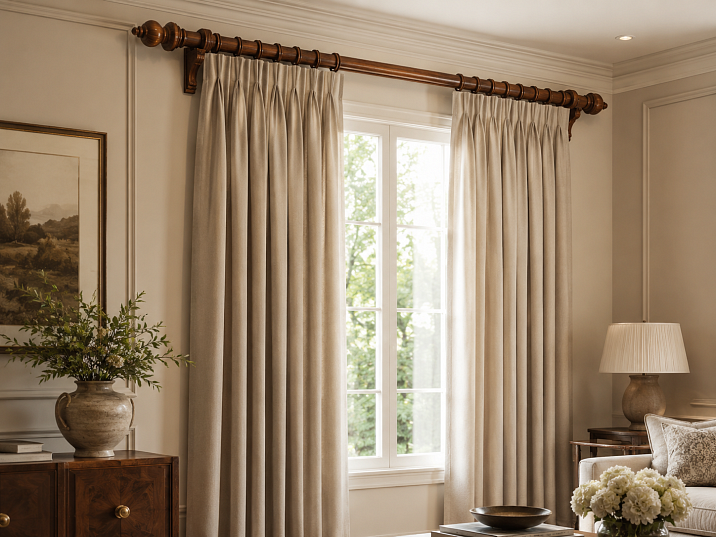
There is a paradox in interior design that even those who spent a considerable amount on finishing face. Expensive curtains were bought — dense fabric, beautiful color, correct length. But the window still looks random. The eye lingers not on the curtains, but on what holds them: a thin metal tube, a plastic profile, or faceless hardware — and the illusion of expensive textiles falls apart.
A curtain rod is the frame for curtains. Just as a frame determines the perception of a painting, a curtain rod determines the perception of a window opening. Wooden cornice for curtains — it's not just a mounting element. It is a visible architectural accent that connects textiles with the interior, adding warmth, weight, and completeness.
The question "which wooden curtain rod to buy" is not rhetorical. Behind it lies a specific choice: single-row or double-row, wall-mounted or ceiling-mounted, with or without rings, for drapes or for light tulle, for dark doors or for light furniture. This article is a breakdown of each scenario. No fluff, with answers.




Why curtains look cheaper if the rod is chosen randomly
Textile is a material sensitive to its surroundings. Beautiful fabric next to a poorly chosen rod doesn't win — it loses. There are several reasons.
Mismatch in weight categories. Heavy drapes made of velvet or dense linen on a thin metal tube — a visual imbalance. The fabric requires support that matches it. Wooden cornice with the right diameter adds reliability — both visual and structural.
Material conflict. Cold metal next to warm wood of furniture, doors, and baseboards — a break in the room's material language. Wood pairs well with wood. A solid wood rod organically fits into an interior with wooden doors, parquet, beams, or slatted panels.
Lack of finish. The window is an area that requires completeness: a casing at the bottom, slopes on the sides and top, and a rod above them. When the rod is chosen at random, the window looks unfinished, as if the renovation is not yet complete.
Cheap hardware. Plastic rings, crooked brackets, low-quality finials — details that are immediately noticeable. Buy a wooden curtain rod means getting a system where rings, finials, and brackets match the material and level.
Our factory also produces:


When you specifically need a wooden rod: a list of scenarios
A wooden cornice is not a universal choice for every room. But there are situations where it is the only correct one.
Get Consultation
Interior with wooden doors and baseboards
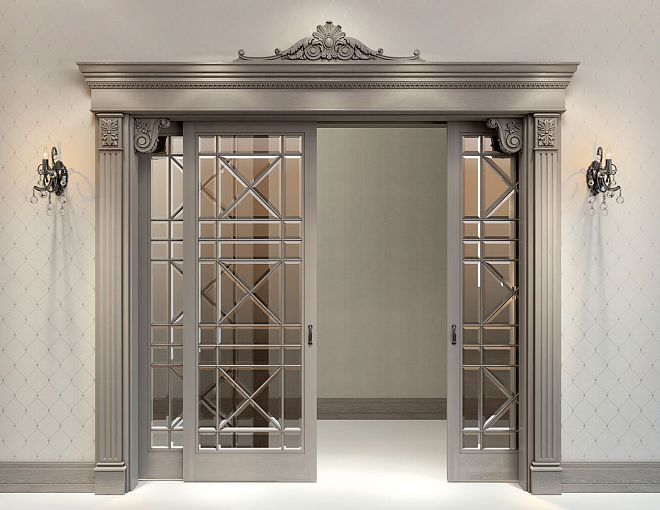
If the apartment or house has wooden doors, Wooden casings и Wooden Skirting Boards the cornice should continue this material line. Metal here would be an exception to the rule built on warm wooden texture.
Classic and neoclassical interior
Classic requires wooden cornices with profiled tips — balls, cones, shaped details. Plastic is categorically inappropriate here. Wood is the native material for classic interiors, where the cornice becomes an independent architectural element.
Country house, cottage, wooden interior
In a country house with paneling, timber, or wooden beams wooden cornice it's not a matter of style, but a matter of logic. Everything is made of wood — and the cornice should be made of wood. This is the ABC of material consistency.
Bedroom with a warm palette and natural fabrics
In a bedroom with linen curtains, a wooden bed, warm lighting, and a wooden floor, a metal cornice would be the only cold element. A wooden cornice for the bedroom completes the warm image of the room.
Office with wooden elements
Home office with wooden shelving, wooden moldings and cornices on the walls, slatted panels — here the cornice continues the system of wooden decor. It should not attract unnecessary attention, but should support the unified language of the interior.
Curtains as part of the interior composition
If curtains are chosen as a design element, and not just as a means of darkening, the cornice should support that level. Wooden beams with rings, with beautiful finials, in the right color and right diameter — part of the interior concept, not just hardware.
Single or double wooden cornice: how to avoid mistakes when buying
This is the most common question and the most common mistake. People buy single wooden corniceThen they realize there's no room left to hang tulle and start improvising. The result is two different curtain rods on the same window that don't match in color or height.
Single-row curtain rod: when it's the right choice
single wooden cornice — for one layer of fabric. This is appropriate when:
-
the window doesn't require blackout, only decoration;
-
only heavy curtains are used without tulle;
-
the interior is intentionally minimalist — one layer, one fabric;
-
the window is narrow or small, and a double rod would look cluttered;
-
tulle is replaced by roller blinds built into the frame.
In the single-row version, the curtain rod looks cleaner and lighter. The only condition is that tulle in this case must be handled separately or omitted entirely.
Double-row curtain rod: when it's mandatory
Two-row wooden curtain rod — for the classic combination of tulle plus drapes. This is the most common format in living spaces: a light transparent curtain lets light through, while a thick curtain covers the window when needed.
Buy two-row wooden curtain rod with rings — means getting a system where both layers of fabric work independently but are attached to a single structure. This is neater than two separate rods and visually much cleaner.
Two-row curtain rod — a choice for:
-
living room, where functionality and beauty are needed;
-
bedroom with a blackout requirement;
-
dining room or study, where the ability to adjust light is important.
Selection table
| Situation | Recommendation |
|---|---|
| Only thick curtains | Single-row |
| Tulle + curtains | Double-row |
| Minimalist interior | Single-row |
| Living room with classic design | Double-row |
| Children's room with zoning | Double-row |
| Bedroom with full blackout | Double-row |
| Kitchen with light curtains | Single-row |
Wall-mounted wooden curtain rod: why it is often better than ceiling-mounted
Choosing between wall-mounted and ceiling-mounted curtain rods is the second most important decision after choosing single-row or double-row.
Wall-mounted curtain rod: when it wins
Stretch ceilings. If the ceiling is stretch, you cannot drill into it. Wall mounting is the only correct option here. The bracket is attached to the wall above the window opening — the cornice extends forward the required distance.
Architectural accent. The wall-mounted cornice is visible. It reads as a window design element. If the cornice is beautiful, you want to show it off, not hide it near the ceiling. A wooden wall-mounted cornice with finials works as a visual accent that completes the window.
Emphasizing window height. The wall-mounted cornice is installed above the window opening — this creates the illusion of a taller window and a higher ceiling. Designers' rule: hang the cornice above the frame, closer to the ceiling.
Combination with architraves and moldings. Wooden cornice for curtains of wall mounting organically continues the vertical wooden trim: Wooden casings on the sides of the window, the cornice above it — this is a unified architectural frame.
Ceiling cornice
wooden ceiling cornice attached to the ceiling. Visually, it is less pronounced; the curtains seem to 'come out' directly from the ceiling. This is a modern technique that works in minimalist interiors. But wooden ceiling cornices are chosen less often — wood is less advantageous here than in the wall-mounted version.
Wooden cornice for heavy curtains: reliability without compromise
Heavy curtains are a separate story. Dense velvet, multi-layer linen, interior burlap — such fabrics create a serious load on the cornice. Here, beauty and reliability must go together, and neither can be neglected.
What affects the load
-
Curtain length: floor-length curtains are longer and therefore heavier.
-
Fabric width: gathering curtains to 2–3 times the window width adds significant weight.
-
Material: velvet, thick cotton, and burlap weigh significantly more than voile or organza.
-
Number of layers: tulle plus drapes doubles the load.
What to consider when choosing a curtain rod for heavy curtains
Rod diameter. The heavier the curtains, the larger the rod diameter should be. For heavy drapes, 35 mm or more. A thin rod will sag or deform under such curtains.
Number of brackets. Standard recommendation: a bracket every 60–80 centimeters. For heavy curtains, every 50 centimeters. Too few attachment points lead to rod sagging, ring misalignment, and difficult curtain movement.
Ring quality. Rings should move smoothly even under load. Wooden rings with a metal insert or high-quality metal rings for a wooden rod are a reliable choice.
Distance from the wall. The rod should be far enough from the wall so that the curtains do not catch on the windowsill or slope. Standard distance is 10–15 cm from the wall surface.
Curtain rod with rings: a classic that never goes out of style
Wooden curtain rod with rings — is a special aesthetic choice. Rings give window decor character: they evoke traditional interiors, solemnity, and thoughtfulness.
Why rings are beautiful
Rings create a visible rhythm. When curtains are drawn aside, the rings on the rod form a uniform pattern — this is already a decorative element, not just hardware. That's why curtain rods with rings are so often used in photos of designer interiors: they look expensive even in pictures.
Functional advantage
Rings provide smooth curtain gliding. Unlike clips or fabric threading, rings allow curtains to move smoothly and easily. This is important in a living room where curtains are opened and closed several times a day.
Where a curtain rod with rings works best
-
In a living room with high ceilings — rings add solemnity.
-
In a bedroom with classic decor — rings support the style.
-
In a study with wooden details — rings fit into the wooden system.
-
In a country house, rings look organic next to natural materials.
How to choose the color of a wooden cornice: not to match the curtains, but to match the interior
A common misconception: the color of the cornice should match the color of the curtains. This is a mistake. The cornice is a wooden element, and it should be selected to match other wooden elements in the room. The curtains can be any color.
Key guidelines for choosing a color
To match the floor color. Parquet or laminate sets the tone for the wooden details in the room. If the floor is dark oak, a cornice in the same range looks logical. If the floor is light, a light cornice continues this tone.
To match the doors. Wooden doors are the most noticeable wooden element in the room. A cornice tinted to match the doors creates a sense of system. Exact matching is not necessary — just being in the same warm or cool range is enough.
To match wooden baseboards. Wooden Skirting Boards They run along the perimeter of the room near the floor. A cornice that matches them in color and material completes the wooden frame of the space — from bottom to top.
To match the furniture. If the furniture is wooden or has wooden details, the cornice supports this accent.
To match slatted panels or beams. If the room has wooden beams on the ceiling or Rafter panels on the walls — a cornice made of the same stone or in the same tint creates unity.
Contrast to the wall. The cornice is slightly darker than the wall — an accent technique. It highlights the cornice as an independent element and adds depth to the window area.
Color combinations: table
| Room finishing | Recommended cornice color |
|---|---|
| Light floor, white doors | Light ash, bleached oak |
| Dark parquet, wenge doors | Dark oak, wenge |
| Pine walls and ceiling | Pine in tone or slightly darker |
| White walls, wooden furniture | For furniture or for flooring |
| Gray walls, neutral decor | Gray-brown, natural oak |
| Warm ochre, terracotta | Warm pine, walnut |
Cornice diameter and visual weight: why scale matters
The shape of the cornice is not only about aesthetics but also physics. A too thin cornice will not support heavy curtains and will look weak even visually. A too massive cornice in a small room will feel oppressive — like an overly wide baseboard in a narrow hallway.
How to choose the diameter
25–28 mm — light and medium curtains. Voile, organza, lightweight cotton. Small windows. Delicate appearance.
35 mm — standard diameter for most residential spaces. Medium and heavy curtains. Looks good in living room and bedroom.
40–45 mm and more — heavy drapes, large windows, rooms with high ceilings. A massive curtain rod requires massive finials and reliable brackets.
Curtain rod length
The curtain rod should extend beyond the width of the window opening on both sides — at least 15–20 centimeters on each side. This allows you to fully draw the curtains and open the window without covering it with fabric. For wide windows — up to 30 centimeters on each side.
Wooden curtain rod for the living room: window area as a decorative center
The living room is a space where windows often become the main decorative zone. Large windows, high ceilings, long curtains — all of this requires the right curtain rod.
In the living room Wooden curtain rod solves several tasks simultaneously:
Visual window frame. The curtain rod above the window and trim on the sides create an architectural frame — the window is perceived as a well-thought-out interior element, not just a hole in the wall.
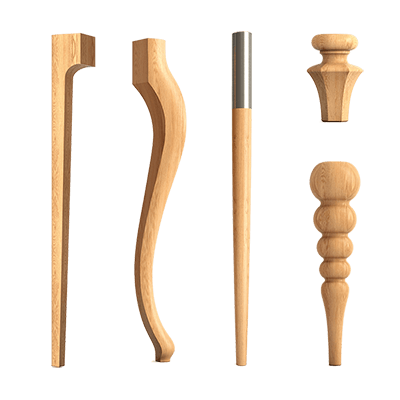
Connection with furniture. A wooden curtain rod, tinted to match a wooden table or sofa legs, weaves the window area into the room's furniture composition.
Ceremony. In the living room, a cornice with rings and beautiful finials is a decorative element that is visible even when the curtains are open. This is important: the cornice works constantly, not only when the curtains are drawn.
Mounting height in the living room
Standard recommendation: mount the cornice 15–20 centimeters above the top edge of the window frame. If the ceilings are high, you can raise it even higher, creating the illusion of a tall window. The curtains are then hung to the floor or with a small allowance.
Wooden cornice for the bedroom: silence begins with details
The bedroom is a room with special emotional weight. Here, every detail that creates or destroys the feeling of comfort matters. And the cornice is no exception.
Bedroom Wooden curtain rod works differently than in the living room. Here, the following are important:
Softness. Wood is a warm material. In a bedroom with a wooden bed, wooden skirting boards and warm curtains, a metal cornice will be an unnecessary cold accent. A wooden cornice continues the warm look.
Nighttime darkening. For full darkening in the bedroom, a two-row cornice is needed: tulle or a light curtain plus a dense blackout curtain. Two-row wooden curtain rod solves this task elegantly.
Curtain width. In the bedroom, curtains are usually wider than the window — to create a sense of coziness and hide the slopes. The curtain rod should be long enough: 20–25 centimeters wider than the opening on each side.
Color. In the bedroom, the color of the curtain rod is most often matched to the headboard, flooring, or wooden furniture details. A dark rod on a light wall is an accent. A rod matching the wall color is minimalism.
Wooden curtain rod for a country house: organic without compromise
A country house is a space where material consistency matters more than anywhere else. Wood is everywhere: in the walls, ceiling, floor, furniture, doors, beams. And the curtain rod here must be wooden.
What to choose for a country house
Pine or spruce. For houses with softwood paneling, a softwood curtain rod fits in organically. Coated with varnish or oil, it looks lively and natural.
Oak or ash. For houses with a more representative design, hardwoods add solidity.
Toning to match logs or timber. If the walls are made of timber, a curtain rod in the same warm brown palette continues the look.
Rings made of wood or metal. In a country interior, both wooden rings and forged ones look organic, depending on the style of the house.
What to pair a wooden curtain rod with: a system of wooden decor
buy a wooden curtain rod — the right step. But even more correct is to integrate it into the wooden trim system that covers the entire room.
Cornice and architraves. Wooden casings frame door and window openings vertically. The cornice completes the window opening horizontally at the top. Together they create a complete window frame.
Cornice and baseboards. solid wood skirting boards — a horizontal line at the floor. The cornice is a horizontal line at the ceiling. Both from the same wood species and in the same tint — the room gains a complete architectural rhythm.
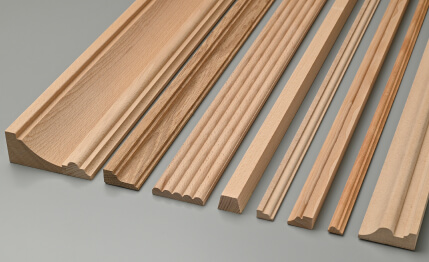
Cornice and moldings. Wooden moldings and cornices on the walls — a decorative frame. The curtain cornice fits into this system as part of the room's upper wooden belt.
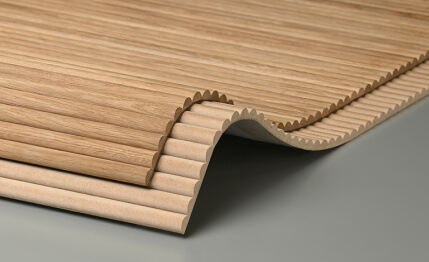
Cornice and slatted panels. If the wall in the room is finished plank panels with solid wood, a cornice of the same species connects the window area with this decorative accent.
Cornice and trim. Pogonazh iz massiva — this is a systematic approach to wooden interior details. The cornice is part of this system along with baseboards, platbands, fillets, and moldings.
Mistakes when buying a wooden cornice: what not to do
Mistakes when choosing a cornice are most often discovered after installation. Redoing it is difficult — it's better to figure it out beforehand.
Getting a single-row cornice without calculating needs
The most common mistake. A person gets a single-row option, then realizes they need tulle — and hangs a second cornice next to it. Result: two cornices of different colors and heights on the same window. The solution is simple: decide right away — whether tulle is needed or not. If there is even the slightest doubt — get Two-row wooden curtain rod.
Not accounting for the weight of curtains
A thin cornice under heavy velvet drapes is a source of problems. Sagging in the center, loose brackets, tight-moving rings. The weight of the fabric is the first parameter when choosing the diameter of the cornice.
Buying a cornice the same length as the window width
A cornice that does not extend beyond the window opening is a mistake. Curtains will partially cover the window even when open. Minimum overhang — 15 centimeters on each side.
Not calculating the number of brackets
Two brackets on a 2.5-meter cornice — sagging is guaranteed. Brackets every 60–80 centimeters — a rule without exceptions. For heavy curtains — more often.
Forgetting about the offset from the wall
A bracket that places the cornice flush against the wall — curtains will hit the windowsill, slope, or glass. An offset of 10–15 centimeters from the wall is a mandatory parameter when ordering brackets.
Choosing a color without connection to the interior
A cornice in a random color "light walnut" in a room with dark doors and white baseboards — three different material messages. The color of the cornice should match one of the wooden elements in the room.
Not checking the completeness
buy a wooden cornice — means ensuring the set includes rings, brackets, and finials. Otherwise, installation turns into a quest to find suitable fittings.
Choosing an unsuitable mounting height
A cornice hung directly above the window frame — a missed potential. Rule: the cornice is at least 15–20 centimeters above the frame. The higher it is, the visually higher the ceiling.
Wooden cornice in different interior styles
Classicism and neoclassicism
Here, a wooden cornice is a mandatory element. Profiled tips in the shape of balls, cones, or stylized capitals. Dark tinting or walnut. Rings are large and pronounced. Curtains are thick, floor-length, with or without a lambrequin. Wooden wall-mounted curtain rod — specifically wall-mounted, so the cornice is visible.
Scandinavian style
Light wood, minimalist tips, thin cornice. Curtains are linen, hanging freely, without lush gathering. Rings are laconic. The cornice is part of a neutral warm background.
Country and rustic style
Pine, spruce, rough wood texture. Wrought iron rings. Large diameter cornice. Curtains are thick linen fabric or cotton. Wooden curtain rod for a country house — this is about strength and naturalness.
Modern interior with wooden accents
Clean lines, minimal decor. The cornice is thin or medium diameter, matching the color of other wooden accents (slat panels, shelves, furniture details). Tips are laconic, without profile. Rings are small.
Where to buy a wooden curtain rod: choosing wisely
Buy a wooden curtain rod — this means choosing not only a beautiful cornice, but also one that is correct in diameter, length, completeness, and material. It is important that the cornice can be integrated into a unified wooden trim system: ordered in the same wood species as the baseboards and casings, and obtaining the required diameter and color.
buy wooden cornice complete with rings, brackets, and finials, choose a single-row or double-row option, select for heavy drapes or light tulle — all this is available in the STAVROS catalog.
STAVROS: a wooden cornice as part of a wooden system
STAVROS — manufacturer and supplier of solid wood for interior projects of any scale. Curtain rods, moldings, casings, baseboards, slat panels, Pogonazh iz massiva — all these are elements of a unified wooden system from which a cohesive interior is built.
buy a wooden curtain rod from STAVROS — means getting a cornice made of proven solid wood, in the required diameter, with full equipment, and the ability to match it to other wooden elements in the room.
Curtains start to look more expensive when the cornice is chosen correctly. This is not magic — it is simply good material in its proper place.
FAQ: Answers to popular questions
Which wooden cornice to buy for curtains and tulle?
For combining tulle and drapes, you need a Two-row wooden curtain rod. It allows you to hang both layers of fabric independently of each other.
How is a wooden curtain rod better than a metal one?
wooden cornice creates a warm window image and blends organically with wooden doors, baseboards, furniture, and trim. Metal is colder and more neutral — it fits in modern minimalist interiors without wooden accents.
Which curtain rod to choose for heavy drapes?
A rod with a diameter of 35 mm or more with reliable brackets every 50–60 centimeters. It's important to consider the rod length and the total weight of the fabric.
Can a wooden curtain rod be used in a modern apartment?
Yes. A minimalist rod made of light wood or in a neutral finish fits perfectly into a modern interior, especially if there are other wooden details.
Which is better: a single or double curtain rod?
Single — for one layer of curtains. Double — for sheer curtains and drapes at the same time. If in doubt, go with a double rod.
At what height should the curtain rod be hung?
15–20 centimeters above the top edge of the window frame. For high ceilings, even higher. This visually lifts the window and increases the sense of space.
How many brackets are needed for the curtain rod?
One bracket every 60–80 centimeters for standard curtains. For heavy drapes — every 50 centimeters.
Do I need to paint a wooden curtain rod?
A wooden curtain rod can be coated with varnish, oil, or stain. Most rods come with a ready finish or for self-application.