Article Contents:
- Three elements — three different roles: why they should not be confused
- Where to start: define the wall's role first, then everything else
- Background wall
- Accent wall
- Architectural wall
- Wall panels: how not to turn texture into a problem
- When panels are needed
- When panels get in the way
- Moldings: architectural grid for any panels
- Frames around panels
- Horizontal and vertical belts
- Transitions between materials
- Decorative stucco near panels: point — not field
- Where stucco enhances the panel
- Where stucco interferes with the panel
- STAVROS collections: ready-made systems for an accent wall
- Accent wall in different rooms: five working schemes
- Living Room: Wall Behind the Sofa
- Bedroom: wall behind the headboard
- Hallway: first impression on two square meters
- Study: wall behind the work chair
- Hall and stair area: architectural wall
- Color: the main tool for managing complexity
- Installation: technological sequence for a clean result
- What to buy: a guide by tasks
- Frequently Asked Questions
- STAVROS: a system that thinks for you
Here's an honest question that designers ask clients at the first meeting but never ask out loud: do you want a beautiful wall or a beautiful interior? Because the difference is fundamental. A beautiful wall is when each element is good on its own. A beautiful interior is when everything together works as a system. And this is where most people who have bought good wall panels, good Relief Decoration and good Moldings made of polyurethane, get disappointment: three good things — and the result is random, disjointed, overloaded.
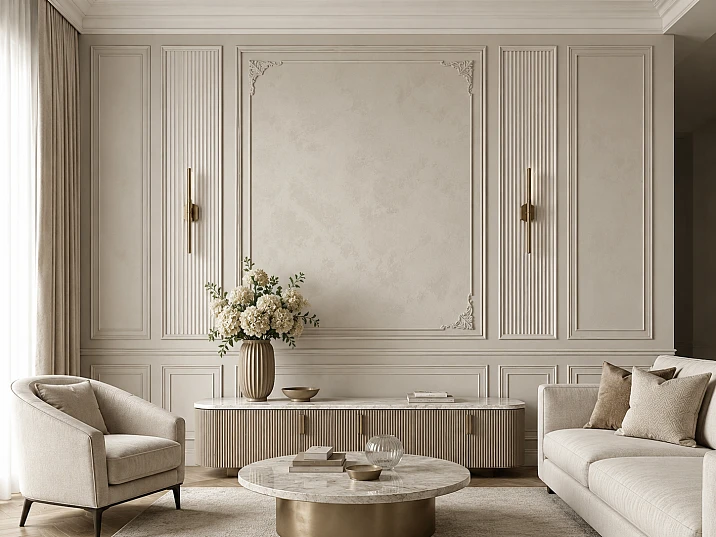
Wall panels give the wall texture, moldings assemble it into clear geometry, and stucco adds an accent: together they make the interior more expensive if chosen as a set, not as random details. This is what this article is about. About the logic of selection, the role of each element, and where the line is between 'expensive and stylish' and 'overloaded and fussy'.
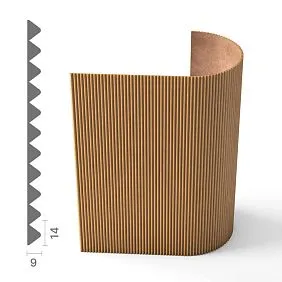
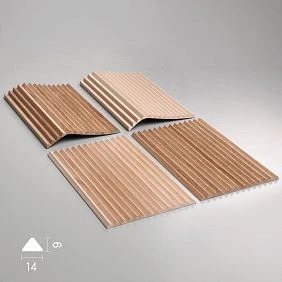
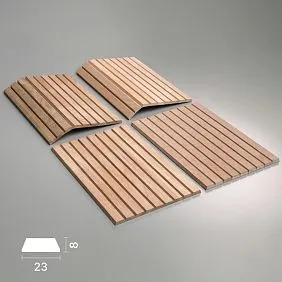
Three elements — three different roles: why they cannot be confused
Before talking about combinations, we need to agree on terms. Because it is precisely the confusion in the roles of panels, moldings, and stucco that leads to chaos on the wall.
Wall panels are texture and field. The panel is responsible for the material feel of the wall. It can be smooth, ribbed, with a fabric-like relief, with a geometric pattern, or imitating stone or wood. The main thing is that the panel occupies area. It does not "decorate" the wall pointwise—it fills it. And that is both its strength and its trap.
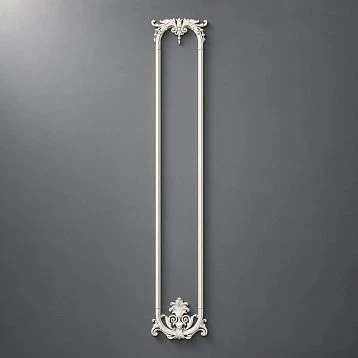
Moldings are lines and geometry. Moldings made of polyurethane they themselves do not take up much area—they are thin. But it is they that assemble the wall into a clear architectural scheme: divide it into zones, frame panels, set the rhythm. If the wall is a book page, then moldings are the lines, margins, and paragraphs.
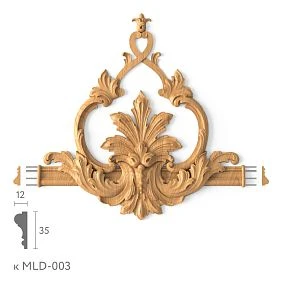
Decorative stucco is an accent and a point. Decorative stucco works pointwise: one element in the center, a couple of overlays on the sides, corner accents in the frame. It does not fill—it fixes the gaze in the right place. And that is precisely why it cannot be glued "everywhere there is space."
Three different roles. Three different scales of impact. And three different moments in the decision-making process. Understanding this means already solving half the problem.




Where to start: determine the role of the wall, then everything else
The classic mistake is to start with a purchase. Saw beautiful panels—bought. Then bought moldings. Then added stucco. And the wall turned out not as intended—it just "happened."
A professional approach begins with the question of the wall's role. Just three roles—and each dictates a completely different set of elements.
Our factory also produces:
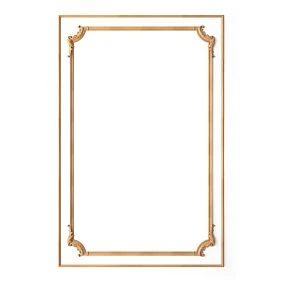


Background wall
Most walls in an apartment are background. They should not attract attention. They hold the space, give a sense of the room's "volume," but do not compete with furniture, light, and people.
For a background wall: thin moldings in the wall color — no stucco, no active panels. At most, a calm panel with a minimalist geometric pattern that is barely visible. Buy molding for a background wall — means choosing something unobtrusive: flat corner pieces, thin linear moldings, no depth greater than 20 mm.
Get Consultation
Accent wall
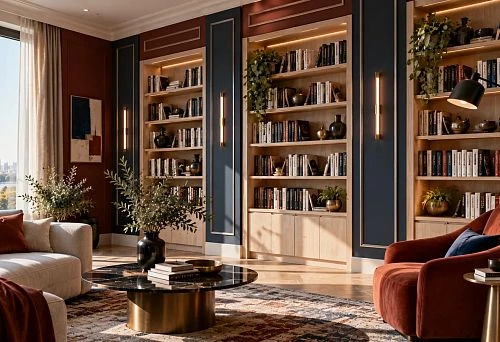
One wall in the room is the main one. It is behind the sofa in the living room, behind the bed in the bedroom, at the entrance in the hallway. This is the wall that is seen first. People look at it. It is for this wall that panels, moldings, and decorative molding.
For an accent wall, the full set works: a panel (or a frame of moldings on a painted wall) + a molding frame + one decorative corner piece at an accent point. This is a set. Not three separate purchases — one solution.
Architectural wall
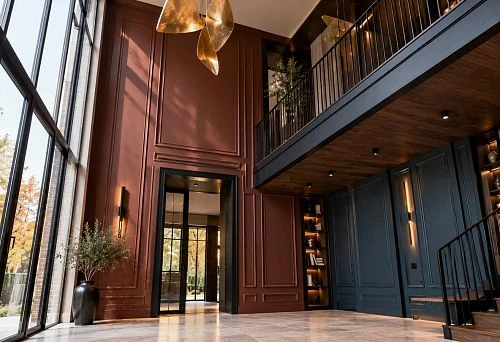
Study, hall, grand staircase — places where the wall should be not just "beautiful," but "significant." Here, a full architectural program is appropriate: wall panels on the lower part, molding frames on the upper part, corner pieces at intersection points, central medallions inside large frames.
Polyurethane wall decor — it is this category that fulfills the task of an architectural wall: the "Versailles," "Petersburg," "Tsarskoye Selo," and "Ekaterinhof" collections are not just individual elements, but ready-made systems for full wall decoration in a classical style.
Wall panels: how not to turn texture into a problem
Panels are a powerful tool. But the stronger the tool, the easier it is to make a mistake. Let's talk about when panels work and when they get in the way.
When panels are needed
Panels solve three problems that regular paint handles poorly.
Cover a large empty wall. A 4 × 2.8 m wall in a living room painted in one color is not "minimalism," it's "emptiness." A textured panel on such a wall immediately creates "presence" — the wall starts to work, becoming part of the interior.
Add materiality. Paint is just color. A panel is color plus texture plus shadow. With side or directional lighting, the textured surface of the panel creates a play of shadow that paint can never provide. This is what makes a wall "expensive": not the material itself, but the play of light on its surface.
Divide zones without partitions. In a studio apartment or a large open-plan room, one wall with panels immediately visually "cuts off" a zone from the rest of the space — without furniture, without partitions, without curtains.
When panels get in the way
A panel with an active texture + moldings with a textured profile + three-dimensional stucco — these are three competing textures on one plane. The eye doesn't know what to focus on. This is "overload."
The rule is simple: if the panel is active — moldings are calm, stucco is minimal. If the panel is neutral — moldings can be more expressive, and stucco more voluminous. One element "speaks," the other two "stay silent."
The "Japandi" collection from the STAVROS range is a good example of panels with a neutral relief: minimalist geometry, flat section, no baroque excess. Such panels combine with both thin moldings and delicate decorative inlays — without conflict.
Moldings: an architectural grid for any panels
Imagine a wall with panels glued on — without framing, without borders, without lines. Just panels. They go from baseboard to ceiling, from edge to edge. Beautiful? Possibly. But it's finishing, not design. Because there is no architectural solution — no grid, no structure, no hierarchy.
Moldings made of polyurethane add this structure. They work on several levels.
Frames around panels
A molding framing each panel along the perimeter is a "picture frame" for the texture. It completes the panel, gives it a border, and introduces it into the architectural system. Without a frame, a panel is just a piece of texture. With a molding frame, it becomes a decorative element with a finished look.
The width of the molding for the frame around the panel is 20–40 mm. This is enough to be readable, but not so much as to "overpower" the panel itself.
Horizontal and vertical belts
In addition to frames around individual panels, moldings can create belts on the entire wall: a horizontal strip of molding at a height of 90–100 cm (countertop or windowsill level) divides the wall into a "base" and a "main zone." Vertical moldings every 80–100 cm set a rhythm and visually raise the ceiling.
This is the very "architectural grid" mentioned above. Any panels fitted into such a grid look meaningful — even if they are very simple.
Transitions between materials
One of the main practical tasks of molding is to cover the transition between different surfaces. A panel meets a painted wall — molding is needed. A panel meets wallpaper — molding is needed. A panel meets a niche or a protrusion — molding is needed. This is not "decoration" — it is a function without which transitions look sloppy.
Decorative stucco near panels: a point — not a field
This is where the finest line lies. Buy decorative stucco — means buying one or several accent elements. Not twenty. Not "the whole wall." One — two — three. Maximum.
Where stucco enhances the panel
A central overlay inside the frame. If a molding frame encloses a large panel or a painted field, one decorative overlay in the center — a medallion, cartouche, floral ornament — turns the frame into a complete composition. This is the final chord that says: "here — the end of the solution."
Corner overlays at the intersection points of moldings. Where a horizontal molding meets a vertical one at a right angle, a corner decorative overlay can be installed. This is a detail that is not noticed immediately — but without which the molding system looks "unfinished."
An overlay above a console or mirror. A console in the hallway or above a fireplace is a zone with high visual density. Decorative stucco above a mirror or above the console area is the "crowning" of the composition, an analogue of a pediment above a door.
Where stucco hinders the panel
If the panel already has a three-dimensional relief, there is no point in placing stucco inside the panel. The panel's relief itself serves as decor. In this case, stucco is only needed on the outside — in a frame of moldings, but not on top of the textured surface itself.
Buy Moldings For a smooth, neutral surface — it makes sense. buy decorative moldings For a wall with a "Versailles" relief panel — it means risking overload. The texture is already there — adding another relief on top of it must be done very carefully.
STAVROS collections: ready-made systems for an accent wall
An important practical point: Polyurethane Items in the STAVROS assortment are organized into collections. This is not a random set of elements — these are well-thought-out systems where panels, moldings, and overlays are coordinated in style, scale, and decorative "weight."
The "Neoclassic" collection — strict geometry, concise profiles, restrained relief. Ideal for modern classics: moldings with a rectangular profile + panels with a geometric pattern + minimalist corner overlays.
The "Neoclassic Light" collection — a lighter version of neoclassicism. Even less relief, even more "air." Suitable for small spaces where a full neoclassical program would be excessive.
The "Versailles" collection — a full classical program. Lush ornamentation, voluminous overlays, wide moldings with a fillet. For studies, formal halls, and foyers with high ceilings.
The "Versailles Light" collection — the same style, lightened for standard ceiling heights of 2.7–2.9 m. The scale is reduced, the ornament is simplified, but the stylistic language is preserved.
The "Japandi" collection — Japanese minimalism with architectural lines. Straight edges, flat planes, no curvature. For modern interiors, Scandinavian style, minimalist apartments.
The "Botanical Garden" and "Summer Garden" collections — floral motifs. Leaves, branches, flower garlands. Suitable for romantic interiors, for bedrooms with a soft color palette.
Accent wall in different rooms: five working schemes
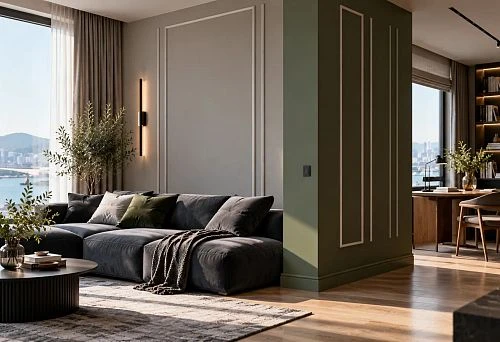
Living room: wall behind the sofa
This is the central design object of the apartment. It is seen from the doorstep. It is photographed. And it is most often the victim of "overload."
Working scheme:
-
Neutral or geometric panel with a width equal to the width of the sofa ± 30 cm.
-
Molding frame around the panel — 15–20 cm indentation on each side.
-
One central decorative element above the top line of the panel — for example, medallion NPU.VRS-013 from the "Versailles" collection.
-
Color: panel and moldings in the tone of the wall. Decorative element — the same color or with a light patina.
This scheme works because it is balanced: there is texture, there is geometry, there is an accent — and nothing screams.
Bedroom: wall behind the headboard
The wall behind the bed is the most intimate zone in the apartment. It doesn't need architectural monumentality. It needs depth and tranquility.
Working scheme:
-
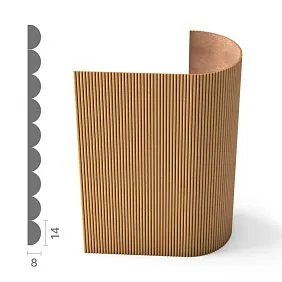
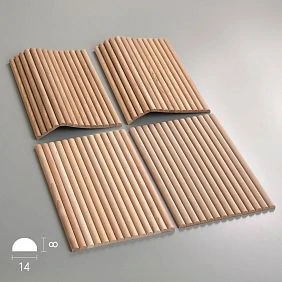
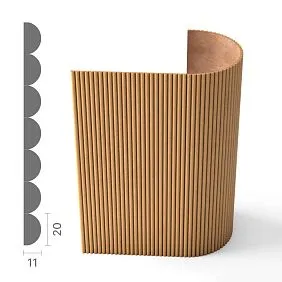
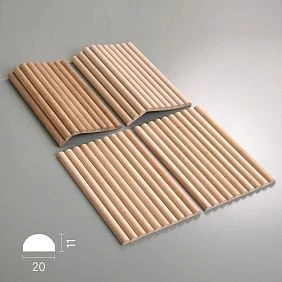
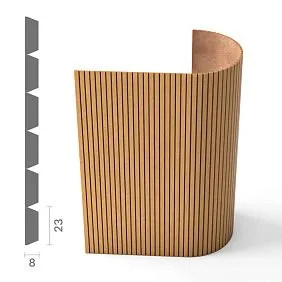
Vertical slat moldings (japandi-style slatted panels): three to five vertical strips in the center of the wall, 5–8 cm wide, extending from the baseboard to the ceiling.
-
No stucco — or miniature NPU-116 overlays (from 650 RUB) at the top points of the slats.
-
Color: slats — dark (anthracite, deep blue, bottle green). Wall — light background.
Entryway: first impression on two square meters
In the entryway, there's no room for a large program. But this is where the first impression forms in seconds.
Working scheme:
-
One panel on the main wall (the one visible immediately upon entry) — 60–80 cm wide, with a light geometric relief.
-
Molding frame around the panel.
-
Decorative overlay above the mirror — symmetrical to the mirror's axis.
-
Everything in one color — monochrome painting removes the "clutter" of a small space.
Study: wall behind the work chair
A study is a space with character. A full classical program is appropriate here, where Polyurethane wall decor works at full strength.
Working scheme:
-
Lower zone (from baseboard to 90–100 cm): wooden slats or panels with horizontal fluting.
-
Horizontal molding belt at a height of 100 cm.
-
Upper zone: molding frames — one or two vertical sections.
-
Corner overlays at molding intersection points.
-
Central overlay in the upper frame — above the area where a painting or diploma usually hangs.
Hall and staircase area: architectural wall
Here, the most monumental scheme works: the entire wall is one large architectural program. Pilasters, horizontal cornices, decorative medallions, molding frames across the entire plane.
It is for this type of walls that the "Petersburg" and "Peterhof" collections from STAVROS are the optimal choice: the elements are designed for spacious rooms with ceilings from 3 meters.
Color: the main tool for managing complexity
When there are three levels of decor on the wall — panels, moldings, stucco — color becomes what either unites them into a system or destroys it.
Monochrome — everything in one color. All three elements — in one tone. The relief is read through shadow. This is the safest and at the same time the most modern approach. No dissonance — only architecture.
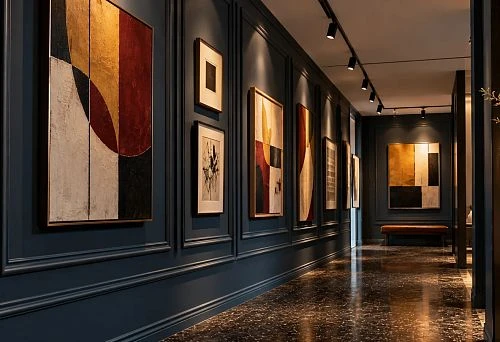
Double contrast — the wall is dark, the decor is light. Dark blue wall + cream moldings + overlays in the tone of the moldings. This is a classic and very effective solution: the relief "glows" against a dark background.
Accent with color inside the frame. The wall is one color — the inner field of the molding frame is another (more saturated or contrasting). The panel is on a neutral background. This is a visual "dip" into the frame, which creates depth.
Installation: technological sequence for a clean result
The correct installation order is half the success. No experiments with "I'll glue the panels first, then figure out the moldings."
Step 1: marking. Laser level. All lines — strictly horizontal and vertical. Marking on the wall with a pencil — very lightly, so that it can be erased later.
Step 2: panels. They are installed first — with assembly glue or liquid nails. The wall is pre-primed. The panels are leveled.
Step 3: moldings. After the panel glue dries — moldings. Acrylic glue, temporary fixation with painter's tape. Corners — at 45° with a miter saw. Joints — acrylic putty.
Step 4: decorative overlays. Installed last. Centered strictly along the axes of symmetry.
Step 5: putty and sanding. All joints and gaps — acrylic putty, sanding with 240 grit.
Step 6: final painting. Primer + two coats of matte acrylic paint. Everything together — wall, panels, moldings, overlays — in a unified system.
What to buy: guide by tasks
| Task | What to purchase |
|---|---|
| Create an accent wall | Panel + Moldings made of polyurethane |
| Add expensive relief | Decorative stucco — selectively |
| Decorate the wall behind the sofa | Panel + molding frame + Relief Decoration |
| Make the bedroom deeper | Vertical slats + delicate overlays |
| Don't overload a small room | Neutral panel + thin moldings in matching color |
| Assemble a complete set | Panels + moldings + Buy molding + glue + paint + spare |
Frequently asked questions
Can you combine stucco molding and wall panels?
Yes, and this is one of the most striking design solutions. It's important to assign roles: panels create texture and a field, Moldings made of polyurethane set the geometry, and Buy decorative stucco is needed for a point accent — not for filling the space.
What's better: panels or moldings?
This is not an 'either/or' choice. Panels provide texture over a large area. Moldings provide structure and geometry. For a full accent wall, both elements are needed — plus a decorative accent from stucco molding.
Where is it best to use stucco molding next to panels?
In the center of the molding frame above the panel, at the corner points of the frame, above a mirror or console. The stucco should be on a "neutral" field — not over the active relief of the panel itself.
What to buy for a wall with panels and stucco molding?
Decorative panels, Buy polyurethane moldings, Decorative stucco for accents, mounting adhesive, acrylic putty, primer, and finish paint. Molding allowance — 15% for cutting corners.
Is stucco molding necessary if there are already moldings and panels?
Not necessarily. In small spaces, the combination of "panels + moldings" without stucco is a complete and restrained solution. Stucco is added only when an additional accent is needed or when the scale of the room allows a third level of decor without overload.
How to avoid overload when combining all three elements?
The rule of one active element: if the panel has a voluminous relief — moldings are calm, stucco is minimal. If the stucco is voluminous — the panel is neutral. Monochrome painting of all three elements reduces visual "noise" by 30–40% and allows for safer use of richer combinations.
STAVROS: a system that thinks for you
When you buy three different elements from three different manufacturers, no one guarantees they will form a cohesive whole. Profiles may conflict in "weight," textures in scale, and styles in era.
STAVROS builds its assortment differently: panels, moldings, and Decorative stucco are designed within unified collections — "Neoclassic," "Versailles," "Japandi," "Summer Garden," and others. Within a single collection, all elements are already coordinated in style, scale, and proportions. You choose a collection — and get a system, not a set of parts.
Buy molding, Moldings made of polyurethane и Polyurethane wall decor — everything in one order, with Contact us to confirm shipping to your destination. and pickup from showrooms in Moscow and St. Petersburg.
Because a beautiful wall is not a coincidence. It's a decision made once and correctly.