










































































Article Contents:
- The main wall of the bedroom: why it cannot be left empty
- Bedroom and architectural hierarchy: where stucco belongs
- Three zones in the bedroom where stucco is appropriate
- Moldings behind the bed: how to create a frame without overloading
- Large single frame behind the bed
- Two vertical frames on either side of the headboard
- Horizontal molding belt and its role
- Molding frame in wall color: the "invisible" headboard
- Wall connection: moldings from baseboard to cornice
- Molding frame sizes for different beds: table
- Decorative stucco at the headboard: one accent or a system
- Above the headboard: central decorative accent
- Inside the molding frame
- On the sides of the bed: paired elements
- At the top of the wall: frieze zone
- Stucco decor for the wall: categories and application
- Medallions and rosettes as wall elements
- Cartouches and shields
- Ornamental borders and horizontal strips
- Sockets and sconces: how to connect lighting with architectural decor
- Socket as a frame for a sconce
- Molding frame around a sconce
- Symmetry as the main principle
- Three styles of wall decoration behind the bed: specific sets
- Option "Modern neoclassicism"
- Option "Classic bedroom"
- Option "Minimal stucco"
- Color and painting: how a unified scheme brings everything together
- Monochrome painting: everything in the color of the wall
- White moldings on a colored wall
- Two-tone wall: lower and upper zones
- How not to overload the bedroom with molding: rules of discipline
- Complete purchase checklist: what to buy for the wall behind the bed
- Installation: how to properly install moldings behind the bed
- Wall preparation
- Marking
- Cutting molding
- Installation
- Painting
- Frequently Asked Questions
- STAVROS: architecture for the main bedroom wall


Main bedroom wall: why it cannot be left empty
Enter any bedroom and observe where your gaze goes first. Always — to the bed and the wall behind it. This is not a coincidence or an aesthetic whim: the wall at the headboard occupies a central place in the room's perspective, it is the first thing visible from the door, and the last thing seen before sleep.
That is why an empty white wall behind the bed is not a neutral solution. It is incompleteness, which is read on a subconscious level. The bed stands, the interior lives, but the wall behind it is silent. And this silence makes the space unfinished, no matter how much money is invested in the rest of the decor.
What helps? Stucco for the Bedroom — moldings, decorative overlays, rosettes — which turn a bare wall into an architectural headboard. Without soft panels, without wooden structures, without custom-made items. Only Moldings made of polyurethane, glue and paint.
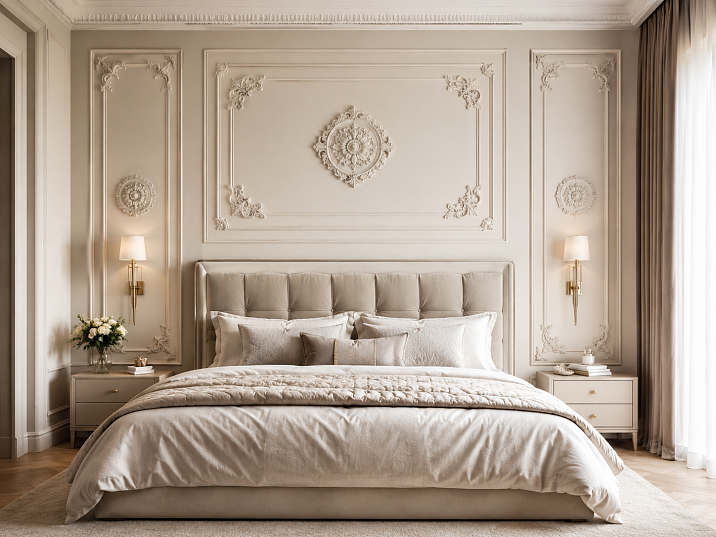
The wall behind the bed becomes an expensive headboard when moldings form a frame, Decorative stucco creates an accent, rosettes support sconces, and a single paint job turns individual details into a calm architectural composition of the bedroom.
This article explains in detail, with dimensions and logic, how it works.




Bedroom and architectural hierarchy: where stucco belongs
The bedroom is a special space in the home decor system. Unlike the living room or hall, it is not meant for display. Here a person rests, and the perception of the interior happens literally while lying down: the gaze glides across the ceiling, along the walls, over the headboard area.
This means the bedroom requires a different proportion of decor: calmer, softer, with fewer 'points of activity.' Stucco here is not ceremonial architecture, but quiet luxury.
Our factory also produces:


Three zones of the bedroom where stucco is appropriate
The wall behind the bed is the main zone. This is where the primary decor is concentrated. Molding frames, a decorative accent, frames around sconces. This wall is the 'face' of the bedroom.
The ceiling above the bed is the second zone. A small ceiling rosette or molding frame on the ceiling directly above the bed creates a "sky" for the headboard. This is a technique used in classic hotels and expensive residences.
The cornice line is the third zone. A ceiling cornice around the perimeter of the room completes the upper line of the bedroom. It does not compete with the accent wall but creates an architectural frame for the entire space.
Get Consultation
Moldings behind the bed: how to create a frame without overload
Moldings behind the bed — this is the basis of the entire composition. They create a visual frame that highlights the bed area and gives the wall architectural character. Without moldings, even the most beautiful decorative element will look like a random sticker on the wall.
Large single frame behind the bed
The most common and most effective solution is one large molding frame that covers the entire area behind the bed.
Frame parameters:
-
Width: equal to the width of the bed + 30–50 cm on each side. For a 160 cm bed → frame 220–260 cm wide. For a 180 cm bed → frame 240–280 cm wide.
-
Height: from the baseboard to the cornice or molding at a height of 220–240 cm. Or from a horizontal molding belt at a height of 90–100 cm to the cornice.
-
Molding: width 25–40 mm, projection 12–20 mm. For a bedroom — a delicate profile, without massive ornament.
Inside the large frame — a clean wall or one decorative accent. The frame itself is already a complete element: it does not require filling.
Two vertical frames on either side of the headboard
Alternative option: two frames on either side of the central area. Each frame sits above a bedside table, on either side of the bed.
Side frame parameters:
-
Width of each frame: equal to the width of the bedside table + 10–15 cm on each side. Usually 45–70 cm.
-
Height: from the baseboard or horizontal belt to the cornice or to a height of 200–220 cm.
-
Between the frames is the central wall area behind the bed, without molding. Or with a separate decorative accent in the center.
This option creates a rhythmic structure: two "columns" on the sides and a center as an "arena" for the bed.
Horizontal molding belt and its role
The horizontal molding belt at a height of 90–110 cm is the "break line" of the wall. Below is the lower zone (usually hidden by the bed), above is the upper decorative zone.
The belt creates a logical lower boundary for the frames and molding system. Without it, the frame "hangs" in space, without support from below. With the belt, the wall acquires a horizontal structure.
Belt width: 20–35 mm. Profile: classic with multiple levels or rectangular.
Molding frame in wall color: "invisible" headboard
One of the most exquisite modern techniques: moldings painted in the exact wall color. The frame is "invisible" at a glance, but creates volume through the shadow of the relief under directed lighting.
This solution is especially effective:
-
With walls in saturated colors (dark blue, bottle green, anthracite).
-
With side lighting from sconces, the shadow from the molding becomes visible.
-
In minimalist interiors, where a bright white molding would be too "loud".
Buy polyurethane moldings for such a solution means choosing a profile with sufficient projection (15–20 mm) so that the shadow is readable even in dim lighting.
Connection with the wall: moldings from baseboard to cornice
For a classic interior — a full vertical system: baseboard at the bottom, molding frame in the headboard area, horizontal belt at 90–100 cm level, cornice at the top. All horizontal elements run the full width of the wall, not just in the bed area.
This is a "continuous line" — an architectural system where the wall behind the bed is part of the overall wall logic.
Molding frame sizes for different beds: table
| Bed size | Frame width | Frame height | Molding (width) |
|---|---|---|---|
| Single 90 cm | 130–160 cm | 150–200 cm | 20–30 mm |
| Standard 140 cm | 180–220 cm | 160–220 cm | 25–35 mm |
| Twin 160 cm | 200–250 cm | 170–230 cm | 25–40 mm |
| Double bed 180 cm | 220–270 cm | 180–240 cm | 30–40 mm |
| Wide 200 cm | 250–290 cm | 190–250 cm | 30–45 mm |
Frame height depends on ceiling height: with a 250 cm ceiling — frame up to 210–220 cm; with a 270–280 cm ceiling — up to 230–250 cm; with a ceiling over 300 cm — the frame can take up the entire wall height.
Decorative molding at the headboard: one accent or a system
Decorative stucco for the bedroom — this is a point element that gives a "voice" to the wall behind the bed. One overlay in the right spot works stronger than ten scattered across the entire surface.
Above the headboard: central decorative accent
The most expressive position is along the central axis of the bed, slightly above the level of pillows or headboard. This is where the gaze naturally falls when looking at the bed.
What to place:
-
Medallion or cartouche: 150–250 mm horizontally. Floral or geometric ornament. For classic style — leaf relief, for modern neoclassicism — geometric.
-
Horizontal ornamental band: 400–600 mm wide, 80–120 mm high. Horizontal ornament as the "header" of the headboard.
-
Vertical symmetrical group: two elements along the vertical axis with a small distance between them.
The size of the decorative element should "rhyme" with the width of the bed. For a 180 cm bed, a medallion of 200–250 mm looks organic. A 100 mm medallion next to a wide bed will appear insignificant.
In the center of the molding frame
If a molding frame is created behind the bed, the decorative element is placed in its upper third, along the central axis. This is the "keystone" of the frame: an element that creates a semantic focal point within the architectural framing.
Important: the decorative element must be smaller than the frame itself. Its width should be no more than 30–40% of the width of the inner field of the frame.
On the sides of the bed: paired elements
Symmetrical decorative overlays on the sides of the bed — at the level of the top edge of the headboard — create a 'retinue' for the main bedroom item. They do not compete with the central accent but support it.
buy decorative moldings For paired side elements — means choosing identical overlays 80–120 mm, which are placed strictly symmetrically: at the same height, at the same distance from the bed.
In the upper part of the wall: frieze zone
With high ceilings (from 280 cm), the frieze zone — the strip of wall between the upper molding belt and the ceiling cornice — can carry horizontal ornamental decor. Small overlays in rhythm across the entire width of the wall create a 'header' above the headboard.
Distance between overlays in the frieze zone: 40–60 cm. Size of each: 60–100 mm. This is a restrained, delicate rhythm that enriches the area without overloading it.
Stucco decor for the wall: categories and application
Buy Moldings For the headboard zone — means understanding the types of decorative elements and figuring out which one works in your specific situation.
Medallions and rosettes as wall elements
Round or oval medallions are a versatile decorative element. In architecture, they were used on walls as early as the Renaissance: they create a 'window' in the ornament, a point that attracts the eye.
On the wall behind the bed, a medallion measuring 150–300 mm is a strong central solution. It works as a standalone element without additional framing: its round shape is complete in itself.
ceiling rosettes It can be used not only on the ceiling. A small rosette 200–300 mm, placed on the wall behind the bed — especially in combination with a sconce — creates an "exhibition zone" for the light fixture.
Cartouches and shields
A cartouche — an ornamental element in the form of an unfolded scroll or heraldic shield — is a "ceremonial" decor. In the bedroom, it is appropriate as a single piece, above the center of the headboard. Its ornament is concentrated, rich, and requires space around it — not "squeezed" in tightness, but freely standing on the wall.
Size for the bedroom: 180–280 mm vertically, 120–200 mm horizontally. Style: floral relief, curls, leaf ornament.
Ornamental borders and horizontal strips
Polyurethane wall decor In the form of horizontal ornamental strips — borders — creates a linear accent. For the headboard area, a horizontal border is suitable:
-
Along the top edge of the molding frame from the inside — as a "cornice" inside the frame.
-
At the level of the horizontal molding belt — as an ornamental reinforcement of the structural line.
Border width: 30–80 mm. The rhythm of the ornament should match the style of the moldings.
Rosettes and sconces: how to connect lighting with architectural decor
Sconces in the bedroom are almost always double, on either side of the bed. And it is at these points that the question arises: how to make the mounting area of the lamp beautiful?
Socket as a frame for a sconce
Small Ceiling rosette as wall decor around a sconce — a classic technique. The socket is mounted on the wall at the wiring exit point, and the lamp is attached in its center. The socket hides the technical unit and creates a decorative "frame" for the lamp.
Diameter of the wall socket for a sconce: 150–250 mm. It is important that the socket is noticeably larger than the base of the lamp itself — otherwise it does not visually "hold" it.
Molding frame around a sconce
A more architectural option: a small molding frame 25–30 × 40–50 cm around the sconce mounting point. The lamp is in the center of the frame. This creates a "wall niche" for each sconce.
The frames of the two sconces must be strictly symmetrical in height. Height of the frame center above the floor: 130–150 cm with standard sconce placement.
Symmetry as the main principle
Two sconces — two sockets or two frames. Strictly symmetrical. The slightest discrepancy in height or horizontal alignment is immediately visible because the eye always compares paired elements.
Before mounting sockets and frames — mark both points simultaneously. Measure the distance from the center of the bed to each point (must be equal), the height from the floor to the center of each point (must be the same).
Three styles of wall decoration behind the bed: specific sets
Modern Neoclassical Option
A calm, elegant option for a modern classic interior.
Set:
-
One molding frame behind the bed — a rectangular profile 30 mm without ornament.
-
Horizontal molding belt 25 mm at a height of 100 cm.
-
One medallion 180–220 mm in the upper third of the frame, centered.
-
Two sconces with rosettes 180–200 mm on the sides.
-
Painting: frames and decor in wall color — monochrome.
Effect: the wall looks architecturally rich but not flashy. This is a modern interior with a classic accent.
Classic Bedroom Option
For interiors in classic or neoclassical style with molding throughout the house.
Set:
-
Large molding frame behind the bed — classic S-shaped profile 35–40 mm.
-
Horizontal molding belt 30 mm + vertical moldings on the sides of the frame.
-
Cartouche or floral medallion 220–280 mm above the center of the headboard.
-
Paired decorative overlays on the sides of the frame — 100–120 mm each.
-
Double sconces with rosettes 200–250 mm.
-
Ceiling cornice made of polyurethane 70–90 mm around the perimeter of the bedroom.
-
Painting: moldings and decor white, wall in warm cream or deep color.
Effect: the bedroom acquires a solemn but not heavy classic character.
Option "Minimal stucco"
For those who want an architectural accent without visible "decoration."
Set:
-
Two side molding frames above the cabinets — a narrow rectangular profile 20 mm.
-
One small geometric medallion 150 mm along the central axis of the bed.
-
Sconces without backplates — mounted directly into the molding frame.
-
Painting: everything in the wall color, monochrome.
-
Wall molding — delicate, without floral ornament.
Effect: at first glance — just a beautiful wall. Upon closer inspection — a thoughtful architectural system.
Color and painting: how a unified scheme ties everything together
Painting is the final and decisive step. It is what transforms a set of individual elements into a unified architectural system.
Monochrome painting: everything in the wall color
Moldings, decorative overlays, rosettes — in the exact color of the wall. The relief is read only through light and shadow, not color contrast. This is a refined, mature technique.
For monochrome painting, the application technique is important: two to three thin layers without drips, even coverage. Paint should not accumulate in corners and the relief of the molding.
White moldings on a colored wall
Classic solution: a wall in a rich color, moldings and decor white. The boundary between the wall and molding is clear. White moldings on a dark blue wall are an example of strong architectural contrast.
For this option, the cleanliness of the molding line is important: cutting corners at 45°, filling joints with putty, an ideal line between the molding and the wall.
Two-tone wall: lower and upper zones
If a horizontal molding belt divides the wall into two zones — lower and upper — they can be painted in two different tones of the same color. The lower zone is darker, the upper zone is lighter. The molding belt is the transition boundary.
This is a technique from classic finishing: the panels of the lower wall zone were historically made of dark wood, the upper zone of light plaster. In the modern version — two tones of the same paint.
How not to overload a bedroom with stucco: rules of discipline
A bedroom is not a formal hall. Here, stucco works differently than in a living room or hallway.
Rule one: one accent wall. The wall behind the bed is decorated. The other three walls are calm. Maximum: a cornice line around the perimeter. No molding frames on all four walls.
Rule two: one decorative element per wall. Medallion, cartouche, or horizontal border — one of the three. Not all together.
Rule three: delicate profile. Molding width of 25–40 mm for a bedroom is sufficient. A wide cornice molding of 80–100 mm is appropriate on the ceiling, but not as a frame behind the bed.
Rule four: painting unifies. Moldings in the wall color or white — but all in one tone. Multicolored stucco in the bedroom is a mistake.
Rule five: sconces and outlets — symmetry is mandatory. Any violation of symmetry in the headboard area is immediately noticeable and disrupts the sense of calm.
Complete purchase checklist: what to buy for the wall behind the bed
| Task | What to buy |
|---|---|
| Create a frame behind the bed | Moldings made of polyurethane 25–40 mm |
| Add a decorative accent | Buy decorative stucco — 1 medallion or cartouche |
| Design the sconce area | ceiling rosettes 180–250 mm — 2 pcs. symmetrically |
| Complete the top line | Ceiling cornice from moldings 50–80 mm |
| Polyurethane wall decor | Wall molding — for the frieze zone or horizontal border |
| Paired side accents | Buy Moldings — 2 symmetrical overlays |
| full set | Buy molding — moldings + decor + rosettes + mounting adhesive + sealant + primer + paint + 20% spare |
Installation: how to properly install moldings behind the bed
Wall preparation
The wall behind the bed must be clean, level, and primed. If the surface is painted with glossy paint, sand it with fine-grit sandpaper 180–240 grit to create an adhesion layer.
Marking
Marking starts from the central axis of the bed. From it — equal distances left and right to the vertical sides of the frame. The horizontals of the frame — by level.
Important: marking with a pencil. After installing the molding, pencil marks are hidden by paint. Marker markings may "show through" the paint.
Cutting the molding
The corners of the frame are cut at 45°. For precise cutting — a miter box with a clamp or a miter saw. Each corner is checked "dry" before applying glue.
Trimming allowance: 15–20% of the calculated length.
Installation
Installation adhesive for polyurethane moldings is applied in a zigzag pattern to the back of the molding. The molding is pressed against the wall for 30–60 seconds, then secured with painter's tape until the adhesive fully cures (1–2 hours).
Joints in corners — acrylic sealant. The sealant is applied to the joint and smoothed with a wet finger. After drying — sanding with fine 320-grit sandpaper.
Painting
Two thin coats of acrylic paint. The first coat is a base coat, the second is a finish coat. Allow 2–4 hours of drying time between coats. For delicate work in relief recesses, use a soft brush.
Frequently asked questions
How to decorate the wall behind the bed?
With molding behind the bed: with a molding frame made of of polyurethane moldings, one central decorative element made of decorative molding and symmetrical rosettes for sconces. Painting in a single color completes the composition.
What to buy for the wall at the headboard?
Moldings made of polyurethane for the frame, Buy Moldings for the central accent, ceiling rosettes for the sconce, mounting adhesive, acrylic sealant, primer, paint, and a 20% material reserve.
Can the headboard be made without soft panels?
Yes. Stucco molding at the headboard — a molding frame and decorative accent — creates the visual effect of an expensive headboard without panels, wooden structures, or custom furniture. The result often looks more architectural and durable.
How not to overload a bedroom with stucco molding?
One accent wall, one decorative element, a delicate molding profile of 25–40 mm, uniform painting. The other walls are calm, only the cornice line.
Is a cornice needed in a bedroom?
Preferably. A ceiling cornice of 50–80 mm around the perimeter creates an architectural 'roof' for the entire space and connects the accent wall to the ceiling. Without the cornice, the molding frame behind the bed looks 'detached' from the upper area.
How to choose the size of the rosette for the sconce?
The diameter of the rosette should be 2–3 times larger than the diameter of the light fixture's base. For a standard sconce with a base of 60–80 mm — a rosette of 150–200 mm. For a large sconce with a base of 100–120 mm — a rosette of 220–280 mm.
STAVROS: architecture for the main bedroom wall
The wall behind the bed is not a background. It is an architectural statement about how your bedroom is arranged. And this statement must be precise, delicate, and complete.
STAVROS offers a full range for decorating the headboard area: Moldings made of polyurethane — classic and modern profiles for molding frames, buy decorative moldings — medallions, cartouches, floral and geometric overlays, ceiling rosettes for designing sconces and lighting points, molding on the wall for ornamental borders and the frieze zone.
All Polyurethane Items — precise profile, perfect geometry, easy glue installation, painting with any acrylic paint.
STAVROS. Delivery across Russia. Pickup in Moscow and St. Petersburg.
Bedroom with a properly designed wall