Article Contents:
- Cabriole legs change not only the lower part of the furniture
- Why a rectangular body on cabriole legs looks lighter
- Why the size of the cabriole leg is especially noticeable
- Dresser on 200 mm legs
- Why 200 mm does not always mean "low"
- When 200 mm look convincing
- When 200 mm can get lost
- What the extra 40 mm change
- Why 240 mm often seem more expressive
- Who should compare 240 mm with other options
- Why the medium size can also turn out to be wrong
- What happens to the proportions
- Transverse dimension of 85 mm
- Example of a short dresser
- Example of a tall sideboard
- What counts as structural additions
- When the nominal height is not fully visible
- Why calculation must be done before ordering
- Dresser with a body of 680 mm
- Nightstand with a body of 340 mm
- Sideboard with a body of 1100 mm
- Distance to side wall
- Distance to facade
- Distance to back wall
- Distance between supports
- Symmetry
- MN-144 200 mm for dresser
- MN-144 240 mm for dresser
- MN-144 270 mm for dresser
- Bottom drawer
- Central support
- What to measure
- MN-144 200 mm
- MN-144 240 mm
- MN-144 270 mm
- What to Check
- Why 270 mm may suit a sideboard better
- Why a tall leg requires caution
- Bottom plane
- Doors
- MN-144 200 mm
- MN-144 240 mm
- MN-144 270 mm
- Wall-mounted position
- Cabriole under a soft body
- Beech for enamel
- Oak for tinting
- Do not mix materials in one set
- Why all four legs must match in quality
- Opaque enamel
- Staining
- Transparent finish
- Paint before or after installation
- Handles
- Moldings on facades
- Set FUR-012
- Comparison of fastening
- Felt FUR-027
- Round FUR-021
- Support foot and final height
- Cabriole and simply curved leg
- Carved and turned leg
- MN-144 and straight column
- 200 × 70 and 270 × 85 mm
- Unpainted leg and finished coating
- One leg and set
- Situation 1. Need to replace the straight plinth of a dresser
- Situation 2. The dresser should look like a console
- Situation 3. Legs should be noticeable, but facades are more important
- Situation 4. The sideboard has a large cornice and carved facades
- Situation 5. The cabinet stands next to a tall bed
- Situation 6. The TV cabinet should allow a cleaning device to pass through
- Situation 7. Oak cabriole legs under clear varnish are needed
- Situation 8. Legs will be painted together with the body
- Situation 9. The dresser is long and heavy
- Situation 10. Old holes do not align
- Situation 11. The baseboard interferes with the rear cabriole legs
- Situation 12. Furniture stands on the carpet
- Mistake 1. Ordering MN-144 without specifying the size
- Mistake 2. Looking only at the 70 mm difference
- Mistake 3. Adding the nominal height without considering installation
- Mistake 4. Not checking the top surface of the dresser
- Mistake 5. Not checking the bottom drawer
- Error 6. Considering four legs a universal quantity
- Error 7. Installing a large 270 × 85 mm under a narrow cabinet
- Error 8. Choosing 200 mm for a tall massive sideboard without trying it on
- Error 9. Not accounting for the baseboard
- Error 10. Turning the legs in different directions
- Error 11. Ordering different wood species
- Error 12. Mixing Standard and Prestige
- Error 13. Painting without a test swatch
- Error 14. Covering threaded areas with paint
- Error 15. Choosing FUR-001 for a weak base
- Error 16. Install FUR-012 without space for the plate
- Error 17. Use screws that are too long
- Error 18. Not adding glides
- Error 19. Using different glides
- Error 20. Trimming the cabriole after receipt
- Error 21. Not inspecting the bottom of the furniture
- Error 22. Choosing by photo without scale
- Error 23. Expecting a finished finish
- Error 24. Not checking doors and drawers
- Error 25. Ignoring lateral loads
- 1. Fix the case size
- 2. Calculate three final heights
- 3. Do a scale fitting
- 4. Check the transverse dimension
- 5. Determine the number of supports
- 6. Choose the material
- 7. Choose the sanding quality
- 8. Assign the finish
- 9. Select fasteners
- 10. Add glides
- 11. Check cards
- 12. Confirm shipment
- Is MN-144 a cabriole?
- What sizes are available?
- What does the first number mean?
- What does the second number mean?
- Which MN-144 is suitable for a regular dresser?
- Can I order 270 mm for a small nightstand?
- Why can't we just choose the average 240 mm?
- How will the height of the dresser change?
- Do we need to take the floor glide into account?
- Will MN-144 fit a bedside table?
- Can MN-144 be installed on a TV stand?
- Is MN-144 suitable for a sideboard?
- Can cabriole legs be placed on a wardrobe?
- Will MN-144 fit a console table?
- Can it be used for a bench?
- Will the leg fit a sofa?
- Which material should I choose for white enamel?
- When to choose oak?
- Can beech and oak be mixed?
- How does Standard differ from Prestige?
- Is painting included in the basic card?
- Which fasteners are suitable?
- What is the difference between FUR-001 and FUR-012?
- Can the leg be attached with regular self-tapping screws?
- What is FUR-027 used for?
- What is FUR-021 used for?
- How many glides to order?
- Is a fifth leg needed for the dresser?
- Can MN-144 be trimmed in height?
- How to check the size before purchasing?
- Can I order one leg for a trial?
- How to turn the cabriole legs under the body?
- What to check upon receipt?
- Why can legs of the same size look different?
- Will 200 mm work for a tall sideboard?
- When is it better to choose 270 mm?
- What should be ordered together with four MN-144s?
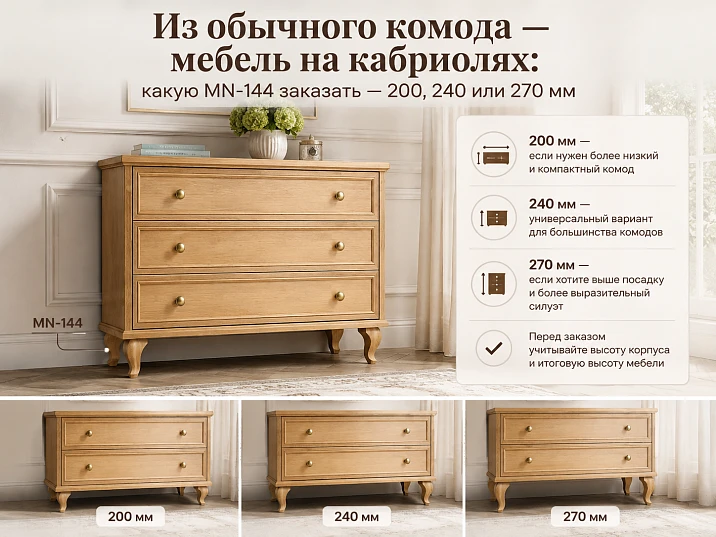
Carved legs for a dresser can change furniture more than a new handle, painting of facades, or a decorative overlay. The body remains the same, but its position relative to the floor, visual weight, and overall character become different. A heavy rectangular dresser can turn into a light piece on expressive cabriole legs, a low cabinet can acquire features of a small console, and a strict sideboard can become noticeably more elegant. But the effect depends not only on the carving pattern. The MN-144 leg has three sizes, and the difference between them changes the entire composition.
It is not enough for a buyer to decide: "I want to buy cabriole legs." For the MN-144 article, you need to choose one of three modifications: 200 × 70 mm, 240 × 75 mm, or 270 × 85 mm. Along with the height, the cross-sectional size increases. A tall support not only raises the body a few more centimeters—it takes up more space under the furniture, stands out more in the composition, and noticeably affects stability, installation, and proportions.
The difference between the extreme options is 70 mm. On a ruler, this seems like a small amount. On a finished dresser, 70 mm determines whether the body remains the main visual mass or the lower carved part begins to compete with the facades. Whether the top surface rises to a convenient level or becomes too high. Whether the cabinet retains compactness or approaches console furniture in silhouette.
MN-144 is made of beech and oak, offered with Standard and Prestige sanding quality, and is intended for suitable frame-less constructions: dressers, cabinets, wardrobes, sideboards, benches, ottomans, sofas, and other furniture where the project provides for the corresponding mounting unit. For fastening, the card specifies a M8 × 60 stud screw, and kits FUR-001 and FUR-012. For the lower part, support pads FUR-027 or FUR-021 are recommended.
If the shape and dimensions are already matched to the project, you can buy the carved cabriole leg MN-144But before adding four identical parts to the order, it is worth understanding what result 200, 240, and 270 mm will give specifically on your furniture.
Cabriole changes not only the lower part of the furniture
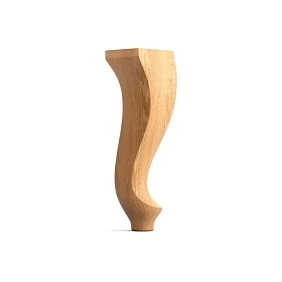
An ordinary straight support is perceived as a structural continuation of the body. Cabriole works differently. Its S-shaped curve creates movement: the upper part extends from under the body, the line changes direction, then the leg narrows and ends with a small supporting part. Even without additional carved decoration, such a silhouette attracts the eye.
On a low cabinet, cabriole can become the main decoration. On a tall sideboard, it connects the massive body to the floor and makes the lower part lighter. On a chest of drawers with several drawers, the curved support softens the rigid grid of horizontal and vertical lines. On a bench or ottoman, the leg supports a more plastic shape of the soft seat.
But cabriole is demanding about proportions. It cannot be considered as an invisible technical support. The higher and larger MN-144, the more noticeable it participates in the design.




Why a rectangular body on cabriole legs looks lighter
When furniture stands on a solid plinth, the body visually touches the floor with its entire lower plane. It seems massive, stable, and heavy. After installing legs, a gap appears. The floor continues under the furniture, and the eye stops perceiving the body as a monolithic block.
Cabriole enhances this effect through the curve. The support does not form a rigid vertical post, but rather seems to lead the load along a smooth line. The furniture gets a lighter base, although the body itself may remain the same.
The practical benefit of such a change is clear:
-
in a small room it becomes visually easier;
-
the dresser does not look pressed to the floor;
-
accessible space appears under the furniture;
-
the carved shape connects the body with the classic interior;
-
the legs become a full part of the furniture design;
-
you can update an existing item without making a new facade.
However, lightness can easily turn into disproportion. If a short body is raised on too high and large legs, the furniture begins to look as if the upper part was accidentally placed on a foreign base.
Our factory also produces:
Why the size of the cabriole is especially noticeable
With a straight leg, increasing the height primarily lengthens the vertical. With MN-144, both height and width change simultaneously:
-
200 × 70 mm;
-
240 × 75 mm;
-
270 × 85 mm.
The high modification is not just a stretched copy of the low one. It is larger in cross-section. Consequently, not only the clearance and final height change, but also the area required under the body, the distance to the side wall, the position of the mounting zone, and the visual mass of each support.
Get Consultation
As confirmed in the MN-144 card
| Parameter | Confirmed value | What this means before ordering |
|---|---|---|
| Article number | MN-144 | The specification should include not only the article number, but also the selected size |
| Product type | Carved cabriole furniture leg | The shape has a pronounced S-shaped curve |
| First size | 200 × 70 mm | The lowest and most compact modification |
| Second size | 240 × 75 mm | Medium option in height and cross-section |
| Third size | 270 × 85 mm | The tallest and largest modification |
| Material | Beech or oak | The wood species is chosen considering the future finish |
| Sanding quality | Standard or Prestige | The surface preparation level must be fixed for the entire set |
| Furniture type | Suitable frameless constructions | The mounting unit is calculated without a traditional connecting frame |
| Possible application | Dressers, sideboards, cabinets, nightstands, poufs, benches, sofas | Specific compatibility depends on the body, load, and fastening |
| Main fastening | Stud screw M8 × 60 | Used only with a suitable base construction |
| Compatible set | FUR-001 | Threaded mounting with stud and insert nut |
| Compatible set | FUR-012 | Mounting through plate and threaded connection |
| Lower part protection | FUR-027 or FUR-021 | The type of foot pad is chosen based on the floor surface and the project |
| Quantity | Determined by the furniture construction | Four legs are not suitable for every long or heavy cabinet |
| Finish | The base card refers to an unpainted leg | Painting, tinting, or clear finishing is planned separately |
These data describe the product but do not provide a ready answer as to which size will suit a specific dresser. To do this, you need to combine three calculations: the final height, the placement area under the cabinet, and the visual ratio of the legs to the fronts.
Three sizes of MN-144 give three different silhouettes
You cannot choose between 200, 240, and 270 mm based on the principle of "I'll take the middle one to avoid mistakes." The middle modification does not automatically become universal. On one dresser, 240 mm will give the right balance, on another, it will raise the cabinet above a comfortable mark, and on a third, it will be too small next to large decor.
| Size MN-144 | Visual Result | Suitable preliminary scenario | Main risk |
|---|---|---|---|
| 200 × 70 mm | The body remains the main element, the base creates an expressive foundation | Chest of drawers, nightstand, small sideboard, pouf, bench | The leg may seem too compact under a tall or richly decorated body |
| 240 × 75 mm | The support and the body are perceived more equally | Chest of drawers, nightstand, sideboard, console composition | The final height may exceed a comfortable mark |
| 270 × 85 mm | The leg becomes an independent decorative part | Tall nightstand, expressive sideboard, console, special project | A short body may look raised too high |
The table shows the direction of choice but does not replace fitting. Particular caution should be exercised with ready-made furniture, where the body height, lower drawers, and mounting zones cannot be changed.
MN-144 with a height of 200 mm: the cabriole is visible, the body remains the main element
Size 200 × 70 mm is the most compact version of MN-144. This is not a short hidden leg: the S-shaped curve and carved form will be noticeable. But compared to the other two options, the support competes less with the body for attention.
This size should be considered when you need to:
-
remove a solid plinth;
-
open up the space under the dresser;
-
give the cabinet a classic character;
-
maintain a moderate final height;
-
not turn the legs into the main decorative motif;
-
install cabrioles under a relatively small body;
-
update furniture without excessively changing its proportions.
Chest of drawers on 200 mm legs
Let's imagine a body 700 mm high. If the top panel is already included in this dimension, the basic calculation looks like this:
700 + 200 = 900 mm.
Only those elements that actually increase the height are added to the resulting value: a protruding foot, an external mounting platform, or a gap provided by the design.
A height of about 900 mm may be convenient for one chest of drawers and excessive for another. It is necessary to check how easy it is to use the top drawer and the top surface. If the furniture stands under a mirror, painting, or wall decor, raising the body will change the distance between objects.
Why 200 mm does not always mean "low"
The buyer sees the word "low option" and may decide that the height will hardly change. But 200 mm is 20 cm. Even without additional parts, the body rises by a significant amount.
If the previous plinth had a height of 50 mm, switching to MN-144 200 mm will raise the body position by approximately 150 mm. The top surface, handles, drawers, and decorative composition on the wall will rise along with it.
When 200 mm looks convincing
Low MN-144 works well under a cabinet that should maintain a sense of stability. It supports a classic shape but does not separate furniture from the floor too sharply.
A particularly successful combination could be:
-
a low chest with large fronts;
-
a cabinet with a massive top panel;
-
a sideboard with a noticeable cornice;
-
a pouf with a voluminous soft seat;
-
a bench with a sturdy frame;
-
a wardrobe that needs a slight decorative lift.
When 200 mm can be lost
Under a very tall sideboard or wardrobe, a small cabriole leg can sometimes look like an accidental finish. If the fronts have a lot of large carvings, wide moldings, and massive handles, a 70 mm leg in cross-section may be perceived as insufficiently substantial.
In such a situation, you need to compare 200 and 240 mm on the furniture image at scale, rather than automatically choosing the taller option.
MN-144 with a height of 240 mm: a balance between the cabinet and the carved base
The size 240 × 75 mm occupies an intermediate position. In height, it is 40 mm taller than the first modification and 30 mm shorter than the third. The transverse dimension also increases to 75 mm.
This version is suitable for projects where the cabriole leg should be clearly visible but not turn the furniture into a showcase of just the legs.
What do the additional 40 mm change?
Let's compare two identical cabinets with a height of 650 mm.
With MN-144 200 mm:
650 + 200 = 850 mm.
With MN-144 240 mm:
650 + 240 = 890 mm.
The difference is 40 mm. It affects:
-
the position of the tabletop;
-
the height of the handles;
-
access to the top drawer;
-
the distance to the mirror or painting;
-
the visible gap under the furniture;
-
the proportion of the body and legs;
-
ease of cleaning;
-
the view of the bottom surface.
If the dresser is used as a vanity table, the additional 40 mm can change the ergonomics. If the furniture serves as a decorative sideboard, the difference may be primarily compositional.
Why 240 mm is often perceived as more expressive
Cabriole legs have more room to develop an S-shaped line. The curve reads more freely than in the low version. At the same time, the 75 mm size does not yet create the large mounting and visual mass of the 270 × 85 mm version.
On a medium-width dresser, such a leg can connect the body to a classic interior without turning the furniture into a heavy stylized piece.
Who should compare 240 mm with other options
The medium version is especially interesting when:
-
200 mm seems too cautious;
-
270 mm looks excessively tall;
-
the body has a medium height;
-
a noticeable gap under the furniture is needed;
-
the cabriole leg should be visible from a normal viewing point;
-
the furniture is not placed flush against other objects;
-
the bottom plane of the body is neatly finished;
-
the mounting zone allows a width of 75 mm.
Why the average size can also turn out to be wrong
Let's imagine a low cabinet with a body height of 300 mm. With a leg of 240 mm, its total height without additional elements will be approximately 540 mm. The proportion of the support relative to the body becomes very large. The furniture may take on a cantilevered character, although the buyer expected an ordinary bedside table.
On a tall sideboard, the situation is the opposite: 240 mm may seem insufficient next to a massive top cornice and large carving.
MN-144 with a height of 270 mm: the leg becomes an independent decoration
Size 270 × 85 mm is the tallest and largest version of the article. Compared to 200 × 70 mm, it is 70 mm taller and 15 mm wider in the second dimension. On finished furniture, this difference is immediately noticeable.
The tall MN-144 is suitable for projects where carved legs should be fully visible and play an independent role.
What happens to proportions
The body rises higher, the clearance becomes open, and the leg curve gets more visual space. The furniture approaches the image of a console, a tall sideboard, or an original chest of drawers on an expressive base.
Advantages of this solution:
-
The cabriole is clearly visible;
-
The lower part of the furniture looks lighter;
-
A strong classical motif appears;
-
The support holds large carved decor;
-
The high clearance simplifies access under the body;
-
The furniture becomes a noticeable interior object.
But a high leg requires a more rigorous structural check.
Cross-sectional dimension 85 mm
There should be enough space under the body to accommodate four supports. Not only the upper visible part must be considered, but also the mounting assembly.
If the cabinet is narrow, 85 mm can take up a significant part of its depth or width. If placed too close to the side panel, the fasteners will end up at the edge. If shifted too far inward, the body will start to noticeably overhang the legs.
Example of a short dresser
The body has a height of 500 mm.
With MN-144 200 mm:
500 + 200 = 700 mm.
With MN-144 270 mm:
500 + 270 = 770 mm.
The second version is not just 70 mm taller. The ratio of legs to body changes from 40% to 54% of the body height. The cabriole legs begin to form a significant part of the silhouette.
Such a result can be beautiful if a console-like character is needed. For a regular spacious dresser, it may seem too ornate or visually not sturdy enough.
Example of a tall sideboard
The body has a height of 1200 mm.
With MN-144 270 mm, the base height will be 1470 mm. Here, the leg's share relative to the body is much smaller, and the large size of 85 mm can support a massive top part.
However, for a tall sideboard, stability becomes more important. You cannot choose supports only by visual balance. You need to check the base, center of gravity, body depth, and mounting method.
The final height formula: the nominal size cannot simply be added blindly
For a preliminary calculation, the formula is used:
Body height + actual visible leg height + structural additions = final furniture height.
In the simplest project, the actual visible height is close to the nominal 200, 240, or 270 mm. But installation can change the result.
What refers to structural additions
-
a support pad protruding below the leg;
-
mounting plate;
-
a separate bottom frame;
-
a decorative gap;
-
top tabletop, if it is not included in the body height;
-
additional overlay;
-
base transition piece;
-
intermediate panel between the body and the leg.
When the nominal height is not fully visible
The leg may partially extend into the lower furniture belt or adjoin a recessed mounting platform. Then the visible part will be smaller than the nominal one.
Cannot be automatically calculated:
body 600 mm + MN-144 240 mm = finished furniture 840 mm, if the top of the leg is recessed by 20 mm.
In this case:
600 + 240 − 20 = 820 mm, after which the actual height of the foot pad and other protruding elements is added.
Why the calculation must be done before ordering
After receiving the legs, it is impossible to change their height without altering the shape. In a cabriole leg, each section is connected to the overall curve and carved pattern. A regular trim from the bottom will change the support part, while a trim from the top will affect the mounting area and proportions.
Therefore, first a furniture section is drawn up, then the modification is selected.
Three calculation examples for cabinet furniture
Dresser with a body of 680 mm
Suppose the top tabletop is already included in the body size, the mounting area does not reduce the visible height, and the foot adds a conditional value that needs to be checked against the actual product.
With MN-144 200 mm:
680 + 200 + foot = 880 mm + foot.
With MN-144 240 mm:
680 + 240 + foot = 920 mm + foot.
With MN-144 270 mm:
680 + 270 + foot = 950 mm + foot.
The difference between the extreme options is 70 mm. For the top surface of the dresser, this is a noticeable change.
Bedside table with a 340 mm body
With a 200 mm leg:
340 + 200 = 540 mm before accounting for additional parts.
With a 240 mm one:
340 + 240 = 580 mm.
With a 270 mm one:
340 + 270 = 610 mm.
Here, the choice is directly related to the bed height. The MN-144 270 mm may be convenient next to a high mattress, but too tall next to a low bed.
Sideboard with a 1100 mm body
With 200 mm:
1100 + 200 = 1300 mm.
With 240 mm:
1100 + 240 = 1340 mm.
With 270 mm:
1100 + 270 = 1370 mm.
On a tall cabinet, the visual difference in overall height seems smaller, but the larger 270 × 85 mm version reads better and better supports massive furniture.
Cross dimension: the second parameter cannot be ignored
Buyers focus on height and sometimes notice the width only after delivery. For MN-144, the second dimension changes with the first:
-
70 mm for the 200 mm version;
-
75 mm for the 240 mm version;
-
85 mm for the 270 mm version.
These values affect the placement of the legs under the cabinet body.
Distance to side wall
The mounting zone should not be too close to the edge of the material. Even if the leg itself visually fits, the fastener may end up in a weak area.
Distance to front
The front cabriole leg should not interfere with the opening of the lower drawer or door. You need to check not only the flat surface of the leg, but also its protruding curved part.
Distance to back wall
The rear legs may conflict with the baseboard, cables, outlets, or the wall. This is especially important for a TV stand and a sideboard.
Distance between supports
On a narrow cabinet, two large legs should not visually merge together. On a wide dresser, too much distance between the outermost supports increases the span of the bottom panel.
Symmetry
Cabriole legs have a directional shape. The four pieces need to be rotated consistently relative to the front and sides. You cannot install each leg in a random orientation.
Dresser, wardrobe, or nightstand: a separate category helps compare supports
If MN-144 attracted you by its shape, but one of the three sizes doesn't fit, it's useful buy legs for a dresser, wardrobe, or nightstand after comparing other models by height, shape, and cross-sectional size.
| Furniture item | What MN-144 changes | What to check before ordering |
|---|---|---|
| Commode | Makes the body lighter and emphasizes the classic character | The height of the top surface, the bottom drawer, and central support |
| Bedside table | Raises the work surface and connects it with the bed | The height of the mattress, outlets, and ease of access |
| TV stand | Opens up clearance and makes the body less heavy | Final screen height, wires, and body length |
| Buffet | Supports classic decor and a massive top | Stability, depth, and center of gravity |
| Cabinet | Separates the body from the floor and styles the lower part | Height to the ceiling and base rigidity |
| Console | Makes the cabriole the main element of the silhouette | Tabletop height and free space near the wall |
| Ottoman | Connects the carved shape with a soft seat | Final seating and lateral loads |
| Ottoman | Adds an expressive base | Ratio of leg to soft part |
| Sofa | Supports the classic body shape | Frame, number of supports, and seat height |
Dresser: when cabriole legs truly transform furniture
The dresser consists of repeating horizontal lines: the top, drawer fronts, and gaps between fronts. The cabriole leg introduces an opposing movement—smooth, vertical, and fluid. As a result, even a strict rectangular body becomes less rigid.
MN-144 200 mm for dresser
Suitable if you need to keep the body as the main element. The cabriole leg is visible but does not turn the lower part into a separate decorative scene.
This option is appropriate for:
-
a medium-height dresser;
-
furniture with large handles;
-
facades with moldings;
-
bodies with a heavy tabletop;
-
rooms where decorative elements are already sufficient.
MN-144 240 mm for a dresser
Provides a more noticeable gap and better reveals the S-shaped curve. Suitable when the legs should be visible not only from below, but also from a normal viewing angle.
MN-144 270 mm for a dresser
Turns the supports into a full-fledged decoration. The body can become closer in character to a console or a formal sideboard. The size is especially demanding on the width and height of the dresser itself.
Bottom drawer
The higher the legs, the higher the bottom drawer rises. This can make use more convenient, but will also raise the top drawers and the tabletop. The entire piece needs to be checked, not just the lower part.
Central support
Four legs may not be enough for a long dresser. The decision on additional support depends on the width of the body, the material of the bottom panel, the weight of the contents, and the placement of partitions. The central support must match the outer ones in actual height.
Bedside table: choosing a leg relative to the bed
Legs for the table cannot be chosen in isolation from the sleeping area. The top surface should remain convenient for a phone, book, lamp, and other items.
What to measure
-
height of the table body;
-
height of the bed together with the mattress;
-
thickness of the top panel;
-
expected height of the footrest;
-
position of the socket;
-
height of the bottom drawer;
-
width of the table;
-
depth of the body.
MN-144 200 mm
Suitable for a tall body or a table that needs to be raised moderately.
MN-144 240 mm
Can be a good option for a low cabinet if a noticeable cabriole leg and a convenient final mark are required.
MN-144 270 mm
Creates high clearance. Such a cabinet looks almost like a small bedside console. The solution requires checking the cabinet width: a large leg of 85 mm should not overload narrow furniture.
TV cabinet: high cabriole legs lift not only the cabinet but also the screen
If the TV is placed on the cabinet, changing the leg height alters the screen position. If the TV is mounted on the wall, the distance between it and the furniture changes.
What to check
-
body height;
-
screen position;
-
power outlet line;
-
cable outlets;
-
plinth depth;
-
space for central support;
-
possibility of cleaning;
-
visibility of wires;
-
finishing of the bottom panel.
For a long TV cabinet MN-144, it may be decoratively appropriate, but structurally require a greater number of supports. Hiding additional support should not come at the cost of strength, but through thoughtful placement.
Sideboard: a large body requires not only a beautiful, but also a proportionate leg
A sideboard is usually taller and deeper than a chest of drawers. It may include dishes, glassware, drawers, and a heavy top section. The cabriole leg must support it visually and structurally.
Why 270 mm may suit a sideboard better
The larger version 270 × 85 mm is more noticeable under a tall body. Its width corresponds better to massive furniture, and the developed curve line is preserved in the overall composition.
Why a tall leg requires caution
The higher the body stands above the floor, the more lateral loads manifest. Stability depends on:
-
depth of the sideboard;
-
mass distribution;
-
door positions;
-
bottom frame;
-
mounting platforms;
-
distance between supports;
-
possible furniture attachment to the wall.
Choosing MN-144 for aesthetics does not cancel the cabinet calculation.
Cabinet on cabriole legs: checking the ceiling and installation method
For the cabinet, you need to add the height of the body, legs, foot pads, and top cornice. Then compare the result with the room height.
It is not enough to ensure that the finished cabinet fits vertically. The body still needs to be lifted and installed. When lifting, its diagonal may require more space.
Bottom plane
A cabinet on high legs reveals the bottom. If it was previously covered by a plinth, the lower surface could remain technical. After installing cabriole legs, it becomes a visible part of the furniture.
Doors
Swing doors rise together with the body. You need to check the convenience of handles, the height of upper shelves, and the distance to the floor.
Console: the cabriole leg can be shown fully
A console is one of the items where a carved leg is revealed especially clearly. The body or tabletop is usually relatively narrow, while the lower part remains open.
For such a project you can order legs for a console table and compare MN-144 with other tall or carved supports.
MN-144 200 mm
Suitable for a low console cabinet that has a full body with drawers.
MN-144 240 mm
Creates an expressive gap but retains the feel of cabinet furniture.
MN-144 270 mm
Can turn a small cabinet into an item with a console character. The cabriole leg becomes noticeable from the front and side angles.
Wall-mounted position
Rear supports should not conflict with the baseboard. Sometimes furniture has to be moved away from the wall, which changes the position of the countertop and mirror.
Ottoman, bench, and sofa: seat height is calculated separately
MN-144 is specified for suitable ottomans, benches, and sofas, but size selection requires a full cut of the upholstered furniture.
The final seat height consists of:
-
legs;
-
bottom frame;
-
the base;
-
spring or other internal system;
-
filling;
-
upholstery;
-
floor glides.
A 200 mm leg does not mean a seat at 200 mm height. The soft part adds a significant amount.
For comparison of supports for upholstered furniture, you can buy wooden sofa legs, having previously checked the frame, the number of mounting points, and the seat height.
Cabriole under a soft body
A curved leg pairs well with:
-
rounded upholstery;
-
button-tufted upholstery;
-
a shaped lower belt;
-
classic armrests;
-
decorative piping;
-
carved wooden details.
But under a strictly rectangular modern sofa, a richly curved support may look stylistically alien.
Beech or oak: one pattern MN-144, two characters of wood
The cabriole shape is the same, but the material changes its perception.
| Criterion | Beech | Oak |
|---|---|---|
| Visual texture | More calm and even | Pronounced, porous, active |
| Opaque enamel | A practical choice with proper preparation | Possible, but hides the natural pattern |
| Toning | Gives a more subdued result | Emphasizes fibers and pores |
| Transparent coating | Maintains a restrained look | Makes the texture part of the carved pattern |
| Combination | Painted bodies, calm wood | Oak veneer, solid wood, expressive finish |
| What to check | Test swatch and color uniformity | Selection of parts by tone and texture |
| For a set | One species and one sanding quality | One species and a coordinated pattern |
Beech for enamel
Beech is appropriate when cabriole legs should become part of a unified painted furniture piece. An opaque finish unites the legs with the body, and the form is read through relief and shadow.
Before painting, you need to decide:
-
whether the color will match the fronts;
-
whether patina is needed;
-
how to prepare thread recesses;
-
what primer to work with;
-
how to protect mounting holes;
-
how to avoid runs on the lower support part.
Oak for tinting
Oak is suitable if the wood texture should remain visible. On convex areas and in thread recesses, light is distributed differently, and the natural grain adds another level of detail.
For four legs, it is important to select a uniform character:
-
similar shade;
-
comparable pore prominence;
-
same direction of finish;
-
one degree of gloss;
-
single tint.
Do not mix materials in one set
Two legs made of beech and two of oak do not become identical after random staining. The species differ in texture and perception of the coating. For one piece of furniture, one material is ordered.
Standard or Prestige: sanding quality affects preparation
In the MN-144 card, Standard and Prestige options are available. These are not two different patterns or two different heights. It is about the quality of surface preparation.
Before ordering, it is worth check the material and sanding quality, especially if:
-
the legs will be covered with a transparent coating;
-
fine enamel is required;
-
the carving will remain clearly visible;
-
the finishing is done by an external workshop;
-
the set is ordered for serial furniture;
-
it is important to reduce the amount of manual preparation.
Why all four legs must match in quality
If part of the set is prepared differently, after finishing they may differ:
-
smoothness of surfaces;
-
nature of recesses;
-
light reflection;
-
primer consumption;
-
tone saturation;
-
visibility of processing marks.
The specification records not only "MN-144, oak, 240 mm" but also the selected sanding quality.
Cabriole leg finishing: the curve and carving require care
MN-144 has a complex shape. On a straight leg, the coating is easier to distribute. On a cabriole leg, there are concave and convex areas, edges, transitions, and recesses.
To complete the finishing stage, you can order materials for painting and wood finishing, but the specific system must match beech or oak and the chosen finish.
Opaque enamel
Enamel emphasizes the silhouette and makes the carving graphic. Shadows appear in the recesses, and light on the convex parts.
Mistakes:
-
a too thick layer hides fine transitions;
-
runs change the pattern;
-
a poorly prepared surface remains visible;
-
different batches of paint give a difference in shade;
-
installation after finishing can damage the coating.
Tinting
The tinting compound preserves the texture. On end and longitudinal sections, wood may absorb the compound differently. A test application is required.
Transparent finish
It protects the wood and preserves the natural color. With this option, differences between parts are especially noticeable, so the set is laid out and compared before coating.
Paint before installation or after
Pre-finishing is convenient because the entire surface is accessible. But during installation, the leg can be easily scratched.
Finishing after installation unifies the color with the body, but makes it difficult to work with inner sides and the bottom part.
A combined approach is often used:
-
Perform a dry fitting.
-
Prepare the holes.
-
Apply the main finish.
-
Protect threaded and mounting areas.
-
Install the legs.
-
Perform local touch-up of the coating.
How to connect cabriole legs with facades, handles, and the top panel.
The legs should not look like a separate set accidentally screwed onto the finished cabinet.
Handles
A complex cabriole leg pairs well with handles that have a smooth silhouette or classic details. But it is not necessary to literally repeat the ornament.
If the handles are very large and richly decorated, the tall MN-144 270 mm may make the composition overloaded. Then a calmer 200 mm version or simplified facade design helps.
Moldings on facades
Thin frames support the lightness of the curve. Wide profiles enhance the ceremonial character. Need to control
Set FUR-012
Order mounting kit FUR-012 is for a project that includes a mounting plate.
Check:
- whether the plate fits;
- whether it extends beyond the edge of the housing;
- whether it intersects with the drawer;
- whether there is material under all mounting points;
- whether the screw length is suitable;
- doesn't the plate create extra clearance;
- is it possible to maintain equal indents.
Mounting comparison
| Criterion | FUR-001 | FUR-012 |
| Basic principle | Stud and threaded insert | Stud and mounting plate |
| Requirement for the base | Durable zone for threaded insert | Platform for plate and self-tapping screws |
| Visible part under the housing | There is no separate plate | Plate is present |
| Main risk | Loose fit of the insert | Lack of area or thickness |
| Preparation | Precise hole | Precise marking of multiple holes |
| For MN-144 | After checking orientation and base | After checking area and thickness |
You cannot choose a mount by price or habit. First, study the body.
Floor glides FUR-027 and FUR-021: protection for the floor and the lower part of the leg
The cabriole leg rests on a relatively small bottom platform. The contact of wood with the floor needs to be thought out in advance.
Felt FUR-027
For sensitive flooring, you can buy felt floor protectors FUR-027.
Felt helps:
- reduce the risk of scratches;
- soften movement;
- separate the leg cover from the floor;
- make the contact less rigid.
But felt requires maintenance. Sand and hard particles can get into it, which themselves start to scratch the floor. The glides need to be inspected and cleaned periodically.
Round FUR-021
For another scenario, you can buy round glides FUR-021.
Before choosing, check:
- diameter of the bottom platform;
- centered placement;
- installation method;
- protrusion;
- compatibility with the floor covering;
- the same height of all four parts.
Support foot and final height
If the protective element protrudes below the wood, it increases the overall height. Even a small addition should be taken into account when the dresser must align with adjacent furniture or fit under a windowsill.
What to buy together with four MN-144
| Position | Why it's needed | For which scenario | What to check |
| Four MN-144 of the same size | Create a main set of supports | Dresser, nightstand, sideboard, bench | Size, material, sanding, and one batch |
| Additional MN-144 | Support a long body | Wide dresser or TV stand after calculation | Central installation location |
| FUR-001 | Threaded mounting via adapter | Prepared sturdy base | Thickness and material |
| FUR-012 | Mounting via a plate | Base with sufficient area | Plate size and fastener length |
| Stud screw M8 × 60 | Connection option specified for the model | Suitable mounting assembly | Depth and construction of the base |
| FUR-027 | Felt floor protection | Parquet, laminate, and other sensitive surfaces | Felt cleanliness and size |
| FUR-021 | Round support protection | Suitable lower platform | Diameter and installation method |
| Finishing materials | Painting, tinting, or transparent protection | Unpainted legs | Compatibility with beech or oak |
| Test swatch | Shade check | Oak and beech for visible finish | Lighting and matching with the body |
| Mounting template | Repeat fastener position | Series of identical items | Axis accuracy |
| Spare leg | Save set for series | Commercial or production project | Same wood species, size, and finish |
How not to confuse MN-144 with similar legs
Cabriole and simply curved leg
Not every curved support is of the cabriole type. MN-144 has a characteristic S-shaped line and carved character. Another curved model may differ in curve, width, top platform, and direction.
Carved and turned leg
A turned support is built around rotation and round profiles. Cabriole is asymmetrical in side silhouette and requires proper rotation.
MN-144 and straight column
A straight leg occupies a more predictable rectangular area. MN-144 curves, so its protrusions need to be checked against the drawing.
200 × 70 and 270 × 85 mm
This is not a single leg with trimming capability. Modifications differ in proportions and cross-sectional size.
Unpainted leg and finished coating
The base MN-144 requires finishing planning. Do not expect that painting to match the cabinet color is automatically included in the order.
One leg and set
The card describes a separate item. Furniture requires the necessary number of identical supports, fasteners, and floor glides.
Practical choice for specific situations
Situation 1. Need to replace the straight plinth of a dresser
First, measure the height of the old plinth. If it was 100 mm, installing MN-144 200 mm will raise the cabinet by approximately another 100 mm, excluding other elements.
Check the bottom surface, fastening, and central support.
Situation 2. The dresser should look like a console
A size of 240 or 270 mm may be suitable. But you need to assess the depth and height of the body. A low, wide chest of drawers on 270-mm cabriole legs can look expressive, while a narrow, tall one can be unstable.
Situation 3. The legs should be noticeable, but the facades are more important
They compare 200 and 240 mm. The first version is more cautious, the second better shows the curve.
Situation 4. The sideboard has a large cornice and carved facades
The 270 × 85 mm version can support the scale. However, it is necessary to check the stability of the tall body.
Situation 5. The nightstand stands next to a tall bed
They calculate three final heights. They choose the one where the top surface is convenient, and the cabriole leg does not overload the narrow body.
Situation 6. The TV stand must allow a cleaning device to pass through
They check not the nominal height of the leg, but the actual clearance under the body. The curve and displacement of the supports can limit the passage.
Situation 7. Oak cabriole legs are needed under a clear varnish
They order the set at the same time, sort by texture, and make a test coating.
Situation 8. The legs will be painted together with the body
They consider beech, choose one sanding quality, and prepare mounting holes in advance to avoid damaging the finish.
Situation 9. The dresser is long and heavy
The number of supports is determined by the design. An additional central leg may be necessary.
Situation 10. The old holes do not match
MN-144 cannot be installed in weak or random points. The base is repaired or reinforced according to the project.
Situation 11. The baseboard interferes with the rear cabriole legs
They check the side silhouette and shift the mounting zone only after calculation. You cannot simply turn the rear legs differently if it breaks symmetry.
Situation 12. The furniture stands on a carpet
The foot and stability are checked on the actual surface. Soft pile can change the position of the furniture.
Errors that are discovered only after delivery
Error 1. Ordering MN-144 without specifying the size
The product card has three modifications. An article number without height does not fully describe the finished item.
Error 2. Looking only at the 70 mm difference
Along with the height, the width changes: 70, 75, and 85 mm.
Error 3. Adding the nominal height without considering installation
A recessed platform reduces the visible part, and the foot can increase the overall size.
Error 4. Not checking the top surface of the dresser
After installation, it may become too high.
Error 5. Not checking the bottom drawer
A cabriole leg or mounting plate can cross its zone.
Error 6. Considering four legs a universal quantity
A long body may require additional support.
Error 7. Installing a large 270 × 85 mm under a narrow cabinet
The supports will take up too much space and overload the composition.
Error 8. Choosing 200 mm for a tall massive sideboard without trying it on
The leg may get lost.
Error 9. Not accounting for the baseboard
The rear cabriole leg will not allow the furniture to be pushed against the wall.
Error 10. Extend the legs differently
An S-shaped silhouette requires coordinated orientation.
Error 11. Order different wood species
Beech and oak do not form a visually unified set.
Error 12. Mix Standard and Prestige
Surface preparation will differ.
Error 13. Paint without a test swatch
The shade on wood may differ from the color on the facade.
Error 14. Cover threaded areas with paint
Installation will become more complicated.
Error 15. Select FUR-001 for a weak base
The bushing must be held in a solid material.
Error 16. Install FUR-012 without space for the plate
It may intersect the side panel or internal hardware.
Error 17. Use screws that are too long
The fastener can protrude into the cabinet body.
Error 18. Do not add glides
The leg covering and floor will remain without the intended protection.
Error 19. Use different glides
The furniture may wobble.
Error 20. Trim the cabriole after receiving
The shape and support area will change.
Error 21. Not inspecting the bottom of the furniture
After lifting, it will become visible.
Error 22. Choosing by photo without scale
Three sizes may look the same on the screen.
Error 23. Expecting a finished coating
The base card refers to an unpainted leg.
Error 24. Not checking doors and drawers
The bend of the support or fasteners may obstruct movement.
Error 25. Ignore lateral loads
A tall cabinet on cabriole legs requires a well-thought-out base.
Who MN-144 is suitable for
The model is worth considering if:
- carved legs for a chest of drawers are needed;
- the S-shaped form of the cabriole leg is liked;
- a choice between 200, 240, and 270 mm is required;
- the cabinet is designed for a frame without aprons;
- there is an option to prepare the base;
- need beech for painting;
- need oak with visible texture;
- the furniture is styled in a classic or plastically similar style;
- the legs should be a noticeable part of the composition;
- the order includes fasteners and support feet;
- height is calculated based on the finished item;
- all supports can be rotated symmetrically.
When it's better to choose a different leg
MN-144 may not be suitable if:
- a straight geometric silhouette is needed;
- the interior requires a minimalist support;
- there is not enough space under the cabinet for the 70–85 mm size;
- none of the three heights gives the desired result;
- the base cannot be reinforced;
- adjustable support required;
- furniture should stand almost on the floor;
- cabriole conflicts with the baseboard;
- facades are already overloaded with carved decor;
- need a round turned leg;
- slanted modern support required;
- the design provides for a different type of apron and fastening.
For comparison, you can buy wooden carved furniture legs after selection by height, shape, and application.
How to place an order without missing parts
1. Fix the cabinet size
Measure height, width, and depth. Separately note the thickness of the bottom panel and the top countertop.
2. Calculate three final heights
For 200, 240, and 270 mm, create separate rows.
3. Do a scale fitting
Use a drawing, cardboard template, or visualization.
4. Check the transverse dimension
Under the cabinet, there should be enough space for 70, 75, or 85 mm, taking into account the fasteners.
5. Determine the number of supports
Four, five, six, or another quantity — depending on the design.
6. Select material
Beech or oak.
7. Select grinding quality
Standard or Prestige for the entire set.
8. Assign finish
Enamel, tinting, or transparent system.
9. Select fasteners
FUR-001, FUR-012, or the option specified in the project with an M8 × 60 stud.
10. Add foot pads
FUR-027 or FUR-021 according to the number of legs.
11. Check cards
Clarify current price, availability, delivery time, and completeness.
12. Agree on shipment
For remote purchase, you can order delivery of furniture legs across Russia, having previously fixed all items in one order.
Example specification
Furniture: dresser / nightstand / sideboard / cabinet / bench.
Leg article number: MN-144.
Size: 200 × 70 / 240 × 75 / 270 × 85 mm.
Quantity: ______ pcs.
Material: beech / oak.
Sanding quality: Standard / Prestige.
Finish: ____________________.
Body height: ______ mm.
Calculated final height: ______ mm.
Mounting type: FUR-001 / FUR-012 / M8 × 60 self-tapping pin / selection required.
Support foot: FUR-027 / FUR-021.
Bottom panel material: ____________________.
Mounting zone thickness: ______ mm.
Is a central support needed: yes / no / calculation required.
Delivery city: ____________________.
FAQ: frequently asked questions about MN-144 legs
Is MN-144 a cabriole?
Yes. MN-144 has a characteristic S-shaped curve and belongs to carved furniture legs of the cabriole type.
What sizes are available?
Three options are confirmed: 200 × 70, 240 × 75, and 270 × 85 mm.
What does the first number mean?
The first number indicates the nominal height of the leg.
What does the second number mean?
This is the cross-sectional dimension, which should be checked against the drawing and the available space under the cabinet.
Which MN-144 is suitable for a regular dresser?
200 and 240 mm are compared first. The 270 mm version is suitable if a particularly expressive lower part is needed and the body maintains proper proportions.
Can I order 270 mm for a small nightstand?
Only after a full-scale fitting. The 270 × 85 mm size can overwhelm a narrow and low body.
Why can't I just choose the middle 240 mm?
The middle option is not universal. The result depends on the body height, installation, and furniture purpose.
How will the dresser height change?
The actual visible leg height and structural additions are added to the body height.
Do I need to consider the foot pad?
Yes, if it extends below the wood and increases the overall size.
Will MN-144 fit a bedside table?
Yes, if the final height matches the bed and there is a suitable base.
Can the MN-144 be installed on a TV stand?
Yes, after checking the screen height, cabinet length, cables, and the need for a central support.
Is the MN-144 suitable for a sideboard?
Yes, the model is specified for suitable cabinet furniture. A tall sideboard requires a separate stability check.
Can the cabriole be placed on a wardrobe?
Yes, if the cabinet, room height, and mounting assembly allow it.
Will the MN-144 fit a console?
Yes. On console furniture, the cabriole is clearly visible, but the tabletop height needs to be calculated.
Can it be used for a bench?
Yes, when calculating the final seat and frame height.
Will the leg fit a sofa?
Yes, for a suitable frame without a tsarga. The number of supports and fastening are determined by the frame.
Which material should I choose for white enamel?
Beech is often considered, but the coating system and preparation must be coordinated.
When to choose oak?
When you need to preserve the pronounced natural texture after tinting or transparent finishing.
Can beech and oak be mixed?
Not recommended for a single set. Wood species differ in texture and coating perception.
How does Standard differ from Prestige?
These are sanding quality options. The exact description should be checked on the materials and quality page.
Is painting included in the basic card?
No, the basic MN-144 refers to unpainted legs. Finishing is planned separately.
Which fasteners are suitable?
The card specifies a stud screw М8 × 60, FUR-001 and FUR-012. The choice depends on the base.
How does FUR-001 differ from FUR-012?
FUR-001 uses a stud and a threaded insert, FUR-012 uses a mounting plate and a threaded assembly.
Can the leg be attached with regular screws?
You cannot choose random fasteners without checking the design. A compatible assembly provided by the project should be used.
What is FUR-027 for?
This is a felt floor protector that helps protect the flooring and the lower part of the leg.
What is FUR-021 for?
This is a round floor protector for the appropriate lower platform of the leg.
How many support pads should be ordered?
One for each installed leg, including the additional central support.
Does the dresser need a fifth leg?
Possibly. The solution depends on the length, bottom panel, and load.
Can the MN-144 be trimmed in height?
It should not be. Trimming will disrupt the shape, support area, and proportions of the cabriole legs.
How to check the size before purchase?
Use the drawing, a scale template, and calculation of the final height.
Can I order one leg for a trial?
The current possibility of purchasing the required quantity should be checked in the product card. For project evaluation, an accurate drawing and consultation are useful.
How to rotate the cabriole legs under the cabinet?
All legs are installed consistently relative to the front and side panels according to the approved scheme.
What to check upon receipt?
Article number, size, quantity, material, sanding quality, thread condition, fasteners, and floor glides.
Why can legs of the same size look different?
Perception is influenced by the height of the cabinet, the width of the furniture, color, lighting, and neighboring decor.
Will 200 mm work for a tall sideboard?
They might work, but there is a risk that the leg will look too compact. A visual fitting is needed.
When is it better to choose 270 mm?
When the cabriole should be a standalone decorative part, and the cabinet and installation allow for a size of 270 × 85 mm.
What should be ordered together with four MN-144s?
Compatible mounting, identical glides, and materials for future finishing.
We choose not the prettiest leg, but the right proportion
The MN-144 in all three sizes retains the characteristic cabriole shape, but the result on furniture will be different. The 200 × 70 mm version supports the cabinet and does not draw too much attention. The 240 × 75 mm size creates a more pronounced clearance and shows the curve more noticeably. The 270 × 85 mm option turns the legs into a standalone decorative part and can bring an ordinary dresser closer to console furniture.
The choice begins not with a photo or a desire to order the largest option. You need to measure the cabinet, calculate three final heights, check the transverse dimension, the position of drawers, the bottom panel, the baseboard, and mounting zones. Then you choose beech or oak, Standard or Prestige quality, the mounting method, and glides.
For one piece of furniture, the set must be uniform: same size, same wood species, same sanding quality, same finish, same fasteners, and same floor protection. If the body is long, the issue of additional support is decided separately.
After such a check, you can order MN-144 with a height of 200, 240, or 270 mm together with the selected mounting kit and floor glides.
STAVROS allows you to move from the general idea of "putting a dresser on carved legs" to a precise specification: choose the correct MN-144 modification, material, surface treatment, mounting, and floor protection. This approach turns the cabriole leg not into a random decoration, but into a well-thought-out part of the furniture.