Article Contents:
- NPU-170 is exactly a carved overlay, not a frame, molding, or part of the screen
- Two sizes of NPU-170: why 580 mm is more interesting for a long screen
- The first question before buying is which part of the screen is actually decorative
- A simple rule
- Free surface around 1200 mm
- Surface about 1500 mm
- Surface about 1700 mm
- Look at the screen standing, not sitting on the floor in front of it
- A template is also needed for the smaller version
- Too high position
- Position too low
- Central position
- Make a three-dimensional mockup
- The tile already has an active pattern
- The plumbing is very minimalist
- The screen should visually disappear
- Unable to save revision access
- The overlay is painted in the same color
- The overlay is highlighted with color
- The overlay fits completely on the door
- The overlay is wider than the door
- The door itself is the visual center, but its surface is too small
- Small access door
- Low screen
- Very active finish
- Need a flatter relief
- The screen itself is short
- Step 1. Determine the screen device
- Step 2. Measure exactly the free decorative plane
- Step 3. Mark the technological zones
- Step 4. Make a template 580 × 74 mm
- Step 5. Compare the 400 × 51 mm option
- Step 6. Check the depth of 15 mm
- Step 7. Perform a real service cycle
- Step 8. Choose the height
- Step 9. Resolve the painting issue
- Step 10. Check the base
- Step 11. Only after this order the product
- Mistake 1. Measuring the bathtub instead of the panel
- Mistake 2. Gluing the overlay through the access seam
- Mistake 3. Checking only 580 × 74 mm and forgetting about 15 mm
- Mistake 4. Centering across the entire bathroom when the visible panel is asymmetric
- Mistake 5. Choosing the large version just because it is more expensive and more noticeable
- Mistake 6. Painting contrastingly before fitting
- Mistake 7. Considering moisture resistance as permission for any installation
- Can the NPU-170 be installed after the bathroom renovation is already finished?
- Can the NPU-170 be used on the access door itself?
- What should you choose for a narrow access door — 580 or 400 mm?
- Can the NPU-170 be installed vertically?
- Does the trim need to be installed exactly in the center?
- Will one NPU-170 be suitable for a screen 1800 mm long?
- Is it mandatory to paint the NPU-170?
- What is more practical for cleaning — a single trim or a frame made of moldings?
- Can the NPU-170 be installed on a screen tiled with tiles?
- What to do if the 580 mm template seems too small?
- What to do if 580 mm is too much, but 400 mm seems too little?
- Can the NPU-170 be used on a removable panel?
- Does it make sense to choose the NPU-170 just for moisture resistance?
- When is it better to avoid the purchase?
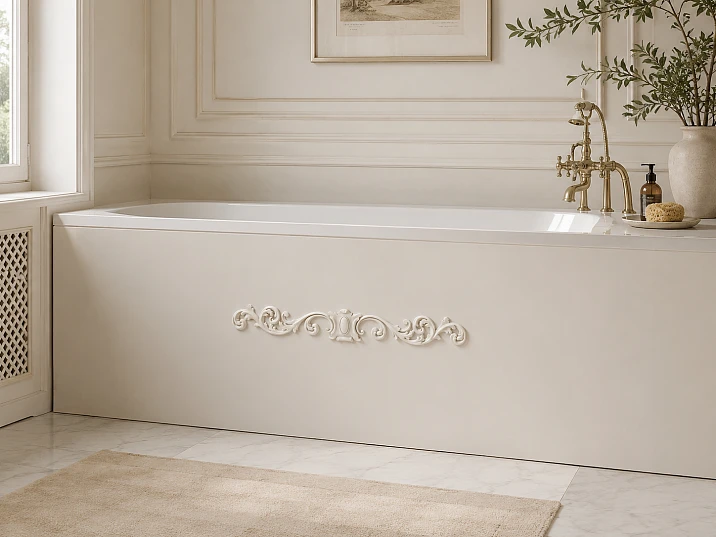
The bathtub is installed, the screen is assembled and technically fully satisfactory. There is no desire to redo the structure, adjust the panels again, or order new cladding. The problem is only visual: the long smooth front surface looks too empty.
In such a situation, it is not necessary to turn the entire screen into a complex decorative system. Instead of a frame of four moldings or a complete replacement of the front panel, you can consider one elongated carved overlay NPU-170, installed horizontally on the existing screen.
For this scenario, the large version of the NPU-170, measuring 580 × 74 × 15 mm, is interesting. At the time of preparing the material, its price is 2,760 ₽. The second item of the same model has dimensions of 400 × 51 × 10 mm and costs 1,440 ₽. The material is polyurethane.
The large version has an important advantage specifically for a long screen: 580 mm allows the product to be perceived not as a small decorative insert, but as an independent horizontal accent.
But before buying the overlay, you need to check not only the width of the screen. In the bathroom, three more things are especially important:
-
where the screen opens or how it is removed;
-
where is access to the siphon and communications;
-
is there enough space for a relief depth of 15 mm.
If NPU-170 overlaps the technological seam, connects the removable panel to the fixed part, or interferes with dismantling, beautiful decor will create a real operational problem. Therefore, the correct order here is: first structure and access, then proportions, and only after that decor.
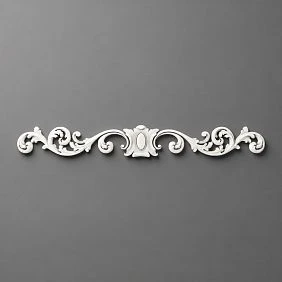
NPU-170 is precisely a carved overlay, not a frame, molding, or part of the screen
This idea has an important terminological boundary.
NPU-170 is a decorative polyurethane overlay. It does not turn the bathtub screen into a load-bearing structure, does not replace the screen itself, and does not serve as an access door.
Its task in the considered variant is much narrower: to change the appearance of the finished front plane without a complete rework.
This differs from a frame made of moldings.
A frame consists of at least four linear parts: two horizontal and two vertical. You need to determine the outer size of the rectangle, design the corners, maintain equal margins, trim the elements, and decide in advance how the frame will go around the door or removable part.
NPU-170 is one ready-made ornamented element.
For the buyer, the difference looks like this:
| Solution | What has to be designed | What the visual result is |
|---|---|---|
| Keep the screen smooth | Nothing | A calm, even surface |
| One NPU-170 | Position of one element | One horizontal decorative accent |
| Frame of moldings | Frame size, four sides, corners, margins | Architecturally designed panel |
| Several overlays | Distances, symmetry, rhythm | More saturated composition |
| Completely new decorative panel | The entire front part of the screen | Maximum design change |
Therefore, choosing the NPU-170 is not because "one part is always better than four." It is suitable when the task truly is to keep the existing screen and add one complete accent to it.




Two sizes of NPU-170: why 580 mm is more interesting for a long screen
The model has two size options:
| NPU-170 | Size | Price at the time of preparation | Difference relative to the larger version |
|---|---|---|---|
| Compact | 400 × 51 × 10 mm | 1 440 ₽ | 180 mm shorter, 23 mm lower, 5 mm less deep |
| Large | 580 × 74 × 15 mm | 2 760 ₽ | Main version of the article |
The very existence of the smaller version is useful: it allows you not to try to fit the 580-mm overlay to any surface.
On a long bathtub, the larger variant emphasizes the horizontal line more. This is especially noticeable if the screen is 1500–1800 mm wide.
But 580 mm is not a universally correct size. The compact NPU-170 may be more logical if:
-
the screen is short;
-
the central decorative area is limited by the inspection door;
-
there are already other active details nearby;
-
a subtle accent is needed, not a noticeable center;
-
a large overlay conflicts with the handle, seam, or another element.
Reducing the size affects not only the width.
The large NPU-170 has a depth of 15 mm, the compact one — 10 mm. If the screen design is very sensitive to protruding elements, this also needs to be considered.
Our factory also produces:

The first question before purchasing is which part of the screen is actually decorative
Measuring the bathtub is not enough.
The phrase "a screen 1700 mm wide" does not yet mean that there is a solid free surface 1700 mm wide in front of you.
The actual screen may consist of:
-
one solid panel;
-
two removable panels;
-
central inspection door and fixed side parts;
-
several sliding panels;
-
decorative panel with push-to-open hatch;
-
clad structure with hidden service access.
Therefore, before calculating the space for the NPU-170, you need to find not the overall width of the bathtub, but the width of the specific surface on which the overlay can be placed entirely.
This is fundamental.
Let's imagine a screen 1700 mm wide with a central door 600 mm. An overlay 580 mm long theoretically almost matches its width. This is a completely different scenario than a solid screen of 1700 mm.
If the inspection door is on the side and the central part is solid, the overlay can be centered relative to the entire composition — but only if it does not cross the door boundary.
Get Consultation
Simple rule
One overlay must belong to one structural component.
If the panel is removed as a whole, the overlay may be removed together with it.
If the door opens, the overlay may be located on the door itself if there is enough space.
But the NPU-170 should not act as a decorative "bracket" that is glued to the opening part at one edge and to the stationary part at the other.
Otherwise, access to the utilities will be blocked by the decor itself.
Do not cover the inspection seam even for the sake of perfect symmetry.
One of the most unpleasant mistakes occurs precisely because of the desire to place the decor perfectly in the center of the bathtub.
Suppose the geometric center of the entire front panel falls on the boundary of the inspection door. Visually, you want to place the NPU-170 strictly along this axis.
But if the 580-millimeter overlay crosses the technical joint, symmetry will be achieved at the cost of the screen's functionality.
This is a bad trade-off.
The priority should be as follows:
-
free access to the serviced area;
-
normal opening or removal of the panel;
-
maintaining technological gaps;
-
then compositional symmetry.
If these conditions do not allow placing one NPU-170 in the center, there are several honest solutions:
-
shift the decorative composition if it is visually justified;
-
choose a smaller NPU-170;
-
use a different type of decor;
-
refuse the overlay;
-
change not the decor, but the screen structure — if the repair still allows such work.
You cannot mask a structural conflict with the words "a few millimeters do not matter." For a removable panel, even a slightly overlapped seam can become critical during disassembly.
How to understand the NPU-170 size on the screen before ordering
A size of 580 mm is easier to assess not from the product card, but relative to a real screen.
If the overlay is installed centered on a solid panel, the side margin is calculated as:
(decorative surface width − 580 mm) / 2
There is no point in repeating the same arithmetic for each size, so it is more convenient to look at the range at once.
| Free front panel width | NPU-170 | Free total | Margin on each side | Overlay share of width |
|---|---|---|---|---|
| 1,200 mm | 580 мм | 620 мм | 310 мм | 48,3% |
| 1 300 mm | 580 мм | 720 мм | 360 мм | 44,6% |
| 1,400 mm | 580 мм | 820 мм | 410 мм | 41,4% |
| 1 500 mm | 580 мм | 920 мм | 460 мм | 38,7% |
| 1,600 mm | 580 мм | 1,020 mm | 510 мм | 36,3% |
| 1,700 mm | 580 мм | 1,120 mm | 560 мм | 34,1% |
| 1 800 mm | 580 мм | 1,220 mm | 610 мм | 32,2% |
On a 1200 mm panel, the overlay takes up almost half the width. Here it becomes a noticeable part of the entire surface.
At 1500–1700 mm, this becomes a calmer central accent.
On a 1800 mm panel, about 610 mm remains around it. The overlay is still large enough to mark the center, but the smooth part of the screen begins to play a greater independent role.
These numbers don't indicate where it's "correct." They help understand the character of the future composition.
A 1200 mm, 1500 mm, and 1700 mm screen are not three identical cases
Although one formula is used for all three sizes, the solution changes not only quantitatively.
Free surface around 1200 mm
Here, the NPU-170 takes up almost half the width.
The ornament reads as a large central object. If the screen itself is low or there is already decorative tile nearby, such an accent may prove quite active.
On a short panel, it is especially important to check not only the 580 mm option, but also the smaller NPU-170 400 × 51 × 10 mm.
Surface around 1500 mm
This is an intermediate scenario.
The 580 mm overlay takes up less than 40% of the width, so enough smooth surface appears around it. The decor no longer looks like almost full filling of the central zone.
Surface around 1700 mm
560 mm remains on both the left and right sides.
Such a screen clearly demonstrates the principle of "one overlay instead of a frame": the ornament does not attempt to decorate the entire perimeter but marks a single center on an extended plane.
But it is precisely on a long screen that the installation height becomes more important. A vertical error will be noticeable across the entire wide surface.
Make a full-size template of 580 × 74 mm
This is one of the most useful checks in the entire task.
Take paper or thin cardboard and cut out a rectangle of 580 × 74 mm.
Secure it with masking tape without damaging the surface and step back to the usual distance.
Do not try to reproduce the ornament yet. At this stage, the actual dimensions are what matter.
The template allows you to see:
-
whether the NPU-170 is too small;
-
isn't it too large;
-
how calm the side fields will remain;
-
where is the best place to position the element by height;
-
how much the composition depends on the exact center;
-
whether the size conflicts with the hatch or seams.
Look at the screen standing, not sitting on the floor in front of it
During installation, a person is very close to the surface. In this position, any relief seems large.
But the bathroom is usually perceived:
-
from the door;
-
standing near the sink;
-
in front of the bathtub;
-
in the mirror;
-
sometimes through the reflection in a glass partition.
Therefore, the main view of the template should not be from arm's length.
Take a photo of the entire bathroom from the entrance. In it, it quickly becomes clear whether the 580-millimeter element is a real accent or gets lost among the tiles, plumbing, and furniture.
The template is also needed for the smaller version
If the choice between two sizes is not obvious, make a second rectangle 400 × 51 mm.
Place them on the screen one by one.
Such a test is usually more useful than the abstract question “what size is better for a 170 cm bathtub?” because two rooms with the same bathtub can have completely different finishes and scale.
The height of the panel is as important as the width
The NPU-170 is quite elongated: with a length of 580 mm, its height is only 74 mm.
Therefore, on a tall screen, the problem is often not whether the overlay fits, but where exactly it should be located.
If the net height of the panel is 500 mm, a mathematically centered NPU-170 will leave:
(500 − 74) / 2 = 213 mm
at the top and bottom.
But this does not mean that such a placement is necessarily the best.
On the screen, there are visual and structural reference points:
-
the top edge of the bathtub;
-
the bottom plinth;
-
the tile seam;
-
the line of the inspection door;
-
handle;
-
push mechanism;
-
legs or supports, if visible;
-
adjacent floor plinth;
-
facing pattern.
Because of this, the mathematical center and visual center may not coincide.
Where to position the overlay by height
Start from the middle — as a reference point.
After that, do two more fittings: slightly higher and slightly lower.
Compare the photos.
Too high position
If the NPU-170 is almost pressed against the top line of the screen, the decor may visually "stick" to the bathtub rim.
This is especially noticeable if there is already a seam or metal edge between the screen and the bathtub.
Too low position
The overlay begins to compete with the baseboard and floor, and the complex ornament ends up in an area where it is more likely to be bumped during cleaning.
Central position
Often looks the most calm, but it is not a dogma.
If there is a wide functional area, hatch, or other element above the screen, the visual center may shift.
The main rule here is this: the position of the NPU-170 must follow the actual construction of the screen, not just a single mathematical formula.
A depth of 15 mm is a small number that is easy to forget
The paper template only checks two dimensions.
But the large NPU-170 has a third one — 15 mm.
After installation, the relief will protrude relative to the screen plane.
On a regular blank panel, this may not cause any problems. But if the screen:
-
is sliding;
-
opens outward;
-
is located near protruding furniture;
-
has a hidden push-to-open door;
-
extends behind the adjacent panel;
-
is removed by pulling toward you and then upward,
15 mm must be taken into account in advance.
Make a three-dimensional mockup
It is not necessary to copy the NPU-170 form.
It is enough to attach strips of cardboard or other material to the paper template so as to approximately obtain a 15 mm protrusion.
After that, try:
-
open the door;
-
remove the panel;
-
move your hand along the usual trajectory;
-
check the neighboring elements.
Such a primitive mock-up can detect the problem even before purchase.
Special case — sliding screen
For a sliding screen, the question becomes more complicated.
The overlay increases the actual thickness of the leaf from the front side. In addition, a large protruding ornament may be inconvenient in the area where the hand usually grips.
Before installation, you need to check:
-
which leaf moves;
-
whether it passes behind the other;
-
whether their trajectories intersect;
-
where the user grips the screen;
-
whether the full travel of the leaf is preserved.
You cannot automatically transfer a solution from a fixed panel to a sliding one.
If the structure is initially designed for flat leaves, it is sometimes wiser to abandon volumetric decor altogether or use it only on the stationary part.
A special case is the push-to-open inspection hatch.
A hidden push hatch is usually good precisely because its boundaries are visually dissolved.
Here, the NPU-170 can operate in two opposite ways.
The first is that the overlay is placed entirely on the door surface and opens together with it.
The second is that the decor is placed nearby and does not touch the door.
What not to do: place the product across the technological boundary.
Additionally, you need to check the press point. If opening occurs by pressing exactly in the central zone, a relief overlay may make use inconvenient.
Before installation, open the hatch several times with a temporary template in place of the future decor.
A special case is a fully removable front panel.
A removable screen may be the most convenient option for such decor.
If the NPU-170 is entirely glued to one panel, it is removed together with it.
But check the dismantling method.
If the panel is first lifted vertically under the edge of the bathtub, the additional 15 mm at the front may not matter.
If it needs to be tilted, maneuvered behind an adjacent part, or pulled out through a narrow gap, the relief becomes part of the actual dimensions.
It is useful to perform a full removal cycle before purchasing:
remove → take out → put back.
While doing this, imagine a 15 mm protrusion at the marked spot.
Why one NPU-170 may be better than a frame made of moldings
The frame has a strong point: it frames not just one point, but the entire central plane.
But that is exactly why the frame requires more conditions.
You need to determine:
-
width;
-
height;
-
identical fields;
-
four corners;
-
position relative to the hatch;
-
intersection with technological seams.
If the screen is already ready and you don't want to turn a small decorative upgrade into a separate project, one NPU-170 is simpler in terms of compositional logic.
It does not require imitating a classic panel across the entire area.
Instead of the question:
"How to build the right frame?"
a narrower one is solved:
"Where to place one ready-made horizontal ornament?"
This is especially reasonable when the screen itself is of good quality and needs minimal changes.
When a frame made of moldings is still better
NPU-170 should not be made an artificial alternative to moldings in all cases.
The frame can look more convincing if the screen:
-
is tall;
-
is wide;
-
completely deaf;
-
already part of a classic wall composition;
-
visually requires not a single center, but a designed rectangular panel.
For example, if the walls in the bathroom are already divided into panels by moldings, a single overlay on the screen may turn out to be stylistically isolated.
Continuing the same frame system sometimes connects the screen to the interior better.
For such a scenario, you can look at buy polyurethane moldings.
But choosing moldings just because the screen is wide is also wrong. First, decide what visual language is already used in the room: individual ornamental accents or a system of frames.
When it is better to leave the screen completely smooth
Adding decor is not always necessary.
There are situations where the absence of an overlay is a full-fledged design solution.
The tile already has an active pattern
Marble graphics, geometric ornament, contrasting layout, or pronounced texture themselves create a decorative center.
NPU-170 over such a surface can become a second competing pattern.
The plumbing is very minimalist
If the entire bathroom is built on a minimum of lines, smooth stone, hidden mixers, and simple furniture, a carved ornament may look random.
The screen should visually disappear
Sometimes it is painted or tiled the same way as the wall to make the bathtub appear lighter.
In such a project, a separate overlay does the exact opposite—it draws attention to the screen.
It is not possible to maintain revision access
This is an absolute practical argument.
If installation requires blocking the door or significantly complicating maintenance, the decorative idea does not justify the problem.
Combination with tile: relief versus pattern
The screen does not exist separately from the walls.
Even if its surface itself is smooth, behind it there may be:
-
large-format porcelain stoneware;
-
small tile;
-
decorative border;
-
mosaic;
-
stone pattern;
-
contrast grout.
The more active the room's background, the more cautious you should be with complex patterns.
A useful way to check is to look not at the screen itself, but at the entire lower half of the bathroom in one frame.
If your gaze simultaneously catches on:
-
the tile pattern;
-
the cabinet legs;
-
hardware;
-
NPU-170;
-
the floor ornament,
perhaps one of these elements needs to become calmer.
What changes if the screen is painted in one color
On a solid-color NPU-170 panel, it's easier to make it part of the architecture itself.
There are two fundamental options.
The overlay is painted in the same color
The relief is revealed through light and shadow.
From a distance, the screen remains quite calm, but up close, an ornament appears.
This option is suitable when you want to make a smooth surface more interesting but not turn it into the main accent of the bathroom.
The overlay is highlighted with color
Even a slight difference sharply enhances its presence.
On a 1700 mm screen, a 580-mm element with the same color can be perceived as part of the panel. In contrast, it begins to look like a separate decoration.
This is neither good nor bad — the task changes.
Before contrast painting, it is especially important to make sure that:
-
the correct size is selected;
-
the center is truly successful;
-
the installation height is beyond doubt;
-
there is enough calm space around.
Contrast makes mistakes more noticeable.
White NPU-170 on a colored screen
This is a special case of contrast that should be checked separately.
A white carved overlay on a blue, green, graphite, or other saturated background will look significantly more active than the same product on a white panel.
Therefore, evaluating such a variant from a photo of an unpainted product on the website is risky.
Make the layout in the desired color.
Even a regular paper template can be printed or painted to approximate the future shade.
This will help you see not only the size but also the visual weight.
If the white 580-millimeter strip breaks up the screen too much, there are three possible solutions:
-
paint the NPU-170 to match the panel color;
-
choose a smaller version;
-
leave the screen without additional decoration.
The moisture resistance of polyurethane does not negate the requirements for the screen itself.
The NPU-170 material is polyurethane, and its moisture resistance is specified in the product card.
This is a good argument for a bathroom, but it does not mean that the base can now be ignored.
The screen can be:
-
painted;
-
plastic;
-
laminated;
-
tiled;
-
made of MDF;
-
made of another material.
The NPU-170 card indicates installation with adhesive, but a specific adhesive contact always consists of two surfaces, not one.
Therefore, before installation, you need to check the compatibility of the selected compound:
polyurethane NPU-170 + specific screen coating.
You cannot automatically transfer successful experience of gluing to a painted panel to smooth tile or plastic.
If in doubt, it is better to do a test on a sample of the base.
Where does the water go
The moisture resistance of the product itself and constant water exposure on the installation joint are different matters.
Look at how the bathtub is actually used.
If water regularly runs down the screen:
-
from the edge;
-
from the shower area;
-
after cleaning;
-
due to the absence of a curtain or glass,
not only the surface of the overlay becomes especially important, but also the quality of its fit to the base.
Do not create places behind the decor where moisture constantly lingers and cleaning is difficult.
This check is especially useful before choosing the installation height.
If the bottom part of the screen is constantly wet, it makes sense not to press the decorative element against the floor just for the sake of composition.
Cleaning around relief decor
A smooth screen is convenient because it can be quickly wiped down.
After installing NPU-170, a relief appears.
This means:
-
more recesses;
-
more contours;
-
the need to pass the cloth more carefully over the ornament;
-
potential accumulation of dust and splash marks on the protrusions.
This is not a reason to give up decor, but there is a difference in maintenance.
If the bathroom is used very intensively and the main criterion is the simplest possible cleaning, a smooth panel is objectively more practical.
If decorativeness matters more and access to the surface is good, caring for a single overlay is noticeably easier than for a complex system of many small parts.
A single element is more convenient precisely because it does not break up the surface.
A frame made of moldings has four sides and four corners. A composition of several overlays creates several separate zones.
NPU-170 leaves most of the screen smooth.
This has two consequences.
First, the screen does not lose its visual integrity.
Second, cleaning remains relatively simple: you need to maintain one relief area, not the entire perimeter of the panel.
For a bathroom, this is a practical argument, not just an aesthetic one.
How to choose a horizontal center
If the panel is solid and the bathtub is symmetrical, the starting point is obvious:
the center of the free decorative surface.
But there are situations where mechanical division in half does not work.
For example:
-
bathtub is partially hidden by furniture;
-
there is a ledge nearby;
-
the screen visually continues only up to the cabinet;
-
the inspection door is offset;
-
plumbing creates a different axis;
-
the floor pattern is highly asymmetric.
Then it is useful to compare two centers:
geometric — the middle of the panel;
visual — the middle of the part of the screen that a person actually perceives as decorative.
Do not shift the overlay "by eye" right away.
First mark both axes with painter's tape, take photos, and compare.
If the inspection door is centered
This is a special case because the NPU-170 itself is designed for a central decorative accent.
Three options are possible.
The overlay fits entirely on the door
Then it can open together with it, if the depth of the relief does not interfere with the mechanism and there is room for pressing or a handle.
The overlay is wider than the door
Overlapping boundaries is not allowed.
Here it is already worth comparing the compact NPU-170 with a length of 400 mm.
The door itself is the visual center, but its surface is too small.
It is better to abandon the attempt to place a large overlay strictly in the center and consider a different decor than to glue the product across the technological seam.
If the inspection hatch is on the side
Such a screen is often more convenient for a single overlay.
The central zone can remain almost solid.
But before installation, still make sure that the side door opens without conflicting with the 15-millimeter protrusion.
If it swings outward next to the NPU-170, the edge of the door should not catch on the relief.
Open the door to the full angle with a temporary volumetric template.
Why you shouldn't mask an access panel with an overlay at any cost
Sometimes there's a desire to use carved ornament as a way to hide the seam.
This is only acceptable when the decor doesn't interfere with function.
If masking requires gluing NPU-170 to two parts at once, the solution is technically incorrect.
It's better to keep a visible thin seam than to get a panel that can't be opened without damaging the finish.
A good decorative project doesn't fight with the maintenance of the structure.
It takes it into account.
How much NPU-170 to buy
The main idea of the article requires one large NPU-170.
This is an important difference from a frame or a repeating ornament.
You don't need to calculate linear meters and the number of corner joints.
Before purchasing, it's enough to answer the questions:
-
the size 580 or 400 mm is selected;
-
one piece is needed or a paired composition is actually being created;
-
where it will be installed;
-
whether the surface is free.
If after trying it on there is a desire to buy two or three NPU-170 "just in case," it's worth returning to the composition.
Several identical overlays are already a different design scheme.
When two NPU-170 can be justified
There are cases where two parts are logical.
For example, a very wide screen may be structurally divided into two identical blank panels.
Then each overlay gets its own center.
Or the room has two identical bathtubs or symmetrical decorative elements that truly require repeating the motif.
But installing two NPU-170 just because one leaves a lot of empty space is not necessary.
Empty space can be a deliberate part of the design.
Don't turn one overlay into the start of endless decoration.
A very common scenario looks like this:
first, install NPU-170;
then it seems empty at the edges;
add two small details;
then a molding is needed on top;
after that, you want to highlight the corners.
In the end, a minimal rework turns into a completely different composition.
Before purchasing, formulate the task in one sentence:
"I need one horizontal decorative center on a ready smooth screen."
If after installation this center reads clearly, the work is done.
When the smaller NPU-170 400 × 51 × 10 mm is better
The compact option is worth considering not just for savings.
It has its own independent advantages.
Small access door
400 mm can fit entirely where 580 mm crosses boundaries.
Low screen
A height of 51 mm leaves more calm space above and below.
Very active finish
A smaller ornament competes less with tiles or furniture.
A flatter relief is needed
A depth of 10 mm instead of 15 mm can be important on a movable structure.
The screen itself is short
On a 1000–1200 mm panel, 580 mm takes up a significant share of the width. If it looks heavy, the 400 mm option may be more proportionate.
That is, the smaller model is not a "downgraded version" but a different scale of the same decorative language.
Price: compare complete solutions, not the cost of a single part
The large NPU-170 costs 2,760 ₽, the compact one — 1,440 ₽ at the time of writing.
Comparing these figures is easy.
Comparing the cost of the NPU-170 and a molding frame is more difficult.
For the frame, you will need to consider:
-
the selected molding model;
-
the required length;
-
allowance for trimming;
-
four corners;
-
possible leftovers;
-
installation;
-
finishing.
Therefore, you cannot automatically claim that one NPU-170 is always cheaper than the frame.
Its advantage here is not necessarily in price.
The main thing is a different complexity of the solution.
One overlay allows you to change the appearance of the screen without designing a full rectangular frame.
Where to buy NPU-170
If after a full-size fitting the large option fits in scale, depth, and location of the revision, you can buy the carved overlay NPU-170.
Before ordering, double-check the selected size position: for the main idea of this article, 580 × 74 × 15 mm is used.
If the size or pattern of NPU-170 is not suitable, it is better not to try to adapt a specific product at any cost. You can first look at Buy decorative polyurethane overlays and compare other options.
For a wider selection of interior decor, you can go to the section You can buy ready-made stucco matching the Baroque style. Calculate the quantity: linear meters of cornices and moldings, number of rosettes, pilasters, consoles, corner elements. Add a ten to fifteen percent allowance for trimming..
If after fitting it becomes clear that the screen requires not a central accent, but a rectangular frame, it is more logical to look at buy polyurethane moldings.
The general section of products can be viewed via the link Buy Molded Decoration.
This selection order is better than starting with a product category. First, the screen task is determined, then the type of decor.
Steps before ordering NPU-170 580 × 74 × 15 mm
To not forget the structural part for the sake of a beautiful picture, it is convenient to go through a check in a certain sequence.
Step 1. Determine the screen device
Do not buy decor until you know:
-
what is removed;
-
what opens;
-
where the inspection is;
-
where the joints are.
Step 2. Measure exactly the free decorative plane
Write down its width and height.
Do not automatically use the length of the bathtub itself.
Step 3. Mark the technological zones
Use painter's tape to highlight:
-
doors;
-
seams;
-
handles;
-
push zones;
-
dismantling areas.
Step 4. Make a template 580 × 74 mm
Place it first at the geometric center.
Step 5. Compare the 400 × 51 mm option
Even if you initially like the large NPU-170, two full-size fittings give a more informed choice.
Step 6. Check the 15 mm depth
Especially on a removable, sliding, or opening screen.
Step 7. Perform a real service cycle
Open the inspection hatch or remove the panel with the template in place.
If this is inconvenient already at the mockup stage, the decor needs to be reconsidered.
Step 8. Choose the height
Compare at least three positions in the photo.
Step 9. Decide on the painting issue
In the screen color or contrast — only after approving the size and position.
Step 10. Check the base
The chosen adhesive method must be suitable not only for polyurethane but also for the actual screen surface.
Step 11. Only after this, order the product
If all checks are passed, you can order NPU-170 580 × 74 × 15 mm.
Mistakes that make a simple rework no longer simple
Mistake 1. Measuring the bathtub instead of the panel
Why it happens: the known figure of 1500, 1600, or 1700 mm seems sufficient.
Consequence: the actual free area turns out to be smaller due to the hatch, side panels, or joints.
How to check: measure only the plane where NPU-170 can be placed entirely.
How to avoid: first make a diagram of the screen, then calculate the decorative margins.
Error 2. Gluing the overlay through the revision seam
Why it occurs: the ideal center falls on the boundary of parts.
Consequence: the panel stops opening or being removed normally.
How to check: run your finger along the entire hatch contour and mark it with masking tape.
How to avoid: the entire NPU-170 must be on one structural part.
Error 3. Checking only 580 × 74 mm and forgetting about 15 mm
Why it occurs: the product is selected based on the frontal image.
Consequence: the relief interferes with the movement of the sash, adjacent part, or disassembly.
How to check: use a volumetric mock-up.
How to avoid: evaluate three dimensions, not two.
Error 4. Centering across the entire bathroom when the visible panel is asymmetric
Why it happens: the geometric center seems like the only correct option.
Consequence: the overlay looks shifted relative to the furniture or the free area of the screen.
How to check: take a photo of the entire bathroom from the doorway.
How to avoid: compare the geometric and visual centers.
Error 5. Choosing the large version only because it is more expensive and more noticeable
Why it happens: a large detail seems automatically more expressive.
Consequence: on a short or busy screen, the ornament becomes heavy.
How to check: compare templates 580 × 74 and 400 × 51 mm.
How to avoid: choose the scale based on the surface, not the price.
Error 6. Painting contrastingly before fitting
Why it occurs: color seems like a way to make the overlay more expressive.
Consequence: an unsuccessful size becomes even more noticeable.
How to check: use a colored paper template.
How to avoid: first approve the geometry, then the color.
Error 7. Considering moisture resistance as permission for any installation
Why it occurs: polyurethane properties are transferred to the entire assembly.
Consequence: the adhesive or the screen coating itself turns out to be unsuitable.
How to check: determine the base material.
How to avoid: consider the system "overlay + adhesive + surface" rather than just the overlay.
Quick decision table
| Question | If the answer is "yes" | If the answer is "no" |
| Is there a solid free plane of at least 580 mm along the selected axis? | Check large NPU-170 | Look at 400 mm or another decor |
| Is the overlay entirely on one screen part? | Can move forward | Position needs to be changed |
| Does revision access remain fully functional? | Check composition | Do not install decor in such a place |
| Does 15 mm depth not interfere with anything? | Installation can be evaluated | Need a different option |
| Does the 580 × 74 mm template look proportional? | Large size is justified | Compare 400 × 51 mm |
| Does the ornament not conflict with the tile and furniture? | Decor supports the interior | Better to reduce activity |
| Is the surface suitable for adhesive mounting? | Select a compatible composition | First resolve the base issue |
| Does one overlay complete the screen? | Do not add unnecessary details | Reconsider the type of composition itself |
FAQ
Can the NPU-170 be installed after the bathroom renovation is already finished?
The article's scenario is designed specifically for a finished screen. However, the possibility of installation depends on the surface condition and the access panel's design. If the screen is intact, accessible, and the chosen area is not involved in dismantling adjacent parts, there is no need to redo the entire structure for a single overlay.
Can the NPU-170 be used on the access door itself?
Yes, if the overlay fits entirely on the door and does not interfere with its opening, push mechanism, handle, or removal. The decor cannot be glued across the boundary between the door and the fixed part.
What to choose for a narrow inspection door — 580 or 400 mm?
The decision is made by the actual width of the free surface. If 580 mm does not fit entirely with the necessary technological gaps, you should check the 400 × 51 × 10 mm option rather than covering the seam with a large overlay.
Can the NPU-170 be installed vertically?
This article considers it as a horizontal accent on a long bathtub screen. A different orientation should be evaluated as a separate composition: proportions, free margins, and the perception of the ornament change. Do not rotate the product just to make it physically fit.
Is it necessary to install the overlay exactly in the center?
No. The geometric center is a starting point for fitting. If it conflicts with the inspection opening or the actual composition of the bathroom is asymmetrical, the position should be chosen based on the free decorative plane. The functionality of the screen is more important than mathematical symmetry.
Will one NPU-170 fit a 1800 mm long screen?
In terms of scale, 580 mm is approximately one third of such width if the entire surface is truly free. But the length itself does not guarantee a good result: you need to check the height, the inspection opening, the screen pattern, and the overall look of the bathroom with a full-size template.
Is it mandatory to paint the NPU-170?
The product card allows painting, but the specific color solution depends on the project. In the color of the screen, the relief appears calmer; contrasting finish makes it a standalone accent.
What is more practical for cleaning — one overlay or a frame made of moldings?
All else being equal, one overlay creates fewer relief areas and leaves most of the screen smooth. But the smooth panel itself without decor will still be the easiest to maintain.
Can the NPU-170 be installed on a screen tiled with ceramic tiles?
You need to separately check the compatibility of the adhesive composition with polyurethane and the specific tile surface. The fact that NPU-170 is moisture-resistant does not replace checking the base and installation technology.
What to do if the 580 mm template seems too small?
You don't necessarily have to buy two overlays right away. First, compare another solution: a frame made of moldings, another large decorative element, or keeping the screen smooth. Two NPU-170s already create a rhythmic composition, not a single center.
What to do if 580 mm is too much, but 400 mm seems too little?
This is a sign that the specific model may not match the scale of your screen. You don't need to choose an unsatisfactory option just for the sake of the article number. It makes sense to look at other Polyurethane decorative appliques.
Can the NPU-170 be used on a removable panel?
Yes, if the product is entirely on that panel and the additional 15 mm depth does not interfere with the way it is removed. It is better to check the full removal with a 3D template before gluing.
Does it make sense to choose NPU-170 just for moisture resistance?
No. The material's moisture resistance is important for the bathroom, but the choice of a specific model should also be determined by size, proportions, screen design, maintenance, and the overall interior.
When is it better to refuse the purchase?
If the only place for the overlay crosses the inspection hatch, if the 15-millimeter relief interferes with the structure, if both sizes look disproportionate, or if the ornament overloads an already active finish, keeping a smooth screen would be the more correct solution.
Summary: first the inspection, then the template, then NPU-170
The point of using NPU-170 on a bathtub screen is not to fill the entire front surface with decor as much as possible.
The task is much more precise: leave the finished screen and add one complete horizontal accent.
For a long panel, the main option of 580 × 74 × 15 mm is interesting for its scale. On a 1700 mm surface with precise centering, 560 mm of free space remains on each side. On 1500 mm — 460 mm on each side. On 1200 mm — 310 mm on each side.
These figures allow you to assess the proportions in advance, but the final decision should be made by a full-size template.
Before purchasing, an even more important thing needs to be checked: the design of the screen itself. NPU-170 cannot be glued across the boundary of a removable part, overlap the inspection gap, or be placed so that the 15-millimeter relief interferes with opening and maintenance.
If there are no constructive conflicts, the 580 × 74 mm pattern looks convincing, and one detail is enough to make a smooth panel no longer seem empty; a complex frame of four moldings can indeed be superfluous.
After such a check, you can order NPU-170 580 × 74 × 15 mm.