Article Contents:
- An opening without a door is not a problem, it's an opportunity
- When a portal is necessary: seven practical scenarios
- How a portal differs from a casing: the fundamental difference
- What elements make up a door portal
- Side trims
- Pilasters
- Capital
- Frieze (entablature)
- Top cornice
- Decorative appliqués
- Wooden Molding
- Extensions: finishing the ends of the opening
- Portal for an opening without a door: what to consider
- Symmetry on both sides
- Passage width and element scale
- Ceiling height and top cornice
- Portal between kitchen and living room: the most relevant scenario
- Visual transition between zones
- Connection with kitchen decor
- Portal scale for open-plan layout
- Pilasters and capitals: the heart of a classic portal
- Why a pilaster makes the portal taller
- Types of pilasters
- Pilaster size: how to avoid mistakes
- Capital: the crown of the vertical
- How to choose a door portal style
- Classic
- Neoclassicism
- Modern Interior
- Country house and eco-interior
- Apartment with low ceilings
- How to choose portal size: practical rules
- Width of side elements
- Height and ceiling ratio
- Baseboard ratio
- Portal depth and wall thickness
- Portal material: what to choose and why wood
- Oak
- Oak
- Ash
- MDF and PVC: An Honest Look
- Wooden Portal Coating: How to Preserve Beauty
- Mistakes in Choosing and Installing a Portal
- What to check before buying: a detailed checklist
- Complete Decorative System Around the Portal
- FAQ: answers to the most common questions
- What is a Door Portal?
- Can You Make a Portal in an Opening Without a Door?
- What to Buy for a Door Portal?
- Will a Portal Suit a Small Apartment?
- How to Decorate the Opening Between Kitchen and Living Room?
- How to Assemble a Classic Portal from Individual Elements?
- How to choose a portal to match your interior style?
- About the Company STAVROS
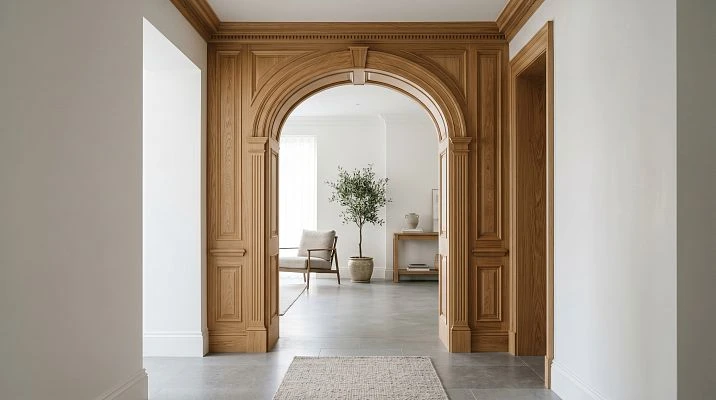
There comes a moment in renovation when the door is removed, the opening is exposed — and it suddenly becomes obvious: you can't just leave it like this. Bare ends, uneven joints with the wall, an empty top of the opening — all of this is not a passage between rooms, but construction incompleteness. This is where the conversation begins about a door portal — an architectural solution that turns an ordinary opening into a deliberate interior element. It doesn't just cover gaps, but creates the character of the space.
View door portals, pilasters, and capitals STAVROS — ready-made solutions and elements from solid wood for classic and modern interiors.
An opening without a door is not a problem, it's an opportunity
Open floor plans have become the norm. The kitchen and living room are combined, the corridor flows into the hall, the bedroom is connected to the dressing room. The door is removed — and the space gains in air, light, and scale. But an opening without a door immediately raises the question: how does it look?
The answer provided by an interior portal— elegant and architecturally literate. The portal does not restore the door; it makes its absence intentional: this is not incompleteness, it is a design solution. The opening gains verticals, horizontals, proportions — and fits into the interior as an equal architectural element.
That is why the topic of door portals is not about renovation in the traditional sense. It is about how people who want not just to renovate an apartment but to create an interior think about space.




When a portal is necessary: seven working scenarios
Before talking about specific elements and solutions, it is worth understanding in which situations door portal it becomes not a desire but a necessity.
Scenario one: the door was removed, but the opening remains. The most common situation. After dismantling the door, the ends of the wall, mounting strips, and unevenness are visible. Without framing, it looks like an unfinished construction object.
Scenario two: a wide opening between zones. Openings 120–180 cm wide are too wide for ordinary architraves, too empty without decoration. This is where a portal with pilasters for a door opening provides visual structure.
Scenario three: an interior in classic or neoclassical style. An ordinary architrave in a classic interior looks like a compromise. Classicism requires an architectural language: pilaster, capital above the doorcornice — all these are elements of the order system that underlies classical decor.
Scenario four: the passage as a room accent. Sometimes an opening is not just a functional transition, but the central axis of a living room, hallway, or foyer. In this case an interior portal it works as an architectural accent: the eye encounters it first and lingers on it.
Scenario five: need to visually connect two spaces. A kitchen and living room in different colors, with different furniture and different materials — they need a neutral transitional element. A portal made of solid wood, matched to the wooden elements of both zones, creates this connecting bridge.
Scenario six: renovation with an eye to the future. The door will be installed later — but for now, the opening needs to be beautifully finished. The portal is mounted before the door, and when the door appears — it will fit into the ready-made frame.
Scenario seven: want to make it look more expensive without big investments. Adding a portal to an opening is a small amount of work with a very high visual result. No redevelopment, no demolition. A few solid wood elements — and the interior changes dramatically.
Our factory also produces:
How a portal differs from a platband: the fundamental difference
To avoid buying the wrong thing — it's important to understand where the line between a platband and a portal lies.
Wooden casings is the framing of a door or window opening. Their function: to close the joint between the frame and the wall, creating a neat border. The platband is flat, fits against the wall, and works as a decorative strip.
door portal is an architectural structure. It has depth, volume, and a hierarchy of elements. The portal does not just close the joint — it builds the space around the opening: sets the vertical through pilasters, the horizontal through the cornice, and connects the floor and ceiling through a unified decorative system.
The difference is roughly the same as between a picture frame and a full-fledged architectural architrave in a classical palace: both cover the edges, but one creates architecture.
More details on how to build a decor system around an opening — in the article finishing a doorway without a door.
Get Consultation
What elements does a door portal consist of
This is the most practical section — because before buying, you need to know exactly what is included in the portal and what function each element has.
Side casings
Vertical planks on the sides of the opening are the basis of any framing. In a simple solution, this is a wide architrave-pilaster with a straight or profiled edge. In a more complex one, it is a separate architrave plus an overlay pilaster on top of it.
Architraves for the portal are chosen based on the wall width and the thickness of the finish. The standard width of side architraves for a portal is from 80 to 150 mm, and in classical solutions it can be wider.
Pilasters
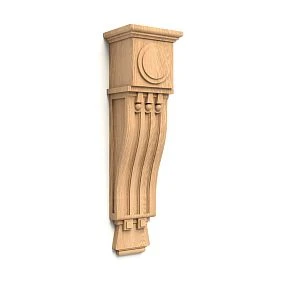
Pilasters for a doorway are flat vertical elements that imitate a column. The pilaster is mounted on top of the architrave or directly onto the wall next to the opening. It adds volume to the verticals and makes the portal recognizably classical.
A pilaster can be smooth (a simple board with a profiled edge), fluted (with vertical grooves), or carved (with ornamentation along its entire length). The height of the pilaster is from the floor to the beginning of the cornice.
It is the pilasters that fundamentally distinguish a portal from a simple architrave: they introduce the order system into the interior.
Capital
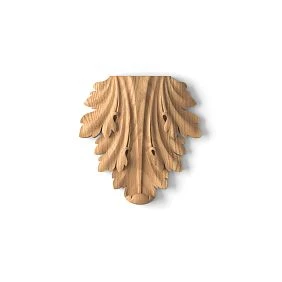
capital above the door — this is the decorative top of a pilaster. The capital marks the transition from vertical to horizontal, unifying the portal into a single architectural system.
Depending on the style, the capital can be:
-
Doric — strict, without decoration, with a simple abacus
-
Ionic — with characteristic volutes on the sides
-
Corinthian — with rich leaf decoration
-
Simplified — for modern interiors, without historical references
The capital is the element that 'activates' the portal within a classical architectural context. Without a capital, a pilaster is just a vertical board. With a capital, it becomes a full-fledged architectural element.
Frieze (entablature)
A horizontal strip that connects the capitals of two side pilasters above an opening. The frieze forms the upper part of the portal — the "lintel." In simple solutions, it is a wide flat plank. In classical ones, it is a multi-level profile with moldings.
The frieze visually completes the verticals of the portal and sets the horizontal line above the opening.
Upper cornice
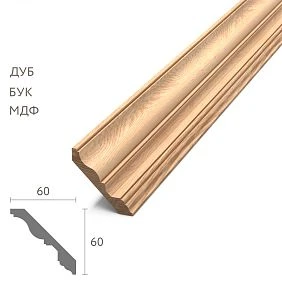
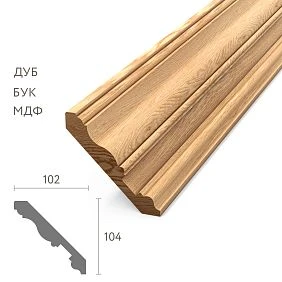
Moldings for a door opening and the upper cornice is the final chord of the portal. The cornice overhangs the frieze, creating volume and shadow. It is this shadow that makes the portal "readable" from a distance: without a protruding cornice, the portal appears flat.
In classical portals, the cornice can be decorated with dentils (teeth), leaf ornaments, or an egg-and-dart profile. In modern ones, a simple profiled projection is sufficient.
Decorative appliqués
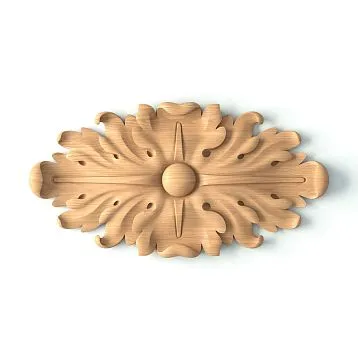
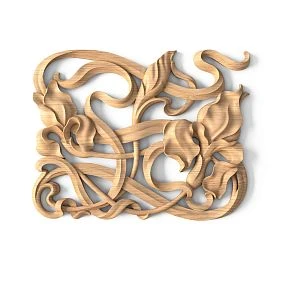
Decorative overlays for the portal are three-dimensional elements that are mounted on the plane of the pilaster, frieze, or the wall itself next to the opening. Rosettes, keystones, cartouches, relief ornamentation — all these are details that elevate a portal from a good level to an exceptional one.
Wooden millwork
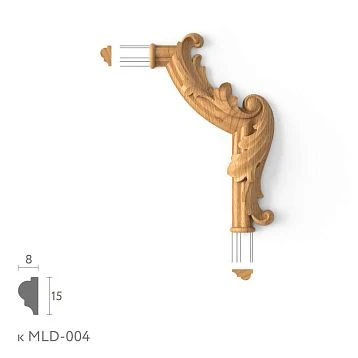
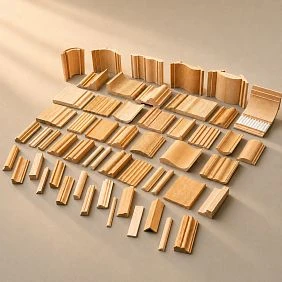
Wooden millwork for the portal are profiled strips from which moldings, extensions, and trims are assembled. Millwork is used both in the main elements of the portal and for finishing the inner ends of the opening.
Extensions: finishing the ends of the opening
The end of the opening is its "interior": the side planes visible when passing through it. In standard renovations, the ends are plastered and painted. In a portal, they are finished with wooden extensions or moldings — so when you enter the opening, you see not bare plaster, but a clean wooden surface.
Portal for a doorless opening: what to consider
When a portal is installed in an opening with a door, it works on one visible side (doors are closed, the front side is visible). A portal in a doorless opening works on both sides simultaneously — and this changes the approach to selection and installation.
Symmetry on both sides
A doorless opening is fully visible — from both the kitchen and the living room. This means that Door Frame Trim it must be neat on both sides. Either an identical portal on both sides, or a mirror solution — where each side "communicates" with its own room, but maintains unity through a common profile and material.
The ends are especially important: in a doorless opening, they are constantly visible. Properly finished ends with wooden extensions or moldings are a sign that the portal is fully completed, not half-done.
Width of the passage and scale of elements
For a wide opening (120 cm or more), pilasters are appropriate and even necessary. They structure a large opening, giving it vertical rhythm.
For a narrow opening (80–90 cm), pilasters can narrow the passage and create a feeling of tightness. Here it is better to use wide architraves with a profile, without bulky side additions.
Ceiling height and top cornice
An expressive top cornice looks good with ceilings from 270 cm. With ceilings of 240–250 cm, it is better to make the cornice more modest: a too heavy top element visually "presses down."
Portal between kitchen and living room: the most relevant scenario
Combining the kitchen and living room is one of the most popular redevelopment scenarios of the last decade. The wall was removed, the space expanded, and an opening appeared that is visible from both zones simultaneously.
It is here door portal solves several tasks at once.
Visual transition between zones
The kitchen and living room are often done in different colors and different materials. A solid wood portal creates a neutral "frame" that belongs to both zones at once. The tinting or painting of the frame is selected to echo the kitchen facades, baseboards, floor, and living room furniture.
Connection with kitchen decor
If the kitchen is decorated with wooden details — cornices under the ceiling, moldings, profiled facades — the portal continues this decorative logic. The same wood species, the same profile, the same tinting — and the transition between the kitchen and living room becomes part of a unified system, rather than a seam between two different renovations.
Portal scale for open-plan layouts
In an open space, the portal is visible from afar — from the sofa, from the kitchen, from the hallway. This means it must be expressive enough to be read from a distance of 6–8 meters. A profile that is too thin will get lost. One that is too heavy will overwhelm the space.
For a combined kitchen-living room, pilasters 60–90 mm wide, medium-sized capitals without excessive decor, and a laconic cornice with a clean profile are optimal.
Pilasters and capitals: the heart of a classic portal
Pilasters and capitals are the elements that elevate a portal from the category of "just framing" to "architectural decor." They quote the classical tradition of order architecture — and they create the feeling of an expensive, serious interior.
Why a pilaster makes a portal appear taller
Pilasters for a doorway — these are vertical accents. When the eye sees vertical lines, it moves upward — and the space is perceived as taller. This is an old architectural trick: pilasters in an interior compensate for low ceilings or create a sense of monumentality even in a small room.
A pilaster from floor to cornice is a continuous vertical that "pulls" the eye from the baseboard to the ceiling. That is why a portal with pilasters is visually perceived as significantly taller than the same opening without them.
Types of Pilasters
Smooth Pilaster — a rectangular board with profiled edges. Calm, versatile, fits well into a modern classic interior. If you want to add structure without excessive decor — this is the right choice.
Fluted Pilaster — with vertical grooves along its entire length. A direct quote from Greek and Roman architecture. Creates a play of light and shadow, visually "enlivens" the surface.
Carved Pilaster — with ornamental decor on its body. Leaves, laurel branches, geometric motifs — suitable for formal interiors, studies, living rooms with expensive finishes.
Pilaster Size: How Not to Make a Mistake
Pilaster width — from 60 to 120 mm for standard openings. Height — from the floor (from the top edge of the baseboard) to the bottom of the cornice. Depth of the pilaster's projection above the wall plane — from 15 to 40 mm.
Principle: the wider the opening — the wider the pilaster can be. The higher the room — the more expressive it can be. capital above the door.
Capital: The Crown of the Vertical
The capital is the cap of the pilaster. It marks the transition point from vertical to horizontal and completes the decorative program of the side elements.
The capital should be wider than the pilaster — usually by 20–40 mm on each side. This is an important visual principle: the capital "overhangs" the pilaster and creates a shadow that fixes the transition.
The height of the capital is from 80 to 200 mm, depending on the size of the portal and the style of the interior. For a tall, ceremonial portal, a higher capital with rich decoration is used. For a calm, modern solution, a minimal height and clean profile are preferred.
How to properly assemble a full classical portal from pilasters, architraves, and capitals — in the article how to assemble a classical door portal.
How to choose the style of a door portal
The style of the portal must match the style of the interior. This is not an abstract piece of advice — it is a practical rule, and violating it is immediately noticeable.
Classic
Full set: pilasters with fluting or ornamentation, Corinthian or Ionic Capitals, multi-layered entablature with frieze and cornice, possibly with dentils. Material — oak or beech with dark tinting or patina.
Classic door portal is appropriate in a living room with stucco, in a study with dark panels, in the grand hall of a country house. This is a solution 'with a reserve' — it will not lose relevance in 20 years.
Neoclassicism
Strict proportions, symmetry, restrained decor. Pilasters are smooth or fluted, the capital is simplified in shape, the cornice has no complex profile. Ornamentation is minimal or completely absent.
Neoclassicism is a modern interpretation of classical principles. It works in apartments with high ceilings, in homes with modern classical furniture, in interiors where they want to combine historical forms with clean lines.
Modern interior
Wide smooth architraves with a clean straight profile. No pilasters, capitals, or carvings — only geometry. Molding can be used to create a frame around the opening. Moldings for a door opening in this case, they create a sense of thoughtfulness without historical pathos.
For a modern interior, precision of details is important: perfect angles, even edges, uniform coating. The strength lies in the flawless execution of simple forms.
Country house and eco-interior
Solid wood with a pronounced texture, possibly with brushing or bleaching. Wide trim with a simple profile. No thin details — everything should look substantial and natural.
Wooden trim made of oak or ash with an oil finish — this is the language of a country interior. Timber, logs, living texture — and in this environment, a solid wood portal looks like an organic extension of the facade, only on the inside.
Apartment with low ceilings
The most common case in city apartments is ceilings of 240–250 cm. Here, a portal without a massive top cornice works better: wide side architraves with a thin profile, a small capital or its imitation through decorative overlay.
The goal is to stretch the opening upward without pressing on the ceiling. Vertical pilasters will handle this better than a horizontal cornice.
How to choose the portal size: practical rules
The portal size is not a parameter that can be chosen 'by eye.' There are specific ratios that work.
Width of side elements
The width of a pilaster or architrave in a portal is approximately 1/8–1/10 of the opening width. For a 90 cm opening — pilaster 90–110 mm. For a 120 cm opening — 120–150 mm. For a wide opening of 160–180 cm — up to 160–180 mm.
These figures are a guideline. The final decision is always made considering the room height and overall decorative richness of the interior.
Height and ratio with the ceiling
A portal from floor to ceiling is the most majestic option. A portal up to 'door height' plus 15–20 cm cornice is more universal.
Important: the top cornice of the portal should not touch the ceiling. The optimal distance is from 15 to 40 cm. This creates the necessary 'distance' between the portal and the ceiling.
Ratio with the baseboard
The width of the pilaster should correspond to the width skirting boards. A thin baseboard of 10 mm and a wide pilaster of 150 mm is a violation of proportions. Rule: the pilaster should be wider than the baseboard, but no more than 3–4 times.
Portal depth and wall thickness
The ends of the wall in the opening are the "inner face" of the portal. Their width determines how deep the portal extends into the opening. A standard wall in an apartment is 120–150 mm. For a country house made of timber — 200–250 mm.
Wooden trim The trim for the ends is selected to match this depth: it covers the entire inner plane of the opening and flows into the front casings through a properly formed corner.
Portal material: what to choose and why wood
The market offers portals made from various materials — and each has its own audience. But for classic and country interiors, there is no alternative to wood.
Oak
Hardness, density, expressive texture with large pores — oak creates a sense of solidity. Solid Oak Products — pilasters, capitals, casings — this is the choice for portals that should be prestigious. Oak with dark tinting or walnut is a classic for study and formal interiors.
Beech
Dense, uniform, without a pronounced texture. Ideal for painting: the surface of beech after sanding is perfectly smooth, paint lays evenly. For portals under white or colored enamel — beech is the first choice.
Ash
Light and durable, with an expressive striped texture. In a light oil finish — a delicate Scandinavian shade. For modern and neoclassical interiors in a light palette — ash is organic.
MDF and PVC: an honest look
MDF is cheaper and is readily used in budget portals. But with humidity fluctuations (especially in apartments with wooden floors), MDF deforms — corners separate, profiles lose their geometry. For a portal that should last for decades — only solid wood.
Covering a wooden portal: how to preserve beauty
A portal in an interior — unlike facade decor — is protected from moisture and sun. This simplifies the choice of coating. But it still requires a thoughtful approach.
Varnish — creates a protective film that allows you to emphasize the wood texture. Matte varnish gives a calm, "soft" feel to the surface. Semi-matte or semi-gloss — slightly more formal. Glossy — only for very grand interiors.
Oil with wax — a natural coating that penetrates the wood structure and does not form a surface film. The wood remains "alive," rough to the touch. For interiors with natural materials — parquet, leather, linen — an oil coating creates a unified organic tone.
Paint — for portals under enamel. White, gray, cream portals in classic interiors. Paint hides the texture but gives a uniform, clean color. For beech under white enamel — an impeccable result.
Stain and tinting — to change the wood shade without losing texture. Pine can be tinted to look like walnut or wenge. Birch — to look like light oak. This saves the budget while preserving aesthetics.
Mistakes when choosing and installing a portal
The list of mistakes is a map of what most often goes wrong. Knowing them means avoiding rework.
Mistake 1: installing regular architraves where a portal is needed. A thin 60 mm architrave on a wide opening in a classic living room is not a solution. The scale and decor must match the size of the opening and the interior style.
Mistake 2: not finishing the ends of the opening. The front sides of the portal are made beautifully, but the inner ends are bare plaster or painted chipboard. In an opening without a door, this is especially noticeable: every time you pass through it, you see an unfinished detail.
Error 3: choosing a capital that is too large for a small room. A capital with rich leaf decoration in a 15 sq. m room is overload. The scale of the decor must match the scale of the space.
Error 4: not coordinating the portal with the baseboard. The baseboard is the "foundation" of the portal. If they are not in a system in terms of width, style, and color, the portal looks attached rather than organic.
Error 5: mixing style codes. Ionic capitals with pilasters in a loft style is architectural illiteracy. Portal elements must belong to a single style language.
Error 6: installing a portal without considering both sides. In an opening without a door, both face solutions must be thought out. You cannot make a beautiful portal on one side and leave the plane on the other side unfinished.
Error 7: buying elements separately without an overall composition. A pilaster here, a casing there, a cornice from another catalog — as a result, the set does not form a portal. All elements must be part of a single system in terms of proportions and profile.
Error 8: not checking the ceiling height. A portal with a heavy cornice at a ceiling height of 240 cm will feel oppressive. Always account for a gap from the top of the cornice to the ceiling — at least 15–20 cm.
Error 9: ignoring the passage width after installing pilasters. Pilasters add depth — and narrow the actual passage width. For a narrow opening of 80 cm, pilasters 80 mm wide will leave a passage of only 64 cm. This is uncomfortable for daily use.
Error 10: not checking compatibility with the door leaf, if there will be one. If a door is planned later, ensure the portal dimensions leave space for the door frame and leaf.
What to check before buying: a detailed checklist
-
Opening width — in mm, after finishing
-
Opening height — from floor to top edge, considering the final covering
-
Wall thickness in the opening — the depth of the end that needs to be covered with an extension or molding
-
Ceiling height — determines the allowable height of the cornice
-
Is there a door now or will there be — if there will be a door, space needs to be left for the frame
-
Interior style — classic, neoclassical, modern, country
-
Are pilasters needed — opening width and style
-
Capital type — strict, Ionic, Corinthian, simplified
-
Is an upper cornice needed — and its height
-
Design on both sides — identical or mirrored
-
End finishing — extension or molding to match wall width
-
Material — oak, beech, ash, birch, pine
-
Coating — varnish, oil, paint, stain
-
Color — matching baseboard, furniture, doors, or contrasting
-
Are decorative overlays needed — rosettes, keystones, ornamental details
Complete decorative system around the portal
door portal — is the central element around which the entire decorative system of the adjacent space is built. It does not exist on its own.
When the portal is installed — it immediately enters into a relationship with baseboards, ceiling moldings, decorative inlays on the walls, with picture frames and mirrors, with furniture. A well-designed interior uses the portal as an anchor point — and builds the entire decorative program of the space from it.
That is why it is more correct to order the portal as a set with baseboard, moldings, and, if necessary, — pilasters for other areas of the room. Then the interior will be a unified statement, not a collection of random finds.
FAQ: answers to the most common questions
What is a door portal?
door portal — this is a decorative architectural framing of an opening. Unlike simple architraves, a portal can include pilasters, capitals, an entablature with a frieze, an upper cornice, moldings, and decorative overlays. It is a full-fledged architectural element that introduces the order system into the interior.
Can a portal be made in an opening without a door?
Yes — and this is one of the strongest use cases. The portal covers the ends of the opening, frames the front planes on both sides, and turns the passage between rooms into a deliberate architectural accent. More details — finishing a doorway without a door.
What to buy for a door portal?
A standard kit includes: side architraves or pilasters, Capitals, upper cornice, Moldings, Trim for the ends of the opening and, if necessary, Decorative Inserts.
Is a portal suitable for a small apartment?
Yes. For small spaces, choose a portal with a thin profile without overly large capitals and a heavy cornice. Pilasters in a narrow opening can be replaced with wide profiled architraves — the vertical effect is preserved, and the passage does not narrow.
How to design the opening between the kitchen and the living room?
The optimal solution is an interior portal with side pilasters or architraves, a top cornice and moldings. The material is selected to match the kitchen decor. It is important to design both sides of the opening and the ends — so that the portal looks complete from any point of the open space.
How to assemble a classic portal from individual elements?
The order is as follows: first, the extension is mounted on the ends, then the side pilasters with architraves, then the capitals, then the frieze and the finishing cornice. Detailed instructions are in the article how to assemble a classical door portal.
How to choose a portal to match the interior style?
Classic — pilasters with capitals and a cornice. Neoclassical — strict profiles, symmetry, minimal decor. Modern interior — wide smooth architraves with clean geometry. Country house — massive moldings made of oak or larch with an oil coating.
About the company STAVROS
STAVROS is a Russian manufacturer of decorative products made from natural solid wood for interiors and facades. The catalog includes Door portals, pilasters, Capitals, Wooden casings, Moldings and cornices, Pogonazh iz massiva, Decorative Inserts and a full range of solid wood for classic, neoclassical and modern interiors.
STAVROS works with private clients, architects, interior designers and construction companies. All products are made from natural wood of Russian and European production, with a wide selection of species, profiles and coatings.
If you need buy a door portalselect pilasters и Capitals for an opening or assemble a set of elements for a classic frame — the STAVROS catalog offers ready-made solutions and individual elements from proven solid wood that will create the architectural character of any space.