










































































Article Contents:
- Why an opening without a door often looks unfinished
- The opening as an architectural moment
- What is a door portal and how it differs from a regular casing
- Three levels of complexity: from casing to portal
- Where to use a wooden interior portal: a complete scenario map
- Portal between kitchen and living room: a design solution that works
- Color and tone of the portal in an open space
- Portal to the hallway: first impression — architectural
- What to consider for a portal in the hallway
- Straight or arched: choosing the portal shape
- Rectangular portal: strictness and versatility
- Arched portal: softness and decorativeness
- Wide and narrow: about scale
- Portal with pilasters: verticality as the main architectural argument
- Pilaster and style: where it works best
- Pilaster trim: an intermediate solution
- Portal with columns and half-columns: when grandeur is needed
- Where columns are appropriate and where they are excessive
- Capital, base, cornice: anatomy of a beautiful portal
- Capital
- Base
- Cornice
- Additional elements
- How to choose a portal to match your interior style
- Classic and neoclassic
- Country house and rustic style
- Office
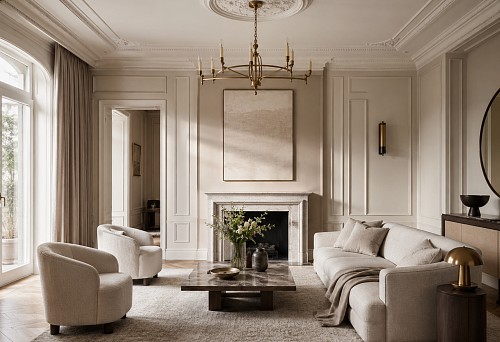
- Modern classic interior
- Russian style and interior with wooden decor
- Mistakes when designing an opening without a door: how not to ruin a good idea
- Portal composition and cross-linking: what and where to buy
- FAQ: answers to the most important questions about door portals
There is one moment in renovation that many people overlook — and then they can't understand for a long time why the interior seems unfinished. The door was removed. The walls were painted. The furniture was arranged. Everything is in place, but something is wrong. The passage between rooms — a bare rectangle with cut walls — looks like an unsealed construction gap, not a well-thought-out transition between spaces.
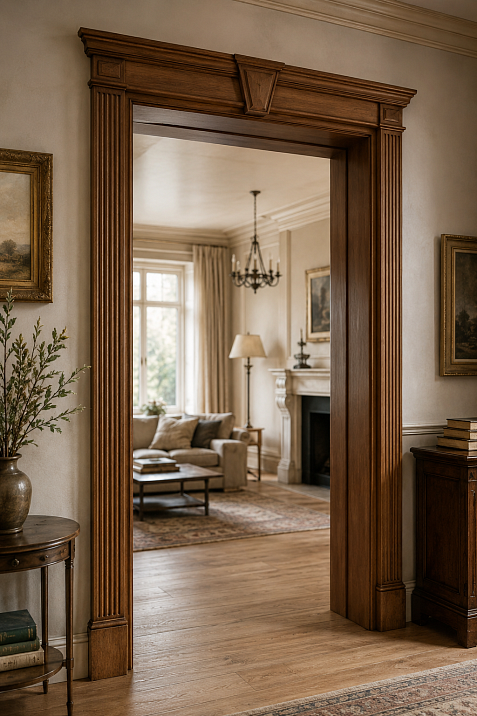
This is where door portalcomes into play. Not a trim. Not a molding. Not a decorative strip around the perimeter. But a full-fledged architectural frame that turns a functional opening into an interior accent. A wooden portal is what makes the transition between rooms an event, not just a hole in the wall.
In this article, we'll cover everything: what a portal is as an architectural element, which rooms need it, what parts it consists of, how it's matched to the style and proportions of the room — and why wood delivers a result that cannot be replicated with plastic or plaster.


Why an opening without a door often looks unfinished
When people remove the door between the kitchen and living room or create a wide passage from the hallway to the hall — it's a conscious decision in favor of open space. Air, light, a sense of spaciousness — all of this is correct and modern. But this decision comes with an architectural cost: a bare opening.
What is a bare opening? It's a wall with a rectangular cutout, the edges of which are either plastered or covered with cheap trims 30 mm wide. On two sides — two different interiors, with different finishes, furniture, and character. And between them — nothing. No "frame," no transition, no accent.
The eye senses this immediately, even if a person cannot explain why they feel uncomfortable. Because in a well-organized space, every transition is designed. In classical architecture, this was always known: an opening is a place where two spaces meet, and this place requires attention.




The opening as an architectural moment
In any building where architecture is done by a thoughtful person, openings are designed. This is not a luxury — it's a basic culture of space. An opening with a portal says: "Here one zone ends and another begins. This is an important moment in the organization of the home." A bare opening says: "Here there is simply no wall."
The difference in perception is enormous. And the cost of the solution is usually much less than it seems at first glance.
Our factory also produces:



What is a door portal and how does it differ from a regular trim
This question is worth examining honestly, because confusion here is common.
A platband is a profiled strip that covers the gap between the door frame and the wall. The width of a standard platband is 60–80 mm. Its purpose is purely technical: to close the joint. It does not form any architectural image; it simply completes the door installation.
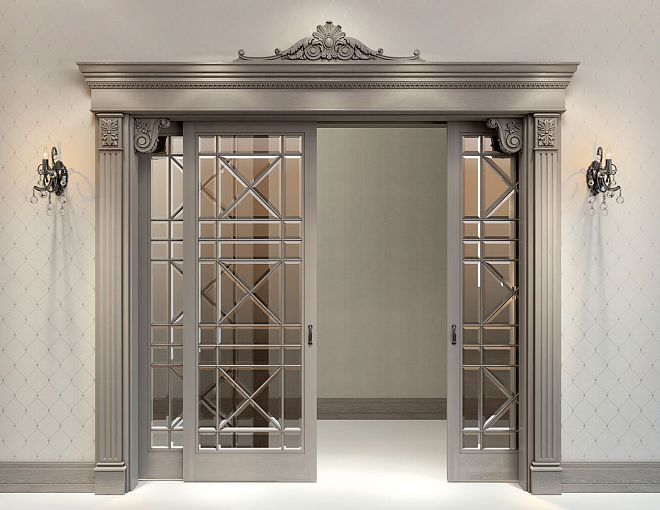
an interior portal — this is a different level. A portal is a system of architectural framing of an opening, which includes side posts (pilasters or columns), a top part (cornice, architrave, shelf), bases at the bottom, and decorative elements. A portal does not just close the joint — it creates the feeling of a frame-arch, which in character is closer to an architectural element than to trim.
If a platband is a signature under a document, then a portal is a seal with a coat of arms.
Get Consultation
Three levels of complexity: from platband to portal
To understand the range of solutions, it is useful to build a scale:
-
Simple platband: a profiled strip 60–80 mm around the perimeter of the opening. Minimalistic, functional, inexpensive.
-
Wide platband with profile: a strip 100–150 mm with a milled profile — already creates the feeling of a frame, but without an architectural accent.
-
Portal with pilasters: side vertical posts with capitals and bases, a top cornice — this is a full-fledged architectural framing.
-
Portal with columns or half-columns: maximum expressiveness, ceremonial appearance, classical architectural tradition.
door portal begins where there is a vertical post with a specific architectural profile — a pilaster, column, or composite structure with a base and capital.
Where to use a wooden interior portal: a complete scenario map
Wooden portal — is not a niche product for palaces and historic estates. It is a practical solution for a wide variety of living spaces. Here is where it works best.
Hallway — living room. This is the most common scenario. The transition from the entry area to the main space of the house is a fundamental architectural moment. The portal here says: you have entered a real home, not an apartment with a corridor.
Kitchen — living room or dining room. In open-plan layouts, this transition is especially important: it visually separates zones without a door. Portal between kitchen and living room — is a way to give each zone its own character while maintaining the unity of the space.
Hall — main room. In homes with a spacious hall, the portal becomes a grand accent. It emphasizes the transition to the main room of the house.
Study or library. Entering a study through a wooden portal is a powerful image. It sets the tone: serious people work here. Strict pilasters, a horizontal cornice, solid mass — this is the image of a study as a place of concentration.
Dining room. A separate dining room with a portal at the entrance is an interior statement that eating is a ritual, not just food intake.
Country house. Here, a wooden portal is organic in itself: natural material, warmth, character. The transition from the hallway to the living room through a wooden portal made of solid wood is something you want to touch with your hands.
A wide arched or rectangular opening without a door. Any non-standard opening with a width of 900 mm or more is a candidate for portal design.
Portal between kitchen and living room: a design solution that works
The modern trend towards open-plan layouts has created an architectural challenge that is not always solved correctly. The kitchen and living room are combined, but that doesn't mean there shouldn't be a visual boundary between them.
A door is no longer needed here — it would only cut the space and hinder the movement of air, light, and people. But a bare opening is also a bad answer. The right answer is — portal for a doorway without a door leaf.
What does it do in this scenario?
-
Creates a clear visual boundary between the kitchen area and the living room;
-
Adds a vertical accent that structures the open space;
-
Works as an architectural anchor: the eye finds support and a reference point;
-
Allows you to design both zones in their own character, but connect them through a single portal material.
A laconic one is ideal for this scenario an interior portal with low pilasters and a horizontal cornice: strict, not overloaded, but clear. The height of the pilasters is up to the level of the upper edge of the opening, the cornice is the width of the opening. Material — solid oak or beech with a coating coordinated with the kitchen set and living room furniture.
Color and tone of the portal in an open space
In the combined kitchen and living room space, a wooden portal should be an "arbitrator" in the dialogue between the two zones. Its color is either a continuation of the wooden elements of the kitchen (e.g., the tone of the facades), or a continuation of the wooden elements of the living room (tone of furniture, floor), or a neutral tone that works in both contexts.
A white portal with clear horizontals is a universal solution that works in both classic and modern interiors. Dark oak is stricter, more accent-focused. Natural light solid wood is warmth, organic, Scandinavian or Japanese spirit.
Portal to the hallway: first impression — architectural
The hallway is the first contact zone. Everything a person sees when crossing the threshold of your home shapes the impression of the house as a whole. And if a bare opening leads from the hallway to the living room, that impression will be of an unfinished home.
door portal at the entrance to the living room from the hallway — this is an interior gesture of immense power. It says: I have thought through this transition. This house is not a set of rooms, but an organized space with architectural logic.
What to consider for a portal in the hallway
Hallways in most apartments are small. This imposes limitations on the scale and type of the portal.
Width of pilasters. For a narrow hallway, pilasters 80–100 mm wide are optimal: they are noticeable but do not consume the side passage space.
Height of the cornice. If the ceiling in the hallway is 2.5–2.7 m, the cornice at the top of the portal can be modest, without a pronounced overhang. If the ceiling is higher than 3 m, the cornice profile can be more expressive.
Connection with hallway doors. The portal should be coordinated with the door frames of other doors in the hallway—in style, tone, and profile. Otherwise, it will look like random decor rather than an architectural system.
Floor line. Bases of pilasters or the lower parts of the posts should "sit" on the baseboard or correspond with it in level and tone. This creates a vertical connection from the floor to the cornice.
Straight or arched: choosing the portal shape
This is not just an aesthetic decision. The shape of the portal influences the character of the entire space.
Rectangular portal: strictness and versatility
Rectangular an interior portal — this is a horizontal cornice at the top and vertical posts on the sides. It conveys strictness, order, architectural clarity. This is a classic image that works in a huge range of styles: from strict classics to modern neoclassicism, from a study interior to a spacious living room with high ceilings.
A rectangular portal is the most versatile choice. It does not dictate style, but rather conforms to it. Its character is determined by details: the width of the pilasters, the profile of the cornice, the presence of carving or the purity of the surface.
Arched portal: softness and decorativeness
Arched portal for a doorway — this is a smooth arc at the top instead of a horizontal cornice. It adds softness, a "breathing" feel, and a romantic note to the interior.
An arch works well in interiors with soft lines, in the Mediterranean style, in country houses with warm finishes. It is less strict, but no less expressive.
An important practical point: an arched opening requires an appropriate wall height. With a ceiling of 2.5 m and an opening width of 1.2 m, the arch will be flat and visually compressed — this is not the best option. An arch requires space: a ceiling height of 3 m or more, or a relatively narrow opening in a tall room.
Wide and narrow: about scale
A wide portal (from 1.2 m) for large rooms and formal areas creates a sense of a grand entrance. Here, the pilasters should be wide enough to maintain the scale of the opening: for a width of 1.5–2 m, pilasters from 120 mm look convincing.
A standard interior opening 80–100 cm wide is a classic spot for a portal with pilasters 80–100 mm and a neat cornice. Precision in proportions is key here: too wide pilasters will "eat up" the opening, too narrow ones will get lost.
Portal with pilasters: verticality as the main architectural argument
pilasters — these are vertical protruding elements that imitate or continue the tradition of an architectural column, but in a flat execution. A pilaster is attached to the wall, not freestanding — this is its fundamental difference from a column.
What does a pilaster do to an opening? It stretches it vertically. Even a standard 210 cm high opening with pilasters looks noticeably taller — because the vertical line activates the vertical perception of space.
Decorative pilasters for a wooden portal are produced in several types. The most common is a pilaster with flutes (vertical grooves): it provides both vertical dynamics and tactile texture. A pilaster without flutes, with a smooth surface — laconic, modern. A pilaster with carved decor — expressive, classic.
Pilaster and style: where it works best
| Interior | Pilaster type | Finish |
|---|---|---|
| Classic | With flutes, wide | Dark oak, walnut, tinting |
| Neoclassical | Smooth or with a light profile | White, ivory |
| Suburban house | Brushed or with a live texture | Natural solid wood, varnish |
| Office | Strict, with minimal decor | Dark tint |
| Modern classic | Smooth, with a capital | White for painting |
Buy pilasters made of solid wood for an interior portal means getting a vertical architectural element that can be coated in any tone.
Pilaster trim: an intermediate solution
If a full portal with projecting pilasters seems too large-scale a solution for a specific opening, there is a compromise: a wide pilaster architrave. This wooden casing has a milled profile that imitates a pilaster 100–150 mm wide, but does not protrude as far from the wall. This is a soft transition between a simple architrave and a full portal — a good solution for small rooms or standard apartments.
Portal with columns and half-columns: when grandeur is needed
If pilasters provide verticality and structure, then wooden columns they make the portal a truly architectural statement. A column is a free-standing vertical support with a base and capital. In an interior context, it can stand in a pier next to an opening or be built into the portal structure.
Half-column is half a column attached to the wall. It provides the same architectural image as a full column but takes up significantly less space. This is a practical compromise between expressiveness and rationality.
Where columns are appropriate and where they are excessive
Wooden columns in an opening are a grand scale. They are appropriate in:
-
spacious living rooms with high ceilings (from 3 m);
-
country houses with large open spaces;
-
hall with classic trim;
-
studies with library shelving;
-
living rooms with a fireplace.
In a standard city apartment with a 2.7 m ceiling, columns in the doorway can be excessive. Pilasters or half-columns work better here: they give the same look but in more modest proportions.
Carved columns with decorative ornament — for interiors where wooden decor is a system: carved architraves, carved cornices, carved decor on furniture. Here a carved column naturally fits into this language. A smooth column without carving — for more austere and modern classical spaces.
Capital, base, cornice: anatomy of a beautiful portal
To choose a portal or assemble it from individual elements, it is important to understand its architectural composition. Each detail carries its own function — not only decorative but also structural.
Capital
Capital — is the crowning element of a column or pilaster. It is located at the top of the vertical post and visually 'carries' the horizontal cornice. The capital is the transition point from vertical to horizontal, from support to load.
In wooden portals, capitals come in several types:
-
Ionic — with characteristic scrolls (volutes);
-
Corinthian — with acanthus leaves, the most decorative;
-
Doric — strict, minimalist, almost without decoration;
-
Simplified modern — a rectangular overlay with a minimal profile for neoclassical and modern interiors.
The choice of capital type determines the "era" of the entire portal. Corinthian is triumph and richness. Doric is strictness and dignity. Modern simplified is elegance without historical references.
Base
The base is the lower element on which the column or pilaster stands. It performs several tasks: creates a clear lower boundary of the vertical element, visually "grounds" the pilaster, and connects it to the baseboard and floor.
The base should be coordinated with the baseboard in height: the bases and baseboard are located at the same horizontal level and in the same tone — this creates architectural coherence around the entire perimeter of the room.
Cornice
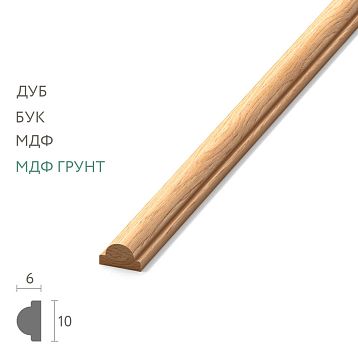
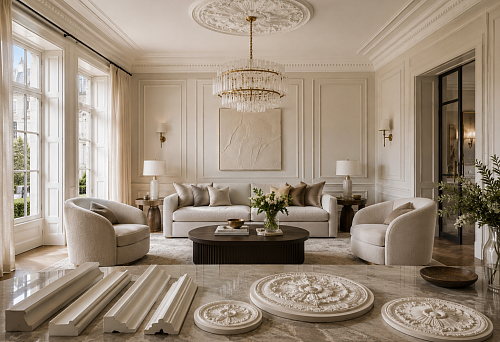
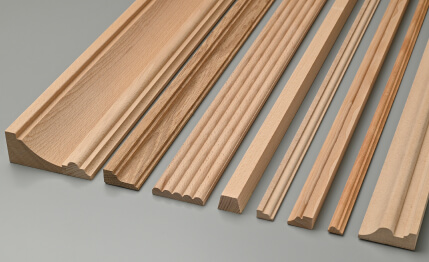
The horizontal cornice is the upper part of the portal that completes the entire structure. It rests on the capitals of the pilasters or columns and forms a horizontal "cap" above the opening. Wooden moldings and cornices for the portal can be either simple (one profiled strip) or composite (three or more strips in a multi-level profile).
A composite cornice with several levels of profile is a classic image, referencing order architecture. A single cornice with a neat milled profile is a modern, more concise solution.
Additional elements
-
Decorative rosettes — small round or square overlays in the corners of the cornice;
-
Carved overlays — ornamental elements on the frieze or in the capitals;
-
Moldings on the surface of pilasters — create additional horizontal divisions and enrich the texture;
-
Corner blocks at the junctions of vertical and horizontal elements — emphasize the architectural logic of assembly.
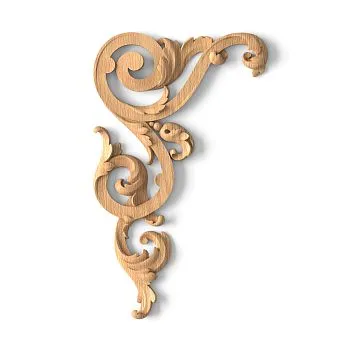
Carved wooden decoration STAVROS is a wide range of overlay elements that can be integrated into the portal: from small rosettes to large ornamental strips. This allows you to create a portal of any level of decorativeness — from ascetic to maximally rich.
How to choose a portal to match the interior style
Style is not just taste. It is a system of rules within which details work together. A wooden portal must follow these rules — otherwise it will look like a random quote from another era.
Classicism and neoclassicism
In a classic interior, the portal is a full-fledged architectural element with a clear order logic: base — pillar — capital — cornice. Pilasters with fluting, Ionic or Corinthian order capitals, a composite cornice with several profile levels. Dark or medium wood — stained oak, walnut, antique finish.
In neoclassicism — the same logic, but softer. Proportions are more restrained, decor is less active. Smooth pilasters with simple capitals, a laconic cornice, white or cream coating. This is classicism stripped of excess.
Country house and rustic
Here, wood is not a decorative technique, but the material basis of the interior. A portal in a country house is solid wood in a natural tone or with a soft tint, without complex architectural details, but with a lively wood texture. A brushed surface emphasizing the fiber structure is an excellent choice. wooden columns or massive oak pilasters — this is organic and durable at the same time.
Office
A study is a space of concentration and dignity. The portal here should be strict, vertical, without decorative excess. Dark wood, minimal carving, clear horizontal lines of the cornice — this image speaks of seriousness and order. Decorative pilasters without fluting or with vertical grooves — ideal.
Modern classic interior
This is the most common request today: an interior without historical references, but with wood, profiles, and order. The portal here consists of laconic pilasters 80–100 mm wide, a simple rectangular cornice without complex profiles, white finish or natural oak. No carving, no historical orders — only pure architectural logic.
Russian style and interior with wooden decor
if the interior already has Carved wooden decoration — overlays, ornaments, carved architraves — a portal with carved elements will fit organically into this context. A carved capital, an ornamental band on the cornice frieze, decorative overlays on the bases — all this continues the decorative language of the space.
Mistakes when framing an opening without a door: how not to ruin a good idea
Practice shows that even with the right intention, the result can disappoint — if a few fundamental mistakes are made.
Leaving the opening without any framing at all. The most common mistake. "We'll figure it out later" turns into "we've been living like this for several years." A bare opening between two finished rooms is an architectural incompleteness that is always felt.
Installing too thin a trim on a wide passage. A 60 mm trim on a 140 cm wide opening is disproportionate. A narrow strip gets lost against the background of a wide passage. The width of the framing should be proportional to the width of the opening.
Not linking the portal with the baseboard and doors. A portal that is not connected in style and tone to other wooden elements in the room — door trims, baseboards, wooden furniture — is perceived as random decor, not as part of the architectural system.
Choosing overly active decor for a small room. A massive portal with columns and a composite cornice in a room of 12 sq. m is like a grand entrance to a doghouse. The decor should match the scale of the space.
Not considering the ceiling height. A portal with high pilasters in a room with low ceilings enhances the feeling of pressure. In a room with a ceiling lower than 2.7 m, the pilasters should end not at the ceiling but slightly lower — or the portal cornice should be modest in projection.
Forgetting about symmetry. A portal is a symmetrical structure by definition. If the wall next to the opening is asymmetrical (more space on one side, less on the other), this needs to be addressed at the design stage — possibly with an asymmetrical solution or by adjusting the position of elements.
Mixing different styles of pilasters and cornices. An Ionic capital on a pilaster and a modern minimalist cornice is a conflict of 'eras' that destroys the image. All elements of the portal must belong to the same style family.
Making the portal 'piece by piece'. First installing pilasters, then adding a cornice a year later — this is a path to an inconsistent result. The portal should be designed and installed as a single system.
Ignoring the floor connection. The base of the pilaster or the lower part of the portal should 'meet' the baseboard. If the baseboard goes under the pilaster or, conversely, the pilaster cuts off the baseboard — this is a carelessness that catches the eye.
Portal composition and cross-linking: what and where to buy
A wooden portal is a system that can be purchased as a ready-made solution or assembled from individual elements. STAVROS offers both options.
For ready-made portals and interior solutions — section door portals: here are complete solutions for decorating openings.
For component assembly — full catalog of solid wood:
-
pilasters and columns — side vertical posts in different profiles and sizes;
-
Decorative pilasters — flat wall-mounted elements;
-
half-columns — wall-mounted volumetric vertical elements;
-
Carved columns — decorative option with carved ornament;
-
Wooden capitals — crowning elements for pilasters and columns;
-
Wooden moldings and cornices — horizontal profile elements for the cornice part;
-
Wooden casings — for additional framing elements;
-
Carved wooden decoration — overhead sockets, ornaments, frieze inserts.
Buy an interior portal or buy a door portal with delivery to St. Petersburg and Russia can be done through the STAVROS catalog.
STAVROS is a Russian manufacturer of wooden architectural elements and solid wood products. Portals, pilasters, columns, capitals, architraves, moldings, cornices, carved decor — everything is produced at our own facility from selected solid hardwood with full quality control. More than 4000 items in the catalog, real warehouse, shipment from one piece. STAVROS understands: an opening without a door is not a problem. It is an opportunity. An opportunity to create an architectural accent that will make your interior complete, alive, and authentic.
FAQ: answers to the most important questions about a door portal
What is a door portal?
door portal — it is an architectural framing of an opening that includes side posts (pilasters or columns), capitals, bases, and a horizontal cornice. It is used both in openings with doors and in open passages without a door leaf.
How does an interior portal differ from an architrave?
An architrave covers the joint around the perimeter of the door — it is a functional detail 60–80 mm wide. an interior portal forms an architectural framing with pilasters, cornice, and decorative elements — it is an interior accent.
Can a portal be installed in an opening without a door?
Yes, this is one of the best use cases. The portal visually frames the open passage, making the transition between zones architecturally complete.
Where is a wooden interior portal most often used?
Most often — in the transition from the hallway to the living room, between the kitchen and dining room, in studies, halls of country houses, and in wide openings without doors.
What is a wooden portal assembled from?
From pilasters or columns, capitals, bases, crown moldings, casings и carved decor elements.
Which portal should I choose for a modern interior?
For a modern classic or neoclassical interior, laconic pilasters without carving, a simple cornice, and a finish in white or natural oak are suitable. The main principle is clean proportions and consistency with other wooden elements in the room.
Do I need to order the portal as a whole or can it be assembled from individual elements?
Both options are possible. Buy an interior portal As a ready-made solution — fast and convenient. Assembling from individual STAVROS elements is flexible and allows precise adjustment to a specific opening and interior style.