










































































Article Contents:
- Why size matters more than ornament
- Three parameters that determine scale
- How ceiling height determines everything
- Ceiling up to 2.7 m: work delicately
- Ceiling 2.8–3 m: the golden standard
- Ceiling above 3 m: need expressiveness
- How to choose molding width: precise guidelines
- Proportion rule: molding to wall height
- Narrow moldings: subtlety as a technique
- Medium moldings: a universal format
- Wide moldings: monumentality and character
- How to check scale before buying: a simple method
- How to choose the size of a ceiling rosette
- Room area as a basis for calculation
- Ceiling height: scale correction
- Chandelier diameter: the connection between decor and light fixture
- Rosette without a chandelier: independent decor
- Ceiling contour as an extension of the rosette
- Decorative stucco: how not to make a mistake with the size of the accent
- Small format decorative stucco: delicacy as an advantage
- Medium format: the workhorse of design
- Large format: decor with architectural character
- Stucco decor: when to use paired elements
- Where pairing is mandatory
- When a single element is appropriate
- Mirror versions: check before ordering
- How scale depends on the room: breakdown by room type
- Living room: expressiveness without overload
- Bedroom: peace and delicacy
- Hallway: first impression in a limited space
- Study: strictness and monumentality
- Hall and formal areas: maximum scale
- Table: scale by task type
- What else influences scale selection: additional parameters
- Viewing distance
- Painting: how color changes perceived scale
- Interior style and perceived weight
- Typical mistakes when choosing scale: how to avoid them
- Mistake 1. Too thin molding on a large wall
- Mistake 2. Too large rosette in a small room
- Mistake 3. Small stucco decor without framing
- Mistake 4. Large decor in a narrow hallway
- Mistake 5. Cornice with an overhang disproportionate to the ceiling
- FAQ: answers to the most common questions about the size of stucco
- What width of moldings should I buy for a wall?
- How to choose the size of a ceiling rose?
- Why can decorative stucco on a wall get lost?
- What to buy for a large wall?
- Can I use large stucco in a small room?
- How to avoid mistakes with size if it's hard to imagine?
- STAVROS: professional scale selection from the full catalog
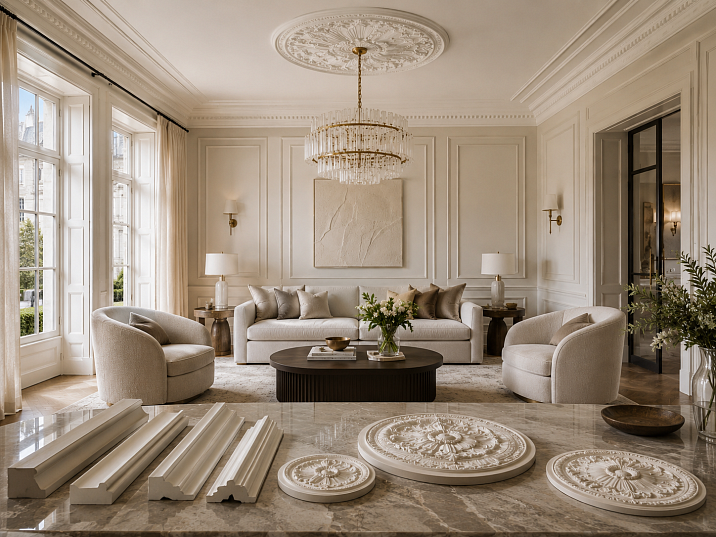
There is a mistake most often made when buying decor — and it's not about choosing the pattern, style, or color. It's about scale. A person finds a beautiful molding, orders it — and gets a thin strip on a large wall that can't be seen from two meters away. Or chooses an impressive ceiling rosette — and it either gets lost on a high ceiling or overwhelms a small room with its diameter. Or places an elegant Relief Decoration above the sofa — and it looks like a random detail, not an accent.
Scale in interior design is not a matter of taste. It's a professional tool. And it determines whether it will Moldings look expensive or random. This article is a detailed practical breakdown of how to choose the size: molding, rosette, decorative overlay, stucco accent. For each type of room, for each ceiling height, for each task.



Why size matters more than pattern
This statement sounds provocative — but it's true. Choose the right scale of molding with the simplest profile, and the wall will look expensive. Choose the wrong scale with the most exquisite pattern — and the effect will be the opposite.
Why? Because the human eye reads space primarily through proportions, and only then through details. The brain first answers the question "is this proportionate?" — and only then starts to read the pattern. If the proportion is off, details won't save it.
to buy molding correctly means first determining the scale, and only then choosing the pattern. This changes the sequence of selection, and it's not random: scale is primary.




Three parameters that determine scale
The correct size of molding for a specific interior is determined by three variables:
Ceiling height. This is the main reference for vertical scale — how wide the cornice can be, how large the ceiling rosette should be.
Room area and proportions. A large wall requires larger elements. A narrow hallway — delicate ones. A square room — balanced ones.
Viewing distance. How far will a person be from the decorative element at the moment of perception? Above a sofa in the living room — a distance of 3–4 meters. On a furniture facade in the hallway — 1–1.5 meters. This is a critically important parameter that directly influences the choice of size.
Only knowing all three parameters can you confidently Buy molding choose the right scale — and get a result that looks professional.
Our factory also produces:


How ceiling height determines everything
Ceiling height is the starting point for any choice in the field of stucco decor. It is not just one characteristic, it is a system-forming parameter. All other decisions — the width of the molding, the diameter of the rosette, the size of the decorative overlay — are made after you know the ceiling height.
Get Consultation
Ceiling up to 2.7 m: work delicately
A low ceiling is not a death sentence, but it requires discipline. The main mistake in such rooms is a cornice that is too wide or a rosette that is too large, which visually makes the ceiling seem even lower.
What works with ceilings up to 2.7 m:
-
A cornice with a projection from the wall of no more than 55–60 mm — lightweight, with a shallow profile
-
A ceiling rosette with a diameter of up to 30 cm — delicate, without a massive relief
-
Moldings made of polyurethane 20–35 mm wide for wall frames
-
Decorative overlays of small and medium format — without overloading the vertical
With a low ceiling, the technique of vertical moldings works especially well: they visually 'stretch' the height and create a feeling of more space. But the moldings themselves should be small — otherwise the effect is the opposite.
Ceiling molding For a low ceiling, this is a cornice with a horizontal flat profile without a deep projection. It creates a horizontal frame and does not 'eat up' the height.
Ceiling 2.8–3 m: the golden standard
This is the range where almost all standard solutions work. Standard cornices, medium moldings, rosettes of classic diameters — everything is designed for this height. Here you have the greatest choice and the least risk of error.
Guidelines for ceilings 2.8–3 m:
-
Cornice with projection 60–100 mm, with a moderate profile
-
Ceiling rosette with a diameter of 35–50 cm
-
Moldings for wall frames 30–60 mm wide
-
Medium-format decorative overlays — clearly visible from a distance of 3–4 meters
Buy ceiling molding for this range, you can use almost any standard line without risking a scale mistake. The main thing is to maintain the proportion between the cornice and the rosette: they should be from the same stylistic family.
Ceiling above 3 m: expressiveness needed
A high ceiling is a luxury that is easy to spoil with the wrong scale. A standard 30 mm wide molding on a wall with a 3.5 m ceiling looks like a thread. A 35 cm diameter rosette on a 4 m ceiling looks like a coin.
What works with ceilings above 3 m:
-
Cornice with projection 100 mm or more, with a pronounced multi-step profile
-
Ceiling rosette with a diameter of 55–60 cm for standard halls, from 80 cm for formal spaces
-
Moldings made of polyurethane 60–100 mm wide for wall panels
-
Large-format decorative overlays — visible from 5–6 meters away or more
For high ceilings, the system is especially important: moldings, cornice, rosette — everything should be a unified ensemble, not a set of separate elements of different scales.
How to choose the width of a molding: precise guidelines
This is the most common question when buying stucco decor. The catalog of polyurethane moldings may contain hundreds of items. How to choose the width if everything looks beautiful in the photo?
Proportion rule: molding to wall height
There is a simple ratio that works flawlessly: the width of the molding for a wall panel should not exceed 1/30 of the room height. This is not a strict rule, but a good guideline.
-
Height 2.5 m → molding width up to 80 mm
-
Height 2.8 m → molding width up to 90 mm
-
Height 3.2 m → molding width up to 100–110 mm
-
Height 4 m → molding width up to 130 mm or more
For cornices, it's slightly different: the cornice includes the projection from the wall, and this parameter is more important than the width. A cornice with an 80 mm projection on a 3 m ceiling looks proportionate. The same cornice with a 2.5 m ceiling already feels heavy.
Narrow moldings: thinness as a technique
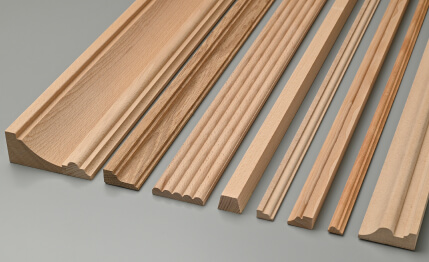
Narrow moldings — from 15 to 30 mm — are not a simplification, but a design choice. They work perfectly in several scenarios:
-
Small rooms and apartments with ceilings up to 2.7 m, where wider molding would look heavy
-
Furniture facades: cabinet doors, kitchen units, dressers — here, thin molding around the facade creates a frame without overloading
-
Thin vertical partitions — a narrow wall section between a window and a corner: a 20–25 mm molding creates an accent without covering the space
-
Modern classic and neoclassical — where decor should be restrained and precise, not lavish
Buy polyurethane moldings in a narrow profile means choosing a tool for delicate surface work.
Medium moldings: a universal format
Moldings 35–60 mm wide are the most popular range. They are most often used in wall frames in living rooms, bedrooms, and hallways. They are clearly visible from a distance of 3–5 meters, create an expressive frame, and do not overload the wall.
Universal scenarios for medium moldings:
-
Wall behind the sofa in the living room
-
Accent wall in the bedroom behind the headboard
-
Molding frame for mirror
-
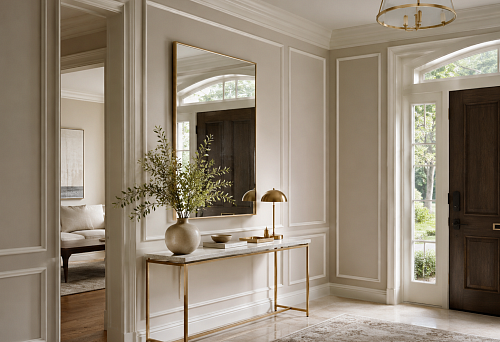
Console area in the hallway or living room
-
Wall in the study
buy polyurethane moldings choosing a medium profile means selecting a format that suits most residential interiors without a preliminary design project.
Wide moldings: monumentality and character
Wide moldings — from 70 mm and above — are a choice for spaces with a claim to architectural weight. They work where a result is needed that is immediately visible, without having to approach closely.
Scenarios for wide molding:
-
Large walls in spacious living rooms and halls
-
High ceilings from 3 m and above
-
Lobbies and grand vestibules
-
Offices in executive style
-
Formal frames around fireplace portals
Important caveat: wide molding in a small room is a mistake. It is not just "large", it compresses the space and makes it heavy. Rule: the smaller the room, the thinner the molding.
How to check scale before purchase: a simple method
There is a practical way to check if the molding of the desired size will look right — before ordering it. Take a strip of paper or tape of the required width and stick it on the wall in several places of the intended frame. Step back to a normal viewing distance — 3–4 meters for a living room, 1.5 meters for a hallway. Look. This takes 5 minutes and prevents ordering the wrong scale.
How to choose the size of a ceiling rosette
A ceiling rosette is the only decorative element visible from any point in the room at any time. That's why a mistake in its size is the most noticeable.
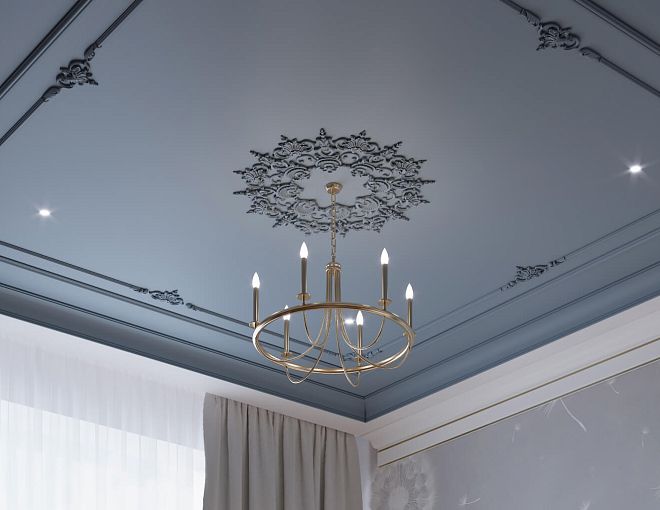
Ceiling molding Choosing a rosette requires careful consideration of four parameters: room area, ceiling height, chandelier diameter, and the presence or absence of a ceiling contour.
Room area as the basis for calculation
Basic guideline: the rosette diameter is 1/8–1/10 of the shorter side of the room.
Practical examples:
-
Room 3×4 m → rosette diameter 30–37 cm
-
Room 4×5 m → rosette 40–50 cm
-
Room 5×6 m → rosette 50–60 cm
-
Hall 7×8 m → rosette 70–80 cm or more
This is not a rigid rule — it's a starting point from which you can deviate in either direction depending on other parameters.
Ceiling height: scale adjustment
A high ceiling allows (and requires) increasing the rosette diameter. A low ceiling — decreasing it. Why? Because with a low ceiling, a large rosette "approaches" the eye and appears even larger. With a high ceiling, the rosette "recedes" and needs additional scale so as not to get lost.
Ceiling height adjustment:
-
Ceiling up to 2.7 m → reduce base diameter by 10–15%
-
Ceiling 2.8–3 m → base diameter
-
Ceiling 3–3.5 m → increase base diameter by 15–20%
-
Ceiling above 3.5 m → consider rosette + ceiling square made of moldings
Chandelier diameter: connection between decor and light fixture
If there is a chandelier above the rosette, its diameter becomes an important reference. Optimal ratio: the rosette diameter should equal the chandelier diameter or exceed it by 20–30%.
This creates the correct visual connection: the rosette frames the chandelier, rather than disappearing behind it. If the rosette is smaller than the chandelier, it is "overwhelmed" by the light fixture. If the rosette is noticeably larger, it works as an independent decorative accent, which can also be beautiful but must be intentional.
Buy ceiling molding Choosing a socket for a specific chandelier means knowing the chandelier's diameter before purchasing. This is a simple rule, but it is often broken: first, a socket is bought, then a chandelier of a different size.
Socket without a chandelier: independent decor
A socket does not have to be a "stand" for a chandelier. In rooms with hidden lighting, spotlights, or ceiling backlighting without a central light fixture, the socket can serve as an independent decorative object — a medallion on the ceiling.
In this case, its size is determined solely by the room's proportions and ceiling height, without reference to the chandelier. For such use, you can choose sockets slightly larger than standard — they will create a more expressive accent.
Ceiling contour as an extension of the socket
In spacious rooms, a single socket is often insufficient to create a "closed" ceiling center. Here, a ceiling square or rectangle made of moldings around the socket comes to the rescue — this is the ceiling contour.
The contour allows you to visually "expand" the central accent zone and fit it into the proportions of a large ceiling. Buy ceiling stucco molding For such a system, it means ordering a socket of the required diameter, ceiling moldings for the contour, and corner blocks.
Decorative stucco: how not to make a mistake with the scale of the accent
Decorative stucco is a pinpoint tool. It places a pause in the right spot, creates an accent, and enlivens a detail. But it is precisely here that scale errors occur especially often: a small overlay on a large wall disappears, a large one in a narrow corridor feels oppressive.
Let's break it down by formats.
Small format decorative molding: delicacy as a virtue
Small decorative overlays — up to 15–20 cm on the larger side — are a tool for delicate accent. They don't claim to be the main wall decoration, but work excellently in supporting roles.
Where small format is appropriate decorative molding:
-
On furniture facades — doors, drawers, panels
-
In corner blocks of molding frames — as part of a system
-
On a narrow wall in the hallway — where there's no room for a large accent
-
Paired details on either side of a mirror or sconce — where symmetry is needed, not dominance
-
In small niches and on decorative shelves
Important: small decor works well only when there are several of them — in pairs, groups of four, or in a system with moldings. One small overlay on a large wall is not an accent, it's a lost detail.
Medium format: the workhorse of design
Medium-sized decorative overlays — from 20 to 40 cm on the larger side — are the most sought-after format in residential interiors. They are clearly visible from a distance of 3–4 meters, create an expressive accent, and do not overwhelm the surface.
Where the medium format works buy decorative stucco molding:
-
Center of a molding frame on a living room or bedroom wall
-
Above a mirror in the hallway or bedroom
-
Above a console — as a vertical accent over a horizontal shelf
-
Headboard area — central accent above the bed
-
Sconces and lamps — decor next to or above them
With the right placement, the medium format creates exactly the visual pause that most interiors without a design project lack.
Large format: decor with architectural character
Large decorative overlays and high reliefs — from 40 cm and above on the longer side — are already architectural objects. They require an appropriate scale of space and the right placement.
Where large format is appropriate decorative molding:
-
Halls and grand foyers with high ceilings
-
Fireplace portals — the central accent of the facade part
-
Large accent walls in the hall or main living room
-
Stairwells with a height of 3.5 m or more
-
Large-scale architectural niches
Large decor is a bold solution. It works well in combination with moldings and other elements that create a system around it.
Stucco decor: when to take paired elements
This is a separate topic that often goes unnoticed when choosing. Relief Decoration almost always looks more convincing as a pair than as a single element. Why?
Symmetry is one of the most powerful visual signals that the brain reads automatically. Two identical elements on either side of a mirror, two brackets on a console, two decorative corners in a frame — this immediately creates a sense of intention, thoughtfulness, and professional design.
Where pairing is mandatory
There are several areas where pairing Buy Moldings is not an option, but a requirement:
-
On either side of the mirror — two symmetrical elements create a frame
-
On both sides of the bed headboard — symmetry in the bedroom
-
In the corner blocks of molding frames — all four corners are identical
-
For sconces — two lights on one wall require two identical decorative accents
-
On furniture facades — each door should have a matching frame
When a single element is appropriate
Single Relief Decoration works in several specific scenarios:
-
A central medallion in the middle of a molding frame — it is alone, and that is correct
-
An accent high relief on an asymmetrical wall — intentional asymmetry as an artistic technique
-
A keystone above an arch or doorway — one by its very form
It is important to understand the difference: a single element placed without a pair where a pair is needed is a mistake. A single element in a central position is a solution.
Mirror versions: check before ordering
If the ornament of the overlay is asymmetrical — a branch pointing to the right, a bird with its head turned, a figure with a pronounced direction — a mirror version is needed. Before ordering, make sure the catalog has a mirror version of the required element.
Buy Molded Decoration in a pair without checking for mirroring means risking getting two elements looking in the same direction instead of a symmetrical pair.
How scale depends on the room: a breakdown by room type
Moving from theory to specific spaces. Each room has its own logic for choosing scale.
Living room: expressiveness without overload
The living room is the main space of the apartment. The largest scale of decor is acceptable here, but only if systematic.
Guidelines for a standard living room (ceiling 2.8–3 m, area 18–25 sq m):
-
Wall moldings: 40–60 mm wide
-
Ceiling cornice: projection 70–100 mm
-
Ceiling rosette: 40–55 cm in diameter
-
Decorative accents: medium and medium-large format
The main rule of the living room: the wall behind the sofa — one main accent. Not five elements, not a patchwork rug, but one central one Relief Decoration or a medallion in a system of molding frames.
Bedroom: peace and delicacy
The bedroom requires a softer approach. Here, decor should be present but not dominant.
Guidelines for the bedroom (ceiling 2.7–2.9 m, area 14–18 sq m):
-
Wall moldings: 30–45 mm
-
Ceiling cornice: projection 50–70 mm
-
Ceiling rosette: 30–40 cm
-
Decorative accents: delicate medium format
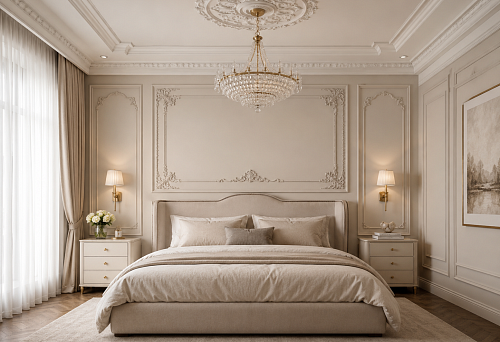
The main zone of the bedroom is the wall behind the headboard. A molding frame 30–40 mm wide with paired decorative accents on the sides is a restrained yet expressive solution.
Hallway: first impression in a limited space
The hallway is a challenge: little space, but the task is to create a first impression.
Guidelines for a standard hallway (ceiling 2.5–2.8 m, wall width 1–2 m):
-
Moldings: 20–35 mm — narrow, creating a vertical line
-
Cornice: lightweight, with an overhang of 40–60 mm
-
Ceiling rosette: not needed or up to 25–30 cm if the ceiling allows
-
Decorative accents: small or medium format above the mirror
In the hallway, verticality is important. Moldings should go from the baseboard upward, creating a sense of height. buy decorative moldings for the hallway, focus on one main accent — above the mirror.
Study: strictness and monumentality
The study is a space with a distinct character. Heavier profiles and monumental elements are acceptable here.
Guidelines for a study (ceiling 2.8–3.2 m, area 12–20 sq m):
-
Moldings: 50–80 mm — strict, geometric profiles
-
Cornice: 80–100 mm projection
-
Decorative accents: expressive, with geometric or classic ornament
The main wall of the study is behind the desk. buy polyurethane moldings Using a frame system on this wall means making the workspace architecturally significant.
Hall and formal areas: maximum scale
Formal halls and large vestibules are the territory of maximum scale. The widest profiles, largest rosettes, and most monumental decor work here.
Guidelines for a hall (ceiling 3.5 m and above, area from 25 sq m):
-
Moldings: 80–130 mm and more
-
Cornice: projection from 120 mm, multi-level profile
-
Ceiling rosette: 70 cm or more, or rosette + ceiling square
-
Decorative accents: large format, possible high reliefs and multi-component compositions
Table: scale by task type
| Task | Molding width | Socket diameter | Decorative molding format |
|---|---|---|---|
| Small room, ceiling up to 2.7 m | 20–35 mm | Up to 30 cm | Small and medium |
| Standard living room, ceiling 2.8–3 m | 40–60 mm | 40–55 cm | Medium and medium-large |
| Large room, ceiling 3+ m | 60–100 mm | 55–80 cm | Large |
| Hallway, narrow corridor | 20–30 mm | up to 25 cm or none | Small above mirror |
| Furniture front | 10–25 mm | — | Small |
| Grand hall, high ceiling | 80–130 mm+ | 70 cm+ | Large and monumental |
What else influences scale selection: additional parameters
Viewing distance
This is perhaps the most ignored parameter when choosing decor. And it is critically important. A decorative panel above the headboard of a bed is viewed from a distance of 2–2.5 meters. Decor above a sofa is viewed from a distance of 3–4 meters. Decor in the hallway above the entrance is viewed from a distance of 5–6 meters.
With each meter of distance, the scale of the element should be increased by about 15–20%. What looks expressive at a distance of 2 meters looks like a trifle from 5 meters.
Painting: how color changes perceived scale
Molding in the color of the wall is perceived as smaller than the same molding in a contrasting color. This is a visual effect: contrast 'brings' the object closer and makes it more noticeable.
Practical conclusion: if you plan to paint the decor in the color of the wall, choose moldings and panels 10–15% larger than seems necessary. After painting, they will visually 'shrink' and fall into the correct scale.
Interior style and perceived weight
A strict geometric profile of a 50 mm wide molding looks lighter than a complex multi-step profile of the same width. This is "optical weight" — how much space the decor "occupies" in perception, regardless of actual dimensions.
Decorative stucco with a flat, delicate relief looks lighter than the same area with a deep, convex ornament. For small spaces, it is important to consider not only the physical size but also the optical weight.
Typical mistakes when choosing scale: how to avoid them
Mistake 1. Too thin molding on a large wall
A 20 mm wide molding on a 3×3 meter wall with a 3 meter ceiling looks like a thread. The frame is there, but it is practically invisible. All installation efforts are wasted: there is no effect.
Solution: for large walls, choose molding no narrower than 50–60 mm.
Mistake 2. Too large a ceiling medallion in a small room
A ceiling medallion with a diameter of 60 cm in a 3×3 meter room with a 2.5 m ceiling creates an anxious feeling: the ceiling seems to press down. The medallion occupies too large a share of the visible ceiling space.
Solution: the diameter of the medallion should be no more than 1/8 of the shorter side of the room.
Error 3. Small stucco decor without framing
One small appliqué on a large wall without moldings and without a system around it looks like an accident. Not like an accent, but like "they glued whatever they found."
Solution: stucco decor should either be large enough to work on its own, or be integrated into a system of moldings.
Error 4. Large decor in a narrow corridor
A high relief 50×40 cm on a corridor wall 1 meter wide is a visual disaster. The decor does not fit into the space, looks like a random item from another interior.
Solution: in narrow spaces — only delicate elements. Rule: the width of the decorative element should not exceed 1/3 of the wall width.
Error 5. Cornice with an overhang disproportionate to the ceiling
A cornice with an overhang of 120 mm with a ceiling of 2.5 m "eats" the height: it takes up almost 5% of the entire wall height. The ceiling seems even lower.
Solution: the cornice overhang should not exceed 3–4% of the room height. With a ceiling of 2.5 m — the maximum overhang is about 80–90 mm.
FAQ: answers to the most common questions about the size of stucco molding
What width of moldings should I buy for the wall?
It depends on the ceiling height and room size. For a small room with a ceiling up to 2.7 m — Moldings made of polyurethane 20–35 mm wide. For a standard living room — 40–60 mm. For spacious halls and high ceilings — from 60 mm and above.
How to choose the size of a ceiling rosette?
Basic calculation: socket diameter = 1/8–1/10 of the smaller side of the room. Adjust based on ceiling height and chandelier diameter. Buy ceiling stucco molding taking into account all three parameters.
Why can decorative stucco on the wall get lost?
Most often due to small size or lack of a framing system. A small overlay on a large wall without a molding frame looks random. Solution: buy decorative moldings proportionally to the wall — or fit a small element into a system of moldings.
What to buy for a large wall?
Moldings made of polyurethane 50–80 mm wide for frames, Relief Decoration medium or large format for accents, ceiling molding to finish the top.
Can you use large molding in a small room?
Yes, but only as one main accent — and nothing else large nearby. One expressive high relief above a console in a 4 sq. m hallway is an artistic technique. Four large overlays on four walls of the same hallway is overload.
How to avoid mistakes with size if it's hard to imagine?
Make a paper mockup: cut out a rectangle of the desired size from paper and attach it to the wall. Step back to a normal viewing distance. This is exactly how the decor will look after installation. This method works for moldings, decorative overlays, and rosettes.
STAVROS: professional scale selection from the full catalog
All the elements discussed in this article — Moldings made of polyurethane of different profiles and widths, Decorative stucco of all formats, Ceiling molding и ceiling rosettes of different diameters, Relief Decoration for any task — presented in the STAVROS company catalog.
STAVROS produces polyurethane decor with precision casting from high-density European raw materials. Each series includes a complete system: moldings, corner blocks, cornices, baseboards, decorative overlays, and rosettes, compatible in proportions and style. This allows you to choose the scale systematically — rather than assembling incompatible elements from different collections.
to buy molding choosing from the STAVROS catalog means selecting not at random, but with an understanding of proportions: here each element has clear dimensions, photos in real interiors, and a systemic connection with other elements of the series. The right scale is not luck. It is the result of the right choice.