










































































Article Contents:
- Why a plastic corner destroys wooden trim
- Three reasons to give up plastic in a wooden interior
- What is a wooden corner and where it works
- External wooden corner: protection and order in the most vulnerable place
- Load and wood species: what matters more
- Corner and baseboard: architectural connection
- Wooden corner for paneling: how a joint becomes a detail
- Corner shelf width and paneling thickness
- Wooden corner piece for internal corners
- Wooden corner piece for slopes: neat finish of a window opening
- Installing a corner piece on a slope: two methods
- Decorative wooden corner piece: when protection becomes an accent
- Corner piece as a vertical line in the interior
- Where a wooden corner piece is especially needed: application map
- Hallway and corridor
- Wooden house and country cottage
- Bathhouse and sauna
- Kitchen-living room with wooden panels
- Staircase hall and stairs
- Furniture ends and decorative details
- Decorative boxes and niches
- How to choose the size of a wooden corner: from 20×20 to 100×100
- How to measure the required size
- Not all wood is the same: how to choose the species for a corner
- Oak
- Oak
- Coniferous species (pine, spruce, larch)
- For painting
- Wooden corner in the trim molding system
- Installation joints: how the corner fits into the system
- Mistakes when choosing and installing a wooden corner
- Where to buy wooden corners for finishing
- FAQ: answers to important questions about wooden corners
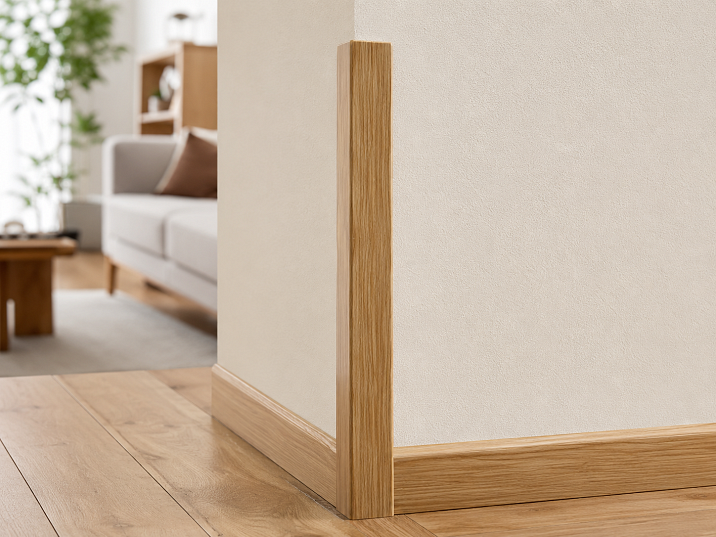
Imagine: you've invested time and money in good wooden trim. Pine or oak paneling, slats on the walls, wooden panels in the hallway — everything is alive, warm, natural. And then the final touch: an external corner. And here — a white plastic corner. The kind sold at every building market in packs of twenty. It covers the joint, yes. But its very presence says that the trim wasn't thought through to the end.
Wooden angle — this is not just an alternative to plastic. It is a profile that simultaneously protects the corner and continues the language of natural materials throughout the space. It works both technically and aesthetically — something you fundamentally cannot expect from a plastic profile.
Today we'll cover everything: why a wooden corner is needed, where it is indispensable, how to choose the size and material, in which scenarios it is mandatory — and why proper corner finishing affects the impression of the entire interior much more than it seems.




Why a plastic corner piece ruins wooden trim
There are things that are hard to explain rationally but easy to feel. The sense that "something is off" when entering a room finished with wood but with plastic on the corners — that's exactly this category. The interior feels like it hasn't been read to the last word.
It's not just about aesthetics. It's about material consistency. When wooden trim meets a corner — and stops there, hidden behind white or beige plastic — a visual break occurs. Plastic has no texture, casts no shadows, and doesn't resonate with the wood's color or warmth. It simply covers the problem. Technically — yes. Artistically — no.
Wooden corner bracket solves the problem differently: it extends the trim all the way to the edge. The corner becomes not a place where the wood "ends," but where it neatly turns — and that looks like a completed thought, not a construction necessity.




Three reasons to ditch plastic in a wooden interior
First — visual inconsistency. Plastic and natural wood are fundamentally different materials in texture, warmth, and light reflection. They don't get along. Plastic next to wood always looks cheaper than it actually is.
Second — lack of durability. Plastic corner pieces yellow, crack, and peel — especially under temperature and humidity fluctuations. In a country house or sauna, they age noticeably faster than wood.
Third — inability to refine. A plastic profile cannot be painted to the right shade, cannot be tinted to match the paneling, cannot be sanded. A wooden corner piece — can.
Our factory also produces:




What is a wooden corner piece and where it works
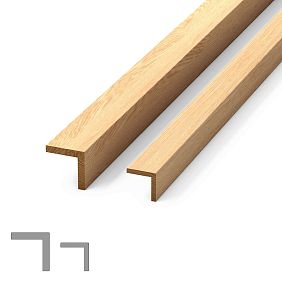
Technically, a wooden corner piece is a linear profile in the shape of the letter "G" (or "L") that is applied to an external corner of a wall, slope, column, furniture edge, or structure. The two flanges of the corner piece cover the adjacent surfaces on both sides — and hide the joint, protect the edge, and create a neat line.
It's a simple product. But in the right place, it does a colossal job.
Wooden angles for finishing used wherever there is an external corner in an interior with wooden or wood-containing finishes:
-
External corners of walls lined with clapboard, slats or wooden panels;
-
Window and door slopes;
-
Corners of decorative boxes, niches and ledges;
-
Ends of furniture panels and parts;
-
Corners of slatted partitions;
-
External corners of decorative columns and pylons;
-
Corner joints of wooden staircase structures.
Everywhere where wood meets wood at a 90° angle — that's the place for a wooden corner.
Get Consultation
External wooden corner: protection and order in the most vulnerable spot
External corners are a vulnerable point of any finish. They take everything: a corner hit by furniture during a move, an accidental touch from a vacuum cleaner, children's toys in the hallway, bags in the entryway. If the corner is poorly protected, the finish here is the first to be destroyed.
External wooden corner covers the end of the finish and takes mechanical load upon itself. It works as a buffer: a soft impact hits it, not the unprotected edge of a board or panel. At the same time, unlike a metal protective corner, the wooden profile is not cold, does not harshly reflect light, and does not look like a construction part.
Load and wood species: what matters more
For external corners in actively used areas — entryway, hallway, stair hall — it is important to choose hard species. Oak corner will withstand mechanical loads significantly better than a pine corner. Beech is also good — it is dense, holds its shape well, and is precisely machined.
In less loaded areas — on slopes, in the bedroom, in the study — softwood species are quite suitable: they are cheaper, easier to install, and provide a warm, lively texture that looks good in country and dacha interiors.
Corner and baseboard: architectural connection
One of the important nuances often overlooked during installation: the lower part of the wooden corner piece must align with with wooden floor skirting. At their meeting point — near the floor — there should be a neat joint or abutment. If the baseboard and corner piece are from the same wood species and in the same tone, the floor line reads as a single horizontal line. This is a detail at the level of a "good craftsman" that everyone entering the room notices.
Wooden corner piece for paneling: how a joint becomes a detail
Paneling is one of the most popular types of wooden finishing. It is used in country houses, baths, saunas, hallways, corridors, kitchens, and even living rooms. But paneling has a feature: it is laid horizontally or vertically along the wall — and at the corners, a joint of two directions or two planes inevitably occurs.
This joint is a place where the finishing either looks truly well-done or reveals haste or cost-cutting.
Wooden corner piece for paneling covers this joint and does the following:
-
Hides unevenness of the ends at the corner, which are inevitable when cutting paneling;
-
Creates a clear vertical line that visually "assembles" the entire corner;
-
Prevents chipping and splintering of the end boards from accidental impacts;
-
Gives a finishing, completed look to the entire cladding.
Width of the corner shelf and thickness of the lining
Important practical point: the width of the wooden corner shelf must overlap the thickness of the lining with a margin. Standard lining has a thickness of 14–16 mm. This means the corner shelf must be at least 20 mm — then it will reliably cover the end and lie on the front surface of the lining.
If the lining is thicker (20–25 mm, as is common in timber country houses), a wider corner is needed — from 25–30 mm on the shelf. This must be considered when choosing the size.
Wooden corner on internal corners
It is commonly thought that a corner is only needed for external corners. But Wooden corner piece for paneling can also be used on internal corners — where two walls meet at 90° and the lining is applied to both. The internal corner covers the joint and creates a neat corner line. This is especially important in baths and saunas, where humidity and temperature changes over time open up the joints.
Wooden corner for slopes: a neat finish for the window opening
Slopes are an area of increased attention. This is where you look when standing by the window. This is where the finish first reveals the quality of the entire renovation. A plastic corner on a wooden slope is like plastic buttons on a silk shirt: technically functional, but in spirit — a mismatch.
Wooden corner for trims is used in several scenarios:
Window slopes in a wooden house. Here, wood is the dominant material, and a solid wood corner piece organically integrates into this system. Softwood species with the same treatment as the walls create a unified material context.
Door slopes made of wooden panels. If the doorway is finished with wooden overlays or panels, a corner piece on the outer edge of the slope completes it with a neat line.
Slopes after window replacement. When replacing windows, slopes are often redone. If the walls are finished with wood or there are many wooden elements in the interior, a wooden corner piece on the slope unifies the old and new finishes into a single system.
Transition between the wall and a wooden slope. Where the wall finish transitions into the slope at an angle, a wooden corner piece cleanly and neatly covers this joint.
Opening without plastic profile. More and more people are abandoning plastic slope corner pieces, even where they were once considered standard. In such cases, a wooden corner piece is not just an aesthetic solution but also a durable and reliable one.
Installing a corner piece on a slope: two methods
A wooden corner piece on a slope is attached either with liquid nails or with finishing nails (brad nailer) followed by puttying the heads. Liquid nails provide a clean result without traces of fasteners. Finishing nails are more reliable in areas with mechanical load. For slopes in residential spaces, both methods are suitable.
Decorative wooden corner piece: when protection becomes an accent
Here we move to another dimension of the wooden corner piece. It can be not just a technical overlay but a neat decorative line—a vertical accent that structures the wall plane and adds detail to the interior.
decorative wooden corner piece — this is a corner piece chosen primarily for visual reasons. It is selected:
-
By species and texture — to match other wooden elements in the interior;
-
By profile — with a chamfer, rounded, or straight edge;
-
By width — for a thin line or a noticeable accent;
-
By finish — for varnish, oil, stain, or paint.
This corner works well on decorative partitions, slatted walls, wooden boxes for pipes, furniture ends, and vertical columns.
Corner as a vertical line in the interior
In interior design, vertical lines play an important role: they elongate the space, add strictness and order. Wooden decorative corner on the corners of a slatted partition or decorative pylons forms exactly such a vertical. It turns a functional element of the structure into a clear architectural line.
This works especially well in combination with wooden slats and panels: a slat wall plus a wooden corner piece on its corners is a complete system with a unified visual language.
Where a wooden corner piece is especially needed: a map of applications
To understand whether a corner piece is needed in your specific case, it's useful to go through typical application areas. Here is where it works most often and best.
Hallway and corridor
The most high-traffic areas. Here, suitcases are carried past corners, bags brush against them, and children rush by with backpacks. wooden outdoor corner made of hardwood here is not about aesthetics, it's a necessity. It absorbs impacts and preserves the finish for years.
Wooden house and country cottage
In a wooden house, a corner piece is an element that completes the log frame or cladding both outside and inside. Inside — on the corners of rooms with paneling. Outside — on the corner joints of the facade cladding. In both cases, a wooden corner piece is organic and functional.
Bathhouse and sauna
In a bathhouse, wood is the main material. The corners of paneling in the steam room and anteroom require finishing that won't warp from temperature and humidity changes. A wooden corner piece made of the same wood species as the paneling is the only correct solution. Plastic doesn't last long in a bathhouse.
Kitchen-living room with wooden panels
If a wall or part of a wall in the kitchen is finished with wooden panels, slats, or paneling — the corners of this area need to be covered with a wooden corner piece. This is especially noticeable in the area where the wall with panels transitions into a corner leading to the living room.
Staircase hall and stairs
Stair structures — stringers, carriages, railings — are often made of wood. At their corners and ends, a wooden corner covers the joints and creates clean lines. It also provides protection: the ends of stair treads experience constant load.
Furniture ends and decorative details
Wooden corner is used in furniture manufacturing and furniture DIY: it covers the ends of panel parts, sides of shelves and cabinets, protects edges from chipping. It is especially relevant for open shelving and built-in furniture made of wooden panels.
Decorative boxes and niches
A box for pipes or wiring made of wooden panels is a standard task in renovation. The corners of such a box need to be neatly covered. A wooden corner handles this quickly and beautifully, without puttying or painting work.
How to choose the size of a wooden corner: from 20×20 to 100×100
Size is a key parameter that determines both the function and appearance of the corner. A mistake in size leads either to the corner not covering the joint, or to it looking bulky and out of place.
Wooden corners are produced in a wide range of sizes — by the width of each shelf:
| Corner profile size | Where it is used |
|---|---|
| 20×20 mm | Thin joints, furniture ends, slopes made of thin panels |
| 30×30 mm | Standard thickness lining, neat slopes, lightweight structures |
| 40×40 mm | Universal size for walls, corridors, hallways |
| 50×50 mm | External corners in active areas, boxes, partitions |
| 60×60 mm | Decorative corners on large structures and panels |
| 100×100 mm | Large external corners, columns, heavy structures |
Wooden external corner 20×20 — the thinnest, most delicate. It is suitable for window slopes, furniture parts, thin decorative panels. It almost "disappears" on the surface — this is its main advantage where a minimal detail is needed.
Wooden corner 100×100 — this is already an architectural element with weight. It is appropriate on large protrusions, decorative columns, external corners of a large wall with powerful cladding. Such a corner not only protects but also itself is a noticeable interior detail.
How to measure the required size
Before buying, you need to answer three questions:
-
What is the thickness of your trim? The width of the corner shelf must be greater than this thickness.
-
How active is the area? High load — a wider profile made of hardwood.
-
Should the corner be noticeable? Decorative accent — wider. Technical joint — as thin as possible.
Oak is not just oak: how to choose the wood species for a corner
Not all wooden corners are the same. The species determines density, appearance, coating ability, and durability in use.
Oak
Oak is a hardwood with a density of about 700–750 kg/m³. An oak corner is the choice for active areas and interiors where the wood texture should be expressive. Oak takes stain and varnish well, giving a deep, rich tone after treatment. Suitable for classic and neoclassical interiors, for studies and country houses with expensive finishes.
Beech
Beech is dense, uniform, and easy to work with. A beech corner is less expressive in texture than oak, but this is its advantage where a neat, "invisible" detail is needed. It accepts coating of any tone well.
Softwood species (pine, spruce, larch)
Softwood corners are warm, light, with a lively resinous texture. This is the right choice for baths, country houses, and rustic interiors. Pine absorbs antiseptic well, larch is resistant to moisture. For high-traffic urban areas, softwood corners are less preferable: they are softer and show signs of wear more quickly.
For painting
Wooden corner for painting — is a blank made of any wood species that you paint in the desired color. A white corner on a white wall — the line "disappears" while retaining its function. A corner matching the color of the paneling — it becomes part of the finish. A corner in a contrasting color — it becomes a decorative line.
This is the most flexible option that allows you to fit into any color context.
Wooden corner in the trim molding system
A corner does not exist in an interior in isolation. It is part of a system of wooden moldings that organizes the entire space along the perimeter and transition lines.
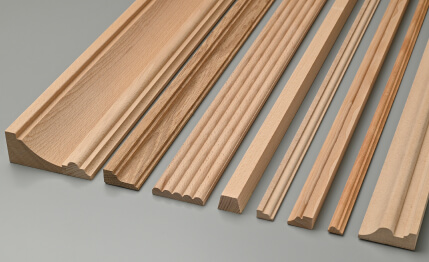
Pogonazh iz massiva STAVROS is a complete set of profiles for interior design: baseboards, moldings, cornices, architraves, corners, battens. When all these elements are from the same wood species, in the same tone, and from the same style family — the interior acquires a completeness that everyone who enters it feels.
Here is how the wooden corner works in this system:
Corner + baseboard. wooden floor baseboard and a corner from the same wood species and tone create a single horizontal line around the perimeter of the room, which the corner neatly turns at the corners.
Corner + architrave. Wooden casings On doors and corner pieces on walls are coordinated vertical elements. When they are made of the same material, doorways and walls are read as parts of a single architectural system.
Corner piece + moldings and cornices. Wooden moldings and cornices Work horizontally, corner pieces work vertically. Together they create a "grid" of decorative lines that organizes the space.
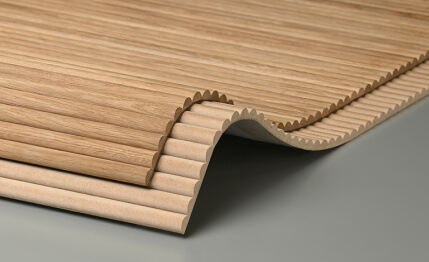
Corner piece + slats and panels. Wooden slats and panels On walls plus a wooden corner piece on their corners is a single decorative system where each detail is coordinated with the adjacent one.
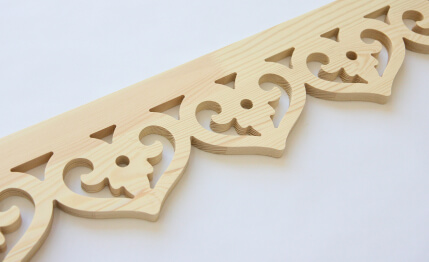
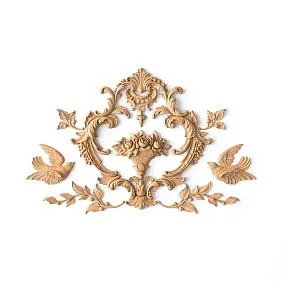
Corner piece + carved decor. In interiors with carved wooden decor — overlays, ornaments, rosettes — the wooden corner piece continues the decorative language of the space. This is especially important in classical and Russian interiors.
Installation joints: how the corner piece fits into the system
The bottom end of the wooden corner piece should neatly adjoin the baseboard. The top end should adjoin the ceiling cornice or molding. The side planes should adjoin the surface of the paneling or panel. When all these joints are thought out in advance, installation yields a clean, professional result.
Mistakes when choosing and installing a wooden corner
Practice shows that mistakes when choosing a wooden corner piece repeat from project to project. Here are the most common ones — and how to avoid them.
Using a plastic corner where all the trim is wooden. This is not saving money — it's destroying the overall look. The cost of a wooden corner is comparable to plastic, but the result is incomparably better.
Choosing a corner that is too narrow for a high-traffic area. A 20×20 mm corner in a hallway with children is guaranteed damage within a few months. For high-load areas, you need a profile from 40×40 mm made of hardwood.
Not accounting for the thickness of the paneling. If the paneling is 16 mm and the corner has a shelf of 12 mm, it won't cover the joint. Always measure the thickness of the trim before purchasing.
Picking a random wood tone. A light birch corner on a wall finished with dark oak is a conflict that is immediately noticeable. The tone of the corner should match the tone of the trim or be intentionally contrasting.
Forgetting about the final treatment. An untreated wooden corner will absorb moisture, dirt, and grease — especially in the kitchen and hallway. Varnish, oil, or stain is mandatory before installation or immediately after.
Installing a decorative corner where mechanical protection is needed. A thin profile with a chamfer looks nice but doesn't withstand impact. For a protective function, you need a profile with a full bearing surface.
Not planning the junction with the baseboard. A corner that extends past the baseboard or doesn't reach it is a carelessness that stands out. Plan the system as a whole.
Choosing the size only based on a picture. Photos can be deceiving. A corner that looks neat in a photo may turn out to be too thin or too thick for your specific angle. Always request exact dimensions in millimeters.
Installing without a preliminary fitting. For long runs (corridor, staircase), you should always hold the corner against the angle before applying glue — to ensure the angle is even, the size is correct, and the corner doesn't protrude beyond the plane of the trim.
Where to buy a wooden corner for finishing
If you are looking for where Buy a wooden corner piece from natural solid wood for finishing corners, paneling, slopes, or furniture — STAVROS offers a full range of wooden corners and solid wood moldings.
In the catalog you will find:
-
External wooden corner — in different sizes, from different wood species, for painting or finishing;
-
Wooden angles for finishing — a full range of profiles for all application scenarios;
-
wooden moldings, cornices, and baseboards — for system finishing together with corner pieces;
-
wooden floor baseboard — for a single horizontal line around the perimeter;
-
Wooden casings — for door openings in the same style system;
-
Pogonazh iz massiva — a complete catalog of natural wood profiles;
-
Wooden slats and panels — for wall finishing, for which the corner piece is selected;
-
Carved wooden decoration — for those building a system with decorative accents;
-
Solid Wood Items — full catalog of wooden interior products.
buy wooden corner piece available from one linear meter. Delivery across Saint Petersburg and all of Russia.
STAVROS is a Russian manufacturer of solid wood products. Corner pieces, baseboards, moldings, cornices, architraves, slats, panels, linear molding, carved decor — everything is produced at our own facility from select raw materials with quality control at every stage. Over 4,000 items in the actual catalog. STAVROS knows: a small detail makes a big difference. A wooden corner piece is not just a profile. It is the final touch that distinguishes a finished interior from an unfinished one.
FAQ: answers to important questions about wooden corner trim
What is a wooden corner piece for?
Wooden angle covers and protects external corners of walls, slopes, paneling, wooden panels, furniture parts and structures. It combines protective and decorative functions.
How is a wooden corner trim better than a plastic one?
A solid wood corner trim has a natural texture, accepts any coating, does not yellow or crack over time. In interiors with wooden finishes, it looks organic and creates a complete look — unlike plastic, which disrupts the unity of natural materials.
Can a wooden corner trim be used for paneling?
Yes, this is one of the most common and correct scenarios. Wooden corner piece for paneling covers end joints on external corners and makes the cladding complete.
What size corner trim should I choose?
For thin slopes and furniture — 20×20 mm. For standard thickness paneling — 30–40 mm. For external corners in high-traffic areas — 40–60 mm. For large structures — up to 100×100 mm.
Can a wooden corner trim be painted?
Yes. External wooden corner accepts any coating: varnish, oil, stain, enamel. It is advisable to apply the coating before installation to cover all ends and hard-to-reach places.
What is better: oak or pine for a corner piece?
Oak is for high-load areas and expensive interiors. Pine and other conifers are for country houses, baths, dachas, where warmth and naturalness are important. For slopes in living rooms, both options are good.
How to attach wooden corner trim?
Use liquid nails for a clean result without fastener marks. Use finishing nails for reliability in loaded areas. In baths and saunas, use clamps or special staples so the corner piece can move with changes in humidity.