








































































Article Contents:
- 526 × 260 × 17 mm — first, let's convert the product card to the real scale of the door
- What will happen on a door 600 mm wide
- The same check for wider panels
- The clear field needs to be measured by the nearest active boundaries
- What to look at during the first fitting
- Measure not the handle attachment point, but its entire overall dimension
- Why a universal offset in millimeters is harmful here
- The 17 mm relief must be considered separately
- The overlay fits freely inside the panel
- The overall dimension almost touches the frame
- The overlay crosses the profile
- The horizontal layout has a stronger effect on width
- The vertical layout has a stronger effect on the height of the decorative area
- The upper composition must be connected to the architecture of the panel
- Do not transfer a position from one leaf with a ruler without visual verification
- First measure one control facade
- The adhesive is selected for the "polyurethane + door covering" system.
- Mistake 1. Treating the panel width as free space
- Mistake 2. Not making a template of 526 × 260 mm
- Mistake 3. Checking only the width
- Mistake 4. Forgetting about 17 mm
- Mistake 5. Measuring to the center of the handle
- Error 6. Use a universal indentation
- Error 7. Shift NPU-417.4 significantly for the handle
- Error 8. Rotate the ornament just because it fits that way
- Error 9. Install on each door leaf without a common layout
- Error 10. Add molding after the overlay is approved
- Error 11. Buy glue based on the material name
- Error 12. Trim the ornament like a regular batten
- Error 13. Consider a similar article number as interchangeable
- Error 14. Order the quantity based on the number of doors without a layout
- Error 15. Do not check the actual product after delivery
- Error 16. Evaluate only up close
- Error 17. Ignore side light
- Error 18. Think one color will fix everything
- What is the exact size of NPU-417.4?
- What material is NPU-417.4 made of?
- Will NPU-417.4 fit on a door that is 600 mm wide?
- Is it enough to know the overall width of the door?
- How do I check the size before ordering?
- Do I need to take the 17 mm thickness into account?
- How can I tell if NPU-417.4 will interfere with the handle?
- Is there a universal minimum clearance to the handle?
- Can NPU-417.4 be installed inside a panel?
- What to do if the overlay is slightly larger than the panel?
- Can NPU-417.4 be rotated vertically?
- How many NPU-417.4 units are needed for one door?
- How many are needed for a double door?
- Is it necessary to install NPU-417.4 on every door in the hallway?
- Can NPU-417.4 be used on a cabinet?
- Will NPU-417.4 fit a dresser?
- Is a molding needed around NPU-417.4?
- When is it better not to add molding?
- Can NPU-417.4 be painted to match the door color?
- Can the overlay be made contrasting?
- What should I use to glue NPU-417.4?
- Can it be glued directly onto a painted door?
- Can a thick layer of glue be used to level the door?
- Do I need to buy a spare NPU-417.4?
- What to do if NPU-417.4 seems too large after the template?
- What to do if NPU-417.4 seems small on a wide door?
- Do I need to account for trim/casings?
- What should I check immediately after delivery?
- Where can I see general material about door molding?
- Where can I see other decorative elements?
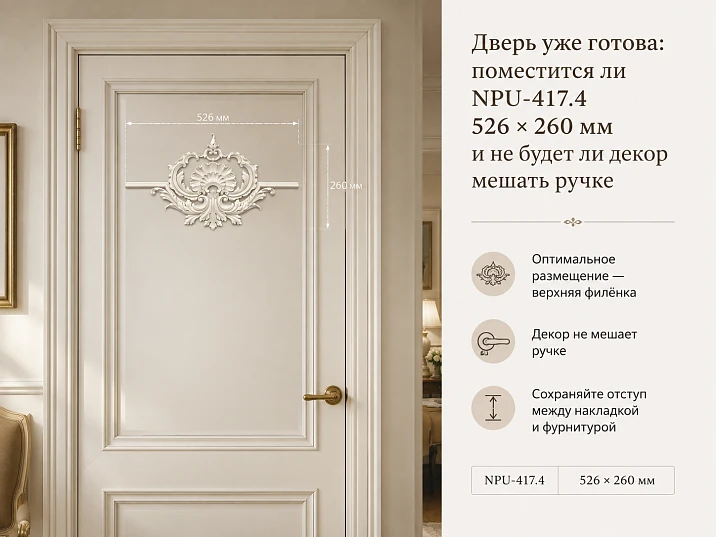
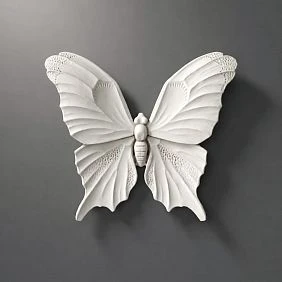
The door is already installed. The handle is in place, panels are set, gaps are aligned, the finish is complete — and only now you want to add expressive relief. In the catalog, NPU-417.4 caught your eye. In the photo it looks assembled and proportional, but the real part has a size that cannot be perceived as an abstract number: 526 × 260 × 17 mm. If you place the long side across a panel 600 mm wide, after a simple geometric check only 74 mm of total remainder is left, that is, 37 mm on each side with strict centering. And that's without the handle, panel, molding frame, and other boundaries.
Therefore, the question "will NPU-417.4 fit on the door" does not start with the overall width of the panel. You need the size of the clean decorative field — the part of the door inside which the overlay can actually be located. If there is already a frame, panel, handle, lock, glass, or pronounced milling on this field, the available area becomes smaller than the full door dimension.
NPU-417.4 is made of polyurethane. The size 526 × 260 × 17 mm makes it a noticeable stucco decor that needs to be fitted as a full compositional element. For a finished door, a simple method is especially useful: cut out a rectangle of 526 × 260 mm from paper or cardboard, attach it with masking tape in the intended place, and check what happens with the handle, panel, edges of the panel, and overall balance. Such a fitting takes a few minutes and answers the main question much more accurately than a product photo on the screen.
If the dimensions fit and the position is already determined, you can buy NPU-417.4 made of polyurethane, but before placing the order, it is better to complete the design check: size, orientation, handle position, number of overlays, and installation method should be clear in advance.
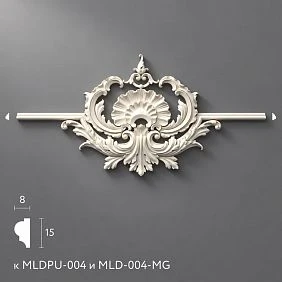
526 × 260 × 17 mm — first, let's convert the product card to the real scale of the door
While the NPU-417.4 is on the screen, its size is easy to underestimate. The photo automatically fits into the card frame and doesn't show how much of the door the product will occupy. In reality, the long side is 526 mm — more than half a meter. The second side is 260 mm. The relief protrudes by 17 mm.
This is no longer a small point overlay that can be placed almost anywhere. The NPU-417.4 requires noticeable space around it.
| Parameter | Confirmed value | What to check on the finished door |
|---|---|---|
| Article number | NPU-417.4 | Don't confuse it with neighboring article numbers |
| Size A × B × C | 526 × 260 × 17 mm | Does the overall contour fit into the selected area |
| Material | Polyurethane | Compatibility of future finishing and installation |
| Type | Decorative molding element | Is one accent needed or a composition with molding |
| The main risk of a finished door | Large size | Will the decor collide with the handle, frame, panel, and edges |
This table has one practical purpose: to prevent the word "overlay" from creating the impression of a small detail. Before you is an element 526 mm long, and on a narrow door leaf it can occupy almost the entire available width.




What will fit on a door 600 mm wide
Let the long side of 526 mm be positioned across the door, with the overlay geometrically centered.
600 − 526 = 74 mm.
74 / 2 = 37 mm.
We get 37 mm of geometric remainder on the left and right.
This is not a recommendation to leave exactly 37 mm. It is not a minimum allowable offset. It is merely an arithmetic result that immediately shows the scale. If within these 37 mm there must also be a panel frame, decorative molding, or handle zone, the placement already raises questions.
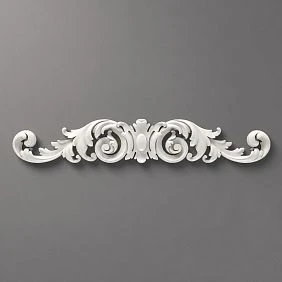
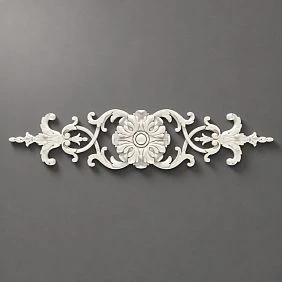
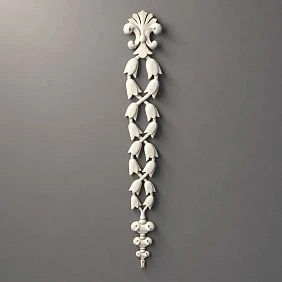
Our factory also produces:
The same check for wider door leaves
| Width of the available field | Remainder after 526 mm | Remainder on each side when centered |
| 600 мм | 74 мм | 37 мм |
| 650 мм | 124 мм | 62 мм |
| 700 мм | 174 мм | 87 мм |
| 750 мм | 224 мм | 112 мм |
| 800 мм | 274 мм | 137 мм |
| 900 мм | 374 мм | 187 мм |
| 1000 мм | 474 мм | 237 мм |
This table also does not set standards. It shows why the same NPU-417.4 on a door 600 and 900 mm wide will be perceived completely differently.
But there is an even more important clarification: the table uses the available field, not the nominal door width. If the panel is 800 mm, but only 620 mm remains inside the frame, you need to calculate based on 620.
Get Consultation
Door size is not the size of the space for stucco decor
The mistake starts with the phrase: "A door of 800 mm, an overlay of 526 mm, so it will definitely fit."
Physically — possibly. Compositionally — still unknown.
On a finished door, the useful field is reduced by the outer frame, panel, glass insert, decorative routing, existing molding, handle, lock plate, and already installed decor. Therefore, first measure the panel, then separately — the decorative area.
The clean field should be measured by the nearest active boundaries
If NPU-417.4 should be inside a panel, the inner part of the panel is measured. If between two moldings — the distance between them. If on a smooth door without frames — the field from edge to edge minus the zones you deliberately leave free. If there is a handle nearby — its dimension also becomes an active boundary.
This is how the real area appears, inside which the decor will live.
A paper template of 526 × 260 mm is the cheapest stage of an expensive solution
For a finished door, a template is more useful than complex visualization.
Take paper, cardboard, or several glued sheets. Make a rectangle exactly 526 × 260 mm. Label it with the article number NPU-417.4. If it's important to feel the height of the relief, you can additionally assemble a rough backing about 17 mm thick, without trying to replicate the ornament itself.
Secure the template with painter's tape. Don't stick it immediately "by eye in the center." First, find several possible positions.
What to look at during the first fitting
Assess the distance to the edge of the door leaf, the position relative to the panel, the distance to the handle, the position relative to the lock plate, the balance of the upper and lower parts of the door, the view from a distance, the side view, and the effect of light. After that, photograph the door strictly from the front. The photo helps compare several options without constantly re-sticking the template.
The handle is not a secondary detail, but a permanent neighbor of NPU-417.4
In visualization, the door handle is sometimes mentally excluded: you want to evaluate only the beautiful overlay. But after installation, the handle doesn't disappear.
It remains a functional object that a person constantly reaches for with their hand. Therefore, next to NPU-417.4 there should be not only a beautiful but also a convenient area.
The main check: whether the relief falls into the working area of the hand.
Measure not the mounting point of the handle, but its entire overall size.
For a lever handle, mark the rosette or plate, the length of the lever itself, the area where fingers are placed, and the hand trajectory when opening. If the handle is elongated, a single distance from the spindle center to the plate is not sufficient.
On the NPU-417.4 template, mark the nearest point of the decorative contour. Then compare it with the actual handle area.
Why a universal offset in millimeters is harmful here
One could devise a rule: leave 50, 70, or 100 mm. But it does not account for the handle shape. A short round handle and a long handle on a plate require different amounts of space. In one case, 60 mm may look spacious; in another, too cramped.
Therefore, the correct criterion is not "are there standard X millimeters," but whether the door can be used without touching the relief with your hand and without feeling visual crowding.
Testing the handle in real motion
After securing the paper template, open and close the door several times. Grasp the handle as you normally would. Do not look at your hand deliberately, but observe the natural movement.
If your fingers pass too close to the template, the actual 17 mm thick plate will protrude more than the flat paper. This is a reason to increase the distance or change the position of the decor.
The 17 mm relief must be considered separately
The flat template checks width and height. The 17 mm thickness checks volume.
If the NPU-417.4 is located near the hand working area, it is useful to make a conditional volumetric mock-up: glue strips of cardboard or foam material to paper to roughly feel the protrusion. There is no need to reproduce the pattern. It is important for us to understand where the edge of the volume will be.
A panel can halve the available area
A paneled door looks large, but the central field can be significantly smaller than the overall leaf. If the NPU-417.4 is planned inside the panel, compare 526 × 260 mm specifically with its internal dimension.
The overlay fits freely inside the panel
This is the most straightforward option. There is a margin around it, and the relief does not cross the frame profile. Next, the handle and vertical position are checked.
The dimension almost touches the frame
Technically, the element can "enter," but the composition becomes dense. A paper template will show whether it feels like intentional filling or a lack of space.
The overlay crosses the profile
You cannot simply decide, "It's fine, we'll trim it." A standard molded element has a finished ornament. Arbitrary crossing with an existing panel must be planned in the project, not arise during installation. More often, it is wiser to change the position or choose different decor.
A smooth door gives more freedom, but does not cancel proportions
On a smooth surface, there is no internal frame. It seems that NPU-417.4 can be moved anywhere. Physically, this is true. Visually, it is not.
The edge of the door itself forms a strong rectangular boundary. If a large overlay comes too close to it, the free field disappears and the decor begins to look larger than the compositional zone itself. On a wide smooth door, this can be an expressive solution. On a narrow one, it can be overloaded.
Horizontally or vertically: first composition, then geometry
NPU-417.4 has a dimension of 526 × 260 mm. Geometrically, the rectangle can be rotated. But the decorative ornament is not an empty rectangle.
Orientation should not be decided just because "it fits better." First, look at the actual pattern of the product and the design intent. For a preliminary check, you can make two templates: 526 mm horizontally and 260 mm vertically; then 260 mm horizontally and 526 mm vertically. After that, compare which composition makes sense for the specific door leaf.
The horizontal layout has a stronger effect on width
On a 600–700 mm door, the long side of 526 mm almost immediately becomes a critical dimension. This layout requires especially careful checking of side margins and the handle.
The vertical layout has a stronger effect on the height of the decorative area
If the long side is directed upward, there is more freedom in width, but the overlay begins to interact with the top and bottom frames, panel, peephole, glass, or other elements. One cannot declare a single option "correct" in advance.
The center of the door leaf and the center of the free field are not the same thing
Suppose the handle is on the right. The geometric center of the entire door does not account for its presence. If NPU-417.4 is placed strictly along the axis of the panel, the distance to the handle on the right may turn out to be much smaller than the visually free space on the left.
Sometimes the compositional center needs to be evaluated relative to the free zone, not the entire door. But here you cannot mechanically shift the plate to the left by an arbitrary number of millimeters. A strong shift can destroy the symmetry.
It is better to take two photos: one option at the geometric center and one with a slight compositional shift. And compare them from the distance from which the door is usually seen.
Upper third of the door: when NPU-417.4 can work better than the center
On some doors, the handle occupies the middle zone, and the lower part is visually heavy due to the panel. Then NPU-417.4 can be considered above the center.
The advantage of this position is greater freedom around the handle. But another question arises: does the decor rise too close to the top frame.
The upper composition should be connected with the architecture of the panel
If the door has two panels, NPU-417.4 is better correlated with a specific panel. If the panel is smooth, the upper third can be used as an independent decorative zone. If there is an expressive portal above the door, a large plate at the top of the panel may begin to compete with it.
The lower zone is not a universal place for a large plate
Placing NPU-417.4 below the handle is sometimes technically easier. But there the decor is more susceptible to accidental touches by shoes, bags, cleaning equipment. In addition, a visually heavy bottom can make the door look squat. This is not a prohibition, but the lower position needs to be evaluated especially carefully.
If the door is 600 mm wide: buying without a template is unwise
Let's return to the most illustrative example. The panel or clear field is 600 mm. NPU-417.4 along the long side is 526 mm. When centered, there is 37 mm of remainder on each side.
This number by itself does not say "impossible." But it does say: there is very little space, and any additional constraint becomes critical. If there is a frame at the edges, the actual field may be less than 600 mm. If there is a handle nearby, one side becomes even tighter. If the overlay must be inside the panel, you need to calculate based on the panel itself.
If the available field is 700 mm
700 − 526 = 174 mm. When centered, that is 87 mm on each side. This already offers more freedom, but even here you cannot automatically consider the task solved. The handle may extend into this zone, molding may take away part of the space, and the panel may have a complex profile. Therefore, 87 mm is only geometry.
If the available field is 800 mm
800 − 526 = 274 mm. That is 137 mm on each side when centered. This margin provides noticeably more placement options. You can compare the center, the upper third, and compositions with moldings. But even here, a large relief 17 mm thick can end up close to the handle if it is shifted toward the center.
If the door is very wide
On a wide panel, the opposite problem arises: NPU-417.4 can fit physically without any issues, but may seem insufficiently connected to the overall architecture. In that case, instead of increasing the number of overlays, it is sometimes more useful to use a molding frame.
If the project requires linear framing, you can buy polyurethane molding in the linear elements section and assemble a larger decorative field around NPU-417.4. This way, the door's scale is supported not by the number of identical overlays, but by the entire composition.
One NPU-417.4 on one door is a basic scenario, but not a rule
For a large element, one overlay per panel is the most understandable starting point for a layout. But this is not a norm that can be applied to all doors.
On a tall, wide door, a single element can look cohesive. On a narrow one, it may appear too large. On a double door, two identical overlays can create a good pair or an overly dense pattern. Therefore, the quantity emerges after the layout, not before it.
Double door: one article becomes two objects of perception.
If NPU-417.4 is intended for both panels, cut out two full-size templates. Do not try on just one, mentally promising yourself that the second will be "symmetrical."
When both pieces are placed side by side, the entire composition changes: the distance between them, the relationship to the central seam, the density of the ornament, the balance of handles, and the interaction with panels. Two large overlays measuring 526 × 260 mm create a much stronger effect than one.
Do not transfer the position from one panel with a ruler without visual verification.
Technical symmetry is useful, but handles and panel architecture may differ. First, the axis is established, then the overall appearance of the closed door is checked. Only after that are the dimensions transferred to the installation layout.
One central composition across two panels is a separate task.
Sometimes you want the decor to be perceived as a single whole across the central seam. For a standard overlay, this cannot be considered an automatic option. Splitting one product across two panels, crossing the working seam, or trimming the ornament without a special project should not be done. If a unified composition on a double door is needed, it is designed separately and checked for how the panels will open.
Cabinet with doors: the same size becomes even more demanding
The request for molding for furniture NPU-417.4 is suitable only where the facade truly withstands its scale. A cabinet door can be narrower than an interior door. If the facade width is 450–500 mm, the long side of 526 mm physically does not fit across. Vertical placement may fit geometrically, but not necessarily compositionally.
Therefore, for furniture, you cannot rely on a successful photo of NPU-417.4 on a large door.
First, measure one control facade
If the cabinet consists of four identical doors, you don't need to immediately order four overlays just because "one per facade." First, make a full-size template on one door. Then copy it to the others. Look at the cabinet as a whole.
Four large NPU-417.4 can create a much denser ornamental rhythm than it seems from a single door.
Dresser and nightstand: the 526 mm size quickly becomes the main limitation
On a small dresser, the NPU-417.4 can take up almost the entire width of the front. If the drawer is 600 mm wide, the geometry is similar to a door: 37 mm on each side when centering the long side.
But the height of the drawer is usually much less than the height of the door. Here, the 260 mm size can become critical. If the front is 280–300 mm high, the overlay will almost completely fill it in height.
Therefore, the NPU-417.4 cannot be considered a universal furniture overlay just because polyurethane decor is generally used on furniture.
When it's better to switch to another overlay
If after a paper mock-up several conflicts arise at once — edge, handle, panel, free space — you don't need to fit the door to the NPU-417.4 at any cost.
In the category where it is collected Relief Decoration, you can look at overlays of a different scale. This is especially reasonable if the long side of 526 mm is too large, the height of 260 mm doesn't fit into the panel, the handle cannot be avoided without significant shifting, the 17 mm relief is too close to the work area, or the door already has rich milling.
Rejecting a specific article is sometimes the right choice.
When the large size of the NPU-417.4 is an advantage
On a wide smooth surface, a small decor can get lost. Then 526 × 260 mm provides exactly the scale needed for an independent central accent.
A large element is also convenient because you don't have to assemble a composition from a dozen small parts. One overlay can set the center, and a molding can organize the field around it. This makes the interior look more cohesive than with a random set of small decor.
A molding frame can solve the scale problem, but it can also reduce the field.
Molding works both ways. On a large door, it helps connect NPU-417.4 with the panel. On a small one, it additionally reduces the free space.
Therefore, the order of actions is as follows: first the NPU-417.4 template, then the lines of the future molding with painter's tape, then a re-evaluation. Not the other way around.
If you first build a beautiful frame and then try to squeeze 526 × 260 mm into it, you may find that the inner field has become too cramped.
Inside the frame, you need to calculate the inner size, not the outer one.
Imagine a decorative rectangle made of molding with a width of 700 mm along the outer contour. If the profile itself has a noticeable width, the inner field will be less than 700 mm. NPU-417.4 should be compared specifically with the inner space.
This is a simple principle, but it is precisely where mistakes are often made in visualizations.
Polyurethane decor works through light, and NPU-417.4 has a relief of 17 mm.
The 17 mm thickness forms a real shadow. On a door next to a window, it will shift throughout the day. Under directed light, the relief will become more noticeable. With soft diffused lighting, it will be calmer.
Therefore, a layout that looks neat under frontal light may appear much more dynamic in the evening.
If you want to compare other decorative polyurethane elements, pay attention not only to width and height, but also to depth. Two elements of the same design with different thicknesses are perceived differently.
A white door and white decor do not make NPU-417.4 invisible
Sometimes a buyer reasons like this: if the overlay is painted in the door's color, a large size is not a problem. Color does reduce the contrast of the material. But the relief remains.
Chiaroscuro continues to reveal the 17-millimeter depth and the shape of the ornament. Therefore, white-on-white may look calm in color, but very expressive in form.
Contrast painting enhances the scale
If NPU-417.4 differs in color from the door leaf, its dimensions of 526 × 260 mm become visually even more pronounced. On a narrow door, contrast can emphasize crampedness. On a wide one, it can make the overlay a true centerpiece.
Hence the practical conclusion: a paper mock-up is useful to supplement with a color one. You can print or color the template in an approximate future tone and see how perception changes.
The finished door covering requires careful installation inspection
The door is already finished—meaning an installation error affects not the blank, but the final surface.
Before gluing, you need to check what the base is made of, what it is coated with, whether the chosen adhesive is compatible with this coating, whether the surface needs local preparation, whether a test can be done on an inconspicuous area, and how to remove excess compound without damaging the finish.
You should not automatically transfer the technology from the wall to the door.
The adhesive is selected for the system "polyurethane + door coating"
NPU-417.4 is made of polyurethane, but the second half of the adhesive joint is the door itself. Therefore, the request for adhesive for molded decor is useful not as advice "take any mounting compound," but as a separate technology check.
For a finished painted door, compatibility with the finish coating is especially important.
Do not use adhesive thickness as a way to fix geometry
If NPU-417.4 does not fit compositionally, an additional layer of adhesive will not solve the problem. If the relief is too close to the handle, the protrusion will worsen the situation even more. If the door is uneven, the adhesive should not replace the design solution without checking the specific compound.
Installation begins after the placement is approved.
Marking on a finished door: a pencil may be worse than painter's tape
On a newly painted surface, you don't want to leave marks. For the first layout, it is more convenient to use painter's tape. On it, you can mark the door axis, the edge of NPU-417.4, the handle position, the panel boundaries, and the future molding.
Once the composition is approved, the marking technologist is selected already taking into account the coating.
The laser helps find the axis, but does not choose the beautiful position.
The laser level is useful for horizontal and vertical. But it does not answer the question of where NPU-417.4 looks better.
First, the composition is chosen by eye and template. Then its geometry is fixed with a tool. If you change the order, you can get a perfectly even but compositionally unsuccessful overlay.
How many NPU-417.4 to order
The quantity is calculated not by the door area, but by the number of approved decorative items.
| Object | Diagram | Base quantity for the layout | What to check before ordering |
| One interior door | One central overlay | 1 pc. | Handle, panel, free field |
| Two identical doors | One for each | 2 pcs. | Same installation height |
| Double-leaf door | One per door leaf | 2 pcs. | General view of closed door |
| Cabinet with 4 fronts | One for each selected front | Up to 4 pcs. | Does the repetition overload the entire cabinet |
| One wide door with a frame | One in the center of the frame | 1 pc. | Internal frame size |
| Series of doors in the corridor | According to the design of each door | By the number of decorated panels | Single line and same orientation |
This is not a quantity standard. The table shows the calculation method. First, it is decided how many decorative points exist in the project. Then each point becomes one order line.
Ordering "two just in case" without a layout is not needed
NPU-417.4 is a large element. A second copy does not automatically become useful just because it is in reserve. If the project provides for one overlay per door, the quantity is determined by this scheme. Reserve makes sense only with a specific risk and after evaluating the project.
A series of identical doors requires a control first door
If there are six identical panels in the house, the temptation to order six elements at once is understandable. But first, it is advisable to fully check one door: template, handle, height, lighting, installation, and color.
After that, the approved coordinates can be transferred to the rest. Thus, the series becomes repeatable, rather than repeating one mistake six times.
It is better to set the installation height from a stable base.
For multiple doors, you cannot rely on the phrase "approximately in the center of the top panel." A base is needed. This could be the bottom edge of the door leaf, the line of a specific panel, or other unambiguous geometry.
The exact coordinate is determined by the project. The main thing is that all doors are calculated the same way.
If the handles on the doors are at different heights
This occurs when mixing different door leaves or furniture. You cannot copy the position of NPU-417.4 only by height from the floor if a handle next to it changes its position.
For each door, the local composition is checked. A unified style does not require millimeter-level identity where the original architecture differs.
What to order together with NPU-417.4
For a finished door, the main purchase usually consists of more than just one overlay.
| What is included in the project | Why | When needed | Where to go |
| NPU-417.4 | Central stucco decor | If the 526 × 260 mm template fits | Order decorative molding NPU-417.4 |
| Polyurethane moldings | Create a frame around the overlay | If the door requires a larger architectural field | You can buy ready-made stucco matching the Baroque style. Calculate the quantity: linear meters of cornices and moldings, number of rosettes, pilasters, consoles, corner elements. Add a ten to fifteen percent allowance for trimming. |
| Other overlays | Select a different scale | If 526 × 260 mm does not fit | Buy Molded Decoration |
| Decor for moldings | Assemble a more complex frame composition | Only if specified in the design | Polyurethane Decor |
| Mounting compound | Secure the polyurethane element | After checking the door covering | molded decoration adhesive |
You don't need to buy all table rows at once. A simple door may require only one NPU-417.4 and suitable mounting compound. Moldings and additional elements are added when they are actually present on the layout.
Why a product card is just the beginning of the selection
The card has the exact size and material. That's enough to understand what kind of product we're dealing with. But the card doesn't know your door width, your panel size, your handle position, the leaf color, installation height, adjacent moldings, lighting, and the number of doors.
The article is needed precisely for the second half of the task — to transfer a specific product to a specific object.
Polyurethane door decor: when it's more useful to first understand the whole system
If NPU-417.4 is to become part of a large portal, casings, cornices, or other elements around the opening, checking just the leaf is not enough.
Then it's useful to consider the entire Polyurethane door decoration as a single composition. The overlay on the canvas should not compete with the very saturated portal around it.
Sometimes the best result is achieved when NPU-417.4 remains the main ornament, and the surrounding lines are calmer.
Decorative stucco and the door handle should have a hierarchy
The handle is the functional center. NPU-417.4 is decorative. If both elements are equally active and placed too close together, the door looks overloaded.
There are three ways: make the handle visually calmer, increase the distance, or change the position of the plate. The choice should be based on the existing door. If the handle is purchased and installed, it is the decor that adapts to it.
A long handle on a backplate requires a separate template
A round rosette occupies a small area. A long backplate can have significant height depending on the model. In such a case, a second large vertical object appears next to NPU-417.4.
Make a paper outline of not only the plate but also the handle. Then you can see whether the two shapes compete.
A handle centered on the panel restricts NPU-417.4 more than a side one
If the handle is strongly shifted to the edge, the central field remains freer. If it is located close to the center of the decorative zone, the large plate has to move up or down.
This is another reason to measure the actual door rather than use someone else's scheme.
Lock, latch, and handle plate: look at the entire group
The door may have a separate plate for the key or lock. It is also part of the visual group. NPU-417.4 should not end up between the handle and the lower plate as if it randomly fills the remaining space. The composition is built around all the hardware.
What to do if NPU-417.4 almost fits
The most dangerous situation is when "just a little bit is missing." You want to trim the edge, slightly overlap the panel, shift the plate, move it closer to the handle, or reduce the gaps.
Individually, each compromise seems minor. Together, they can turn a successful decor into a cramped cluster. If the template shows that the size is at the edge of what is acceptable, it is better to consider other elements in the category.
Trimming the ornament is not a standard way to reduce NPU-417.4
A finished molded element cannot be treated as a rectangular blank of 526 × 260 mm that can always be reduced. The carved shape has a composition. A cut can disrupt the ornament.
If the project requires modifying a standard product, the feasibility of a specific solution must be separately approved, not planned as a routine on-site adjustment.
If the door is already painted, the color of the future NPU-417.4 must be agreed upon in advance
After gluing, experimenting is more difficult. You need to decide whether the decor remains the color of the door, becomes contrasting, is painted separately before installation, or is painted together with the panel using an agreed technology.
The specific procedure depends on the coating and installation system. The main thing is not to leave the color until the overlay is already glued.
A monochrome scheme makes the door calmer, but does not reduce the physical size
NPU-417.4 will remain 526 × 260 × 17 mm regardless of color. Therefore, "let's paint everything white" does not replace checking the scale. A monochrome finish merely shifts attention from color contrast to shadow and relief.
A contrasting scheme requires even more free space
The stronger the color contrast, the more the eye sees the boundaries of the overlay. On a narrow panel, this can emphasize the lack of space. On a wide one, it can make the ornament expressive.
Therefore, it is useful to evaluate a contrasting pattern from the hallway or an adjacent room.
You should look from the side from which the door is most often seen closed
A door is rarely examined up close. In an entryway, it is seen from the corridor. In a bedroom, from the bed. In a study, from the workspace.
It is from this distance that the size of NPU-417.4 should be assessed. Up close, a large relief always looks more significant. From afar, it may gather into a neat center.
Side light can make 17 mm appear visually deeper
Place the template and look at it in the morning, afternoon, and evening if there is a window nearby. If there is a wall sconce or track light, turn it on.
Relief is not flat graphics. Shadow can noticeably increase the visual activity of the edge. This is especially important when NPU-417.4 is located close to a panel: two shadows may begin to compete.
Molding around NPU-417.4: first the distance, then the profile
If a frame is needed, don't choose its width just from the catalog. Apply the future lines with painter's tape around the already fixed template. See what inner gap remains between the ornament and the frame.
A frame that is too tight looks like packaging around the decor. One that is too wide may lose its connection to it. A deliberate gap is needed, determined by the entire door.
When molding is unnecessary
If NPU-417.4 already occupies a significant portion of the field, an additional frame can overload the panel. This is especially likely on a narrow door. Then it's better to leave the overlay as a standalone accent.
When molding helps
On a tall smooth door, a single NPU-417.4 can be perceived as a separate ornament without architectural support. A molding frame creates a larger-scale field and connects the decor with the shape of the panel.
Thus, one element of 526 × 260 mm begins to work as the center of a larger composition.
Comparison of three schemes on one door
| Diagram | Strong point | Main risk | When to try it on |
| One NPU-417.4 | Clean accent | May be too large or too lonely | On a smooth and paneled surface |
| NPU-417.4 + frame | Architectural composition | The frame reduces the free field | On a wide or tall door |
| Two overlays | Rhythm and symmetry | Quick overload | On a double-door system or a very large field |
This table is useful precisely as a comparison of approaches, not as a recipe.
Polyurethane molded decor on furniture: do not automatically transfer the door proportion
On the NPU-417.4 door, it may look moderate. On a cabinet door of the same height but smaller width, it is already too large. On a dresser, it is even larger.
Therefore, one article does not receive a universal coefficient 'suitable for furniture'. For each facade, its own template is created.
A kitchen facade is especially demanding on the handle area
In the kitchen, handles are used constantly. If the NPU-417.4 theoretically fits on a large column or tall facade, you need to check not only the appearance but also the daily grip.
A 17 mm protrusion near the hand area may be inconvenient. Additionally, kitchen furniture has many adjacent facades, and one large ornament affects the entire group.
Wardrobe in the bedroom: repeating NPU-417.4 on each door is not necessary
Suppose the wardrobe has four doors. The scheme 'one on each' gives four large elements. The scheme 'only on the two central ones' gives two. The scheme 'one motif in the central field' gives a different number.
Therefore, the order calculation starts with the cabinet composition, not the number of facades.
A door in a classic interior does not have to be maximally decorated.When it's better to choose a different decor
Another article is more reasonable if 526 mm conflicts with the field width, 260 mm does not fit in height, the handle is too close, the overlay has to be shifted significantly, the ornament crosses the panel, there is already a lot of decor nearby, the element takes up almost the entire facade on the furniture, or you have to come up with trimming to place it.
In that case, you can Buy molding after comparing other categories and sizes, rather than forcing one model to solve an unsuitable task.
How not to confuse NPU-417.4 with similar articles
The line contains items with similar names. Therefore, in the order, you need to record the full details:
NPU-417.4 — 526 × 260 × 17 mm — polyurethane.
Do not limit yourself to "overlay 417". One digit after the dot may indicate a different item. Before payment, compare the article in the specification and the product card again.
Why the neighboring NPU-416.4 is not considered an automatic replacement
Even if two products are next to each other in the catalog and visually related, they cannot be considered interchangeable without comparing sizes and patterns. Replacement must start with a new fitting. The old template for NPU-417.4 is no longer suitable for another article.
Product and category solve different tasks
The NPU-417.4 card is needed when the choice has already been made. The category is needed when the fitting has shown a problem.
Therefore, the commercial route is simple: if it fits, we go to the product; if it doesn't fit, we return to size selection. This way, the catalog helps to choose, not just add items to the cart.
An order for one decorative item is convenient for a control fitting
The NPU-417.4 card is designed for piece quantities, so for a project with one door, there is no need to artificially build a set of several identical parts.
If one overlay is needed, the specification should contain one. If there are two doors, the quantity is determined by two approved items. The principle remains the same: the quantity equals the number of actually designed installation points, not a nice round number.
What to write in the specification
Example:
Bedroom door — NPU-417.4, 526 × 260 × 17 mm, polyurethane — 1 pc.
Study door — NPU-417.4, 526 × 260 × 17 mm, polyurethane — 1 pc.
Double-leaf living room door — NPU-417.4 — 2 pcs., one per leaf.
Nearby, you can add installation height, orientation, binding to the panel, binding to the handle, color, and the number of the approved layout. This way, the installer won't have to reinvent the design on site.
Don't leave the position only in a photo on your phone.
A photo is useful for approval. But the working specification must contain dimensions. If the phone is lost or the photo is cropped, the installation logic will remain.
Bind the overlay to stable door boundaries using at least two coordinates.
Control after delivery
Before installation, apply the actual NPU-417.4 to the door. A paper template checks the dimensions, but the real product shows the relief, light, and actual contour.
Repeat the handle check. Open the door. Look from the side. If everything matches the layout, you can proceed to surface preparation and installation.
Do not discard the template until the project is completed
If there are several doors, it will be useful for the next one. If a question arises about positioning, the template will help compare options without risk to the covering. For a series, you can make a rigid template with a marked axis and control points.
Door 600 mm and NPU-417.4: final criterion
Let's return to the original arithmetic. 526 mm on a 600 mm field leaves 74 mm in total. This is tight geometry. But the final answer depends on the contour of NPU-417.4, the handle, and the door leaf architecture.
Therefore, the formula does not say 'impossible'. It says: be sure to attach the product or a full-size template. This is exactly how catalog dimensions should be read.
Door 700–800 mm: the decision zone expands
On 700 mm, there is 87 mm of side clearance. On 800 mm, there is 137 mm. More breathing room appears, but the handle can still change the picture. If it is long and located close to the center, even 800 mm may require shifting.
Door 900 mm and larger: you can think not only about whether it fits
When the field is noticeably wider than the overlay, the question changes. Now it is important: whether the element will be lost, whether a frame is needed, at what height it looks best, whether one NPU-417.4 is enough, and how it relates to the architraves and the portal.
That is, after checking the physical size, the design part begins.
What to do if the handle is already positioned exactly where you want the overlay
Do not move the handle automatically. On a finished door, the hardware is often already linked to holes, lock, and mechanism.
First, try other positions for NPU-417.4: higher, lower, with acceptable compositional offset, in a different orientation if the pattern allows it, inside a molding frame of a different size. If none of the options work, choose a different decor.
What to do if the panel is smaller than 526 × 260 mm
If NPU-417.4 must be inside the panel, it does not fit this task by size. You can reconsider the composition itself and place the element outside the panel only if the door architecture allows it.
You cannot consider the intersection with the profile insignificant just because "it's only slightly short."
What to do if the overlay fits but seems too large
Physical compatibility does not equal good proportions. Make a second mockup with more compact decor from the category. Compare two photos from the same distance.
Don't ask "which is richer." Ask: which leaves the door with the correct visual weight.
What to do if the NPU-417.4 seems too small
On a very large door, try a molding frame. It increases the scale of the entire decorative composition without needing to add several identical overlays.
If the frame doesn't help, you can compare other elements.
Don't buy molding just because it's shown next to the product
Related products are useful as a hint. But the card doesn't know the width of your door. The molding should only go into the cart after its line has appeared on the layout.
The same applies to any accompanying decor.
Don't buy glue before checking the door's surface.
The phrase "for polyurethane" is only half the condition. The glue must also work with the base. If the door is coated with enamel, varnish, film, or another material, a compatible technology is needed.
Current recommendations are best matched with the specific product and a test on the base.
Practical checklist before payment.
Before Buy decorative overlay NPU-417.4 for the door.answer the questions:
-
is the clean field measured;
-
is the 526 × 260 mm template made;
-
is the 17 mm relief taken into account;
-
is the handle checked in motion;
-
does the panel not intersect;
-
is the orientation selected;
-
is the height determined;
-
is the quantity approved;
-
is molding needed;
-
is a compatible mounting compound selected;
-
is the article number fully recorded.
If at least one answer is "no", the purchase is not yet prepared.
Errors due to which NPU-417.4 has to be rearranged or replaced
Error 1. Treating the panel width as a free field
The panel and handle reduce the working area. You need to calculate the area where the decor is actually placed.
Error 2. Not making a template of 526 × 260 mm
The screen does not convey scale. A full-size rectangle immediately shows the real proportion of the door.
Error 3. Checking only the width
The size has two sides. 260 mm can conflict with the frame in height even when 526 mm in width fits.
Error 4. Forgetting about 17 mm
Flat paper does not show the protrusion. This is especially important near the handle.
Error 5. Measuring to the center of the handle
The full dimension of the hardware and the hand grip area are needed.
Error 6. Using a universal offset
Different handles have different sizes. The check must be actual.
Error 7. Moving NPU-417.4 too much for the handle
Technically the overlay will fit, but the door may lose balance.
Error 8. Rotating the ornament just because it fits that way
The bounding rectangle can be rotated, but the artistic pattern may have a direction.
Error 9. Place on each leaf without a common layout.
Repeating a large element sharply increases decorative density.
Error 10. Add molding after approving the overlay.
The frame will reduce the inner field, and the composition will have to be recalculated.
Error 11. Buy glue based on the material name.
The finished door's coating must be taken into account.
Error 12. Trim the ornament like a regular batten.
NPU-417.4 has a finished shape. Trimming may disrupt the composition.
Error 13. Consider a similar article number as interchangeable.
Each new article requires a new check of dimensions and pattern.
Error 14. Order quantity by number of doors without a layout
Not every door in a series must necessarily receive one overlay.
Error 15. Not checking the actual product after delivery
The template selects the overall size. The actual part confirms the volume and contour.
Error 16. Evaluate only up close
From a normal distance, the proportion may be perceived differently.
Error 17. Ignore side lighting
The shadow from a 17-millimeter relief changes the visual strength of the ornament.
Error 18. Think that one color will fix everything
Identical coloring does not reduce the physical size.
Who NPU-417.4 suits especially well
For a buyer who already has a wide free field on the door and needs one noticeable relief center. For a project where the handle is at a safe distance. Doors with a sufficiently large panel. A smooth surface that seems too empty. A composition with molding where the overlay becomes the central ornament. A series of identical doors after approving one control unit.
Who is better off choosing a smaller element
For the owner of a narrow door. For a facade with a small panel. For a door with a very large handle close to the center. For furniture with narrow leaves. For an interior where the panel is already saturated with frames and milling. For a project where NPU-417.4 has to be placed almost flush with the edges.
Who might benefit more from a large NPU-417.4 than from several small overlays
For someone who wants a single compositional center. One large element is easier to control for symmetry than many small ones. It does not create a frequent repeating pattern. On a wide door, this can look calmer than several small ornaments.
But the solution is tested on a mockup.
How to buy stucco decor without over-spamming details
When you want to "add beauty," it is easy to put too much in the cart. First, one NPU-417.4. Then a frame, if it is really needed. Then additional decor, if the composition remains empty.
This order protects against overload. If you need a wider selection, you can buy stucco decor in the category and compare elements by scale.
Why NPU-417.4 cannot be evaluated separately from the casing
The casing frames the entire door. If it is wide, profiled, and active, a large overlay inside the panel gets a strong neighbor. If the casing is smooth, NPU-417.4 can become the main decorative motif.
Therefore, the photo for approval should show the entire doorway, not just the central fragment of the panel.
The portal above the door changes the vertical balance
Large upper decor above the opening visually pulls the composition upward. If NPU-417.4 is also placed too high, the two accents may come closer together. Sometimes the center of the panel in such a project turns out to be calmer.
The baseboard and floor line affect the lower position
If the overlay is shifted downward, it begins to interact with the baseboard. On a tall door, this may be unnoticeable. On a short panel, it creates a dense lower section. Therefore, evaluate the door from the floor to the top.
Ceiling height does not change the size of the overlay, but it changes its perception
In a room with a high ceiling, the door may be part of a larger architectural system. NPU-417.4 is perceived as part of a large vertical field. In a low room, the same ornament may seem more massive.
This is not a reason to change the product's dimensions — it is a reason to look at the interior as a whole.
Entryway: the strictest test of distance
In a narrow corridor, the door is often seen from a short distance. The large relief of 526 × 260 mm will be perceived more strongly. Therefore, in the entryway, it is especially useful to check the template from the point directly opposite.
Bedroom: the door may be visible from the bed
From a distant point, NPU-417.4 may look calmer than up close. If the handle and panel do not conflict, a large overlay can provide a readable accent without additional decor.
Office: the frontal viewing point is important
If the door is opposite the desk, symmetry is noticeable. A small random shift for the handle will be more noticeable. In this case, either seek a precise balance or choose a different decor size.
Living room: double doors require a unified solution
Here, the scale of NPU-417.4 is often more appropriate, but double repetition intensifies the ornament. Immediately make two templates. Evaluate not each leaf, but the entire opening.
Commercial interior: repeatability matters more than individual beauty
In a hotel, salon, or restaurant, there may be many identical doors. The first sample must be approved especially precisely. After that, the height, axis, orientation, color, distance to the handle, and installation method are fixed.
Thus, subsequent doors repeat the agreed system.
How to form an order without unnecessary items
Example for one door: NPU-417.4 — 1 pc.; mounting compound — according to actual need and instructions of the selected product; molding — only if present in the mockup.
Example for two identical doors: NPU-417.4 — 2 pcs.; mounting materials — as calculated; frame elements — per drawing.
Example for a cabinet: the number of NPU-417.4 — based on the number of facades actually approved for decoration, not automatically by the total number of doors.
Price should not decide the size issue
NPU-417.4 has a current price in its card, but the price changes over time and is checked right before ordering. For this article, something else is fundamental: even an attractive price does not make 526 mm smaller.
First compatibility with the door, then the commercial decision.
Where to use broad keywords without losing meaning
A buyer may come with a query like "buy molding" or "decorative molding," but inside the article they should quickly get a specific answer. Therefore, broad semantics here are subordinated to NPU-417.4.
We do not explain the history of molding. We do not list all materials in the world. We do not go into ceiling rosettes. We lead to one solution: whether 526 × 260 × 17 mm fits your finished door.
Polyurethane molding as a material is important here through practice
Polyurethane allows using a relief decorative element on a finished panel and including it in a paintable interior composition. But for the buyer, what matters more is not the abstract properties of the material, but four actions: check the size, check the base, choose the installation, agree on the finish.
This is how the material becomes part of the solution.
Decorative molding should not prevent the door from performing its main function.
The door must open. The handle must be comfortable to use. The hardware must remain accessible. The decor must not interfere with working areas.
This is a simple criterion that is stronger than any stylistic theory. If NPU-417.4 is beautiful but interferes with using the handle, the placement is wrong.
Before purchasing, test the door with your hands, not just your eyes.
Open it. Close it. Grab the handle. Walk past it. See where clothing touches. If it's a wardrobe, open the adjacent door. If it's furniture, pull out the drawer.
This reveals real limitations that are not visible on the drawing.
FAQ: NPU-417.4 on a finished door and furniture facade
What is the exact size of NPU-417.4?
526 × 260 × 17 mm.
What material is the NPU-417.4 made of?
made of polyurethane.
Will the NPU-417.4 fit on a door 600 mm wide?
Along the long side, 526 mm geometrically fits into a 600 mm field, leaving 74 mm total remainder, or 37 mm on each side when centered. But you also need to check the panel, handle, and the actual contour of the overlay.
Is it enough to know the overall door width?
No. You need the size of the clean decorative field within which the overlay actually sits.
How to check the size before ordering?
Make a template of 526 × 260 mm from paper or cardboard and attach it to the door with masking tape.
Do I need to take the 17 mm thickness into account?
Yes. Especially near the handle: the relief protrudes above the plane, so a flat template is not enough for the final check of the hand working area.
How to understand whether the NPU-417.4 will interfere with the handle?
Mark the full dimensions of the handle and open the door several times with the template attached. Check the actual movement of fingers and hand.
Is there a universal minimum clearance to the handle?
No. The sizes and shapes of hardware vary, so it is safer to check the specific handle and specific position.
Can the NPU-417.4 be placed inside the panel?
This option can be considered if the dimensions and actual contour fit inside the decorative field and do not cross the panel profile.
What to do if the overlay is slightly larger than the panel?
Do not trim it automatically. It is better to change the composition or choose another article.
Can the NPU-417.4 be rotated vertically?
Geometrically, the template can be tried in a different orientation, but the artistic direction of the ornament itself should be evaluated based on the product and the project.
How many NPU-417.4 are needed for one door?
If the project includes one central overlay, 1 piece is needed. But the exact quantity is determined by the specific layout.
How many are needed for a double door?
In the 'one per leaf' scheme, 2 pieces are needed. But first, two full-size templates should be evaluated together.
Is it necessary to install NPU-417.4 on every door in the hallway?
Not necessarily. The decision depends on the overall composition and the purpose of the doors.
Can NPU-417.4 be used on a cabinet?
A furniture scenario can be considered if the facade is large enough. For narrow doors, 526 mm may be an excessive dimension.
Will NPU-417.4 be suitable for a dresser?
Only after checking the width and especially the height of the facade. A size of 526 × 260 mm may be too large for small drawers.
Is a molding needed around NPU-417.4?
Not necessarily. On a large smooth door, a frame can help tie the composition together; on a small one, it can reduce the already limited space.
When is it better not to add a molding?
When NPU-417.4 itself already takes up a significant portion of the door, and an additional frame creates a cramped feel.
Can NPU-417.4 be painted to match the door color?
Such a color scheme can be designed, but the compatibility of the primer, paint, and existing door finish must be checked for the specific finishing system.
Can the overlay be made contrasting?
Yes, as a design scheme, if the contrast suits the interior. Keep in mind that contrast visually enhances the large size.
What should be used to glue NPU-417.4?
The mounting compound is selected based on polyurethane and the material or coating of the base. On a finished door, compatibility with the topcoat is especially important.
Can you glue directly onto a painted door?
This depends on the coating and the adhesive. First, check the recommendations of the chosen compound and its adhesion to the specific surface.
Can a thick layer of adhesive be used to level the door?
You should not plan the mounting compound as a universal leveler without the adhesive manufacturer's instructions and checking the base.
Do I need to buy a spare NPU-417.4?
There is no automatic spare for piece decor. The quantity is determined by the approved installation locations and the risks of the specific project.
What to do if NPU-417.4 seems too large after the template?
Return to the category of overlays and compare smaller items. There is no need to force the door to conform to a preferred article.
What to do if NPU-417.4 seems small on a wide door?
Try a molding frame or another composition, rather than necessarily adding a second identical overlay.
Do I need to consider architraves?
Yes. They form the outer contour of the entire doorway and affect visual density.
What to check immediately after delivery?
Article number, size, appearance, orientation, and actual fitting on the door before applying glue.
Where to view general material about door molding?
For a wider composition of the opening, an article about door decor is useful, especially if NPU-417.4 is combined with architraves, a portal, or moldings.
Where to view other decorative elements?
In the categories of polyurethane stucco decor and decor for moldings on the STAVROS website.
Ready-made procedure before ordering NPU-417.4
First, measure not just the door, but the clear opening.
Second, make a template of 526 × 260 mm.
Third, place the handle in the actual working position and check the grip.
Fourth — evaluate the panel.
Fifth — look at the door from a distance.
Sixth — check the side view taking into account the 17 mm relief.
Seventh — add the molding to the mockup only if it is really needed.
Eighth — determine the quantity.
Ninth — check the mounting composition and door covering.
Tenth — write down the full specification.
After this, ordering the stucco decor NPU-417.4 can be done not as an impulsive purchase based on a photo, but as an element with a clear place on a specific door.
The door is already ready — so NPU-417.4 must adapt to it, not the other way around.
The main practical conclusion here is very simple. 526 × 260 × 17 mm needs to be checked on the door itself.
Not on a similar picture. Not on a door from a catalog. Not based on the phrase "I have a standard door leaf."
On your own door — with your own handle, your own panel, and your own finish.
For a field 600 mm wide, the long side of 526 mm leaves only 74 mm in total. This immediately shows how sensitive the size is. At 800 or 900 mm, there is more freedom, but the handle and frame can still change the decision. The 17 mm thickness adds volume, which is especially noticeable in the hand working area and under side lighting.
If the template shows that NPU-417.4 fits, fix the coordinates, quantity, and mounting system. If it does not fit, it is better to choose another polyurethane decor than to reduce the free field to a random few millimeters.
STAVROS company allows you to move from the specific NPU-417.4 to a whole system: select overlays of another scale, moldings, decorative elements, and study installation recommendations. But a strong composition starts not with the amount of decor. It starts with precise measurement.
For a finished door, the sequence is especially valuable: measure → make a template → check the handle → check the panel → see the relief → decide the quantity → choose the mounting → place the order.
Then the large NPU-417.4 not only physically fits on the panel. It occupies exactly the place where it doesn't interfere with using the door and where its size of 526 × 260 mm works for the composition, rather than conflicting with it.