Article Contents:
- The main answer: "under enamel" describes the re-lamination, not the finished color
- What exactly does the buyer receive when ordering PLT-001
- Why is the oak profile even produced under an opaque coating
- Three characteristics that must not be mixed: oak, "Prestige", and "under enamel"
- Oak — what the profile is made of
- "Prestige" — how the surface is prepared
- "Under enamel" — what visual result the re-lamination is designed for
- White high baseboard
- Baseboard in wall color
- Baseboard matching door and trim color
- Neoclassical interior
- Interior where wood should not dominate
- Project with painting all slats with one system
- Baseboard must match oak parquet
- Colorless oil is planned
- Transparent matte varnish is needed
- Light stain is chosen
- The baseboard runs along the long illuminated wall
- The baseboard adjoins natural oak trim
- The customer expects a uniform pattern around the entire perimeter
- Several full-size planks side by side
- Close-up of the face surface
- The joint area of the lamellas
- End face
- Planks next to a neutral reference point
- Actual warehouse stock
- Apply exactly the designed system
- Check at least two zones
- Evaluate only after complete drying
- Look near the floor, not just on the work surface
- Check in the evening
- Tall baseboard and wall color
- Tall baseboard and oak floor
- High baseboard and wall decor
- Basic calculation procedure
- Why simple perimeter is misleading
- How much to add as a reserve
- Why the price per meter cannot be assessed separately from finishing
- Start with the most open walls
- The planks are being signed
- The transparent finish is checked in the order of future installation
- End cuts are accounted for in advance
- The reserve is stored together with information about the coating
- Continue the floor
- Connect the baseboard to the wall
- Connect the baseboard to the doors
- Living Room
- Bedroom
- Hallway and corridor
- Office
- Commercial space
- Considering any oak ready for a transparent coating
- Thinking that "under enamel" means an already painted product
- Buying the entire batch before choosing the finish
- Checking only one plank
- Matching the color by screen
- Making a test with a random composition
- Applying stain to the entire set at once
- Ordering part now and part later
- Do not add reserve
- Ignore thickness
- Evaluate height only by the number
- Paint before dry layout
- Do not fix the order of planks
- Confuse sanding and re-gluing
- Fix the old discount in the estimate
- Choose PLT-001 only because it is on sale
- Is PLT-001 really made of oak?
- What does gluing 'under enamel' mean?
- Is the skirting board already coated with enamel?
- Is PLT-001 supplied in white?
- Can PLT-001 be coated with natural oil?
- Will PLT-001 work under clear varnish?
- Can stain be used?
- Will the glued joints be visible?
- Why is oak skirting board made for enamel?
- How does 'Prestige' sanding differ from gluing 'under enamel'?
- What does the size 120 × 15 × 2400 mm mean?
- Will a height of 120 mm be suitable for a small room?
- How to check the thickness of 15 mm?
- How many PLT-001 planks will be needed?
- Is a spare needed?
- Can I first buy the skirting board for one room?
- Is a photo enough to choose a transparent coating?
- What should be visible in the photo of the batch?
- How to properly make a test paint sample?
- Will PLT-001 suit oak parquet?
- Can PLT-001 be painted to match the wall color?
- Can the baseboard be painted to match the door color?
- Do the planks need to be laid out before painting?
- Why can't planks from different batches be mixed?
- Where can I see the current price for PLT-001?
- Where can I buy PLT-001?

The room already has oak parquet flooring. The doors are finished in a calm, natural tone, the furniture supports the wood grain pattern, and now a wide wooden baseboard is needed to complete the interior without plastic shine or accidental material mismatch. The buyer opens the product page for the oak baseboard PLT-001, sees the familiar word "oak," dimensions 120 × 15 × 2400 mm — and almost makes a decision. But below, the characteristic "for enamel" is found.
A natural question arises: why buy oak if it's suggested to be painted over? Can PLT-001 be coated with oil, stain, or clear varnish to preserve the natural grain? Does "for enamel" mean the product is already painted? Or is the buyer looking at an unfinished oak profile that allows different finishing methods?
The answer cannot be reduced to a single word "yes" or "no." Oak is a wood species. The phrase "for enamel" refers to the quality of selection and re-gluing of lamellas for opaque coating. These characteristics do not contradict each other but describe different properties of the product. PLT-001 is made of oak, but the stated re-gluing quality directs the buyer primarily toward opaque finishing. If the wood grain must remain visible, the appearance of the actual batch will need to be checked before purchasing the entire volume.
This is where the line between an informed order and an expensive mistake lies. For white or colored enamel, the oak baseboard PLT-001 may be a perfect fit for the project. For natural oil, light stain, or clear varnish, the single word "oak" is not enough. Photos of several planks, a control piece, a test finish, and an understanding of how the transitions between lamellas will look after finishing are needed.
Main answer: "under enamel" describes the gluing quality, not the finished color
The phrase "PLT-001 made of oak under enamel" does not mean that the baseboard is supplied white, gray, black, or painted in another color. It also does not indicate that the set includes primer, enamel, or a coating application service. If the finished finish is not separately specified in the product card and order, the "under enamel" characteristic cannot be read as a description of an already completed surface.
The meaning of the wording is different: when selecting and joining wooden sections, it is assumed that the future opaque enamel will cover differences in shade and grain. The slats remain oak, but their visual matching may be less strict than would be required for transparent oil or colorless varnish.
Therefore, two incorrect interpretations are possible.
First: "Under enamel" means the product is already painted. No. The gluing quality and the final coating are not the same thing.
Second: since the baseboard is oak, any plank can be coated with a transparent finish without checking. Also no. The wood species confirms the material but does not guarantee that the slats of a specific batch are selected to show a continuous grain pattern under a transparent finish.
The correct conclusion is as follows:
PLT-001 is an oak floor baseboard whose gluing quality is primarily designed for opaque painting. The possibility of leaving the natural texture visible is confirmed based on the actual batch and a test finish.
This is not a product defect or a card error. It is a characteristic that helps choose PLT-001 for a suitable project. A problem arises only when the buyer expects one visual result but orders a product prepared for another.




What exactly the buyer receives when ordering PLT-001
Before choosing a covering, it is necessary to separate confirmed parameters from assumptions. The card discusses a specific oak profile, not the entire category of wooden baseboards.
| Parameter | Confirmed value | Practical Meaning |
|---|---|---|
| Article number | PLT-001 | Allows you not to confuse the profile with similar models |
| Product type | Wooden floor baseboard | Covers the transition between wall and floor, forms the lower line of the interior |
| Material | Oak | The profile is made of oak wood |
| Height | 120 мм | The baseboard noticeably participates in the wall architecture and requires checking proportions |
| Thickness | 15 мм | Affects the protrusion from the wall, joints with trim, and furniture placement |
| Length | 2400 мм | The quantity is calculated in whole planks, not only in linear meters |
| Sanding | «Prestige» | Characterizes surface preparation, but does not replace finishing |
| Regluing quality | For enamel | The lamellas are primarily oriented toward opaque coating |
| Ready-made coating | Should not be considered applied without separate confirmation | Color, priming, and finish must be coordinated |
| Sale status | Stock item; terms may change | Price, discount, and stock are checked immediately before payment |
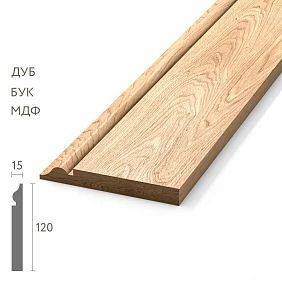
The size 120 × 15 × 2400 mm makes PLT-001 not an inconspicuous strip at the floor, but a full-fledged interior detail. The 120 mm height forms a pronounced lower boundary of the wall. This profile can support tall door casings, classic panels, wall moldings, and painted panels. But it requires precise fitting: in a small room, a tall baseboard can change the perception of the wall more than the buyer expects.
'Prestige' sanding and the quality of re-gluing 'for enamel' also cannot be mixed. The first characteristic refers to surface preparation. The second refers to the principle of visual matching of joined wooden sections. A well-sanded oak profile can still have shade transitions between lamellas if it is designed for opaque painting.
Before ordering, it is reasonable to look at the PLT-001 specifications in the main card, re-check the size, and clarify the actual delivery status. Do not fill in missing information by analogy with other products. If ready enamel, priming, or a specific color are not specified, these works cannot be considered automatically included.
Our factory also produces:

Why is oak profile even produced for covering paint
At first glance, it seems that oak is chosen solely for its beautiful grain. If the pattern will be covered with enamel, wouldn't it be easier to use another material? Such a question is logical, but it describes the role of wood in the project too narrowly.
The wood species is chosen not only for its external pattern. In a specific order, the following may matter:
-
the material itself;
-
hardness of the wood;
-
shape of the available profile;
-
combination with other solid wood elements;
-
design project requirements;
-
possibility of local repair;
-
availability of the needed batch;
-
the desire to use natural wood even under paint;
-
matching the material with doors, trims, or furniture.
Enamel covers color differences but does not turn oak into plastic. The base remains wooden. A subtle relief of pores may remain on the surface, especially if the finishing technology does not involve full visual leveling. How noticeable this relief remains depends on the preparation and the chosen coating system, so a specific effect cannot be promised without a test sample.
There are projects where visible fibers only get in the way. For example, a wall, doors, and baseboard should form a single color field. Oak flooring already has an active pattern, and an additional wood grain line around the perimeter would overload the interior. Then a wide baseboard under enamel does not compete with the parquet but emphasizes the wall's architecture.
Another scenario is painted doors and trims. The baseboard is matched not to the floor color but to the door unit's color. Here, the height, shape, and material of the profile matter, not the visible pattern of each slat.
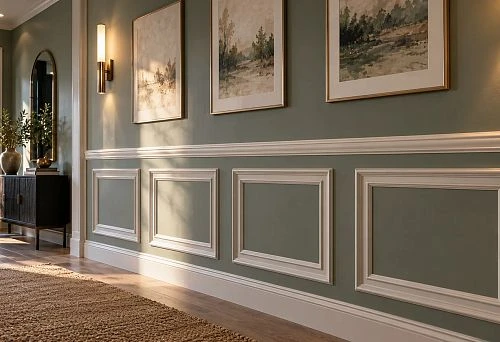
In a neoclassical interior, a tall white baseboard can support cornices, wall panels, and portals. If the oak is left natural, the lower line of the room becomes an independent wood band. If covered with enamel, it continues the color of the wall or trims and is perceived as part of the architecture.
Therefore, the phrase "oak under enamel" does not deprive the product of meaning. It directs it to another category of projects: not where the client wants to admire continuous fibers, but where an oak profile under an opaque coating is needed.
Get Consultation
Three characteristics that should not be mixed: oak, "Prestige," and "under enamel"
A buyer often reads the card as a single sentence: "oak, Prestige, under enamel." This creates a false impression that all words describe the appearance of the finished product. In fact, each answers a separate question.
Oak — what the profile is made of
The material determines the type of wood. PLT-001 is made of oak. This is not a promise of a specific shade, uniform grain, or clear finish. Two oak planks can naturally differ in tone, grain direction, and reaction to stain.
"Prestige" — how the surface is prepared
Sanding affects the quality of the base before further finishing. It does not choose the color or decide whether the finish will be transparent or opaque. After receiving the product, it is still necessary to assess the surface, clean it from dust, and follow the technology of the selected materials.
"Under enamel" — for what visual result the re-gluing is designed
This characteristic warns: the combination of lamellas is primarily designed for a coating that will hide color and grain differences. It does not make oak worse. It indicates for which finishing method the batch was selected.
Separating these concepts protects against two mistakes. The first is expecting an already painted baseboard. The second is considering "Prestige" sanding a guarantee of perfect lamella matching under a clear varnish.
Before purchasing, it is useful to formulate the task in one sentence. Not "I want an oak baseboard," but, for example:
-
need a wide oak baseboard under white enamel;
-
need an oak baseboard matching the color of the trim;
-
need natural oak under colorless oil;
-
need a light tint matching the parquet tone;
-
need a painted profile, but with a slight wood grain relief.
The first two scenarios match the stated direction of PLT-001. The third and fourth require batch inspection. The fifth depends on the finishing technology and definitely needs a test stain.
How the visual non-uniformity of glued oak profile is structured
Wood does not have a factory-identical pattern. Even sections of the same species differ in shade, line density, fiber direction, and absorbency. When a long linear profile consists of joined wood sections, these differences can occur on a single plank.
Under opaque enamel, color transitions are hidden. Under oil, stain, or clear varnish, they become part of the appearance instead.
This does not mean that every PLT-001 will necessarily have sharp spots or rough transitions. Without inspecting the actual batch, one cannot assert either the presence of pronounced differences or their absence. The correct buyer position is not to be scared in advance, but also not to consider transparent finishing as guaranteed safe.
Under a transparent or semi-transparent coating, the following may appear:
-
differences in natural shade;
-
change in fiber direction;
-
boundaries between joined sections;
-
uneven intensity of the stain;
-
darker or lighter areas;
-
contrast between the face surface and end trims;
-
varying expressiveness of the pores;
-
transitions that were almost imperceptible on untreated oak.
Stain is especially treacherous. Untreated areas may seem close in color, but after applying the compound, they can show different absorbency. One lamella will become more saturated, another will remain lighter. Correcting such a difference on an already installed baseboard is much more difficult than detecting it on a test piece.
Oil also enhances the depth of the wood grain. What looked calm before coating can become contrasting after treatment. Clear varnish preserves differences and adds its own degree of gloss. Even a matte compound does not make individual areas visually identical.
Enamel works differently. Its task is to create a covering color layer. That is why re-gluing "under enamel" is rational for projects where the overall tone matters more than the continuity of the natural pattern.
Opaque and transparent finishes: not two colors, but two different requirements for the batch
The choice of coating should be made before purchasing the entire volume. It determines which properties of the planks will be visible after installation.
| Finish option | What remains visible | What is required from the batch | Risk with PLT-001 without prior verification |
|---|---|---|---|
| White enamel | Profile shape, joints, possible pore relief | Even surface preparation and compatibility of the coating system | Low relative to the difference in lamella shades |
| Colored enamel | Shape and overall covering color | Test coating to evaluate shade and surface | Low in wood grain pattern, but the risk of color error remains |
| Enamel matching the wall color | Architectural baseboard line | Precise color matching with the wall | Mismatch between wall and baseboard shade |
| Enamel matching the door color | Connection with trim and door leaf | Coordination of finish with the door unit | Difference in gloss level or tone |
| Natural oil | Wood grain, shade, and transitions | Visually matched batch and test sample | Transitions between lamellas may intensify |
| Transparent varnish | Natural color and pattern under the protective layer | Checking several planks and joints | Visible non-uniformity will remain |
| Stain | Tinted wood pattern | Checking absorbency on different areas | Different tone intensity |
| Semi-transparent tinting | Part of the pattern under the specified shade | Strict sample control | Coating may not hide differences in lamellas |
The table implies a practical conclusion: for opaque enamel, the card formulation works as a useful hint. For transparent finishes, it becomes a warning about the need for additional checks.
If the project hasn't decided on the coating yet, you don't need to buy the entire batch first and then choose between oil and enamel. First, make a visual decision, then check the material for that technology.
Compare in detail enamel, oil, or varnish for wooden baseboard useful before budget calculation. The coating affects not only the appearance but also the list of materials, surface preparation, work costs, and batch requirements.
For which projects PLT-001 is suitable without internal contradiction
The most understandable scenario is a wide oak baseboard under opaque enamel. Here, the characteristic 'for enamel' matches the future finishing method, and the buyer doesn't have to hope that a transparent composition will hide what it's not intended for.
White tall baseboard
A height of 120 mm makes the profile noticeable. White enamel emphasizes its shape and ties it to door trims, ceiling cornices, or wall frames.
This option suits not only white walls. On a colored wall, a light baseboard creates a clear architectural boundary. The main thing is to decide in advance whether its shade will match the doors, wall, or another decorative element.
Baseboard in wall color
Painted to match the wall, PLT-001 does not break up the room with a separate strip. The tall profile retains volume but does not introduce a new color.
This technique is useful in rooms where there is already expressive oak flooring. A natural baseboard could add another active wood line, while enamel keeps the focus on the floor covering itself.
Baseboard in the color of doors and trims
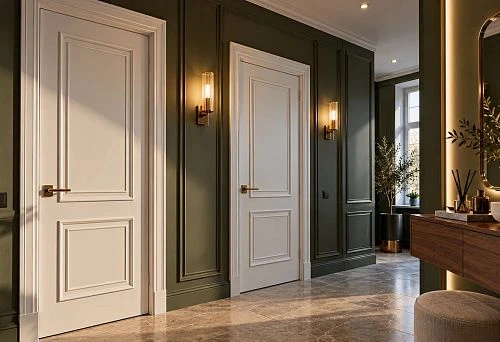
When the door unit has an opaque finish, it is often more logical to tie the baseboard to it. The result is a continuous system: the vertical trim transitions into a horizontal bottom line.
Before ordering, check the 15 mm thickness and the joint with the trim. If the elements have different projections from the wall, the connection needs to be planned in advance. Color matching will not fix sloppy geometry at the junction.
Neoclassical interior
A tall wooden baseboard works well next to painted wall panels, paneled doors, and calm stucco decor. Proportions and a unified finish are important here.
PLT-001 does not have to imitate an antique detail. Its task is to create a pronounced wall base and support the vertical lines of door portals.
Interior where wood should not dominate
The floor, furniture, and individual panels can already have an active texture. Another natural oak strip around the perimeter sometimes overloads the space. A covering enamel preserves the natural material of the profile but makes it visually calmer.
Project with painting all slats with one system
When the entire batch is primed and painted simultaneously, it is easier to ensure a uniform color and gloss level. The slats can be laid out, marked, checked at the joints, and then handed over for finishing as a single set.
In such situations, the request to buy an oak skirting board PLT-001 for enamel matches the product more accurately than a general desire to find any oak profile.
When placing the entire order without a sample is risky
Transparent finishing is not prohibited by the word "oak" itself, but it is also not guaranteed by the characteristic "for enamel." The stricter the expectations for the visible texture, the more important a preliminary check is.
The skirting board must match the oak parquet
"Oak to oak" does not yet mean a visual match. The parquet may have a different selection, tone, pattern, coating, and degree of gloss. Even two surfaces of the same species look different after treatment.
You need to apply not an untreated plank to the finished floor, but a test sample with the same coating that will be used on the baseboard.
Colorless oil is planned
Oil reveals the fibers and deepens the natural shade. It can emphasize transitions between lamellas that were barely noticeable before treatment.
You need to check several areas, not just the beautiful edge of one plank.
A transparent matte varnish is needed
A matte surface does not hide the differences in wood. It only reduces mirror reflections. The pattern, shade, and joints remain visible.
Before purchasing the entire batch, several planks are evaluated side by side.
A light stain has been chosen
The more transparent and lighter the tint, the less it masks the original unevenness. Moreover, different absorbency can increase the contrast.
The sample must be made with the same stain and using the same technology planned for the object.
The baseboard runs along the long illuminated wall
On a short section, the transition may go unnoticed. On a wall several meters long, especially under side daylight, the shade change between planks becomes more obvious.
In such a room, the planks are laid out in advance in the intended order and assessed as a single row.
The baseboard adjoins natural oak trim
The proximity of two clear oak surfaces raises the requirements for matching. Not only shades may differ, but also the direction of the grain, pore width, finish, and gloss.
A joint sample is checked, not each piece separately.
The customer expects a uniform pattern around the entire perimeter
Such an expectation should be voiced before payment. Natural wood is never completely uniform, but the degree of acceptable variation differs for everyone.
If any transitions are considered a perception defect, the "under enamel" option cannot be purchased for a clear finish without approving the actual batch.
Which batch photos actually help make a decision
The request "send a photo of the baseboard" is too general. You can get a beautiful close-up of one successful area and still learn nothing about the batch.
For a meaningful check, different shots are needed.
Several full-size planks side by side
Such a shot shows the overall spread of shades. It is advisable to place the planks in one direction and shoot under even lighting.
One board does not allow understanding how much it differs from neighboring ones.
Close-up of the face surface
The photo should show the fibers, pores, and transitions between wood areas. What is needed is not a decorative angle, but a working image of the surface.
The place where lamellas join
If the transition is visible on the untreated profile, it will likely not disappear under a transparent coating. How strongly it will show will still only be revealed by a sample.
End face
The end face shot helps to see the profile structure and prepare for trimming. It does not answer all questions about finishing, but complements the understanding of the product.
Planks next to a neutral reference
The color on the screen is not an exact reference, but a neutral background reduces the influence of surrounding objects. You should not ask to match the shade only from a phone photo.
Actual warehouse stock
If a limited batch is purchased, it is important to ensure that the planks shown are the ones to be shipped, not a sample from another delivery.
The photo is useful for preliminary selection. It helps to reject a clearly unsuitable option or decide that the batch deserves further inspection. But the image does not replace a physical sample with the actual coating.
Why the screen cannot confirm the color of oak
The same baseboard looks different on two monitors. The phone enhances contrast, the laptop screen makes the image cooler, and automatic white balance changes the wood tone before the file is even sent.
The result is influenced by:
-
lighting temperature;
-
lighting direction;
-
camera settings;
-
automatic image processing;
-
recipient screen;
-
display brightness;
-
surrounding colors;
-
humidity and condition of the wood;
-
polishing;
-
selected coating composition;
-
number of applied layers.
Therefore, from a photo you can assess the prominence of the pattern, noticeable differences between planks, and the overall uniformity of the batch. It is not possible to definitively agree on the exact shade of the plinth relative to the parquet or door.
It is especially dangerous to compare a photo of untreated PLT-001 with a finished oak floor. After oil or varnish, the wood will change the depth of tone. Stain will add a new shade. Enamel will completely transform the appearance.
The photo answers the question "are there obvious reasons to reject the batch". The test piece answers the question "how a specific material will look in our project".
Test piece: a small detail that determines the fate of the entire batch
If a transparent finish is planned, a test piece is needed not just for formality. It allows checking several risks at once:
-
shade development;
-
behavior of pores;
-
stain absorbency;
-
oil depth;
-
degree of varnish gloss;
-
visibility of boundaries between lamellas;
-
combination with the floor;
-
combination with doors;
-
result in daylight and evening light.
It is better that the sample corresponds to the actual batch. A beautiful piece from another delivery does not confirm the appearance of the warehouse stock that will be sent to the site.
The specified system must be applied
You cannot coat the sample with the first available oil if stain and varnish will be used in the interior. You cannot test white enamel when a complex color with a certain degree of gloss has been chosen.
The test must replicate the actual layers as accurately as possible:
-
surface preparation;
-
the selected primer, if provided;
-
stain or other tinting compound;
-
oil, varnish, or enamel;
-
interlayer treatment;
-
the stated number of layers;
-
Complete drying.
The article cannot assign a universal technology for any composition. Instructions depend on the specific finishing system. The buyer's task is not to improvise on the entire batch, but to test the chosen technology on a control sample.
It is better to check at least two areas.
One area may accidentally be uniform. For transparent finishes, it is useful to apply the composition to parts with different grain patterns or at the transition between lamellas.
If the sample is short and does not contain a joint, it shows the color and reaction of the wood, but does not answer the question about the visibility of the glue line.
Evaluate only after complete drying.
Wet oil, fresh stain, and recently applied varnish look different from the finished surface. The final decision is made after the recommended drying time has elapsed.
Look at the floor, not just on the workbench.
The baseboard is at the bottom of the wall. Different light falls on it, with the floor and furniture shadows nearby. The sample is applied in the actual location, not evaluated solely under a bright workshop lamp.
Check in the evening.
During the day, oak can match the floor, but under warm artificial lighting it may become noticeably yellower or darker. If the room is used mainly in the evening, such a check is especially important.
Suitable materials for a test coat are chosen after determining the type of coating. Buying a random product just for a test is pointless: it will show a result that will not occur on the finished object.
What questions to ask the manager before paying for the batch
The phrase "will it suit oil?" is too vague. The manager does not know how uniform a grain pattern the customer expects, what product will be used, and what the baseboard is being compared with.
It is more useful to provide a specific scenario:
We need PLT-001 for a clear coating and installation next to oak parquet. The natural grain must remain visible. We ask you to show several planks from the actual batch, the splice points, and confirm the possibility of obtaining a control piece for testing the selected oil.
Before ordering, clarify:
-
whether the photos show the actual batch;
-
how many full-size planks are available;
-
Can I get a photo of several items together?
-
Are there pronounced transitions between the lamellas?
-
Is it possible to order a short sample?
-
Can I choose slats for a transparent finish?
-
Does the entire volume belong to one batch?
-
Will the remainder be enough for the project with a reserve?
-
Can I add a spare slat?
-
Is the product supplied without a ready-made coating?
-
Is separate color approval required?
-
What terms apply at the time of payment.
If the project involves an opaque enamel, the list is shorter. The main focus is on quantity, sizes, surface, future color, and compatibility of finishing materials.
With a transparent finish, the questions become stricter. You need to agree not on an abstract "oak," but on specific planks.
Height 120 mm: PLT-001 cannot be chosen as an inconspicuous technical strip
A tall wooden baseboard affects the proportions of the room. It visually takes away part of the wall, emphasizes its lower boundary, and interacts with doors, furniture, and wall decor.
Height 120 mm is especially noticeable:
-
in small rooms;
-
near low outlets;
-
under built-in cabinets;
-
near radiators;
-
on short wall sections;
-
near narrow door casings;
-
under wall moldings;
-
on the accent wall.
Before purchasing, it is useful to apply a 120 mm high line with painter's tape on several walls. There is no need to mark the entire apartment. It is enough to check characteristic areas: near the door, behind the sofa, by the wardrobe, and on an open wall section.
On a floor plan, 120 mm may seem like a moderate value. In a real interior, a wide baseboard is perceived more actively, especially if painted in a contrasting color.
High baseboard and wall color
A profile in the color of the wall looks calmer because it does not introduce a horizontal contrasting stripe. Its height is read through relief and shadow.
A white baseboard on a colored wall is more noticeable. It supports classical architecture but requires a connection with other white elements.
A dark profile on a light wall creates a strong graphic line. Such a solution should be planned in the project, not appear accidentally after purchase.
High baseboard and oak floor
Natural PLT-001 can continue the floor material up the wall. This can look seamless if shades and finishes are coordinated. With a noticeable mismatch, the baseboard becomes a separate strip between the floor and the wall.
Enamel removes the need to literally repeat the wood tone. Then the oak floor remains an independent surface, and the baseboard belongs to the wall architecture.
Tall baseboard and wall decor
If molding frames are planned on the wall, check the distance between their lower edge and the top line of the baseboard. A too narrow gap looks random and complicates painting.
Marking is done before ordering both elements. The height cannot be selected independently of the overall wall composition.
Thickness 15 mm: the protrusion from the wall affects trim and furniture
The thickness of the baseboard is often noticed only during installation. Before that, the buyer focuses on height and color. But 15 mm determine how much the profile will protrude from the wall plane.
Special attention is required at junctions with door trims. Three situations are possible:
-
The baseboard and trim have a coordinated protrusion.
-
The baseboard protrudes more than the trim.
-
The architrave protrudes more than the skirting board.
Each option requires its own joint solution. You cannot expect the alignment to happen automatically just because both elements are wooden.
Thickness also affects furniture. A wardrobe or cabinet without a cutout for the skirting board will not fit flush against the wall. For built-in furniture, this gap is planned in advance.
Behind radiators, pipes, and utility boxes, 15 mm also matters. You need to check not only the height but also the depth of the available space.
In a long hallway, the protrusion of the skirting board may intersect with door stops or lower furniture elements. Such details are easy to miss on a plan.
Therefore, before ordering, take actual measurements rather than just relying on wall lengths. Separately record areas near doors, built-in wardrobes, radiators, and utilities.
Length 2400 mm: you need to calculate not in meters, but in cutting whole planks
A room may have a perimeter of 20 m, but that does not mean it is enough to divide 20 by 2.4 and round up. Such a calculation does not account for the length of individual walls, corners, doorways, and the usefulness of offcuts.
For PLT-001, each full-size plank has a length of 2400 mm. The layout is planned wall by wall.
Basic calculation procedure
First, measure all areas where the baseboard will be installed. Doorways and other zones without baseboard are subtracted. Then the walls are divided into segments that can be obtained from strips 2400 mm long.
For each section, note:
-
net length;
-
number of full strips;
-
the joint location;
-
possible remainder;
-
possibility of transferring the remainder to a short wall section;
-
number of external and internal corners;
-
spare strip.
Why simple perimeter is misleading
Suppose, after subtracting doors, the net length of baseboard in a conditional room is 17.6 m. Dividing by 2.4 gives 7.33 strips. Formally, one would want to order eight.
But one wall has a length of 5.1 m. It needs three planks, and after cutting, short sections will remain. The other wall is 3.7 m: two will be needed here. The leftovers may fit the jambs, or they may be useless due to the direction of cuts, damaged ends, or differences in pattern.
Therefore, the final quantity is determined only after placing all segments on virtual planks of 2400 mm length.
How much to add as a reserve
There is no universal percentage for any room. The reserve depends on:
-
the number of corners;
-
complexity of joints;
-
the installer's experience;
-
presence of long open walls;
-
transparent or opaque finish;
-
possibility of buying the same batch;
-
number of short jambs;
-
quality of initial measurements.
For a limited warehouse stock, it is rational to have at least one spare full-length plank, if the project and available quantity allow. It will be useful in case of cutting errors, damage during installation, or subsequent local repairs.
If a transparent finish requires strict batch matching, the spare is especially valuable. A plank purchased later may differ in shade and pattern.
Why the price per meter cannot be evaluated separately from the finish
The project cost consists not only of the profile price. The budget includes preparation, coating, consumables, cutting, installation, and reserve.
Before placing an order, it is useful calculate the cost of an oak skirting board with finish, and not compare products only by the cost of a single plank. Covering enamel and transparent multi-layer finish form different budgets.
Warehouse stock: why the decision needs to be made for the entire project at once
If PLT-001 is on sale or available in limited quantities, postponing part of the purchase is risky. Today there are enough planks for one room, but in a week the same batch may no longer be available.
Buying in stages creates three risks.
The first is shortage. After installing the first room, it turns out that there is not enough remaining stock for the hallway and bedroom.
The second is the difference in batch. An oak board purchased later may have a different shade, pattern, or character of re-gluing.
The third is the lack of a spare part. The entire warehouse volume goes into final installation, and if damaged, there is nothing to replace one section.
Before payment, you need to know:
-
full net area;
-
cutting layout for 2400 mm planks;
-
quantity for all rooms;
-
technological reserve;
-
number of items in actual stock;
-
possibility to get the entire volume in one batch;
-
availability of an additional plank for storage.
You should not rely on the figure seen in an article, old message, or saved screenshot. The balance and discount change. The current state is checked on the product page immediately before ordering.
For this, you can check the current discount and stock for PLT-001. If the main and sale cards show the same product, it is better to clarify before payment which address the order is placed to and what conditions apply now.
Dry layout of oak planks before painting and installation
The plinth cannot be taken out of the packaging one plank at a time and immediately installed around the perimeter. Even under enamel, it is useful to first lay out the entire set. With a transparent coating, this step is mandatory.
Dry layout solves four tasks:
-
distributes shades;
-
assigns a place to each plank;
-
helps use leftovers;
-
shows joints before finishing.
Start with the most exposed walls
The main long wall is visible immediately upon entry. Planks that best match each other are assigned to it. Transitions and seams are evaluated from the usual viewing point, not just up close.
Behind furniture or in less visible areas, sections with more pronounced differences can be used, if acceptable for the chosen finish.
Planks are labeled
After laying out, the room, wall, and sequence are indicated on the back side or on a separate tag:
-
living room, wall A, plank 1;
-
living room, wall A, plank 2;
-
hallway, wall B;
-
reserve.
Labeling is especially important before painting. After applying the covering coat, external differences will diminish, and details can easily be confused.
Transparent finish is checked in the order of future installation
It is useful to make test stains not only on one sample, but on two adjacent planks. Then you can see whether the joint will be calm or contrasting.
End cuts are taken into account in advance
A cut may look different from the face surface. This matters at external corners and ends. The method of finishing the ends is agreed upon before painting.
The reserve is stored together with information about the coating
A spare plank without the name of the stain, oil, or enamel code is almost useless after a few years. Along with it, data about the finish and the remaining material are kept, if storage conditions allow.
How to match PLT-001 with an oak floor
The buyer often formulates the task as: "The floor is oak, so the baseboard should be oak too." But the wood species is only a starting point.
For visual matching, compare:
-
the original shade;
-
the wood sorting;
-
pattern direction;
-
width and expressiveness of pores;
-
tinting method;
-
gloss level;
-
color depth;
-
reaction in daylight and evening light.
Exact match is not always necessary. There are three meaningful strategies.
Continue the floor
The baseboard is coated with a similar transparent compound so it is perceived as a continuation of the oak flooring. For PLT-001, this scenario is possible only after batch inspection.
The result is evaluated at the junction of the wall and floor. The sample should lie vertically, because the same wood reflects light differently in horizontal and vertical positions.
Connect the baseboard to the wall
The profile is coated with enamel in the color of the wall. The oak floor remains a separate natural surface, and the tall baseboard becomes part of the wall architecture.
This is the most direct scenario for the quality of re-lamination "under enamel."
Connect the skirting board with the doors
The color and degree of gloss match the door trims. The floor can be darker or lighter. Visual integrity is created through a continuous framing system.
The strategy choice is made before ordering. Trying to simultaneously match the floor, the wall, and the door often leads to a compromise shade that does not support any surface.
The general approach to selection can be clarified in the material about how to choose an oak skirting board for the floor. For PLT-001, a special quality check of re-lamination under the chosen coating is added to the general criteria.
PLT-001 in different rooms: one model, different requirements
A tall oak skirting board cannot be evaluated the same way for a living room, hallway, and bedroom. Lighting, the length of open walls, adjacent materials, and load change.
Living room
Here there are usually long visible walls, daylight, and large furniture. With a transparent finish, transitions between planks can be especially noticeable.
The full row is laid out before installation. Joint locations should not randomly fall into the central open area if they can be moved closer to furniture or an architectural protrusion.
With enamel, the key is matching the color with the walls, doors, or wall decor.
Bedroom
Most of the baseboard can be behind the bed, wardrobe, and cabinets. But open areas near the door and opposite the bed still require careful selection.
Before installation, the location of built-in furniture is marked. There is no point in using the most pattern-matched planks where they will be completely covered by a wardrobe.
Entryway and Corridor
There are many doors, short wall sections, and joints with trim. A thickness of 15 mm becomes no less important than a height of 120 mm.
Covering enamel helps unify the baseboard with door portals. With a transparent finish, a large number of short pieces can create a patchy pattern.
Cabinet
Natural oak can support the table, bookshelves, and wall panels. But matching the material does not guarantee matching the shade.
If a calm architectural outline is needed, the baseboard is painted in the color of the walls or built-in furniture.
Commercial space
In long corridors, showrooms, salons, or hotel interiors, repairability is especially important. A spare plank from the same batch helps replace a damaged section without searching for visually similar oak.
Colored enamel simplifies restoring the overall tone, but the local repair technique still depends on the coating used.
What to buy together with PLT-001
A plinth is not a complete project by itself. The buyer will need materials for testing, finishing, and installation. The exact set depends on the base, the chosen coating system, and the installation method, so a universal configuration cannot be assigned.
| What you will need | Why | When to choose | What to Check |
|---|---|---|---|
| Control segment PLT-001 | Check color, pattern, and coating | Before purchasing the entire batch for transparent finishing | Whether the sample belongs to the actual batch |
| Primer | Prepare oak for the chosen opaque coating | After choosing the enamel | Compatibility with enamel and wood |
| Enamel | Create an opaque color | For white, colored, or wall solutions | Shade, gloss level, test coat |
| Oil | Preserve visible texture | Only after batch inspection | Shade change and lamella appearance |
| Stain | Change tone while preserving pattern | For transparent or semi-transparent tinting | Absorption difference |
| Varnish | Create a transparent protective layer | After approval of the oak appearance | Degree of gloss and compatibility with previous layers |
| Mounting compound | Fix the profile | After checking the base and installation method | Compatibility with finish, wall, and wood |
| Spare plank | Replace the damaged area | For a limited or visually matched batch | Store together with coating data |
You cannot buy finishing materials based on a single beautiful name. Primer, enamel, stain, oil, and varnish must work as a compatible system. The exact technology is determined by the recommendations of the manufacturers of the selected compounds and the conditions of the site.
In the article, the link to Primer and enamel for baseboard leads to the materials section, but the final decision is made after a test application. The mere presence of a compound in the catalog does not replace compatibility testing.
How not to confuse PLT-001 with a similar article number
In the assortment, similar designations may differ by one character. It is especially easy to confuse PLT-001 and PLT-001-1 if the article number is conveyed verbally, abbreviated in correspondence, or copied without checking.
One cannot assume that models differ only in length, color, or a minor detail. Before ordering, each card is compared separately:
-
full article number;
-
a drawing;
-
cross-section;
-
length;
-
material;
-
sanding;
-
gluing quality;
-
available finish;
-
Sales status.
This article specifically refers to PLT-001 with dimensions 120 × 15 × 2400 mm made of oak with a glue joint quality of "under enamel." Characteristics of another model cannot be automatically transferred here.
In the estimate, cutting map, and order, the article number is written in full. The phrase "that wide oak skirting board" does not protect against assembly errors.
If you need not a specific PLT-001, but a comparison of several models, it is better to open the category and choose a skirting board made of oak, beech, or MDFA broad query like "buy wooden skirting board" should lead to a range of options, not force the buyer to fit one item to any task.
Mistakes that turn an oak skirting board into disappointment
Assuming any oak is ready for transparent coating
The material does not guarantee visual sorting for oil or varnish. PLT-001 is stated with a glue joint quality of "under enamel," so transparent finishing is agreed upon separately.
Thinking that "under enamel" means an already painted product
This characteristic does not select a color and does not confirm the presence of a finished coating. Before ordering, you need to find out the actual condition of the product.
Buying the entire batch before choosing the finish
After payment, it turns out that the customer wanted natural oil, and the transitions between the lamellas do not suit them.
The coating is chosen first. Then the batch is checked specifically for it.
Checking one plank
One successful plank does not show the spread of the entire batch. You need to see several products side by side and the places where they are glued together.
Matching the color by screen
The photo changes due to light, camera, and display. It is suitable for a preliminary assessment, but not for an exact match with the parquet.
Making a test with a random composition
Another product will give a different shade, gloss, and absorbency. The test must replicate the future system.
Apply stain to the entire set at once
Differences appear after application, when fixing them is already expensive. First finish a test piece.
Order part now and part later
Warehouse stock may run out. A new batch can differ. For transparent finishes, the risk is especially high.
Do not add a reserve
A cutting error or damage leaves the object without a suitable replacement. Buying one matching plank later may be impossible.
Ignoring thickness
The baseboard protrudes further than the trim or prevents pushing the cabinet close. The color is matched, but the joints look untidy.
Assess height only by the number
120 mm on screen and 120 mm on a real wall are perceived differently. Marking with painter's tape is needed.
Paint before dry layout
After finishing, the strips are mixed, joints end up in unsuitable places, and the transparent pattern no longer aligns.
Do not fix the order of the strips
Even a well-matched row loses its meaning if the installer swaps parts around.
Confuse sanding and re-gluing
«Prestige» does not promise selection of lamellas for transparent coating. These are different characteristics.
Fix the old discount in the estimate
The price and stock balance of a warehouse item change. They are re-checked before payment.
Choose PLT-001 only because it is sold at a discount
The discount does not make the profile suitable for a specific finish, wall height, or joint with a casing. First, the project is checked, then the commercial terms.
Who PLT-001 is really suitable for
This oak skirting board is worth considering when:
-
a profile with a height of 120 mm is needed;
-
the 15 mm thickness fits with architraves and furniture;
-
the length of 2400 mm is accounted for in the cutting plan;
-
white or colored enamel is planned;
-
the skirting board should match the wall or doors;
-
the natural grain pattern is not a primary requirement;
-
the project involves an oak base under an opaque coating;
-
the buyer is ready to inspect the actual batch;
-
the total warehouse stock is sufficient for the project and reserve.
PLT-001 is especially precise in addressing the task of a tall painted baseboard for a neoclassical, transitional, or modern interior with pronounced wall architecture.
In which cases it's better to choose another option
An order should not be placed without additional approval if:
-
a guaranteed uniform oak is needed under a colorless oil;
-
the baseboard must exactly match the parquet sorting;
-
any transitions between slats are unacceptable;
-
a very light transparent tint is planned;
-
there is no possibility to obtain photos of the batch;
-
it is impossible to perform a test stain;
-
the available remaining stock is not enough for the entire project;
-
the height of 120 mm is too large;
-
thickness of 15 mm conflicts with the architraves;
-
a different length or profile shape is required.
In such situations, rejecting PLT-001 does not mean rejecting wooden baseboards altogether. You need to look at other versions and choose a model whose characteristics match the project.
How to place an order for STAVROS without guessing
The purchase should complete the verification, not start it.
First open the card and order PLT-001 with dimensions 120 × 15 × 2400 mm only after the height, thickness, length, and finishing method have been confirmed.
Then proceed along the route:
-
Determine whether the coating will be opaque or transparent.
-
Take measurements of all walls and openings.
-
Create a cutting plan for strips 2400 mm long.
-
Check joints with trims, furniture, and engineering elements.
-
Request current price and stock availability.
-
For transparent finishes, obtain photos of several strips.
-
Order or approve a control sample.
-
Perform a test paint.
-
Lay out the entire batch before installation.
-
Add a spare strip if quantity allows.
-
Save data about the finish used.
-
Only after these checks, hand over the set for cutting and installation.
If PLT-001 does not fit in height, finish, or available quantity, you can view oak skirting boards in the general category. This is better than trying to force one stock item to solve a task it was not designed for.
Checklist before payment
-
Item verified: PLT-001, not a similar model.
-
Size 120 × 15 × 2400 mm fits the project.
-
Height marked on the actual wall.
-
Thickness matched with the architraves.
-
The furniture will fit in the planned location.
-
Determined whether the finish is opaque or transparent.
-
It is clear that "under enamel" does not mean a ready color.
-
The difference between sanding and re-gluing is clear.
-
Photos of the actual batch have been received.
-
The image shows several slats side by side.
-
A test coat was applied for the transparent finish.
-
The baseboard was matched with the floor and doors.
-
Whole slats of 2400 mm length were calculated.
-
Corners, joints, and short wall sections were taken into account.
-
A reasonable reserve was added.
-
The warehouse stock is sufficient for the entire project.
-
The current price has been verified.
-
The coating materials are compatible with each other.
-
The planks will be laid out and marked before installation.
-
Color and finish system data saved.
FAQ: answers to questions about the oak baseboard PLT-001
Is PLT-001 really made of oak?
Yes, the specifications for PLT-001 indicate oak. The phrase "under enamel" does not change the wood species, but describes the quality of gluing for predominantly opaque coating.
What does gluing "under enamel" mean?
This means that when selecting joined wood sections, an opaque finish is assumed. The opaque enamel should cover possible differences in shade and grain between lamellas.
Is the baseboard already coated with enamel?
It should not be considered painted if the finished coating is not separately specified in the card or order. "Under enamel" is not a color name or confirmation of completed painting.
Is PLT-001 supplied in white?
White color cannot be assumed based on the gluing characteristics. The shade, priming, and finish coating need to be checked in the product card and agreed upon before ordering.
Can PLT-001 be coated with natural oil?
The decision is made only after checking the actual batch. Oil preserves and enhances the oak grain, so transitions between lamellas may become more noticeable.
Will PLT-001 work under a clear varnish?
The possibility of clear finishing needs to be confirmed on several planks and a test piece. The stated gluing quality is oriented toward enamel and does not by itself guarantee a uniform appearance under varnish.
Can stain be used?
Stain can only be considered after a test application on the actual material. Different areas of oak may absorb the compound with varying intensity.
Will the gluing spots be visible?
Without inspecting the batch, it cannot be stated how noticeable the transitions will be. Under opaque enamel, color differences are covered, but under transparent finishes they may show through.
Why is oak baseboard made for enamel?
Oak is chosen not only for its visible grain. Material, hardness, profile shape, project requirements, and combination with other wooden elements can matter. Enamel sets a uniform color while preserving the wooden base.
How does "Prestige" sanding differ from re-gluing "under enamel"?
Sanding describes surface preparation. Re-gluing describes the principle of visually matching joined sections for future finishing. Good sanding does not guarantee an identical lamella pattern under clear varnish.
What does the size 120 × 15 × 2400 mm mean?
The baseboard has a height of 120 mm, a thickness of 15 mm, and a plank length of 2400 mm. All three values are checked before ordering: height on the wall, thickness near trim and furniture, and length in the cutting plan.
Will a height of 120 mm suit a small room?
This depends on the room's proportions, door height, wall color, and adjacent decor. Before purchasing, mark 120 mm with painter's tape on several walls and evaluate the result from a normal distance.
How to check the 15 mm thickness?
Measure the protrusion of door trims, the distance to furniture, and the free space near built-in structures. The baseboard should not create an accidental step or hinder cabinet installation.
How many PLT-001 planks will be needed?
The quantity is determined by the cutting plan. Measure each section, subtract door openings, and place the pieces on 2400 mm long strips. Simply dividing the total perimeter is not enough.
Is a reserve needed?
For a warehouse batch, a reserve is desirable, especially with a transparent finish. The exact quantity depends on corners, cutting, and the possibility of purchasing more products from the same batch later.
Can I first buy skirting boards for one room?
Yes, but with a limited remaining stock, there is a risk that there won't be enough for the other rooms from the same batch. If a uniform shade is needed, it is wiser to calculate the entire project at once.
Is a photo enough to choose a transparent coating?
No. A photo helps assess the overall unevenness, but it does not confirm the exact color and reaction to oil, stain, or varnish. A physical sample is needed.
What should be visible in the photo of the batch?
Photos of several strips side by side, the front surface, glue joints, and ends are useful. It is desirable to confirm that the actual warehouse remaining stock was photographed.
How to properly do a test application?
Use the same material system planned for the project. Apply it to at least two different areas, wait for complete drying, and evaluate the sample next to the floor in daylight and evening light.
Will PLT-001 suit oak parquet?
The wood species matches, but visual matching is not guaranteed. Compare the actual shade, grain, finish, and gloss level on the finished sample.
Can PLT-001 be painted to match the wall color?
Yes, this is one of the most logical scenarios for the quality of re-lamination "under enamel." The shade and gloss level should be agreed upon with a test coat.
Can the baseboard be painted to match the door color?
Yes, if the joint with the architraves, the 15 mm overhang, and the compatibility of the coatings have been checked in advance. Not only the color but also the gloss level should match.
Do the planks need to be laid out before painting?
Yes. A dry layout helps assign a place to each piece, check the joints, and use the leftovers. After the layout, the planks are marked.
Why can't planks from different batches be mixed?
The wood may differ in shade, grain, and reaction to the finish. With a transparent finish, the differences will be especially noticeable.
Where can I see the current price of PLT-001?
The current price should be checked in the product card right before ordering. The article does not fix the cost because sales conditions may change.
Where can I buy PLT-001?
You can check the specifications and make a purchase in the STAVROS product card. Before payment, confirm the size, surface condition, type of lamination, actual stock, and the selected finishing method.
Decision before purchase: first the visual result, then the batch
PLT-001 does not put the buyer before a strange choice between oak and enamel. Oak is responsible for the material. The wording "under enamel" warns what external result the lamination is designed for.
If you need a tall oak baseboard under white, colored, or wall-matched opaque coating, the characteristics of PLT-001 form a clear system. The size 120 × 15 mm creates a noticeable bottom line, the length of 2400 mm allows you to make a cutting map, and the enamel hides differences between lamellas.
If the goal is different — to preserve natural fibers under oil, stain, or clear varnish — you cannot order the entire volume by the single word "oak." First, you need photos of the actual batch, several planks side by side, and a test piece with the planned finishing system.
Before payment, check four things: whether the size fits, whether the coating method matches the quality of lamination, whether one batch is enough for the entire project, and whether a spare plank is provided. After that, PLT-001 ceases to be an ambiguous product and becomes a precise choice for a specific interior.
STAVROS company helps you go through this path without random decisions: open the oak profile card, compare wooden baseboards, select finishing materials, check the actual stock, and assemble an order for a real task. The main principle is simple: first determine what result should remain visible, and only then buy material for the entire perimeter.