










































































Article Contents:
- Doorway decor without a door: how to design a passage with a wooden portal, moldings, and carved decor STAVROS
- What is doorway decor and when is it needed
- Portal, casing, frame: three different concepts
- Door frame
- Baseboard
- Wooden portal
- STAVROS wooden portals: architecture instead of renovation
- Portal PRT-016: universal classic
- Portal PRT-002: classic for a country house
- Portal PRT-004: monumentality without overload
- Portal PRT-009: Empire-style strictness
- Doorway decor without a door: five relevant solutions
- Solution 1. Wooden portal as the main statement
- Solution 2. Moldings and box profile: a neat architectural frame
- Solution 3. Carved decor: accent above the opening
- Solution 4. Slats around the opening: modern vertical texture
- Solution 5. Arch design
- Opening decor in different rooms: from kitchen to hall
- Designing the opening between the kitchen and living room
- Designing the transition from the hall to the living room
- Decorating an opening in a bedroom or dressing room
- Opening in a study or library
- How to choose a door opening decor style
- Classic and neoclassic
- Neoclassicism
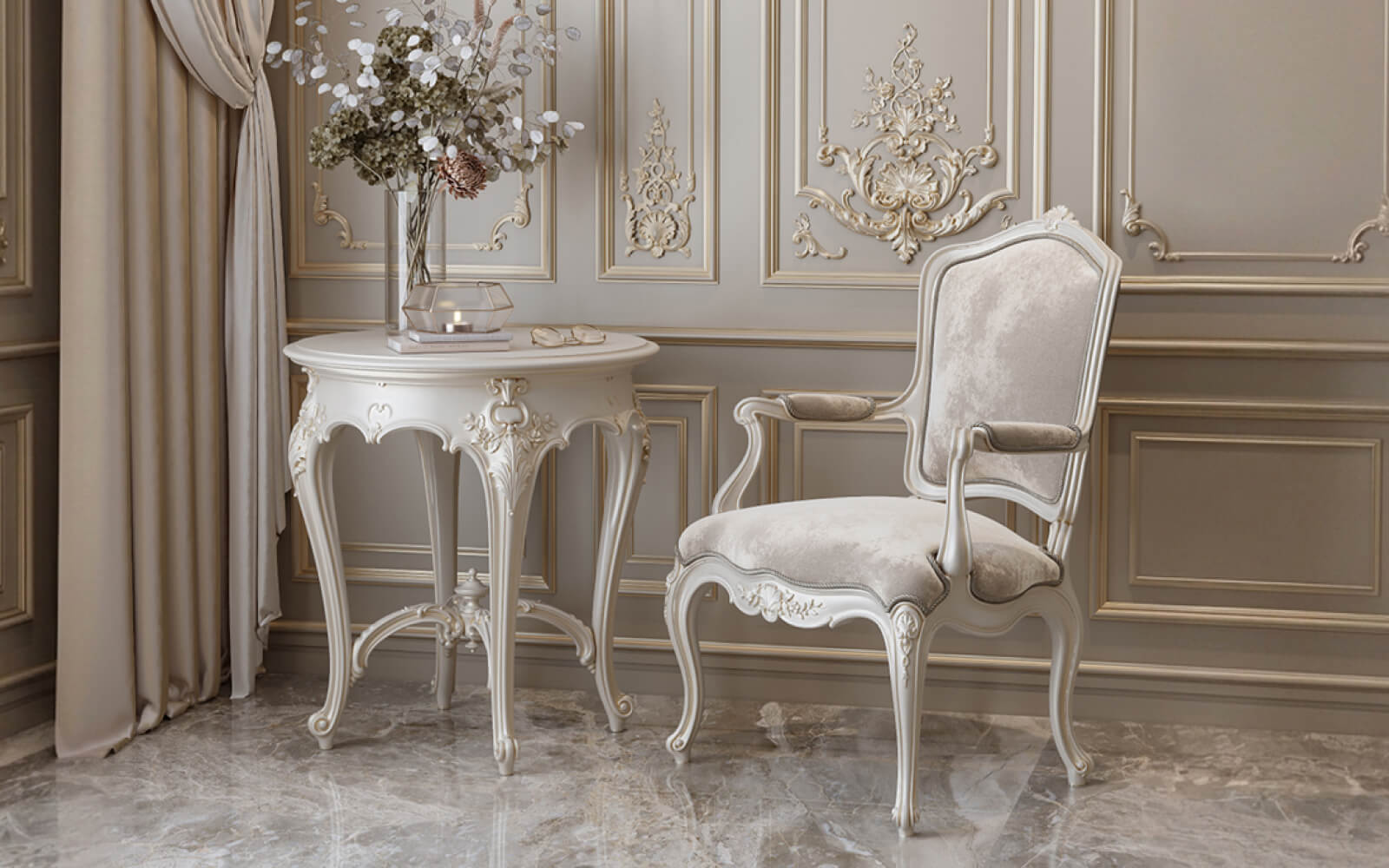
- Provence and French Classics
- Modern classic and neoclassical without unnecessary details
- Modern interior: slats and clean lines
- Materials and finishes: from oak to white enamel
- Solid oak
- Solid beech
- MDF
- Finishing
- How to choose the portal size for a door opening
- Opening width and side post width
- Portal height
- Wall thickness and portal depth
- How to coordinate the opening decor with the rest of the interior
- Errors in designing a doorway
- Where to buy decor for a STAVROS doorway
- Frequently asked questions about doorway decor


Doorway decor without a door: how to design a passage with a wooden portal, moldings, and carved decor STAVROS
There is one element in the interior that most people perceive as a technical inevitability — and almost never see an architectural opportunity in it. This is a doorway. A hole in the wall that is usually plugged with a door and forgotten. But what if you remove the door? Or don't install it at all — because the passage between the living room and kitchen, between the hall and library, between the bedroom and dressing room requires neither soundproofing nor a lock?
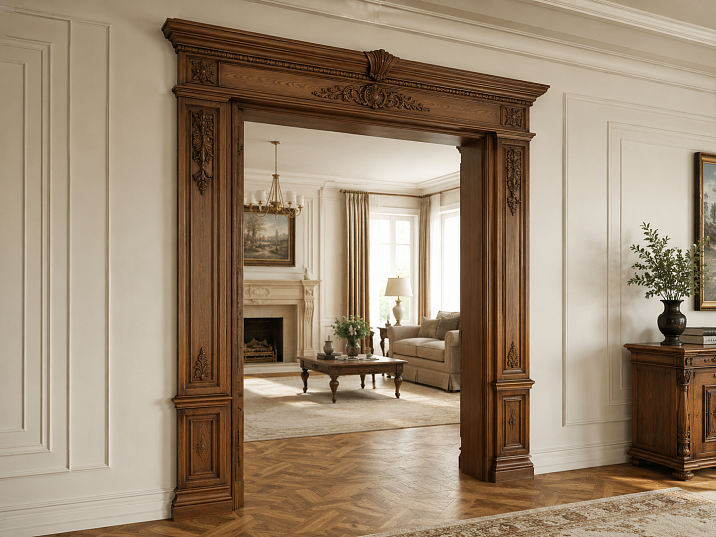
Then the open doorway becomes a statement. And this statement can be banal — just a hole in the wall with unfinished slopes — or architectural: framed by a wooden portal, decorated with carved capitals and moldings, designed so that it turns into the main visual accent of the interior.
Decorating a doorway without a door is a separate design task. Not a repair, not 'covering the slopes', not buying and nailing trim. It is a decision about how the architectural transition between two spaces will look. And it is this decision that we analyze in this article.
Wooden portals STAVROS — a separate section with ready-made solutions for designing door and arch openings: portals PRT-002, PRT-004, PRT-009, PRT-016 show how the same open doorway can be turned into a classic enfilade, a majestic Empire-style entrance, or a restrained neoclassical frame.




What is doorway decor and when is it needed
Before talking about design methods, we need to understand who and when this task is relevant. Who opens a browser and searches for "doorway decor without a door"?
Several scenarios.
First: open plan. The wall between the kitchen and living room was demolished — or the house was originally built without a partition. There is an opening, no door and there won't be one, but a simple "rectangular hole" looks unfinished. The transition needs to be designed.
Second: an opening without a door for functional reasons. A bathroom adjacent to a dressing room. A hallway flows into a library. Here, a door is not needed, but a visual boundary is.
Third: replacing an old door with a portal. There was a door, it became unnecessary — hinges were removed, the frame was taken out. The opening remains and needs to be designed.
Fourth: a request for status. A simple door with architraves is not the right level. Doorway decor with a portal, carved elements, and architectural cornice part is needed. The interior is classic, Empire, or Provencal style — and the transition between rooms should be in the same register.
In all four cases, the task is the same: turn a technical opening into an architectural element. And the tools for this are a wooden portal, moldings, carved decor, door frame profile, and STAVROS trim products.
Our factory also produces:




Portal, architrave, frame: three different concepts
One of the key confusions in this topic is mixing three fundamentally different elements: portal, architrave, and door frame. They are related to one object — the doorway — but perform different functions and imply different levels of solution.
Get Consultation
Door frame
This is a structural element: a wooden or MDF frame that is mounted in the opening and serves as the base for hanging the door. The frame has a rebate for the door leaf, and it adjoins the walls from inside the opening.
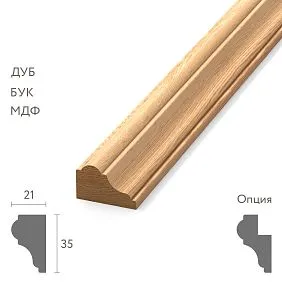
If there is no door, the frame can remain as a structural framework that is later decorated. STAVROS door frame profile — this is exactly such a profile: a structural base that ensures a neat finish of the opening from the wall end side.
Casing
A decorative strip that covers the joint between the door frame and the wall. The casing works on one plane — it hides the technical gap. This is a "closing" element, not an "opening" element of the doorway. A good casing is neat and correct. A casing with a rich profile is closer to a molding.
Wooden portal
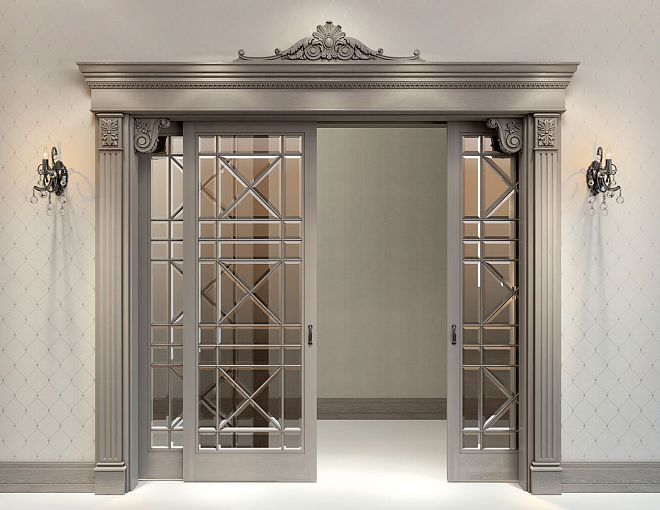
This is not just a frame. It is an architectural composition around the opening: side posts (pilasters), upper horizontal part (architrave or cornice), decorative overlays, capitals, moldings. A portal is when the opening ceases to be a hole and becomes an entrance.
The difference between a casing and a portal is roughly the same as between a door handle and a stained glass window — both are about the door, but about completely different things.
STAVROS wooden portals: architecture instead of renovation
In the STAVROS catalog, portals are not furniture or building material. They are interior architectural solutions, each with its own style, proportions, and character.
Portal PRT-016: universal classic
Portal PRT-016 — one of the most versatile solutions in the collection. The carved elements here are selected so that the portal fits equally organically into a classic interior, neoclassicism, Provence, and a soft vintage style.
For a doorway without a door, PRT-016 works as a "frame" of the space: the side elements provide a vertical accent, the top part completes the composition. At the same time, the portal does not overload — the carving here is delicate, without excessive relief.
Where to use: living room, bedroom, study, hall in a classic house or apartment with high-quality finishes.
Portal PRT-002: classic for a country house
Classic door portal PRT-002 — a more strict solution. A symmetrical architectural composition with a clear division into base, uprights, and crowning part. Suitable for formal rooms: the vestibule of a country house, study, library, restaurant hall.
For a doorway without a door, PRT-002 creates the effect of a "gate" between rooms: you seem to pass not through a wall, but through an architecturally designed entrance.
Portal PRT-004: monumentality without overload
Portal without door PRT-004 — a ceremonial solution for tall openings. Figural elements add monumentality, while proportions maintain balance. For rooms with ceilings from 3.2 m, this is the very solution when the opening must "hold" the height.
Portal PRT-009: Empire austerity
Empire-style portal PRT-009 — for those who build an interior in a ceremonial register. Strict verticals, balanced proportions, decorative top part. White enamel or gilding — this portal is equally good in both finishes.
Application: grand hall, restaurant with Empire-style interior, conference room in a representative office.
Doorway decoration without a door: five relevant solutions
So, the door was removed — or never installed. There is an opening. What to do with it?
Solution 1. Wooden portal as the main statement
The most "architectural" of all possible solutions. The portal turns an open opening into a ceremonial entrance — regardless of whether there is a door behind it or not.
For a classic and neoclassical interior, a wooden door portal is the right answer to the question of opening design. It sets the scale, style, and sense of thoughtfulness.
When choosing a portal for an open doorway, consider:
-
Doorway width: standard 900–1200 mm; for double doorway 1400–1800 mm
-
Ceiling height: the higher it is, the larger the cornice part of the portal can be
-
Interior style: from strict classic to soft Provence
-
Wall thickness: the portal should cover the wall end on both sides
Solution 2. Moldings and box profile: a neat architectural frame
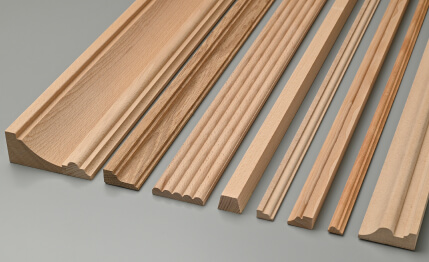
A full portal with capitals and cornice is not always needed. Sometimes a neat wooden frame made of moldings, cornices, and baseboards made of solid wood.
The scheme is simple:
-
Around the perimeter of the doorway — molding with a suitable profile
-
Corner transitions — joints at 45° or with corner rosettes
-
The upper part is a cornice molding that "covers" the opening
Such door opening decor works in neoclassical, modern classical, and Provencal interiors with white panels.
Solution 3. Carved decor: accent above the opening
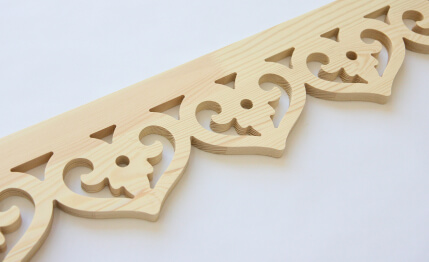
Carved decor above the door opening is one of the most expressive techniques of classical design. A cartouche in the arch keystone, an ornamental insert above a rectangular opening, a carved bracket at the transition from the jamb to the architrave.
Carved decor for door openings STAVROS — these are precisely the elements that turn a simply framed opening into a decorative composition. A carved acanthus or medallion placed above the opening — and the opening instantly "quotes" classical architecture.
Solution 4. Slats around the opening: modern vertical texture
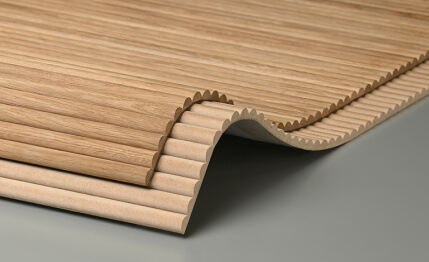
For a modern interior — a laconic solution without carving. STAVROS slatted panels are used as framing for the opening: slats run vertically along the side wall surfaces next to the opening, creating a wooden "corridor" around the entrance.
This is door opening decor with slats — modern, clean, with a warm wooden texture. For a Scandinavian interior, for minimalist classics, for any space where wooden relief is needed without unnecessary details.
Solution 5. Arch design
An arch over a doorway is a classic architectural technique. If the opening itself is rectangular and the arch profile is added decoratively, it creates the visual effect of an "arched entrance" without rebuilding the wall.
To design a doorway arch, use:
-
Curved molding along the radius — custom-made to the specific opening size
-
Straight elements with an imitation of an arch transition (trapezoidal shape of the upper part)
-
Carved keystone at the top of the arch
Decorating the opening in different rooms: from kitchen to hall
Designing the opening between the kitchen and living room
The opening between the kitchen and living room is the most common request for open-plan layouts. Here, the door is deliberately removed, but a visual boundary is needed.
For this scenario:
-
A wooden portal with moderate decor — not too formal, so as not to overload the living space
-
Moldings around the perimeter in the color of kitchen fronts
-
Light carved accent above the opening
-
Finishing in the color of furniture and flooring
The width of such an opening is typically 1200–1800 mm. This is important when choosing a portal: a wide opening requires a more "substantial" design, otherwise the portal will look fragile.
Design of the transition from the hall to the living room
The hall — the entryway — is the first room a guest sees. The decor of the doorway from the hall to the living room is the calling card of the interior.
Here, a full wooden portal with capitals and a cornice part is appropriate. Portal PRT-002 or PRT-016 — classic solutions for this scenario. White enamel or oak tinting — depends on the overall concept.
The opening from the hall to the living room often has a non-standard width of 1400–1600 mm. This is a double opening, for which the portal is selected or custom-made.
Decorating an opening in a bedroom or dressing room
In the bedroom — the most delicate decor. Wide carvings and a grand cornice are excessive here. Optimal: moldings with a moderate profile, coordinated with the wall finish.
For a dressing room — functionality is more important than decor. A simple wooden profile around the perimeter, neat corners, minimal relief.
Opening in a study or library
Study and library — places where stately, "weighty" decor is appropriate. Dark oak, deep tinting, rich molding profile. Classic door portal PRT-002 in dark tinting with patina — a strong choice for this scenario.
How to choose the style of door opening decor
Classicism and neoclassicism
Symmetry is the main principle. The side posts of the portal are equal in width, the top part is strictly horizontal. Capitals on the posts, cornice above the opening. Ornament — acanthus leaves, garlands, geometric meanders.
Finish: white enamel for light interiors, ivory tinting for warm ones. Dark oak — for the study version of classic style.
Coordination: moldings on walls, ceiling cornices, baseboards — all in a unified system. STAVROS solid wood moldings, cornices, and baseboards provide a complete set for creating this system.
Empire
Solemnity, monumentality, strictness. Empire-style portal PRT-009 — an illustrative example. White enamel with gilded details, strict verticals, massive upper part.
Empire-style interior requires consistency: not only the portal, but the entire decor of the space — in a single register. High ceilings (from 3.0 m), large moldings, luxurious carved decor.
Provence and French classicism
A softer, "everyday" version of the classics. White or cream color. Light wood texture visible through the enamel. Decor without heavy relief — rather an "airy" ornament than massive carving.
Portal PRT-016 in the Provencal version — white enamel, light carved accents, soft cornice. Works great in a kitchen-living room or a bedroom in Provence style.
Modern classic and neoclassical without unnecessary details
Here, the door opening decor is based not on carving, but on geometry. Precise proportions of moldings, correct angles, minimal relief. Color — white or gray-white to match the walls, or contrasting — oak on a white wall.
For modern classic, the connection with other wooden interior elements is important: doors, baseboards, furniture. The portal should be "part of the system," not an independent expressive gesture.
Modern interior: slats and clean lines
For a modern minimalist or loft interior — door opening decor with slats. Vertical wooden slats on the sides of the opening create a textured "frame" without classic details. Simple, honest, with the warmth of natural wood.
Slat panels for modern design — exactly for this scenario.
Materials and finish: from oak to white enamel
Solid oak
Oak is dense, durable, with expressive texture. A portal made of oak under clear varnish or tinting — a natural pattern that "lives" under different lighting.
Oak is especially good in dark tinting options: wenge, walnut, dark chocolate. For a study, library, restaurant hall with oak parquet — this is the right material.
Solid beech
Beech is a neutral base for any finish. Under white enamel — a perfectly smooth surface. Under tinting — neat, without sharp texture contrasts.
For a portal with white or cream enamel — beech is preferable to oak: no active pattern under the paint, the surface is smooth.
MDF
For portals and moldings that require enamel coating — MDF is often the optimal choice. Stable geometry, uniform density, ideal base for paint coating.
In interiors where wood texture is not needed — an MDF portal under white enamel looks flawless.
Finishing
| Finish option | Style | Base material |
|---|---|---|
| Transparent varnish | Classic, chalet, country | Solid oak, beech |
| Light tint | Provence, neoclassical | Beech solid wood |
| Dark tint | Study, restaurant, Empire | Oak solid wood |
| White enamel | Classic, Provence, neoclassical | MDF, beech |
| Patina | Classic, antique | Solid wood, MDF |
| Gilding | Empire, Baroque | Any base |
How to choose the portal size for a doorway
Opening width and side post width
Portal side posts should be proportional to the opening width. Guideline:
-
Opening 700–900 mm: post width 80–120 mm
-
Opening 900–1200 mm: post width 100–160 mm
-
Opening 1200–1800 mm: post width 140–200 mm
Posts too thin for a wide opening — the portal looks "skinny." Too wide for a narrow opening — they "press" on the opening.
Portal height
The height of the side posts is determined by the opening height. The cornice part of the portal adds 150–300 mm on top.
With a ceiling of 2.7 m: posts up to the top of the opening plus a moderate cornice. The cornice should not touch the ceiling — a minimum distance of 100 mm.
With a ceiling of 3.0 m and higher: the cornice can be significantly richer, with greater height. Portal without door PRT-004 Designed specifically for high ceilings.
Wall thickness and portal depth
The portal frames the opening on both sides of the wall. With a standard wall thickness of 100–200 mm (interior partition) — framing on each side: a 40–80 mm protrusion onto the wall.
With a thick load-bearing wall of 300–400 mm or more — the portal is installed on one side (the facade), the reverse side is finished similarly or with a simpler molding.
How to coordinate the opening decor with the rest of the interior
Door opening decor is not an independent object. It is part of the interior system.
Portal and doors: if there are doors in the room, their profile should echo the portal profile. STAVROS portals are coordinated with moldings and trim from the same catalog, allowing for a unified system.
Portal and baseboards: the height of the baseboard affects the proportions of the portal's side posts. A baseboard of 120–150 mm with a rich profile requires proportionate portal posts.
Portal and ceiling cornices: the cornice part of the portal should 'quote' or 'echo' the ceiling cornice. If the cornice is in a classic style — the upper part of the portal should also be classic.
Portal and wall panels: if the walls are finished with panels — the portal should take their logic into account. The portal posts can be a continuation of the vertical paneling elements.
Mistakes in designing a doorway
1. Using architraves instead of a portal. Architraves hide the joint between the frame and the wall. A portal creates an architectural image. For a classic interior, an architrave as the only element is clearly insufficient.
2. Overloading a small opening. A narrow 700 mm opening with a monumental portal and heavy carving is a visual mistake. The scale of the decor should match the scale of the opening and the room.
3. Not accounting for ceiling height. The cornice part of a portal against a 2.6 m ceiling without a gap feels oppressive and makes the space seem lower. There should always be 'air' between the portal cornice and the ceiling cornice.
4. Mixing styles. A classic portal with modern doors without a logical transition creates a visual conflict. Either the entire space follows one style, or the mixing is intentional and controlled.
5. Forgetting the reverse side of the wall. The portal is visible from both sides. If only the facade is finished, the reverse side of the opening with unfinished slopes will be dissonant.
6. Not considering lighting. With artificial overhead light, a carved portal creates deep shadows — this can enhance the relief (good) or create unwanted shadow stripes (bad). Plan the placement of light fixtures relative to the portal.
7. Confusing a portal with a door frame. If the door is removed, the frame remains. It can be dismantled and a portal installed, or it can be used as a structural base for decoration. These are two different solutions with different costs and labor intensity.
Where to buy decor for the STAVROS doorway
-
Wooden portals STAVROS — section with ready-made PRT solutions
-
Portal PRT-016 — a universal option for classic and neoclassical styles
-
Classic door portal PRT-002 — for prestigious rooms
-
Portal without door PRT-004 — for tall openings and ceremonial interiors
-
Empire-style portal PRT-009 — for formal spaces
-
Carved decor for door openings — capitals, cartouches, keystones, ornaments
-
STAVROS trim products — moldings, architraves, cornices, profiles
-
Door Frame Profile — a structural base for the opening
-
Slat panels for modern design — for modern interiors without classic details
Frequently asked questions about door opening decor
How to design a door opening without a door?
Through a wooden portal, moldings around the perimeter, or carved decorative elements. The choice depends on the interior style and the scale of the room. For classic style — a full portal with capitals. For a modern interior — slats or moldings with minimal relief.
How is a wooden portal different from a door casing?
A casing is a trim strip that hides the joint. A portal is an architectural frame around the opening: with side posts, a top part, and decorative elements. These are fundamentally different levels of design.
Which portal is suitable for a small apartment?
For a standard apartment with a 2.7 m ceiling — a portal with a moderate cornice without large decorative elements on top. PRT-016 — a good option for urban housing.
Is a door frame needed if a portal is installed?
It depends on the design. If the opening is finished, the portal is attached directly to the wall. If there is a frame, the portal is installed over it. STAVROS door frame profile can be used as a base without hanging a door leaf.
How to choose the decor of the opening for a classic interior?
Rely on details already present in the interior: the profile of baseboards, cornices, and wall moldings. The portal should be in the same system. STAVROS solid wood moldings, cornices, and baseboards allow you to create a fully coordinated solution.
How to use carved decor above a doorway?
A keystone at the top of the arch, a cartouche above a rectangular opening, acanthus leaves on the capitals of the posts. STAVROS carved decor provides a selection of ready-made elements for all these scenarios.
Is a wooden portal suitable for a restaurant or hotel?
Yes. Portals PRT-002, PRT-004, PRT-009 are used in commercial interiors — restaurants, hotels, executive offices, and wine rooms. For commercial use, wear-resistant finishing and professional installation are important.