










































































Article Contents:
- Carved wooden baguette K-130: dimensions of one module and ornament features
- Why the modularity of K-130 matters more than regular length
- Why you shouldn't cut all five modules in advance
- Why you can't calculate 4200 ÷ 4 and order four longer pieces
- What happens if you order four and order the fifth later
- Formula for any length
- Five is a mathematical minimum, not a universal reserve
- Why 450 mm is not necessarily a useful remainder
- Scheme 1. One shortened fragment of 480 mm at the hidden edge
- Scheme 2. Symmetrical trimming of 225 mm from both edges
- Scheme 3. Asymmetrical distribution of 450 mm for the ornament
- Scheme 4. Central insert of 480 mm between full modules
- What to choose for a 4.2 m wall
- First, choose the same orientation for all modules
- What to do with the micro-gap after installation
- Why four factory joints are better than one arbitrary central joint
- How to account for the kerf width and not lose a few millimeters
- How to check a 4200 mm wall before purchasing
- How to choose the height of a decorative belt on the wall
- Beech for opaque enamel
- Oak with visible texture
- What does "for enamel" mean
- What to do if the molding will be contrasting
- When the "Standard" is reasonable
- When the "Prestige" is more convenient
- First marking, then glue
- Installation on painted wall
- Paint K-130 before or after installation
- What to do with the remaining fragment after installation
- What to check when receiving five K-130s
- Mistakes in calculating and installing K-130
- How to place an order for five modules without ambiguity
- What to photograph before ordering
- How to check the order before final payment
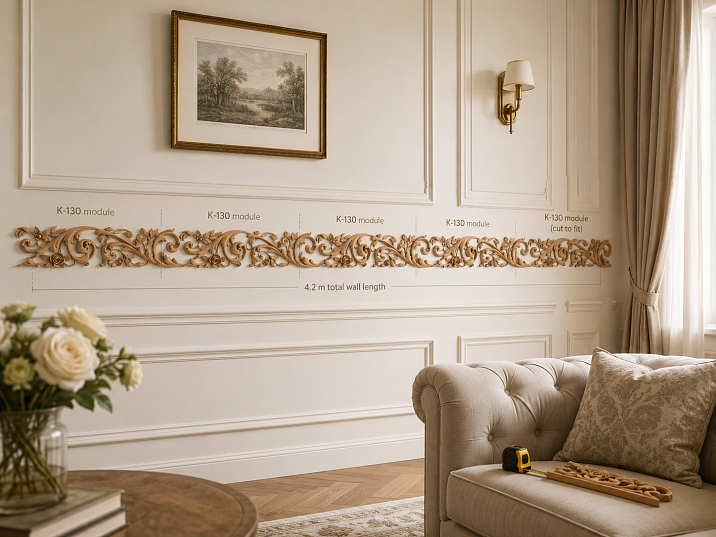
For a decorative belt 4200 mm long, you need not four, but five K-130 modules of 930 mm each. Four elements give only 3720 mm — that's not enough by 480 mm. Five give 4650 mm, so the total nominal excess of material is 450 mm. But calculating the quantity is only the first half of the task. If after purchase you assemble four whole modules and insert a piece 480 mm long in a random place, you can get a noticeable break in the plant ornament exactly where the eye reads the decorative line as a single whole.
Therefore buy wooden baguette K-130 for a 4.2 m wall, it is reasonable only after a preliminary layout. You need to decide from which point the pattern starts, which factory ends will be joined together, which edge of the wall is more visible, whether the cut can be hidden behind a pilaster, furniture, or other decor, and whether a symmetrical ending of the belt is required.
K-130 has an important advantage specifically for a long wall: the card confirms that the module's ornament is designed for sequential joining. The left and right factory edges of adjacent parts continue the pattern. This means the main installation principle should be: preserve factory joints as much as possible within the visible line, and move the inevitable cut to the end of the composition or distribute it between the two outer ends.
For a 4200 mm wall, there are at least two rational scenarios. If one end is covered by a cabinet, pilaster, or goes into a less visible corner, you can leave four full modules and use a 480 mm fragment from the fifth exactly at that edge. If both ends are visible and the composition must be symmetrical, the entire row of five modules can be centered relative to the wall and the total 450 mm removed from the two outer ends — nominally 225 mm from each. Then the three central modules remain whole, the two outer ones become approximately 705 mm each, and all four internal joints remain factory-made and continue the ornament.
But even the scheme "225 mm on each side" cannot be accepted only by calculator. First, five modules are laid out dry, the wall axis and specific pattern motifs are marked, after which the line position is shifted a few centimeters to the right or left if this allows a more convincing finish of a flower, leaf, or curl. Mathematics determines the quantity. The final layout determines the place of the cut.
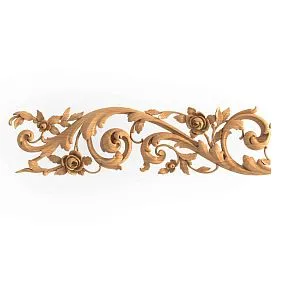
Carved wooden baguette K-130: dimensions of one module and ornament features
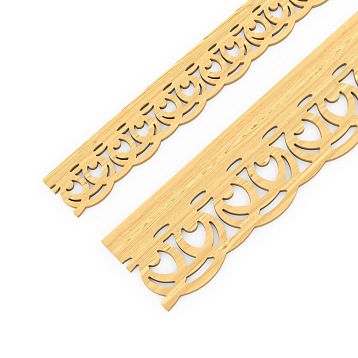
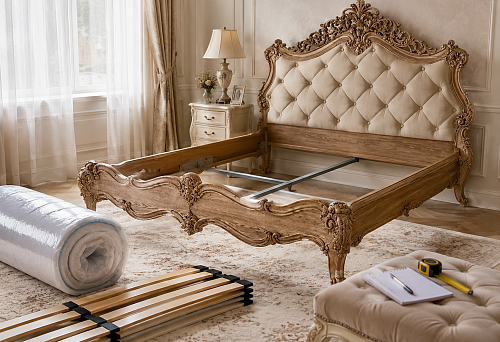
K-130 is not a long smooth slat measured at the warehouse by arbitrary linear meters. The product card shows a separate carved module of fixed size 120 × 17 × 930 mm. This is fundamental for wall calculation: the buyer counts not "4.2 linear meters of baguette" but a whole number of 930-mm elements.
| Parameter K-130 | Value |
|---|---|
| Article number | K‑130 |
| Width of the front part | 120 мм |
| Thickness | 17 мм |
| Length of one module | 930 мм |
| Material | Beech or oak |
| Sanding | "Standard" or "Prestige" |
| Selected preparation on the card | For enamel |
| Pattern type | carved floral ornament |
| Feature | factory edges are designed for pattern continuation when joining |
The 930 mm size is the main parameter for quantity. The 120 mm size is the main parameter for the scale of the decorative band. The 17 mm thickness determines the actual relief protrusion above the wall or furniture panel.




Why K-130 modularity matters more than ordinary length
For smooth moldings, the place of the transverse joint is primarily a technical line: the craftsman monitors the geometry and quality of the connection. K-130 has a second layer — the ornament phase. The two factory edges are designed to continue the pattern. If you cut a piece in the middle and try to join an arbitrary cut with the factory end of an adjacent module, the geometric connection can be made tight, but the pattern is no longer guaranteed to match.
This gives rise to the rule of the entire article:
Factory end + factory end — priority internal joint.
A cut end is primarily the end of the composition.
An exception is possible if the craftsman has pre-marked the ornament and found a point inside the module where the pattern repeat truly allows a hidden or coordinated joint. Based on the 480 mm length alone, such a match cannot be guaranteed.
Our factory also produces:



Why you shouldn't pre-cut all five modules
Imagine a buyer decides: "an extra 450 mm, so I'll remove 225 mm on the left and 225 mm on the right." If the pieces are cut before dry layout, after installation it may turn out that on the left edge almost an entire flower is cut off, and on the right — a different section of the curl in character. Formally, the dimensions are symmetrical, but visually the ends are not.
Therefore, first lay out five whole modules. Only then choose the pattern phase relative to the center of the wall.
Get Consultation
Why four K-130 planks are not enough for a decorative belt 4200 mm long
The check starts with simple arithmetic:
4 × 930 = 3720 mm.
Required length:
4200 mm.
Deficit:
4200 − 3720 = 480 mm.
Consequently, four modules do not cover the wall. There is no "technological allowance" here that could save the calculation: 480 mm of the decorative line are physically missing.
Attempting to stretch four pieces by increasing the gaps between them also contradicts the very idea of a modular ornament. If you distribute 480 mm across the three internal joints between the four elements, you get gaps of 160 mm each. This is no longer a joint, but three large gaps in the pattern.
If you distribute the missing length across five intervals—for example, leaving margins at the edges and gaps inside—the belt ceases to be continuous. Such a variant can only exist as a deliberately designed composition of separate decorative panels, but that is a different design and a different search scenario.
Why you cannot calculate 4200 ÷ 4 and order four pieces "longer"
The K‑130 has a fixed length of 930 mm. The card does not confirm the sale of this model in arbitrary linear meters and does not show the K‑130 variant with a length of 1050 mm, which would result from dividing 4200 by four.
Therefore, the calculation must follow the commercial form of sale:
required wall length ÷ length of one module → round up to a whole product.
For K‑130:
4200 ÷ 930 = 4,516…
Round up:
N = 5.
It is the rounding up that distinguishes the quantity calculation from simple division.
What happens if you order four and order the fifth later
The main loss is not only the time of repeated delivery. Possible:
-
repeated transportation cost;
-
stoppage of finishing works;
-
the need to store four already prepared parts;
-
the risk of finishing the first modules before the fifth and getting differences in technology;
-
re-checking the material and sanding;
-
additional organization of installation.
For a modular pattern, it is much more rational to have the entire set on site before the first cut.
How much wooden molding to buy: calculation of five modules of 930 mm
Five elements give:
5 × 930 = 4650 mm.
Required:
4200 mm.
Total excess:
4650 − 4200 = 450 mm.
Therefore, the base order for one straight line of 4200 mm is 5 pieces of K‑130.
After calculation, you can proceed to wooden baguette K‑130 with a length of 930 mm and choose the desired finish, but before payment it is useful to check three more things: the actual length of the finished wall, the geometry of the ends, and the state of the finishing project.
Formula for any length
For a straight decorative belt:
N = ⌈L / 930⌉,
Where:
-
N — minimum number of modules;
-
L — actual length of the line in millimeters;
-
930 — length of K‑130;
-
the sign ⌈ ⌉ means rounding up to an integer.
For example:
-
3000 ÷ 930 = 3.225 → minimum 4;
-
3600 ÷ 930 = 3.871 → minimum 4 by net length;
-
4200 ÷ 930 = 4.516 → minimum 5;
-
4650 ÷ 930 = 5 → exactly 5 without nominal excess;
-
4700 ÷ 930 = 5.054 → already minimum 6.
But the "minimum by length" is not always equal to the "optimal order". If the ornament layout requires matching identical edge motifs, one additional module may become a technological reserve. The decision about the sixth piece for a 4.2 m wall is not made automatically, but after the layout.
Five is the mathematical minimum, not a universal reserve
For a simple wall without corners, with a stable length of 4200 mm and clear trimming, five pieces are sufficient by total length.
A sixth module may be required if:
-
one element is intentionally reserved in case of a cutting error;
-
the pattern needs to be centered on a specific motif, and the desired phase cannot be achieved from five modules;
-
there are additional short sections;
-
the line transitions to the side wall;
-
part of the material will go to trial complex cuts;
-
the project changes after the order has already been placed.
But buying a sixth K-130 just because of the usual rule "always take 10% extra" is incorrect. For modular expensive decor, the allowance should be calculated based on the actual cutting layout, not an abstract percentage.
Why 450 mm is not necessarily a useful remainder
450 mm is the mathematical difference between the purchased and finished length. After cutting, part of this value will turn into sawdust from the kerf width, and the rest will become one or more offcuts.
If the edge pieces are trimmed on both sides, the waste will be distributed between two pieces. If a single 480 mm fragment from the fifth module is used, the remaining part of the original element is nominally close to 450 mm, but the actual length of the whole remainder will be less due to the kerf width.
Therefore, it is impossible to plan in advance a separate decorative insert "exactly 450 mm" from the remainder. Its actual size is determined by the cutting scheme and the tool.
How to lay out a carved baguette before trimming the ornament
Dry layout is the main stage between calculation and sawing.
For a 4200 mm wall, prepare a flat area at least 4.65 m long, or mark the modules directly at the wall without glue. All five elements are placed in the same orientation and first joined with factory ends.
Step 1. Find the actual working length
Do not use only the figure from the rough design plan. Measure the line after finishing plaster, panels, pilasters, and other elements between which the K‑130 will actually stand.
Write down:
-
the length along the top of the line;
-
the length along the actual mounting axis;
-
the position of the left end;
-
the position of the right end.
If the wall is not parallel to adjacent elements, the two control lengths may differ.
Step 2. Mark the center of the wall
For 4200 mm, the center is at the mark:
4200 / 2 = 2100 mm.
This point is needed not because there must necessarily be a joint in the center. On the contrary, according to the design, it is often better to have a beautiful motif in the center rather than a technical boundary.
Mark the center of the wall and then find on the laid-out five modules the section of the ornament that you want to see on this axis.
Step 3. Assemble the factory chain of 4650 mm
Five modules are connected into one conditional row:
930 + 930 + 930 + 930 + 930 = 4650 mm.
Do not cut anything yet.
Step 4. Apply a conditional window 4200 mm long
Imagine that from a chain of 4650 mm you need to select a visible segment of 4200 mm. You have the ability to shift this "window" along the pattern within the total excess of 450 mm.
If you remove exactly 225 mm from the left and right, the chain is geometrically centered.
But it can be shifted, for example, remove 180 mm from the left and 270 mm from the right, if that way the two extreme motifs end more neatly.
One condition:
Lleft cut + Lright cut = 450 mm.
This is what turns 450 mm from a "remainder" into a tool for compositional adjustment.
Step 5. Only after choosing the phase, transfer the cut marks
On the back side of each extreme element, write:
-
"LEFT";
-
"RIGHT";
-
ornament direction;
-
cut line;
-
module number.
Such simple marking protects against the most annoying mistake: the craftsman takes a seemingly symmetrical element, turns it around, and gets a mismatch at the factory joint.
Central or edge trimming of a wooden baguette: which will be less noticeable
For K-130, it is useful to distinguish three concepts: the joint location, the cut location, and the end of the composition. Factory joints within the belt are designed for pattern continuation. Trimming disrupts the original phase of the module. Therefore, it is safest when the trimmed end coincides with the end of the entire decorative line.
Scheme 1. One shortened fragment of 480 mm at a hidden edge
This is the simplest option if one end of the belt is covered by furniture, a pilaster, a casing, a tall curtain, a built-in wardrobe, or another element that makes the end visually secondary.
Layout:
930 + 930 + 930 + 930 + 480 = 4200 mm.
The fifth module is cut so that its factory end connects to the fourth whole module, and the trimmed end goes to the edge of the composition.
Advantages:
-
four internal joints can be left factory-made;
-
only one edge has an arbitrary cut;
-
the calculation is simple;
-
the remainder of one module can be saved as a finish sample or spare piece;
-
there is no need to distribute two cuts across the two edge pieces.
There is one drawback: the composition is not symmetrical in the pattern phase. If both edges of the wall are equally visible, on one side the ornament ends with the factory pattern, and on the other — at an arbitrary point.
Scheme 2. Symmetrical trimming of 225 mm on both edges
Five whole modules give 4650 mm. To get 4200 mm, you need to remove 450 mm.
With strict geometric centering:
450 / 2 = 225 mm.
So, nominally 225 mm is removed from the external left edge of the first module, and 225 mm from the external right edge of the fifth module.
Finished length of the edge pieces:
930 − 225 = 705 mm.
Summary:
705 + 930 + 930 + 930 + 705 = 4200 mm.
The advantage of this scheme is that the inner chain remains as "factory-made" as possible. The four connections between the five elements preserve the calculated phase of the ornament. Cuts are only in the two outer ends.
This is especially logical if the border starts and ends on equally visible sections of the wall.
But symmetry in millimeters does not guarantee symmetry in the pattern. Before cutting, you need to check that the points 225 mm from the left and right edges indeed give visually compatible endings. If one cut passes through a large floral motif and the other through a thin stem, geometric equality will not yield a beautiful result.
Scheme 3. Asymmetric distribution of 450 mm for the sake of the ornament
Sometimes the best result is achieved with:
180 + 270 = 450 mm
Or:
150 + 300 = 450 mm
or any other pair whose sum equals 450 mm.
For example, the line may be centered not on the physical middle of five modules, but on a large central flower. Then the left and right offcuts turn out different, but the visible composition is perceived as balanced.
This is normal professional logic: in ornamental decor, the visual axis is more important than mechanical symmetry of trims.
Scheme 4. Central insert of 480 mm between full modules
On paper, you can write:
930 + 930 + 480 + 930 + 930 = 4200 mm.
The length is perfect.
But this option is potentially worse, because the 480 mm fragment has at least one cut end. If placed in the center, the arbitrary cut ends up in the most visible part of the decorative band. It must meet the factory end of the adjacent module, and the pattern is not guaranteed to match.
This scheme is acceptable only after a full-scale layout, if the craftsman sees the actual repeat point of the ornament and can confirm a beautiful joint. Based on arithmetic alone, the central piece cannot be recommended.
What to choose for a 4.2 m wall
If one edge is hidden — most often it is more rational to use one 480 mm fragment at that edge.
If both edges are open — first check the scheme 705 + 930 + 930 + 930 + 705 mm.
If the central axis of the wall coincides with an important interior element — a door, fireplace, console, headboard, mirror — the pattern is centered relative to that object, and the 450 mm is distributed along the edges after choosing the phase.
If both ends are closed by pilasters, you can allow yourself more freedom: the trimmed areas partially go under adjacent elements, and the internal factory joints remain untouched.
How to join modular wooden trim without pattern shifting
The K‑130 card confirms that adjacent factory edges are designed for pattern continuation. But "designed for joining" does not mean that installation can be done without marking.
First, choose the same orientation for all modules
On the floor, five elements may seem almost symmetrical. However, a sequential pattern has a beginning and an end. Before installation:
-
lay out all modules face up;
-
align them in one row;
-
find the correct continuation of the ornament;
-
number the parts on the reverse side;
-
put an arrow indicating the direction.
For example:
1 → 2 → 3 → 4 → 5
After that, do not swap the parts without re-checking.
Why numbering is useful even for identical serial decor
Natural wood has an individual texture, and manual or machine preparation of each part may slightly differ in perception. In addition, during dry fitting, the craftsman may select pairs whose ends visually join most neatly.
Numbering preserves the found sequence until gluing.
Joints must be dry and clean
Glue, dust, primer, or paint buildup on the end edge can increase the gap. Therefore, before final fixation, the ends are checked without glue.
If there is a noticeable problem between factory edges, it should not be compensated with a thick layer of glue. First, determine the cause:
-
the end face is contaminated;
-
one part is rotated;
-
the order is mixed up;
-
the wall base has a local unevenness;
-
the part itself requires proper fitting.
Do not start installation from the first corner you come across
If the entire composition is tied to the center of the wall, starting from the left corner and going right is risky. A small error in each joint can accumulate and shift the final pattern.
For a complex ornamental line, it is more useful to first transfer to the wall:
-
the center;
-
the position of the main joints;
-
boundaries of the outermost parts;
-
a reference horizontal line.
After that, installation is carried out according to the approved layout.
What to do with the micro-gap after installation
The treatment method depends on the chosen finish system. Card K-130 describes the possibility of grouting end joints and subsequent finishing under enamel. But you cannot automatically transfer the same repair compound to a transparent tint: under a transparent coating, the putty may differ in color and absorption.
If the project is for enamel, the joint is easier to integrate into a single painted surface.
If a natural wood look is needed, the quality of dry fitting becomes even more important.
Why four factory joints are better than one arbitrary central joint
Five modules in a continuous chain will have four internal connections:
1–2, 2–3, 3–4, 4–5.
All of them correspond to the original modular logic of K-130.
If instead you arbitrarily cut the modules into many short fragments, the number of "non-standard" joints increases. Each such joint requires manual matching of the pattern.
Hence the practical goal of cutting:
minimize the number of internal cut joints.
Not to minimize the number of parts themselves at any cost, but specifically not to create extra cut ends inside the visible area.
How to account for the kerf width and not lose a few millimeters
The calculation 5 × 930 = 4650 mm is idealized. A real cutting disc or saw removes part of the wood as a kerf.
If you simply shorten the outermost module and leave the finished part at 705 mm, the craftsman sets the cutting line so that the finished piece retains 705 mm after the cut. The disc width goes into the discarded offcut and does not reduce the finished size.
The problem appears when one wants to obtain two useful fragments from a single module.
For example, theoretically, you could take one K‑130 with a length of 930 mm and try to get two edges of 240 mm each from it, leaving 450 mm in the middle:
240 + 450 + 240 = 930 mm.
In reality, two cuts will be required. Their total width will also consume wood. Therefore, it is impossible to simultaneously obtain two exact pieces of 240 mm each and a whole remainder of exactly 450 mm.
For a main wall of 4200 mm, this part does not interfere with the scheme involving trimming of edge modules. But it is important if the buyer plans to use the remainder elsewhere.
Why the remainder cannot be sold to yourself "twice"
Sometimes erroneous logic appears in the calculation:
"Five modules give 4650, the wall will take 4200, so I will definitely have a separate 450 mm piece left for furniture."
No. 450 mm is the total unused material, which includes:
-
one or several offcuts;
-
width of cuts;
-
possible technological adjustment;
-
pattern areas that cannot be used as a nice finish.
You can plan a second object based on this remainder only after actual cutting.
How to check a 4200 mm wall before purchasing
To calculate the quantity, one digit from the design project is not enough.
Measure the wall after final preparation
Plaster, wall panels, decorative pilasters, trims, and built-in furniture change the actual line length.
If the rough size was 4200 mm, and after installing two pilasters the working area became 4140 mm, five modules are still needed, but the distribution of offcuts changes:
4650 − 4140 = 510 mm.
With a symmetrical layout, this is nominally 255 mm on each side.
If the working line increased to 4230 mm:
4650 − 4230 = 420 mm.
That is, 210 mm each with a geometrically symmetrical option.
Check not only the length, but also the levelness
A wide carved belt 120 mm makes the deviation noticeable.
If the line should run horizontally, the marking is checked with a laser or another suitable tool. Do not automatically repeat the unevenness of the ceiling or floor: a decorative belt can visually emphasize the curvature.
Check obstacles
Before ordering, note:
-
sockets;
-
switches;
-
wall-mounted lights;
-
wire outlets;
-
ventilation grilles;
-
door trims;
-
furniture;
-
cornices;
-
pilasters;
-
adjacent moldings.
If K-130 intersects with a switch, the problem is not solved by quantity. You need to change the height of the belt, the position of the electrical installation product, or the composition itself.
How to choose the height of a decorative belt on a wall
K-130 has a width of 120 mm. On the wall, this strip is noticeable enough to work as an independent decorative element.
The placement height depends on the room's composition. There is no universal mark like "place at 900 mm from the floor" or "at 2/3 of the wall height".
Check relative to:
-
the top line of the furniture;
-
door trims;
-
molding frames;
-
window sills;
-
chair backs;
-
headboard;
-
wall sconce;
-
decorative panels.
Full-size paper template
Cut a strip of paper 120 mm high and at least 930 mm long. Secure it with masking tape at the intended height.
Even this simple mockup shows:
-
is the belt too wide;
-
does it not conflict with the door;
-
doesn't "cut" the furniture;
-
is there enough air at the top and bottom.
To evaluate the ornament itself, it is better to use a printed fragment or an actual part.
Beech or oak baguette: which material to order for enamel and tinting
Card K-130 shows options in beech and oak. The choice of material should be linked not only to the room style, but also to the finish.
Beech for opaque enamel
STAVROS characterizes beech as dense, non-porous wood, often used under enamel. For opaque painting, this is a logical option: the natural texture is not the main visual effect.
If K-130 is to become a white, cream, gray, or colored decorative band, beech can be considered a natural base.
Oak with visible texture
Oak has a pronounced texture and porosity. If the project involves a semi-transparent finish, it can provide a more active wood grain pattern.
But there is a fundamental limitation here: the K-130 configuration selected in the card shows preparation "for enamel." Therefore, you cannot automatically buy any oak K-130 and assume that it is guaranteed to be matched by texture for transparent tinting.
Before ordering for a translucent finish, you need to clarify whether the specific K-130 version is available as a re-lamination "for tinting."
What does 'under enamel' mean
Under the STAVROS system, a blank "for enamel" can be glued without matching lamellas by color and texture. This is normal because opaque paint hides natural tonal differences.
Therefore, you should not buy the "for enamel" option and then change the concept to clear varnish and expect a perfectly matched texture.
What to do if the baguette will be contrasting
For example, the wall is light, and K-130 is dark. Then it makes sense to finish a test fragment before installation and check:
-
how the relief reads;
-
how deep the shadows become;
-
whether the 120-millimeter strip looks too heavy;
-
how the shade matches the doors and furniture.
For a long line of 4.2 m, even a small color error becomes noticeable due to the large repeating area.
Sanding "Standard" or "Prestige" for carved wooden baguette
For K-130, two levels of surface preparation are available — "Standard" and "Prestige". These are not different ornaments or different grades of wood. It is about the quality of sanding before final finishing.
STAVROS describes "Standard" as machine sanding, and "Prestige" as more detailed manual processing, after which the product requires less refinement before coating.
For a smooth strip, the difference between the two options can be easily compensated by manual preparation. K-130 has a more complex relief: there are recesses, curls, leaves, and transitions where careless sanding can soften the shape.
When "Standard" is reasonable
"Standard" can be chosen if:
-
finishing is done by an experienced painter or carpenter;
-
manual refinement is already included in the estimate;
-
the baguette will be fully covered with enamel;
-
the craftsman is ready to carefully go through complex areas of the relief;
-
The project budget is sensitive to preparation costs.
In this case, savings are achieved not by sacrificing quality, but by shifting part of the preparation to the site.
When "Prestige" is more convenient
"Prestige" makes more sense if:
-
you want to minimize manual thread finishing;
-
the finish is complex and sensitive to base defects;
-
most of the surface will be well lit from the side;
-
the installer and painter are different contractors, and it's important to get a surface as ready as possible for finishing;
-
there is little time on site for manual processing of five modules.
Why it's better to order five elements at the same sanding level
On a wall of 4.2 m, all modules work as a single line. If you take part as "Standard" and part as "Prestige", the amount of manual preparation will differ. This makes it harder to achieve a uniform surface before enameling.
Therefore, in the specification it is better to fix one version for the entire row:
K‑130, 120 × 17 × 930 mm, 5 pcs., material ___, sanding ___, preparation for finishing ___ .
More details on the differences between options can be checked on the page the quality of sanding of wooden products.
How to glue wooden baguette K‑130 to a wall or furniture panel
K‑130 has one dimension larger than 100 mm — the width of 120 mm. In the STAVROS recommendation table, such wooden decor falls into the large category.
But the choice of glue depends not only on size. The official table separates at least two scenarios:
-
unpainted solid wood on an unpainted surface;
-
primed or painted decor on a primed/painted surface or wallpaper.
For unpainted large solid wood decor on an unpainted base, STAVROS indicates PVA Kleiberit 303.0 D3. For large decor on a primed or painted base, the table indicates Tytan Professional Classic Fix.
Therefore, the link buy mounting adhesive for wooden baguette is useful not as a universal recommendation "this adhesive is always suitable," but as a specific option for the corresponding type of prepared surface.
First marking, then adhesive
Before applying the compound, the entire line must be assembled dry.
The following are transferred to the wall:
-
upper or lower control line;
-
beginning and end of the belt;
-
module numbers;
-
position of each factory joint;
-
lines of edge trims.
If you glue the first module without having the full layout of the others, an error of a few millimeters can accumulate by the fifth element.
Why a wide part needs to be checked across the entire surface
K-130 has a height of 120 mm. If the wall has a local bump or depression, the end of one module may align with the adjacent one along the bottom edge, but diverge along the top.
Before gluing, place the elements against the base and check:
-
fit in the center;
-
fit along the top edge;
-
fit along the bottom edge;
-
alignment of the end planes.
Large irregularities in the base are better fixed before installation, rather than trying to pull the relief with glue.
Additional fixation
In STAVROS recommendations for large decor, additional fixation with a manual pin nailer is allowed. But the specific method of attachment depends on the wall base, finish, and project requirements.
Do not automatically punch the face relief anywhere. The fixing point should be chosen by the craftsman so as not to split a thin section of the ornament and so that the hole can be properly prepared for the finish.
Mounting on a furniture panel
For a furniture facade or panel, the same principle applies: first a dry layout, then check the opening, edges, and adjacent parts.
The thickness of K-130 is 17 mm. On the facade, this is already a noticeable protrusion. If a door, drawer, handle, or adjacent panel passes nearby, the trajectory of movement must be checked.
Mounting on a painted wall
If the wall is already painted, it is necessary to ensure that the coating adheres firmly to the substrate. The adhesive will bond the baguette to the top layer of paint. If this layer is peeling, the strength of the entire assembly will be limited by the weak coating.
Before installation, a local test is carried out and the recommendations of the selected adhesive are followed.
It is useful to verify the full preparation sequence with the official page tips for finishing and installing wooden decor.
Paint K-130 before installation or after
Both approaches are possible, but they solve different tasks.
Finishing after installation
Suitable if:
-
the baguette and the wall must be the same color;
-
it is necessary to visually unify the joints;
-
project for opaque enamel;
-
all five modules are mounted as one continuous line.
Advantage: after fitting, the joints can be treated and then a single finish applied.
Disadvantage: painting a deep relief on the wall is more difficult than painting a separate piece on a workbench.
Finishing before installation
Suitable if:
-
the baguette contrasts with the wall;
-
The side faces should be painted especially carefully;
-
There is already finished expensive trim nearby;
-
It is easier to work with elements separately.
Disadvantage: after trimming, a fresh end is exposed, which needs to be finished separately. Joints may also require local correction of the coating.
Combined scheme
Often the most practical is:
-
perform the main preparation before installation;
-
do a dry layout;
-
trim;
-
install;
-
locally treat the joints;
-
apply the final coat to the already assembled line.
The specific technology is coordinated with the paint and varnish material system.
When K‑130, 120 mm wide, turns out to be too large for the room
The 120 mm width makes the K-130 a noticeable decorative band. It does not have to suit every wall just because the required quantity can be assembled in length.
Low narrow corridor
In a short corridor, a wide relief can visually reduce the clean wall surface, especially if there are already massive architraves and a cornice nearby.
Small furniture facade
If the front itself has a height of 180–200 mm, a 120 mm wide baguette will take up most of its field. The ornament may turn out to be larger in scale than the furniture itself.
Dense molding composition
If there are already several horizontal profiles on the wall, the K-130 can create an extra competing line.
Area with a large number of outlets and switches
Due to the 120 mm width, it becomes harder to bypass electrical installation products without disrupting the pattern.
Very close proximity to furniture
If the top of a cabinet, dresser, or headboard passes just a few centimeters from the molding, the reliefs may visually "merge together."
How to check without buying five modules
Make a paper strip 120 mm high across the entire wall. To assess the volume, add a small cardboard profile about 17 mm thick along the bottom edge.
Such a mockup shows the scale much more honestly than a small photo in a card.
If 120 mm is clearly too large, it makes sense to open the section and Buy wooden picture frame molding of a different profile, rather than trying to "save" the K-130 by reducing the height. Trimming the carved baguette to
This is a good example of the rule from the master prompt: pure arithmetic may say "six is enough," but practical cutting may say "one more is needed."
How to buy a wooden baguette with a reserve and not order an extra module
For one straight wall of 4200 mm, the basic need is five K-130.
The buyer often asks the following question: "Should I take a sixth as a spare?"
There is no universal answer.
Five modules are usually enough if
-
the wall length is already finished and confirmed;
-
the line is straight;
-
no corners;
-
there is no bypassing of outlets;
-
layout of five modules verified;
-
the edge trims are clear;
-
installation is performed by an experienced craftsman;
-
no additional decorative inserts are planned.
It makes sense to consider the sixth module if
-
the project may still change;
-
there is a risk of complex cutouts;
-
material is needed for an additional section;
-
the ornament has to be phased to fit the central object;
-
the order goes to a remote region and repeat delivery is especially inconvenient;
-
the craftsman wants to have a full backup module.
Why is a percentage margin worse here than a per-piece one
10% of 4200 mm is 420 mm.
But K‑130 cannot be bought as "another 420 mm" as a separate standard item. The minimum additional unit is one 930 mm module.
Therefore, it is better to formulate the margin not as "10%", but as:
5 pcs. — working set.
6th pcs. — separate reserve for a specific reason.
This keeps the estimate transparent.
What to do with the remaining fragment after installation
It is better not to throw away the K-130 offcut immediately.
It can be useful as:
-
a color reference sample;
-
a sample for restoration touch-up painting;
-
test part for putty or primer;
-
fragment for setting up the tool before working with another module;
-
profile reference for future reordering.
If the remainder has a beautiful finished motif, it can be used in another decorative node only after a separate compositional check.
Do not automatically glue the remainder "somewhere so it doesn't get lost." This creates random decor and reduces the value of the main project.
What to check when receiving five K-130
Before cutting and painting, lay out the set and check:
-
article number;
-
size of each module;
-
material;
-
same level of sanding;
-
same preparation for finishing;
-
absence of transport damage;
-
condition of the relief;
-
factory edges;
-
sequence of joining.
Why checking the length of each module is useful
The calculation of the article is based on nominal 930 mm. Before precise cutting, the craftsman must still work with actual parts and the approved layout.
Why you cannot paint before checking the set
If one module is damaged or does not match the order, the finish applied by the buyer complicates return and replacement.
Errors in calculation and installation of K-130
Error 1. Order four modules
Reason: 4 × 930 is perceived as "almost 4 meters", and the wall is called "approximately four".
Consequence: 480 mm is missing.
Prevention: divide the exact length 4200 by 930 and round up.
Error 2. Place a 480 mm piece in the center
Reason: mathematically 2 × 930 + 480 + 2 × 930 = 4200.
Consequence: an arbitrary cut ends up in the most visible part of the ornament.
Prevention: preserve factory internal joints and move the cut to the end.
Error 3. Trim 225 mm without dry layout
Reason: the scheme seems perfectly symmetrical.
Consequence: the two edges end with fragments of the pattern that differ in character.
Prevention: first phase the pattern relative to the center of the wall.
Error 4. Flip one module
Cause: the pattern appears symmetrical.
Consequence: adjacent ends no longer continue the pattern.
Prevention: number the parts and add a direction arrow.
Error 5. Not accounting for the cut
Cause: the 450 mm remainder is perceived as a finished part.
Consequence: the second planned fragment turns out shorter.
Prevention: calculate the width of the cut when cutting multiple useful parts from one module.
Error 6. Buy the sixth element "because a 10% reserve is needed"
Reason: automatic rule from regular finishing materials.
Consequence: an expensive whole module remains without a task.
Prevention: reserve the sixth only for a specific risk.
Error 7. Order material for enamel, then decide to tint
Reason: the finishing concept changes after purchase.
Consequence: matching slats by tone may not meet the expectation of a transparent finish.
Prevention: choose the type of coating before ordering.
Error 8. Use one adhesive for any wall
Reason: the K-130 card shows the accompanying mounting compound.
Consequence: the selected technology does not match the surface condition.
Prevention: check the unpainted/painted base against the STAVROS table.
Error 9. Start gluing from the corner without overall marking
Reason: it is easier to start this way.
Consequence: the central motif and edge trimming deviate from the calculated position.
Prevention: first transfer the full diagram of five modules to the wall.
Error 10. Treat K-130 as a regular long-length batten
Reason: the word "baguette" is associated with linear products.
Consequence: the buyer plans arbitrary length and does not account for the pattern's modularity.
Prevention: count items as 930 mm and work with factory ends.
How to place an order for five modules without ambiguity
In the request, it is better not to write "need 4.2 meters of K-130". Such wording may create the impression that the product is sold in arbitrary lengths.
An exact request looks different:
K-130, 120 × 17 × 930 mm — 5 pcs.
Additionally, they specify:
-
material — beech or oak;
-
sanding quality — "Standard" or "Prestige";
-
preparation for future finishing;
-
quantity;
-
delivery address;
-
the need to receive all five items in one delivery.
If the project involves opaque painting, one can naturally use the commercial query "buy unpainted wooden baguette", but the buyer must understand: it is not about arbitrary unpainted length, but about five specific K-130 modules.
What to photograph before ordering
It is useful to send the manager not only the size 4200 mm, but also a photo of the entire wall. It should show:
-
both ends;
-
adjacent furniture;
-
doors;
-
pilasters;
-
switches;
-
wall sconce;
-
other decorative lines.
You can attach a diagram separately:
wall 4200 mm; axis 2100 mm; K-130 along the entire length; left edge open/closed; right edge open/closed.
This makes it easier to discuss whether an additional module is needed for a specific composition or if five are really enough.
How to check your order before final payment
Before confirming, compare four numbers:
4200 mm is the finished length of the line.
930 mm is the length of one K-130.
5 pcs. is the quantity.
4650 mm is the total nominal length of five modules.
After that, write down the selected layout:
-
one edge fragment 480 mm;
-
symmetrical edge elements of 705 mm each;
-
another layout confirmed by dry fitting.
If the layout is not yet selected, five pieces are still the mathematically minimum quantity, but they cannot be cut until the composition is approved.
Before sending the order, also check the current payment and delivery terms for the order. Price, production time, and availability may change, so they do not need to be fixed in the publication article.
Frequently asked questions about calculating and trimming wooden molding K-130
How many K-130 elements are needed for a wall 4.2 m long?
At least five elements.
Calculation:
4200 ÷ 930 = 4,516…
The quantity of goods is rounded up to a whole number:
5 pcs.
Four elements give only 3720 mm and physically do not cover the entire length of the wall.
Why can't you order four strips of 930 mm?
Because:
4 × 930 = 3720 mm.
Up to 4200 mm is missing:
4200 − 3720 = 480 mm.
K‑130 is not declared as an arbitrary long-length profile that can be ordered as "another 480 mm". The next purchase unit is a full module of 930 mm.
How much material will remain after installing five modules?
Nominal excess:
4650 − 4200 = 450 mm.
But this is not necessarily one whole remainder of 450 mm in length. Depending on the layout, the excess is distributed between offcuts and the width of the cut.
With a symmetrical scheme, the two outer modules are nominally shortened by 225 mm each.
With a one-sided scheme, one module is used as an edge fragment of about 480 mm, and the remainder is approximately 450 mm minus the material lost to the cut.
Where is the best place to position the shortened fragment?
If one edge of the wall is hidden by furniture, a pilaster, or is in a less visible corner, it is convenient to move the cut there.
Then you can use:
930 + 930 + 930 + 930 + 480 = 4200 mm.
It is important that the inner end of the 480-mm fragment is factory-made and connects to the adjacent full module. The cut end remains at the outer edge of the composition.
If both edges are equally visible, it is wiser to check a symmetrical layout.
Can identical cuts be made on both sides?
Yes. Five modules give 4650 mm, so 450 mm needs to be removed.
For a geometrically symmetrical option:
450 ÷ 2 = 225 mm.
The outer elements after cutting will be:
930 − 225 = 705 mm.
Summary:
705 + 930 + 930 + 930 + 705 = 4200 mm.
But before cutting, be sure to check the pattern: equal millimeters do not guarantee an equally beautiful finish of the plant motif.
Can a carved baguette be cut in the middle of the ornament?
Physically, wood can be cut at the desired point, but decoratively this is not always acceptable.
The main risk: a trimmed end ceases to be a factory end designed for pattern continuation. If this cut needs to be joined inside the belt with an adjacent piece, the ornament may not match.
Therefore, an arbitrary cut is better used as an external ending. An internal cut joint is acceptable only after precise layout of the pattern and confirmation by a master.
How to align the pattern of two K-130 elements?
First, connect the factory right edge of one module with the factory left edge of the next in the correct orientation.
Before installation:
-
lay out the entire row dry;
-
check the pattern continuation;
-
number the modules;
-
mark the direction;
-
only then transfer the order to the wall.
If the module is rotated or the sequence is changed without checking, the visual continuation may be disrupted.
Is an additional reserve needed beyond five planks?
For a straight wall of 4200 mm, five elements are sufficient in total length.
The sixth is not a mandatory “10 percent reserve.” It makes sense to buy it only in case of a specific risk: complex pattern alignment, corners, an additional section, the likelihood of project changes, the need for a spare module, or expensive repeat delivery.
That is:
5 pcs. — calculated set.
6th pcs. — a deliberate reserve, not a mathematical necessity.
Why can’t you simply buy K‑130 by linear meters?
The card shows the product as a module of fixed size 120 × 17 × 930 mm. For a specific SKU, the calculation is done per piece.
Requests for "wooden baguette buy by the meter" may refer to other products and a different scenario. In the article about K-130, they cannot be used as a promise of a sales method.
Is K-130 suitable for a small furniture facade?
In terms of application, K-130 can be used on furniture facades and panels, but the width of 120 mm and thickness of 17 mm require large-scale verification.
If the facade is low, the ornament can occupy a large part of the free field. In addition, the 17 mm protrusion needs to be checked against handles, adjacent doors, and pull-out elements.
Before purchasing, it is useful to make a full-size template of 120 × 930 mm and apply it to the furniture.
What to choose for enamel — beech or oak?
For opaque enamel, beech is often a logical choice due to its calmer texture. But oak can also be used in painted projects.
The main thing is to choose a preparation option suitable for an opaque coating. The K-130 card shows the "for enamel" version.
If the goal is to preserve the visible wood texture, the question should be posed differently: which material and which re-gluing are suitable for a translucent finish. This should be clarified before ordering.
Can K-130 be tinted if the "for enamel" option is selected in the card?
It is not worth automatically considering such an option optimal for a transparent or semi-transparent finish.
Preparation "under enamel" allows for the absence of lamella selection by color and texture, because the opaque coating hides differences.
If tinting is needed, request K-130 in a suitable version for semi-transparent finishing, if it is available for the selected material.
What to choose — "Standard" or "Prestige"?
"Standard" is machine sanding. It is suitable if the project involves professional finishing before the final coat.
"Prestige" is more detailed hand sanding and a reduced amount of preparatory work.
For a wall of 4.2 m, it is better to make a decision for all five modules at once so that the level of preparation is the same.
Is it necessary to paint the baguette before installation?
Not necessarily.
If the baguette and the wall should be the same color, final finishing after installation and joint treatment is often convenient.
If K-130 is contrasting, part of the work can be done in advance. But after trimming, the ends and joints still require local touch-up.
The technology is chosen together with the painter and according to the instructions of the specific coating system.
What glue should be used for attaching a wooden baguette?
There is no single composition for all situations.
According to the STAVROS table:
-
large unpainted solid wood decor on an unpainted surface — PVA Kleiberit 303.0 D3;
-
large decor on a primed or painted surface — Tytan Professional Classic Fix.
Since K‑130 has a width of 120 mm, it is classified as large decor by the criterion "one of the dimensions exceeds 100 mm".
The specific composition is selected based on the condition of the baguette and the substrate.
Can K‑130 be glued to wallpaper?
The official STAVROS table classifies wallpaper as a group of primed/painted surfaces when choosing glue for decor, but the strength of the final joint depends on how firmly the wallpaper itself adheres to the wall.
If the top layer of the base is weak, the adhesive will hold the decor together with that weak layer. For a heavy and wide wooden element, the condition of the base must be checked before installation.
Do I need to use pins?
In STAVROS recommendations, additional fixation of large decor with a manual pin gun is allowed as an option.
But this does not mean that every K‑130 must necessarily be pinned. The decision is made by the craftsman based on the wall material, adhesive system, and relief location.
What to do if after measuring the wall turned out to be not 4200, but 4175 mm?
The quantity remains five:
4175 ÷ 930 = 4.489… → 5 pcs.
Total excess:
4650 − 4175 = 475 mm.
For a symmetrical geometric option, you can start with the calculation:
475 ÷ 2 = 237.5 mm
trims from each edge, and then adjust the pattern phase according to the dry layout.
What to do if after measuring you get 4660 mm?
Five modules are no longer enough:
5 × 930 = 4650 mm.
Deficit — 10 mm.
Despite the fact that the difference seems insignificant, a sixth element is required for the clean length. You cannot rely on stretching five pieces by using gaps: this will ruin the pattern alignment.
Can installation start from the center of the wall?
Yes, if the craftsman has predetermined the sequence and control points. For a symmetrical composition, this is often convenient.
But you cannot take two modules and simply spread out from the center in opposite directions without checking the orientation of the pattern. The K-130 ornament has a factory logic of continuation, so the left and right directions must be planned before gluing.
Can the trim be hidden under a pilaster?
If the pilaster structure indeed overlaps the end of the baguette and the mounting assembly allows such an abutment, this is one of the best ways to make the ending less noticeable.
Before ordering, you need to know the actual overlap width and the installation sequence: what is installed first — K‑130 or the pilaster.
Do all five modules need to be joined tightly together?
Internal factory joints should form a continuous ornament, so there is no need to deliberately create decorative gaps between them, unless the project involves separate independent segments.
The actual fitting is performed by the craftsman, taking into account the condition of the ends and the final finish.
Can the remaining 450 mm be used on another section of the wall?
Only after actual cutting.
450 mm is the total nominal excess. The actual remainder may be split into two pieces or reduced by the width of the cut.
If a usable fragment remains after installation, it is first applied to the new location and the ornament is checked, rather than automatically considered a full module.
What is more important when trimming: the same length of the end pieces or the same completion of the pattern?
For a decorative result — completing the pattern.
The scheme 705 + 930 + 930 + 930 + 705 mm is excellent as a starting calculation. But if a slight shift of the entire chain makes the ends of the ornament significantly more beautiful, it is reasonable to redistribute 450 mm between the left and right edges.
The main thing is that the total amount of removed material matches the actual wall length, and all internal factory joints remain aligned.
When is it better to choose a different wooden baguette instead of K-130?
If after a full-size mockup it becomes clear that the 120 mm width is too large, the ornament does not match the style, or the wall line requires too many complex bypasses, it is better to choose a different profile.
This is exactly why the general section on wooden baguettes is useful: the goal is not to adapt K-130 at any cost, but to achieve a neat decorative composition.
Conclusion. For a straight wall 4200 mm long, the calculation is unambiguous: five K-130 pieces of 930 mm are needed. Four are short by 480 mm, while five give a total excess of 450 mm. But a professional result begins after the arithmetic. Do not insert a shortened piece into the center without checking the pattern. First assemble five modules with factory ends, find the phase of the ornament relative to the wall center, and only then determine the trimming.
If one edge is hidden, a scheme with one 480 mm end fragment is practical. If both ends are visible, the starting point is a symmetrical layout of 705 + 930 + 930 + 930 + 705 mm, which is then adjusted according to the pattern. The sixth module is needed not automatically, but only in case of a specific technological risk.
Thus, the request "buy carved baguette" turns into a normal design task: the buyer knows the quantity in advance, understands the purpose of each of the five modules, does not break factory joints, and does not pay for repeat delivery due to missing 480 mm.