Article Contents:
- Why legs are bought separately: seven real scenarios
- Table legs and underframe: what's the difference and when to choose which
- How to calculate leg height: the math of comfortable seating
- Standard height of dining and kitchen table
- Height for bar and semi-bar table
- Height of coffee table
- Leg height for desk
- Legs for kitchen table: stability above all
- Stability: leg placement matters
- Attaching legs to kitchen countertop
- Coating for kitchen legs
- Shape of kitchen legs: what to choose
- Dining table legs: when beauty matters as much as strength
- Matching countertop dimensions
- Stability under lateral load
- Style: from classic to minimalism
- Coffee table legs: lightness and proportion
- Proportions — the key word
- Shape to match living room style
- Round or oval coffee table top
- How to choose the shape of legs: a complete breakdown
- Straight Legs
- Tapered legs
- Turned legs
- Carved legs
- Massive legs of large cross-section
- Wooden or metal legs: an honest comparison
- Metal legs
- Wooden legs: warmth, versatility, durability
- Solid wood legs: the species matters
- Oak
- Oak
- Ash
- Birch and pine
- Table leg glides: a small detail with great significance
- Mistakes when choosing wooden table legs
- What to check before buying: final checklist
- Decorative details: how to connect legs with the rest of the interior
- FAQ: answers to the most common questions
- What height of legs is needed for a dining table?
- Can I buy legs separately and install them on my own tabletop?
- Which is better — wooden or metal table legs?
- Which legs should I choose for a heavy solid wood tabletop?
- Are carved legs suitable for a kitchen table?
- How many legs are needed for a dining table?
- Which legs should I choose for a round tabletop?
- About the Company STAVROS
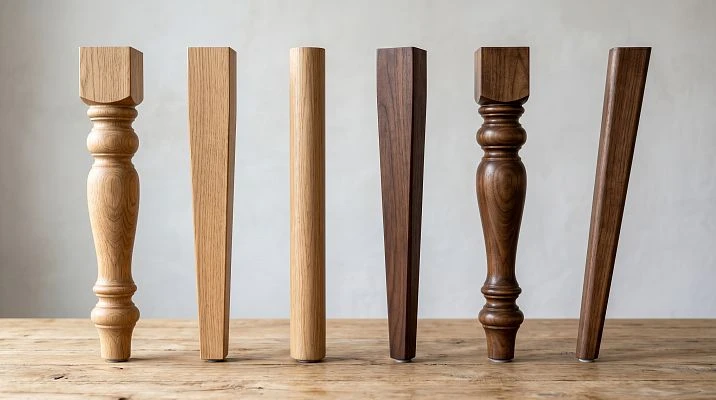
Wooden legs for table — these are not just four supports under the tabletop. They are the structural and aesthetic foundation of the entire piece of furniture: the seating height, stability under lateral load, visual weight of the table, and its harmony with the interior all depend on the right choice of legs. Whether you are building a kitchen table from scratch, replacing worn-out supports, or turning a ready-made tabletop into furniture — the choice of legs determines everything else.
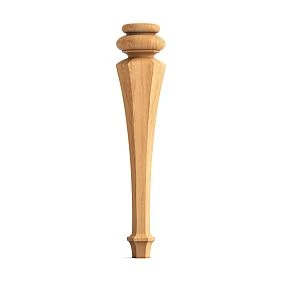
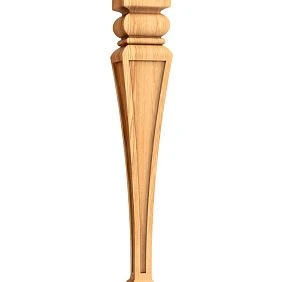
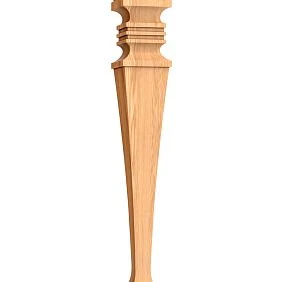
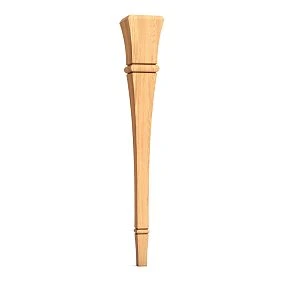
View wooden table legs STAVROS — a wide range of solid natural wood: turned, carved, tapered, straight, in various heights and wood species.
Why legs are bought separately: seven real-life scenarios
The furniture components market grew precisely because people gained the ability to assemble furniture to their own specifications — without settling for standard solutions from store catalogs. And buy legs for a table separately — this is not exotic, but a completely common practice.
There is a ready-made tabletop — but no suitable supports. A live-edge slab, a custom solid wood tabletop, a purchased marble or dense MDF slab — all of these require legs matched to a specific size, weight, and style. Ready-made tables do not offer such flexibility.
Old legs have worn out or broken. A high-quality solid wood tabletop lasts for decades. But legs — especially if they were made of soft wood without protective coating — may become unusable sooner. Replacing the legs while keeping the tabletop is a logical and economical step.
A table of non-standard height is needed. If a dining table is made for a specific person with a non-standard height, or for a kitchen counter, or for a tall bar stool — the standard height of 74–76 cm may not be suitable. Legs for tables are produced in different heights, and this allows for precise selection.
Metal legs need to be replaced with wooden ones. Trendy metal hairpin legs or trapezoidal metal frames look good in loft and industrial interiors. But if the interior has changed — or was originally classic, country, or Scandinavian — wooden legs are more harmonious. Metal can be swapped for solid wood at any time.
A set of identical tables is needed. For a cafe, restaurant, or corporate space, identical tables are required — same height, same style, same material. Ordering a batch of legs from the manufacturer ensures series uniformity.
There is a desire to update furniture without replacing the tabletop. Sometimes a table becomes "outdated" not structurally, but visually: its legs do not fit the updated interior. Changing the legs radically alters the item's appearance, spending minimal money and time.
A beautiful base for an interior table is needed. Decorative carved legs for tables or turned supports with a profile are not just a "board stand". This is an architectural element that turns a table into a piece of furniture art.




Table legs and underframe: what's the difference and when to choose what
This distinction is important to make before purchasing — so you don't end up with something you don't need.
Legs are separate vertical supports that attach to the tabletop via a mounting plate or screw into threaded nuts. Each leg works independently. Four legs under a rectangular tabletop is the classic design for dining and kitchen tables.
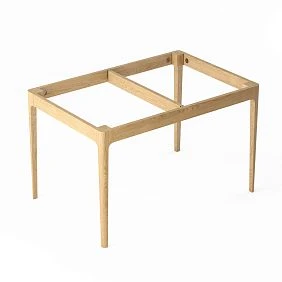
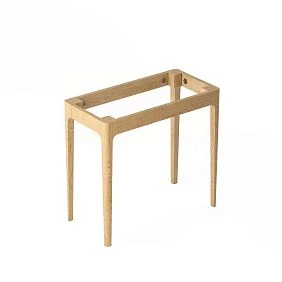
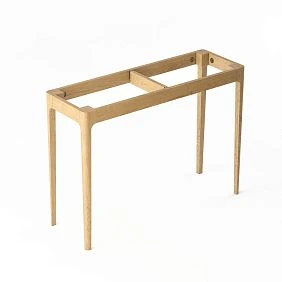
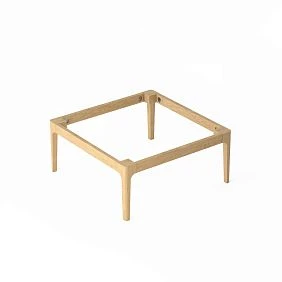
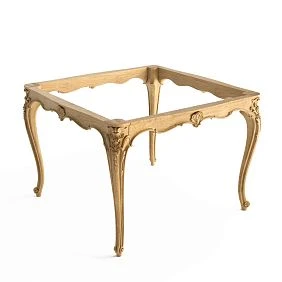
An underframe is a ready-made load-bearing base: a frame or structure of two longitudinal beams connected by crossbars and legs. The underframe is mounted under the tabletop as a single unit. It provides greater lateral rigidity along the length of the table and is suitable for heavy or long tabletops.
wooden base for the table — the right choice when the tabletop is long (from 180–200 cm), heavy (solid oak 50 mm thick or more), or when maximum lateral rigidity of the entire structure is important.
Individual legs are optimal for standard-sized tabletops (up to 160–180 cm), for light and medium tabletops, and also when visual lightness is important — no horizontal beams around the perimeter, the table looks airier.
For a round or oval tabletop, the situation is special. With a diameter up to 100 cm, four legs installed symmetrically are sufficient. With a diameter of 120 cm or more — either add a central column leg or use an underframe with a crosspiece. This is important to consider when purchasing.
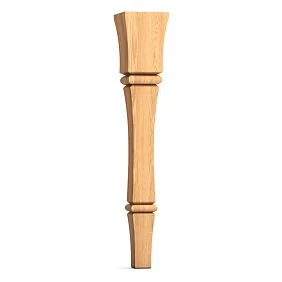
Our factory also produces:
How to calculate leg height: the math of comfortable seating
This is where most people make the first and main mistake. The leg height is not the table height. Table height = leg height + tabletop thickness. And you need to calculate it exactly this way.
Get Consultation
Standard height of a dining and kitchen table
The accepted standard height for a dining and kitchen table is 74–76 cm. This is optimal for a person 165–180 cm tall when sitting on a chair with a seat height of 44–46 cm. The difference between the tabletop and the chair seat is 28–32 cm — this is the space needed for comfortable positioning of arms and thighs.
If the tabletop is 25 mm thick, the legs need to be 715–735 mm high
.If the tabletop is 40 mm thick, the legs need to be 700–720 mm high
.If the tabletop is 50 mm thick, the legs need to be 690–710 mm high
.If the tabletop is 60 mm thick (slab, solid wood), the legs need to be 680–700 mm high.
This calculation is without adjustable feet. If the legs are equipped with adjustable feet 10–15 mm high, add that to the result accordingly.
Height for bar and counter-height table
A bar table with a tabletop height of 90–95 cm requires legs 820–870 mm high (with a tabletop of 25–40 mm). Bar tables require special high bar stools or stools.
A counter-height table is a compromise between a dining and bar table — it stands at a height of 80–85 cm. Popular for kitchen islands.
Height of a coffee table
Legs for coffee tables Fundamentally different. The standard height of a coffee table is 40–50 cm. This is the level of the sofa or armchair seat next to which the table stands. With a tabletop of 20–25 mm, the legs for a coffee table need to be 375–480 mm high.
But there is a nuance: modern sofas may have a seat height of 35–42 cm, while classic sofas on high legs have 45–50 cm. Before buying legs for a coffee table, measure the height of the sofa. The table should be slightly below the seat level or flush with it, but not higher.
Height of legs for a desk
A desk is made at a height of 73–76 cm for a standard office chair. If the chair is low, adjustable to 40–42 cm, the table is made slightly lower. If a person taller than 185 cm works, the table height is increased to 80 cm.
Legs for a kitchen table: stability above all
The kitchen is not a living room. Here, the table works every day, in several modes simultaneously: breakfast, chopping vegetables, children's homework, evening tea with guests. People lean on the kitchen table, move it, bump into it, wipe it with a wet cloth.
And that is why legs for a kitchen table must meet strict requirements.
Stability: the arrangement of legs matters
Four legs placed at the corner points of the tabletop with an indentation of 5–8 cm from the edge provide maximum stability. The wider the legs are spread, the more stable the table is under lateral load. If the legs are moved closer to the center, the table will feel "wobbly" when leaning on the edge of the tabletop.
A typical mistake when assembling yourself: placing the legs too close to the center so they don't get in the way under the table. The result is that the table wobbles with every touch to the edge.
Attaching legs to a kitchen tabletop
For a kitchen table, the type of attachment is especially important. There are several options:
Mounting plate (flange). A metal plate with holes for screws is screwed to the underside of the tabletop, with a matching thread in the leg. This is the most common and reliable attachment for individual legs.
Threaded stud. A metal rod with threads is screwed into the tabletop, and the leg is screwed onto it. Fast and easy, but requires precise matching of thread diameter.
Wedge nut + screw. Used for legs with a hole for attachment. Holds well if the tabletop wood is dense enough.
For a kitchen table made of MDF or chipboard, legs with flange attachment are needed: threaded connections quickly loosen in soft materials. For a solid wood tabletop, all three options are suitable.
Coating of legs for the kitchen
Kitchen legs must withstand periodic exposure to moisture: floor washing, wet cleaning, accidentally spilled liquid. Uncoated wood in the kitchen is a risk. The right choice: varnish, oil with hard wax, or enamel.
Oil with wax is a natural coating that penetrates the wood structure, does not form a film, and is easy to renew. Ideal for wood with pronounced texture (oak, ash).
Varnish creates a protective film resistant to moisture and mechanical impact. The best choice for a kitchen with heavy use.
Enamel is for legs to be painted. Completely hides the texture, gives a uniform color. Pairs well with painted kitchen fronts.
Shape of legs for the kitchen: what to choose
For a modern kitchen — straight or slightly tapered legs without decorative profile. They are easy to clean, do not accumulate dust in the relief, and do not visually overload the space.
For a classic kitchen in country, Provence, or neoclassical style — turned legs with a simple profile. They add character without unnecessary complication.
carved legs for tables on the kitchen — a bold but quite appropriate solution for classic and country interiors. It is important that the carving is protected with varnish: grease and dust accumulate in the pores of unprotected relief.
Legs for a dining table: when beauty is as important as strength
A dining table in the dining room or living room is a different context. Here, furniture is less often subjected to household loads, but is more often in the spotlight: guests are received, holidays are celebrated, and families gather for special occasions. This is furniture that is looked at — and it should look the part.
Matching the size of the tabletop
dining table legs should be proportionate to the tabletop. Thin, elegant legs under a massive slab of 200×100 cm look structurally unreliable — even if they actually hold it. Massive turned supports under a small tabletop of 100×80 cm will visually "eat up" the table.
Guideline: the cross-section of a standard-sized dining table leg (140–160 cm) is from 50×50 mm to 70×70 mm. For a table of 180–200 cm — from 65×65 mm to 80×80 mm. Turned legs with a round cross-section — from 60 to 80 mm in diameter at the widest point.
Stability under lateral load
A dining table experiences lateral loads with every movement: when sitting down, standing up, bumping with a leg, or leaning on it. For the table not to wobble, two factors are important:
-
Correct leg placement: corner points of the tabletop, maximum offset from the edge
-
Secure fastening: legs should not wobble at the attachment point to the tabletop
An additional measure is cross braces or struts under the tabletop that connect the legs to each other. This is especially important for long tables.
Style: from classic to minimalism
Classic and neoclassical. This is the territory of turned table legs with a pronounced profile: goblet shape, reverse cone, baluster turning. Dark oak or walnut under varnish is a classic combination. Carved Furniture Leg With floral decor — for more formal and luxurious interiors.
Provence and country style. Turned legs are slightly more massive, with a simple profile, in light wood or white enamel. Slight texture imperfections — like real rustic furniture — add authenticity.
Scandinavian style. Straight conical legs with an outward slant. Cross-section is small, shape is strict and functional. Light wood without pronounced texture — birch, ash. Tinted with natural oil.
Modern and minimalist interior. Straight legs with rectangular or square cross-section, no profile or decor. Can be painted to match the tabletop or in a contrasting neutral tone.
Legs for a coffee table: lightness and proportion
A coffee table is a piece of furniture that is allowed to be decorative. It is not used for heavy work, no one leans on it, and hot pots are not placed on it. But it is always in sight — between the sofa and TV, next to an armchair, in the center of the living room area.
Legs for coffee table Must solve several tasks at once: support a lightweight tabletop, avoid visual overload of the small structure, and fit the living room style.
Proportions are the key word
A coffee table is small in size. Its legs with a diameter or cross-section of 40–50 mm already look quite massive. Legs of 60–70 mm on a small table create an overloaded structure that visually 'drowns' the table.
For a coffee table 80×50 cm, the optimal leg cross-section is 35–45 mm. For a table 100×60 cm — 45–55 mm. Leg height — 30–45 mm + tabletop thickness.
Shape for living room style
If the living room is in Scandinavian style — thin tapered legs with a slight outward tilt. This is a classic "Danish" coffee table form from the 1950s–60s that never goes out of style.
If the living room is in classic style — small turned legs, possibly with a decorative "shoe" at the base. Dark tint or natural walnut.
If the living room is in modern style — straight square legs, minimalist form, possible painting in the color of the underframe or contrasting with the tabletop.
Round or oval coffee table top
For a round tabletop, legs should be placed symmetrically — most often three or four points along equidistant radii. Three legs provide ideal stability on any surface (like a three-legged stool — never wobbles). Four legs are visually more familiar and create a larger area for a big tabletop.
For an oval tabletop — four legs at corner points, with sufficient indentation from the edge.
How to choose leg shape: full breakdown
Leg shape is not just aesthetics. It's load geometry, style character, and practical use. Let's break down each type in detail.
Straight legs
Straight legs of rectangular or square cross-section are the most versatile and common shape. They work equally well in modern minimalist, Scandinavian, and functional interiors. A straight leg does not "distract" the eye — it serves as a calm base for the tabletop.
Straight legs are technologically simpler to manufacture, making them more affordable. For a kitchen table in a modern style — this is the ideal option.
Conical legs
A leg that tapers downward — from a wide base at the tabletop to a narrow one at the floor. This shape creates lightness and dynamics: the table seems to "float" above the floor. Conical legs are associated with mid-20th century furniture — Scandinavian design, modernism, functionalism.
A conical leg with an outward tilt — this is already a classic of the "Danish chair" or "Finnish coffee table." The tilt adds stability and even more lightness.
Turned legs
Turned furniture leg — this is a leg with a profile turned on a lathe: a stemware shape, a baluster, a vase-turned form. The profile can be laconic (one thickening and one narrowing) or more complex — with several levels and decorative belts.
Turned legs are a classic, neoclassical, Provence, romantic style. They require an appropriate context: wooden details in the finish, classic or transitional furniture, warm materials in the interior.
Turned legs for a dining table made of lacquered oak — this is already a full-fledged design statement.
Carved Legs
carved legs for tables — this is hand or CNC carving on wood. Acanthus leaves, animal paws, grapevines, geometric ornaments — the range of motifs is vast. A carved leg is not just a support, it is an element of the entire table's decorative program.
Carved legs are appropriate in interiors with a pronounced historical character: Classicism, Baroque, Renaissance, Empire, country estate style. For a modern minimalist space, they are excessive. But in the right context — they are irreplaceable.
Carved Furniture Leg made of oak with dark tinting and matte lacquer — a level that was previously only available by custom order from a carpenter.
Massive legs of large cross-section
For large tables — dining tables for 8–10 people, desks with reliable parameters, office tables — legs with a large cross-section are needed: 80×80 mm, 90×90 mm, or even 100×100 mm. Such a leg bears significant load and does not deform under lateral pressure.
A massive leg visually "grounds" a large tabletop and creates a sense of solidity. This is the right choice for furniture pieces destined to be the centerpiece of an interior.
Wooden or metal legs: an honest comparison
A question that is often asked. And the answer is not "one is better than the other," but "for which interior."
Metal legs
Metal legs — pins, cones, trapezoidal frames, L-shaped brackets — have firmly entered the furniture mainstream along with the trend for loft, industrial style, and minimalism. Metal provides contrast with a wooden tabletop, looking light and technological.
But metal legs have limitations: they are cold to the touch, pair poorly with classic furniture, warm-toned wooden floors, and any natural materials in the interior. Metal is always about functionality and "modernity."
Wooden legs: warmth, versatility, durability
wooden furniture legs — it is a living material that "breathes" with the interior. Wood is warm to the touch and warm visually. It accepts any coating — paint, lacquer, oil, tint — and becomes exactly what is needed for a specific space.
Wooden legs look organic with wooden floors, with wood or veneer furniture, with solid wood or MDF kitchen fronts that mimic wood. They "talk" to wooden baseboards, moldings and decorative interior elements — creating a unified natural system.
For classic, neoclassical, country, Scandinavian, and natural interiors — wooden legs always look more appropriate than metal. That's why they never lose popularity regardless of trends.
| Parameter | Metal legs | Wooden legs |
|---|---|---|
| Style | Loft, industrial, minimalism | Classic, Provence, Scandinavian, natural |
| Feeling | Cold, technological | Warm, organic |
| Finish | Powder coating, chrome, matte metal | Varnish, oil, wax, enamel, tinting |
| Painting | Difficult (requires special materials) | Easy (any wood paint) |
| Durability | High corrosion protection | High with proper coating |
| Compatibility with wooden floors | Contrast | Harmony |
| Repairability | More difficult | Simpler |
Solid wood legs: species matters
When they say 'wooden legs' — it covers a very wide range. From soft alder to hard oak — the difference is fundamental.
Oak
Hardness, strength, expressive texture with large open pores. Legs made of solid wood Oak furniture is durable, does not deform, does not wear out, and only gains a noble appearance over the years. Oak is good for tinting: its texture under oil, varnish, or stain is expressive and beautiful.
For a dining or kitchen table in a classic or country interior — oak is the first choice.
Beech
Hard, dense, uniform in structure. Beech without pronounced texture is an ideal material for painting: the surface after sanding is smooth, paint lays evenly. For legs under white or colored enamel — beech is optimal.
Ash
Light and durable, with a characteristic striped texture. Ash is lighter than oak, and combined with natural oil gives a delicate, "Scandinavian" shade. It is well suited for tables in light interiors.
Birch and pine
Softer woods. Birch is uniform, easy to turn and paint. Pine is light, with a warm yellow tint. Both are suitable for legs in interiors without heavy loads: a coffee table, a desk in the bedroom, a small kitchen table for one or two people.
Table leg glides: a small detail with great importance
Any table legs — wooden, metal, any — require glides. These are small pads on the bottom end of the leg that perform several functions at once.
Floor protection. A leg without a glide scratches parquet, tile, or laminate with every movement of the table. A few months — and deep scratches will appear on the floor that cannot be covered with parquet chemicals or varnish.
Slip prevention. Felt or rubber glides create traction with the floor — the table does not slide at every touch.
Compensation for uneven floors. Adjustable glides (with a plastic screw) allow you to level the table on an uneven floor — eliminating wobbling without placing paper under the leg.
Protection of the leg itself. The bottom end of the leg is the area that most often comes into contact with moisture when mopping the floor. The glide protects the end from getting wet and swelling.
Furniture hardware STAVROS includes different types of glides for wooden legs — felt, rubber, and adjustable. This is a mandatory accessory for any set of legs.
Mistakes when choosing wooden table legs
Each of these mistakes occurs regularly. Knowing them means avoiding unnecessary expenses and disappointment.
Mistake 1: buying legs without calculating the final table height. A 720 mm leg + a 50 mm tabletop = a 770 mm table. This is 2–3 cm above the standard. It seems minor, but with daily use, the difference is noticeable.
Mistake 2: not considering the weight of the tabletop. Thin legs with a 40×40 mm cross-section under a 60 mm thick oak slab measuring 200×90 cm is a structural risk. Such a tabletop weighs 70–90 kg. Legs should be chosen with a safety margin for load-bearing capacity.
Mistake 3: choosing overly decorative legs for a heavy tabletop. Carved legs with thin elements are beautiful, but carving weakens the cross-section in the most ornate areas. For a heavy tabletop, it's better to choose massive turned legs with a large cross-section rather than intricate carved ones.
Mistake 4: not checking legroom. If the legs are placed at the corners but too close together in width, sitting at the side of the table will be uncomfortable—your legs will hit the leg. The distance between the inner edges of the legs across the table width should be at least 50–55 cm for comfortable seating.
Mistake 5: mixing different wood shades. Light birch legs with a dark oak tabletop create visual dissonance. Either match the legs to the tabletop tone or paint them in a unified accent color that ties the structure together.
Mistake 6: buying legs separately from chairs and other furniture. The table and chairs should form a unified system in style, material, and shade. When buying table legs, think about how they will pair with chair legs and other wooden elements in the room.
Mistake 7: choosing the leg shape without considering the tabletop shape. For a round tabletop, conical legs with an outward tilt give excellent results. Straight vertical legs under a round tabletop look stiffer. For a rectangular tabletop, both straight and conical legs work—but the placement logic differs.
Mistake 8: skimping on the finish. Unprotected wood in the kitchen quickly darkens, absorbs moisture and grease. The finish is not decoration—it's protection. Even if the legs are bought unfinished for DIY treatment, don't forget this step.
What to check before buying: final checklist
Before placing an order, go through each point:
-
Final table height: leg height + tabletop thickness = comfortable seating height
-
Tabletop weight and size: leg cross-section must match the load
-
Tabletop shape: rectangular, square, round, oval — affects leg placement
-
Attachment type: flange, stud, dowel — must match the tabletop material
-
Leg shape: to match interior style — straight, tapered, turned, carved, massive
-
Wood species: oak, beech, birch, ash — for load, finish, and aesthetics
-
Coating: paint, varnish, oil, wax — for operating conditions
-
Floor protectors: mandatory — according to floor type
-
Quantity: four legs for a standard table; for a long or large round table — additional solution may be needed
-
Compatibility: with chair legs, baseboards, floor, and other wooden interior elements
Decorative details: how to connect legs with the rest of the interior
Good news: Solid wood products — it's a system. Table legs, chair legs, moldings, cornices, baseboards — all of these can be made from the same material, with the same tint and the same stylistic logic. That's how interior unity works.
If the living room has a wooden ceiling Cornice made of light oak — dining table legs made of the same oak, with the same tint, will create a sense of a well-thought-out space. If the hallway has Skirting made of birch under light enamel — a coffee table on painted white legs in the living room will be in dialogue with it.
wooden countertop in combination with legs made of the same solid wood — it's a monolithic statement. Such a table doesn't need explanation — it speaks for the owner's taste.
FAQ: answers to the most common questions
What height of legs is needed for a dining table?
The height is calculated as follows: the final table height should be 74–76 cm. The thickness of the tabletop is subtracted from this — and you get the required leg height. With a 25 mm tabletop — legs 715–735 mm. With a 40 mm tabletop — legs 700–720 mm. With a 50–60 mm tabletop — legs 680–710 mm.
Can I buy legs separately and put them on my own tabletop?
Yes, this is standard practice. legs for a table to buy It is especially beneficial if you have a ready-made tabletop, need a replacement, or are assembling custom furniture. It is important to choose legs based on height, cross-section, type of attachment, and load.
What is better — wooden or metal table legs?
Metal ones are suitable for loft, industrial style, minimalism. Wooden legs for table more organic for classic, Provence, Scandinavian, and natural interiors, they pair better with wooden floors, furniture, and wood finishes.
Which legs to choose for a heavy solid wood tabletop?
Supports with a cross-section of at least 65×65 mm (for tabletops up to 60 kg) or 80×80 mm (for heavier ones) are needed. Attachment — flange or stud with a metal nut. An alternative is wooden table base as a single load-bearing base.
Are carved legs suitable for a kitchen table?
Yes, if the kitchen is designed in a classic, neoclassical, Provence, or country style. carved legs for tables must be coated with varnish — this will protect the relief from dirt and make maintenance easier.
How many legs are needed for a dining table?
For a rectangular table up to 160–180 cm — four legs at the corners. For a table 180–220 cm — four legs with additional cross braces. For very long tables (from 220 cm), sometimes a fifth central leg is added or an underframe is used.
Which legs to choose for a round tabletop?
Three or four legs, arranged symmetrically around the perimeter with an indent of 8–10 cm from the edge. Conical legs with an outward tilt provide better stability. The distance between the inner edges of the legs in each direction is at least 50 cm for comfortable seating.
About the company STAVROS
STAVROS is a Russian manufacturer of products made from natural solid wood and decorative interior elements. The company's assortment includes Wooden legs for table in various shapes, heights, and wood species: turned, carved, straight, conical, painted, and for finishing. Also here — wooden bases, solid wood tabletops, chair frames, Moldings and cornices and a full range of solid wood.
STAVROS works with private customers, furniture workshops, designers, and enterprises. All products are made of natural wood, without substitutes. Batch orders and selection for a specific project are possible.
If you need legs for a table to buy for a specific tabletop, for a kitchen or dining table, for a coffee table or desk — the STAVROS catalog offers ready-made solutions from proven material with transparent characteristics and the ability to select by parameters.