Article Contents:
- Confirmed specifications Prestige HL-001 and Cenote HL-029
- Direct comparison: overlay Prestige or inset Cenote
- Why facade readiness matters more than handle shape
- Three states of the facade before purchase
- Prestige HL-001 for already assembled furniture
- Cenote HL-029 for a new facade
- Can Cenote be installed on finished furniture
- Why Cenote protrudes less
- Why Prestige is more noticeable on the facade
- Size Prestige 88 mm
- Prestige size 158 mm
- Prestige size 248 mm
- Prestige size 350 mm
- Prestige size 460 mm
- How not to confuse length and center distance
- How to measure old holes
- What to do if the holes do not match
- Horizontal installation Prestige
- Vertical installation Prestige
- Cenote on a small drawer
- Cenote on a wide drawer
- Cenote on a cabinet door
- How to prepare a template for Cenote
- Why a sample on the trim is needed
- Milling before or after painting
- Why you cannot deepen the sample by eye
- How to check the thickness of the facade
- How to choose glue for Cenote
- How to glue a handle without contaminating the facade
- Can a glued Cenote be replaced
- How to remove Prestige for repair
- What is included in the Prestige kit
- Why Cenote has no center distance
- Beech for opaque enamel
- Oak for tinting
- Can oak be painted with enamel
- Can beech be tinted
- How to make a test paintout
- Paint handles together with fronts or separately
- How to preserve natural texture
- White wooden handles on the kitchen
- Contrasting oak handles
- Handles matching the facade color
- Can you combine beech and oak in one set
- Prestige for kitchen fronts
- Cenote for a minimalist kitchen
- Handle for a kitchen tall cabinet
- Handle for a wide kitchen drawer
- Dresser handle
- Handle for bedside table
- Handle for tall cabinet
- Handle for wardrobe
- Handle for hallway
- Handle for children's furniture
- Handle for study
- How to combine different sizes of Prestige
- Can Prestige and Cenote be combined
- How to choose handles for corner kitchen
- How to check opening of adjacent fronts
- How to calculate the number of handles for a kitchen
- Do I need to count internal drawers
- One or two handles for a wide drawer
- How many spare pens to order
- Why it's better to order handles in one batch
- How to compile a handle list
- How to check convenience before ordering
- Size range Prestige HL-001
- What to buy and study together with pens
- Practical selection matrix Prestige or Cenote
- How not to confuse Prestige with a regular bracket
- How not to confuse Cenote with a furniture button
- How not to confuse the overall length of Cenote and the fit
- Mistake: choosing only by image
- Error: milling Cenote after final enamel
- Error: not checking facade thickness
- Error: confusing center distance with length
- Error: installing long Prestige on a small facade
- Error: installing a short handle on a tall cabinet
- Error: do not account for the protrusion in the passage
- Error: drilling Prestige holes without a template
- Error: gluing Cenote without a trial fit
- Error: using random glue
- Error: ordering handles in different batches
- Error: not considering internal hardware
- Error: do not check adjacent handles in the corner
- Error: paint only the front side
- Error: mix beech and oak without intent
- Who is Prestige HL-001 for
- Who is Cenote HL-029 for
- Who these models may not suit
- How to inspect handles upon delivery
- How to store unpainted handles
- How to care for finished handles
- How to buy Prestige HL-001
- How to buy Cenote HL-029
- What to check before paying for Prestige
- What to check before paying for Cenote
- How to estimate the budget for replacing handles
- How to estimate the budget for a new furniture project
- Why a sample is more important than a color name
- How to save data for reordering
- When to consult a furniture maker
- Why a finished wooden handle is better than a random blank
- FAQ: questions about Prestige HL-001 and Cenote HL-029
- How is Prestige HL-001 different from Cenote HL-029?
- Which handle to choose for a finished facade?
- Which model is suitable for a new facade?
- Can I install Cenote on already finished furniture?
- What sizes are available for Prestige HL-001?
- What does center-to-center distance mean?
- How to measure old holes?
- What depth is needed for Cenote?
- Will Cenote fit a 16 mm facade?
- Which handle protrudes less?
- What to choose for a tall cabinet?
- What to choose for a small drawer?
- What to choose for a narrow corridor?
- Can Prestige be used vertically?
- Can Cenote be used on a wide drawer?
- Should I choose beech or oak for enamel?
- Should I choose beech or oak for tinting?
- Can handles be painted together with the facade?
- Is the mounting hardware included with Prestige?
- How is Cenote attached?
- Can a glued-in Cenote be replaced?
- How many handles should I order for the kitchen?
- Is a spare handle needed?
- Can I combine different sizes of Prestige?
- Can I combine Prestige and Cenote?
- What to do if the old holes don't match?
- Why is it better to mill Cenote before painting?
- Can Cenote be installed on a frame facade?
- How to check the size of Prestige before purchasing?
- How to check Cenote before purchasing?
- What is the average production time for custom orders?
- Where to buy both models?
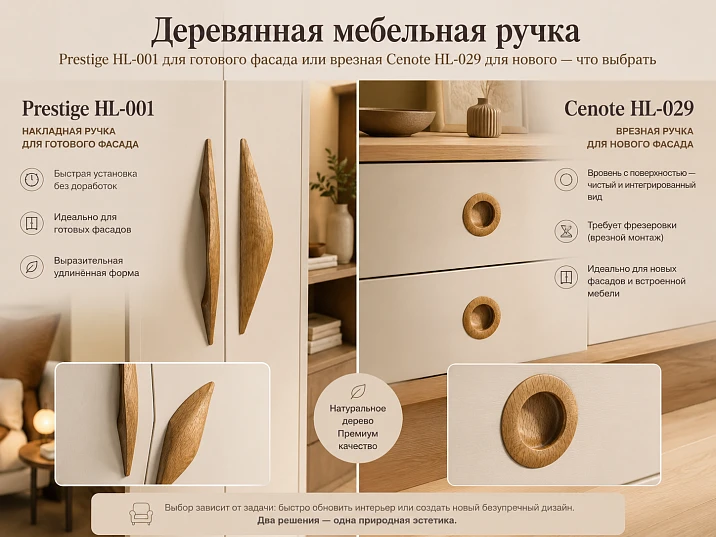
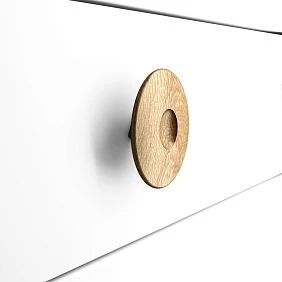
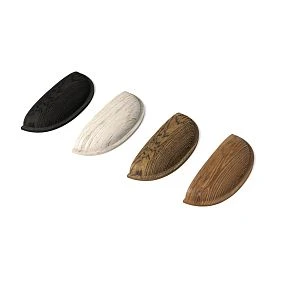
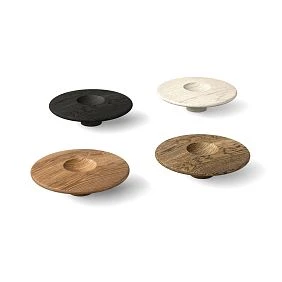
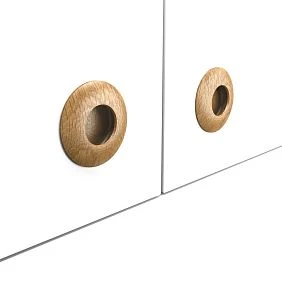
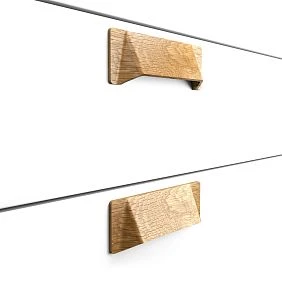
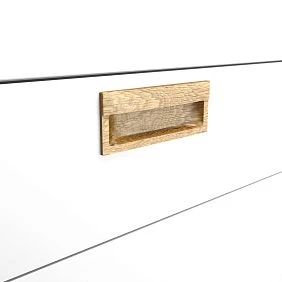
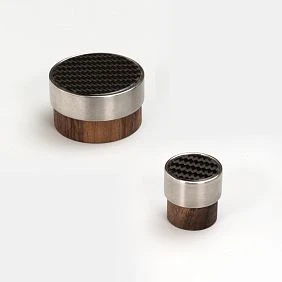
Wooden furniture handles are easier to buy when the choice starts not from a photo, but from the facade manufacturing stage. Prestige HL-001 is an overlay shell handle with screw fixing and five sizes. It is especially convenient for already assembled furniture, replacing old fittings, and projects where holes can be marked without deep milling. Cenote HL-029 is a recessed round handle, for which a mounting recess with a diameter of 67 mm and a depth of 11.5 mm is prepared in advance. It is more sensible to plan it into a new or unpainted facade.
The main difference is not about shape. Prestige forms a noticeable longitudinal line and protrudes about 30 mm in size C. Cenote, after gluing, rises above the front plane by about 9 mm, so it catches less on clothes in a narrow hallway or passage between kitchen modules. However, recessed installation requires a facade thickness of at least 16 mm, a precise template, and careful milling before final finishing.
If the furniture is already in use and the door has two holes with a center distance of 32, 64, 128, 192, or 256 mm, the first candidate is the surface-mounted wooden handle Prestige HL-001. If the facade is only being designed, a nearly flat surface is needed and a Ø 67 mm recess is acceptable, consider the recessed wooden handle Cenote HL-029. Both models are made of beech or oak in an unpainted finish and are suitable for individual customization.
The article helps determine not only the model but also the size, material, installation method, number of handles, and work sequence. The buyer will get a practical route for a kitchen, chest of drawers, wardrobe, dressing room, hallway, and furniture in a narrow passage — without substituting handle length with center distance and without risky milling of a finished painted facade.
Short answer. Finished facade, old holes, and hardware replacement — more often Prestige HL-001. New facade, minimal protrusion, and possibility of precise milling — Cenote HL-029.
For a tall cabinet and a uniform series throughout the kitchen, the Prestige size range of 88–460 mm is convenient. For a narrow corridor, a smooth minimalist surface, and local grip — Cenote with a protrusion of about 9 mm.
choose the Prestige HL-001 size View Cenote HL-029 Buy wooden furniture handles Choose handles without coating
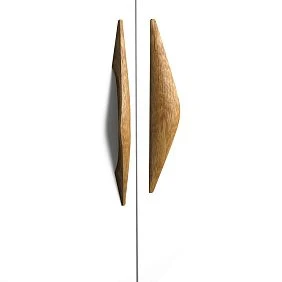
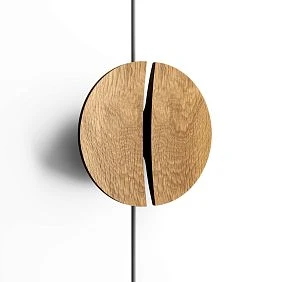
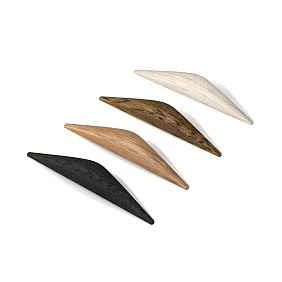
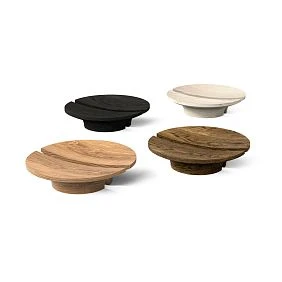
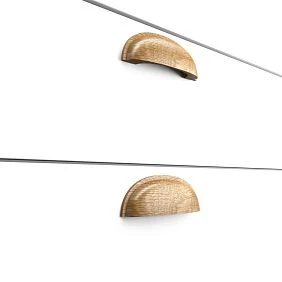
Confirmed characteristics of Prestige HL-001 and Cenote HL-029
| Parameter | Prestige HL-001 | Cenote HL-029 |
|---|---|---|
| Type | Overlay shell handle | Round recessed handle |
| Size range | 88, 158, 248, 350 and 460 mm in size A | One size 80 × 20 × 66 × 11 mm |
| Center-to-center distance | 32, 64, 128, 192 or 256 mm | Not applicable: handle is glued into a round recess |
| Installation | Screw mounting through the facade; mounting kit included in the price | Gluing into a pre-prepared mounting recess |
| Mounting preparation | Two holes at the selected center distance | Diameter 67 mm, depth 11.5 mm |
| Facade thickness | Checked by fastener length and facade design | From 16 mm |
| Protrusion | About 30 mm by size C | Visible part about 9 mm |
| Material | Beech or oak | Beech or oak |
| Sanding quality | «Prestige» | «Prestige» |
| Supply | Unpainted view | Unpainted view |
| Main Scenario | Finished furniture, handle replacement, five sizes of one series | New facade, precise milling, minimal protrusion |
| Average production time for made-to-order items | 5–10 days; current availability checked in the product card | 5–10 days; current availability checked in the product card |




Direct comparison: Prestige overlay or Cenote inset
| Criterion | Prestige HL-001 | Cenote HL-029 | Practical conclusion |
|---|---|---|---|
| Project stage | Suitable for finished and new facade | Better to plan before painting and assembly | Manufacturing stage is more important than external similarity |
| Replacing the old handle | Possible if the center distance matches | Requires a new round cutout | Prestige is more often chosen for repairs |
| Visual line | Long horizontal or vertical shape | Compact local round grip | Prestige emphasizes rhythm, Cenote preserves flatness |
| Narrow passage | Protrusion about 30 mm | Protrusion about 9 mm | Cenote snags less on clothing |
| Tall cabinet | Sizes 350 and 460 mm create a proportionate line | Maintains a small grip | Choice depends on design and convenience |
| One design for all furniture | Five sizes in one series | One size | Prestige is easier to distribute from drawer to tall cabinet |
| Installation risk | Marking error for two holes | Error in diameter, depth or position of the sample | Cenote requires more precise preparation |
| Dismantling | The screw connection is easier to maintain | A glued handle is harder to replace without damage | Maintainability needs to be assessed in advance |
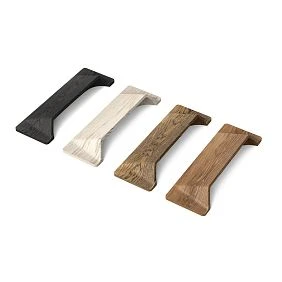
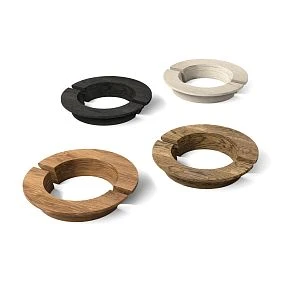
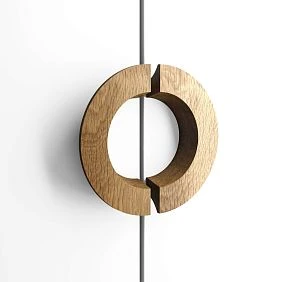
Our factory also produces:
Why facade readiness is more important than handle shape
An overlay and an inset model cannot be compared as two interchangeable decorations. Prestige requires two through holes and is fixed with screws. Cenote requires a circular sample of large diameter, controlled depth, and gluing. If the facade is already painted, assembled, and has old holes, choosing an inset model can turn updating the hardware into a full rework.
At the project stage, the situation is reversed. While the facade has not been sent for painting, you can make a template, check the thickness, perform a test milling, and get a clean fit for Cenote. Therefore, the correct question is not 'which handle is prettier', but 'what operations are still permissible with the facade without risk'.
Get Consultation
Three states of the facade before purchase
The first state is when the furniture is already in use. Here, old holes, door thickness, access from the back side, and the desire to avoid deep processing are important. The second is when the facade is manufactured but not yet painted: precise marking and milling are allowed, but an error will still lead to reworking the part.
The third state is when the facade is only being designed. At this stage, the handle can be coordinated with the frame, panel, edge, and internal fittings. Cenote is most conveniently integrated at this point, while the Prestige size should be chosen together with the door's height and width.
Prestige HL-001 for already assembled furniture
A surface-mounted handle is suitable for updating a dresser, kitchen, or cabinet if the inner side of the facade is accessible and fasteners can be installed. If the center distance matches, the new model can use existing holes without expanding the visible area.
If the holes do not match, old points cannot be ignored: they may remain visible along the edges of the handle. Before ordering, a paper template of the specific Prestige size is made and applied to the facade along with marked mounting centers.
Cenote HL-029 for a new facade
The recessed model requires a mounting recess Ø 67 mm with a depth of 11.5 mm. With a facade thickness of at least 16 mm, there is a small structural margin, so the operator must monitor the actual material thickness, flatness, and tool depth.
Milling is performed before final finishing. This makes it easier to remove fuzz, adjust the edge of the cutout, and conduct a trial installation without the risk of chipping the finished enamel or varnish.
Can Cenote be installed on ready-made furniture
Technically, such installation is possible if the facade has sufficient thickness, can be removed from the furniture, allows milling, and does not contain a hidden frame, glass, profile, or fasteners in the cutout area. However, this is no longer a simple handle replacement.
Before work, the facade structure is checked, a template is made, and the front surface is protected. If the furniture is valuable or the finish is complex, it is safer to make a new facade or choose a surface-mounted handle.
Why Cenote protrudes less
After installation, the visible part of the Cenote rises approximately 9 mm. The grip is formed by an internal concave cavity, so the hand works with a recessed geometry rather than a long bracket.
This is useful in the passage between a cabinet and a wall, near the entrance door, in a small kitchen, and in a dressing room. The smaller protrusion does not negate the convenience check: the handle must be accessible to the user's fingers and be at a suitable height.
Why Prestige is more noticeable on the facade
The C size of Prestige is 30 mm, and the A length varies from 88 to 460 mm. The handle becomes an independent line that can stretch the facade horizontally or emphasize the vertical of a tall cabinet.
This effect is convenient when the hardware should support the proportions of the furniture. But in a narrow passage and on a small drawer, a long model may look heavy and protrude more.
Prestige size 88 mm
The size 88 × 31 × 30 × 32 mm is suitable for a small drawer, a compact nightstand, and a narrow facade. The center distance of 32 mm should be checked separately: the total length of 88 mm does not mean the holes are located at the edges.
On a small facade, the handle should not overlap the frame, molding, or edge of the panel. A paper template helps to see the external dimensions and the position of the screws.
Prestige size 158 mm
The variant 158 × 31 × 30 × 64 mm is suitable for a chest of drawers, a nightstand, and a medium furniture facade. The center distance of 64 mm is found in both old and new furniture, but it is still measured from center to center.
On a wide drawer, a single 158 mm handle can be more convenient than two small knobs if the guides operate smoothly and the load is distributed correctly.
Size Prestige 248 mm
The size 248 × 31 × 30 × 128 mm is often considered for a kitchen, cabinet, and wide drawer. The center distance of 128 mm allows the model to be used as a noticeable bracket while maintaining a comfortable grip.
Before replacing old hardware, not only the 128 mm between holes is checked, but also the traces from the previous handle. The new wooden part must completely cover the damaged or faded area if required.
Size Prestige 350 mm
The option 350 × 31 × 30 × 192 mm is suitable for a large door, kitchen tall cabinet, and high cabinet. The long line makes the facade visually slimmer and helps to use the door at different grip heights.
On a narrow door, 350 mm may be excessive. You need to check the distance to the edge, hinges, adjacent handle, and the opening door.
Size Prestige 460 mm
The size 460 × 31 × 30 × 256 mm is intended for a tall cabinet, wardrobe, and large facade. The center distance of 256 mm requires precise marking and a rigid template to prevent the holes from shifting diagonally.
In the kitchen, such a handle is used only where the scale of the facade supports it. On a small drawer, it will not only be visually heavy but may also come close to the side edges.
How not to confuse length and center distance
Total length A shows the external dimension of the handle. Center distance D is the distance between the centers of two mounting holes. For Prestige, these pairs are 88/32, 158/64, 248/128, 350/192, and 460/256 mm.
Buying by total length alone leads to mismatched holes. To replace an old handle, first measure the center distance with a caliper or ruler, then check if the new model covers the old marks.
How to measure old holes
Remove the handle and measure the distance between the geometric centers of the holes on the front or inside of the facade. Measuring from the edge of one hole to the edge of another is only acceptable with subsequent recalculation of the diameter.
If the holes are damaged, oval, or drilled at an angle, their centers are determined using a template. Do not order a handle based on an approximate figure like "about 128 mm."
What to do if the holes do not match
Options depend on the material and finish. Old holes can be professionally restored, covered with a new longer handle, or a new facade can be made. Simply shifting the mounting a few millimeters next to the old point is dangerous: the wood or board may weaken.
Before repair, apply a full-size Prestige template. If the handle does not cover the old marks, make a decision before purchasing, not after drilling.
Horizontal installation of Prestige
On a drawer, the handle is usually placed horizontally along the central axis of the facade. Long sizes help unify a wide surface and provide a comfortable grip.
The position is checked relative to the frame, molding, and adjacent drawers. All handles on the same line must have the same height and orientation.
Prestige vertical installation
On a tall door, the handle can be installed vertically to support the cabinet's proportion and provide the user with a long grip zone. The 350 and 460 mm sizes are particularly expressive.
The placement height is determined by ergonomics, not just the center of the facade. The lower end should not fall into the kick zone, and the upper end should not interfere with opening the adjacent module.
Cenote on a small drawer
The 67 mm mounting diameter requires sufficient facade area around the recess. On a very low drawer, the handle may come close to the edges or internal box components.
Before milling, a cross-section is constructed: the face plane, a recess 11.5 mm deep, the remaining thickness, and the location of drawer fasteners. The small external size of the handle does not mean the mounting fits any small facade.
Cenote on a wide drawer
One compact recessed handle maintains a clean surface, but on a heavy wide drawer, the convenience of the central grip and the operation of the guides must be checked. Two Cenote handles can provide symmetrical opening, but require two recesses and precise distance calculation.
The number of handles is determined by the furniture project. A universal scheme cannot be promised without width, filling weight, and guide specifications.
Cenote on a cabinet door
On a swing door, the handle is placed in a convenient grip zone, maintaining distance to the edge and hinges. The nearly flat front part suits a cabinet in a passageway and minimalist furniture.
If the door is framed, the circular cutout may fall into the joint of elements or a thin panel. The facade construction is checked before ordering.
How to prepare a template for Cenote
The template fixes the center of the circular cutout and prevents the router from drifting sideways. It is made from a stable material, tested on a scrap of the same facade, and only then transferred to the final part.
For a series of doors, one proven template and the same reference base are used. Marking from a random edge leads to different handle heights on adjacent facades.
Why a test on a scrap is needed
A test routing shows the actual diameter, depth, edge cleanliness, and Cenote fit. The nominal 67 mm and 11.5 mm must match the real tool and material.
On the scrap, glue and the finishing system are also checked. If the handle fits too loosely or too tightly, the final facade is not touched until the technology is adjusted.
Routing before or after painting
It is better to perform the cutout before the final enamel, oil, or varnish. The tool may raise fibers, leave chips, or require light sanding of the edge.
After milling, a dry fit is performed, the recess is cleaned, and only then the facade is finished according to the selected technology. Gluing is done after the coating has completely dried, unless the installation system provides otherwise.
Why you cannot deepen the recess by eye
A depth of 11.5 mm leaves a limited material thickness in the facade from 16 mm. An error of a few millimeters can weaken the face layer or go through to the back side.
Use a depth stop, a verified router, and measuring tools. The facade thickness is measured actually, not assumed by the material name.
How to check the thickness of the facade
The thickness is measured in the area of the future handle. Frame, veneered, and multi-layer facades may have local variations, recesses, or internal profiles.
A value from 16 mm is the minimum confirmed condition for Cenote. It does not replace checking the remaining wall, material strength, and furniture designer recommendations.
How to choose glue for Cenote
The card provides for gluing the handle into the mounting recess. The glue must be compatible with the handle wood, facade material, and finish coating.
A universal recommendation without knowledge of the surface is unsafe. Before serial installation, a test is done on a scrap piece, checking adhesion, fixation time, and absence of stains around the handle.
How to glue the handle without contaminating the facade
The mounting sample is cleaned of dust, and the front surface is protected. The glue is applied in a measured amount to the designated area so that it does not seep onto the painted surface during installation.
The handle is installed according to the orientation mark and held in accordance with the instructions of the selected compound. Excess is removed using a method compatible with the coating, without smearing it on the wood.
Can the glued-in Cenote be replaced?
Replacement is more difficult than removing a screw-mounted Prestige. Attempting to extract it may damage the edge of the sample, the enamel, or the facade itself.
For furniture with high repair load, this factor is considered in advance. In a serial project, it is useful to order spare handles from the same batch and preserve the installation technology.
How to remove Prestige for repair
The screws are unscrewed from the inside of the facade, supporting the handle from the outside. If the coating has bonded the parts, do not abruptly pull the wooden handle.
After removal, check the holes, fasteners, and the mark on the facade. Reinstallation requires a suitable screw length and intact threads.
What is included in the Prestige kit
The current card confirms that the mounting kit is included in the price of Prestige HL-001. This applies to the standard installation of the handle on a suitable facade.
Before ordering, they still check the door thickness and fastener length. If the facade is non-standardly thick, the kit may require an agreed replacement.
Why does Cenote have no center distance
The recessed handle is not fastened with two screws, so the parameter D between centers is absent. For it, the center of the cutout, diameter 67 mm, and depth 11.5 mm are important.
Attempting to select Cenote based on the old center distance is pointless. Existing holes will have to be covered or accounted for in the new mounting assembly.
Beech for opaque enamel
Beech has a calm texture and is suitable for projects where handles are painted white, gray, colored, or in a tone matching the facade. Opaque coating unifies the handle and furniture into one system.
To match the color, handles and facades are primed and painted according to one sample. Different batches of enamel and gloss levels can create a noticeable difference.
Oak under tinting
Oak is chosen when it is necessary to preserve expressive wood texture. Tinting, oil, or clear varnish emphasize the pattern and turn the handle into a natural accent.
The shade is checked on a sample from the same batch. An oak handle does not have to completely replicate the pattern of an oak facade, but the color system must be coordinated.
Can oak be painted with enamel
Opaque coating is possible if the selected configuration and technology allow it, but the decorative advantage of the oak texture will be hidden. For simple enamel, beech is often chosen.
The material is evaluated together with the budget, texture, and desired result. You should not overpay for an expressive species if it is completely covered by an opaque layer without a design reason.
Can beech be tinted?
Beech can be finished with translucent materials, but its grain and absorption differ from oak. The result is checked on a test sample.
If a pronounced wood texture is needed, oak is usually more predictable. If a calm surface and color are important, beech is convenient under enamel.
How to make a test paintout
One handle or a separate sample is prepared with the same sanding, primer, and finish as the entire set. The color is evaluated next to the facade under daylight and artificial lighting.
After approval, the brand of materials, color number, gloss level, and number of layers are recorded. This is especially important for reordering.
Painting handles together with facades or separately
A joint batch makes it easier to match the color, but handles are more convenient to finish separately to paint all edges and not cover mounting areas. Prestige is removed after fitting; Cenote is usually finished before gluing.
The order is coordinated with the finisher. It is important that the coating does not increase the fit of Cenote beyond the allowable limit and does not get into the threaded areas of Prestige.
How to preserve natural texture
For oak, a transparent or semi-transparent system is used, which emphasizes the grain and protects the surface from hands. The handle constantly contacts the skin, so the finish must be suitable for furniture use.
The exact material is chosen according to the coating manufacturer's recommendations. The article does not specify a universal oil or varnish for all conditions.
White wooden handles in the kitchen
Beech under white enamel helps make Prestige part of the facade or highlight Cenote with a neat round contour. It is important to match the shade of white and the degree of gloss.
In the kitchen, handles are regularly cleaned, so the coating must be designed for maintenance. Harsh abrasives and aggressive solvents can damage the finish.
Contrasting oak handles
Oak with dark or natural staining reads well on a light facade. Prestige creates a long graphic line, Cenote — a compact point.
The contrast should be repeated in the countertop, legs, or other details, otherwise the handles look random. On a large set, first assemble one control facade.
Handles in the color of the facade
The same enamel makes Prestige an architectural part of the door, and Cenote almost dissolves into the plane. This technique suits calm modern furniture.
Even with the same color, the shadow from the protrusion remains different: about 30 mm for Prestige and about 9 mm for Cenote. The visual result is checked under side lighting.
Can beech and oak be combined in one set
Under a transparent finish, the species differ noticeably, so random mixing creates unevenness. Under a common opaque enamel, combination is possible after checking the technology.
For one facade row, it is safer to order handles from the same species and the same batch. This simplifies finishing and future replacement.
Prestige for kitchen facades
The size of 248 mm with a center distance of 128 mm is suitable for many medium and wide kitchen facades, while 350 and 460 mm are for tall tall cabinets. The size is chosen based on the actual door width, not the overall kitchen style.
On lower drawers, check whether adjacent handles collide when opening at an angle. On upper modules, consider the grip height and protrusion.
Cenote for a minimalist kitchen
A recessed round handle maintains a clean surface and does not create long lines on the facades. It is especially appropriate in a narrow passage between two rows of furniture.
All centers of cutouts must be aligned on a single grid. Even a difference of a few millimeters is noticeable on a straight facade row.
Handle for kitchen cabinet
A tall cabinet supports Prestige 350 or 460 mm if a pronounced vertical line and comfortable grip are needed. Cenote is chosen when the door should remain nearly flat.
The solution is tested on a full-size template and considering user height. The handle should not be too high or too low.
Handle for wide kitchen drawer
Prestige 248 or 350 mm creates a clear central grip. Cenote can be used singly or in pairs, but the number of handles depends on the width and guides.
Before ordering, open a loaded test drawer. If using one compact point is inconvenient, change the layout before milling.
Handle for a chest of drawers
On small upper drawers, it is convenient to use Prestige 88 or 158 mm, and on wide lower ones — 248 mm. One series maintains a common pattern, changing only the length.
Cenote suits a chest of drawers with smooth fronts and a small protrusion. For a wide heavy drawer, check if one central grip is enough.
Handle for bedside table
Compact Prestige 88 mm emphasizes a small front without excessive length. Cenote 80 mm suits a modern bedside table if the front thickness allows for routing.
The handle should not protrude into the narrow passage next to the bed. In a cramped bedroom, the advantage of Cenote becomes especially noticeable.
Handle for a tall cabinet
Prestige 350 and 460 mm supports the scale of a tall door and helps open it at a comfortable height. Vertical installation creates an expressive line.
Cenote maintains a minimal protrusion and suits a cabinet in the hallway. However, a small handle must provide a comfortable grip for a heavy door with the selected hinges.
Handle for a walk-in closet
In a spacious walk-in closet, you can use different sizes of Prestige: short on drawers, long on cabinets. The series unifies all the furniture.
In narrow passages between sections, Cenote reduces the risk of catching clothes. The layout can be combined if the difference is explained by function.
Handle for an entryway
Furniture near the entrance constantly contacts outerwear and bags. A protruding Prestige requires checking the passage, while Cenote at about 9 mm is usually safer.
On small drawers and nightstands, Prestige 88 or 158 mm remains convenient if the furniture is not in the path of movement.
Handle for children's furniture
The smaller protrusion of Cenote reduces the likelihood of accidental snagging, but the round cutout and adhesive must be done professionally. Prestige is suitable if its edges, size, and placement height are safe.
Any handle is tested for fastening strength and absence of sharp transitions after finishing. Children's use refers to the finished furniture, not just the shape of the hardware.
Handle for office
Oak Prestige for tinting emphasizes wooden furniture and creates a calm horizontal line on drawers. Cenote is suitable for laconic built-in cabinets.
On file drawers, the weight of the contents is taken into account. Grip comfort is tested with actual load.
How to combine different sizes of Prestige
One series allows distributing 88 and 158 mm on small drawers, 248 mm on medium fronts, 350 and 460 mm on tall doors. The profile, thickness, and handle height remain common.
Sizes should not be changed chaotically. A rule is established: type of front, width range, and corresponding handle length.
Can Prestige and Cenote be combined
Yes, if the difference is related to function. For example, long Prestige on tall cabinets and Cenote on furniture in the passage. A single wood species and finish help combine them into one system.
Random alternation on adjacent identical fronts looks like a mistake. The combination is shown on the layout of all furniture.
How to choose handles for a corner kitchen
Opening fronts near the corner may collide with handles. Prestige is tested in the full range of motion, especially long sizes.
Cenote reduces protrusion, but its center must remain comfortable. Sometimes in the corner area, a recessed model is used only on one group of doors.
How to check the opening of adjacent fronts
Cardboard templates of handles with actual protrusion are made: about 30 mm for Prestige and about 9 mm for Cenote. The fronts are opened simultaneously and possible collisions are noted.
Checking is needed before drilling and milling. After installation, changing the handle axis without traces is difficult.
How to calculate the number of handles for a kitchen
Each hinged door, outer drawer, inner front, tall cabinet, and separate section is counted. Then the model and size are assigned according to the list.
The quantity does not equal the number of cabinets: one cabinet may have two doors and several drawers. The final table is checked against the furniture drawing.
Do I need to count internal drawers
Internal drawers may have separate handles or special cutouts. If Prestige or Cenote is used, they are included in the order and finishing.
Concealed fronts are often forgotten, causing one to later buy a handle from a different batch. The list should cover all furniture.
One or two handles for a wide drawer
One long Prestige creates a central grip. Two short handles distribute the force but require simultaneous movement of both hands or allow misalignment.
For Cenote, one or two points are also possible. The decision depends on width, guides, and content weight, so there is no universal number.
How many spare handles to order
For a single dresser, the exact quantity may suffice if the model is available. For a large kitchen, hotel, or series of furniture, a small repair stock is useful.
It is especially important to preserve Cenote: removing a glued-in part may damage the handle. Spare parts are ordered from the same wood species and batch.
Why it's better to order handles in one batch
Wood differs in shade and grain, and finishing differs by material batch. Ordering simultaneously facilitates sorting and uniform coating.
If Prestige of different sizes is purchased in stages, keep the article numbers, material, glue quality, and coating sample.
How to compile a handle list
The table indicates the facade number, room, model, size, center distance or fit, wood species, finish, quantity, and allowance.
For Cenote, add the facade thickness and the position of the sample center. For Prestige, add the fastener length and installation direction.
How to check convenience before ordering
A full-size model is cut from thick cardboard or printed according to the drawing. Prestige is supplemented with a 30 mm spacer, Cenote with a 9 mm protrusion imitation.
The mockup is applied to the facade, the furniture is opened, and the grip is checked by different users. This test reveals errors that are not visible in the catalog.
Size range Prestige HL-001
Five sizes allow maintaining one handle shape on all furniture. The table shows the full size A × B × C × D and the center distance D. Practical scenarios help start the selection, but the final decision is made based on the facade mockup and grip convenience.
| Size Prestige | Center-to-center distance | Preliminary scenario | What to Check |
|---|---|---|---|
| 88 × 31 × 30 × 32 mm | 32 мм | Small drawer, bedside table, compact facade | Does it overlap the frame and old holes |
| 158 × 31 × 30 × 64 mm | 64 мм | Chest of drawers, cabinet, middle door | Convenience of one handle on a wide drawer |
| 248 × 31 × 30 × 128 mm | 128 мм | Kitchen, cabinet, wide drawer | Mark from previous hardware and collision in the corner |
| 350 × 31 × 30 × 192 mm | 192 мм | Large door, kitchen tall cabinet | Distance to edges and adjacent front |
| 460 × 31 × 30 × 256 mm | 256 мм | Tall cabinet, walk-in closet | Placement height and template accuracy |
What to buy and study together with handles
Buying handles is related to the facade, finish, and installation. The internal links below lead only to pages allowed by the SEO scheme. They help compare products but do not replace a specific furniture drawing.
| What to open | Why | For which scenario | What to Check | Link |
|---|---|---|---|---|
| Prestige HL-001 | Choose a surface-mounted handle and one of five sizes | Ready-made facade, replacement of old fittings | Center distance and overall dimension | Buy Prestige HL-001 overlay wooden handle |
| Cenote HL-029 | Choose a recessed handle with a small protrusion | New facade, narrow passage | Thickness from 16 mm, Ø 67 and depth 11.5 mm | Buy Cenote HL-029 recessed wooden handle |
| All furniture handles | Compare other shapes and sizes | Both models do not fit the project | Mounting type and material | Buy wooden furniture handles |
| Unpainted handles | Select products for self-finishing | Uniform color with the facade or tinting | Beech or oak, one batch | buy wooden handles without coating |
| General guide | Understand the choice for cabinets, kitchen, and drawers | Need a broad overview up to the article number | Do not replace it with technical verification | how to choose wooden handles for a cabinet, kitchen, and drawers |
| Handle types | Compare surface-mounted and inset solutions | The buyer is still choosing the mounting principle | Facade readiness stage | What is the difference between surface-mounted and inset furniture handles |
| Inset mounting | Prepare the facade for routing | Cenote project | Template, thickness, and finish | How to prepare a facade for an inset handle |
| Long handles | Select size for pencil case and tall cabinet | Prestige 350 or 460 mm | Proportions and vertical installation | How to choose a long handle for a cabinet or kitchen pencil case |
| Kitchen fronts | Create a size system for the set | Kitchen with different doors and drawers | Corners, passages, and quantity | How to choose the handle size for a kitchen facade |
Practical selection matrix for Prestige or Cenote
| Situation | Preliminary selection | Why | What to Check |
|---|---|---|---|
| Old holes 32–256 mm | Prestige | There are five matching center-to-center options | Trace of the old handle and fastener length |
| New unpainted front | Cenote or Prestige | Both preparation methods are acceptable | Design, protrusion, and maintainability |
| Narrow corridor | Cenote | Visible protrusion about 9 mm | Grip convenience and front thickness |
| Tall cabinet | Prestige 350 or 460 mm | The long line corresponds to the scale | Mounting height and adjacent doors |
| Small box | Prestige 88 mm or Cenote | Compact formats | Margins around the Ø 67 mm sample |
| One series for the entire kitchen | Prestige | Five sizes of one profile | Size distribution rule |
| Minimalist smooth surface | Cenote | Compact local grip | Accuracy of all sample centers |
| Maintainability is more important than minimal protrusion | Prestige | Screw disassembly is easier than glued fit | Access from the back side of the facade |
| White enamel | Beech | Smooth texture under covering color | Uniform color of handles and facades |
| Natural texture | Oak | Expressive pattern for tinting | Sample and one batch |
How not to confuse Prestige with a regular bracket
Prestige has a shell-handle shape and its own profile with dimensions B and C of 31 and 30 mm. It cannot be replaced by any metal bracket with the same center distance without checking the external footprint and grip.
When replacing old hardware, compare not only D, but also the overall length, width, height, and position of mounting plates.
How not to confuse Cenote with a furniture button
The Cenote looks compact, but its installation is fundamentally different. The button is usually secured with one screw, while the Cenote is glued into a round recess with a diameter of 67 mm.
The buyer must consider the facade treatment and the impossibility of simple replacement through a single hole. External compactness does not mean easy installation.
How not to confuse the overall length of the Cenote and the seating
The product size of 80 mm does not equal the recess diameter. The seating recess has a diameter of 67 mm, while the visible part forms the external dimension of the handle.
The template is built according to the technical drawing, not the outer contour of a photograph. A diameter error will lead to play or inability to seat.
Error: selecting only by image
On screen, the Prestige and Cenote may appear close in scale. In reality, one handle protrudes about 30 mm and reaches a length of 460 mm, the other requires a recess Ø 67 mm and protrudes about 9 mm.
A full-size mockup and facade section provide more information than an interior visualization.
Error: milling the Cenote after final enamel
The cutter can chip the coating, lift the edge, or leave a template mark. Correction on a finished facade is more noticeable and expensive.
First, perform sampling and dry fitting, then finish the surface, and after drying, glue the handle using the technology.
Error: not checking the thickness of the facade
The minimum confirmed thickness for Cenote is 16 mm. However, the frame, panel, or local sampling may reduce the material in the required area.
The thickness is measured exactly in the center of the future handle and compared with the depth of 11.5 mm.
Error: confusing center distance with length
Prestige 248 mm has a center distance of 128 mm, while the 350 mm model has 192 mm. Purchasing by external length does not guarantee matching old holes.
Both parameters are recorded in the order, and a template is applied to the actual facade.
Error: placing a long Prestige on a small facade
The handle may approach the edges, overlap the frame, and make the drawer visually heavy. A large length does not always mean more convenience.
For compact furniture, consider 88 or 158 mm, and confirm the choice with proportions and grip.
Error: placing a short handle on a tall cabinet
A small handle can look random and force the user to pull a heavy door at a single point. On a tall front, Prestige 350 or 460 mm is often more appropriate.
Cenote remains an alternative if the project deliberately maintains a compact grip and the hinges ensure easy opening.
Error: not accounting for the protrusion in the passage
Prestige protrudes about 30 mm and can catch on clothing, a bag, or an adjacent door. It is especially important to check the cabinet in the hallway and a narrow kitchen.
A cardboard mockup with a spacer shows the real trajectory. If clearance is critical, Cenote is often safer.
Error: drilling Prestige holes without a template
On a long model, a small offset turns into a noticeable tilt. The two holes must be on the same axis and exactly match D.
For a series of fronts, use a rigid jig and one marking base, rather than measuring each door anew from different edges.
Error: gluing Cenote without a trial fit
Too tight a fit can damage the edge of the front, too loose will create play and require excessive glue.
The sample is performed on a cut of the same material and with the same finish. Only after this do they proceed to the final parts.
Error: using random glue
The composition may not adhere well to the coating, change the color of the wood, or bleed onto the surface. Compatibility depends on the facade and finish.
The glue is selected according to technical requirements and tested on a sample. A universal promise for all materials is unacceptable.
Error: ordering handles in different batches
Beech and oak have natural differences in shade and grain. With a transparent finish, the difference between deliveries may be noticeable.
It is better to order the entire set and spare parts at the same time, and keep a sample of the coating.
Error: not considering internal fittings
The Cenote cutout may fall into the hinge cup, tie rod, profile, or inner frame. The Prestige screw may be too long or too short.
Before installation, check the facade in cross-section and the position of all hidden parts.
Error: not checking adjacent handles in the corner
Long Prestige handles on two perpendicular facades may collide when opened simultaneously. Cenote reduces the risk but does not eliminate the need for checking.
The actual protrusion and door trajectory are drawn on the plan. The corner area is tested before drilling.
Error: painting only the front part
An unpainted wooden handle requires treatment of all visible and accessible faces. Uneven finish can change color and tactile feel.
Prestige is removed for finishing, Cenote is coated before gluing with control of seating areas.
Error: mixing beech and oak without intention
Under a transparent coating, the species differ and look like mismatched parts. Even the same tinting does not turn beech into oak.
For one series, choose one species or use a common opaque enamel after a test sample.
Who is Prestige HL-001 suitable for
The model is suitable for owners of ready-made furniture, kitchen and cabinet manufacturers who need an overlay handle with a simple screw fastening and five sizes.
It is especially useful for a unified series from a small drawer to a tall cabinet, as well as when replacing old hardware with matching center distance.
Who is Cenote HL-029 suitable for
The recessed handle is suitable for new fronts, minimalist furniture, narrow passages, and projects with an almost flat front plane.
The buyer must be prepared for precise milling of Ø 67 mm with a depth of 11.5 mm and gluing into a front with a thickness of at least 16 mm.
Who these models may not suit
Prestige is not suitable if the protrusion of about 30 mm interferes with passage or old holes cannot be aligned. Cenote is not suitable for thin fronts, finished valuable finishes without permissible milling, and projects where a simple screw replacement is needed.
In this case, you should open the catalog of wooden furniture handles and choose a different type without attempting to modify the front to fit an unsuitable model.
How to accept handles upon delivery
They check the article, size, center distance for Prestige or parameters for Cenote, wood type, and quantity. The surface is inspected before painting and installation.
The Prestige set is checked for fasteners. For Cenote, the geometry of the seating part and the absence of damage around the circumference are assessed.
How to store unpainted handles
Handles are kept in a dry room, protected from construction dust, moisture, and direct sunlight. Parts from different facades are not mixed after sorting by pattern.
Before finishing, the products are not placed on contaminated surfaces that may leave oil or stains.
How to care for finished handles
Care depends on the enamel, oil, varnish, or other chosen system. The surface is wiped with a soft cloth, and abrasives are not used without the coating manufacturer's permission.
Periodically check the Prestige screws. Cenote is inspected along the edge of the inlay; play is eliminated before damage to the facade occurs.
How to buy Prestige HL-001
In the card, select one of five sizes, beech or oak, and the required finish preparation. To replace an old handle, measure the center-to-center distance before adding the product to the cart.
After selection, check the quantity, mounting kit, current availability, and delivery time. The price depends on size and material, so it is not fixed in the article.
How to buy Cenote HL-029
Before ordering, confirm the facade thickness of at least 16 mm, the possibility of a Ø 67 mm recess with a depth of 11.5 mm, and the handle center position. Then choose beech or oak.
Together with the furniture maker, agree on the glue, template, and finishing procedure. Price and availability are checked in the card on the purchase date.
What to check before paying for Prestige
Full dimensions A × B × C × D, center-to-center distance, wood species, sanding quality, preparation for enamel or tinting, and number of items are required.
For finished furniture, additionally check the length of standard screws, facade thickness, access from the reverse side, and the handle's ability to cover the old mark.
What to check before paying for Cenote
Dimensions 80 × 20 × 66 × 11 mm, Ø 67 mm seat, depth 11.5 mm, facade thickness from 16 mm, material, and quantity are required.
On the drawing, mark the center of each sample and the hidden door structure. An order without this check transfers the risk to the finished facade.
How to estimate the budget for replacing handles
The budget includes the handles themselves, possible repair of old holes, drilling, fasteners, finishing, and installation. Prestige usually requires less intervention if D matches.
Cenote on ready-made furniture may require removing facades, making a template, and refinishing. You need to compare the cost of the entire process, not just the product.
How to estimate the budget for a new furniture project
On a new facade, both models can be planned in advance. Prestige requires drilling and fasteners, Cenote requires precise milling and gluing.
For a furniture series, the cost of templates and setup is distributed across the entire order. An error in the first part must be identified before batch production starts.
Why a sample is more important than a color name
The phrase "white enamel" or "natural oak" does not describe the exact color, gloss, and pattern. The handle is in the light and constantly touched by hand, so differences are noticeable.
The control swatch is applied to the facade, countertop, and adjacent hardware. The approval is finalized before finishing the entire batch.
How to save data for reordering
The archive retains the article, size, wood species, center distance or sampling parameters, order date, coating recipe, and furniture photographs.
For Cenote, the template and adjustment depth are saved. For Prestige, the screw length and layout on the facades are saved.
When a furniture maker's consultation is needed
It is necessary for frame facades, glass, complex edges, thin materials, heavy drawers, and replacement of mismatched holes.
The manager confirms the product data, while the furniture maker is responsible for the facade design, layout, and installation. These tasks cannot be replaced by assumptions based on a photograph.
Why a finished wooden handle is better than a random blank
Finished models have confirmed geometry, a size range, and technical parameters. The buyer does not need to independently cut the Prestige profile or form the concave cavity of Cenote.
The work focuses on selection, finishing, and precise installation. This reduces the number of unknowns and helps replicate the set across all furniture.
FAQ: questions about Prestige HL-001 and Cenote HL-029
How is Prestige HL-001 different from Cenote HL-029?
Prestige is an overlay shell handle on screws with five sizes. Cenote is a round inset model that is glued into a Ø 67 mm recess with a depth of 11.5 mm.
Which handle to choose for a finished facade?
More often Prestige, especially if there are already two holes with center distances of 32, 64, 128, 192 or 256 mm.
Which model is suitable for a new facade?
Both models are suitable, but Cenote is more convenient to embed in advance, while precise milling can be done before final finishing.
Can Cenote be installed on ready-made furniture?
Only after checking the thickness, construction, and the possibility of safely removing and milling the facade. This is more difficult than simply replacing a surface-mounted handle.
What sizes does Prestige HL-001 have?
88 × 31 × 30 × 32, 158 × 31 × 30 × 64, 248 × 31 × 30 × 128, 350 × 31 × 30 × 192 and 460 × 31 × 30 × 256 mm.
What does center distance mean?
This is the distance between the centers of two mounting holes. It is not equal to the total length of the handle.
How to measure old holes?
Remove the handle and measure the distance from the center of one hole to the center of the other. If the holes are damaged, use a template.
What recess is needed for Cenote?
Round cutout with a diameter of 67 mm and a depth of 11.5 mm.
Will Cenote fit a 16 mm facade?
Yes, the card indicates a thickness from 16 mm. But you need to check the actual construction and the remaining material after the cutout.
Which handle protrudes less?
Cenote: its visible part rises about 9 mm. Prestige has a height of about 30 mm in size C.
What should I choose for a tall cabinet?
Prestige 350 or 460 mm creates a long vertical line. Cenote is chosen if minimal protrusion and a clean surface are more important.
What to choose for a small drawer?
Prestige 88 mm or Cenote, if the facade has sufficient area and thickness for a round cutout.
What to choose for a narrow corridor?
Cenote is usually safer due to the protrusion of about 9 mm. The grip convenience is still checked with a mockup.
Can Prestige be used vertically?
Yes. Vertical installation is especially appropriate on tall cabinets and tall units.
Can Cenote be used on a wide drawer?
Yes, but you need to check the convenience of a single grip point, the weight of the contents, and the operation of the guides. Sometimes two handles are used.
Should I choose beech or oak for enamel?
For opaque enamel, beech is often chosen. It provides a calm base and does not require preserving a pronounced texture.
Should I choose beech or oak for tinting?
For visible wood texture, oak is often chosen. The color must be checked on a test sample.
Can handles be painted together with the facade?
They can be finished with the same system, but it is more convenient to paint handles separately to cover all edges and avoid contaminating the mounting areas.
Is the fastener included with the Prestige?
The current card confirms the mounting kit. The compatibility of screw length with a specific facade is checked separately.
How is Cenote attached?
The handle is glued into the prepared mounting recess. The adhesive is selected based on the facade material and coating after a test trial.
Can a glued-in Cenote be replaced?
Yes, but removal is more difficult and may damage the edge of the cutout or the finish. For a series, it is useful to have a repair stock.
How many handles to order for a kitchen?
Count each door, outer and inner drawer, cabinet, and separate facade. Then add a justified repair stock.
Is a spare handle needed?
For a large kitchen, hotel, or serial furniture, a stock is useful. It should be from the same wood species and batch.
Can different sizes of Prestige be combined?
Yes. This is one of the main advantages of the series: short models are placed on drawers, long ones on tall doors.
Can Prestige and Cenote be combined?
Yes, if the difference is explained by function: for example, Prestige on cabinets, Cenote in a narrow passage. It is better to coordinate the material and finish.
What to do if the old holes do not match?
Professionally restore the facade, choose a different size, or make a new door. Do not drill new holes too close to the old ones.
Why is it better to mill Cenote before painting?
This makes it easier to remove lint and chips, check the fit, and avoid damaging the final enamel or varnish.
Can Cenote be installed in a framed facade?
Only after checking the cross-section. The cutout must not fall into the frame joint, thin panel, glass, or concealed hardware.
How to check the size of Prestige before purchase?
Make a full-size paper template with hole centers and a 30 mm spacer, then check the facade and opening.
How to check Cenote before purchase?
Mark a circle Ø 67 mm, depth 11.5 mm, and outer dimension 80 mm on the facade cross-section, then test on a scrap piece.
What is the average production time for custom orders?
The cards indicate an average time of 5–10 days. Actual availability and date for a specific configuration are checked before payment.
Where to buy both models?
In the official cards of Prestige HL-001 and Cenote HL-029, as well as in the category of wooden furniture handles on the STAVROS website.
Result: Prestige for a finished facade or Cenote for a new one
Prestige HL-001 and Cenote HL-029 solve different tasks. Prestige is convenient when the furniture is already made, two holes are available, and an overlay handle with screw fastening is needed. Five sizes from 88 to 460 mm allow assembling one series on drawers, cabinets, and tall tallboys.
Cenote HL-029 is rationally planned for a new or unpainted facade. It requires a recess of Ø 67 mm with a depth of 11.5 mm, a facade thickness of at least 16 mm, and compatible mounting adhesive. After installation, the visible part protrudes about 9 mm, so the model is suitable for narrow passages and minimalist furniture.
Beech is chosen primarily for opaque enamel, oak for tinting and preserving texture. It is better to order handles in one batch, make a test paintout, and store the specification. For Prestige, the overall length and center distance are mandatory to record; for Cenote, the center, diameter, and depth of the recess.
on the Stavros website you can choose the Prestige HL-001 size, view Cenote HL-029 in beech or oak и view all STAVROS handlesCorrect order of purchase: determine the condition of the facade, check the installation, make a template, choose the material, calculate the quantity, and only then place the order.