Article Contents:
- What is an inset furniture handle: the essence in a nutshell
- Where inset handles are used: a complete overview of scenarios
- In the kitchen
- For wardrobe and dressing room
- For wardrobe and sliding doors
- For chest of drawers, nightstand, and drawer
- Inset handle on the facade: technique, installation, and nuances
- Inset handle on the end of the facade
- Profile inset handle for the facade
- Inset handle for the kitchen: clean lines and hidden functionality
- Recessed handle for wardrobe and sliding doors: technical requirements
- Recessed handle for sliding doors: formats and features
- Round recessed handle: compactness and versatility
- Sink handle: recessed grip with character
- Wooden recessed handle: tactile truth of natural material
- Recessed handle Nova HL-028: modern geometry in wood
- How a recessed handle differs from an overlay and profile handle: detailed comparison
- Comparison table of handle types
- Pros and cons of recessed handles: honest analysis
- Advantages
- Disadvantages
- How to install a recessed handle in a facade: step-by-step instructions
- Pull handle or recessed handle: which to choose for a drawer and cabinet
- Hidden handles for furniture: integrated systems and modern trends
- Common mistakes when choosing and installing a recessed handle
- Recessed handles in the context of the complete interior: a designer's perspective
- Materials and coatings for recessed handles: what to choose
- FAQ: answers to popular questions about recessed handles
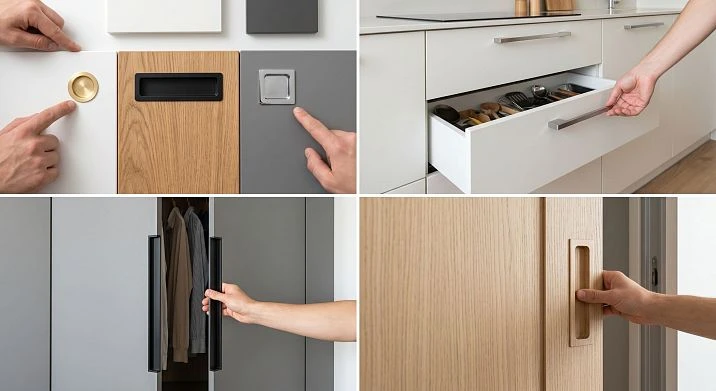
There are interior details that speak loudly — and details that speak quietly. A recessed handle belongs to the second type. It does not protrude, does not shout, does not attract attention — and that is precisely its strength. Modern design increasingly chooses restraint: facades without unnecessary protrusions, furniture without clutter, a space where you can breathe freely. It is precisely Inset handle has become a symbol of this philosophy — functional, hidden, organic.
If you are choosing hardware for a kitchen without unnecessary protrusions, for a sliding wardrobe, sliding door, or simply want the facade to look seamless and minimalist — this article is written for you. We will break down everything: what a recessed handle is, how it differs from a surface-mounted and profile handle, where it is used, what shapes are available, and how to avoid mistakes when purchasing.
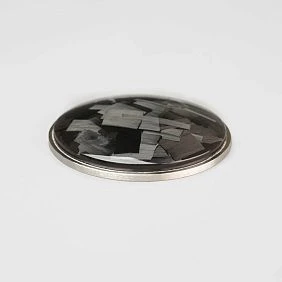

What is a recessed furniture handle: the essence in a nutshell
First of all, a definition that will put everything in its place. Recessed furniture handle is a type of hardware where a special seat is made under the handle in the body of the facade, door, or end: a recess, routing, groove, or round hole. The handle is installed in this place and recessed into the surface — it does not protrude 30–40 mm like a bracket, and does not overhang the facade like a knob.
The key difference from all other types of furniture hardware is precisely this: the handle is recessed, i.e., integrated into the body of the panel. Externally, the facade looks monolithic, without hanging elements. Fingers enter the recess, grip the handle from the inside — and the door opens smoothly, without jerks.
This is not just an aesthetic technique. It is a design solution that changes both the way of interacting with furniture and the visual perception of space. A recessed handle does not take up space in front of the facade, does not collect dust on protruding arcs, and does not catch on clothes in a narrow hallway.
It is important to understand that recessed handle is a broader concept. It includes several design varieties: recessed handles with front installation, end handles, round recessed plates, shell handles, profile recessed systems. Each option has its own specifics, its own installation requirements, and its own best application scenarios.




Where recessed handles are used: a complete overview of scenarios
Before choosing a model, it is worth understanding: where exactly does a recessed handle give the maximum result? Where is it indispensable, and where is it just one of the options?
Our factory also produces:
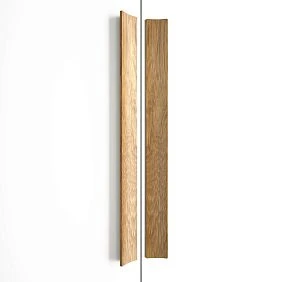
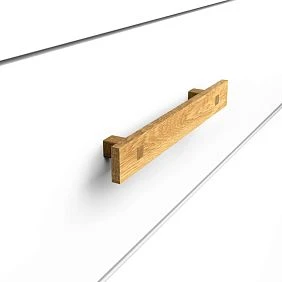
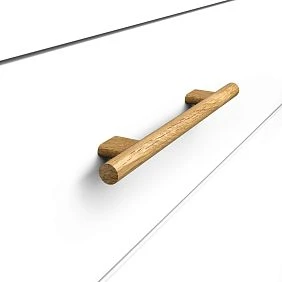
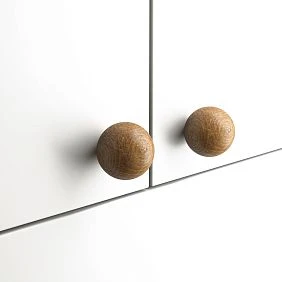
In the kitchen
The kitchen is an environment where furniture hardware operates under constant load. Two hundred openings per day is not an exaggeration for an actively used kitchen. At the same time, kitchen space is often not infinite: narrow passages between the cabinet and the island, tightly spaced sections, doors opening to the sides.
It is here kitchen handle As a recessed element, it shows its best side. It does not obstruct passage, does not catch on clothing, and does not become an obstacle during quick movements. This is especially relevant for lower drawers and corner sections, where a protruding bracket inevitably ends up in constant contact with the body.
For kitchens in minimalist, contemporary, Japanese, and Scandinavian styles, a hidden handle is not a compromise but a conscious choice. Facades without visible hardware create the feeling of a single surface panel, and the recessed integrated handle supports this concept.
Get Consultation
For wardrobes and dressing rooms
Built-in cabinets are another area where the recessed handle reigns. Swinging doors of wardrobes in the bedroom, hallway, and children's room — all are opened daily, and the handle must be comfortable, reliable, and not take up extra space.
For cabinets in a minimalist interior Furniture mortise handle — this is practically the standard. It allows maintaining clean lines without adding decorative elements that may eventually become tiresome or go out of style.
For sliding wardrobes and sliding doors
This is perhaps the main niche for recessed handles — sliding wardrobes and any sliding door systems. Why? Because here, protruding hardware physically interferes. A handle that sticks out from the door plane will catch on the adjacent panel, slow down movement, create scratches, and cause mechanical obstructions.
A recessed handle for a sliding wardrobe is the only type of hardware that works without conflict with the structure. It is recessed into the door plane, does not protrude beyond its edges (or protrudes minimally), and therefore creates no obstacles during movement.
For a chest of drawers, cabinet, and drawer
Small drawers of a chest of drawers or bedside table are another scenario where a flush pull handle can be the optimal solution. Especially if the furniture is in a bedroom or children's room, where soft shapes and the absence of sharp protruding elements, which could be a hazard in case of careless nighttime movement, are important.
For a shallow drawer, a round flush pull handle with a diameter of 40 mm is a compact, functional, and aesthetic solution. Fingers enter the hole from above or below, the drawer opens easily, nothing protrudes, nothing gets in the way.
Flush pull handle in the facade: technique, installation, and nuances
How exactly is the flush pull handle installed in the facade? This question is important not only for craftsmen — everyone who chooses such hardware should understand what they are dealing with.
For a front-type flush pull handle, a rectangular or oval cutout is made in the facade — routing of the required depth and shape. The handle is inserted into this mounting spot and secured from the back side of the facade with fastening elements. The routing depth is usually 12–20 mm depending on the handle model.
It is important to understand: routing weakens the panel body. If the facade is thin — 16 mm MDF or particleboard — there may not be enough material for a deep cutout. Therefore, before purchasing a flush pull handle, always check the facade thickness and the handle's mounting depth: these parameters must be compatible.
Flush pull handle in the edge of the facade
A separate and very interesting variety is a recessed edge handleThis handle is mounted not on the front side of the facade, but on its end edge — most often at the bottom, sometimes on the side. Fingers catch the door from below by pulling on the end groove. This creates a completely different visual effect: the facade looks absolutely "fitting-free" — no protrusions or recesses on the front plane.
End-mounted recessed handles are widely used in minimalist kitchens, where the key idea is maximally clean, uncluttered surfaces. This type is often called a "hidden handle for furniture facades" — and this definition is accurate: there is simply no handle on the front side.
For an end-mounted recessed handle, the geometry of installation is important: the groove must be precisely cut in depth and width so that the hand enters freely but without excessive gap. This requires careful milling and sometimes finishing treatment of the groove with edge material.
Profile recessed handle for facade
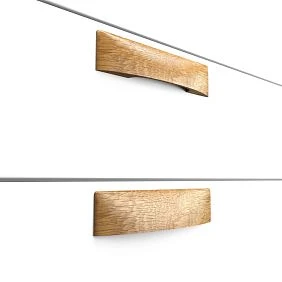
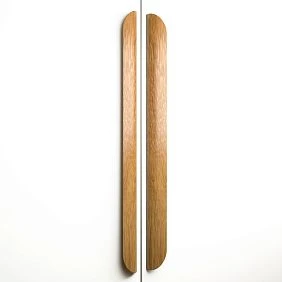
A profile recessed handle for a facade is another design option that deserves separate consideration. Profile Handle in its recessed version, it is an aluminum or wooden profile that is inserted into a groove along the entire length or part of the length of the facade. Externally, such a handle looks like a horizontal line — thin, clear, geometric.
A recessed profile handle for a kitchen is a classic of modern kitchen sets in high-tech and minimalist styles. It creates a sense of architectural precision: each facade is a rectangular plane with a thin horizontal line at the bottom or top. Nothing extra, only geometry.
Recessed handle for kitchen: clean lines and hidden functionality
A minimalist kitchen is a space where every detail carries meaning. Facades without handles, facades with integrated handles, facades with end cutouts — all these solutions are united by one idea: nothing extra on the surface.
A hidden handle for a kitchen does not just "hide" — it becomes part of the facade's architecture. Fingers enter the recess, the hand feels the dense texture of wood or metal from inside, the door opens with a precise movement. This is a fundamentally different tactile experience compared to a bracket or button.
For kitchen facades made of MDF, veneer, acrylic, and laminated chipboard, inset handles are used differently. On MDF facades, routing is done precisely and cleanly — this material holds the groove shape well. On veneered panels, it is important to consider the grain direction to prevent routing from creating chips on the visible surface.
An inset handle on a natural wood kitchen is not just a technical element, but part of the concept. A wooden handle, cut from the same solid wood as the facade, creates the feeling of a monolithic object. This is especially valuable in interiors where wood is the main material statement.
For kitchen drawers with pull-out sections — for dishes, groceries, kitchen utensils — an inset handle on the lower end of the facade allows opening the drawer with the toe of a foot or a light touch from below. This solution is used in functional kitchens where hands are often busy.
Buy kitchen handles choosing an inset wooden model for the kitchen means choosing not just hardware, but a concept. A wooden inset handle made of solid oak or ash gives the kitchen a natural warmth that cannot be created with metal or plastic.
Inset handle for wardrobe and sliding doors: technical requirements
Wardrobes and sliding door systems impose strict requirements on furniture hardware. Here, the handle must be inset or as recessed as possible — otherwise, the structure simply will not work.
An inset handle for a wardrobe is not just a nod to aesthetics. It is a structural necessity. The doors of a wardrobe move in parallel planes, overlapping each other. If a protruding handle is installed on one of them, it will immediately come into contact with the adjacent panel — leaving scratches, creating a mechanical obstacle, and under certain conditions, simply blocking movement.
Inset handle for wardrobe of the recessed type radically solves this problem. It is either completely hidden in the plane of the door, or protrudes no more than 5–8 mm — which is enough for fingers but does not create a conflict with the adjacent panel.
Inset handle for sliding doors: formats and features
Several formats of recessed handles are used for sliding doors:
-
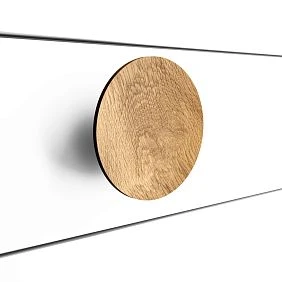
Round recessed handle — installed in a round hole with a diameter of 35–50 mm. Fingers enter from below or above into a semicircular recess. Compact, reliable, suitable for light and medium-weight doors.
-
Rectangular recessed handle — mounted in a rectangular cutout. Provides a more secure grip across the entire width of the palm. Suitable for heavy door panels.
-
End groove handle — milled into the lower or side edge of the door. Fully concealed installation, minimal protrusion.
When choosing a handle for sliding doors, special attention should be paid to the depth of the cutout and the material of the door panel. For mirrored or glass doors, standard milling is not possible — here, special recessed elements made of metal or plastic, adapted for glass, are used.
Round recessed handle: compactness and versatility
Among all formats of recessed hardware, the round handle holds a special place. Why? Because it combines minimal size with maximum functionality, and at the same time looks geometrically perfect.
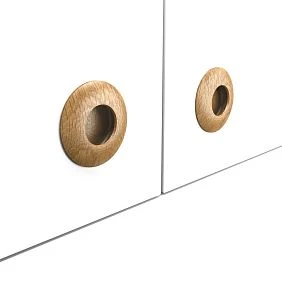
The round recessed handle is installed in a drilled or milled round hole in the facade. Standard diameter — 35, 40, or 50 mm. The handle can be completely recessed into the plane of the panel (then it forms a smooth depression) or have a small rim-ring protruding 5–10 mm above the surface.
A round recessed furniture handle with a diameter of 40 mm is the optimal size for most applications. Such a hole is large enough for three or four fingers to fit in, but not so bulky as to disrupt the proportions of the facade. On a small drawer or wardrobe door, it is exactly what is needed.
A black round recessed furniture handle for a wardrobe is one of the most popular options in modern interiors. The black color combined with a matte surface creates a restrained, confident accent against a light or neutral facade. This works in monochrome interiors, in loft style, in Scandinavian aesthetics with dark accents.
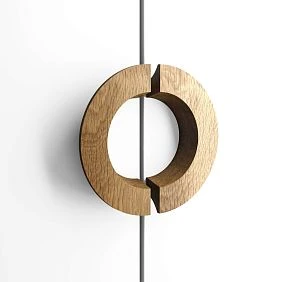
Wooden round recessed handle — a natural alternative option. Made from solid oak or ash with a ring groove for the finger — such a handle is organic in natural interiors, in eco and boho styles, in apartments with exposed wooden structures.
Shell handle: recessed grip with character
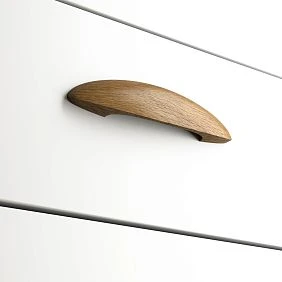
If a round recessed handle is geometric minimalism, then shell handle is organic. Its shape mimics the curve of a shell or sea shell: a concave recess with smooth edges, into which fingers fit naturally and comfortably.
furniture shell handle Shell HL-024 made from solid wood is not just a functional element, but a decorative accent. Rounded edges, natural wood texture, soft silhouette — all this makes it ideal for furniture where tactile softness is important. Children's room, bedroom, reading nook with built-in shelves — anywhere you want to avoid metallic coldness.
The recessed shell handle fundamentally differs from other types of recessed handles in its grip method. If in a round handle or rectangular cutout the fingers enter horizontally or at an angle, the shell handle involves a grip from below: the palm scoops the facade from the recess, as if lifting a box lid. This is an intuitively pleasant gesture that makes opening a drawer or door not just a functional action, but a small pleasure.
Where it is used handle sink?
-
On dresser drawers — a classic scenario. Several shells in a row on drawers of different sizes create a rhythmic pattern.
-
On small doors of a sideboard, credenza, or bookcase with closed sections.
-
In classic and neoclassical interiors, where wooden fittings organically combine with carved elements and natural materials.
-
In boho and eco-interiors — here the "shell" shape is perceived as a reference to natural motifs.
An important nuance: a shell handle also requires routing, but it is less deep than for a classic inset handle. A shallow concave recess — a "bowl" — is routed, into which the handle is installed and fixed. A facade thickness of 18–22 mm is quite sufficient for reliable mounting.
Inset wooden handle: the tactile truth of natural material
Inset handles are made from various materials: metal (aluminum, steel, zinc alloy), plastic, acrylic, glass. But wooden inset handles stand apart in this series.
Wood is a living material. Its texture is unique, each solid wood product is one of a kind. Wooden Furniture mortise handle does not get cold in winter, does not slip with wet hands, does not lose color, and does not develop oxides. With proper care, such a handle lasts for decades and only becomes more beautiful over time — dark patina, polished edges, living texture.
For kitchen furniture made of solid oak, a wooden inset handle from the same species is a cohesive solution. The facade and handle become a single object: one material, one texture, one tone. This is achieved either by selecting a handle from similar wood, or by making the handle as an element of the facade itself — which is especially striking in handmade furniture.
In the catalog on stavros.ru handles without coating solid wood handles are presented in several finish options: without coating (for subsequent treatment to match a specific facade tone), with oil, with wax, with stain. This allows precise matching of the handle's color and tone with the furniture's color.
Solid wood coated handles are another option: they come with a factory finish (oil, varnish, paint) that is ready to use immediately. Handles with Finish convenient when there is no opportunity or desire to perform finishing work yourself.
Flush pull handle Nova HL-028: modern geometry in wood
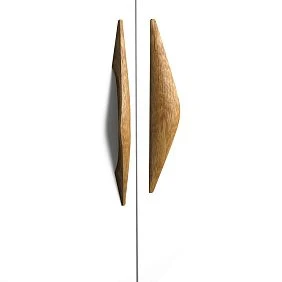
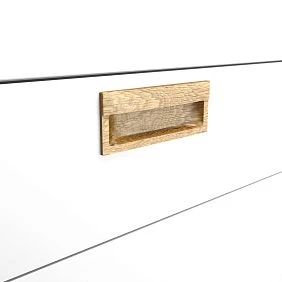
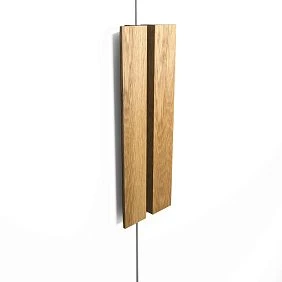
One of the standout models in the line of mortise handles stavros.ru — Furniture handle Nova HL-028. This is a solid wood flush pull handle with clear rectangular geometry: a flat front panel, a deep grip groove at the bottom, precise angles. It is mounted in a rectangular cutout on the front plane of the facade.
What makes it interesting? First of all, its versatility of use. Nova HL-028 looks equally organic on a kitchen facade, a dresser drawer, or a wardrobe door in the bedroom. Its geometry works in modern, Scandinavian, Japanese, and minimalist interiors. At the same time, wood adds warmth that metal counterparts lack.
If you are looking for where buy a flush pull handle for a facade made of natural wood — Nova HL-028 in the stavros.ru catalog — is the exact answer to the request. The handle is made of solid oak, available without coating (for self-finishing to match the facade tone), and comes with the necessary fasteners.
How a flush pull handle differs from a surface-mounted and profile handle: a detailed comparison
The question "which is better — a flush pull, surface-mounted, or profile handle" arises for everyone choosing furniture hardware. There is no definitive answer — there are situations where each type performs best.
Comparison table of handle types
| Handle type | Installation | Protrusion from the facade | Best use case |
|---|---|---|---|
| Recessed | Milling/drilling in the facade | Minimal or zero | Wardrobe, sliding doors, minimalism, narrow passages |
| Overlay | Mounting on top of the facade | Medium (10–20 mm) | Classic, neoclassical, decorative accents |
| Profile | Edge or groove mounting | Small (linear form) | Long facades, minimalism, end mounting |
| bracket | Two holes, bolt fastening | Significant (30–45 mm) | Kitchen, heavy facades, hinged cabinets |
| Button | One hole | Small (15–25 mm) | Light facades, cabinets, decorative accent |
The difference between a recessed and a surface-mounted handle is best explained through an image. A surface-mounted handle is like a painting on a wall: it is attached externally and always visible. A recessed handle is like a bas-relief built into the wall: it is part of the surface, adding nothing on top of it.
Overlay handle Requires minimal preparation — drill one or two holes and screw it on. This is quick and simple. A recessed handle requires precise routing of the appropriate depth and shape. This is technically more complex, but the result is fundamentally different visually.
Choosing between them is not a matter of 'what is better in principle,' but 'what is better in a specific situation.' For a sliding door — definitely a recessed handle. For a classic buffet in the hallway — possibly a surface-mounted handle. For a minimalist kitchen — a recessed or profile handle.
Pros and cons of recessed handles: an honest breakdown
It would be dishonest to only talk about the advantages. Recessed handles also have weaknesses — knowing them will help you make a more balanced decision.
Advantages
No protrusion. The main advantage is obvious. Nothing sticks out from the front. This makes the furniture visually cohesive and a narrow passage free of obstacles.
Clean lines. A front with a recessed handle looks monolithic and geometrically strict. This is an ideal solution for interiors where visual minimalism is valued.
Compatibility with sliding systems. No other design works as organically for sliding wardrobes. A recessed handle is the only correct choice for sliding doors.
Safety. No sharp protruding elements that you could catch your clothes on or hurt a child with.
Durability. A handle recessed into the front is protected from side impacts and accidental damage. It does not loosen from lateral loads, as sometimes happens with knobs and brackets.
Disadvantages
Need for precise installation. Milling requires skill and equipment. A mistake in the size or depth of the groove — and the handle will sit crooked or not fit at all. For DIY installation, you need a router or at least a chisel and a steady hand.
Limitations on front thickness. A thin front (14–16 mm) may not withstand the required depth of cut without risk of through penetration or cracking. Be sure to check compatibility before purchasing.
Less convenient for heavy doors. If a cabinet door weighs 8–10 kg, a small round recessed handle with a diameter of 35 mm will not provide a comfortable grip. For heavy fronts, either a larger recessed handle or a bracket is needed.
Difficulty of replacement. If the mounting spot in the front is already made for a specific handle, replacing it with a handle of a different type or size will be problematic: the groove in the front will remain and will need to be filled.
Grip is not always intuitive. Some users, not accustomed to inset handles, initially do not understand how to properly grasp the facade. This is especially true for edge handles.
How to install an inset handle in a facade: step-by-step instructions
Installing an inset handle is an operation that requires precision. A step-by-step algorithm will help you do everything correctly.
Step one: marking. Determine the exact position of the handle on the facade. Mark the center of the recess with a pencil or painter's tape. For a round handle, mark the center of the hole. For a rectangular one, mark the contour of the groove. For an edge handle, mark a line on the edge of the facade.
Step two: checking the facade thickness. Ensure that the milling depth is compatible with the panel thickness. If the facade is 18 mm MDF and the handle requires a recess depth of 15 mm, only 3 mm of material will remain. This is too little. For thin facades, choose handles with a small mounting depth.
Step three: milling. For rectangular recesses, use a hand router with a straight bit and a guide frame. For round holes, use a Forstner bit of the required diameter. For edge grooves, use a thin disc cutter or a chisel.
Step four: trial installation. Insert the handle into the groove without fastening. Ensure it fits evenly, without distortions, and sits flush with the surface (or with the required protrusion).
Step five: final fastening. Secure the handle with the fasteners from the kit — usually bolts tightened from the back side of the facade. Do not overtighten — excessive force can crack the MDF or deform the wood.
Step six: finishing treatment. If the handle is made of untreated solid wood, apply oil or wax to the groove area to protect the wood ends from moisture.
Is milling necessary for all inset handles? Not always. Some models have a simplified mounting system — they are attached to pre-drilled holes of a standard diameter. Check this detail in the description of the specific model.
Shell handle or inset handle: which to choose for a drawer and cabinet
This question most often arises when you need to choose hardware for a chest of drawers, nightstand, or pull-out drawer. And shell handle, and a classic inset handle are installed into the facade — but they provide a different grip and a different visual effect.
The shell handle is for those who value organic forms. The concave "bowl" accepts fingers smoothly, without sharp edges, with a pleasant tactile sensation. It is slightly more complex in shape, making it a more "artistic" detail on the facade. It works well in interiors with natural motifs, in classic style, in retro style.
The rectangular or profile-type inset handle is for those who choose geometric strictness. Straight lines, clear angles, a sense of architectural precision. This is the choice for minimalism, high-tech, modern interiors without unnecessary decorations.
What to choose for a cabinet without protrusions? If you need a handle for a cabinet without protrusions — both the shell and the rectangular inset handle will provide this effect. The difference lies in the style and the method of grip. Decide on the interior — and the choice will become obvious.
Hidden handles for furniture: integrated systems and modern trends
Fully integrated handles deserve a separate discussion — those where the grip is provided not by an inserted element, but by the design of the facade itself.
The Gola system is a horizontal aluminum profile along the top or bottom edge of the facade, creating a handle without any overlay elements. Technically, this is a borderline case between a profile and an inset handle.
A milled groove in the body of the facade — when the router removes material along the bottom edge, forming a grip directly from the panel body. No additional elements — the handle is part of the facade itself.
These solutions are even more radical than a standard recessed handle. They create a maximally clean surface where there is no hardware as such — only geometry. For kitchens at the "designer object" level, this is currently one of the main trends.
Furniture Handles in the stavros.ru catalog cover the entire range — from protruding brackets to fully recessed models. This allows you to choose a solution for any concept: from a classic kitchen with traditional bracket handles to a minimalist wardrobe with completely hidden hardware.
Common mistakes when choosing and installing a recessed handle
Experience shows: most problems with recessed handles arise not due to the quality of the product, but due to errors at the selection and installation stage. Let's list the main ones.
Buying a handle without checking the facade thickness. The most common mistake. If a recess depth of 18 mm is needed, but the facade has a thickness of 16 mm — nothing good will come of it. Always measure the facade first, then choose the handle.
Not accounting for the depth of the mounting seat. Even with a compatible facade thickness, it is important that after installing the handle, a sufficient layer of material remains for reliable fixation of the fasteners.
Choosing a handle that is too small for a heavy door. A round recessed handle with a diameter of 35 mm on a cabinet door weighing 7–8 kg is inconvenient. For heavy facades, choose models with a wider grip or switch to handle-eyes standard type.
Confusing a recessed handle with an overlay profile handle. A profile handle attached to the surface of the facade with bolts is an overlay handle, not a recessed one. The difference is fundamental: the first requires milling, the second does not. Do not confuse them when ordering.
Not checking if the handle interferes with the sliding door movement. Even a small protrusion of a recessed handle can create a conflict in the compartment system. Before installation, ensure the gap between the doors is sufficient for the handle, considering its actual protrusion.
Choosing a shape only by photo, without understanding the grip. A beautiful handle in the picture may turn out to be uncomfortable in actual use. Pay attention to the angle of finger entry, groove depth, and the presence of rounded edges. Sharp edges inside the groove mean discomfort with every opening.
Ignoring the final treatment of a wooden handle. Untreated wood in the milling area—especially on the ends—quickly absorbs moisture and dirt. Always treat wooden recessed handles with oil or wax, paying special attention to the internal surfaces of the groove.
Recessed handles in the context of a complete interior: a designer's perspective
An interior is a system. Every element in it influences the perception of others. And Recessed furniture handle is no exception. It sets the tone not only for the furniture facade but also for the entire space in which that facade exists.
In small apartments with limited square footage, recessed handles work to expand the space. Fewer protrusions mean more of a feeling of free air. A kitchen with recessed end handles seems more spacious, a hallway with a wardrobe without protruding hardware feels less cluttered.
In spacious apartments and houses with high ceilings, recessed handles can be an element of stylistic design—part of the concept of "clean" architectural furniture. When a floor-to-ceiling cabinet has no visible handles, it is perceived as part of the wall, as an architectural element, not as a piece of furniture.
For children's rooms, recessed handles are especially relevant from a safety perspective. No protruding elements, no sharp edges at a child's head level. A wooden round recessed handle on a drawer—warm, soft, safe.
Materials and coatings of recessed handles: what to choose
Recessed handles are made from several materials, each with its own area of application:
Solid wood — oak, ash, walnut, beech, birch. Warm, natural, pleasant to the touch. Optimal for kitchen furniture made of wood and veneer, for eco-friendly interiors, for classic and Scandinavian styles. handles without coating allow you to independently choose a color to match the furniture tone.
Aluminum — lightweight, corrosion-resistant, modern. Anodized aluminum in matte black, silver, or gold is the standard for high-tech and contemporary kitchens.
Zinc alloy — durable, easy to cast, available in various coatings (chrome, nickel, bronze). Used in classic and decorative solutions.
Stainless steel — maximum strength, resistance to moisture and aggressive environments. Ideal for kitchen and bathroom.
Coatings affect not only appearance but also practicality. Matte coatings hide fingerprints — relevant for the kitchen. Chrome shiny ones require more frequent care, but give a feeling of expensive finish.
FAQ: answers to popular questions about recessed handles
What is a recessed handle for furniture?
This is a type of furniture fitting that is installed into a pre-prepared mounting spot — a milled groove, round hole, or end cutout in the facade. Inset handle minimally protrudes or does not protrude at all, providing a clean, minimalist look for furniture.
Where is the best place to use inset handles?
They are used on kitchen fronts, sliding wardrobes, sliding doors, chests of drawers, cabinets, and pull-out drawers. They are especially indispensable for sliding door systems, where protruding hardware physically obstructs the movement of the panels.
How is an inset handle different from a surface-mounted handle?
An inset handle requires preparation of the front (routing) and is installed inside the surface. Overlay handle is mounted on the surface of the front with bolts or screws, without routing. Installation of a surface-mounted handle is simpler, but it creates a larger protrusion.
Is an inset handle suitable for a sliding wardrobe?
Yes, and this is one of the best scenarios for its use. An inset handle for a sliding wardrobe does not interfere with the movement of the panels, does not scratch adjacent panels, and creates a clean appearance. For sliding systems, this is the optimal solution.
Which is better: an inset handle or a profile handle?
If a recessed grip is needed on a small section of the front, an inset handle is better. If a long horizontal line is needed on the edge or rim of the front across its entire width — Profile Handle preferable.
Is milling required for all inset handles?
Not for all. Some models with simplified installation are mounted in standard diameter round holes drilled with a regular Forstner bit. Rectangular and profiled inset handles require milling. Check the description of the specific model.
How to choose the size of an inset handle?
Focus on the size of the facade and the weight of the door. For lightweight drawers — a round handle with a diameter of 35–40 mm. For medium doors — a rectangular cutout with a width of 60–100 mm. For heavy doors — a wider groove or switching to a different type of handle.
Where to buy an inset handle made of natural wood?
The catalog on stavros.ru presents Inset handles made of solid wood — models Nova HL-028, Shell HL-024 and others. Here you can buy an inset handle with precise dimensions, confirmed manufacturing quality, and the ability to match a specific facade tone.
Are a shell handle and an inset handle the same thing?
The sink handle is a type of recessed handle. Shell Handle It is installed in a milled concave recess in the facade and provides a grip from below. The difference lies in the shape (an organic "bowl" instead of a rectangular groove) and in the method of gripping.