Article Contents:
- Why you should buy MLD-005 or MLD-010
- What is a quarter-round wooden molding
- What is this profile used for
- Why cross-section matters more than a photo
- How a ready-made molding is better than a random batten
- Why 9 mm is more noticeable than it seems
- Why you can't choose only by catalog photo
- Small furniture facade
- Double frame
- Mirror framing
- Furniture edge and transition
- Small wall frame
- Complex composition with multiple profiles
- Large wall panel
- Tall furniture doors
- Wide framing of panel or mirror
- Architectural strip under the ceiling
- Commercial interior
- One profile instead of several thin ones
- Look at the free field
- Match it with the front frame width
- Check several doors next to each other
- Consider the handles
- Compare both models on a real object
- One large frame
- Series of narrow frames
- Baseboard with lower panel
- Frame around wallpaper or decorative plaster
- Niche
- Horizontal line under the ceiling
- Direct abutment into the corner
- Ceiling panel design
- Room with a low ceiling
- High hallway
- Oak
- Oak
- MDF
- How to connect material to the base
- Why material affects angles
- Opaque enamel
- Toning
- Same color as furniture
- Contrasting Finishing
- Clear protective finish
- Finish before installation
- Finishing after installation
- Combined scheme
- Living Room
- Bedroom
- Kitchen
- Entry Hall
- Office
- Children's room
- Walk-in closet
- Hotel and restaurant
- Showroom and boutique
- Need to decorate the dresser front
- Need to frame the cabinet
- Need to make wall frames
- Need to design a mirror
- Need to close the decorative junction
- Need to tie furniture and interior together
- Need to design a column or pilaster
- Need to replace old molding
- First calculate the net length
- Distribute the length across planks
- Avoid short inserts
- Add a margin
- Consider the pattern direction
- Create a cutting map
- 45-degree bevel cut
- Inside corner
- External corner
- Joining along the length
- Can I cut it myself
- Construction Adhesive
- Primer
- Enamel, tinting or clear coating
- Painter's tape and marking
- Baseboard, cornice, and casing
- Additional molding of a different cross-section
- Quarter-round and half-round profile
- Molding and wooden corner
- Molding and glazing bead
- Molding and floor threshold
- Molding and cornice
- Molding and plastic profile
- Considering a 9 mm difference insignificant
- Buying based on a single large photo
- Not accounting for material length
- Mixing materials in one line without reason
- Ordering without a cutting map
- Not checking the profile direction
- Trying to bend a straight plank
- Using a weak base
- Choosing the finish after installation
- Save on trial coal
- Use molding as a structural part without calculation
- Owner of compact furniture
- Designer of complex wall grid
- Craftsman connecting multiple profiles
- Buyer who needs a delicate contour
- Owner of a large panel or tall furniture
- Commercial interior
- Project with one main frame
- High room
- Need a very thin furniture trim
- Need a carved ornament
- Need to cover a large ceiling joint
- Need a flexible radius
- The base is constantly getting wet or heating up
- Check the evenness
- Remove weak coatings
- Lay out the profile dry
- Sign the elements
- Align the mounting system
- Dust on the arc
- Wet Cleaning
- Repair of joints
- Protection of external corners
- Make two strips
- Show the full outline
- Evaluate from three distances
- Add the future color
- Check the light
- Compare the cost not by one plank, but by the project
- Check the model and cross-section
- Check the length
- Inspect the face arc
- Check the straightness
- Assemble a test corner
- Keep a level support
- Do not move directly from cold to finishing
- Separate materials and projects
- Protect the face surface
- The line must be continuous
- The corners must match along the arc
- The frames must have equal margins
- The finish must not hide the geometry
- Functional elements must work freely
- How is MLD-005 different from MLD-010?
- Which profile to choose for a small furniture facade?
- Which molding is best for a large wall panel?
- Is MLD-005 suitable for a mirror frame?
- Where to use MLD-010?
- What is the length of the moldings?
- Are MLD-005 and MLD-010 available in MDF?
- What to choose for enamel?
- Which material to choose for tinting?
- Can I use quarter-round molding at the ceiling?
- How to calculate the quantity?
- What margin should be added?
- Can I cut the profile at 45 degrees?
- Should I paint the molding before or after installation?
- What glue is needed?
- Can I combine MLD-005 and MLD-010?
- Is the profile suitable for the kitchen?
- Can I bend the molding along a radius?
- How not to confuse quarter-round profile with half-round?
- Where to buy MLD-005 and MLD-010?
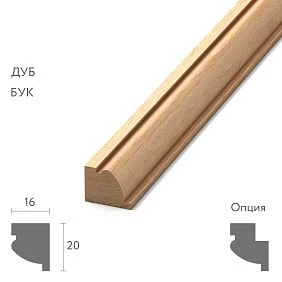
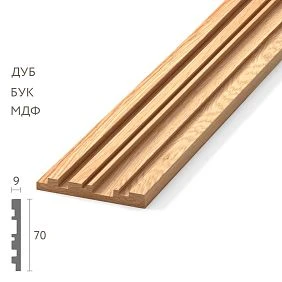
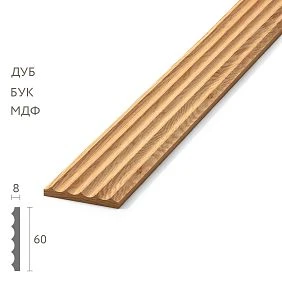
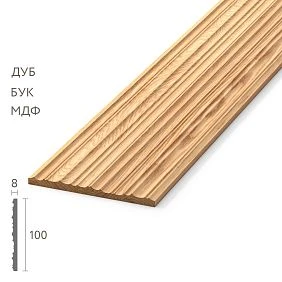
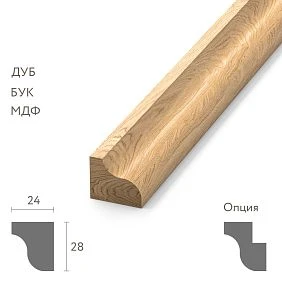
Why you should buy MLD-005 or MLD-010
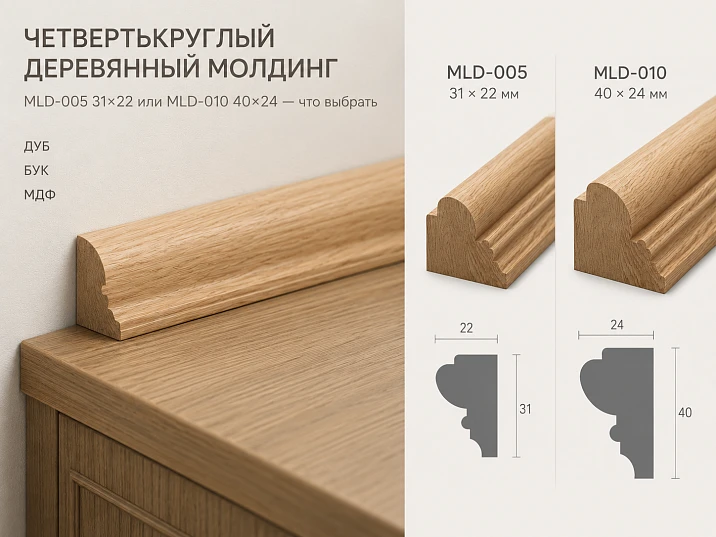
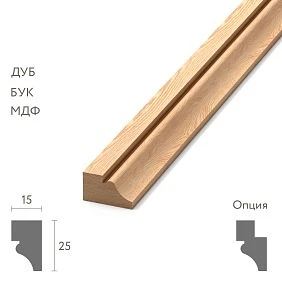
Both profiles have a calm quarter-round cross-section, but solve different tasks. MLD-005, sized 31 × 22 mm, creates a more compact line and fits more easily into furniture facades, small frames, or narrow panels. MLD-010, sized 40 × 24 mm, is 9 mm wider and more noticeable in the interior, making it better suited for large wall panels, wide trims, and architectural transitions.
Short answer: MLD-005 is worth buying for compact furniture fronts, small frames, and areas where the profile needs to remain neat. MLD-010 is chosen for large panels, wide trims, and a more prominent architectural line. Before ordering, check the surface scale, material, finish, length of each strip, and total footage with a margin.
Buy quarter-round wooden molding makes sense after checking not only the length of the wall or facade, but also the scale of the cross-section itself. The difference between 31 and 40 mm seems small on a drawing, but on furniture and wall panels, the extra nine millimeters change the line width, shadow depth, and the profile's relationship to the surrounding plane.
MLD-005 and MLD-010 belong to the same clear geometric group. Their front part forms a smooth convex arc, and the two mounting planes allow the profile to be used as a decorative junction, frame, or transition between surfaces. The buyer chooses not a "beautiful molding in general," but a specific proportion: more subdued or more architectural.
Both models are suitable for furniture and interior finishing. They can be used on facades of dressers and cabinets, wall panels, wainscoting, niches, mirror and decorative frames, and with a properly designed joint, on the upper part of a wall or in the ceiling transition area. But one profile does not become universal just because it has a simple shape. A too-wide molding weighs down a small facade, while a too-narrow one gets lost on a large wall.




What is a quarter-round wooden molding
A quarter-round profile is a trim strip with a convex arc that resembles a quarter of a circle. Unlike a flat batten, it creates soft volume and directional shadow. Unlike a complex carved molding, it does not impose a specific ornament and therefore pairs more easily with modern, classic, and transitional furniture.
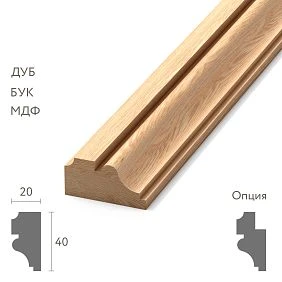
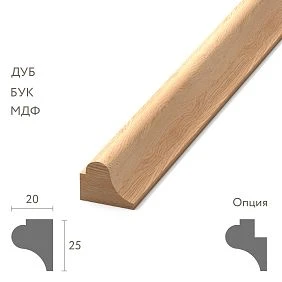
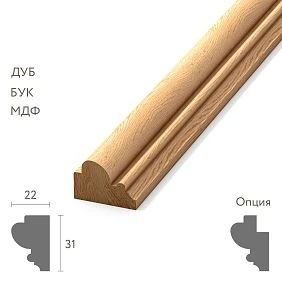
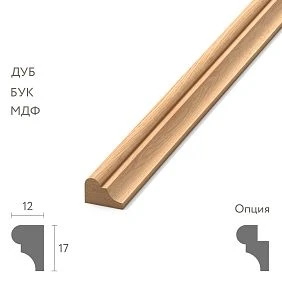
Our factory also produces:
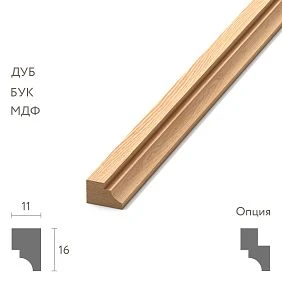
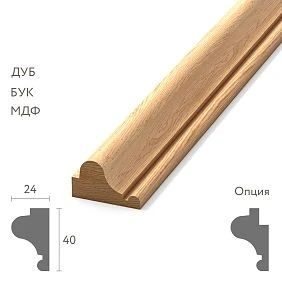
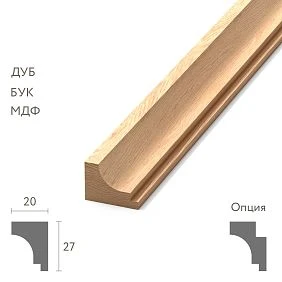
What is this profile used for
On furniture, it can frame the front, emphasize the edge of a panel, separate the central plane from the frame, or cover a decorative joint. On a wall, it forms a frame, horizontal strip, or panel border. In a niche, it helps soften a direct transition. At the ceiling, it creates a calmer line than a large cornice.
Get Consultation
Why the cross-section matters more than a photo
A photo shows the overall appearance but does not explain how much the profile protrudes above the surface. MLD-005 measures 31 × 22 mm, MLD-010 measures 40 × 24 mm. The first number creates a more noticeable difference than the second: the MLD-010 profile is 9 mm taller, and on the second side, 2 mm taller. Therefore, it is not just "slightly larger" but visually forms a wider arc.
Why a ready-made molding is better than a random batten
It is difficult to independently achieve an identical quarter-round radius on several strips. Errors become noticeable at joints and corners. A ready-made profile is more convenient for repeated frames, serial furniture, and long interior lines where each strip must continue the next.
Confirmed specifications of MLD-005 and MLD-010
| Parameter | MLD-005 | MLD-010 | Practical conclusion |
|---|---|---|---|
| Cross-section | 31 × 22 mm | 40 × 24 mm | MLD-005 is more compact, MLD-010 forms a wider line |
| Shape | Quarter-round profile | Quarter-round profile | The choice is determined by scale, not by difference in ornament |
| Materials | MDF, beech, oak | MDF, beech, oak | You can choose covering or wood-based finishing logic |
| MDF length | 2600 мм | 2600 мм | Convenient for calculating long walls and large panels |
| Length of beech and oak | 2400 мм | 2400 мм | Joints and corner cuts need to be laid out in advance |
| Sanding | Prestige | Prestige | Surface is prepared for subsequent finishing according to the selected system |
| Preparation | For enamel or tinting — depending on the material | For enamel or tinting — depending on the material | Finish must be determined before ordering |
| Checkout | Cart and quick order | Cart and quick order | Current price and availability are checked in the product cards |
Both model cards currently show MDF, beech, and oak. MDF has a length of 2600 mm, solid options — 2400 mm. Options for preparation for enamel and for tinting depend on the selected material, so before checkout you need to activate the desired configuration and check the card.
MLD-005 and MLD-010: main difference
The main fork is not between a "weak" and a "strong" profile, but between two scales of the same shape. MLD-005 is not a miniature slat: the cross-section of 31 × 22 mm already creates a noticeable volume. But next to MLD-010 measuring 40 × 24 mm, it is perceived as calmer, lighter, and closer to furniture detailing.
| Criterion | MLD-005 31 × 22 mm | MLD-010 40 × 24 mm |
|---|---|---|
| Visual effect | Compact smooth line | Wider architectural arc |
| Small furniture | Fits in without clutter | May take up too much facade space |
| Large dresser or cabinet | Suitable for inner frames and secondary lines | Reads well along the perimeter of a large panel |
| Wall panel | Creates a delicate frame | More noticeable on a large area |
| Ceiling area | Suitable for a thin line or small room | Forms a more confident transition |
| Mirror or panel frame | Convenient for a small object | Suitable for a large frame and wide surrounding field |
| Main choice | Delicate design | Pronounced volume |
Why 9 mm is more noticeable than it seems
The profile width is perceived relative to the surface being decorated. On a facade 400 mm wide, the difference between 31 and 40 mm occupies a noticeable part of the field. On a wall several meters long, it seems smaller, but MLD-010 gives a deeper shadow and more confidently connects large panels.
Why you cannot choose only based on the catalog photo
The card shows a close-up profile. In a real room, it will be located next to handles, doors, baseboards, cornices, and furniture. Before ordering, it is useful to cut two paper strips 31 and 40 mm wide, apply them to the facade or wall, and look from a normal distance.
When to choose MLD-005 size 31 × 22 mm
Small furniture facade
On the door of a bedside table, compact dresser, or upper cabinet, the profile should leave enough internal space. MLD-005 forms a volumetric frame but does not eat up most of the facade. This is especially important if there is already a panel, handle, or decorative insert inside.
Double frame
If two lines of molding are planned on the wall or furniture, a compact cross-section gives more freedom. Air remains between the outer and inner frame. With MLD-010, a double scheme requires a significantly larger surface.
Mirror framing
For a small mirror, the 31 × 22 mm profile creates a neat border and does not reduce the reflective area. On a narrow frame, MLD-010 may look too heavy. Before choosing, consider not only the size of the mirror but also the width of the base to which the molding is attached.
Furniture edge and transition
MLD-005 is suitable for areas where you need to soften the transition between two planes or emphasize an edge. The quarter-round arc looks softer than a rectangular strip and does not create a sharp protrusion. However, the profile remains decorative: it does not replace a structural edge if protection or reinforcement is required.
Small wall frame
In a hallway, bedroom, or study with limited wall width, a compact line maintains proportions. MLD-005 can be used around a single panel, photograph, mirror, or a local section of boiserie.
Complex composition with multiple profiles
If there is already a wide baseboard, casing, and cornice nearby, MLD-005 plays a subordinate role. It connects elements but does not compete with them. For such a task, you can look at MLD-005 in beech or oak and choose a material to match the overall finish.
When you need MLD-010 size 40 × 24 mm
Large wall panel
On a wide wall, a thin profile can sometimes get lost. MLD-010 creates a more noticeable frame that is visible from a distance. It is suitable for a living room, hall, study, and commercial space where the decorative line should support the scale of the room.
Tall furniture doors
On a cabinet two meters high or more, a 40 × 24 mm profile may look more appropriate. It does not disappear on a long vertical line and helps assemble a large door into a finished facade. In this case, you need to check the distance to the handle, hinges, and edge.
Wide framing for panels or mirrors
A large object requires a more confident border. MLD-010 forms a rounded line that reads as an independent part of the frame. On a massive mirror or large panel, MLD-005 may look too cautious.
Architectural strip under the ceiling
The 40 × 24 mm profile is more visible at the top of the wall. It creates a shadow and completes the panel. However, using it as a full ceiling cornice is only possible after checking the assembly: molding and cornice have different functions and fit.
Commercial interior
In a boutique, hotel, restaurant, or salon, the decorative line is perceived from a greater distance. MLD-010 helps maintain expressiveness. For a small office, the same width may be excessive.
One profile instead of several thin ones
Sometimes a single wide quarter-round line looks neater than a combination of two or three narrow strips. This reduces the number of joints and simplifies finishing. For such a solution, you can choose a large wooden profile MLD-010 and check the material in the product card.
How to choose a profile for the size of a furniture front
Look at the free field
After installing the frame, there should be enough space left inside. If the molding is too close to the handle, panel, or edge, the facade looks cramped. The smaller the door, the more careful you need to be with MLD-010.
Match with the width of the facade frame
On a framed facade, the new molding should not accidentally duplicate the existing geometry. If the standard frame is already wide, it is better to use the quarter-round profile inside it or choose a more compact option.
Check several doors next to each other
On a cabinet, every line repeats. A profile that looks good on one door can create a pattern that is too frequent in a series of four doors. The paper mockup should be placed on several facades at once.
Consider the handles
The hand should not touch the protruding arc. For a pull handle, leave a free zone. For a knob, check that it does not blend with the frame. A hidden handle profile also requires precise distance.
Compare both models on the actual item
Instead of choosing by numbers, apply the 31 and 40 mm strips to the furniture. If both options are not suitable, it is better buy decorative wooden moldings of a different cross-section, rather than trying to adapt an unsuitable profile.
Which molding to choose for a wall frame
A wall frame does not work on its own, but within a specific wall section. On a narrow area between a door and a corner, MLD-005 often maintains lightness. On a wide living room wall, MLD-010 reads better from a distance. In both cases, distances from the floor, ceiling, trim, and adjacent frames are important.
One large frame
If a wall is decorated with one large rectangular frame, a 40 × 24 mm profile can emphasize the perimeter more confidently. MLD-005 is suitable when there is a bright panel, mirror, or textile inside and the molding should remain a background.
Series of narrow frames
On a wall with several vertical sections, a wide line repeats many times. MLD-010 can make the grid heavy, especially in a small room. MLD-005 allows more space between frames and does not reduce the wall sections.
Boiserie with a lower panel
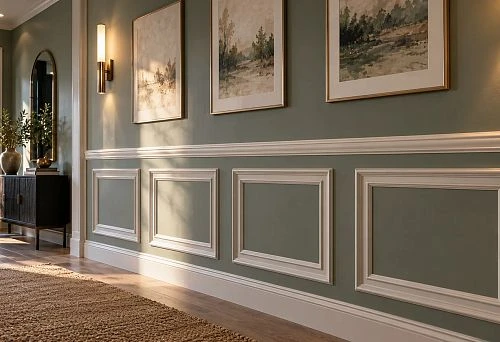
In boiserie, the profile can be used as a top border, inner framing, or transition between panels. MLD-010 is suitable for the main line, MLD-005 for inner frames. Combining two sizes is possible if one profile is clearly dominant and the other is subordinate.
Frame around wallpaper or decorative plaster
A quarter-round arc creates a neat edge and shadow. If the insert has an active pattern, MLD-005 usually does not conflict with it. For a solid panel, you can choose MLD-010 to make the framing more prominent.
Niche
Inside a niche, the profile size depends on the depth. In a shallow niche, a wide MLD-010 may take up too much of the face plane. In a large architectural niche, it helps define the outline and connect it to the baseboard and cornice.
Will a quarter-round profile work for the ceiling
MLD-005 and MLD-010 can be used at the top of the wall, but they cannot automatically be considered full ceiling cornices. A cornice is designed for a specific wall-to-ceiling junction, while a molding can be installed on a wall, ceiling, panel, or prepared frame. Before ordering, the exact joint must be determined.
Horizontal line under the ceiling
The molding can be placed on the wall at a small distance from the ceiling. Such a line completes the panel and creates a shadow. MLD-005 looks lighter and suits a room with a low ceiling. MLD-010 forms a more noticeable architectural strip.
Direct corner joint
The quarter-round shape can soften the corner, but the mounting planes and actual orientation of the profile must match the wall and ceiling. You cannot choose a model based solely on the cross-section name. First, study the drawing and make a test piece.
Ceiling panel design
On a coffer, decorative insert, or wooden ceiling panel, the profile acts as a frame. Here, MLD-005 suits small sections, while MLD-010 suits large rectangles and wide fields.
Room with a low ceiling
A horizontal strip that is too wide can visually lower the top border. MLD-005 is safer if the task is only to neatly finish the wall. MLD-010 should be chosen after layout and evaluation at eye level.
High hallway
In a room with high ceilings, a thin profile can disappear. MLD-010 creates a more confident shadow and supports the scale. But for a real ceiling cornice, it is better to compare the molding with other types of trim.
If the project includes not only molding but also baseboard, cornice, casing, or slats, it is useful to select wooden trim for furniture and interior in one system of sizes and finishes.
Oak, beech, or MDF
Oak
Oak is chosen when the texture should remain visible. The pores and wood grain are well readable on the convex curve. Under a transparent tint, MLD-005 looks more delicate, MLD-010 shows more surface and therefore emphasizes the material more strongly.
Beech
Beech has a calmer pattern. It suits furniture and interior lines where form is more important than active texture. In the product cards, beech is presented as a solid option with a length of 2400 mm. Depending on the selected configuration, the profile can be prepared for enamel coating.
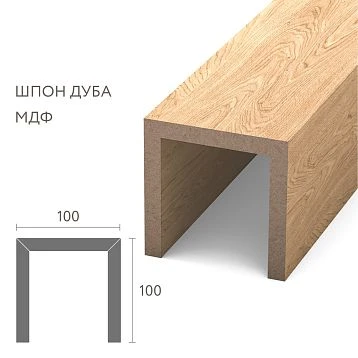
MDF (740–760 kg/m³, emission class E1/E0) provides ideal geometry, uniformity, and better base for enamel: high adhesion, smooth surface, absence of knots and cracks.
MDF is rational for even, covering finishes. It is available in a length of 2600 mm, which reduces the number of joints on a long wall. The material is not chosen for its wood grain: its advantage is revealed under enamel when a uniform color with the wall or furniture is needed.
How to connect the material to the base
A wooden facade does not require choosing the same species if everything is painted with an opaque finish. For a transparent finish, matching oak, beech, and adjacent details is more important. MDF works well on painted wall panels, but it cannot be passed off as solid wood in a project with an open texture.
Why the material affects the corners
Solid wood and MDF react differently to processing and finishing. When cutting at a 45-degree angle, the edge must remain clean, and the wood grain must continue logically. A test cut helps select the tool and mode.
For enamel or for tinting
Opaque enamel
Enamel unifies the profile with the wall, facade, or panel. A white molding creates an architectural shadow but does not add a separate wood color. A dark or colored profile can become a graphic frame. MLD-010 under contrasting enamel looks more active due to its greater width.
Staining
Tinting preserves the texture and changes the shade. On oak, it emphasizes the pores; on beech, it gives a calmer pattern. Before finishing the entire length, a test sample is needed: the color on a convex profile is perceived differently than on a flat board.
Same color as the furniture
If the molding is painted together with the facade, you need to decide in advance whether to install it before or after finishing. Joint painting makes the seam visually seamless but requires careful preparation of corners and joints.
Contrast finish
A contrasting profile emphasizes the frame and every geometry error. MLD-005 is suitable for a thin dark line on a light facade. MLD-010 creates a stronger outline and requires more free space.
Transparent protective finish
If the natural color is preserved, the surface must be protected with a system compatible with oak or beech and room conditions. In the kitchen, hallway, and commercial interior, the cleaning regime is more intensive than in the bedroom.
Paint the molding before or after installation
Finishing before installation
Suitable for contrasting color and transparent tinting. Strips are easier to process on all sides, and the wall or furniture does not get dirty. But after cutting the corners, fresh ends are exposed that need to be finished and touched up.
Finishing after installation
Convenient for a uniform color with the wall or facade. Joints can be filled and painted together. The risk is flooding thin lines, leaving drips in the lower part of the arch, or staining adjacent material.
Combined scheme
The profile is primed in advance, installed, corners are finished, and the final coat is applied after installation. This approach requires compatibility of primer, adhesive, putty, and enamel.
To prepare the project, you can purchase materials for installing and finishing moldings, but the exact composition of the system is chosen based on the profile material, base, and selected coating.
Where to use a quarter-round molding
Living room
On living room walls, the profile can form large rectangular frames, frame a mirror, or finish a panel behind the sofa. MLD-005 suits a room with a lot of furniture and decor, where a new line should remain calm. MLD-010 is more appropriate on a free wall, in a tall room, or on a wide panel visible from afar.
If the molding runs near a TV, check that the shadow does not create an extra frame around the screen. On a wall with a fireplace or console, it is better to align the profile with the axis of the main object rather than the entire room.
Bedroom
Behind the headboard, several vertical frames are often used. MLD-005 leaves more air between them and pairs more easily with soft upholstery. MLD-010 suits a single large frame or wide panel if the headboard is massive and the tall wall requires a more confident line.
On bedside table fronts, a 31 × 22 mm profile usually looks neater. The 40 × 24 mm model should be checked on a mockup: it may take up too much of a small door.
Kitchen
On kitchen fronts, a quarter-round profile can create a frame, highlight an island, or decorate a side panel. Handles, opening of adjacent doors, and regular cleaning must be considered. MLD-005 suits upper cabinets and small fronts. MLD-010 works better on columns, island sides, and large panels.
Near the sink and stove, the finish must match the room conditions. Wood and MDF cannot be chosen without considering moisture, temperature, and coating system. The profile does not replace edge protection technology.
Hallway
In a narrow space, a large protrusion can easily catch on a bag or clothing. MLD-005 is safer for small wall frames and shoe cabinet fronts. MLD-010 can be used on the upper part of a wall or a wide panel that is not in an active walkway.
Cabinet
On library cabinets and panels, MLD-010 creates an expressive architectural line. If the fronts are divided into many sections, MLD-005 helps avoid an overloaded grid. Under a transparent finish, the oak profile can be tied to the table and bookshelves.
Children's room
In a children's room, it is better to avoid protruding lines at active movement level. The quarter-round shape is softer than a right angle, but the profile still protrudes above the surface. MLD-005 is suitable for high-mounted frames or furniture where the child does not catch on the decor.
Wardrobe
On tall doors, the profile helps assemble the front. For narrow doors, choose MLD-005; for wide ones, MLD-010. If there are many doors, first make a mockup of the entire wardrobe wall, since repeating a wide profile enhances the pattern.
Hotel and restaurant
A commercial interior is perceived from a greater distance and requires repeatability. MLD-010 works well on large panels, posts, and door frames. MLD-005 is convenient for serial furniture fronts and a more frequent grid of frames. Before a mass order, make one test section.
Showroom and boutique
The profile can frame mirrors, panels, and product niches. MLD-010 creates a noticeable contour around a large display window. MLD-005 is suitable for small stands and furniture where the main focus should remain on the products.
Practical choice for different tasks
Need to design a dresser front
Measure the width and height of each door or drawer. Mark the handle and leave a free field. On compact furniture, start with the MLD-005 layout. If the facade is wide and simple, compare with MLD-010. Do not transfer the profile across the joint between drawers without a deliberate scheme: the pattern will break apart when opened.
Need to frame the cabinet
On tall doors, vertical proportion is important. MLD-010 reads more confidently, but on four or more doors it can create a too frequent massive pattern. MLD-005 is suitable for inner frames and repeating doors.
Need to make wall frames
Draw a grid of the entire wall. First set the offsets from the baseboard, ceiling, and trim, then choose the section. For a series of narrow frames, MLD-005 is suitable. For one large panel, MLD-010. The profile should not compensate for a poorly thought-out grid.
Need to design a mirror
Check the width of the mounting base and the usable reflection area. MLD-005 is suitable for a small mirror in the hallway or bedroom. MLD-010 for a large mirror in the dressing room, living room, or hotel. The mirror and molding attachment are calculated separately.
Need to cover the decorative junction
A quarter-round shape can soften the transition, but should not hide a movable or technically incorrect joint. The base must be stable. If the junction works structurally, a profile and fastening designed for this task are needed.
Need to connect furniture and interior
The same MLD-005 can be repeated on the facade and a small wall frame. MLD-010 is suitable for repetition on a large panel and door framing. The material and finish must match or intentionally contrast.
Need to design a column or pilaster
The profile is used as a vertical edge or transition between planes. On a narrow structure, MLD-005 maintains proportions. On a wide column, MLD-010 reads better. Curved surfaces require a separate technology: straight linear molding cannot simply be bent without checking.
Need to replace the old molding
First, measure not only the face width but also the mounting surfaces. The new profile must cover traces of the old fastening and fit into existing corners. MLD-005 and MLD-010 cannot be considered interchangeable just because of similar shape.
How to calculate required quantity
First, calculate the net length
For a straight line, add the lengths of all sections. For a rectangular frame, double the sum of width and height. For several identical frames, multiply the result by their number. Convert all dimensions to one unit.
Break down the length into planks
MDF in active cards has a length of 2600 mm, beech and oak — 2400 mm. Plan which plank each side of the frame is cut from. Simply dividing the total footage by the product length does not account for waste after corner cuts.
Avoid short inserts
On a noticeable straight line, it is better to use a single plank or place the joint in a logical spot. A short filler near a corner is conspicuous. Sometimes it is more rational to order an extra plank than to save at the cost of random connections.
Add a margin
A reserve is needed for cuts, wood grain matching, possible cutting defects, and repairs. Its size depends on the number of corners and layout complexity. For simple straight lines, the reserve is smaller; for many frames and corners, it is larger. Do not fix a percentage without a cutting diagram.
Consider the direction of the grain
On oak, adjacent planks may differ in texture. For a frame, it is better to pre-select the sides. Sometimes part of the material remains technically usable but is not visually suitable for a specific area.
Create a cutting map
Record the length of each element and the number of the plank from which it is cut. Such a map is useful for a series of identical facades and a commercial project. It shows the actual need before ordering.
How to finish internal and external corners
45-degree miter cut
For a rectangular frame, the profile is usually joined with a miter. Precision is critical: the quarter-round arc must continue without a step. A test cut on a short piece helps check the tool and orientation.
Inner corner
In a niche or abutment, two planks converge inward. A cutting error creates a gap in the most visible part of the arc. The base must be level, otherwise the profile will repeat the misalignment.
External corner
A protruding corner is vulnerable to impacts. MLD-010 has a more noticeable arc and requires particularly careful joining. If the corner is in a walkway, the operational risk must be assessed.
Lengthwise joining
A straight transverse joint may be noticeable. An angled joint increases the contact area and helps hide the line, but requires precise grain matching and final finishing.
Can you cut it yourself
Yes, if you have the right tool, support, and experience working with the material. Poor fixation leads to chipping and incorrect angles. For large volumes, it is more cost-effective to first make a reference sample or entrust the cutting to a workshop.
What to buy together with MLD-005 or MLD-010
Molding is rarely the only purchase. A finished frame requires glue, materials for preparation and finishing, marking tools, and sometimes adjacent types of trim. It is better to plan the set before placing an order, so as not to select finishing and installation compounds after cutting.
Construction adhesive
The composition is chosen based on the material of the profile and the base. MDF, unfinished solid wood, painted facade, plaster, and wall panels require different preparation. The glue must hold the strip along its entire length and not damage the finish.
Primer
Primer is needed under covering enamel and to level absorption. On a quarter-round surface, too thick a layer can smooth out the line. The primer system must be compatible with the glue and paint.
Enamel, tinting, or clear coating
The finish is chosen together with the material. MDF is logical to use under enamel, oak under tinting or a clear protective layer, beech suits both logics depending on the configuration. The color is tested on a sample.
Painter's tape and marking
For frames, equal offsets and right angles are important. Tape helps temporarily show a line on the wall, and a laser level or template helps repeat it on several sections.
Baseboard, cornice, and casing
If the molding is to continue the overall architecture, it is compared with adjacent profiles. The width and shape do not have to match literally, but must have a clear hierarchy. For this, it is convenient to select wooden trim for furniture and interior in one section.
Additional molding of a different cross-section
The main frame can be made with MLD-010, and the inner one with a more compact profile. But combining two sizes is only worth it on a sufficient area. If both options under consideration are not suitable, it is better buy decorative wooden moldings of a different profile.
| What to add to the purchase | Why | For which scenario | What to Check |
|---|---|---|---|
| Construction adhesive | Secure the profile along the entire length | Furniture, wall, ceiling panel | Profile material and base condition |
| Primer and enamel | Get a uniform covering color | MDF, beech, painted facades and walls | Layer compatibility and coating thickness |
| Tinting or transparent finish | Preserve array texture | Oak or beech molding | Test paint and match with adjacent wood |
| Masking tape and template | Keep consistent frames and margins | Series of facades, boiserie, wall panels | Marking accuracy and coating safety |
| Adjacent trim | Link molding with baseboard, cornice, and casing | Comprehensive room finishing | Size hierarchy, material and color |
| Additional strip | Compensate for waste and possible cutting defects | Frames with many corners | Length of 2400 or 2600 mm and cutting map |
Before ordering, you can purchase materials for installing and finishing moldings, but they should be chosen as a single system, not as a random set of cans and tubes.
How not to confuse quarter-round molding with similar products
Quarter-round and half-round profile
Half-round molding has a more symmetrical convexity and often works on a plane as an independent roller. Quarter-round is designed for transition between two directions or a frame line with a pronounced fit. Orientation is checked according to the drawing.
Molding and wooden corner
The corner covers an external or internal corner and often has straight edges. A quarter-round molding creates a smooth decorative arc. It does not replace a protective corner where the edge is subject to impacts.
Molding and glazing bead
A glazing bead holds glass or a panel in place. Molding primarily decorates a surface. Using MLD-005 or MLD-010 as a structural glazing bead is only possible with a separate calculation, not based on external similarity.
Molding and floor threshold
A threshold is designed for transitions between coverings and foot traffic loads. A decorative wooden profile is not intended for constant contact with shoes and wheels.
Molding and cornice
A cornice has geometry for the top finish of a wall or furniture. A quarter-round molding can be in the same area, but it does not always cover a corner and does not automatically replace a cornice.
Molding and plastic profile
Plastic differs in behavior, finish, and connection method. MLD-005 and MLD-010 are available in MDF and solid wood, so they are chosen for a wooden or painted system, not as a flexible plastic trim.
Errors when choosing MLD-005 and MLD-010
Consider the 9 mm difference insignificant
On a small door, nine millimeters change the internal field of the frame. On a series of facades, the effect repeats. Always apply two templates to the actual surface.
Buy one large photo at a time
The card shows texture and shape, but not scale next to furniture. Without the MLD-010 layout, it may be too wide, and MLD-005 may get lost on the wall.
Do not account for material length
MDF has a length of 2600 mm, solid options — 2400 mm. The same total footage may require a different number of slats and joints.
Mix materials in one line without reason
MDF, beech, and oak have different ends, textures, and behavior under finishing. If a frame is assembled from several slats, it is better to use one material and one preparation.
Order without a cutting map
Total footage does not show waste. Four short sides of frames can be used efficiently, while several long ones may require additional slats. A cutting map prevents material shortage.
Do not check profile direction
A quarter-round shape has two sides. Incorrect orientation changes the shadow and fit. On all frame elements, the arc must continue uniformly.
Attempting to bend a straight strip
Straight molding does not become radius without special technology. Attempting to bend solid wood or MDF can lead to cracks, delamination, or loss of geometry.
Using a weak base
Adhesive holds the profile together with the top layer of the wall or facade. If the paint peels, the molding will come off with it. The base must be checked before installation.
Choosing the finish after installation
Material, primer, adhesive, and finish are interconnected. If the decision about enamel or tinting is made late, part of the surface may be prepared incorrectly.
Saving on a test corner
Cutting errors repeat throughout the room. One test rectangle shows joint quality, color, and actual scale before all material is cut.
Using molding as a structural part without calculation
A decorative profile should not hold glass, reinforce the frame, or cover a moving joint just because it fits the shape. The function is determined by the project.
Who is MLD-005 suitable for
Owner of compact furniture
The 31 × 22 mm profile is suitable for cabinets, small chests of drawers, upper kitchen cabinets, and narrow doors. It provides relief but leaves more free space inside the frame.
Designer of complex wall grids
MLD-005 is convenient for multiple frames and double contours. It is easier to repeat without feeling like a heavy grid. In a small bedroom, study, or hallway, this is especially noticeable.
Craftsman who connects multiple profiles
The compact quarter-round can be used as a secondary line next to a wide baseboard, casing, and cornice. It does not compete with the main elements.
Buyer who needs a delicate contour
If the profile should emphasize a mirror, panel, or beautiful surface, rather than becoming the main decor, MLD-005 most often meets the task.
Who MLD-010 suits
Owner of a large panel or tall furniture
The 40 × 24 mm section reads better on a wide facade, tall door, and large wall. It creates a stable architectural line visible from a distance.
For a commercial interior
In a hotel, restaurant, salon, or boutique, MLD-010 suits large mirrors, panels, and niches. The space and viewing distance allow for a wider profile.
A project with one main frame
If a wall or piece of furniture needs one confident outline, a wider arc works more expressively than several thin lines. This reduces the number of joints and simplifies the visual structure.
A tall room
Under the ceiling and on long verticals, MLD-010 is less likely to get lost. But a real mockup is still needed, especially if the ceiling is high and the profile is installed far from eye level.
When it's better to choose a different molding
A very thin furniture layout is needed
Even MLD-005 has a noticeable cross-section. For a small box, miniature frame, or frequent grid, a narrower profile from the general category may be required.
Need a carved ornament
MLD-005 and MLD-010 have a smooth quarter-round geometry. They do not replace textured, carved, and ornamental moldings if the decor must have a pattern.
Need to cover a large ceiling joint
In that case, compare full cornices and ceiling profiles. A molding can create a line, but it does not always cover the geometry of the corner and technological irregularities.
Need a flexible radius
Straight planks are not suitable for a curved wall without a special solution. For an arch, oval, and round furniture, a technology confirmed for the specific material is required.
The base is constantly getting wet or heating up
The material and finish must match the conditions. If the area is not suitable for wood or MDF, the appearance of the profile should not be the only argument.
How to prepare the base for installation
Check the evenness
A long level shows every wave of the wall or facade. Unevenness creates a gap that cannot be properly eliminated with a thick layer of glue. The base is leveled before installation.
Remove weak coatings
Paint, varnish, or veneer must adhere firmly. The molding is glued to the top layer, so a peeling surface makes the entire connection unreliable.
Lay out the profile dry
First, trim the strips, assemble the frame without glue, and check the corners. For a wall, you can temporarily attach lightweight templates. It is more difficult to adjust the length after applying the compound.
Label the elements
In a series of frames, it is easy to confuse the top, bottom, and side strips. Marking on the reverse side preserves the cutting map and the direction of the quarter-round.
Coordinate the mounting system
The glue, temporary fixation, primer, and finish must work together. For a longer and heavier MLD-010, a different method of holding it until setting may be required than for a short furniture section MLD-005.
Post-installation care
Dust on the arch
A convex surface collects less dust than a deep carved ornament, but horizontal installation requires regular cleaning. Use a soft, non-abrasive cloth.
Wet cleaning
The method depends on the finish. Do not leave water on joints and ends. In the kitchen and hallway, remove dirt quickly without using harsh chemicals without testing.
Joint repair
If a thin line appears after seasonal changes, first determine the cause. Do not simply cover it with a thick layer of paint. For repairs, keep the name of the material and finishing system.
Protection of external corners
Protruding areas near doors and passages are protected by furniture arrangement and careful use. An impact can damage not only the finish but also the profile itself.
How to buy MLD-005 and MLD-010 on STAVROS
First, select the cross-section using a full-size template. Then open the card of the desired model and activate the material: MDF, beech, or oak. Check the length, sanding quality, and available option for enamel or tinting preparation.
After that, create a cutting map. Count the solid sides of the frames, corners, joints, and allowance. For a large project, it is useful to indicate to the manager the number of identical frames, section lengths, and desired finish. This helps verify the configuration before payment.
Do not fix the price seen earlier in the project: the actual cost and availability depend on the material and the current card. Both models can be added to the cart or ordered via quick order.
If a compact profile is needed, you can purchase the quarter-round molding MLD-005 31 × 22 mm. For a wider architectural line, purchase the quarter-round molding MLD-010 40 × 24 mm.
What to Check Before Ordering
- the actual width of the surface being decorated;
- a full-scale mockup of the 31 and 40 mm profile;
- the free space inside the furniture or wall frame;
- the position of handles, hinges, sockets, and lights;
- quarter-round section orientation;
- MLD-005 or MLD-010 for each section;
- MDF, beech or oak;
- preparation for enamel or tinting;
- length 2600 or 2400 mm;
- cutting map and number of whole slats;
- allowance for corners and test cuts;
- quality and evenness of the base;
- compatibility of glue, primer and finish;
- temporary fixing method;
- current price and availability in the card.
How to make a full-size layout before purchasing
The most accurate way to compare MLD-005 and MLD-010 without ordering a trial batch is to show both cross-sections in full size. You don't need a complex drawing for this. Just thick paper, cardboard, masking tape, and the dimensions from the card.
Make two strips
Cut one strip 31 mm wide and the second 40 mm wide. For a more accurate assessment, you can fold the cardboard to show a 22 or 24 mm protrusion. Even a flat template already explains how much space the profile will take up on the facade or wall.
Show the full contour
Don't just apply a short piece to one corner. Assemble at least one complete frame or mark all its sides with masking tape. The width of the profile is perceived differently when the line closes around a large plane.
Evaluate from three distances
First, look up close to check the handles, edges, and joints. Then step back to the distance of normal room use. Finally, evaluate the composition from the entrance. MLD-005 may look expressive enough up close but get lost from afar; MLD-010, on the contrary, may seem heavy up close and gather the wall well at a distance.
Add the future color
White paper only shows the geometry. If the molding will be dark or wood-toned, apply a strip of a similar shade. Contrast enhances width: black MLD-010 on a light facade looks more active than the same profile in a uniform white enamel.
Check the light
A quarter-round arc creates a shadow. Direct side light onto the mockup or temporary sample. The top line, bottom line, and vertical sides will be perceived differently. This is especially important for wall panels and the ceiling area.
Compare the cost not by a single plank, but by the project
A wider profile may require fewer additional lines but have different material consumption and cost. A more compact one is more convenient in a complex grid, but a large number of frames increases the number of corners and installation operations. The choice should consider the entire project, not just the price of one linear element.
How to accept molding after delivery
Check the model and cross-section
Check the marking and measure the profile in several places. MLD-005 and MLD-010 are similar in shape, so with a large order, it is important not to mix planks before cutting. Separate the batches and label the material.
Check the length
MDF and solid wood options have different standard lengths. Check the actual number of planks against the cutting map. An error detected before cutting is easier to resolve than a material shortage in the middle of installation.
Inspect the face arc
The surface must not have damage that will remain visible after the selected finish. For transparent tinting, texture, chips, and processing marks are especially important. Under enamel, some minor defects can be prepared, but geometric damage to the profile is unacceptable.
Check straightness
Place the plank on a flat surface or align it with a reference line. The long profile must match the design. A strong bend cannot be compensated with glue without the risk of detachment and a wavy frame.
Assemble a test corner
Before cutting the entire batch, cut two short pieces and join them at 45 degrees. The test shows whether the arc matches, how the material behaves, and what gap will remain after finishing.
How to store the profile before installation
Maintain an even support
Long planks must not be stored with sagging ends or leaned against a wall at a single point for an extended time. Support must be even along the length to prevent geometry changes before installation.
Do not transfer directly from cold to finishing
The material must be kept in conditions matching the future room and manufacturer recommendations. Sharp changes in temperature and humidity are undesirable for solid wood and MDF. Do not start painting immediately after cold delivery without checking.
Separate materials and projects
If MLD-005 and MLD-010, beech, oak, and MDF are ordered simultaneously, store them in separate labeled stacks. Similar profiles can be easily confused, especially after priming.
Protect the front surface
Sand, metal shavings, and hard spacers leave marks on the convex arc. Use clean, soft spacers compatible with the finish between painted or prepared slats.
How to check the result after installation
The line must be continuous
Look along the profile. Waves, steps at joints, and different orientations of the quarter-round are noticeable under side lighting. It is better to correct them before the final coat.
Corners must match along the arc
At a 45-degree joint, the convexity should continue without a break. If one side is higher, the issue may be in the cut, base, or an inverted slat.
Frames must have equal margins
On a wall with multiple sections, check not only the level of each frame but also the distances between them. Wide MLD-010 makes the error more noticeable because the line stands out more.
The finish should not hide the geometry
A thick layer of putty or paint can turn a clean quarter-round arc into an uneven bead. Joints are finished locally, preserving the original cross-section.
Functional elements must operate freely
Open doors, drawers, and flaps. Check handles, hinges, and adjacent surfaces. The decorative frame should not interfere with normal furniture use.
How to maintain the project specification
After approving the profile, record the model, material, length, finish, number of slats, and cutting plan. For each frame, it is useful to save the side dimensions and a photo of the layout. Such a specification is needed not only by the installer: it helps to repeat the design on a second door, order an additional slat, and restore a damaged area without re-comparing all profiles.
If MLD-005 and MLD-010 are used simultaneously in the project, specify the role of each cross-section. For example: MLD-010 — outer frame of the wall panel, MLD-005 — inner furniture frames. This prevents accidental substitution on site. For a transparent finish, save a sample of the wood species and the finish name; for enamel, the exact color designation and gloss level. The more accurately the data is recorded, the easier it is to maintain a uniform look throughout the interior.
Before making a final choice, it is useful to photograph both full-size templates on the same surface and compare them under daylight and artificial light. Such a check shows not only the line width but also the shadow depth, the profile's relationship to handles, baseboards, architraves, and adjacent frames.
Frequently asked questions
How is MLD-005 different from MLD-010?
MLD-005 has a cross-section of 31 × 22 mm, MLD-010 — 40 × 24 mm. The second profile is 9 mm wider and creates a more noticeable line.
Which profile should I choose for a small furniture facade?
MLD-005 is usually suitable. It leaves more free space and is less likely to conflict with the handle and edge.
Which molding is best for a large wall panel?
MLD-010 reads better on a large area. But on a wall with several narrow frames, MLD-005 may look calmer.
Is MLD-005 suitable for a mirror frame?
Yes, especially for a small mirror. Check the base width and whether the profile reduces the useful reflective area.
Where to use MLD-010?
On large facades, tall cabinets, wide panels, large mirrors, niches, and architectural lines under the ceiling.
What is the length of the moldings?
In the active cards, MDF is presented with a length of 2600 mm, beech and oak with a length of 2400 mm. Check the selected configuration before ordering.
Are there MLD-005 and MLD-010 from MDF?
Yes, both cards now contain options from MDF, as well as from beech and oak.
What to choose for enamel?
MDF is rational for even covering finishes. Beech can also be used in a painted system depending on the available configuration.
Which material to choose for tinting?
Oak emphasizes a pronounced texture, beech gives a calmer pattern. A test sample is needed before placing a full order.
Can a quarter-round molding be used at the ceiling?
Yes, as a decorative line or frame, if the drawing and installation node are suitable. It does not always replace a full cornice.
How to calculate the quantity?
Add up the lengths of all sections, distribute them across planks of 2400 or 2600 mm, and add a margin for corners, pattern matching, and test cuts.
What allowance should be added?
It depends on the number of corners and the cutting layout. For a single straight line, the margin is smaller; for a series of frames, it is larger. An accurate calculation is made for each element.
Can the profile be cut at 45 degrees?
Yes, that's how rectangular frames are assembled. You need a precise tool, reliable fixation, and a test cut on a short piece.
Should the molding be painted before or after installation?
Contrast or transparent finishing is more convenient to do in advance. A uniform color with the wall or facade is often applied after installation and joint finishing.
What glue is needed?
The adhesive is chosen based on the material of the profile and the base. Unpainted wood, MDF, enamel, plaster, and furniture facades require compatibility testing.
Can MLD-005 and MLD-010 be combined?
Yes, if MLD-010 is the main line and MLD-005 is the secondary one. On a small surface, two cross-sections may overload the composition.
Is the profile suitable for the kitchen?
It is suitable for facades and panels after selecting a coating that matches humidity and cleaning. Conditions near the sink and stove need to be evaluated separately.
Can the molding be bent along a radius?
A straight strip cannot be bent without a proven technology. An arch or oval requires a special solution.
How not to confuse a quarter-round profile with a half-round one?
Look at the section drawing and mounting planes. A half-round profile is perceived as a symmetrical bead, a quarter-round one as a smooth transition.
Where to buy MLD-005 and MLD-010?
Both models are presented in the STAVROS catalog. In the product cards, you can select the material, view the current price, and place an order.
Conclusion: choose not 'small or large', but the correct scale
MLD-005 and MLD-010 have the same calm quarter-round geometry, but work differently on the surface. MLD-005, sized 31 × 22 mm, is suitable for compact furniture, small frames, and complex compositions where the molding should remain a neat supporting line. MLD-010, sized 40 × 24 mm, is needed for large facades, wide wall panels, and architectural areas perceived from a distance.
Before purchasing, compare two full-size templates, choose MDF, beech, or oak, decide on enamel or tinting, and create a cutting map. The length of the strips affects the number of joints no less than the total footage. Corners, handles, junctions, and adjacent trim are best agreed upon before ordering.
STAVROS allows you to choose both sections in real product cards and assemble a kit with materials for installation and finishing. A conscious choice of profile helps achieve a straight line, correct scale, and an interior system without a random combination of unsuitable strips.