



























Article Contents:
- Wooden molding MLD-063: five product variants of one article
- After changing the finish, first check the drawing, not the color sample
- One millimeter on MLD-063: when 8 and 9 mm really don't need to be dramatized
- When oak MLD-063 14×9 cannot be automatically substituted for MDF 14×8
- Flush with the adjacent element
- Rigidly defined mounting shelf
- Handle next to the frame
- Panel or another profile
- Pre-manufactured assembly
- Example: vertical 2450 mm
- Example: vertical 2480 mm
- What is the size of MLD-063 made of MDF?
- What is the size of the oak MLD-063?
- What is the size of the beech MLD-063?
- Why does one article have different depths?
- Is a 1 mm difference always noticeable?
- When does 1 mm become critical?
- Can I simply replace MDF with oak in the estimate?
- Does one oak plank cover the 2450 mm side?
- And MDF 2600 mm?
- Can oak be used on only one side of an MDF frame?
- Can 1 mm be placed under MDF?
- Can oak be sanded down to 8 mm?
- What material should be left under white enamel?
- When to choose oak?
- When to choose beech?
- Is it necessary to recalculate the quantity after changing the material?
- Where can I see real samples?
- What should be the last thing to check before payment?
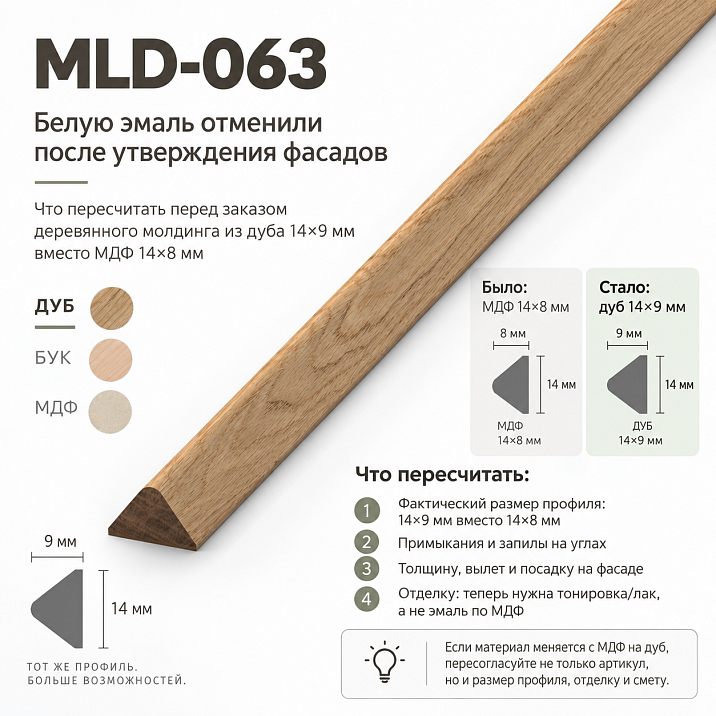
The facades are already approved, and the original list specifies MLD-063 / MDF / 14×8×2600 / for enamel. Then the client changes their mind: the white opaque enamel is cancelled, and they want to keep the visible wood texture and use oak for tinting or a clear finish. The most dangerous reaction to such an edit is to replace one word in the estimate: "MDF" with "oak."
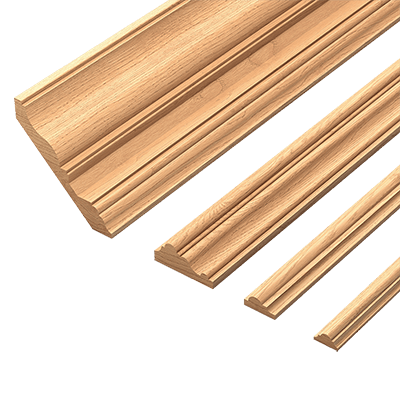
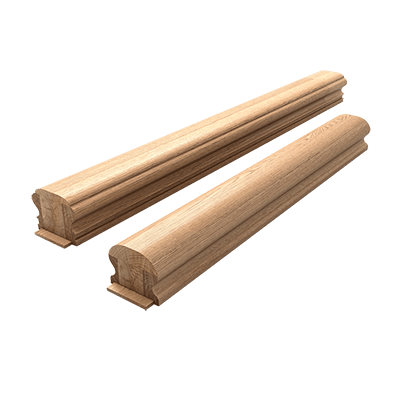
For MLD-063, changing the material changes not only the color and texture. MDF has a cross-section of 14×8 mm and a length of 2600 mm. Beech and oak are 14×9 mm, and are available in lengths of 1000 and 2400 mm. That is, after switching to solid wood, at least two things need to be rechecked: the profile depth C=9 mm instead of 8 mm, and the cutting layout for blanks of 1000/2400 instead of 2600 mm.
One millimeter in depth does not need to be declared a disaster. If MLD-063 is simply glued onto a free surface and there are no adjacent parts that need to be flush, the visual difference may be insignificant. But in an already approved furniture project, this millimeter cannot be ignored without checking: it starts to matter at the panel, handle, adjacent molding, in a narrow installation field, and in any joint with a specified relief height.
Therefore, the correct order after changing the finish is: new finish → new material → updated drawing → check C → new blank length → new cutting layout → test sample → updated specification → order.
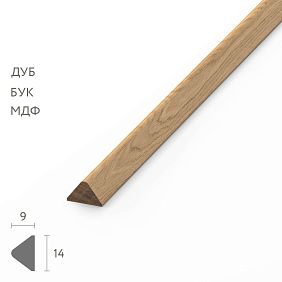
Wooden molding MLD-063: five product variants of one article number
MLD-063 retains the face width A=14 mm, but the card separates configurations by material and length.
| Material | A × C × L, mm | Sanding | Typical finishing scenario |
|---|---|---|---|
| MDF | 14 × 8 × 2600 | Prestige | For opaque enamel |
| Beech | 14 × 9 × 1000 | Prestige | painting or finishing per project |
| Beech | 14 × 9 × 2400 | Prestige | painting or finishing per project |
| Oak | 14 × 9 × 1000 | Prestige | toning, varnish, oil per project |
| Oak | 14 × 9 × 2400 | Prestige | toning, varnish, oil per project |
As of September 8, 2026, the STAVROS category shows MLD-063 from 360 ₽; the final price must be checked after selecting the specific material and length. The average production time for an out-of-stock item is 5–10 days.
Key point: the line MLD-063 without material and full A×C×L is insufficient. For purchasing, write either:
MLD-063 / MDF / 14×8×2600 / Prestige / for enamel / quantity ___
Or:
MLD-063 / oak / 14×9×2400 / Prestige / finish ___ / quantity ___
After re-negotiation, it is possible buy the wooden molding MLD-063 already in the exact configuration, not just by model number.

After changing the finish, first check the drawing, not the sample color
The buyer thinks naturally:
it was white → became wood.
For furniture production, this means a longer chain:
finish changed → profile material changes → depth C changes → standard length L changes → need to recalculate fit and cutting.
If in the original drawing MLD-063 was just a decorative frame on a free plane, the change from 8→9 mm may pass without reworking the facade geometry. If the profile adjoins another part, the conclusion is no longer obvious.
Need to re-check:
- frame around the panel;
- belt next to the furniture handle;
- transition to the adjacent overlay;
- place near the cornice;
- narrow shelf for the molding sticker;
- line that should match in height with another profile;
- any groove or pre-made limiter.
Therefore buy wooden molding for furniture after changing the design — it's not about "choosing a nice oak." First, you need to understand whether the already approved joint accepts the new geometry.
Our factory also produces:




One millimeter at MLD-063: when 8 and 9 mm really don't need to be dramatized
The difference C is exactly:
9 − 8 = 1 mm.
With a regular decorative installation on a free surface, this millimeter may indeed be visually subtle. The face width A remains 14 mm, so in a frontal view the outline barely changes.
A scenario where the difference usually requires only a check, not a rework:
- a new independent frame begins;
- the entire outline is made from one new material;
- there are no adjacent parts that the molding must be flush with;
- the surface is sufficiently free;
- the test piece looks normal after finishing.
In this case, there is no reason to panic just because of the number 9 instead of 8.
But it is important to compare the finished sample not only frontally. Oblique light and a side view better show changes in relief.
Get Consultation
When oak MLD-063 14×9 cannot be automatically installed instead of MDF 14×8
There are situations where 1 mm already becomes a design parameter.
Flush with the adjacent element
If the top point of MLD-063 must match the level of another strip or overlay, the new profile will be nominally 1 mm higher.
Rigidly defined mounting shelf
If limited space in depth is left for the profile, 9 mm needs to be checked on the actual part.
Handle near the frame
When the handle or its base is located close to the molding, additional relief may change the visual and physical gap.
Panel or another profile
If MLD-063 works as part of a complex stepped composition, 1 mm can change the shadow and the sequence of levels.
Pre-manufactured assembly
If the facade is already milled or there is a fixed stop nearby, the material cannot be replaced "by article number" without a trial fit.
The main conclusion here is not "1 mm always interferes," but "1 mm cannot be considered zero until the specific assembly is checked."
If the project still remains under enamel, changing the MDF is not mandatory
Changing the material should solve a real problem.
If the client ultimately returns to a fully opaque finish, MDF 14×8×2600 remains a logical configuration for MLD-063. The card directly links MDF to preparation for enamel, and the 2600 mm length may be convenient for tall furniture lines.
There is no need to switch the project to oak just because natural wood seems "more expensive" or "more premium." If the texture is still covered, the advantages of oak may not work visually.
In such a situation, it is useful to compare not materials in general, but a specific goal:
a solid enamel is needed → MDF remains a working option;
an array is needed, but the texture is not critical → beech can be considered;
an open oak texture is needed → the transition to oak gets a clear justification.
Oak MLD-063 14×9: when a material change justifies re-approval
Oak makes sense not as an "improved version of MDF," but as part of a new finish.
If the client canceled the white enamel precisely because they want to see the wood, oak starts to work as a design material. It can be tinted, coated with a clear varnish, or another system that preserves the grain pattern.
But along with this aesthetic, you need to accept the entire new specification:
- C=9 mm;
- L=1000 or 2400 mm;
- a different cutting layout;
- a different finishing system;
- possible difference in mating with adjacent parts.
Oak is justified when the new design actually uses its texture. If the oak is again completely covered with white enamel after purchase, the reason for re-matching disappears.
Beech MLD-063: a third path between MDF and oak
In MLD-063, beech has the same geometry as oak:
- 14×9×1000 mm;
- 14×9×2400 mm;
- Prestige.
Therefore, switching from MDF to beech also requires checking C=9 and new cutting.
Beech is logical if the project needs solid wood, but oak texture is not mandatory. For example, the new frame can be beech and then painted with an opaque color, or the material can match other beech furniture parts.
It is important not to reduce the choice to the formula "MDF is cheap, beech is medium, oak is expensive." Each option has its own task, and the geometric difference between MDF and both solid materials is the same: 8 vs 9 mm.
Length 2600 vs 2400 mm: sometimes this matters more than the depth millimeter itself
In practice, the workpiece length can impose a stricter constraint than C.
MDF:
2600 mm.
Beech and oak:
1000 or 2400 mm.
If in an old project the vertical was designed for a solid MDF board, a simple replacement with oak may not work.
Example: vertical 2450 mm
MDF 2600 mm:
2600 − 2450 = 150 mm of remainder before accounting for the technological cut.
Oak 2400 mm:
2450 − 2400 = 50 mm shortfall.
That is, one oak plank physically cannot cover the entire line.
Example: vertical 2480 mm
MDF 2600:
120 mm of nominal remainder.
Oak or beech 2400:
80 mm is missing before the cut.
Therefore, after switching to solid wood, not only the number of slats is recalculated, but also the possibility of making each visible side seamless.
Why you can't take the old number of MDF slats and order the same number of oak ones
Suppose the list had 6 MLD-063 made of MDF.
This number was calculated for a length of 2600 mm. After changing the material, the length becomes 2400 or 1000 mm, so the number "6" no longer has independent meaning.
We need to go back to the details:
| Detail | Finished length | Quantity | From which blank |
|---|---|---|---|
| Vertical 1 | ___ | ___ | 2400 / 1000 |
| Vertical 2 | ___ | ___ | 2400 / 1000 |
| Horizontal 1 | ___ | ___ | 2400 / 1000 |
| Horizontal 2 | ___ | ___ | 2400 / 1000 |
First, parts are laid out on 2400- and 1000-millimeter rods, then a new quantity is obtained.
That is why Buy wooden moldings for several facades, it is better after a new parts map, rather than by the old line "6 pcs. MDF".
Six identical doors: recalculating parts, not the total perimeter
Suppose the finish changes for six identical wardrobe doors.
For each frame, there is:
- two verticals;
- two horizontals;
- four corner cuts;
- specific final dimensions.
Bad calculation:
total perimeter of all frames ÷ 2.4 m = number of oak slats.
It does not show how individual parts fit into the blanks.
Correct calculation:
- write out the lengths of all verticals;
- write out horizontals;
- choose where to use 2400 and where 1000 mm;
- account for the actual cut and workshop allowances;
- form the cutting layout;
- only then add up the number of strips.
A short 1000 mm plank may prove more useful than the remainder of a 2400 mm one if the project has many short horizontals. But this only becomes apparent after cutting.
What to rewrite in the specification after switching from MDF to oak
Original entry:
MLD-063 / MDF / 14×8×2600 / Prestige / For enamel / ___ pcs.
The new entry should not look like this:
MLD-063 / oak / 14×8×2600.
Such a product combination does not exist in the card.
Correct form:
MLD-063 / oak / 14×9×2400 mm / Prestige / finish per approved sample / ___ pcs.
For short parts:
MLD-063 / oak / 14×9×1000 mm / Prestige / finish per project / ___ pcs.
Additionally, it is useful to specify:
- facade number;
- side of the frame;
- direction of the beveled profile;
- prohibition of unauthorized material substitution;
- layout version.
Then the manager sees not an abstract article number, but a specific configuration.
Do not leave old 14×8 next to the word "oak"
This is a typical mistake in editing the specification.
Was:
MLD-063 / MDF / 14×8×2600.
Someone changes only the second field:
MLD-063 / oak / 14×8×2600.
The result is a combination that the MLD-063 card does not offer.
To avoid this, when changing the material, it is better not to "edit" the line, but to rewrite it entirely from scratch. The five fields are checked as a linked set:
SKU → material → A×C → L → finish.
This is especially important for MLD-063, because the same SKU does not guarantee the same depth and length.
One millimeter cannot be compensated with a random shim or glue
When it turns out that oak is 1 mm higher than MDF, there is a temptation to "raise" the MDF or "sink" the solid wood right on site.
A random shim is not a universal solution. It can:
- protrude from under the edge;
- give unstable thickness;
- change the position of corners;
- create a wave;
- behave differently after the glue dries.
The adhesive layer should also not be used as a precise height calibrator unless such technology is approved by production.
If compensation is really needed, the craftsman must show a control assembly with the actual substrate, glue, profile, and finish. Only after that can the solution be transferred to the series.
Do not grind oak "down to 8 mm" without a separate technological check
Theoretically, a workshop can calibrate a wooden part from the back side. But one cannot promise in advance that MLD-063 made of oak can simply be reduced by 1 mm and get an exact copy of MDF.
Need to check:
- whether the geometry of the bevel will be preserved;
- whether straightness will change;
- Is it possible to process 2400 mm evenly?
- Will the front edge be damaged?
- How will the seating of the corners change?
- Will the profile remain stable after finishing.
And even successful calibration does not solve the second problem — the array length still remains 1000/2400, not 2600 mm.
Therefore, “let’s take oak and remove a millimeter” cannot be recorded as a standard order scenario without workshop confirmation.
A new independent oak contour is safer than a mixed frame
An important difference of this article from the reorder scenario: if the white enamel was canceled before production of the entire frame, the entire new contour can be made from a single oak configuration 14×9.
This is significantly simpler than mixing MDF 14×8 and oak 14×9 within one frame.
For the new contour:
- all four sides have the same depth;
- the material is the same;
- one finish;
- uniform light and shade;
- one technological map.
However, you still need to check the adjacent facades and furniture elements. But inside the rectangle itself, there is no transition from 8 to 9 mm.
Sample before the large batch: we check 8/9 mm and the new finish at the same time
After a design change, a physical sample becomes especially useful.
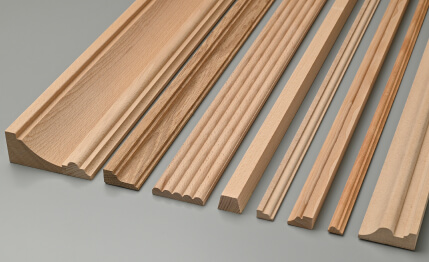
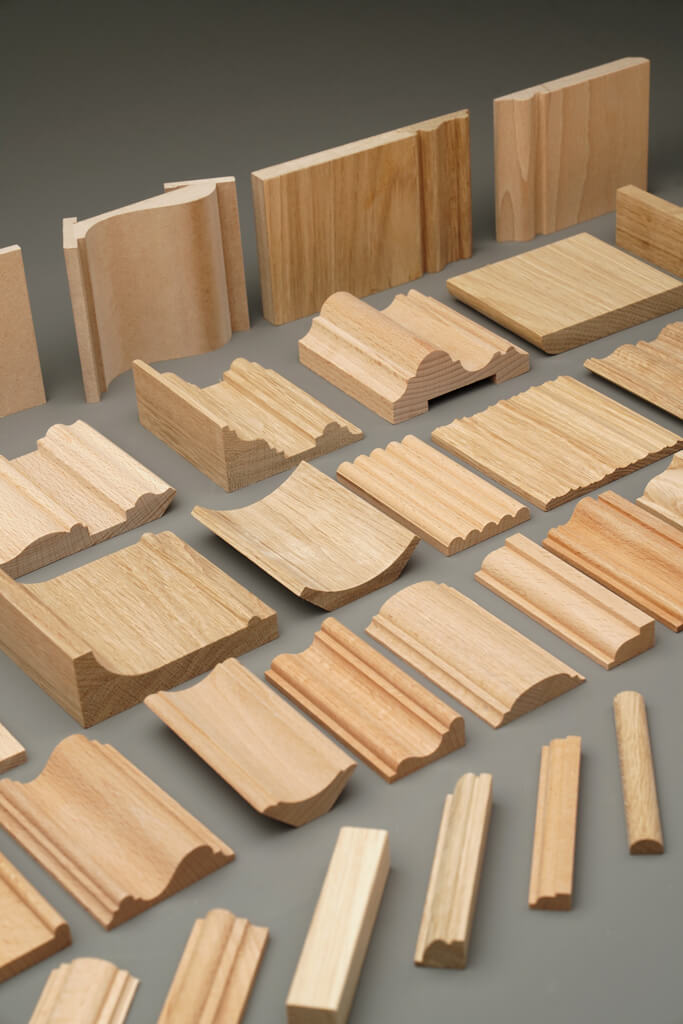
The OMLD-005 set currently contains 84 samples of moldings, cornices, and baseboards made of oak, beech, and MDF. It can be used to compare materials and geometry at full scale. The current set card shows a price of 5,240 ₽; it is better to check it again before ordering.
A useful test:
- apply MDF and solid wood to the facade;
- view the profile from the front;
- evaluate the side light;
- check 8 and 9 mm next to adjacent parts;
- apply the approved trial finish;
- after that, make a decision for the entire batch.
If you need to regularly compare profiles on objects, you can use a set of molding samples. For one private project, a separate physical sample of the selected MLD-063 is sufficient.
When oak is truly worth choosing after canceling enamel
Oak is justified if the reason for changing the project is visible natural texture.
Examples:
- clear varnish;
- Tinting;
- oil;
- combination with an open oak plinth or cornice;
- oak facade details nearby;
- a separate oak decorative frame as an accent.
In these cases, the new material creates real visual value, and re-matching the depth and cut makes sense.
If the enamel is simply changed from white to another solid opaque enamel, the oak needs to be justified separately again.
When beech may be more logical than oak
Beech is also solid wood and also has 14×9 mm with lengths of 1000/2400.
If the project requires a wooden part specifically, but oak texture is not the goal, beech is worth checking as a standalone option.
For example, beech is suitable for a project where:
- the molding will be painted;
- Adjacent elements are also beech;
- The material must be solid according to the specification;
- Oak wood type is not included by the designer.
But geometrically, the transition from MDF to beech requires the same check as oak: C changes to 9 mm, L — to 1000/2400.
What to check in the cart before paying for MLD-063
| Field | What should be in the order |
|---|---|
| Article number | MLD-063 |
| Material | MDF / beech / oak |
| Cross-section | 14×8 for MDF; 14×9 for solid wood |
| Length | 2600 / 2400 / 1000 mm |
| Sanding | Prestige |
| Finishing | matches the new project |
| Quantity | recalculated after selecting the length |
| Layout | current version |
| Facade/assembly | Specified |
| Material replacement | only after approval |
After checking, you can Buy wooden molding in the required finish or return to MDF if the new finish becomes opaque again.
When not to order MLD-063 after changing the finish
The purchase should be postponed if:
- the designer canceled the enamel, but the new finish is not yet approved;
- the estimate says "oak", but the size remains 14×8×2600;
- there is a vertical longer than 2400 mm without a solution for the joint;
- MLD-063 must be flush with another part, but 9 mm has not been checked;
- the craftsman offers to compensate a millimeter "by eye" with glue;
- the quantity is simply copied from the old MDF list;
- there is no test sample on the already approved facade;
- different materials are to be mixed within one frame without a control assembly.
First, the joint is re-approved. The order is the last step.
Where to buy MLD-063 after re-approval of the project
If the new specification is already approved, the final point is the MLD-063 card.
If you need to compare other profiles, Buy wooden moldings you can do so in the general molding category. For choosing between solid wood and MDF, the selection is also useful Wood and MDF moldings.
Main conclusion:
replacing MDF with oak for MLD-063 is not a color change in one line.
Was:
14×8×2600 mm, MDF.
Now:
14×9×1000/2400 mm, oak or beech.
So, after changing the finish, you need to re-check the depth, length of each visible side, cutting, and the full specification. Only then does the new material truly become part of the project, rather than a source of rework.
Questions before ordering MLD-063
What is the size of MLD-063 made of MDF?
14 × 8 × 2600 mm.
What is the size of the oak MLD-063?
14 × 9 mm; standard lengths 1000 and 2400 mm.
What is the size of the beech MLD-063?
Also 14 × 9 mm, length 1000 or 2400 mm.
Why does one article number have different depths?
Because the specific product modification depends on the material. The article number describes the model but does not override the full A×C×L.
Is a 1 mm difference always noticeable?
No. On a free decorative surface, it may be visually insignificant. But at rigid junctions, it needs to be checked.
When does 1 mm become critical?
When aligning flush, next to a handle or another profile, in a confined installation area, in a pre-fabricated assembly, and when mixing materials in the same frame.
Can I simply replace MDF with oak in the estimate?
No. You also need to replace 14×8×2600 with the actual oak configuration 14×9×1000 or 14×9×2400 and recalculate the quantity.
Does one oak plank cover a 2450 mm side?
No. The standard long solid wood plank is 2400 mm.
And MDF 2600 mm?
Theoretically, it provides sufficient length for 2450 mm before accounting for the technological cut and allowances.
Can oak be used on only one side of the MDF frame?
Physically possible not in all joints, but without a test assembly, this is risky due to differences in depth and finish.
Can 1 mm be placed under the MDF?
Only as a professionally designed and tested joint. A random shim is not a universal solution.
Can oak be sanded down to 8 mm?
Only if the workshop separately confirms the technique on a sample. This cannot be considered a standard operation in advance.
Which material should be left under the white enamel?
If the project remains opaque and there is no requirement for solid wood, MDF 14×8×2600 remains a logical option.
When to choose oak?
When visible oak texture is needed or the project directly requires solid oak.
When to choose beech?
When solid wood is needed, but oak texture specifically is not mandatory.
Do I need to recalculate the quantity after changing the material?
Yes. The lengths of the blanks change from 2600 to 1000/2400 mm, so the old quantity figure may become incorrect.
Where can I see real samples?
On the OMLD-005 set or on a separate physical sample MLD-063 before a large batch.
What should be checked last before payment?
Material, A×C×L, finish, cutting, quantity, specific facade, and prohibition of unauthorized replacement.