























Article Contents:
- Why the staircase to the second floor requires a full railing
- Safety is the first and main argument
- Support when moving
- Visual function
- What does the staircase railing to the second floor consist of
- Balusters
- Handrail (railing)
- Posts
- Fasteners
- Decorative elements
- Landing railing
- Which balusters to choose for a private house
- Turned balusters: a classic that is always appropriate
- Carved balusters: elegance for a special occasion
- Square and rectangular balusters: strictness and modernity
- Flat balusters: folk motif
- Wood for balusters: what to choose for a house, cottage, or dacha
- Beech: the best choice for painting
- Oak: open texture and premium status
- Pine: a budget solution with caveats
- Selection by house type
- How to choose balusters for handrails and posts
- Stylistic coordination
- Dimensional Compatibility
- Proportions: baluster and post
- Height of baluster under handrail
- Height and spacing of balusters: how to calculate correctly
- Standard railing height
- Baluster spacing: safety over beauty
- Effect of baluster shape on visual rhythm
- How many balusters are needed for a staircase to the second floor
- Simple calculation for a straight flight
- Two balusters per step or one?
- Calculation for a landing
- Calculation for a turning staircase
- Example of a full calculation
- What to buy along with balusters: a complete staircase kit
- Handrail
- Posts
- Fasteners
- Baluster Supports
- Post caps
- Installation materials
- Mistakes when buying balusters for a staircase
- Mistake one: buying only balusters
- Mistake two: not counting the quantity
- Mistake three: choosing different styles
- Mistake four: not considering installation
- Mistake five: skimping on the wood species
- Mistake six: incorrect height
- Mistake seven: too large a spacing when children are present
- Handrails and balusters: how to ensure a unified style
- Monochromatic Approach
- Contrast approach
- Accent approach
- Where to buy balusters and staircase components
- Hypermarket or manufacturer?
- What to pay attention to when choosing
- STAVROS: wooden balusters and staircase components for the second floor
- Frequently Asked Questions
- Which balusters are best for a staircase to the second floor?
- What to buy together with balusters for a staircase?
- How many balusters are needed for a staircase to the second floor?
- Can I buy only balusters without posts and handrail?
- Which balusters are suitable for a classic wooden staircase?
- What baluster spacing is safe for children?
- How to calculate the height of a baluster?
- Where to buy balusters and railings for stairs with Contact us to confirm shipping to your destination.?
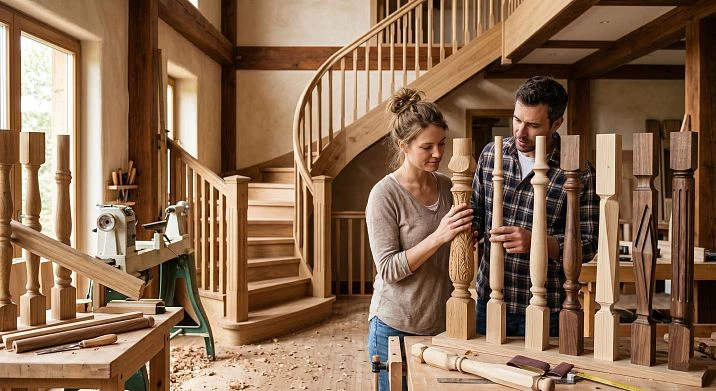
A staircase to the second floor in a private house is not just an architectural transition between levels. It is the axis around which the space is built. Entering the house, a person sees the staircase one of the first — and it sets the tone for the entire interior. Monumental or light, strict or elegant, dark or light — the staircase speaks of the owners' taste more eloquently than any painting on the wall.
And in this conversation Balusters for staircase — are the main ones. They create the rhythm of the railing, set its character, determine whether the staircase will look like an expensive product or an ordinary structure from a hardware store. Choosing balusters is a decision made once and lives in the house for decades.
This article is a practical guide for those who are building or finishing a staircase to the second floor and want to understand: which balusters to choose, how many to buy, what to order with them, and how to avoid mistakes that cannot be corrected later without complete dismantling.
Why a staircase to the second floor requires a full railing
Let's start with the main thing: why is a railing needed at all? If the staircase leads to the second floor in a residential house, a railing is mandatory both for safety standards and common sense. But it's not just about physical protection.
Safety — the first and main argument
A staircase to the second floor lifts a person to a height of 2.7–3.5 meters (standard floor-to-floor height with ceiling). A fall from a height of 1.5 m is a serious injury. A fall from a flight of stairs without a railing is already a medical incident with predictable consequences.
balusters for staircase to buy means first of all buying safety. Especially if there are children in the house: a child who loses their footing on a step should lean against the railing, not fall down. Balusters are a physical barrier that keeps a person on the flight.
Our factory also produces:
Support when moving
Railings resting on balusters are handrails. The hand slides along them when going up and down. Elderly people, people with balance disorders, pregnant women, those carrying heavy loads — all hold onto the railings. A fence without well-secured balusters cannot provide reliable support: it is the balusters that transfer the load from the handrail to the staircase structure.
Get Consultation
Visual function
The fence defines the silhouette of the staircase. A flight without balusters is a bare structure, a staircase "frame" without a picture. Balusters fill the space between the handrail and the steps, creating rhythm, decor, and visual depth.
Beautiful wooden balusters for staircases turn the staircase from a utilitarian element into an architectural detail. This is work that no other interior element can replace.
What does the staircase railing to the second floor consist of
Before choosing balusters, you need to understand the entire system — what is included in the railing set and how the elements are connected to each other.
Balusters
Vertical railing posts. Installed between the handrail and the stringer (side beam of the staircase) or steps. Their number determines the frequency of the railing "step". They bear the main decorative load.
Handrail
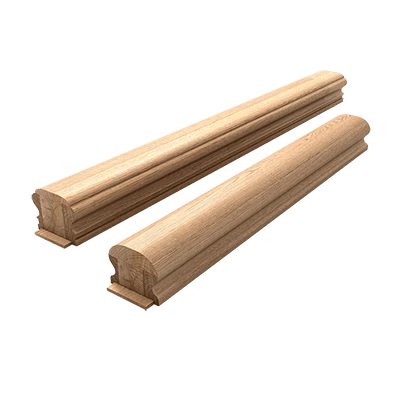
A horizontal or inclined element running along the flight. Lies on top of the balusters. The hand slides along it. The profile of the handrail — round, D-shaped, rectangular — should be comfortable for gripping and stylistically compatible with the balusters.
Columns
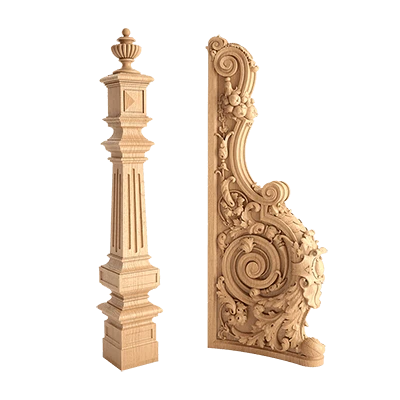
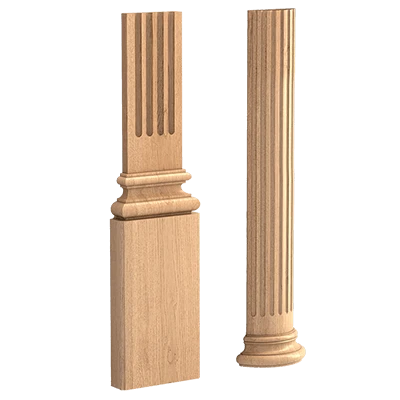
Support vertical elements at the beginning and end of the flight, as well as on turning platforms. Wooden stair posts — load-bearing elements: the handrail is attached to them from the ends. They are significantly more massive than balusters — cross-section 80×80, 100×100, 120×120 mm — and visually place accents in the railing.
Fasteners
Pins, screws, dowels, metal brackets, anchor bolts — everything that holds the balusters in the string and handrail, and the posts in the step or floor of the platform. The fasteners are invisible, but the rigidity of the entire system depends on them.
Decorative elements
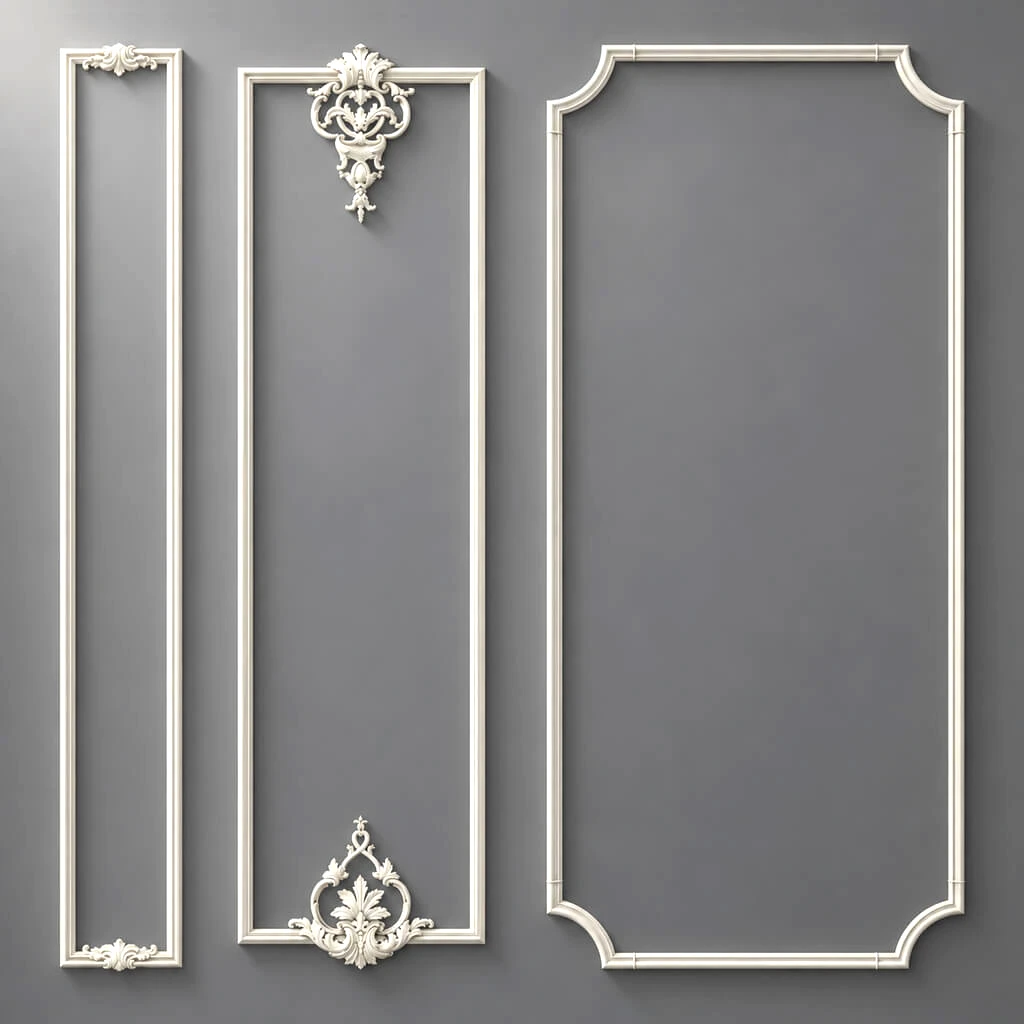
Under-baluster trims (decorative overlays on the lower row of the railing), post caps, decorative rosettes, transition elements at stair turns — all this makes the railing complete and professional.
Landing railing
A staircase to the second floor often has a horizontal landing at the top or an intermediate landing at a turn. On the landing, the railing runs horizontally — and here separate balusters of the required height are needed (standard for a landing is 900 mm or 1000 mm from the floor level).
All these elements together make up components for wooden staircases — a unified system that must be coordinated in style, size, and material.
Which balusters to choose for a private house
The question of shape is a question of style. And there is no single correct answer. There is logic: the shape of the baluster should match the character of the house, interior, and staircase.
Turned balusters: a classic that is always appropriate
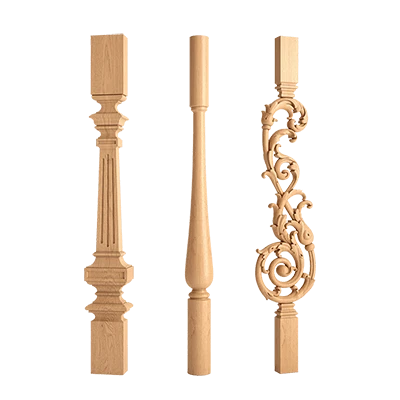
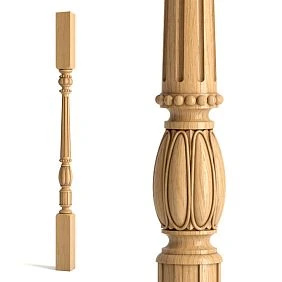
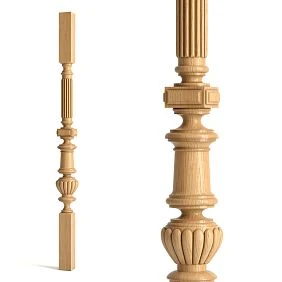
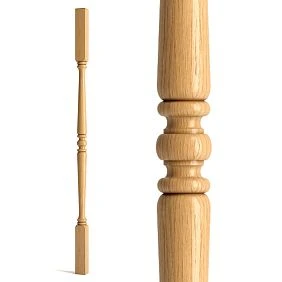
Turned balusters are produced on a lathe. The profile — with rollers, necks, and smooth diameter transitions — creates that very "staircase" look we all know from childhood. Standard turned balusters have a round or multi-step cross-section with clear proportions.
Turned wooden balusters for staircases Suitable for:
-
Classic interiors with wooden elements
-
Houses made of timber and logs
-
Cottages in country and rustic style
-
Country houses with traditional decor
Dimensions: height 900–1200 mm (plus tenons), diameter 40–60 mm at the widest part.
Carved balusters: elegance for special occasions
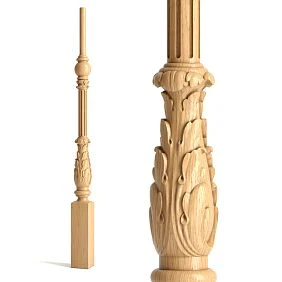
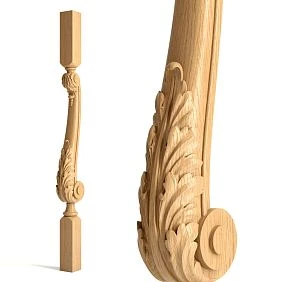
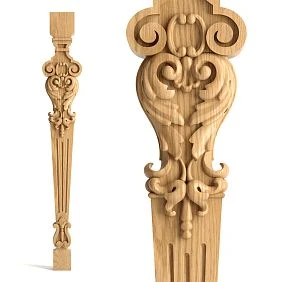
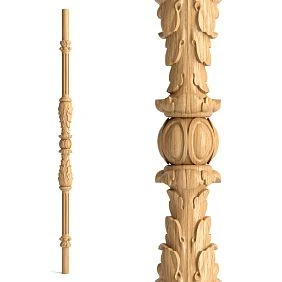
Carved balusters are three-dimensional decor: applied ornaments, through cutouts, relief patterns. This is the highest level of decorativeness for wooden railings. Carved balusters are appropriate for grand staircases in large country houses, in Baroque, Empire, and Classicism interiors.
Important: carved balusters require more careful finishing and a stylistically strong context. In a modest interior, they look excessive. In the right one, they turn the staircase into a work of art.
Square and rectangular balusters: strictness and modernity
Square balusters — clean edges, geometric profile, longitudinal chamfers or grooves. This is wooden conciseness: no extra plasticity, only form and material.
Square Wooden balusters organic for:
-
Modern classic
-
Scandinavian style
-
Minimalist interior with wooden accents
-
Houses where wood is combined with metal or concrete
Section: 40×40, 45×45, 50×50, 60×60 mm. Height — standard, to fit the required handrail.
Flat balusters: folk motif
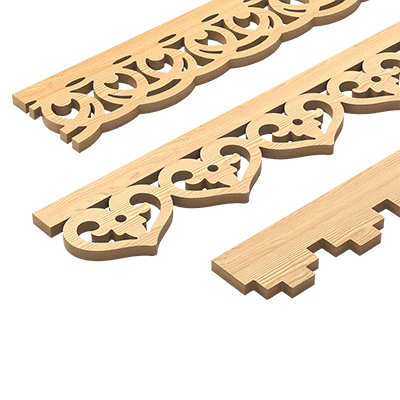
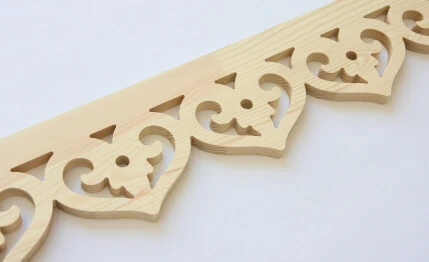
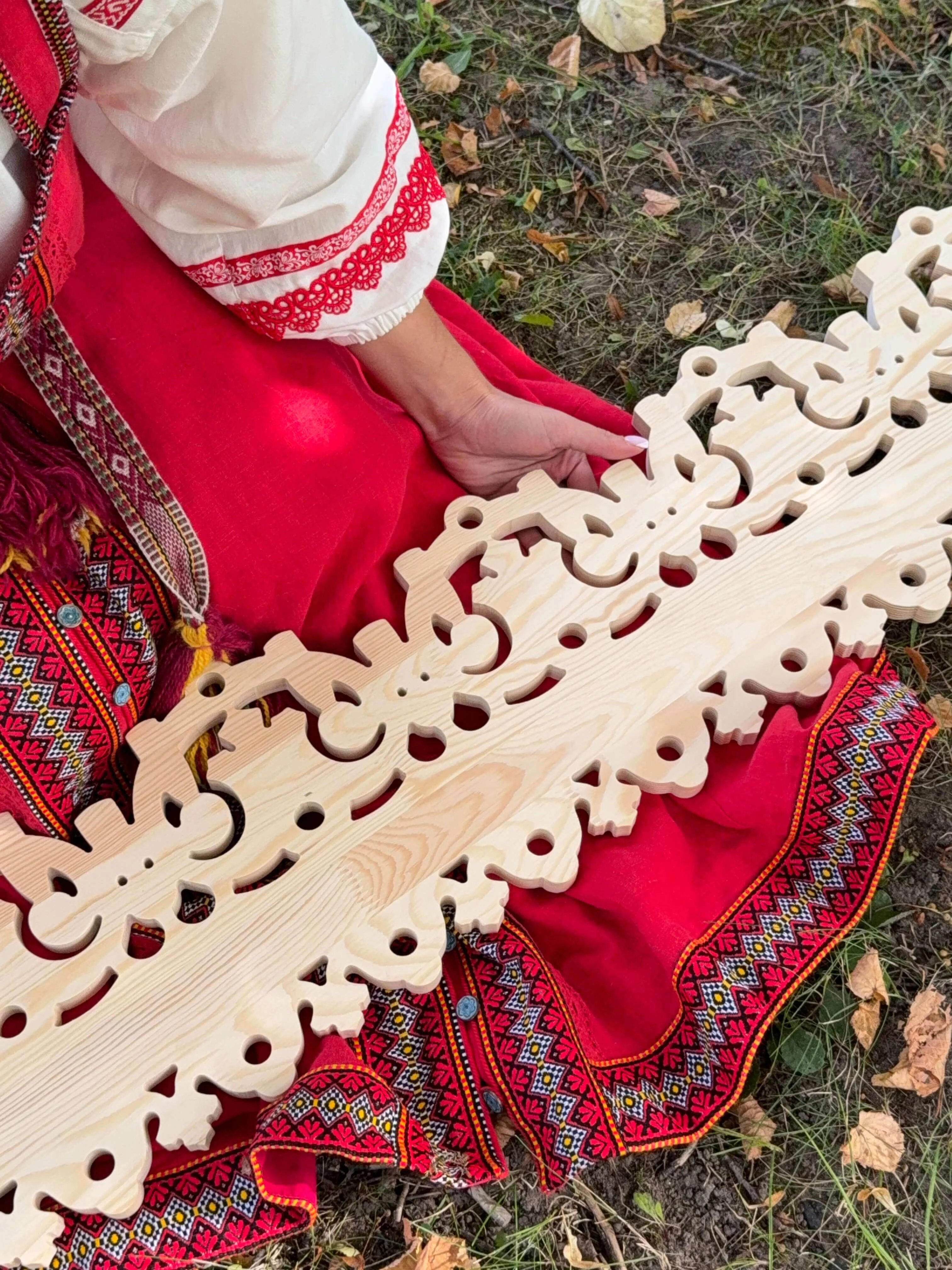
Flat balusters are cut from a board and installed "face" to the viewer. The decorative contour silhouette creates an ornament. This is a tradition of folk wooden architecture, "through-cut" carving. They are suitable for country houses with ethnic character, wooden houses made of timber with traditional elements.
Wood for balusters: what to choose for a house, cottage, dacha
The shape of the baluster defines the style. The type of wood determines durability, performance in use, and the final appearance after coating. These two variables always go together.
Beech: the best choice for painting
Beech is a hard, dense wood with a uniform structure. Density 680–750 kg/m³. Turning is ideal: the profile is clear, the sanding is smooth, the surface is free of pores and tear-outs.
The main advantage of beech is its neutral texture. This is a plus for those planning tinting or painting: the stain applies evenly, white paint does not produce streaks from knots and resin. Buy wooden balusters Beech is the right choice for classic stairs with tinting to match walnut, oak, wenge, or for white Scandinavian interiors.
Service life with proper treatment is 25–35 years under normal operating conditions.
Oak: open texture and premium status
Oak is the choice for those who want to see the living natural texture of wood. Under clear oil or varnish, oak balusters reveal their full potential: a deep golden-brown tone, expressive grain pattern, and a tactilely pleasant surface.
Oak is denser and harder than beech, contains natural antiseptic substances, and is less sensitive to moisture. For stairs in homes with a "living" microclimate (periodic ventilation, seasonal humidity fluctuations), oak is more stable.
The service life of oak balusters in a home is 50 years or more. This is an investment, not an expense.
Pine: a budget solution with caveats
Pine is the most affordable wood. It is light, easy to work with, and widely available. But for a staircase to the second floor in a permanently occupied residential house, it is a weak choice.
Pine is soft: it scratches, dents upon impact, and poorly holds sharp edges of turned profiles. Resin pockets and knots show through the coating. With humidity changes, pine "works" more actively than hardwoods, which over time leads to looseness in joints.
Pine balusters are suitable for country houses with undemanding interiors and seasonal use. For permanent housing, choose beech or oak.
Choice by house type
| Type of house | Recommended Wood Species | Finishing |
|---|---|---|
| City apartment, condominium | Beech | Toning + varnish |
| Country cottage (permanent residence) | Oak or ash | Oil or varnish |
| Timber house | Beech, oak | Tinting to match the base color |
| Country house (seasonal living) | Pine, beech | Varnish or glaze |
| Grand mansion | Oak | Oil or clear varnish |
How to match balusters to handrails and posts
A baluster is not a standalone object. It lives within a system. The main mistake when buying is choosing balusters separately from the handrail and posts.
Stylistic coordination
The principle is simple: the shape of the baluster and the shape of the handrail should speak the same language.
Turned round baluster with beads and necks → handrail with a rounded, smooth profile (D-shaped or classic 'rail' shape).
Square baluster with longitudinal chamfers → rectangular handrail with sharp edges and minimal chamfers.
Carved baluster → shaped handrail with ornamental profile.
If the styles do not match, the railing looks as if it was assembled from different sets.
Dimensional compatibility
The upper tenon of the baluster fits into the groove of the handrail from below. The groove must match the tenon diameter with a tolerance of 1–2 mm. The lower tenon fits into the hole in the string or step.
Standard combinations:
| Baluster cross-section | Upper tenon diameter | Handrail groove width |
|---|---|---|
| 40×40 mm | 28–30 mm | 50–55 mm |
| 45×45 mm | 32–34 mm | 55–60 mm |
| 50×50 mm | 36–38 mm | 60–68 mm |
Proportions: baluster and post
The post should be visually significantly larger than the baluster — otherwise it loses its role as an accent. The rule of proportions: the cross-section of the post is approximately 2–2.5 times larger than the cross-section of the baluster.
Baluster 40×40 mm → post 80×80 or 100×100 mm.
Baluster 50×50 mm → post 100×100 or 120×120 mm.
carved wooden balusters with volumetric decor look especially advantageous next to turned or carved balusters — a decorative dialogue between the main and secondary elements.
Baluster height under handrail
Stair railing height — distance from the top of the step to the top of the handrail — at least 900 mm (standard for residential buildings). For homes with children — 1000–1100 mm.
Baluster height = railing height minus handrail thickness. With a 50 mm handrail and 950 mm railing height → working length of baluster ≈ 900 mm. Plus tenons (top 30–40 mm, bottom 40–50 mm) — total baluster with tenons ≈ 970–990 mm.
Baluster height and spacing: how to calculate correctly
Two parameters that determine the safety and aesthetics of the railing: installation height and spacing.
Standard railing height
According to Russian building codes for residential buildings:
-
Stair railing height — at least 900 mm from the step level
-
For buildings over three stories — at least 1000 mm
-
For horizontal landings — at least 900 mm from the floor level
These standards are minimum. In practice, for the comfort of an adult 170–180 cm tall, a handrail height of 950–1000 mm feels most convenient.
Baluster spacing: safety matters more than beauty
The clear spacing between balusters (distance between their side surfaces) must not exceed 120 mm — this is the maximum for homes with children. A child should not be able to stick their head through the railing gap.
Calculating spacing on centers:
Spacing on centers = clear spacing + baluster thickness
With a 45×45 mm baluster and desired clear spacing of 110 mm:
Spacing on centers = 110 + 45 = 155 mm.
Visually, a spacing of 130–160 mm makes the railing look elegant without creating a "cage" effect. With spacing under 100 mm, the railing becomes almost solid — visually heavy.
Effect of baluster shape on visual rhythm
Round turned balusters with the same spacing appear more airy than square ones: square balusters have a flat face that blocks more of the gap. If you want a "light" railing, choose turned balusters with a smaller cross-section at the same spacing. If you want a more "closed" look, choose square balusters with a larger cross-section.
How many balusters are needed for a staircase to the second floor
Correct calculation of the quantity prevents the situation of "bought and didn't have enough" or "took with a large margin and don't know where to put half of it."
Simple calculation for a straight flight
Step 1. Measure the length of the flight along the horizontal projection (not along the inclined surface). For example, 3,500 mm.
Step 2. Choose the spacing along the axes. For example, 150 mm.
Step 3. Number of spans = flight length / spacing along axes = 3,500 / 150 = 23.3 ≈ 23.
Step 4. Number of balusters = number of spans + 1 = 24.
Step 5. Keep in mind that at the beginning and end of the flight there are posts — they "consume" the outermost balusters. Adjust the quantity considering the distance from the post to the first baluster.
Two balusters per step or one?
The traditional approach in classic wooden staircases is two balusters per step. This creates a spacing of about 130–170 mm depending on the step width. One baluster per step is a rarer spacing, suitable for wide steps (more than 300 mm) and large balusters (60×60 mm).
Calculation for landing
A horizontal landing is a separate section of railing. Measure the length of the landing railing and calculate similarly to stair balusters. Note that for a landing, the baluster height may be different (from the landing floor level to the handrail).
Calculation for a turning staircase
When the staircase turns (U-shaped or L-shaped), each flight is calculated separately, plus the intermediate landing. Posts are installed at the beginning and end of each flight and at the corners of the landing.
Example of a full calculation
Two-flight L-shaped staircase:
-
Flight 1: length 2,800 mm, spacing 150 mm → 20 balusters
-
Landing: length 1,200 mm → 8 balusters
-
Flight 2: length 2,400 mm, spacing 150 mm → 17 balusters
-
Posts: 4 pieces (start of flight 1, turn, end of flight 2, top)
-
Total: 45 balusters + 4 posts
What to buy together with balusters: a complete staircase kit
Here is the most common mistake: buy balusters, forget about the rest, and then buy everything separately — and end up with incompatible elements from different batches. The right approach is to order the entire kit at once.
Handrail
For a standard staircase to the second floor, you need a handrail length along the flight (with a margin of 100–150 mm on each side). The profile is chosen to match the balusters. Attachment to the posts is from the ends using connecting bolts or metal brackets.
Columns
Standard kit: 2 posts for a straight flight (start and end). For an L-shaped staircase — 3–4 posts. For a U-shaped staircase — 4–5. Wooden stair posts are selected from the same wood species as the balusters, from the same product line.
Fasteners
-
M8 or M10 studs for attaching balusters to the stringer and handrail
-
Threaded inserts for studs
-
Anchor bolts for attaching posts to steps or the floor
-
Metal shoes or brackets for posts
Detailed instructions on fastening options are in the article How to attach railings to balusters.
Baluster supports
Decorative boards or beams covering the bottom row of baluster connections to the stringer. They give the railing a finished and professional look.
Post caps
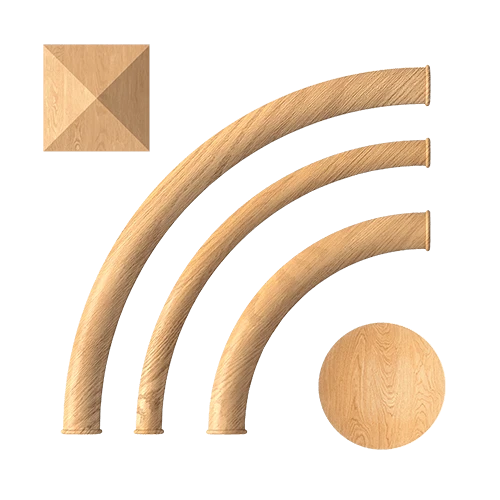
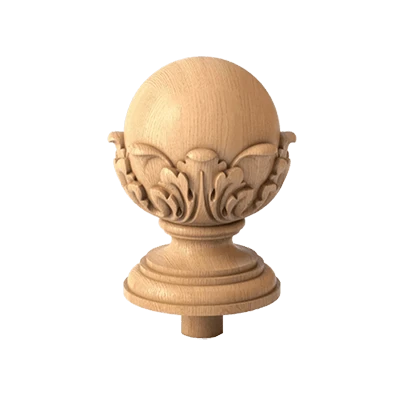
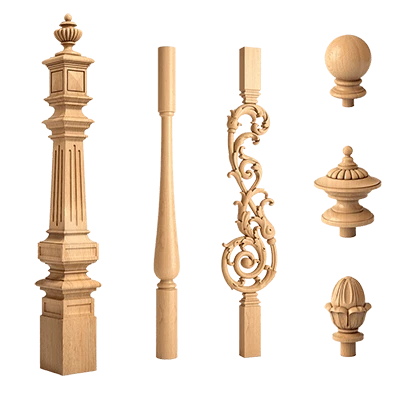
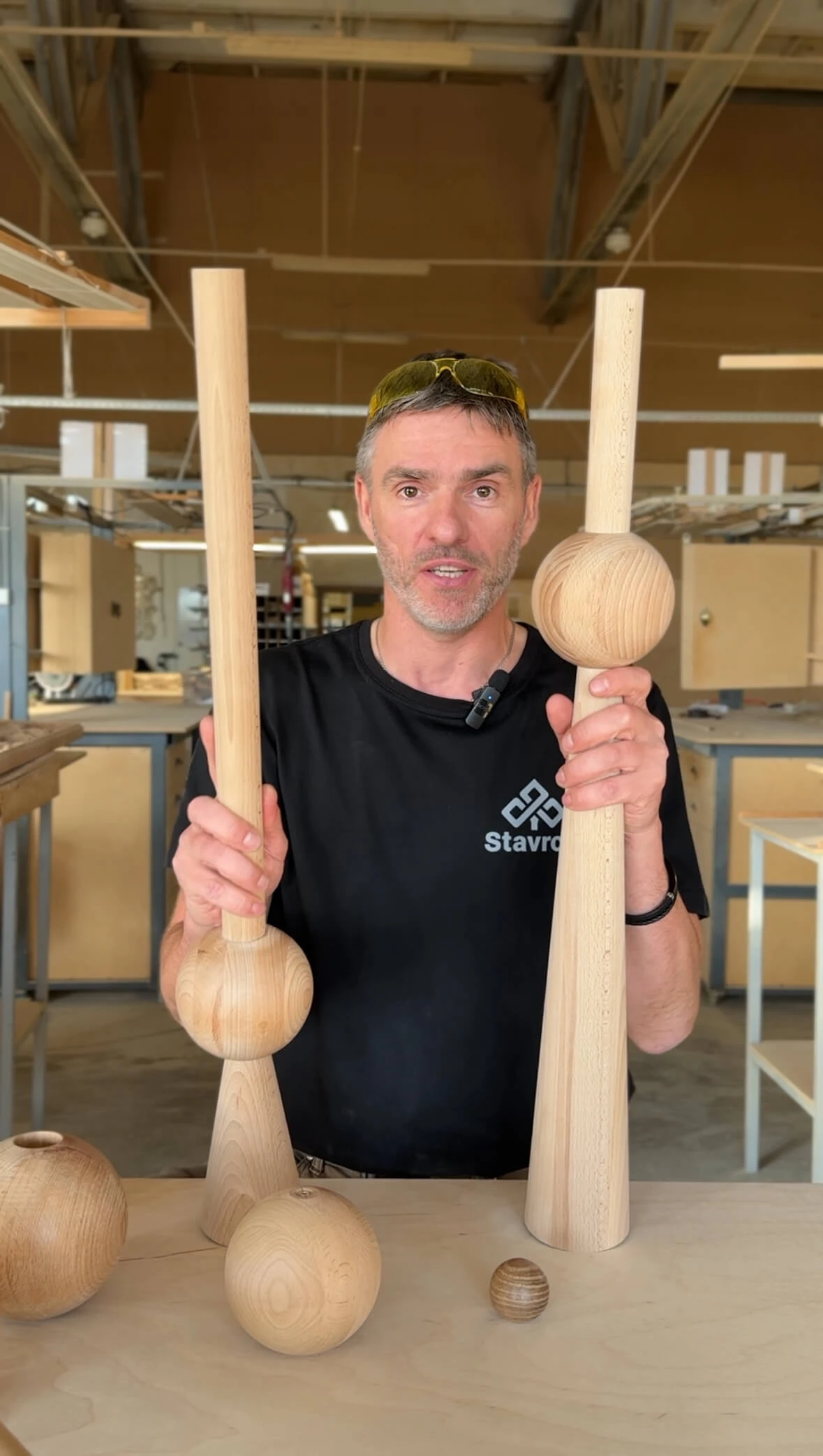
Decorative "balls", "drops", "pyramids", "mushrooms" for the top end of a post. They can be turned, carved, geometric — depending on the style. They complete the post and protect the top end from dust.
Installation materials
PVA-M glue (for wood joints), silicone sealant, wood putty for filling gaps, sandpaper. About the correct sequence of work — in the article Installation of Wooden Handrails and Balusters.
Mistakes when buying balusters for a staircase
Years of practice reveal the same mistakes. Knowing them in advance, you won't make them.
First mistake: buying only balusters
The most common one. A person goes for balusters, buys them — and discovers that the handrail doesn't match their profile, the posts are in a different style, and the fasteners are not provided at all. Rule: always order a complete set or at least ensure compatibility of all elements before purchasing.
Second mistake: not counting the quantity
"I'll take twenty pieces, that's enough." It's not enough. Then you have to buy more — and the new batch turns out to be a different shade (wood from different batches differs even within the same species). Rule: calculate the quantity accurately, with a 5–10% margin for defects and trimming.
Mistake three: mixing different styles
Balusters from one store, handrail from another, posts from a third. Each element is fine on its own — together they look like a mishmash. Rule: all visible wooden railing elements should be from the same product line of the same manufacturer.
Mistake four: not considering installation
You bought it, had it delivered — and then found out that the necessary fasteners were missing, that the tenon diameter doesn't match the handrail groove, and that special tools are required for installation. Rule: before purchasing, check with the manufacturer or seller for the complete installation kit.
Mistake five: skimping on wood species
"I'll take pine and repaint it later." After 5 years — cracks, darkening, loose joints. Rule: for a staircase in a constantly used house — at least beech, ideally oak. Saving on wood species leads to full replacement in a few years.
Mistake six: incorrect height
Bought "standard" height balusters without accurately measuring the distance from the step to the handrail. Result: balusters are too short, the handrail hangs at the right height, but the tenons barely fit into the grooves. Rule: measure first — then buy.
Mistake seven: too large spacing when children are present
"120 mm clear" is the minimum safe standard. A spacing of 150–180 mm looks nice but is dangerous for children. Rule: if there are children in the house, the clear spacing should be no more than 100–110 mm.
Railings and balusters: how to ensure a unified style
It's not just about shape. A unified style means wood species, finish, color, proportions. All these variables must be coordinated.
Monochromatic Approach
All wooden staircase elements — steps, stringer, balusters, handrail, posts — in one color. This is a strict, "architectural" approach that works especially well in modern interiors. A single stain is chosen for all elements.
Contrasting Approach
Dark balusters and handrail + light steps (or vice versa). This visually separates the railing from the load-bearing structure, highlighting each element. Works well if the steps are made of a different material (e.g., oak + metal).
Accent approach
Light balusters + dark posts. The posts become accents, the balusters a neutral background. This creates a sense of lightness and depth simultaneously.
In any of these approaches, it is important that Handrails and balusters are made from the same wood species and finished with the same topcoat — otherwise the shade will inevitably differ.
Where to buy balusters and staircase components
Choosing a supplier is the final and very practical question. The market for wooden balusters is wide: from building hypermarkets to specialized manufacturers. The difference is fundamental.
Hypermarket or manufacturer?
At a construction hypermarket, you will find standard pine balusters of a limited range. Humidity is unknown. Compatibility with handrails and posts is not guaranteed. The ability to order the desired length or wood species is usually not available.
With the manufacturer, you get full quality control, a stable assortment, the ability to order the entire set in one style, precise dimensions, and guaranteed humidity of 8–12%.
What to pay attention to when choosing
-
Wood species and humidity: the manufacturer must have an answer to both questions
-
Completeness of assortment: balusters, handrails, posts, fasteners — all in one place
-
Constant warehouse availability: not 'made to order in a month', but right now
-
Consultation: the manager should help with quantity calculation and selection
STAVROS: wooden balusters and staircase components for the second floor
STAVROS is a manufacturer of solid wood products, specializing in components for wooden stairs. The company produces a full range of fencing elements: from balusters to posts, handrails, and fasteners.
In the Stavros catalog — Balusters for staircase in all current shapes: turned classic, square geometric, carved, and turned-carved. All products are made from kiln-dried wood with a humidity of 8–12%. Wood species: beech, oak, ash, and other hard deciduous species.
Buy wooden balusters At STAVROS, ordering the entire set at once means balusters, handrails, Wooden stair posts and all related components staircase components from a single production system. This eliminates compatibility issues and ensures stylistic unity of the railing.
Constant warehouse availability. Contact us to confirm shipping to your destination. Professional selection consultation: STAVROS managers will help calculate the quantity, select the wood species and shape for a specific project.
STAVROS is when the wooden staircase in your home becomes exactly as you dreamed it: beautiful, durable, and complete.
Frequently asked questions
Which balusters are best for a staircase to the second floor?
For a constantly used staircase in a private home, the optimal choice is wooden balusters made of solid beech or oak. Beech is for painting and tinting. Oak is for an open natural texture under oil or clear varnish.
What to buy together with balusters for a staircase?
The complete set includes: balusters, handrail (railing), support posts, fasteners (studs, anchor bolts, threaded inserts), post caps, and under-baluster rails. All elements must be from the same product line.
How many balusters are needed for a staircase to the second floor?
Depends on the length of the flight and the installation step. With a standard step of 150 mm per linear meter of flight — approximately 6–7 balusters. Plus a separate calculation for horizontal landings. Total for a standard single-flight staircase — 15–25 balusters.
Can I buy only balusters without posts and handrail?
Yes — if the other elements are already selected and you are confident in compatibility in terms of size and style. But it is more reliable to order a complete set from one manufacturer.
Which balusters are suitable for a classic wooden staircase?
For classic — turned balusters made of beech or oak with a round profile, smooth transitions, and necks. Paired with a D-shaped handrail and turned posts — this is a classic wooden railing at its best.
What is the safe spacing of balusters for children?
The clear distance between balusters is no more than 100–120 mm. If there are small children, a clear step of 90–100 mm is recommended.
How to calculate the height of a baluster?
Baluster height = railing height (from step to top of handrail) minus handrail thickness. Add the length of the upper tenon (30–40 mm) and lower tenon (40–50 mm). Standard railing height is 950–1000 mm.
Where to buy balusters and railings for stairs with Contact us to confirm shipping to your destination.?
In the STAVROS catalog — a full range of wooden balusters, handrails, posts, and components with constant warehouse availability and Contact us to confirm shipping to your destination.