Article Contents:
- What exactly is KPU-080 and what not to expect from it
- Why a wooden top strip remains the basic solution for an acoustic slat wall
- How KPU-080 visually differs from a regular wooden strip
- The wooden strip continues the material
- KPU-080 separates the slat surface from the painted wall
- KPU-080 changes the style of the entire wall
- Only a smooth decorative border is visible
- A soft or acoustic backing is visible
- The multi-layer panel construction is visible
- A technical gap is left between the panel and the ceiling
- KPU-080 is located on the painted wall directly above the panel
- The trim is installed on a specially prepared strip flush with the slats
- The profile is being glued directly onto the protruding slats
- Above the slat field on a smooth wall
- On a separate finish substrate
- Over the front part of the slats
- The room already has polyurethane molding
- The top line should become an accent
- The slat surface does not cover the entire wall
- Wood is already present in abundance
- The interior is eclectic, classic, or neoclassical
- In the color of the wall
- In the color of the slats
- Contrast color
- Step 1. Determine the function of the top edge
- Step 2. Measure the length of the line
- Step 3. Check the base
- Step 4. Make a 35 mm template
- Step 5. Simulate a 9 mm protrusion
- Step 6. Check the acoustic zone
- Step 7. Compare with a wooden plank
- Step 8. Lay out two-meter elements
- Step 9. Calculate the cost
- Step 10. Make a commercial decision
- Scenario 1. Acoustic panel ends cleanly, with a painted solid strip on top
- Scenario 2. Soft backing and complex edge of the acoustic panel are visible
- Scenario 3. Modern room with active lighting and ceiling cornice
- Error: treating KPU-080 as a regular end cap
- Error: gluing onto a soft substrate without checking
- Error: only looking at the 35 mm width
- Error: counting quantity without laying out the ornament
- Error: assuming carved molding is an improvement by default
- Can KPU-080 be used if the top of the acoustic panel is under a stretch ceiling?
- What to do if the top line of the panels is slightly wavy?
- Can KPU-080 be installed vertically along the side edge of an acoustic wall in the same way?
- Is it necessary to coordinate KPU-080 with the acoustic system manufacturer if the panels were not purchased from STAVROS?
- Can KPU-080 be left unpainted?
- If the wall is exactly 4 m, are two KPU-080 strips enough?
- Does it make sense to install KPU-080 only above one part of a large acoustic wall?
- Can a wooden strip and KPU-080 be combined at the same time?
- What matters more when choosing: acoustics or the appearance of the top edge?
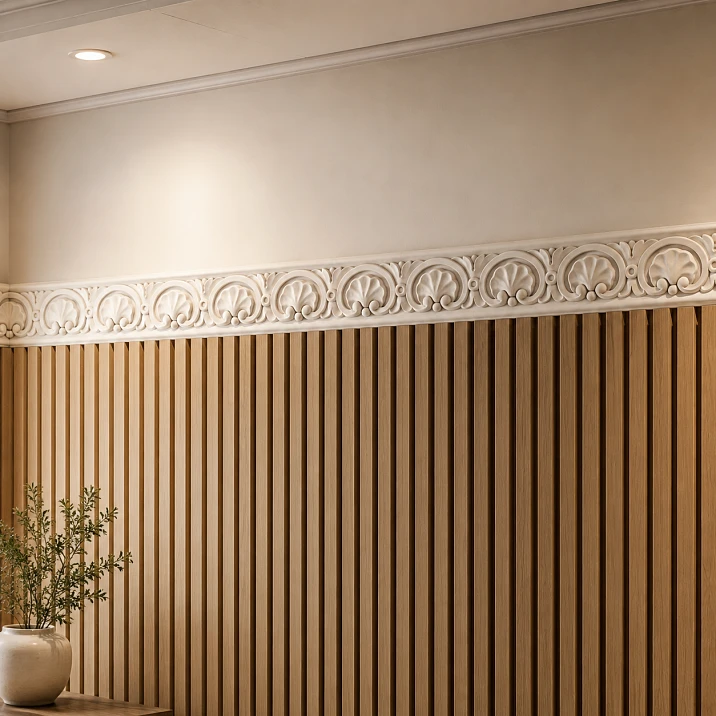
The acoustic slat wall is already installed, but the panels end below the ceiling. Between the top edge of the slats and the ceiling, a painted strip of wall remains, and the end of the panel field is clearly visible. The most expected way to finish it is with a wooden trim or molding matching the slats. But if the interior already combines wood with classical or ornamental details, another question arises: can carved decorative polyurethane molding KPU-080 be installed along the top edge instead of a smooth wooden trim?
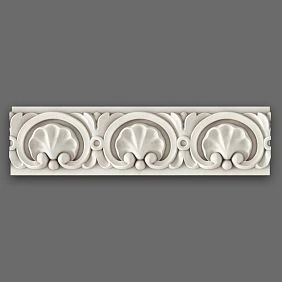
KPU-080 has specific geometry: A 35 × C 9 × L 2000 mm, material — polyurethane, price of one two-meter strip — 7,380 ₽. This is not a universal end profile for any acoustic panels or a technical plug. It is decorative carved molding. Therefore, it should be evaluated in two roles at once: can it neatly finish the top edge visually, and is there a proper solid base for it that does not require covering the working acoustic surface.
The short answer: KPU-080 can be considered instead of a wooden finishing strip if the top line of the panels is even, there is a stable mounting strip under the molding, the ornament fits the interior, and the profile does not have to be glued to the soft or functionally acoustic part of the panel. If the wooden strip simultaneously covers the end of the structure, works as part of the panel system, or provides a more logical continuation of the slat material, carved polyurethane molding should not be considered an automatic replacement.
Before ordering, three checks are needed: a paper strip of 35 mm width along the top edge, an assessment of the protrusion C = 9 mm from the side, and an inspection of the base to which the product will actually be glued. Only after this does it make sense to count the two-meter strips and move on to the card buy carved polyurethane molding KPU-080.
What exactly is KPU-080 and what not to expect from it
KPU-080 is carved polyurethane molding. Its task is decorative: to run an ornamental line along a wall, furniture, door composition, or another prepared surface. In our situation, this line is considered as the top finish of the slat field.
It is convenient to record the current parameters before any calculations:
| Parameter | KPU-080 |
|---|---|
| Product type | Carved decorative molding |
| Material | Polyurethane |
| Size A | 35 мм |
| Size C | 9 мм |
| Length L | 2000 мм |
| Price | 7,380 ₽/pc. |
| Average production time for made-to-order items | 3–7 days |
Size C = 9 mm here is more correctly perceived as the product's overall thickness dimension, rather than a separate confirmed "thread depth." The card indicates the overall size A × C × L, but does not establish a separate depth value for each ornament element.
Even more important is the following: the KPU-080 card does not state that the product is a specialized profile for acoustic panels. Therefore, one cannot conclude that "if the profile fits in width, it automatically fits structurally." The decision is determined by where exactly it is glued, what it covers, and whether it interferes with the functional zone of the panel.




Why a wooden top rail remains the basic solution for an acoustic slat wall
In STAVROS's own article on how to assemble Acoustic slat wall panels, the top edge is suggested to be finished with a wooden molding. In this logic, the finishing material and the material of the additional element match: a wooden or wood-based slat surface gets a continuation from the same visual system.
This solution has clear advantages. A wooden rail:
-
supports the material and color of the slats;
-
can be perceived as a natural end of the panel field;
-
does not introduce a new ornamental language;
-
fits well in interiors where the top boundary should be as calm as possible;
-
allows preserving the modern architectural logic of the acoustic wall.
Therefore, the article should not prove that polyurethane KPU-080 is "better than wood." The right question is different: in what composition does a carved profile add extra value that a regular wooden plank does not?
If the interior is modern, monochrome, minimalist, and the acoustic wall itself should look like a single wooden volume, a wooden finish is usually more logical. If, however, there is already polyurethane molding, classic frames, carved furniture facades, a decorative console, or a ceiling composition nearby, KPU-080 can become a connecting element between the vertical rhythm of the slats and the rest of the room's decor.
Our factory also produces:
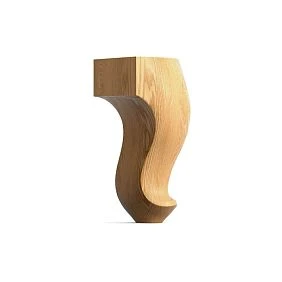
How KPU-080 visually differs from a regular wooden plank
The difference is not only in the material. A wooden finishing plank usually works as a border. KPU-080 works simultaneously as a border and as an ornamental line.
At the top edge of the acoustic wall, this produces three different effects.
Get Consultation
The wooden plank continues the material
The eye perceives it as part of the panel system. The top does not attract separate attention. This works especially well when slats of natural oak, beech, or veneer are the main decorative material of the room.
KPU-080 separates the slatted surface from the painted wall
The carved pattern creates an independent band. This can be useful if a noticeable painted area remains between the panels and the ceiling, and what is needed is not just a neat end but a compositional transition.
KPU-080 changes the style of the entire wall
Even a relatively narrow strip A = 35 mm can make a modern acoustic wall more classic, eclectic, or decorative. This is a strong intervention. That is why the profile should be tried on at full scale, not chosen from a beautiful large photo on a card.
Therefore, the wooden slat and KPU-080 are not two interchangeable versions of the same element. They produce different artistic results.
First, determine what exactly you want to cover at the top edge
Before choosing the material, you need to understand the joint itself. The phrase "panels do not reach the ceiling" describes several different constructions.
Only a smooth decorative border is visible
The panel ends cleanly, the end of the backing is not noticeable, and a painted wall begins above. Here, the trim is needed mainly as a decorative line. This is the most favorable scenario for KPU-080.
A soft or acoustic backing is visible
If the top end shows felt, fabric, porous material, or another functional base, the issue is more complex. KPU-080 cannot be automatically glued directly to such a surface. You need to determine whether there is a solid mounting area nearby or behind it.
A multi-layer panel construction is visible
Sometimes the top shows the backing, slats, and thickness of the entire system at once. Then a regular wooden extension strip can serve not only a decorative but also an end-cap function. A narrow carved profile of 35 × 9 mm may physically not cover the entire joint.
A technical gap is left between the panel and the ceiling.
If the gap is related to construction, compensation, ventilation, framing, or another design requirement, it cannot be automatically covered with continuous decor. First, determine the function of the gap.
The main point: KPU-080 is chosen not by the mere presence of a top edge, but by the type of that edge.
There is another useful way to check the task: look not only at the front of the wall but also at the cross-section of the joint. Draw four layers by hand — ceiling, painted wall, panel, and the line of the future molding. If in the diagram KPU-080 simply lies on the solid wall above the panel, the task is mainly decorative. If it must simultaneously cover the end of the slat, the thickness of the backing, the void of the frame, and also extend onto the painted wall, the profile is already being used as a complex technical cover. For a product with dimensions of 35 × 9 mm, this is a completely different scenario.
It is also useful to measure not only the total length of the top line but also the actual height of the visible end. If the multi-layer end is taller than what KPU-080 can visually cover in the chosen position, the decorative strip will not fully solve the task. In this case, a wooden extension piece can first cover the structure, and the carved polyurethane molding — if desired — can then be installed on top of a separately prepared strip. But then the basket and installation become more complex, and this needs to be considered before purchase.
Separately, look at the two side endings of the top line. If the slat field meets the wall on both sides, the molding can be finished in the corners. If the panel ends openly in the middle of the wall, KPU-080 will have a visible end. A beautiful front ornament does not guarantee that the open end will look finished without additional treatment. Therefore, the length of the line and the method of finishing at the edges should be designed together.
Make a template 35 mm wide before ordering KPU-080.
For a large product photo, 35 mm seems like a small size. On a real wall, the scale is perceived differently, especially if the panel field is tall and wide.
The simplest test is to cut a strip 35 mm wide from paper or painter's tape and run it along the entire top edge of the slat panels. There is no need to imitate the ornament exactly. At the first stage, it is important to understand the scale of the strip.
Look at the mockup from at least three distances:
-
close to the wall — to assess the joint and the base;
-
from a normal distance in the room — to see the proportion;
-
from the entry point — to understand whether the upper band turns into too strong a horizontal accent.
If a 35 mm strip visually "cuts" the wall and makes the slat field look squat, KPU-080 is likely to be too active. If the line neatly finishes the top and connects it with other interior details, the product can be checked further.
The template is especially useful if the panels end only 150–300 mm below the ceiling. In such a narrow upper field, the carved band can take up a noticeable share of the free height and look much larger than on an open wall.
Do not limit yourself to a short piece of the template 300–400 mm long. On a small fragment, any decorative detail looks neat because the eye evaluates only the pattern. For a purchase decision, it is much more useful to run a paper strip at least 1.5–2 m. Then it becomes visible how the horizontal line affects the entire vertical rhythm of the slats.
If the wall is longer than two meters, mark a conditional joint on the paper line where two factory planks will connect. This allows checking both the scale and the future layout at the same time. On a wide wall, a long continuous ornament is perceived more calmly if the joints do not fall into the center of the most noticeable area.
There is another test: photograph the wall without the template and with the template, then reduce the photos on the screen to the size at which the whole room is usually perceived. If the carved band remains the first element that catches the eye, its visual strength is higher than it may seem at the wall. For a minimalist interior, this is often an argument in favor of a wooden finish.
Dimension C = 9 mm needs to be checked from the side, not just from the front
The frontal paper template shows only one part of the task. KPU-080 has a dimension C = 9 mm, meaning it protrudes from the mounting plane.
For a regular wall, this is a small profile. But on slat panels, there is already its own relief: the slats protrude relative to the backing. Therefore, you need to look at the top edge from the side and answer the question: in which plane should the carved molding end up relative to the front surface of the slats.
Three situations are possible.
KPU-080 is located on a painted wall directly above the panel
Then it may end up slightly deeper than the front plane of the slats themselves. This is not necessarily bad: the line works as a separate frieze above the textured wall. But the transition should look intentional.
The molding is installed on a specially prepared strip flush with the slats
This way, you can get a more solid end, but this is already an additional structure. It needs to be designed before ordering, not trying to compensate for the difference with a thick adhesive layer.
The profile is being glued directly onto the protruding slats
If there are deep gaps between the slats, the contact of KPU-080 will be intermittent. The molding should not turn into a bridge that holds only on individual peaks of the lamellas without a calculated base.
It is often the side view that decides whether KPU-080 is technically suitable.
At the same time, you should not try to "bring" the molding to the desired plane solely with the thickness of the adhesive. If in one area KPU-080 almost lies on the base, and in another a noticeable adhesive pad is required, the profile begins to work as a means of compensating for geometry. For a long two-meter carved strip, this is bad initial logic: any unevenness begins to show on a continuous horizontal line.
It is better to check the upper boundary in advance with a long rule or a laser. If the wall itself is wavy and the end of the panel varies in height, first fix the base or design an additional piece. Decorative trim should emphasize an already prepared line, not create an illusion of leveling.
It is also useful to compare the projection of KPU-080 not only with slats, but also with the ceiling cornice, if there is one. When the cornice protrudes significantly more, the narrow carved line can be perceived as a thin intermediate belt. If both profiles are similar in projection and actively carved, the top of the wall gets two competing reliefs.
Can KPU-080 be glued directly onto an acoustic panel
There is no universal "yes" answer for all acoustic panels. Designs vary: wooden slats can be attached to MDF, fabric, felt, a soft sound-absorbing backing, or a combined system.
Before installation, it is necessary to determine the material of the exact strip where the glue will be applied.
If it is a hard, stable, and prepared surface compatible with the chosen mounting adhesive, installation is possible after the usual adhesion test and recommendations from the material manufacturer.
If it is a soft acoustic layer, gluing decorative trim directly onto it without a separate solution is risky. The soft base may flex, have insufficient adhesion, or be part of an acoustic system that should not be locally sealed or loaded.
If contact is only with the tops of wooden slats, assess the actual gluing area. A narrow profile may cross many empty gaps and actually have insufficient support.
In such a case, it is more reasonable to first make a solid finishing strip—for example, an additional piece provided by the project—and then attach KPU-080 to it. But this means the trim becomes a second decorative layer, not a direct replacement for a wooden plank.
Will KPU-080 damage the acoustic function of the wall
By itself, a single narrow decorative profile along the top edge cannot automatically be declared either "acoustically safe" or "harmful." It depends on which part of the system it covers.
STAVROS, in materials about acoustic panels, specifically notes that the acoustic effect is related to the slat structure, sound wave scattering, and, in some designs, sound-absorbing material behind the backing. In another article, the company warns that even multi-layer paint covering perforations can reduce acoustic efficiency.
Hence the safe practical conclusion:
-
if KPU-080 is glued above the active acoustic surface, on a separate solid painted strip, it does not cover the slat zone itself;
-
if the profile lies over acoustic holes, soft backing, or a functional top section, the impact must be assessed based on the specific design;
-
if acoustic efficiency is a design requirement, not just an additional property of the interior, changes to the assembly should be coordinated with the system supplier/designer.
You cannot invent a percentage of sound absorption reduction or promise no impact without testing the specific design.
If acoustics for a room are not a marketing advantage but a measurable design requirement, it is useful to keep documents for the panel and installation diagram. Then any new decorative element can be compared with the original design. This is especially important in a meeting room, home theater, music room, studio, or commercial space where reverberation was calculated in advance.
In such a situation, the decision to "install KPU-080" must answer an additional question: are we changing only the inactive top strip or interfering with an area that was part of the acoustic calculation. If the decorative profile is entirely above the acoustic cladding, the risk is fundamentally different than when covering part of the sound-absorbing surface.
For a residential living room, where the acoustic effect of panels is just an additional bonus, requirements may be less strict. But even here, it is reasonable not to cover porous, perforated, or soft areas unnecessarily. A good decorative detail should complement the system, not reduce useful area for visual effect.
Where to place KPU-080: above the panel, on the end, or partially over the slats
Three positions give different results.
Above the slat field on a smooth wall
The cleanest logic for decorative use. The molding runs along a solid strip directly above the panel and visually completes it. The slatted surface remains untouched.
On a separate finishing substrate
If the top of the panels is uneven or soft, you can first create a structurally suitable base, and then use KPU-080 as an external decorative layer. This is more complex and expensive, but it does not force the carved molding to solve a task it was not designed for.
Over the front part of the slats
This option needs to be checked especially carefully. The ornament may get lost on the relief, the adhesion may be intermittent, and the upper ends of the slats may be partially covered. If you want frontal overlay, you need a full-size mockup and checking the base along the entire line.
For most scenarios where the acoustic panel is already ready, a separate solid zone above it is the most understandable place for KPU-080.
When KPU-080 is really better than a wooden strip
It makes sense to choose carved polyurethane molding not just because it is more unusual. A specific reason is needed.
The room already has polyurethane stucco molding
For example, ceiling cornices, molding frames, decorative inserts, or a classic portal. Then KPU-080 can connect the modern material of the slats with the existing molding language of the room.
The top line should become an accent
The wooden profile dissolves into the panel. KPU-080, on the contrary, emphasizes the boundary. If the designer's task is exactly that, carved molding works more strongly.
The slatted surface does not occupy the entire wall
When the panels form a separate field and the surrounding wall remains painted, a decorative frame along the top edge can make the composition more complete.
Wood is already present in abundance
Sometimes another wooden plank makes the wall too heavy, while a polyurethane KPU-080 painted in the wall color creates a lighter transition.
The interior is eclectic, classic, or neoclassical
In such styles, the combination of vertical slats with carved ornament can be a deliberate design choice rather than a stylistic error.
In all these scenarios, the product solves an additional artistic task rather than simply covering the end.
Another sign of a successful choice is that KPU-080 can connect several existing elements. For example, a room has a white ceiling cornice, painted wall moldings, and natural wooden slats. If the trim above the panels is painted in the color of the wall or the molding, it becomes a transition between the wood texture and classical details. In this case, the new material does not appear on its own but completes an existing system.
If KPU-080 is the only carved element in the entire room, the reason for its presence must be very convincing. A single classical ornamental band above a modern acoustic wall can easily look accidental. Then the wooden plank wins precisely because it requires no explanation.
It is better to compare the two options at the same height and with the same color of the mockup. Otherwise, you might accidentally decide that "wood is worse" simply because the wooden sample is darker or thicker, not because the finishing principle itself is unsuitable.
When a wooden plank is better than KPU-080
There are also opposite situations where it is better to avoid carved trim.
The interior is minimalist. If the wall is built on a clean vertical rhythm and neutral materials, carved ornament can look alien.
The top plank must cover a complex end. If significant width, edge protection, or matching the panel thickness is required, a wooden additional piece more often solves the task constructively.
There is no solid base for adhesive. If the top of the panel is soft or the contact area is too small, KPU-080 should not be chosen solely for appearance.
The panels work like a serious acoustic system. If the profile needs to cover the active part of the sound-absorbing structure, it is better to keep the design solution.
The room already has a lot of ornament. A carved belt above textured slats may become an extra layer.
A maximally repairable part is needed. A wooden slat matched to the panel system is sometimes easier to replace as an additional element than to restore a painted ornamental profile.
How to calculate the quantity of two-meter KPU-080
Once compatibility is confirmed, the calculation is simple: the length of one slat is 2000 mm. But you need to calculate not the "wall footage in general," but the actual line you want to decorate.
Basic formula:
N = rounding up (Lline / 2000 mm).
For a quick estimate:
| Length of the top line | Geometric minimum KPU-080 | Cost at 7,380 ₽/pc. |
| up to 2.0 m | 1 pc. | 7 380 ₽ |
| more than 2.0 up to 4.0 m | 2 pcs. | 14 760 ₽ |
| more than 4.0 up to 6.0 m | 3 pcs. | 22 140 ₽ |
| more than 6.0 up to 8.0 m | 4 pcs. | 29 520 ₽ |
This is a geometric minimum, not a ready-made order. For carved moldings, you also need to check the pattern repeat, the joint location, and possible trimming.
Besides the total length, the number of independent panel sections matters. For example, two walls of 1.2 m each give a total of 2.4 m, but one two-meter plank cannot cover both sections at the same time. Formally, you need two pieces of material, even though the total length is less than four meters. Therefore, you need to count not only meters, but also the distribution of these meters across individual lines.
The same applies to short returns in niches. A 400 mm remainder after the main wall can be useful on an adjacent section only if it matches the pattern, orientation, and joint location. You cannot assume in advance that every remainder is fully interchangeable.
Before placing the final order, it is convenient to draw a cutting table: plank #1 — section A, plank #2 — section B + possible remainder. Such a simple plan often shows that two elements are enough where you felt like buying three, or vice versa — that the geometric minimum does not allow for a neat pattern layout.
For example, a wall 3.6 m long formally requires two planks: 4 m of material covers the length. But if the pattern cannot be beautifully joined at the chosen point or one section must start with a specific part of the design, the actual consumption may change. That is why you first do the layout, not just divide the meters.
After calculation, you can order KPU-080 35 × 9 × 2000 mm in the confirmed quantity.
Where is the best place to make the joint of two planks
If the top line is longer than 2 m, a visible seam appears between the segments. For carved molding, the joint is more important than for a smooth wooden batten, because the pattern must continue convincingly.
Before ordering, it is useful to draw two layers of markings on the wall:
-
vertical joints of the slat panels themselves;
-
the intended joints of KPU-080.
They do not have to coincide. Sometimes it is better that the joint of the molding does not fall directly above the joint of the panels: then the composition resembles a technical grid less. In another interior, on the contrary, aligning the axes may look neater.
The main thing is not to leave the connection on a random remainder of 100–150 mm at the very edge of the wall. A short offcut is harder to fit to the ornament and visually it more often looks like a forced insert.
If the top line is 2.8 m, it is wiser to decide in advance where the connection of two planks will be: in the center, closer to a less noticeable corner, or at a point where the ornament allows the pattern to continue neatly. This is already a matter of layout, not quantity.
For a long wall, it is useful to avoid another extreme — making symmetry at any cost. If the center of the wall is occupied by a TV, speaker, niche, or another object, the joint of KPU-080 directly above the central axis may turn out to be visually more noticeable than a connection shifted to a calm zone. Symmetrical cutting is good only when it helps the composition.
Also check whether the joint aligns with a directional spotlight. A narrow beam falling directly on the seam can emphasize even a well-finished line. Sometimes it is enough to shift the layout by 200–300 mm so that the joint falls into a less contrasting area without changing the number of planks.
Do you need to buy a spare plank
The universal rule "take +10%" should not be applied to KPU-080. Here, the product is sold individually as two-meter elements, and the price of one plank is 7,380 ₽. An extra unit noticeably increases the budget.
A spare plank is justified if:
-
a complex pattern requires significant trimming;
-
there are several independent areas where leftovers are poorly reused;
-
installation is done for the first time and the risk of damage is higher;
-
the project requires perfect pattern alignment at visible joints;
-
delivery later would be inconvenient in terms of timing.
If the line is simple, the layout is drawn, and two planks confidently cover the entire area, buying a third one just "just in case" is commercially irrational.
How to compare the real KPU-080 basket and a wooden plank
With polyurethane molding, the cost is calculated precisely: the price is known from the product card. For a wooden plank, a universal price cannot be invented — it depends on the wood species, profile, length, quality, and finish.
Therefore, the comparison should be structured as follows:
| Parameter | KPU-080 | Wooden plank |
| Material | Polyurethane | depends on the selected wooden profile |
| Element length | 2000 мм | depends on the specific product |
| KPU-080 dimensions | 35 × 9 mm | Depends on profile |
| Price | 7,380 ₽/pc. | must be taken from the specific product card |
| Visual effect | Carved ornament | wood continuation/smooth edge |
| Base | a stable bonding zone is needed | depends on the profile and panel design |
| Main risk | decorative overload and unsuitable substrate | mismatch of color/wood species and geometry |
Such a comparison is fairer than artificially declaring one option "more expensive" or "cheaper" without a selected wooden SKU.
To the material cost, you should mentally add three more different types of expenses. The first is substrate preparation. If for KPU-080 you have to make a separate hard strip, its real project price is no longer equal to just the cost of the slats. The second is finishing: polyurethane ornament usually requires careful painting, and the joints require touch-up. The third is the risk of rework: if the profile was chosen without a mockup and looks overly busy after installation, dismantling and restoring the painted wall costs more than a timely refusal.
The wooden option has its own additional costs: selecting the wood species or tinting, matching the color to the slats, and possible final finishing. Therefore, you need to compare two complete systems, not just the price of the linear material.
For a private buyer, this is a useful filter: if the aesthetic effect of KPU-080 is needed only to be "slightly prettier," and installation requires separate preparation, the carved option may not justify the added complexity. If it ties together the entire stucco composition of the room, the additional work becomes part of a deliberate design decision.
What happens if the panels end 150–300 mm below the ceiling
This is a common scenario and an important compositional variable. Between the top of the slatted wall and the ceiling, there remains a relatively narrow smooth strip. KPU-080 in this zone creates a horizontal band 35 mm wide.
If the free strip is 150 mm, the profile occupies a noticeable share of this zone. It becomes a strong accent, and the upper part of the wall is visually divided into several horizontals: the edge of the panels, carved molding, the free strip, the ceiling cornice or the ceiling.
If the free zone is 300 mm, there is more air around KPU-080, and the decorative belt is easier to perceive as an independent line.
But one cannot derive a universal threshold from these figures. Ceiling height, wall width, molding color, and the presence of a ceiling cornice greatly change perception. Therefore, instead of a rule like "at 150 mm it's not allowed," a full-length physical template is needed.
If there is already a ceiling cornice above, KPU-080 can create a double frame
This is a separate scenario that is easy to miss.
Imagine a wall: slatted panels end below the ceiling, and a ceiling cornice runs along the perimeter of the room above. If a carved KPU-080 is added between them, two decorative horizontals appear on a short section of the wall.
In a classic interior, this can work as a system: the lower line finishes the panel, the upper one finishes the ceiling. But in a modern interior, two active strips often create a feeling of an overloaded frieze.
Before ordering, it is worth comparing three layout options:
-
only the existing ceiling cornice;
-
wooden plank above the panel + cornice;
-
KPU-080 + cornice.
If the third option visually splits the height, it's better not to buy carved molding, even if it technically fits.
The color of KPU-080 changes its role more than the material.
The same profile can look like a nearly invisible relief or like an independent ornamental band.
Matching the wall color
KPU-080 becomes a relief transition. The ornament is readable thanks to the shadow, but it argues less with wooden slats. This is one of the safest scenarios next to an acoustic wall.
In the color of the slats
The molding visually attaches to the panel, but the material remains different. For this option to look convincing, you need to match the shade and gloss level very well. Imitating a natural wood texture on carved polyurethane is not necessary — sometimes it's easier to choose a solid color of a close tone.
Contrast color
The carved belt becomes the main graphic element. This is only acceptable in an interior where such a horizontal line is truly needed. Otherwise, the contrast intensifies the conflict between modern acoustic slats and classic ornament.
The color needs to be checked on a mockup together with the ceiling and the top painted strip, not just next to a slat sample.
Lighting can visually increase the relief of KPU-080.
The dimension C = 9 mm seems small, but side lighting can make the carved pattern much more active.
If linear lighting runs along the ceiling, track lighting, or light from a window falls along the wall, each element of the ornament creates its own shadow. As a result, KPU-080 may visually appear deeper than in the product card under frontal lighting.
This is especially important on an acoustic wall: the slats themselves already form a pronounced light-and-shadow pattern. This creates two rhythms simultaneously:
-
vertical shadow from the slats;
-
horizontal ornamental relief on top.
If they are well balanced, the wall becomes more interesting. If both are very contrasting, the composition can become too noisy.
Therefore, it is useful to test KPU-080 in the evening with the working lighting on, not just during the day.
Light also helps to assess the quality of future joints. On a frontally lit wall, the connection of two planks can be almost invisible, but with sliding side light, any step will show as a shadow. If the lighting goes from top to bottom along the slats, the joint of the trim should be planned especially carefully.
If RGB or warm contour lighting is used, color also affects the perception of the ornament. Warm light enhances the wooden component of the interior, while cold light more strongly separates the painted polyurethane from the natural slats. Therefore, the final color of KPU-080 should be chosen under the actual lighting scenario, not just by the paint sample in the store.
How KPU-080 interacts with the vertical rhythm of acoustic slats
This is where the main design point of this article lies. Acoustic slats create a vertical direction. KPU-080, installed along the top edge, introduces a horizontal line.
A horizontal line can:
-
neatly stop the vertical rhythm;
-
visually mark the boundary of the panel field;
-
make the composition more "architectural";
-
at the same time slightly reduce the sense of height if the line is too active.
The taller and narrower the slat field, the stronger the upper belt is perceived as a finish line. The wider the wall, the more KPU-080 works as a long frieze.
Therefore, the question of "wood or polyurethane" should be decided not only by material. You need to understand whether the wall needs a neutral edge or a pronounced horizontal line.
Can KPU-080 be used only on part of the upper edge
Technically, separate sections of the decorative line are possible, but in this task, fragmentary installation usually requires a very strong compositional reason.
For example, if the slat field consists of two independent blocks on the sides of a TV or niche, each block can get its own top line. Then KPU-080 is calculated separately for each section.
But if it is one continuous acoustic wall and the molding suddenly ends in the middle without an architectural event, the solution looks unfinished. In that case, it is better either to run the line along the entire boundary or to abandon it completely.
The number of slats should therefore be calculated for each compositionally independent section, rather than summing up leftovers without considering the start and end points of the pattern.
What to do at an internal or external corner
If the slat wall turns onto an adjacent plane, the task becomes more complex. KPU-080 is a carved molding, and the corner cut must preserve the pattern and a neat joint.
At the internal corner, you need
Installation on a finished painted wall: what to check before purchasing
If the acoustic wall is already assembled and the top strip of the wall is painted, installing KPU-080 becomes a retrofit task.
Before ordering, check:
-
paint is not peeling;
-
whether there is dusty putty;
-
whether the line is level enough;
-
whether existing panels will need to be trimmed;
-
is the selected adhesive compatible with the base and polyurethane;
-
will it be possible to touch up the molding and the mounting seam locally without redoing the entire wall.
STAVROS itself offers mounting adhesive for KPU-080 among related products, but the specific choice of adhesive should be matched with the actual base. You should not buy a compound just because "it is sold next to the product" if the molding will come into contact with an unusual acoustic underlay.
If you need a complete system of polyurethane linear decor, you can check the section Buy polyurethane trim and compare KPU-080 with more subdued profiles.
Will the carved molding become a dust collector above the acoustic wall
Any relief requires a bit more care than a smooth strip. On the upper horizontal line, some dust may settle on the protruding elements of the ornament.
This does not make KPU-080 impractical, but in an interior with high dust levels, near a ventilation grille, or in a commercial space with intensive use, maintenance should be considered in advance.
A smooth wooden strip is usually easier to wipe down. Carved polyurethane molding wins in decorativeness but loses in surface simplicity.
If easy cleaning is critical for the project and only a neat edge is needed visually, a wooden option may be more rational.
In a commercial space, the risk of accidental damage during maintenance of the ceiling, lighting, or ventilation is added to wear. The top line is located high, but when using a stepladder, tools are often leaned against this area. A smooth extension strip is easier to restore locally. The carved KPU-080 requires more careful restoration of the ornament and painting.
For a home wall, this factor is usually secondary, but if regular maintenance of hidden lighting directly above the panels is planned, it is better to ensure in advance that the trim does not block access to the cable, power supply, or removable panel.
What to do if 35 mm is visually too much
If a full-size template shows that KPU-080 is too active, there is no need to try to "hide" it with color and still buy it. It is better to change the type of decorative solution.
Options:
-
return to a wooden finishing strip;
-
choose a narrower and calmer polyurethane trim;
-
leave a clean painted gap if the panel edge is already neatly finished;
-
move the decorative molding to another part of the wall.
To compare the assortment, you can You can buy ready-made stucco matching the Baroque style. Calculate the quantity: linear meters of cornices and moldings, number of rosettes, pilasters, consoles, corner elements. Add a ten to fifteen percent allowance for trimming. only after it becomes clear that the 35-millimeter carved line is not suitable.
It is important not to turn the selection into a chain of "this product didn't fit — let's take a similar one at random." Each new profile is checked again against the template and the base.
When you should not buy KPU-080 at all
Refusing to buy is a normal result of the check. KPU-080 should be excluded from the cart if:
-
the top of the panel requires a specialized wooden or technical additional part;
-
there is no solid mounting base;
-
the profile would have to be glued to a soft acoustic substrate without a confirmed solution;
-
it covers functional openings, a gap, or an active acoustic surface;
-
the 35-millimeter strip visually weighs down the short gap to the ceiling;
-
the ceiling cornice already creates a strong horizontal line;
-
the interior requires a neutral modern finish;
-
the carved pattern contends with the vertical rhythm of the panels;
-
a significantly different geometry is needed to close the end;
-
the cost of several KPU-080 units is not justified by the decorative effect.
The last point is especially important. For a wall wider than 4 m, at least three two-meter strips will be required, that is, 22,140 ₽ just for KPU-080. If the layout does not show a clear artistic advantage over a wooden strip, there is no point in buying an expensive carved profile just for the sake of using molding.
Practical verification algorithm before ordering
To avoid returning to the same doubts, let's assemble the decision into a sequence.
Step 1. Determine the function of the top edge
Do you simply need to decoratively finish the wall or close the actual end of a multilayer panel?
Step 2. Measure the length of the line
Measure the actual length of each independent section.
Step 3. Check the base
Write down where the KPU-080 will be glued: painted wall, solid trim strip, wood, MDF, or soft acoustic underlay.
Step 4. Make a 35 mm template
Run the strip along the entire length and look at it from the room.
Step 5. Simulate a 9 mm protrusion
Especially if the panel itself has a pronounced relief.
Step 6. Check the acoustic zone
Make sure the trim does not overlap the functional part of the structure without approval.
Step 7. Compare with a wooden slat
Make two visual mockups rather than choosing the material abstractly.
Step 8. Lay out the two-meter elements
Draw the joints and check the pattern.
Step 9. Calculate the cost
1 / 2 / 3 slats = 7,380 / 14,760 / 22,140 ₽.
Step 10. Make a commercial decision
Buy KPU-080 only when it passes both technical and compositional checks.
Three different scenarios and three different solutions
Scenario 1. The acoustic panel ends cleanly, with a painted solid strip on top
The slat field is almost ceiling height, leaving 250 mm of wall above. The interior features moldings and classic details. KPU-080 can be glued directly onto the prepared wall above the panel without overlapping the acoustic part.
Solution: KPU-080 looks justified. Next, we calculate the length and joints.
Scenario 2. A soft substrate is visible, and the complex end face of the acoustic panel is exposed.
The trim formally overlaps the edge in width, but there is no proper solid strip underneath it. To secure it, you first need to create a separate base.
Solution: do not treat KPU-080 as a direct replacement for a wooden plank. First, a correct transition piece is needed; possibly, a wooden finishing detail will turn out to be simpler and more logical.
Scenario 3. A modern room with active lighting and a ceiling cornice.
Technically, KPU-080 can be installed, but the carved horizontal line under the existing cornice and next to vertical slats creates too many lines and shadows.
Solution: abandon KPU-080 for compositional reasons and leave a wooden or more neutral finish.
These scenarios change not only the appearance but also the final cart—this is why it is useful to separate them.
Mistakes when choosing KPU-080 for the top edge of acoustic panels
Mistake: treating KPU-080 as a regular end trim.
Why it happens: the profile is linear and has a convenient length of 2000 mm.
Consequence: decorative trim begins to be tasked with closing a complex multi-layer edge, for which it was not designed.
Check: determine what exactly is visible on the top edge.
How to avoid: separate the decorative and structural functions.
Mistake: gluing onto a soft substrate without verification
Why it occurs: the surface seems wide enough.
Consequence: weak adhesion, sagging, local damage, or interference with the acoustic structure.
Check: determine the material of the contact area.
How to avoid: use a solid confirmed base or another additional component.
Mistake: looking only at the 35 mm width
Why it occurs: this is the main visible dimension.
Consequence: after installation, the profile unexpectedly protrudes relative to the battens or creates a complex side step.
Check: evaluate C = 9 mm from the side.
How to avoid: make a full-scale mockup.
Mistake: counting the quantity without laying out the pattern
Why it occurs: two planks give exactly 4 m of material, so for a 3.6 m wall "everything is ready."
Consequence: the joint ends up in an inconvenient place or the pattern continues poorly.
Check: draw the actual two-meter segments on the diagram.
How to avoid: count the quantity after choosing the joint point.
Mistake: considering carved molding an improvement by default
Why it occurs: an expensive and ornamental element seems more "premium."
Consequence: a modern acoustic wall loses its cleanliness and starts to look overloaded.
Check: compare the full-size mockup of KPU-080 with a calm wooden slat.
How to avoid: buy only if the carved horizontal truly improves the composition.
How to integrate KPU-080 into an interior if there is furniture and doors nearby
The top line of a slat wall rarely exists on its own. Nearby there may be a door, built-in wardrobe, TV stand, console, or furniture portal. These objects add extra horizontals that need to be checked against KPU-080.
If the top of a cabinet or door portal almost matches the height of the panel line, the carved molding can tie the elements together. If the heights differ by a small amount, on the contrary, the new strip emphasizes the mismatch.
Special care is needed near tall hidden-mount doors. Their aesthetic is built on minimal framing, and the carved KPU-080 above the slat wall can create a foreign stylistic note.
Before ordering, it is useful to photograph the entire wall and draw the KPU-080 horizontal line on the photo. This is a simple way to see connections that are hard to assess when standing close to the panel end.
What to buy if KPU-080 fits
After all checks, the cart should be simple and specific.
For one continuous section:
-
up to 2 m — 1 KPU-080 = 7,380 ₽;
-
more than 2 to 4 m — 2 KPU-080 = 14,760 ₽;
-
more than 4 to 6 m — 3 KPU-080 = 22,140 ₽.
Additionally, a mounting and finishing solution suitable for the actual base will be needed, but it cannot be considered universal without data on the wall and panel.
If the project is still at the stage of selecting the wall system itself, you can go to the section buy slatted panels and immediately link the panel type, top edge, and future finishing detail. For an already finished wall, this step is not mandatory — here the task is specifically to choose the finishing.
What to buy if KPU-080 is not suitable
If the reason for rejection was not the idea of the decor itself, but the specific geometry of KPU-080, the next step depends on the problem.
35 mm is too wide or the ornament is too active — compare other profiles in the polyurethane molding category.
Need to close the structural end — return to a wooden or system extension strip for specific panels.
There is no solid base — first develop the top mounting assembly, and choose the decorative element after it.
There is a risk to the acoustic surface — preserve the designed acoustic solution and do not cover the functional area with a decorative profile.
The problem is only stylistic — leave a smooth finish; the absence of molding in this case is better than excess decor.
This is a more useful route than seeking a "similar KPU" at any cost after a negative fitting.
If the problem is only in style, not geometry, it is useful to pause and check whether an additional profile is needed at all. Sometimes a neatly finished top of panels against a painted wall looks better than any strip. This is especially true when the panel field already has a beautiful factory end and the difference in materials itself creates a sufficient boundary.
The absence of a separate finish does not always mean an "unfinished renovation." Sometimes it is a deliberate minimalist assembly. Therefore, a commercial solution should always include a third option: not buying either KPU-080 or a decorative wooden strip if the structure is already neat and an additional line adds no value.
Why this article does not duplicate the general material on acoustic panels
The general STAVROS article already answers how to complete acoustic slat panels and how to finish the top edge. It suggests a wooden molding as a typical finish.
Here the task is different. We do not re-explain the structure of an acoustic wall. We test one specific alternative product — carved polyurethane KPU-080 — against a typical wooden strip and bring the decision to quantity and cost.
After this page, the reader should be able to:
-
determine the type of top end;
-
check the base;
-
make a 35 mm template;
-
assess the 9 mm protrusion;
-
understand whether the acoustic zone is affected;
-
compare the visual result with a wooden plank;
-
calculate the number of two-meter elements;
-
name the budget for KPU-080;
-
reject the product if it does not pass inspection.
This is what makes the page a standalone commercial material, rather than a retelling of an existing guide.
Result: KPU-080 is a conscious decorative alternative, not an automatic replacement for a wooden finish.
Acoustic slat panels that do not reach the ceiling do require a neat top finish. The typical solution from the same wood system usually remains the most neutral and structurally clear. But in an interior where molded decor is already present or an expressive ornamental band is needed, the carved decorative molding KPU-080 can yield a more interesting result.
To order it correctly, you cannot limit yourself to the wall length. First, you need to understand what exactly is being covered at the top edge and where the profile will be glued. Then make a full-size strip of 35 mm, check the dimension C = 9 mm on the side, ensure that KPU-080 does not overlap the functional acoustic part, and only then compare it with the wooden plank in terms of appearance.
If all checks are passed, the quantity is calculated based on two-meter strips, taking into account joints and pattern. At the current price of 7,380 ₽, one element costs 7,380 ₽, two — 14,760 ₽, three — 22,140 ₽. For a long wall, this is already a noticeable budget, so the decorative advantage should be obvious even at the mock-up stage.
If there is no reliable base under the profile, a complex end needs to be covered, or the carved band overloads a modern acoustic wall, a wooden finishing plank will be the more correct solution. KPU-080 should be purchased not because polyurethane molding is more impressive in itself, but only when it truly improves a specific joint and does not force the decorative profile to perform a foreign technical function.
FAQ
Can KPU-080 be used if the top of the acoustic panel is under a stretch ceiling?
You need to check the actual gap and the ceiling installation sequence. The molding must not interfere with service access or extend into the structural zone of the stretch ceiling. The size of 35 × 9 mm itself does not confirm compatibility with a specific ceiling joint.
What to do if the top line of the panels is slightly wavy?
First, level or properly finish the base. The rigid decorative line of KPU-080 will most likely emphasize the wave rather than hide it.
Can KPU-080 be installed vertically along the side edge of an acoustic wall in the same way?
This is a separate node. The vertical boundary may have a different construction, and the side end is more often subject to mechanical impacts. A new check of the base and the role of the profile is needed.
Is it necessary to coordinate KPU-080 with the manufacturer of the acoustic system if the panels were not purchased from STAVROS?
If the profile affects the functional substrate, perforation, expansion gap, or another part of the acoustic construction, such coordination is reasonable. Decorative installation on a separate solid wall above the panel requires less intervention in the system.
Can KPU-080 be left unpainted?
The decision depends on the required finish and recommendations for the specific product. In the interior, the color of the polyurethane relative to the wall, wood, and ceiling needs to be assessed separately; decorative molding is often included in the overall finishing scheme.
If the wall is exactly 4 m, are two KPU-080 strips enough?
By geometric length, two strips give 4 m. But before ordering, you still need to check the trimming and continuation of the carved pattern at the central joint. If additional material is required for a beautiful repeat, the geometric minimum may not be enough.
Does it make sense to install KPU-080 only over one part of a large acoustic wall?
Yes, if that part is a separate architectural block—for example, a niche or an independent panel field. On a single continuous wall, an abrupt break in the decorative line usually looks weaker.
Can a wooden strip and KPU-080 be combined simultaneously?
It is possible if the wooden part solves the structural closing of the end, and KPU-080 becomes a separate decorative layer. But such a two-layer system increases thickness and visual activity, so it must be checked with a side mockup.
What is more important when choosing: acoustics or the appearance of the top edge?
If acoustic efficiency is a project requirement, the functional design takes priority over the decorative profile. KPU-080 should only be used where its installation does not require disrupting the working part of the system.