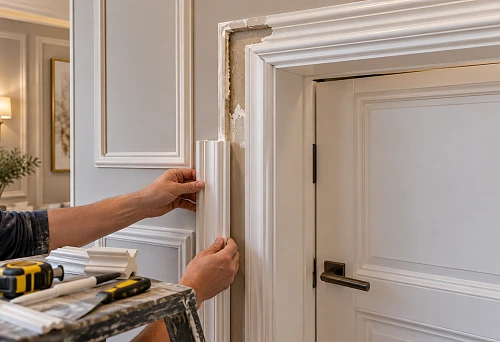
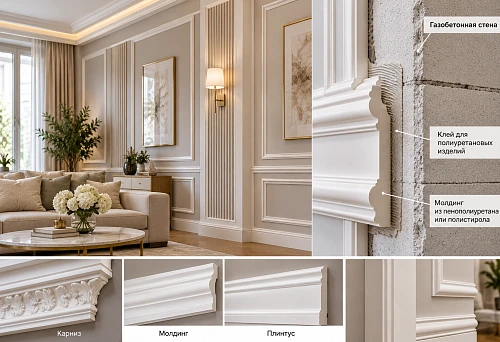
Article Contents:
- Wooden border MLD-041 36×11 mm: which three versions can actually be bought
- MLD-041 made of MDF 36×11×2600 mm
- Beech wooden border MLD-041 36×11×2400 mm
- Oak furniture profile MLD-041 36×11×2400 mm
- Why the length of 2600/2400 mm matters more than the price per single strip
- Why the perimeter of one conditional frame is 2000 mm
- Why 16×2 m = 32 m is only the initial figure
- Four parts of 600 mm each
- Six parts of 400 mm each
- Two parts of 600 mm and three of 400 mm
- Three parts 600 + one 400 mm
- Why short 400 mm pieces are convenient as fillers
- Why you cannot build a cutting scheme without the kerf width
- 4×600 mm nominally gives 2400 mm
- 6×400 mm has the same problem
- Which dense patterns work
- Working map for 15 strips
- Why shorter length does not mean catastrophic waste increase
- Part length along the outer side of the frame
- Length along the inner light opening
- Why these dimensions cannot be mixed
- Where to get the 600×400 mm size
- How to create a unified part drawing
- Size of the glass itself
- Size of the visible opening
- External frame size
- Mounting seat size
- Why this matters specifically for purchasing
- Small furniture doors
- Width of the glass field
- Offset to the facade edge
- When 36 mm looks proportional
- When to check MLD-042 55×15 mm
- The original workpiece is longer
- Low current price of MLD-041 MDF
- Covering finish
- Repeatability of 16 identical frames
- When MDF is more rational than solid wood
- Natural Wood
- Painting or tinting
- Repeatability of the series
- Sorting parts four pieces per facade
- First, the parts map
- Then, the number of initial rods
- Then, the reserve
- Only then, the order
- Why reserve in parts is better than a percentage
- Why 'one strip = one frame' is inefficient
- For 2400 mm
- When parts cannot be fully mixed
- What else can be recorded
- Why store the original whip number
- Check 36 mm on a real facade
- Compare material
- Check next to glass
- Agree on profile with customer
- Formula for one log
- Why the number of cuts is n−1
- Error 1. Counting 600×400 as the border length without a drawing
- Error 2. Dividing 32 m by the length of the log
- Error 3. Counting 4×600 from 2400 as a real scheme
- Error 4. Adding standard 10% without a map
- Error 5. Cutting frames one by one
- Error 6. Mixing internal and external dimensions of tenons
- Error 7. Choosing oak before checking 36 mm
- Error 8. Not sorting oak into sets
- Error 9. Not accounting for end trimming
- Error 10. Not saving useful offcuts
- For MDF 2600 mm
- For beech or oak 2400 mm
- MDF 2600 mm
- 2400 мм
- But the conclusion cannot be transferred to any sizes
- Step 1. List all pieces
- Step 2. Record the useful length of the stock
- Step 3. Make the cut
- Step 4. Iterate through combinations
- Step 5. Calculate the remainder
- Step 6. Cover the exact quantity
- Step 7. Add reserve separately
- 1. Number of initial planks
- 2. Total remainder
- 3. Production flow convenience
- Approach A. First, sort the logs
- Approach B. First, cut, then match
- MDF 2600 mm
- 2400 mm array
- Production conclusion
- By facades
- By types
- What size is MLD-041?
- What is the length of MLD-041 made of MDF?
- What is the length of MLD-041 made of oak and beech?
- Is MLD-041 suitable for furniture facades?
- Can MLD-041 be used around a glass insert?
- How much MLD-041 is needed for a 600×400 mm frame?
- How many parts are needed for 16 frames?
- What is the total net footage?
- Why can't you just buy 13 MDF strips?
- Why can't you buy 14 beech or oak strips?
- How many MDF strips are obtained in the working example?
- How many beech or oak strips?
- Which MDF map is used in the example?
- Which solid wood map is used in the example?
- Why don't 4×600 fit into 2400 mm?
- Why don't 6×400 fit into 2400?
- What is more profitable — MDF, beech, or oak?
- How much does the profile cost for 16 facades in the base map?
- Do I need to buy a spare?
- Can I get a reserve from the base cut?
- What is OMLD-005 for?
- When does MLD-042 make sense?
- Do I need to account for the width of the cut?
- How do I find out the kerf width?
- Do I need to account for end trimming?
- What does a length of 600 mm mean for a miter cut?
- If 600×400 is the glass size, can I use this article for ordering?
- What to do if the lengths became 650 and 450 mm?
- Can I cut each frame from a separate bar?
- How to mark the parts?
- How to kit out oak?
- Do I need to store the leftovers?
- Where to buy MLD-041?
- Where to buy furniture moldings if the profile is still being selected?
- How to check the current price?
- How to order MLD-041?
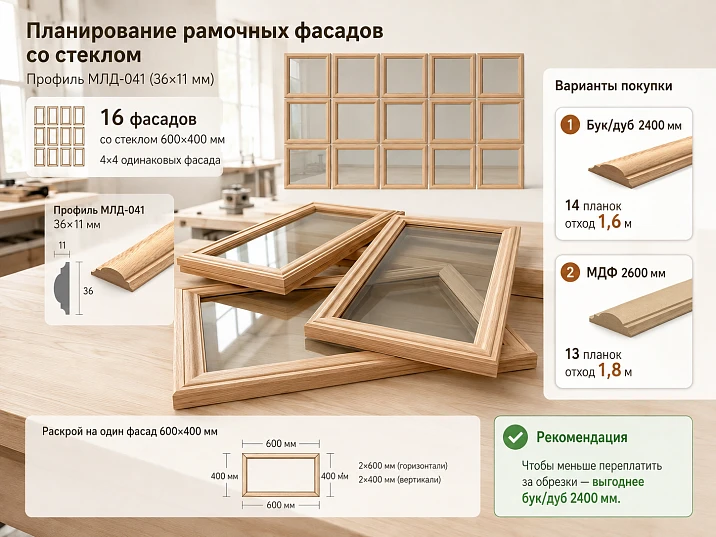
For a series of 16 identical furniture facades, a specific decorative profile has been selected — a wooden border MLD-041 36×11 mm. The project includes glass inserts 600×400 mm, and for the calculation example, after approval of the structural drawing, it is expected to obtain 32 parts 600 mm long and 32 parts 400 mm long.
The pure arithmetic looks simple:
32 × 600 + 32 × 400 = 32,000 mm = 32 linear m.
But 32 meters is not a finished order.
If you simply divide 32 m by the length of MLD-041, you get:
-
32 / 2.6 ≈ 12.31 — the mathematical minimum is 13 MDF strips of 2600 mm;
-
32 / 2.4 ≈ 13.33 — the mathematical minimum is 14 beech or oak strips of 2400 mm.
These numbers look nice, but they are insufficient for real production. Each part is cut from a specific strip, material is lost to the saw kerf between cuts, ends may require trimming, and frame parts often have 45° miters. In addition, 600×400 mm in a real project may be the size of the glass, not the length of the finished MLD-041 parts. Then you first need to determine the internal light opening, glass overlap, external frame size, and the miter cut dimension line — and only then fix the lengths of 600 and 400 mm.
Therefore, the article is built on two levels.
The first is a calculated educational case, where after constructive coordination, 32 parts of 600 mm and 32 of 400 mm are indeed needed.
The second is a production check that explains why, before purchasing, you cannot automatically transfer the size of the glass insert to the length of the border.
For the working cutting example below, we will introduce conditional technological parameters of the workshop:
-
saw kerf width — 3 mm;
-
trimming/refreshing the ends of the original log — 5 mm from each end, i.e., 10 mm per log.
These are not characteristics of MLD-041 and not a STAVROS standard. This is a calculation model that shows how even a few millimeters of technological losses change the cutting map. In real production, you need to substitute the actual kerf width of the specific saw, the miter cutting method, and your own allowances.
With these inputs, an important result is obtained:
-
for MLD-041 MDF 2600 mm — 14 original logs in the optimized calculation map;
-
for beech/oak 2400 mm — 15 original logs.
That is, the additional 200 mm of MDF does reduce the number of purchased planks by one piece in this specific case. But the savings arise not because 2600 is "always better than 2400," but because the specific 600/400 mm parts are packed differently into the two standard lengths after accounting for the kerf.
According to the current MLD-041 card:
-
MDF 36×11×2600 mm — 790 ₽;
-
beech 36×11×2400 mm — 1,790 ₽;
-
oak 36×11×2400 mm — 2,440 ₽.
For the base map without additional reserve, the product cost is:
-
14 × 790 = 11,060 ₽ for MDF;
-
15 × 1,790 = 26,850 ₽ for beech;
-
15 × 2,440 = 36,600 ₽ for oak.
But even these amounts are not yet the full cost of the series. You need to add finishing, sorting of the array, possible defects, technological reserve, corner processing, assembly, and delivery.
If the dimensions of the parts are already finally approved and MLD-041 is selected, you can buy wooden border MLD-041 36×11 mm according to the calculated map. If 600×400 mm currently only denotes the glass, buying 14 or 15 strips is premature: first, the frame structure is needed.
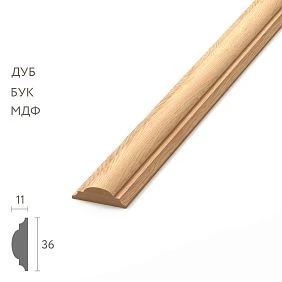
Wooden border MLD-041 36×11 mm: which three versions can you actually buy
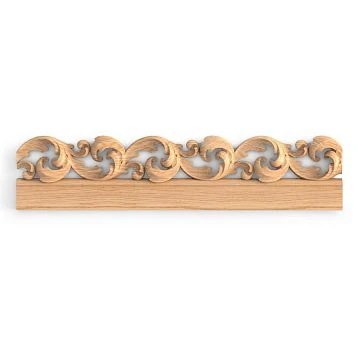
MLD-041 has a compact cross-section of 36×11 mm and is positioned as a profile for frame furniture structures, decorative panels, and units with glass inserts. For the facade series, this means the profile was not chosen randomly: its geometry is already tied to a specific furniture task.
According to the current product card, three main versions are available:
| Material | Size | Price at the time of check |
|---|---|---|
| MDF | 36×11×2600 mm | 790 ₽ |
| Beech | 36×11×2400 mm | 1 790 ₽ |
| Oak | 36×11×2400 mm | 2 440 ₽ |
At the time of checking, the card shows the item in stock and indicates an average production time of 5–10 business days for out-of-stock positions. Before placing an order for the series, availability and price should be re-checked: warehouse stock changes.




MLD-041 made of MDF 36×11×2600 mm
MDF is interesting for three reasons at once.
The first is the length of 2600 mm.
The second is the lowest current price of the original strip.
The third is logical compatibility with covering paint, if the facade series must have the same color, and the natural texture is not part of the design.
But the advantage of length needs to be proven with a map. If the parts do not use the extra 200 mm, MDF wins only in price and finish logic, not in the number of strips.
Our factory also produces:
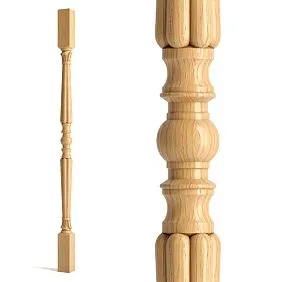

Beech wooden border MLD-041 36×11×2400 mm
Beech is solid wood with a length of 2400 mm.
It may be needed if furniture production fundamentally uses solid wood, if visible ends must remain wooden, or if the project involves tinting/semi-transparent finishing.
For a painted series, beech should not be chosen automatically just because of the word "wooden." If MDF fits the technical specification and finish, the price difference on 15 strips becomes significant.
Get Consultation
Oak furniture profile MLD-041 36×11×2400 mm
Oak is the most expensive option.
It is rational to choose it when the natural texture must remain visible and is part of the facade design.
In such a series, another production factor is added to the profile price: the parts need to be distributed across 16 frames so that one frame does not accidentally get four sharply different tone elements.
Therefore, oak cutting cannot be optimized only by millimeters. Sometimes visual sorting forces you to abandon the mathematically densest combination of parts.
Why length 2600/2400 mm is more important than the price per plank
The comparison "790 vs 1790 vs 2440" shows the material price, but not the quantity.
For 64 parts, the difference of one plank means:
-
for MDF plus/minus 790 ₽;
-
for beech — 1,790 ₽;
-
for oak — 2,440 ₽.
Therefore, an error in the map is especially sensitive on oak.
Buy furniture molding for 16 facades: first we count parts, not linear meters
If you need buy furniture molding for serial production, the calculation starts not with the total perimeter, but with the list of parts.
In the training case, after the construct is approved, one frame requires:
-
two parts of 600 mm each;
-
two pieces of 400 mm.
For 16 frames:
-
32 parts × 600 mm;
-
32 parts × 400 mm.
Total:
64 finished elements.
Why the perimeter of one conditional frame is 2000 mm
2 × 600 + 2 × 400 = 2000 mm.
For 16 frames:
16 × 2000 = 32,000 mm.
This is the control sum of the net length.
Why 16×2 m = 32 m — only the initial figure
Because the whip cannot be used without losses.
To get four parts of 600 mm from one blank of 2400 mm, you would need to have:
600 + 600 + 600 + 600 = exactly 2400 mm
and zero kerf.
In a real workshop, the saw blade removes material.
With a conditional kerf of 3 mm, four parts require at least:
4 × 600 + 3 × 3 = 2409 mm,
not counting end trimming.
From a 2400 mm blank, such a scheme is already impossible.
This is one of the main practical conclusions of the article.
MLD-041 from MDF 2600 mm: which cutting schemes to check
For a 2600-millimeter workpiece and a calculated useful size of 2590 mm after two end trims of 5 mm each, let's check several combinations.
Four parts of 600 mm each
Part length:
4 × 600 = 2400 mm.
Three intermediate cuts:
3 × 3 = 9 mm.
Total:
2409 mm.
Useful length — 2590 mm.
Remainder:
2590 − 2409 = 181 mm.
The scheme works.
Six parts of 400 mm each
6 × 400 = 2400 mm.
Five cuts:
5 × 3 = 15 mm.
Total:
2415 mm.
Remainder:
2590 − 2415 = 175 mm.
The scheme is also workable.
Two parts of 600 and three of 400 mm
2 × 600 + 3 × 400 = 2400 mm.
Four cuts:
4 × 3 = 12 mm.
Total:
2412 mm.
Remainder:
178 mm.
This is another dense option.
Three parts 600 + one 400 mm
3 × 600 + 400 = 2200 mm.
Three cuts:
9 mm.
Total 2209 mm.
Remainder:
381 mm.
The second part of 400 mm no longer fits — even before accounting for the next cut.
Why short 400 mm pieces are convenient as fillers
They allow combining the remainder after long elements.
But the specific optimization depends on the quantity of each type.
For 32 long and 32 short pieces, one of the simplest optimal layouts on 14 rods of 2600 mm is:
-
8 rods × 4 pieces of 600 mm = 32 long pieces;
-
5 rods × 6 pieces of 400 mm = 30 short pieces;
-
1 rod × 2 pieces of 400 mm = another 2 short pieces.
Total:
-
14 rods;
-
32 pieces of 600;
-
32 pieces of 400.
This map does not claim to be the only possible one. It shows a provable variant with a conditional kerf of 3 mm and 10 mm of total end allowance.
Why you can't build a cutting layout without considering the kerf width
Because the nominal combination that "fits exactly" becomes longer in the workshop due to losses between parts.
That's why the calculation 2400 = 4×600 is misleading.
Beech and oak MLD-041 2400 mm: why a shorter length doesn't always mean more waste
For 2400 mm, after a conditional end trimming of 10 mm, the useful length is 2390 mm.
4×600 mm nominally gives 2400 mm
But with kerfs:
2400 + 9 = 2409 mm.
This is more than 2390 and more than the board itself at 2400.
The layout is impossible.
6×400 mm has the same problem
2400 + 15 = 2415 mm.
Also impossible.
Which dense layouts work
3×600 + 1×400:
1800 + 400 + 9 = 2209 mm.
Remainder from 2390:
181 mm.
1×600 + 4×400:
600 + 1600 + 12 = 2212 mm.
Remainder:
178 mm.
Both layouts use the 2400-mm rod well.
Working map for 15 rods
One option that exactly covers 32 long and 32 short parts:
-
9 whips according to the scheme 3×600 + 1×400;
-
5 whips according to the scheme 1×600 + 4×400;
-
1 whip with 3×400.
Let's calculate:
Parts 600:
9×3 + 5×1 = 27 + 5 = 32.
Parts 400:
9×1 + 5×4 + 3 = 9 + 20 + 3 = 32.
Total:
15 whips of 2400 mm.
Why a shorter length does not mean a catastrophic increase in waste
The difference from 2600 mm is just one whip.
2400 mm is less suitable for a clean scheme of 4×600 and 6×400, but mixed layouts 3+1 and 1+4 use the length quite efficiently.
Therefore, the statement "MDF is 200 mm longer, so there is much less waste" would be an exaggeration.
Buying wooden molding: why you cannot divide 32 m by the length of one plank
If Buy wooden molding by net footage, you get 13 MDF strips or 14 solid wood strips.
But the working map above shows 14 and 15, respectively.
The difference is one plank.
For oak, this single mistake costs 2,440 ₽ at the current price.
For a larger series, the error scales even more.
Therefore, the mathematical minimum is needed only as a check:
the working quantity cannot be less than the mathematical minimum, but almost always must be confirmed by a separate map.
Wooden furniture molding MLD-041: how to account for a 45° cut
Up to this point, the calculation deliberately used ready-made parts with lengths of 600 and 400 mm. But in a furniture frame with a miter joint, the main question is different: what exactly does a length of 600 mm mean — the external dimension, the internal clear opening, or the length of the workpiece between the cut vertices?
If this question is not resolved, any map of 14/15 rods is only an illustration.
Part length along the outer side of the frame
If 600 mm is the external dimension of the assembled frame, the long edge of the miter element is measured along the outer vertices of the 45° cuts.
Then the internal length of the clear opening will be smaller by an amount related to the profile width and the geometry of the joint.
Length along the internal clear opening
If 600×400 mm is the size of the visible glass field, the lengths of the MLD-041 elements will be larger.
With a profile width of 36 mm, simply adding "36 mm on each side" should not be applied automatically without a construction drawing: it is necessary to consider where exactly the miter joint line runs, how the glass is fixed, and which part of the profile overlaps it.
Why these dimensions cannot be mixed
Let's imagine two workshops.
The first one gets the record:
horizontal 600 mm.
She understands it as an external dimension.
The second one — as an internal clear dimension.
Both cut MLD-041 accurately, but get different frames.
Therefore, for the series, one dimensional system should be used.
Where to get the 600×400 mm dimension
From the approved assembly drawing.
If in the original task 600×400 is exactly the glass insert, after design, for example, parts 640/440, 670/470, or other dimensions may result. The article should not invent them.
Only after this is the cutting repeated.
How to create a unified part drawing
For each position, it is useful to specify:
-
article number — MLD-041;
-
material;
-
profile 36×11 mm;
-
length along outer vertices;
-
left cut angle;
-
right cut angle;
-
designation of the front side;
-
the facade number;
-
finish.
For serial 64 parts, such a document sharply reduces the number of disputes at the cutting site.
Glass insert 600×400 mm: what frame size should be considered actual
The phrase "glass facade 600×400" can mean several different objects.
The size of the glass itself
This is the physical dimension of the glass part.
The size of the visible opening
It can be smaller than the glass if the edge of the glass extends behind the decorative profile.
The external size of the frame
It is larger than the internal opening by the width of the profile and structural zones.
The size of the mounting seat
If MLD-041 is used not only as a front frame but also participates in holding the insert, another dimension line appears.
Why this is important specifically for procurement
Suppose that after construction, the horizontal length grew not from 600 to 610, but to 670 mm.
Then the previous dense layouts stop working.
for 2600 mm:
3×670 + 1×400 = 2410 mm without cutting.
With conditional 3-millimeter cuts:
2410 + 9 = 2419 mm.
The layout still fits into the useful 2590 mm.
But four parts of 670:
2680 mm before cutting — already impossible.
The number of rods changes.
That is why the final order cannot be built based on the glass size.
MLD-041 with a width of 36 mm: is this scale sufficient for a facade?
This article should not repeat the separate comparison of MLD-041 and MLD-042, but the serial batch has a checkpoint: 36 mm must be physically approved before purchasing all the rods.
Small furniture doors
On a compact facade, 36 mm can look quite expressive.
Width of the glass field
The smaller the glass, the larger the share of the facade visually occupied by the border.
Indent to the edge of the facade
If MLD-041 is used inside a larger facade, the width of the field between the frame and the outer edge is important.
When 36 mm looks proportional
When the sample shows the right balance:
-
the glass does not seem pinched;
-
the frame does not look too thin;
-
the profile matches the handles and adjacent fronts.
When to check MLD-042 55×15 mm
If 36 mm at real scale looks too small, you can briefly check an alternative — buy a wooden border MLD-042 55×15 mm.
But this should happen before cutting MLD-041.
After ordering 14–15 rods, it is too late to change the profile scale.
Buy wooden MDF furniture molding: when 2600 mm really helps the series
If the project involves covering paint, buy wooden furniture molding In MDF execution, it may be the most economically viable option.
The initial workpiece is longer
2600 mm allows for the following schemes:
-
4×600;
-
6×400;
-
2×600 + 3×400;
given our conditional technological tolerance.
Low current price of MLD-041 MDF
14 rods × 790 ₽ = 11,060 ₽.
For beech, 15×1790 = 26,850 ₽.
The difference:
26 850 − 11 060 = 15 790 ₽.
For oak:
36 600 − 11 060 = 25 540 ₽.
This is no longer a "slight difference in material."
Cladding finish
If all 16 facades are painted with dense enamel, the natural texture of beech or oak is not a visible advantage.
Repeatability of 16 identical frames
MDF is convenient for series where a uniform surface for finishing is important.
When MDF is more rational than solid wood
If simultaneously:
-
the client does not require solid wood;
-
transparent finish is not needed;
-
the construction allows MDF;
-
the humidity regime of the furniture is standard interior;
-
the chosen fastening system matches the project.
Then expensive solid wood needs separate justification.
Beech border MLD-041: when material matters more than optimal cutting
Beech may lose to MDF in price and length, but win in terms of specific furniture requirements.
Natural wood
If the material must be solid wood, MDF is excluded even before the map.
Painting or tinting
Beech is often used under enamel, but can also be used in other agreed finishing systems.
Series repeatability
In natural material, slats need to be sorted.
Sorting parts in groups of four per facade
After cutting, it is better to kit:
-
F01-L;
-
F01-R;
-
F01-T;
-
F01-B.
If the paint is opaque, the wood shade is less critical.
If the finish is semi-transparent, it is significantly more critical.
Oak MLD-041: how not to lose money on an incorrect cutting map
On oak, the cost of a mistake is most noticeable.
First, the parts map
Not the total footage.
Then the number of initial rods
In the calculation example — 15.
Then the reserve
Not automatic 10%, but specific spare parts.
Only then the order
For example, if a reserve is needed:
-
2 horizontals of 600;
-
2 verticals of 400.
This is one spare frame kit.
Need to check if it can be integrated into an additional whip or into the remnants of the existing map.
Why reserve in details is better than percentage
10% of 15 whips = 1.5.
Rounding up to 2 whips means an extra charge:
2×2440 = 4 880 ₽.
But the project may only need one additional whip, from which the necessary repair elements are obtained.
How to distribute MLD-041 parts among 16 frames
It is not necessary to cut each facade from a separate plank.
This worsens the cutting layout.
It's better to consider all 64 parts as a common pool:
-
32×600;
-
32×400.
After cutting, the parts are sorted by facades.
Why "one plank = one frame" is inefficient
One frame requires 2000 mm of clean length.
If using a separate 2600 mm stick for each frame:
16×2600 = 41,600 mm of purchased material.
With an optimized layout of 14×2600:
36,400 mm.
The difference:
5,200 mm.
These are two whole MDF strips.
For 2400 mm
If using 16 strips on the principle of "one frame — one strip":
38,400 mm.
Optimized layout — 15×2400:
36,000 mm.
One strip is saved.
When parts cannot be fully mixed
For oak with a clear finish, it may be useful to maintain tonal compatibility.
Then sorting is done before or after cutting with group marking.
How to mark parts after cutting a wooden border
Marking turns a common pool into a manageable series.
Example:
-
F01-L — left;
-
F01-R — right;
-
F01-T — top;
-
F01-B — bottom.
Up to F16.
What else can be recorded
For solid wood:
-
whip number;
-
tonal group;
-
side;
-
Texture direction.
Why store the original billet number
If a material defect is later found on one frame, related parts can be checked.
OMLD-005 sample set: is it needed before ordering MLD-041
Useful before purchasing the series Buy OMLD-005 molding sample set, if MLD-041 is not yet physically approved.
Check 36 mm on a real facade
The photo does not show scale.
Compare material
MDF, beech, and oak give different effects.
Check near the glass
The glass shine enhances the perception of the frame.
Coordinate the profile with the customer
One physical sample is cheaper than redoing 16 facades.
MLD-041 price: what to really compare between MDF, beech, and oak
Full formula:
source rods + waste + processing + finishing + defects + reserve + logistics.
For our calculation example without reserve:
| Parameter | MDF 2600 | Beech 2400 | Oak 2400 |
|---|---|---|---|
| Source rods | 14 | 15 | 15 |
| Rod price | 790 ₽ | 1 790 ₽ | 2 440 ₽ |
| profile cost | 11 060 ₽ | 26 850 ₽ | 36 600 ₽ |
| Purchased length | 36.4 m | 36.0 m | 36.0 m |
| Net length of parts | 32 м | 32 м | 32 м |
Interesting result: MDF uses fewer sticks, but more total length is purchased because one stick is longer.
Therefore, the metric 'total waste in meters' and 'number of commercial strips' are different metrics.
Waste MLD-041: should be calculated by the map, not by feelings
For MDF:
36.4 m purchased − 32 m of finished parts = 4.4 m difference.
But this includes:
-
saw cut;
-
end trimming;
-
actual leftovers.
For 2400:
36.0 − 32 = 4.0 m.
That is, with this map, the array has a slightly smaller difference in total purchased length, although it requires one more plank.
This again shows why one cannot claim that 2600 mm “always reduces waste.”
How to account for the actual cut at the production site
Before the final order, the specific blade is measured.
The conditional 3 mm from the article is not used.
If the cut is 2.2 mm, some maps get a bit more allowance.
If it is 4 mm, slightly less.
Formula for one rod
For n parts:
Lconsumed = sum of part lengths + (n−1)×k + end allowance
Where:
-
k — actual kerf;
-
end allowance — the actual value from the workshop.
Why the number of cuts is n−1
If n sequential parts are obtained from one continuous piece and the end is already prepared, there are n−1 separating cuts between them. In real operations, there may be additional cuts for trimming and mitering, so the technologist must calculate their own route.
How to account for a 45° miter without double allowance
A common mistake is to first add a large allowance to the length, and then add the same amount again to the part size.
If 600 mm is already specified as the length between the outer vertices of the finished miters, do not add the profile width 'for the angle' again.
You only need to account for the technology of obtaining these vertices from the workpiece.
If 600 mm is the internal opening, then the calculation is different.
The main thing is one dimensional system.
When MLD-041 does NOT need to be purchased yet
The purchase is postponed if:
-
600×400 is only the glass size;
-
the external frame size is not built;
-
the size line of the whiskers is not defined;
-
the actual cut is unknown;
-
the material has not been chosen;
-
the 36 mm profile is not physically fitted;
-
the 2400/2600 map is not built;
-
The quantity is calculated only for 32 meters.
When the wooden border MLD-041 can already be ordered
The order is ready if:
-
The dimensions of all facades are confirmed;
-
The glass is confirmed;
-
The frame structure is built;
-
64 ready-made parts are defined;
-
The 45° dimension line is fixed;
-
The cut is measured;
-
material selected;
-
The cutting map is built;
-
The reserve is calculated;
-
finish approved;
-
current price and availability have been rechecked.
How to order MLD-041 for a series of furniture facades
Example string:
MLD-041 / 36×11 mm / MDF 2600 / 16 frames / 32 parts 600 mm + 32 parts 400 mm / size by outer miter vertices / machine cut 3 mm / end allowance 10 mm per strip / working quantity 14 slats / reserve ___ / enamel ___
For beech/oak:
MLD-041 / 36×11×2400 / 15 slats per map / reserve ___ / finish ___
After that, you can order MLD-041 for furniture facades already based on the provable quantity.
Errors in calculating MLD-041
Error 1. Counting 600×400 as the border length without a drawing
The cause is confusion between the glass size and the frame size.
The consequence is that all 64 parts are the wrong size.
Error 2. Dividing 32 m by the length of the whip
The cause is ignoring discrete cutting.
The consequence is an under-order.
Error 3. Considering 4×600 from 2400 as the real scheme
The cause is a forgotten cut.
The consequence is that the fourth part does not fit.
Error 4. Adding standard 10% without a map
The cause is habit.
Consequence — an especially expensive extra oak.
Mistake 5. Cutting frames one at a time
Reason — convenience of marking.
Consequence — more waste.
Mistake 6. Mixing internal and external miter dimensions
Reason — no single drawing.
Consequence — frames do not assemble.
Mistake 7. Choosing oak before checking 36 mm
Reason — the material is liked from a photo.
Consequence — after purchase, MLD-042 turns out to be needed.
Error 8. Do not sort oak by kits
Reason — optimization of length only.
Consequence — one frame visually looks "striped."
Error 9. Do not account for end trimming
Reason — the whip is considered ideal along its entire length.
Consequence — the map works only on paper.
Error 10. Do not save useful offcuts
Reason — the series is finished.
Consequence — there is no material for a repair frame.
Practical scenario: add one spare frame to a series of 16 facades
Instead of an abstract 5–10% reserve, you can calculate a specific repair frame.
One conditional frame requires:
-
2×600 mm;
-
2×400 mm.
That is, another 2000 mm of clean parts.
For MDF 2600 mm
One additional strip allows you to get, for example:
600 + 600 + 400 + 400 = 2000 mm
plus three cuts of 3 mm each:
2009 mm.
With the end allowance, the model still fits within 2600 mm.
That is, the 15th MDF strip can become a full spare set for one frame.
Reserve cost:
790 ₽ for the original profile plus processing and finishing.
For beech or oak 2400 mm
The same combination:
600+600+400+400 + 9 = 2009 mm.
It also fits within the usable 2390 mm.
This means the 16th solid wood strip can provide a spare frame.
Cost:
-
beech — 1,790 ₽;
-
Oak — 2,440 RUB.
This is much more accurate than automatically buying two additional oak whips at "10%."
Practical scenario: need a reserve for only two long parts
Suppose the risk of damage is higher specifically for 600 mm horizontals.
Need two spare parts.
They may not be obtainable from the base card's leftovers.
Then one additional whip of 2400 or 2600 mm gives more reserve than needed right away.
In this situation, you can consider whether there are on site:
-
adjacent facade;
-
decorative insert;
-
a test part;
-
a reserve for future repairs.
If not, the excess material remains as a conscious reserve.
Practical scenario: the kerf width is not 3 but 4 mm
Let's check the sensitivity of the map.
MDF 2600 mm
4×600:
2400 + 3×4 = 2412 mm.
It still fits.
6×400:
2400 + 5×4 = 2420 mm.
It fits too.
The basic 14 rods remain possible with a 10 mm end allowance.
2400 мм
3×600 + 400:
2200 + 3×4 = 2212 mm.
It works.
600 + 4×400:
2200 + 4×4 = 2216 mm.
It works.
The working map of 15 whips is also preserved.
This is a good result: our illustrative map does not collapse when the cut increases from 3 to 4 mm.
But the conclusion cannot be transferred to any sizes.
If the parts are 620/420 or 670/470, the margin will change.
Therefore, the actual lengths after the design need to be recalculated.
Practical scenario: end trimming of 20 mm instead of 10 mm
Useful lengths:
-
2580 mm for MDF;
-
2380 mm for solid wood.
Dense layouts:
4×600 + 9 = 2409 — MDF passes.
6×400 + 15 = 2415 — MDF passes.
3×600+400+9 = 2209 — 2400 passes.
600+4×400+12 = 2212 — also passes.
The quantity again does not change.
This does not mean that allowances are not important. It's just that in this particular set of parts, the sheets have sufficient leftover.
Practical scenario: finished parts became 620 and 420 mm
Let's imagine that after refining the frame, it turns out:
-
32×620;
-
32×420.
Net length:
32×620 + 32×420 = 33,280 mm.
Now the previous map cannot be used.
For MDF 2600:
4×620 = 2480 mm.
With three cuts of 3 mm each:
2489 mm.
With 10 mm of end allowance — the actual requirement is 2499 mm in a full log of 2600 mm.
It works.
6×420:
2520 + 15 = 2535 mm.
With ends — 2545 mm.
That also works.
Probably 14 logs can still be assembled, but this needs to be proven with a new map.
For 2400:
3×620 + 420 = 2280 mm.
With 9 mm cuts and 10 mm ends:
2299 mm.
It works.
620 + 4×420 = 2300 mm.
With four 12 mm cuts and 10 mm ends:
2322 mm.
That also works.
But the leftovers are already significantly smaller.
This shows why a size adjustment of 20 mm may not change the quantity yet, but reduces the technological allowance.
Practical scenario: parts 650 and 450 mm
Net length:
32×650 + 32×450 = 35,200 mm.
For MDF:
4×650 = 2600 mm — already without a cut equals the full length.
The layout is impossible.
Need to look for mixed combinations.
For 2400:
3×650 + 450 = 2400 mm — also impossible with a cut.
That is, changing dimensions by just 50 mm completely destroys the previous tight layouts.
This is one of the strongest arguments against ordering glass to size.
How to independently check a cutting layout without complex software
For 16 frames, a simple table is enough.
Step 1. List all parts
For example:
| Type | Length | Quantity |
|---|---|---|
| H | 600 | 32 |
| V | 400 | 32 |
Step 2. Record the useful length of the profile
For the calculation model:
-
MLD-041 MDF: 2590 mm;
-
beech/oak: 2390 mm.
Step 3. Record the cut
3 mm.
Step 4. Iterate through combinations
For 2600:
-
4H;
-
6V;
-
2H+3V;
-
3H+1V.
For 2400:
-
3H+1V;
-
1H+4V;
-
2H+2V;
-
5V.
Step 5. Calculate the remainder
Combinations with a large remainder are not always bad if that remainder is used later.
Step 6. Cover the exact quantity
Need to get exactly:
-
32 H;
-
32 V.
Step 7. Add reserve separately
Do not mix the reserve with the mandatory quantity.
Why the 'longest element first' algorithm is usually useful but not always optimal
A simple production approach:
-
first distribute 600 parts;
-
fill the remainder with 400.
For MLD-041 this works quite well.
But if the ratio of long and short parts is different, a denser map may start with mixed combinations.
Therefore, for large batches it makes sense to use a cutting optimizer or at least a spreadsheet.
How to compare maps by three metrics
The shortest map by number of strips is not always the best.
Look:
1. Number of source slats
Affects purchasing and packaging.
2. Total remainder
Affects material efficiency.
3. Production flow convenience
Monotonous patterns are easier to cut without errors.
For example, an MDF map:
-
8 identical strips 4×600;
-
5 identical 6×400;
-
1 short pattern.
Very simple for the workshop.
A solid wood map of 9+5+1 is also quite clear.
The price of production simplicity
Imagine that a more complex optimal map saves one whip but requires 8 different cutting schemes.
On MDF, the savings are 790 ₽.
If the operator, due to complexity, makes one mistake and ruins the profile, the savings disappear.
For oak, the price of a whip is higher, so complex optimization may be more justified.
This is a compromise between material and risk.
How to mark source whips before cutting
You can use a code:
-
M01…M14 for MDF;
-
B01…B15 for beech;
-
O01…O15 for oak.
In the map:
M01–M08 → 4×600
M09–M13 → 6×400
M14 → 2×400
After cutting, parts receive their facade marking.
How to assemble oak by grain without destroying the map
Two approaches are possible.
Approach A. First, sorting of logs
Logs are divided into tonal groups.
Then, within each group, a map is made.
Approach B. First cutting, then assembling
All parts are marked according to the original log, then visually compatible sets are assembled.
The first approach better controls tone, the second gives more freedom in lengths.
What to do with knots, contrast, and local features of the array
In the article, you cannot assign an acceptable defect class on your own.
You need to use the actual quality of the batch and the customer's requirements.
For a transparent series before cutting, it is useful to determine which profile zones may end up on the face part.
If a separate part of the whip is not visually suitable, the map actually loses useful length.
This is another reason to have a reserve in oak.
MDF and painting: why profile savings can be eaten up by finishing
The cheapest source material does not always give the cheapest finished frame.
Need to consider:
-
primer;
-
interlayer sanding;
-
enamel;
-
drying;
-
control.
If the beech technology is already debugged
How to order a reserve without mixing with the base card
In the specification:
-
working quantity — 14 rods;
-
reserve — 1 rod;
-
total to purchase — 15.
So in a month it's clear why we bought 15, although the base card requires 14.
Financial table with one reserve rod
| Material | Base | Reserve | Total | Cost |
|---|---|---|---|---|
| MDF | 14 | 1 | 15 | 11 850 ₽ |
| Beech | 15 | 1 | 16 | 28 640 ₽ |
| Oak | 15 | 1 | 16 | 39 040 ₽ |
The reserve is significantly more expensive on the array.
Therefore, its purpose must be deliberate.
When a spare plank is not needed
if:
-
the first pilot facade is already assembled;
-
the map is verified;
-
the machine is stable;
-
the material is available for quick reordering;
-
the leftovers provide repair parts.
Then you can do without a full spare whip.
When a spare plank is justified
if:
-
oak with custom tinting;
-
the object is far away;
-
repeat delivery is expensive;
-
The series must be closed with a single visit;
-
The batch invoice is critical.
How to check savings per finished facade
Base cost of MLD-041:
MDF:
11,060 / 16 ≈ 691.25 ₽ per facade.
Beech:
26 850 / 16 ≈ 1 678,13 ₽.
Oak:
36 600 / 16 = 2 287,50 ₽.
This is only the initial profile without finish and labor.
Difference between MDF and oak:
≈ 1,596 ₽ per facade.
For 16 facades — the same 25,540 ₽.
This makes it easier to compare the material in the product estimate.
Practical scenario: glass dimensions confirmed, but the facade turned out to be 20 mm larger on each side
This is a typical point where the initial purchase could have been erroneous.
Suppose glass 600×400 mm is confirmed, but after building the decorative frame of MLD-041, the lengths turned out:
-
32 pieces of 640 mm;
-
32 pieces of 440 mm.
Net length:
32×640 + 32×440 = 34,560 mm.
The old map 600/400 is no longer used.
MDF 2600 mm
Let's check several schemes with the same conditional cut of 3 mm and 10 mm end allowance.
4×640:
2560 + 9 = 2569 mm within the useful 2590 mm.
The scheme works, but the margin is only 21 mm.
5×440:
2200 + 12 = 2212 mm.
6×440:
2640 + 15 = 2655 mm — does not fit.
Mixed scheme:
3×640 + 1×440 = 2360 + 9 = 2369 mm.
It works.
Array 2400 mm
3×640 + 1×440:
2360 + 9 = 2369 mm.
With a useful 2390 mm, it fits with a margin of 21 mm.
That is, the same size adjustment sharply reduces the technological budget of both cards.
If the cut increases further or more end trimming is needed, the scheme may stop working.
Production conclusion
Buying MLD-041 before approving the size line of the whiskers is more dangerous than it seems. Even a small adjustment to the finished frame can change not only the total footage, but also the allowable combinations within each rod.
Practical scenario: the facades are not all the same
Let's say out of 16 facades:
-
12 standard;
-
4 narrower.
Then you cannot multiply one frame by 16.
You need to form two pools of parts.
For example:
-
24 parts of 600;
-
24 parts of 400;
-
8 parts of 520;
-
8 parts 400.
Now short elements can be used as placeholders between long ones of another type.
In such a batch, the cutting optimizer becomes especially useful.
How to count a mixed series without confusion
Each facade type is assigned a code.
For example:
-
A — 600×400;
-
B — another size.
In the list:
| Facade type | Detail | Length | Quantity |
|---|---|---|---|
| A | H | 600 | 24 |
| A | V | 400 | 24 |
| B | H | 520 | 8 |
| B | V | 400 | 8 |
Then all parts go into the common cutting algorithm.
Why the 181 mm remainder is not necessarily useful
After the 4×600 pattern from a 2600 mm rod, our model leaves about 181 mm of useful length.
It is too short for the main frame.
But it can be used:
-
as a finish sample;
-
as a control piece;
-
for glue testing;
-
for angle checking;
-
as a batch sample.
If there are no such tasks in production, the remainder becomes waste.
Why a large remainder is sometimes better than a small one
A M14 whip in an MDF card, from which only two 400 mm parts are obtained, leaves a large remainder.
At first glance, this is poor optimization.
But this remainder can provide:
-
spare 600;
-
trial parts;
-
repair kit.
If the project is going to buy a reserve anyway, a large remainder of the base card can replace a separate spare whip.
Therefore, the optimizer should consider the usefulness of the remainder, not just the minimum waste percentage.
How to rebuild the MDF card with built-in reserve
Base card:
-
8 whips → 4×600;
-
5 whips → 6×400;
-
1 whip → 2×400.
The last whip has a large remainder.
From it, after two 400 mm parts, you can try to get, for example, 2 more 600 mm parts:
2×400 + 2×600 = 2000 mm.
Three cuts:
9 mm.
Total 2009 mm.
This fits.
Then M14 gives:
-
two mandatory 400 parts;
-
two spare 600 parts.
That is, the basic 14 whips already contain a partial reserve.
This is significantly better than automatically buying a 15th whip if you specifically need spare horizontals.
How to rebuild a massive map for reserve
In the base map, one last whip gives 3×400.
You can add:
600 + 3×400 = 1800 mm.
Three cuts:
9 mm.
Total 1809 mm.
This means that on the same whip, one spare 600-millimeter part fits.
If reserve is needed only for one long side, a separate whip is not required.
Why the cutting map should count mandatory and spare parts in different colors
In Excel or production software, it is convenient:
-
mandatory parts — one color;
-
reserve — another;
-
the rest — a third.
This allows you to remove the reserve at any time and understand the minimum order.
How to account for oak sorting in the cutting map
For natural oak, each log can first be assigned to a group:
-
A — light;
-
B — medium;
-
C — dark.
Then the map is built within groups or with the restriction that parts of one frame must be in compatible groups.
This can increase the number of whips relative to the mathematical minimum.
Such overrun is not an error if its cause is the visual consistency of the series.
How to calculate the cost of sorting
If sorting takes up working time, it is included in the cost of the oak solution.
For example, four hours of a technologist or picker is a real operation.
The article does not set a rate, but recommends including it in the estimate.
How to compare material not by purchase price, but by the cost of the finished series
Formula:
C series = profile + reserve + cutting + marking + sorting + finishing + assembly + defects + logistics.
MDF may win on profile, but require a different painting system.
Beech may be more expensive to purchase, but match the current production process.
Oak can be the most expensive, but it creates premium facade value.
When MLD-041 made of MDF loses despite its low price
For example:
-
the customer requires solid wood;
-
the finish is transparent;
-
visible MDF edges are unacceptable;
-
the furniture technical card is designed for wood;
-
future repairs must be done with the same solid wood.
Then the low price of 790 ₽ is not an argument.
When beech loses to MDF
if:
-
everything is painted with enamel;
-
array is not needed;
-
map 2600 saves the whip;
-
MDF is already used on adjacent elements.
Then the difference of 15,790 ₽ for the base profile should have a specific explanation, otherwise beech just increases the budget.
When oak justifies the maximum cost
if:
-
texture remains open;
-
facades are part of a premium interior;
-
oak supports countertops, panels, or furniture;
-
the client consciously pays for the natural pattern.
Then the material price is part of the design task.
How to check MLD-041 on one pilot facade
Before the whole batch, it is useful to assemble F00.
Check:
-
actual glass size;
-
whisker lengths;
-
45° angle;
-
external size;
-
visible opening;
-
36 mm profile;
-
finish;
-
assembly gap.
After F00, the lengths 600/400 are either confirmed or changed.
Only after this is the map of 14/15 rods finally approved.
Why a pilot facade reduces risk more than one spare rod
A spare rod helps after an error.
The pilot helps prevent errors on all 64 parts.
These are different tools.
What to do if the length changed by 2–3 mm after the pilot
Recalculate the map.
Do not consider the change "too small."
Dense layouts can be sensitive even to a few millimeters.
How to accept the finished 64 parts after cutting
Check:
-
length;
-
grain direction;
-
left/right pair;
-
quality of the front edge;
-
marking;
-
material;
-
Completeness.
Why you cannot mix the right and left parts
With a symmetrical profile, this may go unnoticed.
But if the profile has a pronounced face orientation or finish, the error becomes critical.
Therefore, it is useful to mark L/R in advance.
How to count completeness before assembly
For 16 frames, there should be:
-
16 L;
-
16 R;
-
16 T;
-
16 B.
Total 64.
If some elements come from a common pool of the same length, they still need to be assigned to facades before final assembly.
What packaging of parts to use inside the workshop
After cutting, it is better to kit the parts by facades or by operations.
Two routes are possible:
By facades
F01 — four parts together.
By types
All 600 separately, all 400 separately, then assembly after finishing.
For clear oak, the first route is more convenient due to shade matching.
For painted MDF, the second may be faster.
How to account for loss on test cuts
The first whip may be partially used for setting up the miter saw.
If the pilot is made from commercial MLD-041, its consumption must be included in the map.
Do not assume that the test piece appears out of thin air.
When a separate technological whip is needed
if:
-
new profile;
-
new machine;
-
new finishing system;
-
complex joint;
-
the customer requires several samples.
Then a separate whip may be more rational than ruining the working map.
How to calculate such a whip in an order
Base + technology + reserve.
For example, MDF:
-
base — 14;
-
technological — 1;
-
repair reserve — 0 or 1.
Total 15–16 depending on the project.
This keeps the estimate transparent.
When MLD-041 is NOT yet needed to be purchased — extended checklist
Do not place an order if at least one critical item is unknown:
-
glass 600×400 — this is only a preliminary size;
-
the method of glass installation is not defined;
-
the light opening is not approved;
-
external size not approved;
-
whiskers not defined;
-
cut not measured;
-
36 mm profile not shown to customer;
-
The material has not been selected;
-
finish not selected;
-
map not tested on pilot facade;
-
reserve has no purpose.
When order is ready — production point
Can buy if:
-
F00 assembled;
-
part lengths approved;
-
map has a version number;
-
actual cut is entered;
-
scheme for each log is detailed;
-
material approved;
-
reserve is defined in parts;
-
price rechecked;
-
acceptance and storage are organized.
How to order MLD-041 without ambiguity
Example specification for a calculation case:
MLD-041 / MDF / 36×11×2600 mm / 14 working strips / map CUT-R01 / 32×600 + 32×400 mm, lengths along outer mitre tips / saw kerf 3 mm, end allowance 10 mm per strip / covering enamel / reserve — two 600 mm parts from M14 / pilot F00 approved.
For oak:
MLD-041 / oak / 36×11×2400 mm / 15 working strips / sorting by tone / map CUT-R01 / finish ___ / reserve ___
This way the order can be checked before payment.
FAQ
What is the size of MLD-041?
Cross-section is 36×11 mm.
What is the length of MLD-041 made of MDF?
2600 mm.
What is the length of MLD-041 made of oak and beech?
2400 mm.
Is MLD-041 suitable for furniture fronts?
The card classifies the profile as suitable for frame structures, furniture fronts, glass inserts, and decorative panels.
Can MLD-041 be used around a glass insert?
Yes, if the design of the specific facade is calculated for this profile and the frame dimensions are approved.
How much MLD-041 is needed for a 600×400 mm frame?
If 600×400 are the finished frame part lengths, the net perimeter is 2 m. If it's the glass size, the frame needs to be calculated first.
How many parts are needed for 16 frames?
In the calculation case — 32 of 600 mm and 32 of 400 mm, 64 in total.
What is the total net length?
32 m.
Why can't you just buy 13 MDF strips?
Because 13 is only the result of dividing the total length by 2.6 m. Real cutting with saw kerf requires 14 in our model.
Why can't you buy 14 strips of beech or oak?
14 is the mathematical minimum in terms of length. A working map for 600/400 mm with a conditional cut requires 15.
How many MDF strips are obtained in the working example?
How many strips of beech or oak?
What MDF map is used in the example?
8 strips of 4×600, 5 strips of 6×400, and one strip with the remaining two 400 mm pieces.
What solid wood map is used in the example?
9 strips of 3×600+1×400, 5 strips of 1×600+4×400, and one strip with 3×400.
Why don't 4×600 fit into 2400 mm?
Because there is a cut between the pieces. At 3 mm, about 2409 mm is required.
Why don't 6×400 fit into 2400?
For the same reason: 2400 mm of parts plus five cuts.
Which is more cost-effective — MDF, beech, or oak?
Based on the original profile in our calculation, MDF is cheaper. But the final choice depends on the finish, solid wood requirements, and total cost.
How much does the profile cost for 16 fronts in the basic map?
At the time of check: MDF — 11,060 ₽, beech — 26,850 ₽, oak — 36,600 ₽.
Is it necessary to buy a spare?
Not automatically. It's better to define specific spare parts.
Can I get spare parts from the base cutting layout?
Yes. For example, the large leftover of the last MDF stick can be used for additional 600-millimeter parts.
What is OMLD-005 for?
To physically check the scale and material of the profile before purchasing the series.
When does MLD-042 make sense?
If the 36-mm MLD-041 looks too thin on the actual facade and a wider profile of 55×15 mm is needed.
Do I need to account for the width of the cut?
Absolutely.
How to determine the kerf width?
Measure the actual cut of a specific machine/blade or use confirmed technological data from the workshop.
Should end trimming be taken into account?
Yes, if the production performs it.
What does the length of 600 mm mean for a miter cut?
This should be defined by the drawing: for example, the length along the outer vertices. The parameter cannot be left ambiguous.
If 600×400 is the glass size, can this article be used for ordering?
Only after recalculating the actual lengths of the frame parts.
What to do if the lengths became 650 and 450 mm?
Completely rebuild the map: previous dense combinations stop working.
Can each frame be cut from a separate bar?
Yes, but this may increase waste. For a series, a common pool of parts is more beneficial.
How to mark the parts?
For example, F01-L, F01-R, F01-T, F01-B.
How to assemble oak?
Taking into account the tonal compatibility of four parts of one frame.
Do I need to store leftovers?
Useful leftovers should be kept for repairs and finish samples.
Where to buy MLD-041?
In the MLD-041 card after the final calculation.
Where to buy furniture moldings if the profile is still being selected?
In the STAVROS wooden moldings category.
How to check the current price?
In the product card, right before placing the order.
How to order MLD-041?
Provide the material, length, number of strips, approved details, finish, and reserve.
Final calculation algorithm for MLD-041 for 16 facades
-
Confirm what 600×400 mm means.
-
Assemble a pilot facade.
-
Record the finished lengths of the parts.
-
Record the dimensional line of the miters.
-
Measure the cut.
-
Set end allowances.
-
Choose MDF, beech, or oak.
-
Build a map of 2600 or 2400 mm.
-
Check the mathematical minimum.
-
Calculate the working quantity.
-
Add only justified reserve.
-
Calculate the profile cost.
-
Add processing and finish.
-
Approve the R01 version map.
-
place the order.
-
Accept rods before cutting.
-
Check the first actual rod.
-
After this, run the entire series.
Conclusion
In the calculated scenario with 32 parts of 600 mm and 32 parts of 400 mm, the net length is indeed 32 meters. But dividing these 32 meters by 2400 or 2600 mm gives only the lower mathematical limit, not the working purchase.
In a conditional production example with a saw kerf of 3 mm and end trimming of 5+5 mm:
-
MLD-041 MDF 2600 mm covers the series with 14 sticks;
-
beech or oak 2400 mm — with 15 sticks.
According to prices at the time of verification:
-
MDF — 11,060 ₽;
-
beech — 26,850 ₽;
-
oak — 36,600 ₽.
But before using these figures, you need to confirm the main thing: 600×400 mm must be the exact finished lengths of the frame elements in the accepted dimensional system, not just the size of the glass insert. If it is glass, first calculate the visible opening, profile overlap, outer dimension, and 45° miters — then the entire map is rebuilt from scratch.
The additional 200 mm of MDF in this case reduces the number of strips by one piece, but does not result in a smaller total purchased footage: 14×2600 = 36.4 m versus 15×2400 = 36.0 m. Therefore, "2600 is longer" does not automatically mean "less waste." The correct criterion is how many usable parts are obtained from each original strip during actual cutting.
For the painted MDF series, it often has strong economics. For beech, a specific reason for choosing solid wood is needed. For oak, the natural texture may justify the price, but then the cutting layout must also account for tonal sorting.
After the pilot facade, approval of 64 parts, and verification of actual cutting, it is possible buy wooden border MLD-041 36×11 mm to order in a provable quantity, rather than ordering "32 meters plus ten percent."
Control matrix before payment MLD-041
Before sending the order to the supplier, it is useful to consolidate the entire calculation into a single table. It separates confirmed parameters from working assumptions.
| Parameter | What should be recorded |
|---|---|
| Article number | MLD-041 |
| Profile | 36×11 mm |
| Material | MDF / beech / oak |
| Whip length | 2600 / 2400 mm |
| Glass size | actual size |
| Finished frame size | According to the approved drawing |
| Horizontal length | ___ mm |
| Vertical length | ___ mm |
| Dimension line | by outer / inner vertices |
| Angle | 45° |
| Actual cut | ___ mm |
| End face cleaning | ___ mm |
| Required parts | ___ pcs. |
| Reserve parts | ___ pcs. |
| Working rods | ___ |
| Spare rods | ___ |
| Cutting map | CUT-R__ |
| Finish | ___ |
| Pilot facade | approved / not approved |
| Current price | checked before ordering |
If lengths of parts or actual saw kerf remain empty in this table, the number of rods cannot yet be considered final.
Why 14 and 15 rods are not a universal recommendation for any 600×400 facade
The numbers 14 and 15 apply only to the calculated scenario where, after the design stage, exactly 32 finished parts of 600 mm length and 32 parts of 400 mm length need to be obtained.
If 600×400 mm is the glass size and the finished MLD-041 elements are longer, the quantity may change.
If the workshop uses a different saw kerf, the cutting map is recalculated.
If miters are first cut with a rough allowance and then finished, additional length must be taken into account.
If clear oak is sorted so that individual sections of the rod cannot be used for face parts, the working quantity may also increase.
Therefore, the professional conclusion of the article is not the number "buy 14 MDF or 15 oak rods," but the method by which these numbers are verified for a real project.
What should a purchaser do if production hasn't provided a cutting map yet?
Do not order by total footage.
Instead, request four lines from the technologist:
-
finished length of the horizontal part;
-
finished length of the vertical part;
-
actual saw kerf width;
-
layout map of parts across 2400/2600 mm sticks.
Such a request takes a few minutes and can prevent purchasing extra expensive oak profile or, conversely, an urgent reorder due to a shortage of one plank.
For a serial order of 16 facades, the cutting map should be part of the purchasing documentation alongside the article number and material.
Final savings test: one extra plank versus precise calculation
For MDF, an error of one strip means 790 ₽ on the current card. For beech — 1,790 ₽. For oak — 2,440 ₽. On a single series, this doesn't look like a critical amount compared to the cost of all the furniture, but it is precisely such "small" overpayments on dozens of items that turn a purchase without a card into systematic overspending.
The reverse error is more dangerous: ordering one strip less and stopping the assembly of 16 fronts. Then, to the cost of the missing MLD-041, a new delivery, waiting, re-inspection, the risk of a different batch of solid wood, and production downtime are added.
Therefore, the optimal purchase is not the minimum possible number of strips at any cost. What is needed is a minimum provable working batch that covers all mandatory parts and a predetermined reserve.
For the calculation case, such a base is 14 MDF strips or 15 beech/oak strips. If a technological or repair reserve is needed, it is added as a separate line and its purpose is explained. This maintains budget control and makes subsequent analysis of actual consumption possible.
Check after the first working strip
Before serial cutting, it is useful to take one MLD-041 and perform the full cycle according to the card: end cleaning, first miter, dividing cuts, marking of parts. Then the actual remainder is compared with the calculated one.
If instead of the expected 181 mm, for example, 168 mm remains, the cause must be established: the actual cut is wider, the end cleaning is larger, or the length of parts is measured differently. Until the discrepancy is explained, it is not worth starting the remaining 13–14 strips using the old card.
Thus, the first strip becomes a production verification of the calculation. For a series of 16 fronts, this is cheaper than discovering a systematic error after cutting half of the order.