Article Contents:
- Why one word "glazing bead" creates two completely different orders
- Functional and decorative glazing bead: comparison without substituting concepts
- What does the width of 10 mm mean
- What does the depth of 6 mm mean
- Why the semicircular cross-section is important for SEO and for the buyer
- Why you cannot reason: "The profile is glued — so the glass will hold"
- Can MLDPU-001 be installed on top of already fixed glass
- Thin frame on a blind MDF facade
- Internal division of a large furniture facade
- Framing of a fixed glass or mirror insert
- Glass is intended to be held only by this profile
- The profile must fit exactly into the calculated rebate
- The insert will need to be removed regularly
- Need a natural oak or beech texture
- The element is located in an area of constant impacts
- The profile should align a curved facade
- The molding is intended to be used instead of the calculated frame
- When a wooden profile cannot be chosen only by visual similarity
- When a polyurethane profile wins as decor
- Outer frame
- Inner frame
- Nested frames
- Vertical division
- Horizontal division
- What is only visible on a real sample
- Example: frame 600 × 400 mm
- Example: frame 720 × 420 mm
- Which size to use in the formula: external or internal
- Example: six facades with a frame of 500 × 300 mm
- Why can't one Lₚ value be fixed in an article
- Cutting map for multiple facades
- On the frame around the insert
- Along the boundary of the frame and glass
- Over the technical clamp
- At some distance from the insert
- What to check before installation
- Mark the frame
- Perform dry layout
- Label the elements
- Prepare the base
- Apply a compatible compound
- Set the profile along the control lines
- Secure until it sets
- Perform finishing
- Profile finishing before installation
- General finishing after installation
- Combined scheme
- Cabinet with mirror insert
- Dresser with smooth drawers
- Tall wardrobe door
- Wall panel behind furniture
- Restoration of an old facade
- Showcase with replaceable glass
- Mistake 1. Read the word "glazing bead" and not check its purpose
- Mistake 2. Leave the glass without a separate fixation system
- Mistake 3. Call MLDPU-001 a rectangular molding
- Mistake 4. Order by total length without a cutting map
- Mistake 5. Not checking the actual length of the strip
- Mistake 6. Buy exactly to the clean perimeter
- Mistake 7. Use a universal allowance without project analysis
- Mistake 8. Measure only the facade
- Error 9. Mixing external and internal frame dimensions
- Error 10. Cutting before dry layout
- Error 11. Not marking sides
- Error 12. Gluing to peeling coating
- Error 13. Choosing adhesive only by the word 'polyurethane'
- Error 14. Applying too much compound
- Error 15. Pressing profile with deformation
- Error 16. Installing molding flush with handle
- Error 17. Not checking opening of adjacent door
- Error 18. Painting all parts before test assembly
- Error 19. Making complex curve without confirmation
- Error 20. Consider polyurethane as a replacement for oak under a transparent finish
- Error 21. Hide technical glass fasteners without access
- Error 22. Do not compare paired facades
- Error 23. Calculate all facades as identical
- Error 24. Order decor before approving handles
- Error 25. Do not account for delivery of long-length goods
- Fix the task
- Specify the article and cross-section
- Confirm actual length
- Attach dimensions of all frames
- Calculate total footage
- Add agreed allowance
- Round up to whole slats
- Check installation materials
- Coordinate the finishing
- Calculate delivery
- Is MLDPU-001 really a glazing bead?
- Can MLDPU-001 hold glass on its own?
- Can they install already fixed glass?
- Is MLDPU-001 suitable for a blind MDF facade?
- What is the cross-section of MLDPU-001?
- What shape does the profile have?
- Can it be called a rectangular molding?
- What is MLDPU-001 made of?
- Is it suitable for natural oak finish?
- How do I calculate one frame?
- How to calculate several identical facades?
- How to calculate the number of planks?
- What is the length of one MLDPU-001 strip?
- Why can't one of these values be used without checking?
- Is a spare needed?
- Can I take the universal 10%?
- How to measure the frame — outside or inside?
- Is glue included in the kit?
- What glue is needed?
- Can I glue the profile onto painted MDF?
- Can I install the frame after painting the facade?
- Is it better to paint before or after installation?
- Can I bend MLDPU-001 along an arc?
- Will MLDPU-001 fit for a mirror?
- Can I remove the profile when replacing the glass?
- How to order a profile for ten different facades?
- Is a preliminary fitting needed?
- Where can I see other polyurethane moldings?
- Where can I choose additional decor for frames?
- Where can I find documentation and catalogs?
- What is the main question to ask the manager?
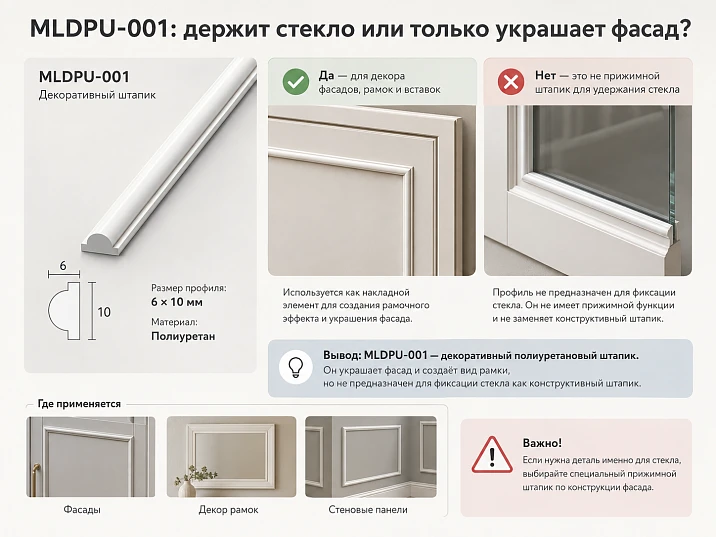
The word "glazing bead" sounds unambiguous only until it comes to a specific purchase. In carpentry construction, a glazing bead is a profile that presses glass, a mirror, or another insert into a prepared rabbet. The buyer sees the familiar name in the MLDPU-001 card and makes a natural conclusion: a thin strip of 10 × 6 mm should hold the glass part of a furniture facade. But for this product, such a conclusion is not confirmed.
MLDPU-001 should be considered primarily as a decorative polyurethane glazing bead — a thin profile with a semicircular cross-section that creates a frame, contour, or additional line on a furniture facade, door, panel, or another surface being decorated. The card does not confirm that this polyurethane molding can independently bear the load from glass and perform the function of structural clamping.
If a glass or mirror insert is provided in the facade, its reliable fastening is designed first. It must correspond to the frame construction, insert dimensions, seating area, and assembly method. Only after that can MLDPU-001 be considered as decorative framing of an already secured perimeter.
In other words, the answer to the question in the title is this: MLDPU-001 decorates the facade, but should not automatically be considered an independent glass holder. Before purchasing, it is necessary to decide what task the profile faces. For a thin overlay frame, you can buy decorative glazing bead MLDPU-001For structural fixation of the glass insert, a separately calculated node and profile are required, the purpose of which is confirmed by the project.
Why one word "glazing bead" creates two completely different orders
A buyer rarely starts with a technical definition. They see a photo of a cabinet, imagine a thin frame around the glass, and search for a glazing bead for furniture facades. In the search results, wooden profiles, plastic elements, polyurethane moldings, and decorative strips appear side by side. The names are similar, but the purpose differs.
In the first case, the glazing bead is part of the structure. It presses the insert against the frame rebate, fits into the calculated seat, and works together with the base. Its cross-section is chosen not only for aesthetics but also based on glass thickness, rebate depth, fastening method, and possible disassembly.
In the second case, the word describes the external shape and visual role. The profile resembles a thin furniture glazing bead but is used as applied decor. It forms a line, divides the surface, emphasizes the perimeter, or imitates frame assembly on a blind facade.
MLDPU-001 belongs precisely to this second task. It is a polyurethane decorative profile with a cross-section of 10 × 6 mm. It is purchased not to replace a wooden clamping element without verification, but to create a neat thin frame.




Functional and decorative glazing bead: comparison without substituting concepts
| Criterion | Functional glazing bead | MLDPU-001 |
|---|---|---|
| Main task | Press the glass, mirror, or panel into the intended seat | Create a decorative line or frame |
| Basis of selection | Groove, quarter, insert thickness, mounting structure | Facade scale, frame pattern, line width |
| Load | May participate in holding the insert | Should not be automatically considered a load-bearing element |
| Location in the project | Built into the frame structure | Can be used as overlay decor |
| Material | Depends on the calculated joinery system | Polyurethane |
| Confirmed section MLDPU-001 | Not applicable | 10 × 6 mm |
| Disassembly | Can be designed with glass replacement in mind | Decorative installation does not guarantee easy removal |
| Suitability criterion | Reliability of the joint and compatibility with the insert | Appearance, scale, base, and finish |
| What to check before ordering | Cross-section, groove, fixing method, glass dimensions | Frame size, footage, actual strip length, installation, and finishing |
The difference is fundamental. A beautiful profile may visually resemble a real glazing bead, but external similarity alone does not turn it into a structural part. Conversely, a reliable wooden clamping profile is not always suitable for a thin overlay frame on a flush door.
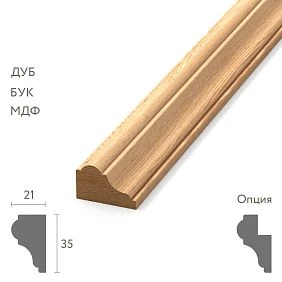
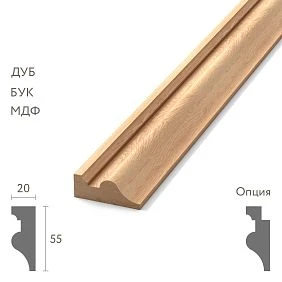
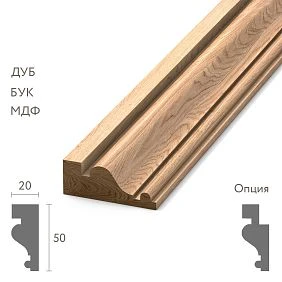
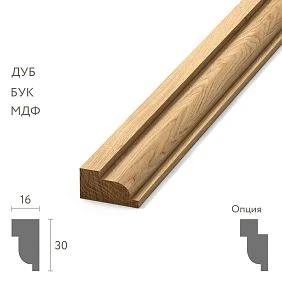
Our factory also produces:
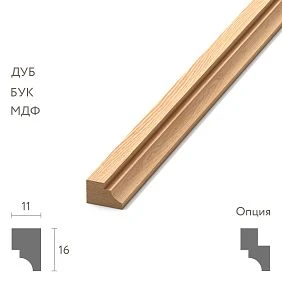
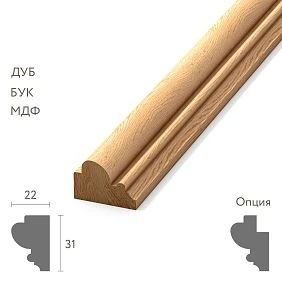
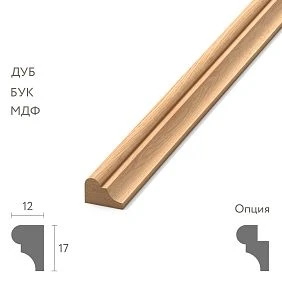
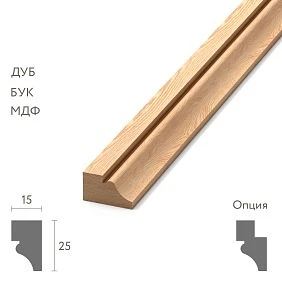
MLDPU-001 10 × 6 mm: what is confirmed and how to read these dimensions
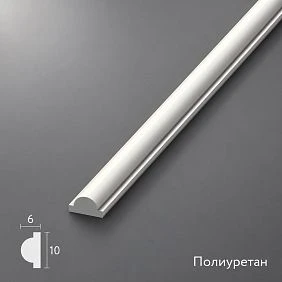
MLDPU-001 is a decorative polyurethane glazing bead or molding with a semicircular cross-section. The confirmed profile size is 10 × 6 mm.
These two values describe the cross-section, not the size of the finished frame. The profile remains narrow and is intended for a delicate line. It should not be perceived as a massive casing, wide furniture molding, or deep carved overlay.
| Parameter | Confirmed data | What this means when choosing |
|---|---|---|
| Article number | MLDPU-001 | The full number must be specified in the order |
| Type | Decorative glazing bead, polyurethane molding | The main task is surface decoration |
| Material | Polyurethane | This is not a wooden profile with natural texture |
| Cross-section | 10 × 6 mm | Thin decorative line |
| Cross-section shape | Semicircular | The product should not be promoted as a rectangular molding |
| Application | Furniture facades, decorative frames and lines | The specific base and installation are checked separately |
| Glass retention function | Not confirmed by the card | MLDPU-001 cannot be considered an independent fastener |
| Plank length | Requires verification in the selected product item | Different values are found in available card versions |
| Quantity calculation | Along the perimeter of the frames and the actual length of the strip | Lₚ must be confirmed before payment |
| Additional materials | Selected separately | Adhesive, preparation, and finishing depend on the base |
Get Consultation
What does the width of 10 mm mean
On the facade plane, the profile creates a thin contour. This width is suitable for a composition where the molding should be noticeable but not take up most of the front panel.
On a small door, a 10-millimeter line can become the main decorative technique. On a large cabinet, a single contour will look calmer and thinner. If a stronger architectural division is required, the buyer should compare other profiles in the category, where they can buy polyurethane moldings for furniture and walls.
What does the depth of 6 mm mean
A 6 mm protrusion creates relief and shadow. Even a thin frame will not be a drawn stripe: under side lighting, the semicircular cross-section will appear more noticeable.
At the same time, the depth affects practical use. On a furniture facade, you need to check whether the profile interferes with the handle, the adjacent door, the opening of the leaf, or the passage of the hand. Narrow gaps between paired facades are especially carefully assessed.
Why the semicircular cross-section is important for SEO and for the buyer
Calling MLDPU-001 a rectangular molding is incorrect. Such a query creates a different expectation: a flat geometric strip with pronounced straight edges. A semicircular profile gives a softer light transition and a different character of the frame.
In the text and specification, it is more correct to use the formulations:
-
decorative glazing bead;
-
polyurethane glazing bead;
-
thin molding 10 × 6 mm;
-
semicircular decorative profile;
-
molding for furniture facade;
-
frame made of polyurethane molding.
Can MLDPU-001 hold a glass facade
It cannot be considered a fastener on its own. The card confirms the decorative purpose of the profile, but does not confirm the function of mechanically holding the glass.
A glass insert requires a structural system. It must define:
-
glass dimensions;
-
insert thickness;
-
shape and depth of the seating area;
-
material of the main frame;
-
method of clamping;
-
assembly sequence;
-
possibility of glass replacement;
-
behavior of the assembly when opening the facade;
-
distances to hinges and handles;
-
safety requirements.
MLDPU-001 does not answer these questions by itself. The size 10 × 6 mm indicates the geometry of the decorative profile, but does not specify the permissible load, the method of structural fastening, or compatibility with a specific glass.
Why you can't reason: "The profile is glued — so the glass will hold"
Adhesive can firmly bond a decorative part to the base, but that doesn't turn the whole assembly into a calculated insert retention. Not only bond strength and contact area matter, but also load direction, frame material, glass weight, vibration when opening, and the possibility of dimensional changes in the structure.
If the glass is held only by a narrow glued strip, the error won't necessarily show up immediately. The problem may arise after repeated door openings, an impact, cabinet distortion, or changes in the adhesive joint's condition.
The article should not promise the safety of such a solution without design verification. The reliable path is different: first, the cabinetmaker designs the insert retention, then MLDPU-001 is added as decorative framing.
Can MLDPU-001 be installed over already secured glass
The profile can be considered a visual frame if the glass is already securely held by a separate system, the base allows for decor installation, and the mounting won't compromise the facade structure.
Before ordering, check:
-
Exactly where the profile is glued — to the frame, panel, or another surface.
-
Whether the adhesive gets on the visible part of the glass.
-
Whether the insert can be replaced without damaging the facade.
-
Whether the frame blocks technical access.
-
Are the mounting materials compatible with the base and future finishing?
-
Is there sufficient clearance for opening?
-
Does the decor hide a defect or incorrect size of the mounting seat?
The profile can frame the perimeter of the secured insert, but should not replace its primary fastening.
Three scenarios where the decorative bead is properly revealed
Thin frame on a blank MDF facade
This is the most straightforward scenario. There is no glass, so the issue of structural retention does not arise at all. MLDPU-001 is installed as a decorative molding on a flat surface.
The bead for MDF facades helps:
-
form a contour without milling a complex profile;
-
create a classic or transitional frame composition;
-
highlight the central field;
-
connect several identical doors;
-
add relief to the smooth front panel;
-
prepare the facade for general decorative finishing.
However, even on a blind door, you cannot glue a profile without layout. First, choose the outer frame size, distance to the edge, handle position, and gaps between facades.
For a small facade, one frame may be sufficient. On a large panel, nested contours or internal division are possible, but the number of lines should match the scale of the furniture.
Internal division of a large furniture facade
A tall cabinet door can look empty even after installing a handle. Wide carved decor can overload the surface, while a thin polyurethane molding creates a calmer grid.
MLDPU-001 can be used for:
-
one elongated rectangle;
-
two vertical fields;
-
upper and lower decorative blocks;
-
several identical frames;
-
imitation of paneled division;
-
connection with architectural lines of neighboring facades.
For such a task, it is useful to look at wardrobe design ideas, and then transfer the chosen principle to the actual dimensions of your furniture.
The internal division should not cross handles, hinges, or work areas. If the facade opens by the edge, the profile should not interfere with fingers. If an overlay handle is used, its base and projection must be checked.
Framing of a fixed glass or mirror insert
In this scenario, MLDPU-001 works as the final visual layer. The main system already holds the glass, and the molding covers or emphasizes the transition line.
This design can:
-
make the technical perimeter neater;
-
connect the insert with other frames on the facade;
-
repeat the contour of adjacent flush doors;
-
add a thin relief line;
-
unite the mirror and surrounding decor.
The key condition remains unchanged: the insert is secured separately. The polyurethane glazing bead does not gain a structural function just because it runs along the edge of the glass.
Additional scenario: polyurethane molding on a wall
MLDPU-001 can be considered not only as a glazing bead for furniture facades. The narrow profile is suitable for delicate decorative lines on panels and walls, if the base and installation technology match the project.
A thin molding on the wall is used:
-
inside a wider frame system;
-
for small rectangular fields;
-
around a decorative insert;
-
in composition with other polyurethane elements;
-
to repeat the lines of furniture facades;
-
as a neat inner contour.
If you need not a single thin line, but a complex composition, you can choose polyurethane molded decor and select related elements in one project.
Here too, you cannot transfer structural expectations onto MLDPU-001. Polyurethane wall molding performs a decorative task, not holding heavy panels or mirrors without a separate mounting system.
Where MLDPU-001 should not be ordered
An honest commercial article should not only lead to the product but also stop an incorrect purchase. MLDPU-001 is not suitable when the project requires a function not confirmed by the product card.
The glass is intended to be held only by this profile
If there is no other mounting system, the order must be stopped. First, design the frame and the insert clamp.
The profile must fit exactly into the calculated rebate
The decorative section of 10 × 6 mm cannot be automatically substituted with a functional joinery profile. Exact dimensions of the groove, glass, and seating assembly are needed.
The insert will need to be removed regularly
A glued decorative frame can complicate access. If the facade is designed to be disassembled, the installation method must account for maintenance and glass replacement.
Natural oak or beech texture is required
Polyurethane is not solid wood. If the surface must retain natural fibers under a transparent finish, one should buy wooden millwork for a furniture project and select a profile with a suitable structural role.
The element is located in an area of constant impacts
A thin decorative frame should not be installed without verification where it is regularly hit by carts, footwear, heavy objects, or door handles.
The profile must straighten a curved facade
MLDPU-001 follows the base and does not replace surface repair. Waves, delamination, and damage are fixed first.
The molding is intended to be used instead of a calculated frame
A decorative profile does not turn a flat panel into a structural frame for glass. The base must exist independently of the decor.
Wooden glazing bead and MLDPU-001: which product your project actually needs
The issue cannot be resolved by the principle “wood is more reliable, polyurethane is more convenient.” First, the function is determined.
| Buyer's task | What to consider | Why |
|---|---|---|
| Hold the glass in a wooden frame | Functional profile designed for a quarter and insert | Need a structural joint |
| Create a frame on a blind facade | MLDPU-001 | Glass is missing, decor required |
| Frame an already mounted mirror | MLDPU-001 after base inspection | The profile works visually |
| Preserve oak texture | Wooden molding | Polyurethane does not provide a natural pattern |
| Make a thin paintable line | MLDPU-001 after finishing approval | Section 10 × 6 mm is suitable for delicate relief |
| Get a detachable insert mounting | Project functional glazing bead | Decorative gluing may interfere with dismantling |
| Arrange a wall frame | Polyurethane molding | The main task is decorative |
| Assemble multi-level decor | Moldings and elements for frames | A coordinated system is needed |
When a wooden profile cannot be chosen only by external similarity
Not every wooden molding is automatically a functional glazing bead. To hold the glass, the purpose of the specific profile, its cross-section, seating, and fastening method must be confirmed.
The category of wooden millwork provides a search direction but does not replace the cabinetmaker's work. The buyer must bring a drawing of the facade and the dimensions of the insert, rather than asking for a "similar wooden strip."
When a polyurethane profile wins as decor
MLDPU-001 is convenient where natural texture and structural function are not needed. A thin frame can be added to an existing blank surface without making a complex panel. The profile helps quickly test the pattern using a paper layout and assemble a repeating system on multiple facades.
But the commercial advantage is revealed only with the right task. Buying a decorative molding instead of a fastening part does not save the budget: it creates rework.
How to choose the frame size on a furniture facade
The profile cross-section is already known — 10 × 6 mm. The buyer only needs to determine the dimensions of the contour itself.
Measure:
-
facade width;
-
facade height;
-
distance to each edge;
-
handle position;
-
handle base dimensions;
-
gaps between doors;
-
location of glass or mirror insert;
-
existing holes;
-
protruding decorative elements;
-
opening direction.
Outer frame
It is located closer to the edges of the facade and emphasizes the overall contour of the door. Do not press the molding flush against the edge. Leave a visually and technically sufficient margin, which is checked on a full-size template.
Inner frame
This contour creates a central field. It is convenient if there is already a handle, hinges, or other decor along the edges.
Nested frames
Two contours enhance the classic look but increase the footprint and precision requirements. The distance between lines must be equal on all sides.
Vertical division
Suitable for a tall door. Lines can mimic two narrow panels but must not fall under the handle.
Horizontal division
Works on wide fronts and drawers. Before ordering, check that the frame does not create an accidental connection with inter-front gaps.
Full-size layout: the profile needs to be seen before cutting
On screen, 10 mm looks different than on furniture. Make paper strips 10 mm wide and attach them to the front with painter's tape that does not damage the finish.
Check the layout in four modes:
-
Strictly from the front.
-
From a normal viewing distance.
-
With the door open.
-
Under side lighting.
Paper does not show the 6 mm depth, so for a final check it is useful to attach a physical sample. It can be obtained through the section where it is offered order samples of polyurethane decor.
What is only visible on a real sample
-
the actual shape of the semicircular profile;
-
the nature of the shadow;
-
the combination with the handle;
-
the depth of the protrusion;
-
scale on a small facade;
-
behavior in corner joint;
-
quality of surface adhesion;
-
future finishing on the selected base.
Purchasing a sample is especially useful for a large batch of cabinets, kitchen facades, or wall frames. An error in one contour is unpleasant; repeating the error on twenty doors becomes an expensive rework.
Formula for calculating one rectangular frame
For a rectangle, use the basic perimeter formula:
P = 2 × (H + W)
Where:
-
H — frame height;
-
W — frame width;
-
P — profile length without allowance.
All values must be calculated in the same unit. If height and width are given in millimeters, the result will also be in millimeters.
Example: frame 600 × 400 mm
P = 2 × (600 + 400) = 2000 mm.
The clean contour requires 2000 mm of profile. However, this does not mean you can order a strip exactly 2000 mm long and guarantee the frame will assemble. Cuts, test cutting, and a technological allowance are needed. Additionally, the actual length of the sold item MLDPU-001 must be checked.
Example: frame 720 × 420 mm
P = 2 × (720 + 420) = 2280 mm.
If the actual strip is shorter than this value, one piece is not enough. If longer, you need to check whether four pieces can fit on a single blank considering the cuts. Total footage and the actual cutting layout are not the same thing.
Which size to use in the formula: external or internal
First, determine what H and W mean in your project:
-
outer frame size;
-
internal light opening;
-
length along the selected installation line.
Do not mix measurement methods. If verticals are marked on the outside and horizontals on the inside, the corners will not align.
For miter cuts, the cabinet maker must establish a unified dimension system and transfer it to the cutting map.
Calculation of several identical facades
For N identical frames:
L = P × N
Where:
-
P — perimeter of one frame;
-
N — number of facades;
-
L — total finished length.
Example: six facades with a frame of 500 × 300 mm
Perimeter of one frame:
P = 2 × (500 + 300) = 1600 mm.
Total finished length:
L = 1600 × 6 = 9600 mm.
This is 9.6 m without allowance.
If the project includes an agreed 10% allowance, the illustrative calculation looks like this:
Z = 9600 × 0.10 = 960 mm.
L + Z = 10,560 mm.
The percentage in this example is not a universal standard. It shows the calculation mechanics. The actual allowance depends on the number of corners, cutting complexity, the craftsman's experience, and the need for a spare part.
Number of slats sold: formula with actual length
The number of planks is calculated as follows:
Q = ⌈(L + Z) / Lₚ⌉
Where:
-
Q — number of planks;
-
L — total finished length;
-
Z — agreed allowance;
-
Lₚ — actual length of one commercial plank;
-
the symbol ⌈ ⌉ means rounding up.
Why a single Lₚ value cannot be fixed in the article
In the available versions of the MLDPU-001 card, lengths of 2000 and 2600 mm are found. Before placing an order, you need to check which value is currently specified in the selected product item.
The quantity depends on the length. For the above project with a requirement of 10,560 mm:
-
with Lₚ = 2000 mm: Q = ⌈10,560 / 2000⌉ = 6 planks;
-
at Lₚ = 2600 mm: Q = ⌈10 560 / 2600⌉ = 5 planks.
The difference is one whole plank. Therefore, an inconsistent card length affects not only the text but also the price, packaging, and delivery.
Correct wording for the buyer:
The quantity of MLDPU-001 is calculated based on the actual plank length specified in the selected product item at the time of ordering.
Why total length is not enough: a cutting map is needed
Let's imagine that the total length of four parts is 2400 mm, and the plank has a confirmed length of 2600 mm. It seems that one piece is enough. But the parts may not fit sequentially due to the sizes of individual sides and cutting losses.
For example, the frame consists of:
-
two verticals of 800 mm each;
-
two horizontals of 400 mm each.
The sum is 2400 mm. Theoretically, everything fits. In practice, you need to consider:
-
width of each cut;
-
trimming of the damaged edge;
-
test corner;
-
possible marking error;
-
quality of the ends;
-
cutting order.
If one part is damaged, the 200 mm remainder is not enough to replace an 800 mm vertical.
Cutting map for multiple facades
It is not necessary to cut one full frame from a single strip. Sometimes it is more advantageous to distribute identical verticals across one workpiece and horizontals across another. But parts should be marked to avoid mixing up facades and the direction of the miter cut.
The map indicates:
-
the facade number;
-
part position;
-
finish size;
-
left end angle;
-
right end angle;
-
source plank number;
-
reserve part;
-
remainder.
This approach reduces random waste and allows you to know in advance how much profile to actually put in the cart.
Nested frames: the footage grows faster than it seems
If there are two frames on one facade, their perimeters are calculated separately.
Let the outer frame have a size of 700 × 400 mm:
P₁ = 2 × (700 + 400) = 2200 mm.
Inner frame — 560 × 260 mm:
P₂ = 2 × (560 + 260) = 1640 mm.
Total finishing length for one facade:
P_total = 2200 + 1640 = 3840 mm.
For four facades:
L = 3840 × 4 = 15,360 mm.
After that, an agreed allowance is added and division by the actual length of the commercial strip is performed.
Two thin lines look visually light, but almost double the consumption. The cost of finishing depends not only on the price of one strip, but also on the number of contours, corners, and cuts.
Arched, oval, and complex frame: the rectangular formula is not suitable
The formula 2 × (H + W) is valid for a rectangle. For an arc, oval, polygon, or complex line, the length is determined from the drawing or template.
Do not:
-
approximately replace an arc with a straight line;
-
calculate an oval as a rectangle using its extreme dimensions;
-
buy a profile without checking the possibility of forming the required line;
-
assume that the material will bend to any radius;
-
make a conclusion about permissible bending based only on a photograph.
The possibility of repeating a curved contour must be agreed upon for the specific profile and project. If there is no confirmation, it is safer to use a straight frame or choose another element.
Layout around the glass: where the MLDPU-001 line runs
An already fixed insert may have several levels:
-
the glass itself;
-
the main frame;
-
structural pressure plate;
-
technological joint;
-
decorative facade surface.
MLDPU-001 cannot be placed in a random location just because it is closer to the glass. First, determine the mounting plane.
On the frame around the insert
The profile forms a second contour and does not touch the glass. This scenario is easier to maintain.
Along the boundary of the frame and glass
Requires special care. Adhesive and finishing must not contaminate the insert. Access to the structural fastening must be preserved.
Over the technical clamp
Admissibility depends on the shape of the node. Decorative molding should not interfere with disassembly or hide a malfunction.
At some distance from the insert
This creates a double frame: the inner contour is defined by the glass, the outer one by MLDPU-001. This technique allows air to be retained between the lines.
Installation starts with the base, not with choosing the adhesive
Before installation, determine the surface to which the profile will be bonded:
-
painted MDF;
-
unfinished MDF;
-
wood;
-
primed panel;
-
another prepared surface.
The adhesive bonds to the top layer of the base. If the paint is peeling, the decorative frame will come off with it. If the surface is coated with polish, wax, or another compound, adhesion may be insufficient.
What to check before installation
-
Coating strength.
-
Surface evenness.
-
Absence of dust and grease.
-
Compatibility of the adhesive with polyurethane and the base.
-
Ability to remove excess.
-
Open time.
-
Method of temporary fixation.
-
Compatibility with future finishing.
-
Access to corners.
-
No conflict with glass and fittings.
To select compositions, you can to buy materials for furniture installation and finishing, but the specific product is chosen after checking both surfaces to be joined.
Work procedure with MLDPU-001 on a blind facade
Mark the frame
First, mark the axes and corners. Distances to the edges must match. For multiple facades, use a single template.
Perform a dry layout
All four parts are placed without glue. Check the corners and appearance.
Label the elements
Each strip is assigned a position: top, bottom, left, and right sides. For a series, add the facade number.
Prepare the base
The method depends on the coating. Aggressive sanding of finished enamel is not allowed without approval.
Apply a compatible compound
Use the adhesive according to the instructions. Too much may seep out at the edges and ruin the finish.
Set the profile along the control lines
Adjust the position within the working time of the compound. Check corners immediately.
Secure before it sets
The fixing method must not deform the semicircular profile or damage the facade.
Perform the finishing
The painting sequence depends on the project: before installation, after installation, or a combination.
Painting before or after installation
Profile finishing before installation
Suitable when the facade is already fully finished and cannot be repainted. The profile is processed separately.
Advantages:
-
less risk of staining the facade;
-
easier to work with individual strips;
-
you can check the color before gluing.
Limitations:
-
the finished coating can be damaged during cutting;
-
corner joints may require local touch-ups;
-
glue must not get on the front surface;
-
the shade needs to be compared with the facade.
General finishing after installation
Suitable when the frame should look like part of a single surface.
Advantages:
-
the color unifies the facade and the profile;
-
joints can be prepared in a common system;
-
the frame is perceived as more integral.
Limitations:
-
protection of the glass, handles, and adjacent elements becomes more complicated;
-
installation errors are already visible on the facade;
-
finishing materials need to be coordinated.
Combined scheme
The profile is pre-prepared, then installed, and the final layer is applied together with the facade. This order is determined by the finisher after a trial.
What to order together with MLDPU-001
| Position or section | What it is for | What to Check |
|---|---|---|
| buy decorative glazing bead MLDPU-001 | Create a thin frame 10 × 6 mm | Actual length, quantity, and base |
| buy polyurethane moldings for furniture and walls | Compare other profiles | Cross-section, scale, and purpose |
| choose polyurethane molded decor | Assemble a complex composition | Compatibility in style and dimensions |
| Order decorative elements for moldings | Add corners or a frame system | Quantity, size, and layout |
| buy wooden millwork for a furniture project | Select a natural or functional profile | Actual purpose, groove, and finish |
| to buy materials for furniture installation and finishing | Install and arrange decor | Compatibility with the base |
| order samples of polyurethane decor | Check cross-section and scale | Compliance with a specific facade |
| Order a furniture facade design project | Calculate complex layout | Dimensions of all facades and inserts |
| Download STAVROS drawings and catalogs | Verify available documentation | Data relevance |
| Calculate delivery of long-length molding | Account for receiving slats | Actual length and packaging |
The table shows the purchase route, not a mandatory set. For a simple frame on one facade, a profile, compatible mounting materials, and an accurate cutting map may be sufficient. For a series of cabinets, a sample and a design project are useful.
Decorative elements for moldings: when one line is not enough
MLDPU-001 creates a calm outline. If the project requires a more complex pattern, corner and center elements can be selected for it, but only after checking the dimensions.
Additional decor can:
-
decorate four corners;
-
emphasize the top of the frame;
-
connect multiple contours;
-
Cabinet with mirror insert
The mirror must be secured separately. A decorative profile can frame its perimeter, but adhesive and finishing materials must not damage the reflective or face surface.
Dresser with smooth drawers
A thin molding creates frames on each front. The distance to the edge and handle must be consistent. Material consumption is calculated for each drawer size: the top row may differ from the bottom.
Tall wardrobe door
A single rectangular frame can look too elongated. Two or three sections create a more manageable rhythm, but increase material usage and the number of corners.
Wall panel behind furniture
The profile connects the furniture frame to the wall. Lines should be aligned before cabinet installation so they don't accidentally extend beyond the cabinet body.
Restoration of an old front
MLDPU-001 can add a new decorative layer, but must not hide an unstable coating. First, the surface is repaired and checked.
Display case with replaceable glass
If the insert needs to be removed regularly, glued decor along the access line may be inconvenient. A demountable structural system is needed.
Typical mistakes when buying and installing
Mistake 1. Reading the word "glazing bead" and not checking its purpose
The profile is purchased as glass fastening, although the card confirms its decorative role.
Mistake 2. Leaving the glass without a separate fixation system
The decorative frame does not replace a calculated structural assembly.
Mistake 3. Calling MLDPU-001 a rectangular molding
The actual cross-section is semicircular.
Mistake 4. Ordering by total length without a cutting map
The total footage may be sufficient, but there may be no suitable whole pieces.
Error 5. Not checking the actual length of the plank
In available versions of the card, different values are specified, which changes the quantity of goods.
Error 6. Buying exactly to the clean perimeter
No material is left for cuts and test cutting.
Error 7. Using a universal reserve without project analysis
A simple frame and a series with many corners require different reserves.
Error 8. Measuring only the facade
The handle, insert, and inter-facade gaps are not taken into account.
Error 9. Mixing external and internal frame dimensions
Corner joints do not align.
Error 10. Cut before dry layout
The error is detected after shortening the profile.
Error 11. Do not mark sides
Left and right parts are swapped, cuts do not match.
Error 12. Glue onto peeling coating
The molding comes off along with the paint.
Error 13. Choose glue only by the word 'polyurethane'
The base material must also be considered.
Error 14. Apply too much compound
Excess material protrudes along the edges and spoils the facade.
Error 15. Press the profile with deformation
The semicircular line changes, the frame looks uneven.
Error 16. Install the molding flush against the handle
Fingers constantly catch on the relief.
Error 17. Do not check the opening of the adjacent door
The profile falls into the contact zone.
Error 18. Paint all parts before the test assembly
After cutting, the finished edges get damaged.
Error 19. Make a complex curve without confirmation
The possibility of the required bend has not been verified.
Error 20. Considering polyurethane as a replacement for oak under a transparent finish
Materials produce different visual results.
Error 21. Hiding technical glass fasteners without access
Replacing the insert becomes difficult.
Error 22. Not checking paired facades
Frames end up at different heights.
Error 23. Calculating all facades as identical
Dimensions of upper, lower, and side doors may differ.
Error 24. Ordering decor before approving handles
The fittings conflict with the frame.
Error 25. Not accounting for delivery of long-length goods
Receipt conditions are checked after confirming the actual length of the plank.
Who MLDPU-001 is suitable for
The profile is worth considering if:
- a thin decorative frame is needed;
- the facade is blind or the insert is already fixed separately;
- the 10 × 6 mm cross-section matches the scale;
- the semicircular shape suits the composition;
- the natural wood texture is not required;
- the base is suitable for installation;
- the buyer is ready to perform precise layout;
- the quantity is calculated based on the actual length of the plank;
- the profile must not bear structural load;
- finishing is approved before installation.
Who needs a different profile
MLDPU-001 should not be chosen if:
- the glazing bead must hold the glass;
- precise seating in the rebate is required;
- a demountable structure is needed;
- the project requires natural oak or beech;
- a wide architectural molding is necessary;
- the semicircular cross-section is not suitable;
- the surface is constantly subjected to impacts;
- the length or shape of the frame is incompatible with the product;
- the base is unstable;
- it is impossible to check the mounting assembly.
In such cases, it is necessary to compare wooden trim for a furniture project or others polyurethane moldings for furniture and walls.
How to place an order for MLDPU-001 without shortages
Lock the task
Write in the specification: "Decorative frame on a blind facade" or "Decorative framing of an already fixed insert." Do not use the vague "glass bead for glass."
Specify the article number and cross-section
MLDPU-001, 10 × 6 mm, semicircular cross-section.
Confirm the actual length
Before calculating the quantity, verify the current card and the final invoice.
Attach dimensions of all frames
For each facade, specify H and W, as well as the measurement method — along the outer or inner edge.
Calculate the total length
Add up the perimeters of all contours.
Add the agreed allowance
It depends on the cut map, the number of corners, and spare parts.
Round up to whole planks
Use the actual length of the line item.
Check installation materials
The compound must be suitable for polyurethane and the substrate.
Coordinate the finish
Specify when the profile will be painted and who performs the work.
Calculate delivery
After confirming the length, you can Calculate delivery of long-length molding.
Checklist before payment
-
Item MLDPU-001 confirmed.
-
Cross-section 10 × 6 mm confirmed.
-
The semicircular shape is taken into account.
-
The profile is used as decoration.
-
The glass is secured by a separate system.
-
The mounting surface is determined.
-
All facades are measured.
-
The external or internal frame size is recorded.
-
The perimeter of each contour is calculated.
-
The number of identical facades is counted.
-
The agreed allowance is added.
-
The actual length of the sold strip is checked.
-
Cutting map has been created.
-
A spare part is provided.
-
Handles and gaps have been checked.
-
Dry layout has been done.
-
The base is sturdy and level.
-
Mounting materials are compatible.
-
Finishing has been approved.
-
Glass maintenance accessibility has been checked.
-
Delivery has been calculated.
FAQ: questions about decorative glazing bead MLDPU-001
Is MLDPU-001 really a glazing bead?
Yes, the product is called a decorative polyurethane glazing bead or molding. However, the name does not confirm the function of mechanically holding the glass.
Can MLDPU-001 hold glass on its own?
Such use is not confirmed by the card. The glass insert must have a separate structural mounting system.
Can it be used to frame already fixed glass?
Yes, the profile can be considered as decorative framing if the main fastening is already done and the installation does not interfere with facade maintenance.
Is MLDPU-001 suitable for a blind MDF facade?
Yes, this is one of the main decorative scenarios. The profile creates a thin overlay frame on a flat surface.
What is the cross-section of MLDPU-001?
10 × 6 mm.
What shape does the profile have?
A semicircular cross-section is confirmed.
Can it be called a rectangular molding?
No. Such wording does not match the confirmed shape.
What is MLDPU-001 made of?
made of polyurethane.
Is it suitable for a natural oak finish?
Polyurethane does not have a natural oak texture. For visible wood, you should consider wooden trim.
How to calculate one frame?
Add the height and width, multiply the sum by two: P = 2 × (H + W).
How to calculate multiple identical facades?
Multiply the perimeter of one frame by the number of facades: L = P × N.
How to calculate the number of planks?
Divide the total footage with allowance by the actual length of one plank and round up.
What is the length of one MLDPU-001 plank?
The value needs to be checked in the selected product item. Available card versions include 2000 and 2600 mm.
Why can't one of these values be used without checking?
The length affects the number of planks, price, and delivery. An error can lead to a shortage of material.
Is a reserve needed?
Yes, allowance is provided for cuts, test cutting, end damage, and possible part replacement. Its size is determined by the cutting map.
Can a universal 10% be used?
Such a value can only be used as a preliminary assumption. The final allowance depends on the project and the installer's skill.
How to measure the frame — from the outside or inside?
Any one agreed method can be used, but they cannot be mixed. The dimensions must correspond to the cutting map.
Is adhesive included in the kit?
Mounting materials cannot be considered automatically included. They are ordered separately.
What glue is needed?
The composition is selected based on polyurethane, base material, and finish. Before a large batch, a test is useful.
Can the profile be glued to painted MDF?
Such installation can be considered if the coating is durable and compatible with the chosen composition. First, perform a test on a sample or an inconspicuous area.
Can the frame be installed after painting the facade?
Yes, but the profile will have to be finished separately, and installation must be done without damaging the finished coating.
Is it better to paint before or after installation?
The decision depends on the facade and technology. For a uniform color, a common finish after mounting is often convenient; for a finished facade, the profile is processed separately.
Can MLDPU-001 be bent along an arc?
The feasibility of a specific radius must be confirmed before ordering. Arbitrary bending cannot be promised without checking the profile.
Will MLDPU-001 fit a mirror?
As decorative framing for an already mounted mirror — after checking the base. As the sole mounting — not confirmed.
Can the profile be removed when replacing the glass?
Glued decor may complicate disassembly. If the insert is planned to be replaced, access is designed in advance.
How to order profiles for ten different facades?
Create a table with dimensions for each frame, calculate individual perimeters, sum them up, and prepare a cutting plan.
Is a preliminary fitting required?
Yes, especially for a large batch. A paper template shows the line width, while a physical sample shows the depth and cross-section shape.
Where can I see other polyurethane moldings?
In the category you can buy polyurethane moldings for furniture and walls after comparing cross-sections.
Where to choose additional decor for frames?
You can Order decorative elements for moldings and check them by size.
Where to find documentation and catalogs?
You can Download STAVROS drawings and catalogs, and verify the actual data of a specific product before purchasing.
What is the main question to ask the manager?
Clarify the actual length of the selected MLDPU-001 strip and ask to save it in the invoice or specification.
MLDPU-001 should be purchased as a decorative line, not as a promise of fastening
The word "glazing bead" should not replace the technical purpose of the product. MLDPU-001 is a thin polyurethane profile 10 × 6 mm with a semicircular cross-section. It is suitable for a decorative frame on a blind facade, internal division of a large door, and visual framing of an already fixed glass or mirror insert.
If the glass is planned to be held only by this molding, the order should be stopped and the assembly should be handed over to a furniture designer. First, reliable fixation is designed, then the decorative contour is added.
For the calculation, measure the height and width of each frame, find the perimeter, multiply it by the number of facades, add the agreed allowance, and divide the result by the actual length of the product strip. The last parameter is especially important: in available versions of the card, 2000 and 2600 mm are found, so the value must be confirmed before payment.
After checking the purpose, layout, and quantity, you can order a polyurethane glazing bead 10 × 6 mm for a specific furniture project.
STAVROS company combines the MLDPU-001 card with categories of polyurethane moldings, wooden trim, decorative elements, samples, and installation materials. The buyer can avoid substituting a decorative bead for a structural one and instead assemble the correct set: separate glass fastening, a suitable profile for finishing, exact footage, and compatible trim.