Article Contents:
- Specifications of table base STL-023
- What is a three-legged table base
- Why three support points form a stable plane
- Three or four legs for a round table
- Who is STL-023 suitable for
- When it is better to choose another table base
- Why a round tabletop better reveals triangular geometry
- How to choose the diameter of a round tabletop
- How to calculate tabletop overhang without made-up standards
- Why a table on three legs can still tip over
- How to check the support contour STL-023
- How the center of gravity changes after installing the tabletop
- Tabletop ST-023 as recommended configuration
- Can I install a different round tabletop
- Can I install a solid wood tabletop
- Will a glass tabletop work
- Is an oval tabletop suitable
- How to arrange seating positions between the legs
- STL-023 for kitchen
- STL-023 for living room and dining room
- STL-023 for hallway, foyer and showroom
- Can STL-023 be used as a coffee table base
- Beech or oak for STL-023
- STL-023 made of beech for enamel coating
- STL-023 made of oak for tinting
- How to match MDF tabletop with solid wood base
- Painting before or after assembly
- How to assemble STL-023 table base without warping
- How to check the tightening of fittings
- How to secure the tabletop on STL-023
- How to mark the center of a round tabletop
- FUR-001 or FUR-012
- Why you shouldn't choose fasteners based only on a photo
- What is included in the delivery and what needs to be checked separately
- How to avoid damaging the finish during assembly
- How to level a three-legged table
- Practical choice for different tasks
- How not to confuse STL-023 with individual furniture legs
- How not to confuse STL-023 with a central cabinet
- How to check the table after final assembly
- Why a round table may wobble after assembly
- Common mistakes when choosing STL-023
- Who STL-023 is really suitable for
- Who should choose another option
- What to buy together with STL-023
- How to buy STL-023 on STAVROS
- Why a ready-made STL-023 is more convenient than a homemade triangular frame
- How to store parts before assembly
- Care for the finished table
- Three legs and four legs: a practical comparison
- Practical selection of STL-023 for specific situations
- Table of 'what to buy together'
- Useful materials for selection and installation
- FAQ: questions about the STL-023 base
- What is the STL-023 base?
- Why does the STL-023 have three legs?
- Is a table on three supports stable?
- How do three legs differ from four?
- What size is the STL-023?
- What tabletop does STAVROS offer for STL-023?
- Can I install a different round tabletop?
- How to calculate the allowable overhang of a tabletop?
- Can I install a solid wood tabletop?
- Is a glass tabletop suitable?
- Is an oval tabletop suitable?
- What to choose for the underframe — oak or beech?
- Which finish to choose for enamel?
- Which finish is suitable for tinting?
- Is hardware included in the set?
- Is STL-023 supplied assembled?
- How to attach the tabletop to the base?
- FUR-001 or FUR-012 — which to choose?
- How to position seating relative to the legs?
- Is STL-023 suitable for the kitchen?
- Can STL-023 be used for a coffee table?
- Why might the table wobble after assembly?
- Do I need to retighten the fasteners?
- Where to buy the STL-023 table base?
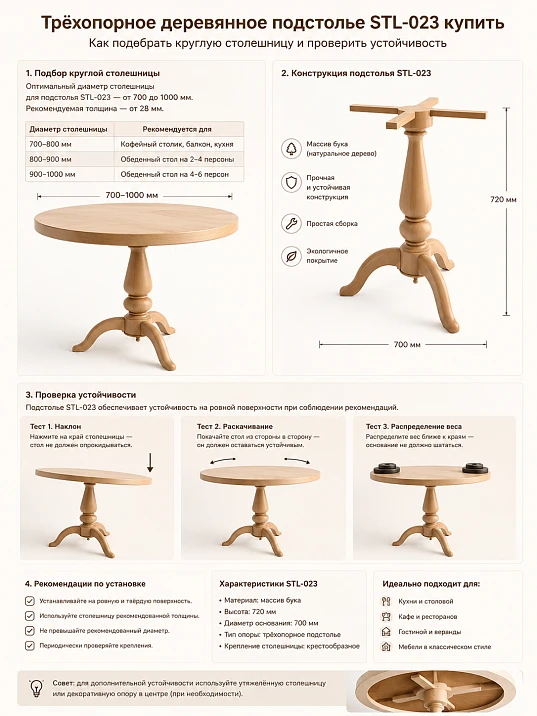
Buying a three-legged wooden table base STL-023 makes sense for those who want to assemble a round table not on four corner legs, but on a compact triangular base. This design frees up the edges of the tabletop, makes the silhouette lighter, and helps arrange seating around the round top. However, the unusual geometry requires more careful selection: you need to check not only the appearance, but also the diameter, weight, and attachment of the tabletop, the overhang beyond the support contour, the position of the center of gravity, and seating comfort.
STL-023 has dimensions of 524 × 460 × 725 mm. The base is built on three wooden supports and forms a triangular frame. The table base is available in beech or oak; the current card shows the "Prestige" processing quality, and the preparation is related to future enamel or tinting. The structure is supplied disassembled, with assembly hardware included. As a recommended top, the card indicates the round tabletop ST-023 made of MDF.
Three points always define a single plane, so a three-legged table is less prone to wobbling due to minor floor unevenness than a four-legged one, where one support may be higher or lower than the others. However, this advantage should not be confused with automatic protection against tipping. If you install a tabletop that is too large or heavy, shift it off-center, or heavily load the edge between the legs, stability will deteriorate. Without technical calculations, it is impossible to specify a universal allowable diameter, tabletop weight, or edge load.
This article helps you go from an idea to a complete purchase. You will understand who the STL-023 is suitable for, how the support triangle works, how three legs differ from four, why a round tabletop must be precisely centered, when it is safer to choose the recommended ST-023, how to compare beech and oak, what to check during assembly, and what questions to ask the STAVROS manager before ordering.
Short answer. STL-023 is suitable for a small dining, kitchen, side, or accent table with a round tabletop when a compact three-legged base and free access to the edges are required. The most predictable route is to assemble a set with the recommended ST-023 tabletop and check the drawings of both parts.
Another tabletop can only be considered after checking the diameter, weight, thickness, attachment points, and actual support contour. The three-support design wobbles less on minor floor unevenness but may tip over with excessive overhang or load on the edge between supports.
Buy a three-legged wooden table base STL-023Select a round tabletop ST-023 for the table baseView STAVROS frames and table bases


Specifications of the STL-023 table base
| Parameter | Confirmed data | What this means for the buyer |
|---|---|---|
| Article number | STL-023 | Use the exact article number in the order and drawing |
| Type | Wooden base | Base for assembling a table with a tabletop |
| Construction | Three legs, triangular geometry | The support frame differs from a four-legged base |
| Size | 524 × 460 × 725 mm | Need to check the overall dimensions, height, and seating space |
| Material | Beech or oak | Beech is chosen for opaque finishes, oak for preserving texture |
| Processing quality | «Prestige» | The surface is prepared for further finishing |
| Preparation | For enamel or tinting | The finishing system is coordinated with the material of the underframe and tabletop |
| Supply | Disassembled | Careful assembly with geometry control will be required |
| Package contents | Hardware for assembly | The kit composition is checked in the product card before ordering |
| Recommended tabletop | ST-023 | The most straightforward start for a complete assembly |
| Material ST-023 | MDF according to the current STL-023 card | The finish of MDF and solid wood must be coordinated in color and technology |




What is a three-leg base
STL-023 is not a set of three separate legs, but a ready-made geometric system. The supports are connected into a triangular frame and work together. This is an important difference from independently selecting furniture legs, where distances, angles, and fasteners have to be calculated from scratch.
The triangular shape aligns well with a round tabletop: a circle has no fixed corners, and three supports can be distributed around the center. The outer edge remains freer than a table with four legs at the corners, so seating positions can be planned between the supports.
The height of 725 mm refers to the base itself. The final table height will increase by the thickness of the tabletop and the specifics of the fastening assembly. For dining or work seating, this is checked on the overall drawing, not by the base height alone.
The base is supplied disassembled. This simplifies transportation but shifts some responsibility to assembly: the connections need to be tightened evenly, the triangle must not be skewed, and then the top must be properly centered.
Our factory also produces:


Why three points of support form a stable plane
Any three points that are not collinear uniquely define a plane. Therefore, three legs touch the floor simultaneously even when the surface has a slight local irregularity. With a four-legged table, one support may be slightly higher, and the table starts to wobble between diagonals.
This geometric advantage is especially noticeable on old wooden floors, tiles with a slight height difference, or in a room where the covering cannot be perfectly leveled. STL-023 does not require a fourth point that would need adjustment.
However, contact of all three legs with the floor does not guarantee stability against tipping. For this, the center of gravity of the entire system must remain inside the support triangle. A large overhang of the tabletop between the legs increases the risk when loading the edge.
It is important for the buyer to distinguish between two issues: whether the table wobbles on the floor and whether it will tip over when pressed. The three-leg design solves the first issue well, but the second depends on the tabletop, load, and geometry of the entire set.
Get Consultation
Three or four legs for a round table
Four legs provide a familiar design and can form a wide rectangular outline. They are convenient for a large tabletop if the distances and construction are calculated correctly. However, on an uneven floor, the fourth leg sometimes becomes a cause of wobbling.
Three legs form a plane without additional adjustment for a fourth point. For a round table, they look logical because they follow the radial composition and do not tie the seating to four corners.
On the other hand, a triangular support outline has zones between the legs. If the edge is loaded precisely in such a zone and the tabletop extends significantly beyond the base, the tipping moment may increase.
STL-023 should be chosen not because three legs are always better than four, but because this design matches the specific round tabletop, room scale, and usage scenario.
Who STL-023 is for
This underframe is suitable for a customer who is assembling a small dining or kitchen table, a breakfast table, a tall side table, or an accent table in a hallway and wants to avoid four legs around the perimeter.
It is convenient in a compact room where a round tabletop helps navigate around the table without sharp corners, and three legs leave more legroom. The actual seating capacity depends on the top diameter and leg placement.
STL-023 is interesting for custom furniture: you can choose oak for tinting or beech for enamel and match the base with the color of the tabletop, kitchen fronts, chairs, or other wooden decor.
The model is not suitable for a project that requires a long rectangular tabletop, a very low coffee table, or a deliberately large heavy top without engineering calculation.
When to choose a different underframe
If the tabletop is rectangular and significantly longer than the base, the triangular layout may not provide sufficient support contour. In such a project, it is better to compare other frames.
For a large family table with multiple seats around, you need to carefully evaluate the diameter, legroom, and edge load. If there is no calculation, it is safer to choose a base directly designed for the required top.
For a low coffee table, a height of 725 mm is usually excessive even before adding the tabletop. STL-023 is closer to a dining or work format, although the exact purpose depends on the overall height and project.
A wide selection helps create a section where you can select a base for the tabletop and compare STL-023 with other frames without trying to fit one model to all tasks.
Why a round tabletop better reveals triangular geometry
A circle distributes the edge evenly around the center. If the underframe is precisely centered, the distances from the center of the tabletop to each support become symmetrical, and the appearance looks cohesive.
A circle has no corners that need to be aligned with legs. This makes it easier to place chairs between supports and makes the table more convenient for passage.
However, the round shape does not eliminate the need for overhang calculation. Between each pair of legs, there is a section of the edge that may be farther from the support contour. The load on this section requires verification.
The most straightforward route is — to assemble the STL-023 and ST-023 kit, using the tabletop recommended by the card and cross-referencing the drawings of both parts.
How to choose the diameter of a round tabletop
The universal diameter cannot be determined solely by the dimensions 524 × 460 mm. These numbers describe the base dimensions, but to choose the top, you need to see the location of the attachment points, the shape of the support triangle, the weight, and the thickness of the tabletop.
First, take drawing STL-023 and apply the tabletop circle to it. Then evaluate the overhang in the direction of each leg and in the gaps between the legs. The most sensitive zone is often between the supports, not above them.
After the geometric check, analyze the fit. The edge should be sufficiently free for knees, but excessive overhang increases the moment when load is applied to the edge.
If the diameter differs from the recommended ST-023, compatibility must be confirmed with a STAVROS manager or designer. Without calculation, a safe size cannot be promised.
How to calculate the tabletop overhang without made-up standards
Overhang is the distance from the extreme point of the support contour to the edge of the tabletop in a chosen direction. For a triangular base, it varies around the circumference: one value above the leg, another between the legs.
To check, make a scale plan. Show the support triangle and the tabletop circle on it. Draw several radial directions from the center and measure the distance from the support contour to the edge.
The larger the overhang, the stronger the lever when pressing on the tabletop. But a permissible number cannot be given without weight, thickness, attachment, and construction.
The practical conclusion is simple: choosing a tabletop only because it beautifully covers the base from above is not enough. You need to check the drawing, fasteners, and the behavior of the finished mockup.
Why a table on three supports can still tip over
Tipping begins when the overall center of gravity moves beyond the support triangle. In practice, this can happen with strong pressure on the edge of the tabletop, especially in the gap between legs.
A large diameter and heavy tabletop increase not only the mass but also the leverage. At the same time, a high tabletop raises the center of gravity of the entire structure. Therefore, it cannot be assumed that a heavy top automatically makes the table safer.
The risk is increased by shifting the tabletop relative to the center. Even a slight misalignment changes the overhang on different sides and makes one area more vulnerable.
Stability testing should include a drawing, careful assembly, and testing of the finished table without extreme loads. Technical limits are confirmed by the manufacturer or designer.
How to check the support contour STL-023
The support contour is an imaginary triangle connecting the contact points of the legs with the floor. As long as the vertical projection of the center of gravity is inside this triangle, the table remains stable.
On the plan, mark the three supports and the center of the base. Then overlay the tabletop circle. Pay special attention to the directions from the center to the midpoints of the triangle's sides, because there the edge can move farthest from the supports.
If the planned tabletop differs from ST-023, it is advisable to make a scale model or a temporary assembly with a slab of similar size and weight.
This approach helps to see not only the risk of tipping but also the convenience of placing chairs between the legs.
How the center of gravity changes after installing the tabletop
The underframe itself has its own center of gravity, but after installing the top, the system changes. The mass of the tabletop, its thickness, and position can raise the center of gravity and shift it to the side.
A round symmetrical tabletop, when precisely centered, distributes mass more evenly. An asymmetrical, oval, or offset tabletop requires separate verification.
Additional items on the table also affect the load. A heavy object at the edge creates a greater moment than the same object in the center.
Therefore, stability is assessed not only for an empty table but also considering the actual usage scenario.
ST-023 tabletop as recommended configuration
The STL-023 card directly specifies ST-023 as an additional configuration. This makes it the first option for a buyer who wants to assemble a table without randomly selecting a top.
According to the current card, the ST-023 underframe is made of MDF. The tabletop material differs from the base's solid wood, so the color and finish need to be coordinated in advance.
Before ordering, it is worth view the dimensions of the ST-023 tabletop and compare them with the underframe drawing. Do not transfer data from one card to another from memory.
The recommended configuration does not eliminate the need to check the attachment, finish, and final height. It only provides the most understandable starting point.
Can I install a different round tabletop
A different tabletop can be considered if its geometry, weight, thickness, and attachment points are compatible with STL-023. Matching the shape alone is not sufficient.
First, compare the diameter and support contour. Then, check where fasteners can be installed without weakening the material or exceeding the safe zone.
If the top is heavier, thicker, or made of a different material, the behavior of the entire system changes. This is especially important for solid wood, stone, glass, and composite structures.
Without confirmation, compatibility of a specific alternative tabletop cannot be guaranteed. The correct approach is to send the drawing to a STAVROS manager or designer.
Can I install a solid wood tabletop
A solid wood tabletop may look natural next to an oak or beech base, but its weight, seasonal wood changes, and attachment method require a separate solution.
Solid wood cannot be considered a simple equivalent of MDF of the same width. Wood fibers react to humidity, and fasteners must account for possible dimensional changes.
The heavier and larger the top, the more important it is to check the center of gravity and the span between supports. Without calculation, the permissible thickness and weight cannot be determined.
If the project requires solid wood, coordinate the tabletop drawing, wood species, grain direction, and attachment assembly before ordering.
Will a glass tabletop fit
Glass emphasizes the triangular geometry of the base and visually lightens the table, but requires a special fastening solution and safe edge treatment.
You cannot simply drill or screw glass the same way as MDF. The assembly must be provided by the tabletop manufacturer and coordinated with STL-023.
A transparent top makes the centering of the base especially noticeable. Any offset or asymmetrical position is visible from above.
Compatibility of a glass tabletop is confirmed by its thickness, weight, diameter, and mounting system. Without this data, a positive answer cannot be given.
Does an oval tabletop fit
An oval differs from a circle in that it has long and short axes. If placed on a triangular base, the overhang in the direction of the long axis can become significantly larger.
Besides stability, the visual balance changes: the triangle of the base may appear offset relative to the shape of the top if the orientation is not thought through.
An oval tabletop requires a separate drawing with the position of supports, fastening points, and seating locations.
If a simple and predictable set is needed, the round ST-023 remains a more logical option.
How to arrange seating between the legs
A round table on three supports naturally forms three sectors between the legs. It is better to position chairs so that knees and feet do not hit the supports and connecting elements.
The number of seats depends on the tabletop diameter, chair width, and the actual space between the legs. The exact number of seats cannot be guaranteed based on the base size alone.
Before ordering, it is helpful to lay out the tabletop circle on the floor and mark the support points. Then place actual chairs or seat templates.
This check shows where it is most convenient to place the main chair and whether the seating conflicts with any of the legs.
STL-023 for kitchen
In the kitchen, a round tabletop helps create a compact dining area without sharp corners. Three supports provide more freedom around the perimeter than legs placed at four corners.
The base height of 725 mm requires checking the total height together with the tabletop and chairs. Comfort is determined not only by appearance but also by the distance from the seat to the underside of the top.
Beech under enamel can be paired with painted kitchen fronts. Oak under tinting will complement natural tabletops, chairs, and other wooden details.
For the kitchen, stability during daily use, surface protection, and the ability to periodically check the fasteners are especially important.
STL-023 for living room and dining room
In the living room or dining room, the triangular base becomes a noticeable part of the furniture. The round tabletop allows the underframe to be viewed from all sides, so the quality of assembly and finishing is especially important.
Oak with preserved texture makes the base more expressive and suits the designer table. Beech under enamel allows for a calmer colored or monochrome option.
If the table is placed in the center of the room, check the passages around it and the arrangement of seating. If placed near a wall, consider that one of the legs may be in the path of a chair.
The size of the tabletop is chosen according to the room, but do not increase it without checking stability just for more seats.
STL-023 for hallway, foyer, and showroom
In a foyer or showroom, STL-023 can work as an accent table for catalogs, samples, flowers, or small items. The triangular geometry is well read in an open space.
For commercial use, it is important to consider frequent accidental loads on the edge. A visitor may lean on the table, so the overhang and fastening require particularly careful checking.
The surface of the underframe and tabletop should be designed for regular cleaning. The specific finishing system is chosen according to the room conditions.
For a series of identical tables, first assemble one control sample and test it in real use.
Can STL-023 be used as a coffee table base
The height of 725 mm itself is closer to a dining or work table. After adding the tabletop, the final height becomes even greater, so for a regular low coffee table, the model is generally not suitable.
It can be used as a tall side or accent table if it matches the furniture and purpose of the space.
Calling STL-023 a coffee table base without specifying the height is incorrect. The buyer needs to compare the final level with the sofa back, seat, and table tasks.
For a low table, it is better to choose another base from the category of frames and table bases.
Beech or oak for STL-023
Beech and oak offer different finishing scenarios. Beech is chosen when the base is planned to be painted with opaque enamel and matched to the color of the kitchen, chairs, or tabletop.
Oak is suitable for a project where you need to preserve the natural texture and emphasize the solid wood. Tinting can make the base lighter, darker, or closer to other wooden furniture.
The wood species is chosen together with the tabletop. MDF ST-023 can be finished in a matching color, but the texture of MDF and solid wood remains different.
If the table should look like a single piece, prepare a color sample in advance and check it on both parts.
STL-023 from beech under enamel
The beech underframe is convenient for white, black, gray, or colored opaque finishes. Enamel hides the natural grain and emphasizes the shape of the triangular structure.
On a light base, joints and shadows may be more noticeable, so the quality of preparation and uniformity of coating are important.
If ST-023 is also painted, it is better to coordinate the shade and gloss level on one sample. Even the same color name on MDF and solid wood may be perceived differently.
The specific primer, enamel, and technology depend on the preparation of the product and the conditions of use. They cannot be assigned only by the type of wood.
STL-023 from oak under tinting
The oak underframe shows the wood structure and makes the base an independent decorative part of the table. Tinting helps to match it with oak chairs, flooring, doors, or other furniture.
Transparent finish emphasizes the quality of the surface, so 'Prestige' preparation is especially important. At the same time, natural differences in shade and grain do not disappear.
If the ST-023 tabletop is made of MDF, achieving a complete imitation match with natural oak can be difficult. It is better to perceive the materials as a coordinated combination rather than promising identical texture.
Before ordering, it is useful to prepare a color sample and view it under both daylight and artificial lighting.
How to coordinate an MDF tabletop and a solid wood base
MDF and solid wood react differently to finishing. This is not a problem if the project decides in advance whether the surfaces should match in color or intentionally differ.
One option is to paint the beech underframe and the MDF tabletop in a similar opaque color. Another is to stain the oak base and make the tabletop contrasting.
Do not expect the texture of MDF to automatically replicate natural oak. If visible wood is needed on both parts, the set composition and finishing are coordinated separately.
A sample helps evaluate not only the color but also the gloss, because light reflection greatly affects the perception of a round table.
Painting before or after assembly
Finishing individual parts before assembly makes it easier to access inner sides and helps avoid unpainted areas. But connection points must remain suitable for installation.
Assembly before finishing allows you to see the entire frame and check the geometry, but painting internal areas of the triangle becomes more difficult.
The decision depends on the workshop's technology and the chosen coating. In any case, a test assembly is done first without final tightening to ensure all parts match.
The tabletop is usually finished separately and finally attached after the coating has dried, unless the technical chart requires a different order.
How to assemble the STL-023 underframe without skew
Since the product is supplied disassembled, assembly begins with checking the completeness and condition of the parts. Hardware is sorted by type, and wooden elements are protected from scratches.
Connections are first tacked without final tightening. This allows you to align the triangular geometry and ensure the legs are symmetrical.
After checking the base on a flat surface, the fasteners are tightened gradually, moving from one connection to another. Tightening one side too much before the others can create a skew.
Place the finished underframe on the floor and check that all three legs make contact. If one point does not touch the surface, first look for an assembly error rather than trying to compensate with a random shim.
How to check hardware tightening
A loose connection can cause movement even in a properly designed structure. After initial assembly, carefully check the table for play in different directions.
Tighten the fasteners with enough force to secure the connection, but without damaging the threads or wood. A universal tightening torque cannot be specified without hardware data.
After the first few days of use, it is helpful to recheck the connections, especially if the wood and room have adapted to humidity and temperature.
Regular checking should not turn into constant retightening. If play returns, investigate the cause and consult a specialist.
How to attach a tabletop to STL-023
The tabletop cannot be attached only by the visual center. First, find the geometric center of the circle and align it with the axis of the underframe. Then check the equal overhang in several directions.
The attachment points are determined according to the drawing and the design of the assembly. They must securely hold the top, not weaken the tabletop material, and not create distortion.
A detailed general procedure is disclosed in the material how to attach the table base to the tabletop. For STL-023, this scheme must be clarified according to the specific drawings.
After installation, the table is turned over and placed in a safe manner, without resting on the edge of the tabletop and without damaging the finish.
How to mark the center of a round tabletop
The center of the circle can be determined by the intersection of two diameters drawn through equal chords, or by using factory markings and a drawing. It is important not to rely on the eye.
On the reverse side, mark the center point and the orientation of the legs. This helps control where the seating areas will be.
The underframe is temporarily placed on the tabletop without drilling, the overhang is checked, and only then are the attachment points transferred.
If the countertop has a decorative pattern, seam, or texture direction, the orientation is aligned simultaneously with the geometric center.
FUR-001 or FUR-012
The STL-023 card shows FUR-001 and FUR-012 as furniture fastener options. This does not mean that any set automatically fits every connection between the underframe and the countertop.
You can view the FUR-001 mounting kit, which uses an M8 stud and insert for the furniture structure. Its applicability is checked against the assembly drawing.
You can also view the FUR-012 mounting kit with a round mounting plate. The choice depends on the support structure, top material, and provided attachment points.
The final decision is made by the furniture maker or designer after verifying all dimensions. The article does not replace the assembly drawing.
Why you cannot choose fasteners based only on a photo
In the photo, the kits may look suitable, but the thread, length, seating depth, material thickness, and mounting platform location are important.
Too long fasteners can damage the front side of the countertop, too short ones may not provide a secure connection.
MDF and solid wood have different seating requirements. You cannot transfer a solution from one countertop to another without checking.
Before purchasing hardware, it is better to compare the card, drawing, and actual configuration of STL-023.
What is included in the delivery and what needs to be checked separately
The underframe is supplied disassembled, and assembly hardware is included in the package. This is confirmed card data.
The ST-023 countertop is considered an additional recommended item and should not automatically be considered part of one package without order verification.
Finishing materials, specific glue, tools, and additional fasteners are also checked separately. Their composition depends on the chosen project.
Before payment, it is useful to make a list: underframe, countertop, fastening assembly, finishing, tools, and assembly services.
How not to damage the finish during assembly
The work surface is covered with a soft, clean material. Parts must not be placed on abrasive dust, metal shavings, or protruding fasteners.
The tool is kept under control to prevent it from slipping onto the wood. The protective film should not interfere with the precise fit of the joints.
Painted parts are assembled only after the coating has completely dried. Under-dried enamel may stick to gaskets and become damaged during tightening.
The table is turned over by at least two people if the size and weight of the set make a single-person operation unsafe.
How to level a three-legged table
If the table wobbles, first check the floor and repeat the test after rotating the table. If the wobbling pattern changes, the cause may be the surface.
Then check the assembly geometry, fastener tightness, and leg contact. Three properly functioning supports on a level surface should touch the floor simultaneously.
Random shims under one leg may hide a misalignment but do not eliminate the cause. First, correct the assembly.
If the structure is assembled correctly and the problem persists, contact a specialist and do not use a table with noticeable wobble.
Practical choice for different tasks
For a kitchen area with limited passage, compactness of the circle, absence of sharp corners, and free space between the legs are important. Start with the recommended ST-023, then check the height with the chairs.
For a separate dining room, the number of seats becomes the main factor. The tabletop should not be enlarged just for an extra chair without checking the support contour.
For a hall or showroom, the appearance of the base and resistance to accidental load from a visitor on the edge are important. A control sample is more useful here than a theoretical description.
For a custom project with a different tabletop, first prepare a general drawing, then agree on the fastening, and only after that order the finishing.
How not to confuse STL-023 with individual furniture legs
Individual legs allow you to independently choose the distance and number of supports, but require calculation of mounting points, fastening, and geometry. STL-023 is already a connected three-support system.
A buyer who sees only three supports may mistakenly think they can be rearranged arbitrarily. In a ready-made underframe, the position is determined by the design.
You cannot replace one part with a random leg of similar height. This will change the geometry, load, and appearance.
If a free arrangement of individual supports is needed, it is better to choose the appropriate product group rather than modify STL-023.
How not to confuse STL-023 with a central column
A central column or pillar rests on the floor with one wide base. STL-023 uses three spaced points and leaves open space between them.
A central base can provide different legroom and a different support contour. The triangular frame is visually lighter but requires considering the position of each leg.
When choosing, they look not only at the style but also at the actual placement of chairs, overhang, and tabletop fastening.
General material how to choose a table base for a tabletop helps compare types of bases, and this article reveals the specific geometry of STL-023.
How to check the table after final assembly
First, the table is placed on a level surface and checked to see if all three legs touch the floor. Then the joints are inspected and the tabletop is ensured to be centered.
After that, a moderate household load is applied in the center, and the edges are carefully checked in several directions. The test should not be extreme and does not replace calculation.
Also check behavior when moving a chair and accidental contact. The table should not have noticeable play or twisting.
If a problem is detected, operation is stopped until the cause is determined. Do not mask mobility with an additional decorative overlay or random tightening.
Why a round table may wobble after assembly
The cause may be an undertightened joint, misalignment during assembly, an uneven tabletop, damaged hardware, or incorrect top attachment.
Sometimes the table seems to wobble due to the flexibility of the tabletop itself, not the contact of the legs with the floor. This must be distinguished from base mobility.
Offset of the tabletop relative to the center also creates uneven behavior when pressing from different sides.
Diagnosis begins with simple checks and comparison with the drawing, not by adding support pads or shims without understanding the cause.
Common mistakes when choosing STL-023
The first mistake is to consider three legs as an automatic guarantee of stability with any tabletop. They guarantee a contact plane but do not protect against tipping with excessive overhang.
The second is to choose the diameter only based on the desired number of seats. The base geometry and fasteners may not match a large top.
The third is to forget that 725 mm is the height of the underframe without the tabletop. The final table will be taller.
Fourth — buying another tabletop without checking the weight, thickness, and attachment points.
Fifth — assuming ST-023 is automatically included in the underframe kit. The order composition must be checked separately.
Sixth — choosing FUR-001 or FUR-012 only by photo, without checking the mounting assembly.
Seventh — fully tightening one side of the frame before the others, causing misalignment.
Eighth — installing seating areas opposite the legs without checking legroom.
Ninth — selecting solid wood and MDF finishes without a common sample.
Tenth — using STL-023 as a low coffee table underframe, not considering the height of 725 mm.
Who STL-023 is really suitable for
STL-023 is worth considering for the owner of a small kitchen, dining room, or living room where a round dining-height table with an expressive wooden base is needed.
The model is suitable for a designer or furniture maker who values a ready-made triangular geometry rather than arranging individual legs independently.
It is convenient for a buyer ready to assemble a set with the recommended ST-023 and choose beech under enamel or oak under tinting.
The underframe is also interesting for commercial interiors if the tabletop size and operational loads are confirmed by the project.
It's better for someone to choose a different option
A different frame is needed for a long rectangular tabletop, a large banquet table, a very low coffee table, or a heavy stone top without calculation.
If many seats are required and the STL-023 legs interfere with the chosen chairs, it is better not to increase the circle endlessly but to select a different base.
If the buyer is not ready to handle assembly and finishing, it is necessary to clarify available services and readiness options in advance, rather than assuming the product is fully assembled and painted.
Honest alignment with the task is more important than the desire to use a liked model in an unsuitable structure.
What to buy together with STL-023
The first accompanying item is a round MDF tabletop for STL-023. It is directly indicated on the card as a recommended additional configuration.
For comparison and alternatives, you can open a catalog of oak and beech underframes. The broad category matches queries like "buy wooden underframe" and "buy underframe for tabletop".
Fastening options are presented in cards where you can select hardware for assembling the underframe и select a plate for furniture support. The final choice is made according to the drawing.
For final preparation, it is useful to open materials for assembling and finishing the underframe, without assigning random paint or glue without checking the system.
How to buy STL-023 on STAVROS
Start with the underframe card and download or study the current drawing. Check the size 524 × 460 × 725 mm against the room, chairs, and planned tabletop.
Then open the ST-023 card and check the dimensions, material, and finish of the recommended top. If a different tabletop is needed, prepare its drawing.
Choose beech or oak, an enamel or tinting option, and clarify the actual configuration. Hardware for assembling the underframe is included, but additional mounting elements are checked separately.
If in doubt, send the STAVROS manager the base plan, tabletop specifications, and usage scenario. This is more reliable than random selection from a photo.
Why the ready-made STL-023 is more convenient than a homemade triangular frame
A homemade structure requires precise placement of three supports, fabrication of connecting elements, ensuring equal angles, and selecting fasteners. An error in one node changes the entire contour.
STL-023 already has a confirmed size, material, and component logic. The buyer can focus on the tabletop, finish, and careful assembly.
The ready-made article simplifies reordering and working with a furniture maker. There is no need to explain the design from a sketch without dimensions.
This does not eliminate checking the stability of the finished table, but reduces the risk of random base geometry.
How to store parts before assembly
Wooden elements are stored in a dry room with stable conditions, protected from moisture, direct heat, and contact with a dirty floor.
Parts are not placed on thin protruding areas and are not pressed down by heavy objects. Hardware is kept in a labeled bag.
Before finishing, the underframe is allowed to adapt to workshop conditions in accordance with the coating manufacturer's recommendations.
If the packaging is damaged, the condition of the parts is checked before painting and assembly.
Care for the finished table
Care depends on the finish coating. For regular cleaning, use soft materials and products compatible with enamel, varnish, or another confirmed system.
Water should not accumulate in the joints of the underframe. After wet cleaning, wipe the surface dry.
Periodically check the fasteners, especially after moving the table. It is safer to lift the structure than to drag it across the floor by the tabletop.
If play appears, do not load the table temporarily and determine the cause.
Three legs and four legs: a practical comparison
| Criterion | Three supports STL-023 | Typical four-legged scheme | What matters to the buyer |
|---|---|---|---|
| Contact with uneven floor | Three points always define a plane | One leg may not touch the floor | Do not confuse absence of wobbling with tip-over protection |
| Support contour | Triangle | Usually a rectangle or square | Compare tabletop overhang in different directions |
| Seating around a round table | Seats are placed between supports | Legs often occupy the four corner zones | Check real chairs with a mockup |
| Centering the tabletop | Critical for even overhang | Also important, but geometry is more familiar | Mark according to the drawing, not by eye |
| Suitable top shape | A round tabletop reveals the scheme best | Many shapes fit | Check other shapes separately |
| Risk of tipping | Depends on load between legs and overhang | Depends on contour, overhang, and load | No scheme replaces calculation |
Practical selection of STL-023 for specific situations
| Situation | Solution | What to Check | Commercial route |
|---|---|---|---|
| Small kitchen table | STL-023 with round ST-023 | Final height, chairs, and walkways | Choose STL-023 from oak or beech |
| Breakfast table | Compact round set | Seating between three legs | Buy ST-023 tabletop |
| Another round tabletop | Only after checking the drawing | Diameter, weight, thickness and mounting | Selecting base by shape and size |
| Oak base | Tinting while preserving texture | Color sample and combination with MDF | Select wood staining products |
| Beech base | Opaque enamel | Primer, color and gloss level | Order STL-023 for enamel or tinting |
| Need mounting kit | Compare FUR-001 and FUR-012 | Drawing of specific component | Fastener kit for wooden supports |
| Commercial interior | Reference sample | Loads, care and repeatability | Buy a table assembly kit |
Table "what to buy together"
| What to add | Why | When needed | What to Check |
|---|---|---|---|
| Tabletop for a three-leg wooden base | Assemble the recommended kit | When the most straightforward option is needed | Dimensions, finish and fasteners |
| M8 stud and insert for furniture construction | Consider one of the mounting options | If the assembly matches the drawing | Length, thread, and seating depth |
| Mounting with round mounting plate | Consider alternative mounting assembly | After design review | Compatibility with STL-023 and tabletop |
| Materials for enamel or tint finish | Prepare beech or oak for finishing | For unpainted underframe | Compatibility of entire coating system |
| Other frames and underframes | Compare the design if STL-023 is not suitable | For a large, low, or rectangular table | Shape, height, and support contour |
Useful materials for selection and installation
The article reveals general differences of bases how to match the tabletop and base. The practical part is supplemented by a guide how to install the tabletop without warping. If the buyer compares materials and styles of frames, it is useful to look at underframes made of oak and beech.
These materials provide a broad context, while the current article answers a specific question: how to assemble a round table on the three-legged base STL-023 and not confuse the absence of wobbling with stability against tipping.
FAQ: questions about the STL-023 table base
What is the STL-023 table base?
This is a wooden table base measuring 524 × 460 × 725 mm with three legs and a triangular geometry. It is supplied disassembled with hardware for assembly.
Why does the STL-023 have three legs?
Three supports form a single plane and pair well with a round tabletop. This design reduces wobbling due to minor floor unevenness but does not eliminate the need to check for tipping.
Is a table on three legs stable?
With a proper tabletop, precise centering, reliable fastening, and correct assembly, a three-legged table can be stable. Universal load limits cannot be specified without calculation.
How do three legs differ from four?
Three points always touch a single plane, so a fourth redundant point does not cause wobbling. A four-legged design may have a wider support contour, but one leg sometimes does not touch an uneven floor.
What size is STL-023?
The confirmed size of the underframe is 524 × 460 × 725 mm.
What tabletop does STAVROS offer for STL-023?
The underframe card recommends the round ST-023 MDF tabletop as an additional option.
Can I install a different round tabletop?
Another option can only be considered after checking the diameter, weight, thickness, attachment points, overhang, and drawing.
How to calculate the allowable tabletop overhang?
First, draw a plan of the support triangle and the tabletop circle, then measure the overhang over the legs and between them. The allowable value is confirmed by calculation or by the manufacturer.
Can I install a solid wood tabletop?
Only after checking the weight, seasonal wood changes, and the fastening assembly. Solid wood cannot be considered a direct replacement for MDF of the same width.
Will a glass tabletop work?
Glass requires special mounting and verification of thickness, weight, diameter, and safe processing. Compatibility cannot be confirmed without a drawing.
Will an oval tabletop work?
An oval requires a separate calculation because the overhang along the long axis changes. A round tabletop remains the most predictable option.
What to choose for the base — oak or beech?
Beech is more often chosen for opaque enamel, oak for tinting while preserving the texture.
Which finish to choose for enamel?
A beech base is suitable for opaque painting. The specific primer and enamel are checked based on the product preparation.
Which finish is suitable for tinting?
An oak base is chosen when the natural wood grain needs to be preserved.
Is the hardware included in the kit?
Hardware for assembling the underframe is included in the package. Additional elements for connecting to the tabletop are checked separately.
Is the STL-023 supplied assembled?
No, the underframe is supplied disassembled.
How to attach the tabletop to the base?
Align the center of the tabletop with the axis of the underframe, and determine the attachment points according to the drawing. Specific fasteners are selected after checking the assembly.
FUR-001 or FUR-012 — which one to choose?
Both kits are shown as options for furniture fasteners, but the final choice depends on the joint design, tabletop material, and the drawing.
How to position the seating areas relative to the legs?
Place chairs in the sectors between the supports and check the knee and foot space on a full-size mockup.
Is STL-023 suitable for the kitchen?
Yes, for a compact round table when checking the final height, tabletop diameter, and seating comfort.
Can STL-023 be used for a coffee table?
For a typical low coffee table, a height of 725 mm is generally too large. The model is closer to a dining or high side table format.
Why might the table wobble after assembly?
The cause could be misalignment, loose fasteners, uneven floor, tabletop shift, or mobility of the top itself.
Do I need to retighten the fasteners?
After the first few days of use, it's helpful to check the connections. Persistent recurring play requires diagnosis, not endless tightening.
Where can I buy the STL-023 table base?
In the STL-023 product page on the STAVROS website. Before ordering, check the material, finish, drawing, configuration, and selected tabletop.
Result: how to assemble a stable round table on STL-023
STL-023 is a wooden table base on three supports measuring 524 × 460 × 725 mm. Its strong point is the triangular geometry, which does not require a fourth point of contact with the floor and pairs well with a round tabletop. However, the stability of the finished table is determined not by the number of legs alone, but by the entire system: the support contour, the mass and diameter of the top, the overhang, centering, fastening, and the actual usage scenario.
The most straightforward commercial route is to choose STL-023 in oak or beech, check the recommended MDF tabletop ST-023, agree on the finish, and assemble the structure according to the drawing. If a different top is needed, its compatibility is confirmed by dimensions, mass, thickness, and attachment points. It is not possible to guarantee a universal allowable diameter or edge load without a technical calculation.
Beech is suitable for opaque enamel, oak for tinting while preserving the texture. The table base is supplied disassembled with hardware for assembly, so the geometry and tightening of connections are controlled before installing the tabletop. FUR-001 and FUR-012 are considered only as options after checking the specific assembly.
On the STAVROS website, you can open the STL-023 product page, select the ST-023 tabletop, compare other frames, and choose materials for installation and finishing. This approach allows you to assemble a custom round table not from random parts, but from a coordinated set with clear dimensions and an honest stability check.
How to evaluate stability before manufacturing the tabletop
While the tabletop has not yet been manufactured, you can test the idea using a full-size template made of cardboard, plywood, or another lightweight board. Mark the center, the position of the table base, and the lines of the support triangle on the template.
Such a mockup does not show the behavior of a heavy top, but it helps to see the overhang, the placement of chairs, and possible conflicts between the legs of a seated person and the supports.
If the circle appears disproportionately large relative to the base, this is a reason not to continue the project out of inertia, but to return to the drawing and agree on a different size.
How to account for the thickness of the tabletop
Thickness affects the final height, weight, and mounting method. Two circles of the same diameter but different thicknesses can load the underframe differently and require different fastening solutions.
A top that is too thin may not hold fasteners sufficiently or may sag, while an excessively thick one raises the surface and increases weight. A universal value cannot be given without considering the material and construction.
Before ordering, the thickness is always included in the overall drawing along with the base height of 725 mm and the seating of the selected chairs.
How to check the height of the finished table
The thickness of the tabletop and any mounting layer are added to the height of STL-023. The resulting value is compared with the seat height and the required knee clearance.
Checking only standard ideas about a dining table is not enough: different chairs, armrests, and top thickness change comfort.
It is useful to assemble a temporary mock-up of the desired height and sit at it on the selected chair. This simple check protects against a beautiful but uncomfortable set.
How to place STL-023 on an uneven floor
Three supports usually touch the surface simultaneously, but this does not correct a large floor slope, damaged tiles, or a soft covering that sinks under load.
The table is installed at the working point and checked for verticality, tabletop position, and absence of slipping. If the floor has a pronounced slope, a decision is made together with a specialist.
A serious problem cannot be compensated for by random thin gaskets that may slip out and change the position of the support triangle.
How to move a finished round table
The table should not be pulled by the edge of the tabletop across the floor. Such movement creates lateral stress on the fasteners and may damage the legs, floor covering, or the connection between the top and base.
The structure is lifted by sturdy sections and moved with coordinated motion. A heavy set requires several people.
After moving, check the tightness, centering, and contact of all supports with the new floor area.
How to place an order for a furniture maker or designer
The order specifies the article STL-023, wood species, finish, tabletop dimensions, top material, and selected fastening unit. A single phrase "round table on three legs" is not enough.
Attach a plan with the support triangle and a section with the final height to the specification. Separately show the position of the chairs and the direction of the tabletop texture.
If ST-023 is used, both cards are linked in one set. If the top is third-party, its drawing becomes a mandatory part of the approval.
Test purchase for a series of tables
For a cafe, showroom, hotel, or other project with multiple identical tables, first assemble one sample. It is tested for stability, seating comfort, finish quality, and behavior during cleaning.
After testing, the position of the underframe relative to the tabletop, type of fasteners, color, and assembly order are fixed. Only then is the solution repeated in the series.
This approach reduces the risk of a mass error, where all tables have the same inconvenient overhang or incorrectly oriented seating positions.
Final cart check before ordering
The cart must contain the exact STL-023, selected wood species, and preparation option. The ST-023 tabletop is added as a separate item if needed in the set.
Additional fasteners FUR-001 or FUR-012 are included only after checking the drawing. Finishing materials are selected for beech or oak and for the tabletop material.
Before payment, double-check the dimensions 524 × 460 × 725 mm, final height, seating positions, and the ability to bring the assembled table into the room.
How to check compatibility of chairs with STL-023
Even a correctly chosen tabletop does not guarantee comfortable seating if the legs are exactly opposite the knees or feet. Therefore, chairs are checked simultaneously with the underframe, not after the table is made.
On the plan, mark the seat width, position of the chair's front legs, and the person's seating depth. Then assess whether one can freely approach the tabletop between two supports.
If the chairs have armrests, additionally check the height of the tabletop's lower surface. The armrest should not press against the edge and force the person to sit too far away.
For three seats, the geometry is usually built along three sectors between the legs. For a larger number of seats, a separate check of the diameter and support contour is required.
How to match STL-023 with the interior
The triangular structure is visible under the round tabletop, so the underframe becomes not a hidden technical part, but a full-fledged interior element. The color and texture of the base should support the chairs, flooring, and adjacent furniture.
A beech base for enamel suits a modern interior where the table should match the color of the kitchen or wall panels. Oak for tinting is appropriate next to natural wood and a warmer palette.
It is not necessary to achieve a complete match between the base and the tabletop. A contrasting top can emphasize the triangular geometry if the materials and shades are coordinated in advance.
What to check upon receiving the underframe
Before finishing and assembly, check the article number, number of parts, wood condition, and hardware kit. It is better to record damage before the product is painted or assembled.
The size 524 × 460 × 725 mm is checked against the order and drawing. If a specific tabletop was planned, its card and completeness are checked simultaneously.
The parts are laid out on a clean, soft surface, and it is ensured that the joints match without forced adjustment. Any doubt is best resolved before final finishing.