
























Article Contents:
- Decorative trim KPU-060: one plank 60×9×2000 mm
- First, we build the frieze line relative to the three doors
- Three KPU-060 pieces give 6000 mm: what does the 600 mm reserve mean
- Why the 1800 + 1800 + 1800 mm scheme is only mathematical for now
- Where to place joints on the wall with three doors
- Joint along the door axis
- Joint at the trim vertical
- Joint on the partition wall
- Two joints symmetrically relative to the central door
- Three items
- Four items
- What is the size of KPU-060?
- What material is KPU-060 made of?
- How many KPU-060 are needed for a 5.4 m line?
- Will three 2 m strips be enough?
- Why can't 600 mm be considered a guaranteed margin?
- Can I just cut three pieces of 1800 mm each?
- Where is it better to make joints above the three doors?
- When is a fourth strip needed?
- How much do three KPU-060 cost?
- How much do four KPU-060 cost?
- Does STAVROS perform cutting of KPU-060 to size?
- How to choose glue for KPU-060?
- Can I use leftover KPU-060?
- How to get a drawing before cutting?
- Where to buy other options if KPU-060 is not suitable?
- Where to view all polyurethane decor?
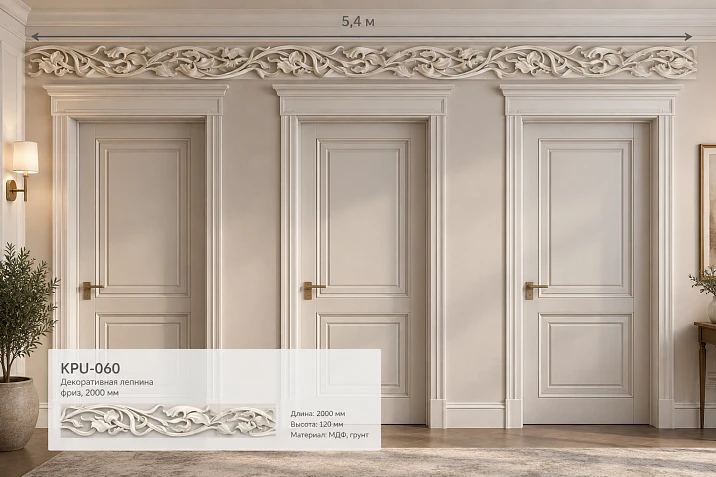
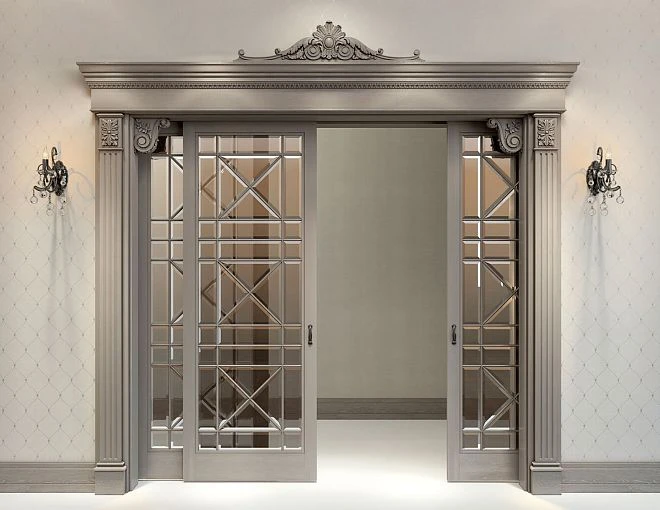
In a long hallway, three doors are in one row, and above them, you want to run one continuous ornamental line. The finished length of the frieze per the project is 5.4 m. KPU-060 is selected: carved polyurethane molding 2000 mm long. The calculator gives the answer immediately: 5400 / 2000 = 2.7, meaning at least three pieces are needed.
For ornamental molding, this calculation is not enough. Three strips give 6000 mm of gross length, but you also need to determine joint locations, check the KPU-060 pattern, account for finished trimming, and ensure the required segments can actually be obtained from three two-meter blanks. Sometimes 600 mm of arithmetic margin is enough. Sometimes the cutting map shows the need for a fourth strip — not "just in case," but because the three original lengths do not assemble into the approved composition.
Therefore, it is better to buy KPU-060 after unfolding the entire wall. First, fix the start and end of the frieze, door axes, and allowed joint zones, then build a cutting map, and only then decide whether to order three strips for 24,960 ₽ or four for 33,280 ₽.
If the product is already selected, you can buy decorative molding KPU-060 as whole products 60×9×2000 mm, and send the cutting scheme to the installer as a separate document.
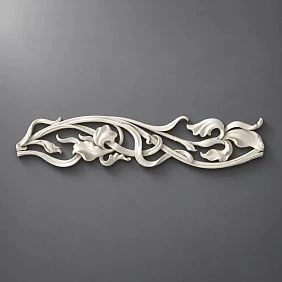
Decorative molding KPU-060: one strip 60×9×2000 mm
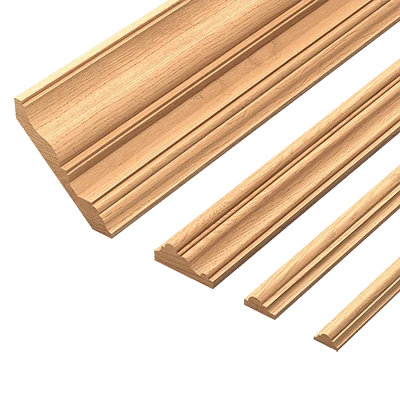
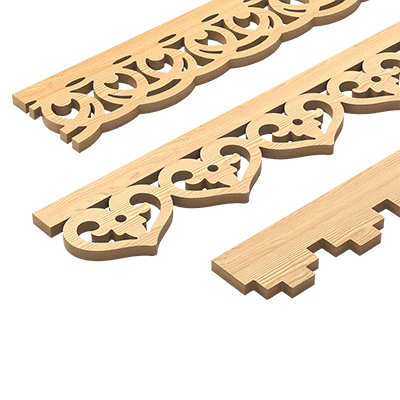
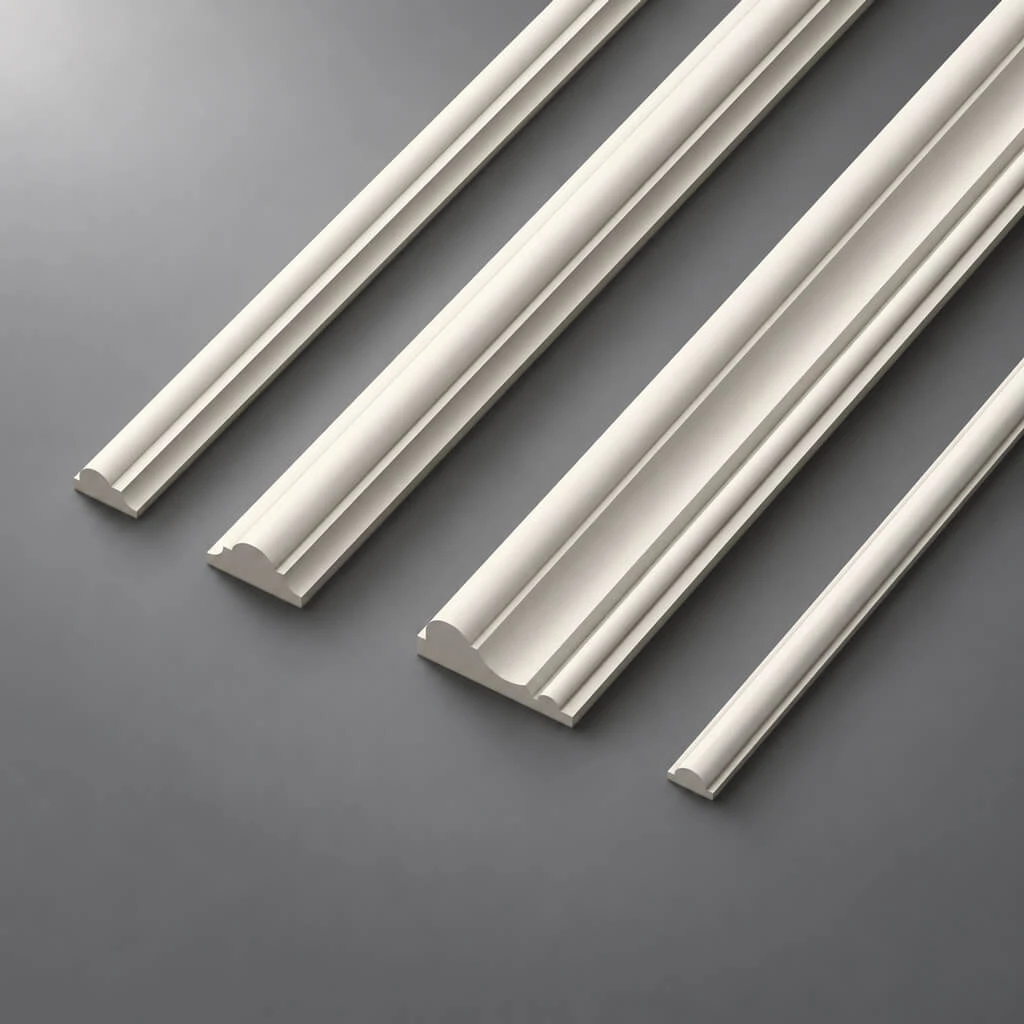
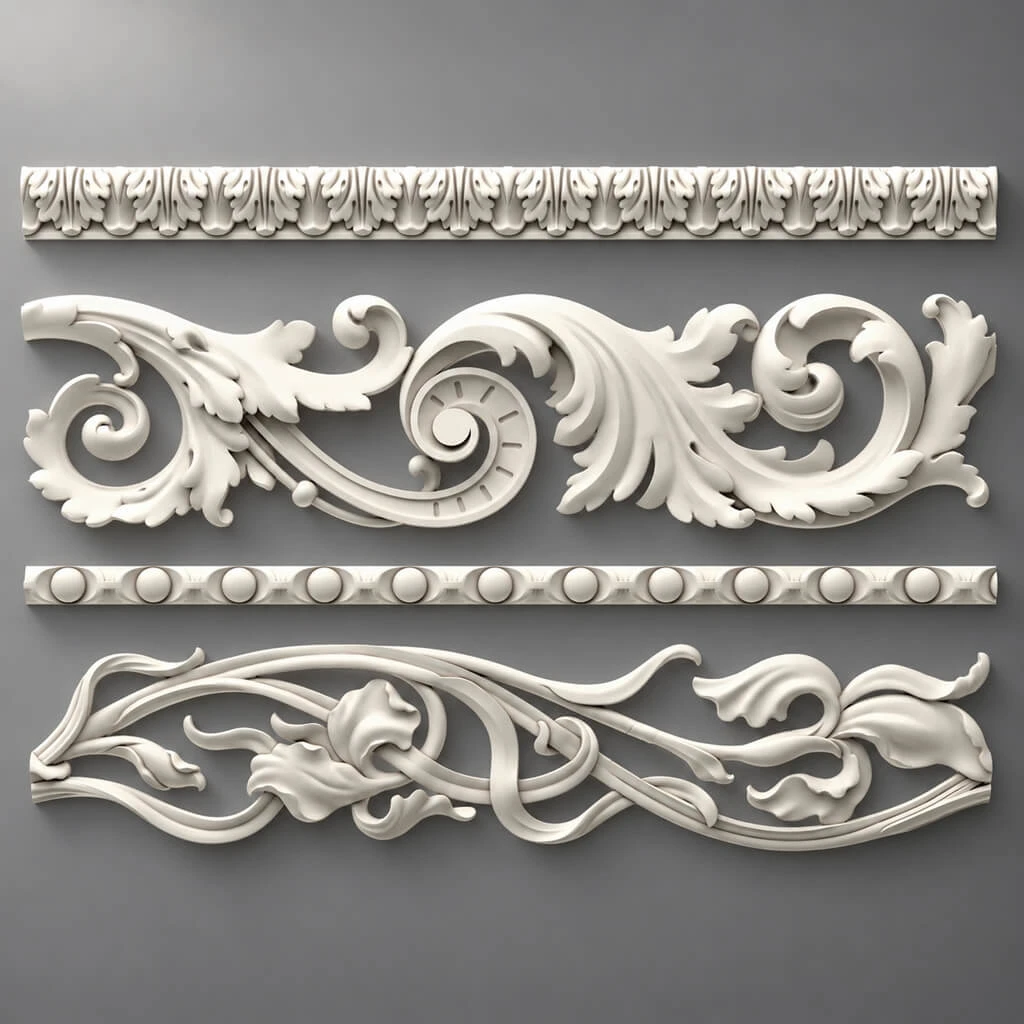
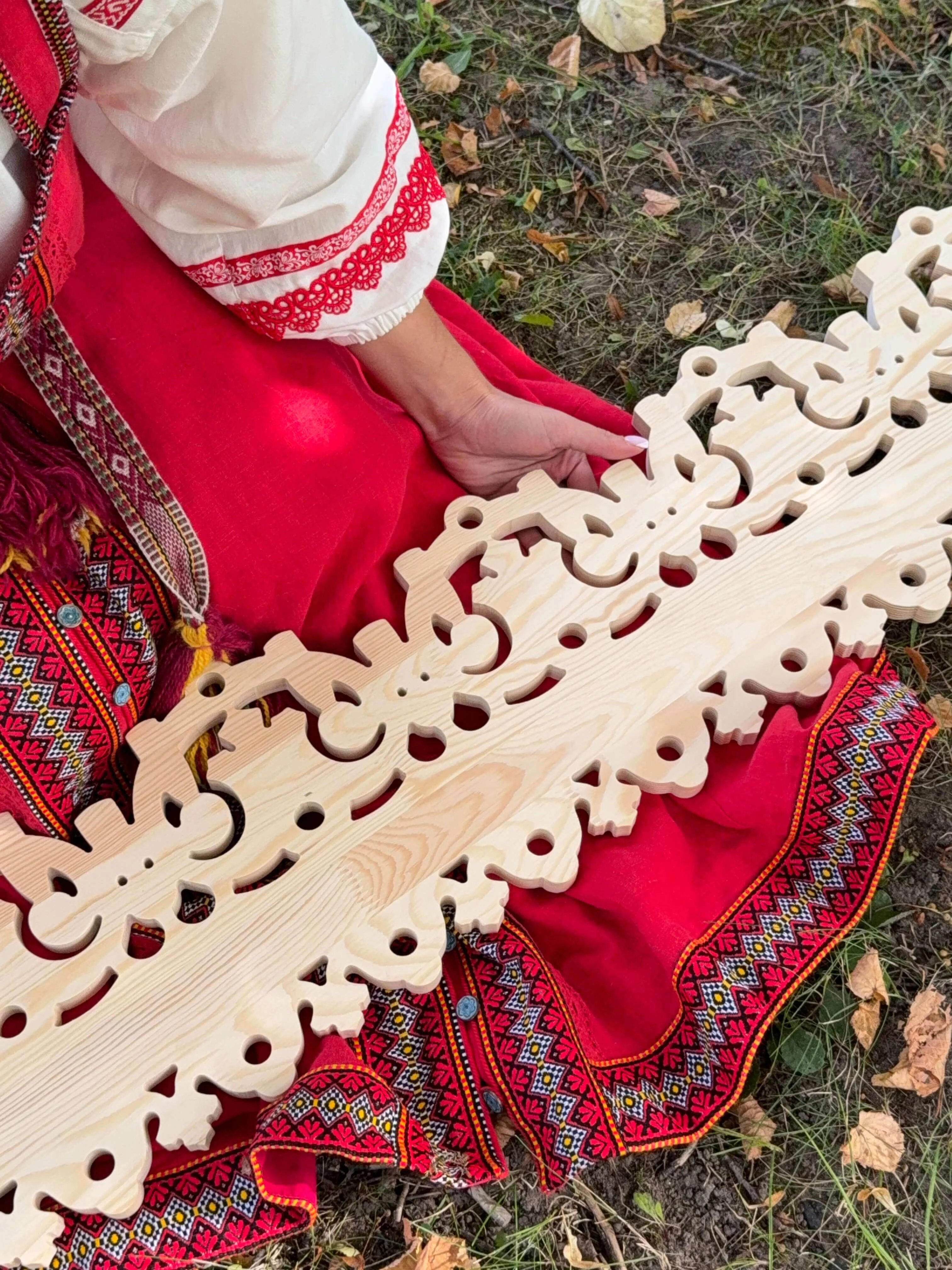
KPU-060 — carved decorative polyurethane molding. The product card shows one version:
| Parameter | KPU-060 |
|---|---|
| Material | Polyurethane |
| A | 60 мм |
| C | 9 мм |
| L | 2000 мм |
| Price per plank | 8 320 ₽ |
| Made to order | 3–7 days |
The page includes a drawing and a 3D model. For the article, the length L=2000 mm is especially important: the design frieze of 5400 mm cannot be obtained with one or two whole pieces, so joints will inevitably appear in the composition.
The price of ₽8,320 refers to one whole product item. It does not mean the cost of two linear meters of an already installed and painted frieze. The final estimate separately accounts for surface preparation, installation materials, fitting, joint treatment, finishing, and delivery.
The service of cutting to a specific project also cannot be considered automatically included. On the STAVROS website, there are different wordings about cutting linear materials, so for a safe purchase, you should assume whole planks of 2000 mm and separately confirm with the manager whether cutting specifically for KPU-060 is performed in your order.
First, we build the frieze line relative to the three doors
A bad sequence looks like this: buy three planks, bring them to the site, and ask the craftsman to "distribute the joints beautifully." On a wall with three doors, the joint location affects the entire composition, so it is determined before cutting.
On the elevation, mark:
-
the beginning and end of the decorative line;
-
the finished length of 5400 mm;
-
the width of each door opening;
-
upper lines of the architraves;
-
the axes of the three doors;
-
the width of the piers;
-
luminaires, sensors, ventilation grilles, and other obstacles;
-
areas where the joint is visually undesirable;
-
areas where the connection is acceptable after checking the pattern.
The result is not an abstract 5.4 m line, but a specific architectural scheme:
pier → door 1 → pier → door 2 → pier → door 3 → pier.
KPU-060 is applied over it. Only now can we discuss where one original plank ends and the next begins.
If the door layout is complex or the overall composition has not yet been approved, you can order a design project for the decorative layout before purchasing. This is especially useful when joints need to be aligned not only with doors but also with other interior lines.
Our factory also produces:
Three KPU-060 units give 6000 mm: what the 600 mm reserve means
Basic arithmetic:
3 × 2000 = 6000 mm.
Project line:
5400 mm.
The difference:
6000 − 5400 = 600 mm.
Therefore, the total length of the three products is sufficient. But 600 mm is a gross reserve, not a promise to get one perfect 600 mm remnant after installation.
Some material may be needed for:
-
aligning the initial end;
-
fitting of joints;
-
moving the cut to a more suitable place in the pattern;
-
compensating for a damaged or unsuccessful edge;
-
technological operations determined by the installer.
There is an even more important reason. Linear material is purchased in planks, while the frieze is assembled from individual finished segments. Even when their total length is less than 6000 mm, a specific set of segments may not fit into three 2000 mm blanks.
Therefore, before ordering, they check not only the total length, but also the layout of parts across the original planks.
Get Consultation
Why the 1800 + 1800 + 1800 mm scheme is still only mathematical for now
For a 5400 mm line, an elegant solution suggests itself:
1800 + 1800 + 1800 = 5400 mm.
Each part fits into one two-meter plank, and each blank leaves 200 mm. The gross remainder is again 600 mm.
In terms of length, the scheme is flawless. But KPU-060 is carved ornamental molding. The public product table does not provide a separately confirmed value for the pattern repeat, so it cannot be stated in advance that a cut every 1800 mm will always land at a convenient point in the motif.
Before cutting, the following questions need to be answered:
-
does the pattern repeat along the length with a constant step;
-
where is the boundary of the repeating motif;
-
Can two arbitrary cuts be visually aligned?
-
will it be necessary to shift the joint location for the sake of the pattern;
-
how much extra length will be consumed by such fitting.
If this data can be read from the DWG or obtained from the manager, the cutting map is refined accordingly. If not, a real sample or a single received plank is useful before irreversible cutting of the entire batch.
There is no need to invent an "approximate repeat" from a photo. An error of a few centimeters can repeat at two joints and make the ornamental line ragged.
Where to place joints on a wall with three doors
There is no universal rule that "the seam is always on the wall section" or "the seam is always at the center of the door." On one wall, one option works well; on another, the opposite does.
Seam along the door axis
It ends up in a visually active spot. If the pattern at the joint is noticeable, the eye may keep returning to the technical seam right above the center of the portal.
This option is only acceptable after a mockup. Sometimes symmetry makes it natural, sometimes it emphasizes the joint too strongly.
Seam at the vertical of the casing
The joint can support an existing architectural line. But if the end of the ornamental motif does not align with this vertical, it will give the impression of a randomly cut-off pattern.
Joint on the pier
This is often a calm zone, especially if the pier is wide enough. But two seams randomly scattered across different piers can disrupt the symmetry of the entire wall.
Two joints symmetrically relative to the central door
This is a good candidate for visual inspection. With symmetrical architecture, technical joints become part of the overall logic. But the solution is acceptable only if the segment lengths do not exceed 2000 mm and the KPU-060 pattern allows joints at the selected points.
The designer must first choose the desired joint coordinates, then check whether the corresponding segments can be obtained from stock planks. Doing it the other way around means subordinating the composition to a random material remnant.
Three planks may not be enough even with a total length of 5400 mm
This is the main calculation nuance.
Let's imagine that after anchoring to doors and permitted joint locations, four finished segments result:
1300 + 1300 + 1300 + 1500 = 5400 mm.
The total length is still the same — 5.4 m. Three stock strips give 6 m. At first glance, a 600 mm allowance should be enough.
But let's try to distribute four parts across three blanks of 2000 mm each.
Two parts of 1300 mm cannot be cut from one strip: 1300 + 1300 = 2600 mm.
A 1500 mm part also cannot be combined with a 1300 mm one: 1500 + 1300 = 2800 mm.
It turns out:
| Source strip | Finished part | Gross remainder |
|---|---|---|
| №1 | 1300 мм | 700 мм |
| №2 | 1300 мм | 700 мм |
| №3 | 1300 мм | 700 мм |
| №4 | 1500 мм | 500 мм |
Such a layout requires four original strips, even though the total of finished segments is only 5400 mm.
This is a training example, not a proposed scheme for three specific doors. It demonstrates the principle: total length does not replace checking the cut piece by piece.
Professionally, the task looks like distributing all finished segments among blanks with a capacity of 2000 mm. If they do not fit into three groups, a fourth plank is indeed necessary.
How to build a cutting map for KPU-060 before purchasing
For a working document, it is convenient to assign designations P1, P2, P3 to the initial planks, and P4 if necessary.
First, on the common line, number the finished segments: F1, F2, F3, and so on. For each one, record:
-
the design length;
-
position on the wall;
-
the left and right end type;
-
the connection point with the adjacent segment;
-
the pattern requirement;
-
the allowance assigned by the master;
-
the source plank from which the part will be cut.
Then fill in the table:
| Segment | Finished length | Master's allowance | Source plank | Remainder after confirmation |
|---|---|---|---|---|
| F1 | ___ | ___ | P1 | ___ |
| F2 | ___ | ___ | P2 | ___ |
| F3 | ___ | ___ | P3 | ___ |
If the 1800+1800+1800 scheme is used and the pattern allows such cuts, it's simple: one finished piece from each original plank.
If there are more segments, check whether two short fragments can be placed on one original length. In this case, not only their finished sizes are added, but also all confirmed allowances.
The map cannot be considered complete until it is known where it is safe to cut the pattern. The wall geometry and the pattern must be checked simultaneously.
Three or four KPU-060: comparing two purchases
The current price of one KPU-060 is 8,320 ₽.
Three items
3 × 8 320 = 24 960 ₽.
Nominal length — 6000 mm.
The arithmetic margin relative to the 5400 mm line is 600 mm.
This option is rational if the map confirms that all segments fit into three planks, the joint locations suit the project, and the pattern can be aligned without exceeding the available length.
Four items
4 × 8 320 = 33 280 ₽.
Difference from three:
33 280 − 24 960 = 8 320 ₽.
The fourth plank is justified not because "it's safer," but for a specific reason: for example, the required segments do not fit into three original lengths, pattern fitting consumes the gross allowance, or approved joint locations require an additional blank.
| Option | Planks | Gross length | Price |
|---|---|---|---|
| Minimum purchase | 3 | 6000 мм | 24 960 ₽ |
| Extended by cutting map | 4 | 8000 мм | 33 280 ₽ |
| Difference | 1 | 2000 мм | 8 320 ₽ |
Buying four items without calculation is just as wrong as automatically buying three. In the first case, you may overpay for an unnecessary blank; in the second, you may halt installation due to an impossible cut.
We consider the KPU-060 remainder useful only after cutting.
The phrase "600 mm will remain" sounds like a ready bonus. In reality, the remainders are distributed among the original planks and may have different patterns at the ends.
For example, with three pieces of 1800 mm each, three fragments of about 200 mm remain before accounting for technological operations. Three short remainders are not equivalent to one 600 mm element.
With four original planks, the remainder may be significantly larger, but its usefulness still depends on the pattern and the future task.
Before installation, decide whether a usable remainder is needed:
-
as a repair reserve;
-
for a short section of the same composition;
-
for making a test cut-out;
-
for subsequent finish verification;
-
for another element where the pattern matches.
There is no need to invent decorative uses just to avoid throwing anything away. An extra joint on the main frieze is usually worse than an honest remainder.
It is especially useful to label the repair reserve: article number, order date, batch, and ornament direction. This way, later on, you won't have to figure out which profile an unnamed piece came from.
One ornamental line requires one finish logic
Three or four original planks after installation should be perceived as a single frieze. Therefore, finishing cannot be approved separately for each segment.
First, perform a dry layout and confirm the geometry of the joints. After that, determine the preparation of the seams and the overall coating system.
For the project, the following are recorded:
-
color;
-
gloss level;
-
the need for priming;
-
the method of treating joints;
-
the order of painting relative to installation;
-
local touch-up after joining.
The detailed technology needs to be tied to the selected materials and the condition of the base. General tips on installing and finishing molding are useful as a starting point, but do not replace the instructions for a specific adhesive, primer, or paint.
If three segments are painted separately without a single sample, a slight difference in shade can emphasize the joints more than the geometry of the seam itself. Therefore, a single color sample here has practical significance.
The mounting compound is calculated separately from the length of the frieze
In the KPU-060 card, mounting adhesive is offered nearby, but the trim itself should not be considered a ready-made "kit with adhesive."
You cannot take a length of 5.4 m and automatically derive the number of tubes without checking:
-
wall substrate;
-
surface conditions;
-
actual contact area of the back side of KPU-060;
-
the selected adhesive;
-
the method of application;
-
consumption specified by the compound manufacturer;
-
additional installer requirements.
Correct sequence: first determine the compatible mounting material, then calculate it according to the technical documentation and the actual layout.
After choosing the technology, you can buy materials for installing moldings as separate items. Do not buy adhesive just because it is shown next to the product if the substrate and installation method have not yet been verified.
When KPU-060 for a 5.4 m line does not need to be ordered yet
It is better to postpone the purchase if the finished length of 5400 mm was obtained before installing the trims and may change after wall finishing.
No need to order three strips if the joint locations have not yet been agreed upon.
Do not order four just because the pattern 'probably will require extra'. First, the need for a fourth cutting map must be proven.
Do not cut the received products before checking the DWG, 3D model, or other information about the pattern.
Do not start finishing work before a dry layout if the joints will be refined on site.
And there's no need to use KPU-060 at any cost if the 60 mm width or a specific ornament doesn't work well with the door architecture. In this case, it's more reasonable to look at carved polyurethane moldings and choose a different model before purchasing.
Errors in calculating KPU-060 for three doors
Error: calculating only 5400 / 2000.
This results in three pieces, but the segment layout isn't checked. You need to build a piece-by-piece map.
Mistake: considering 600 mm as a guaranteed usable remainder.
This is the gross length difference. It can go into several separate offcuts and adjustments.
Mistake: cutting three strips of 1800 mm in advance.
The scheme is correct only in length. The ornament may require a different cut location.
Error: placing a seam where the original plank ends.
Wall architecture matters more than the convenience of an arbitrary two-meter boundary.
Error: buying a fourth strip without a reason.
The additional 8,320 ₽ must be justified by a cutting map, not by anxiety.
Error: considering glue included in the linear footage.
Installation materials are a separate part of the estimate.
Error: factory cutting is promised.
The service question needs to be confirmed for a specific order, because different wordings appear on the website.
What to write to the manager before ordering
A good request is not limited to the phrase "need 5.4 meters of molding".
Working product line:
KPU-060 / polyurethane / 60×9×2000 mm / 3 or 4 pcs. according to the approved cutting map / application — a single decorative frieze 5400 mm long above three doors / confirm the timeline and delivery.
It is worth adding questions to it:
Can I get the current DWG or recommendations for joining the KPU-060 ornament before cutting?
Is there a KPU-060 cutting service by size map for the current order, and if so, how is this work arranged?
How is the selected quantity of two-meter planks packaged?
Such a query helps distinguish confirmed product from design work.
If the diagram shows three planks, there is no need to automatically buy a fourth. If the map proves four, one should not try to save money at the expense of an extra seam or an unfortunate pattern.
After the final calculation, you can order KPU-060 60×9×2000 mm in the confirmed quantity. Before payment, it is also worth checking the payment and delivery terms for KPU-060.
Acceptance of three or four planks before cutting
After receiving KPU-060, you should not immediately transfer the project dimensions to the material and start cutting. First, the entire delivery is checked as one batch of the future frieze.
You need to verify the number of slats, the article number, the size 60×9×2000 mm, and the condition of the front surface. Then the products are laid out side by side in the same orientation and the pattern is compared. The task is not to declare all slats "absolutely identical," but to notice in advance where the joint may require more precise fitting.
After that, the number from the cutting map is transferred to each original slat: P1, P2, P3 and, if it is really needed, P4. The finished segments should also have their own designations. Then the installer sees not just four identical two-meter pieces, but a clear route: which blank turns into which wall section.
Before the first cut, it is useful to apply the map to the actual wall once again. If the trim has shifted after finishing, a new light fixture has appeared, or the end of the frieze has changed, the cutting plan should be adjusted before the irreversible operation.
Separately, it is checked whether the actual orientation of the ornament matches what was laid out in the sketch. If one slat is accidentally rotated relative to the neighboring one, this may be unnoticeable on the table and become obvious only after installation.
Such control is especially important for the three-slat option: it has less freedom for re-cutting. If one of the three blanks is ruined by an erroneous cut, the gross reserve of 600 mm no longer saves the project automatically.
Questions before purchasing KPU-060
What is the size of KPU-060?
The card shows 60×9×2000 mm: A=60 mm, C=9 mm, L=2000 mm.
What material is KPU-060 made of?
made of polyurethane.
How many KPU-060 are needed for a 5.4 m line?
By total length, at least three items are needed: they provide 6000 mm. But the final quantity is confirmed according to the cutting map and the pattern.
Will three 2 m planks be enough?
It's enough by length. For a real project, you also need to prove that the required finished segments and joint locations fit within three two-meter blanks.
Why can't 600 mm be considered a guaranteed margin?
Because it is the gross difference between 6000 and 5400 mm. Real offcuts may be split between several strips and partially go to fitting.
Can you simply cut three pieces of 1800 mm?
Only after checking the drawing. The length fits the pattern, but the public card does not confirm the ornament repeat that would guarantee such cuts.
Where is the best place to make joints above the three doors?
The specific location is chosen based on the overall layout: door axes, trims, wall sections, symmetry, and the KPU-060 pattern are considered. There is no universal point.
When is a fourth plank needed?
When the approved segment map, allowances, and pattern fitting do not allow obtaining all parts from three original planks.
How much do three KPU-060 cost?
At the current price of 8,320 ₽ per piece — 24,960 ₽.
How much do four KPU-060 cost?
33,280 ₽. The difference compared to three strips is 8,320 ₽.
Does STAVROS cut KPU-060 to size?
Do not consider this service guaranteed without manager confirmation: the website has different wording about cutting linear moldings. In the purchase calculation, it is safer to assume whole strips of 2000 mm.
How to choose glue for KPU-060?
Based on the trim material, wall base, surface condition, and the instructions of the specific mounting compound. A single length of 5.4 m is not enough to choose and calculate the glue.
Can KPU-060 leftovers be used?
Yes, if the length and pattern of a specific leftover fit another task. The usefulness of a leftover is determined after the cutting plan, not before it.
How to get a drawing before cutting?
In the KPU-060 card, drawings and a 3D model are available. For project layout, you can request current materials from the manager to check the pattern and joints.
Where to buy other options if KPU-060 is not suitable?
If you need a different pattern or size, you can Buy polyurethane trim from the corresponding category.
Where to view all polyurethane decor?
For a wider selection, you can open the section You can buy ready-made stucco matching the Baroque style. Calculate the quantity: linear meters of cornices and moldings, number of rosettes, pilasters, consoles, corner elements. Add a ten to fifteen percent allowance for trimming. and from there go to the desired type of decor.