






























































Article Contents:
- What is a round furniture support
- Definition and shape
- Functions of a round support
- Where round wooden supports are used
- Broader range of applications than a dresser
- How a round support differs from a regular furniture leg
- Shape defines character
- Furniture supports vs decorative overlays
- Turned furniture leg: when it is appropriate
- Interior styles where a turned support is the rule
- When a turned leg is inappropriate
- How to choose the height and diameter of a round support
- Height: logic of application
- Table of approximate heights
- Diameter: load-bearing capacity and proportion
- Proportionality: support and body
- Material: why wood is suitable for furniture supports
- Wood is a living and versatile material
- Advantages of wood over metal and plastic
- Support without coating: why it is needed
- Round supports for classic furniture
- Classic style requires matching supports
- How to combine round supports with handles and decor
- Unity is the main principle
- What not to combine
- Common mistakes when choosing a round furniture support
- Mistake 1: Too thin support for a heavy body
- Mistake 2: incorrect height
- Mistake 3: Different style of legs and handles
- Mistake 4: Choosing only by photo without measurements
- Mistake 5: Mismatch of wood species
- Error 6: Weak fastening
- Additional materials on the topic
- FAQ: questions about round furniture supports
- Where to buy round wooden furniture supports
- STAVROS: round furniture supports made of solid beech and oak
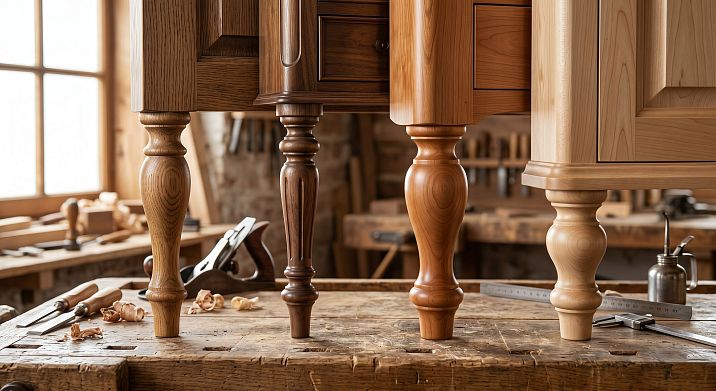
There are details in furniture that are only noticed when they are wrong. Here is a cabinet with square "chocks" instead of legs — heavy, squat, without air. And next to it — the same cabinet, but on elegant turned supports with a smooth profile. The second one seems lighter, more expensive, and more significant — although the body is the same.
This is exactly how round wooden furniture support: it sets the silhouette of the object, lifts it above the floor, creates "air" under the body, and gives the furniture a stylistic character — light or solemn, classic or neutral.
In this article — everything about how to choose round furniture support, for which items it is suitable, how to match it with handles and decor, and what mistakes to avoid when choosing.


What is a round furniture support




Definition and shape
furniture leg — a load-bearing element of furniture that takes the vertical load from the body and transfers it to the floor. Unlike a built-in base or a wooden block "leg", a furniture support is a separate part that is attached to the body from below.
A round furniture support is a support with a cross-section in the shape of a circle. Not square, not rectangular, not trapezoidal — exactly round, with possible decorative transitions in height: thickenings, grips, relief rollers.
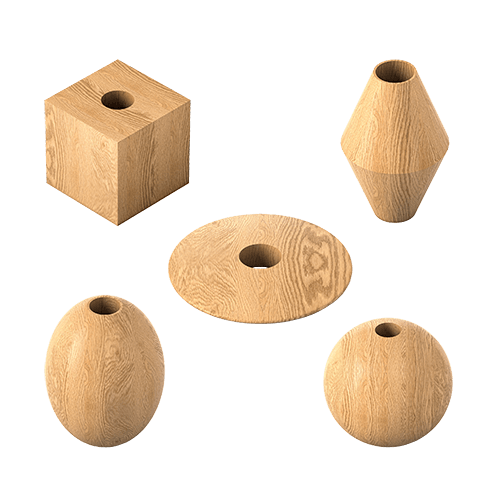
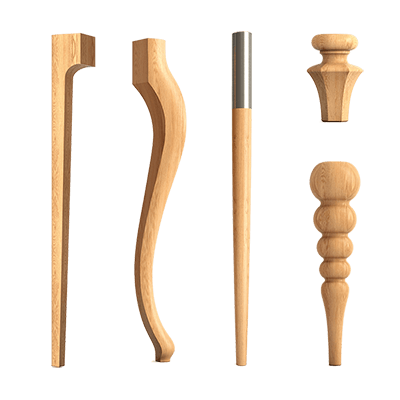
A turned support is a round wooden leg made on a lathe. During turning, the craftsman (or CNC machine) forms a profile element with a given shape from a cylindrical blank: expansions, constrictions, fillets, barrel-shaped or spindle-shaped sections.
It is turning that gives the round support that decorative silhouette that makes it part of the classic furniture image.
Our factory also produces:


Functions of a round support
-
Load-bearing: holds the body, evenly distributes the load.
-
Spatial: lifts the body above the floor — creates a gap for cleaning, visual "air", a feeling of lightness.
-
Decorative: shapes the silhouette of the furniture, gives it style.
-
Constructive: allows using furniture on uneven floors (if the leg has an adjustable base).
Get Consultation
Where round wooden supports are used
The range of applications is wider than that of a chest of drawers
Wooden legs round shapes are used on a wide variety of items — and in each case they solve a specific problem.
Chests of drawers. One of the most common objects. A chest of drawers on four turned legs is a completely different item than a chest of drawers on a plinth or square supports. The leg "opens up" the body, makes it light, visually reduces it.
Cabinets (bedside, TV, shoe). Small cabinets on round supports 5–15 cm high look much neater and more expressive than similar items "without legs".
Consoles and dressing tables. Here, round supports are the standard. Thin turned console legs create the image of a light, almost floating object.
Coffee and side tables. Small tables on elegant turned legs are the quintessence of "tea style", classic, and Provence.
Sofas and armchairs. The front supports of upholstered furniture are one of the most important style-forming elements. Round turned sofa legs are "classic". Square straight ones are "modern".
Ottomans and poufs. Small items with bright round supports are a classic decorative technique.
Cabinets and display cases. Tall cabinets on pronounced round supports are rare but very striking. A cabinet "on legs" looks lighter and more expressive than a "floor-standing cabinet."
Restoration. Replacing broken or stylistically mismatched supports is one of the most popular application scenarios.
How a round support differs from a regular furniture leg
Shape defines character
At first glance, all legs are the same: they stand at the bottom and hold the body. But the cross-sectional shape changes the entire visual impression.
Square leg. Strict, technological, modern. Suitable for furniture in minimalist, high-tech, loft, and Bauhaus styles. Not suitable for classic and Provence styles — it looks like a "wooden block."
Rectangular leg. Even stricter, often metal. For industrial style and ultra-modern furniture.
Tapered leg (round cone). A transitional option — it carries both modernity and softness. For Scandinavian style, mid-century modern, and modern classic.
Turned round leg with profile. Soft shape, decorative transitions, classic silhouette. Ideal for classic, neoclassical, Provence, rustic styles, and any interior with natural wood as an accent.
It is precisely the softness of the round shape that is its main visual advantage. A circle has no sharp corners; it is "friendly" to the eye. Therefore, furniture on round turned supports seems warm, human, and lived-in — even if it is new.
furniture legs vs decorative overlays
The leg bears the load — the decorative overlay does not. This is a fundamental difference. Overlays made of wooden decor add relief to the facade — but do not lift the body. The leg works structurally: it holds, lifts, and sets the height.
Turned furniture leg: when it is appropriate
Interior styles where a turned leg is the rule
Turned furniture leg is not "just any leg." It is a specific image that works in certain stylistic contexts.
Classic and neoclassical. Here, a turned leg is the norm. Smooth profile, symmetrical transitions, sometimes with a light carved relief. The more formal the classic style, the more expressive the leg.
Provence. Soft turned legs of a slightly simpler shape — often white or in pastel tones. They look rustic and cozy, with a sense of history.
Modern classic (neoclassical). A turned leg with a moderate profile, without excessive carving. Closer to a conical shape, but with characteristic transitions that distinguish it from a minimalist cone.
Rustic and country. Simple turned legs with a "rough" character — made from solid wood with minimal finishing.
Scandinavian style. Thin tapered legs — a simplified version of a turned support. The most popular style of the last twenty years.
When a turned leg is inappropriate
-
Minimalism with metal supports.
-
High-tech and loft.
-
Modern furniture with straight geometric shapes.
-
Furniture "without legs" — on a plinth or built-in.
How to choose the height and diameter of a round support
Height: logic of application
Height furniture support determines how high the body will be raised above the floor. This affects both aesthetics and ease of use.
Low legs (5–10 cm). For cabinets, shoe shelves, benches, and side tables. A slight lift provides functional "air" under the body. Visually, the piece looks low but neat.
Medium legs (10–20 cm). The most versatile height for dressers, nightstands, consoles, and coffee tables. The body is noticeably "raised," making the furniture feel light.
High legs (20–30 cm and more). For tables, sofas, armchairs, and tall consoles. They determine the final height of the work or decorative surface.
Table of approximate heights
| Furniture type | Recommended leg height |
|---|---|
| Bedside table | 5–12 cm |
| Commode | 8–15 cm |
| Console / vanity table | 15–25 cm |
| Coffee table | 30–45 cm |
| Sofa (front legs) | 10–18 cm |
| Chair | 8–15 cm |
| Bench / ottoman | 8–15 cm |
Diameter: load capacity and proportion
The support diameter must match the load and body dimensions.
Thin supports (diameter 25–35 mm): for lightweight furniture — cabinets, consoles, small dressers. Elegant, delicate silhouette.
Medium supports (35–50 mm): universal. For dressers, nightstands, coffee tables.
Heavy-duty supports (50–70 mm and more): for dining tables, massive bodies, sofas. Reliability and visual weight.
Proportionality: support and body
The rule most often broken: the leg should be proportional to the body. A thin 25 mm leg on a heavy oak dresser 120 cm wide — visual and structural imbalance. A massive 60 mm support on a small nightstand — comical.
Guideline: leg diameter ≈ 1/3–1/4 of body width divided by the number of legs. But the main thing is to look in person, maintain proportion 'by eye'.
Material: why wood is suitable for furniture supports
Wood is a living and versatile material
Wooden buy furniture leg — it is a choice of material that is simultaneously beautiful, warm, repairable, and versatile in finishing.
Beech. The most popular species for turned supports. Homogeneous dense structure — ideal for turning: the profile is clear, without fuzz or tear-outs. Light cream tone in its natural state. Takes any tinting and paint well. Durable.
Oak. Denser and more expressive in texture than beech. A turned oak leg under clear oil is lively, with a distinctive grain. For interiors with an emphasis on natural wood. Slightly heavier and more expensive than beech.
Pine. Softer, more affordable. Paints well, but less wear-resistant at contact points. Optimal for light furniture, rustic style, for supports to be painted white or pastel tones.
Advantages of wood over metal and plastic
| Criterion | Wood | Metal | Plastic |
|---|---|---|---|
| Tactile warmth | Yes | No | No |
| Possibility of painting/tinting | Yes, any color | Limited | Limited |
| Repairability | High | Low | Very low |
| Decorative profile | High | Medium | Low |
| Durability | High | High | Low |
| Ecological | Natural material | Neutral | Synthetic |
It is wooden furniture legs remain the most sought-after choice for classic furniture, restoration, and custom interior solutions.
Uncoated support: why it is needed
Buy furniture legs for a 200-room hotel project — this is not an ordinary deal, but a partnership requiring a special approach. uncoated — a conscious professional choice. An unpainted support allows:
-
Tint to match existing furniture.
-
Paint in any color — including together with the body.
-
Apply special compounds (oil, wax, interior varnish) for a specific interior.
This is especially important during restoration, when you need to exactly match the tone of old furniture.
Round supports for classic furniture
Classics require appropriate supports
Classic furniture is a system. A carved facade, a profiled cornice, wooden handles, applied decor — all these elements work together. And the leg is part of this system.
For classic furniture, a turned support is selected based on several criteria:
Profile. The more formal the classic style, the more expressive the leg profile. For strict neoclassicism — a moderate cone with one or two decorative rings. For formal classic style — a more complex profile with several transitions.
Height. Classic furniture is rarely too high on legs. A moderate height of 10–20 cm creates stability and monumentality. Legs that are too long give classic furniture an inappropriate lightness.
Tone. A support in the same tone as the body — unity of the image. A support slightly darker or lighter — an acceptable accent. A support of a different color — only in the case of a deliberate artistic decision.
Wood species. For classic furniture a beech body — legs made of beech. For an oak body — legs made of oak. Mismatch of wood species — a conflict of textures and tones.
How to combine round supports with handles and decor
Unity is the main principle
A piece of furniture is an ensemble. The leg, handle, and decor must speak the same language.
Round turned leg + wooden button handle: an excellent combination. Both elements are rounded, both wooden, both laconic. A chest with such a pair is minimalist classics.
Round turned leg + wooden hook handle: a slightly more formal combination. The bracket adds a horizontal rhythm, the leg adds a vertical one. The chest gets a "classic" look with hardware.
Round turned leg + metal bronze handle: a classic technique. Warm metal on a wooden facade + wooden turned leg — an organic trio.
Round turned leg + decorative elements for furniture: overlay rosettes, corner overlays, profile moldings on the facade — all of this should be in the same tone as the legs.
What cannot be combined
-
Round turned legs + metal straight modern handles. Style conflict — a classic leg and ultra-modern hardware.
-
Round legs of different profiles on one piece. All four legs are identical.
-
Turned legs and square corner overlays simultaneously — a conflict of "warm" and "cold", "round" and "sharp".
Common mistakes when choosing a round furniture support
Error 1: Too thin support for a heavy body
A thin, elegant 25 mm leg under a massive oak chest weighing 60–70 kg — risk of deformation and destruction. For heavy furniture — supports with a safety margin in diameter and wood species (beech or oak, not pine).
Mistake 2: incorrect height
A bedside table on 25 cm legs — raised too high, losing stability and proportion. Or, conversely, a coffee table on 8 cm legs — inconvenient in height. The leg height is always calculated based on the final functional height of the item.
Error 3: Mismatched style of legs and handles
Choosing legs and handles separately, in different stores, from individual photos — a sure path to an inconsistent result. The leg, handle, and decor are ordered as a unified system.
Error 4: Choosing only by photo without measurements
A photo of a 10 mm leg and a 50 mm leg look the same. Without specific dimensions — height, base diameter, top diameter — it's a 'blind' purchase.
Error 5: Mismatch of wood species
A beige beech leg on a dark-toned oak chest — a visual disconnect. All wooden elements of one item — from the same species or in a unified tone.
Error 6: Weak fastening
The leg is attached to the body via a built-in threaded element (stud + nut) or with self-tapping screws. Attachment "with glue" without a threaded connection is unreliable for furniture with regular load. Clarify the attachment method before purchasing.
Additional materials on the topic
If you are studying the issue of choosing furniture supports in detail, pay attention to related articles:
-
О tall wooden legs for furniture — when long supports are needed and how to choose them.
-
О wooden legs for chairs and tables — specifics of supports for tabletops and seats.
Together, these materials cover the entire range of questions on choosing wooden furniture supports for different tasks and items.
FAQ: questions about round furniture supports
How many legs are needed for a dresser?
Standard — four: at the corners. For wide dressers (120 cm and more) — sometimes six: four at the corners and two in the center for even load distribution.
Can I replace just one broken leg?
Yes, but only if you can find an exact match. One leg of a different profile or shade will be immediately noticeable. It's better to replace all four at once during restoration.
How is a wooden leg attached to the body?
Most often — through a metal stud (screwed into the leg) and a socket with a nut in the body. A reliable, detachable fastener. Also on a wooden dowel with glue or on screws from below.
Can I paint a wooden leg after purchase?
Yes. An uncoated leg is sanded, primed, and painted in any color. A coated leg is sanded, primed again, then painted.
Which wood species is stronger for legs under load?
Beech and oak are the strongest among available species. For dining tables with a load of 50+ kg, oak or beech with a diameter of 45 mm or more is recommended.
How to match the leg color to existing furniture?
Take a sample or photo of the furniture with you. Order legs without coating and tint them yourself — this guarantees an exact color match.
Where to buy round wooden furniture supports
Full range of wooden supports and related products:
-
Round furniture leg — turned wooden legs.
-
buy furniture leg — catalog of uncoated supports.
-
Wooden legs — full catalog of furniture legs.
-
Buy legs for furniture — wooden furniture legs for finishing.
-
wooden button handle — coordinated fittings.
-
wooden hook handle — coated brackets for classic furniture.
-
decor for furniture — applied solid wood elements.
-
decorative elements for furniture — sockets, overlays, friezes.
-
Furniture and decor from solid wood — complete product catalog.
STAVROS: round furniture legs made of solid beech and oak
round wooden furniture support — this is a small detail that shapes the image of the entire object. A properly selected turned leg turns an ordinary chest of drawers into a piece with character, and a bench from a neutral object into a stylish interior accent.
STAVROS manufactures wooden furniture legs made of solid beech and oak — turned, profiled, with a proper threaded base for secure fastening. Legs without coating — for tinting, painting or varnishing at the customer's choice. Unified system: legs, handles, applied decor and moldings from one catalog, one wood species, one manufacturer.
STAVROS works with furniture manufacturers, designers, restorers and private customers. Stable quality, precise dimensions, fast Contact us to confirm shipping to your destination.