Article Contents:
- Carved SNL connecting element — a small detail that assembles the facade
- How a connecting element differs from a platband, bracket, and overlay
- Platband — frame
- Bracket — support and accent
- Overlay — decorative insert
- SNL element — connection, joint, completion
- Where to use carved connecting elements in house carving
- At the joints of carved platbands
- At the corners of the window frame
- On the facade of a wooden house
- On the veranda and terrace
- In the decor of doors and furniture
- In an interior in Russian style
- How to beautifully cover the joint of trims
- Why the joint cannot be left random
- How the SNL element covers the joint
- How to choose an SNL for a specific joint
- How to choose an SNL by shape: square, rectangle, vertical accent
- Square elements
- Rectangular elongated elements
- Elements with vertical accent
- Large elements for facade accent
- Small elements for detailing
- Selection principle by shape
- Material: why pine is suitable for house carving
- Pine is a traditional material for Russian house carving
- Pine accepts paint well
- Pine is light and strong in the right cross-section
- Pine creates the correct facade aesthetics
- How to assemble a house carving kit with SNL elements
- Basic window framing kit
- Extended facade kit
- How to calculate the number of SNL elements
- What else is needed for a complete kit
- How to choose the size of the connecting element
- First reference: width of the casing
- Second reference: window scale
- Third reference: overall facade rhythm
- Fourth reference point: decor thickness
- Installation of carved connecting elements: what to check before installation
- Step 1: dry layout
- Step 2: Surface preparation
- Step 3: priming and painting
- Step 4: mounting
- Step 5: Sealing joints
- Step 6: final inspection
- Mistakes when buying carved connecting elements SNL
- Buying one element without calculating the entire composition
- Mixing different ornaments
- Not considering the thickness of the casing
- Choosing too small an element for a large window
- Forgetting about pairing and symmetry
- Not checking the material and wood species
- Buying stencils instead of ready-made decor
- Installation mistakes: a separate topic
- Where to buy carved connecting elements SNL for house carving
- About the Company STAVROS
- FAQ: Answers to the Most Popular Questions
- What is a carved connecting element SNL?
- How is SNL different from a platband?
- What wood are SNL elements made from at STAVROS?
- How many SNL elements are needed for one window?
- Can SNL be used inside a house?
- How to choose the size of SNL for the casing?
- How to attach the SNL element?
- Can I order an SNL for a specific size?
There are things that don't catch the eye, but without them everything falls apart. In music, these are pauses. In architecture, these are transitions between elements. In house carving, these are connecting elements. They turn a set of individual wooden parts into a cohesive facade decor. They cover the joint where one casing ends and another begins. They maintain the rhythm and logic of the entire carved composition.
If you want buy house wood carving and decorate the facade of a wooden house truly professionally — this article is about that very missing link: carved connecting elements of the SNL series. How they work, where they are used, how to choose the right size and shape, how to install, and where to buy.
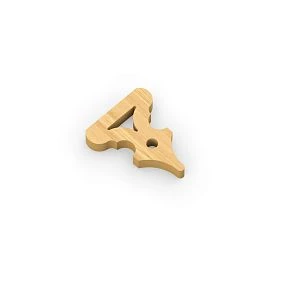
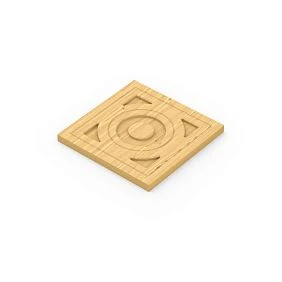
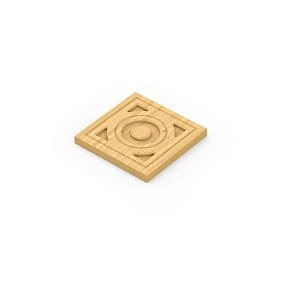
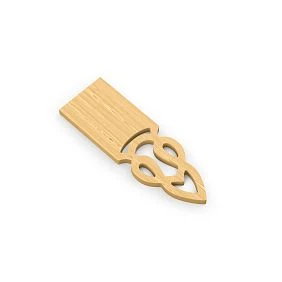
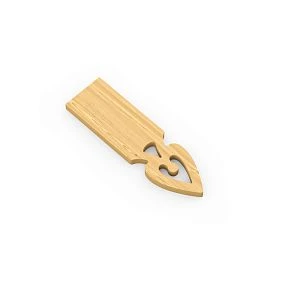
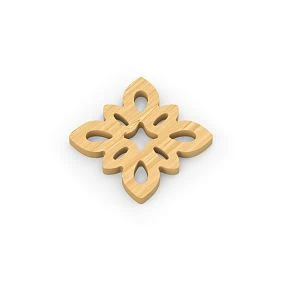
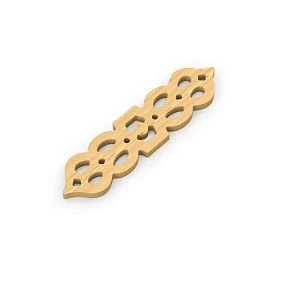
Carved connecting element SNL — a small detail that assembles the facade
House carving is not just an ornament. It is the architectural language of a wooden house, where every detail has a function: the window casing sets the frame, the bracket supports the cornice, the carved insert creates an accent. But between all these elements, there are points where one fragment ends and another begins. It is at these points that the facade either looks assembled or unfinished.
The carved connecting element SNL is a decorative wooden part specifically designed for these points. It is not the main framing element. Its role is nodal, connecting: to cover the joint, shape the corner, create a pause in the ornamental row, add a decorative accent where a 'void' would otherwise appear.
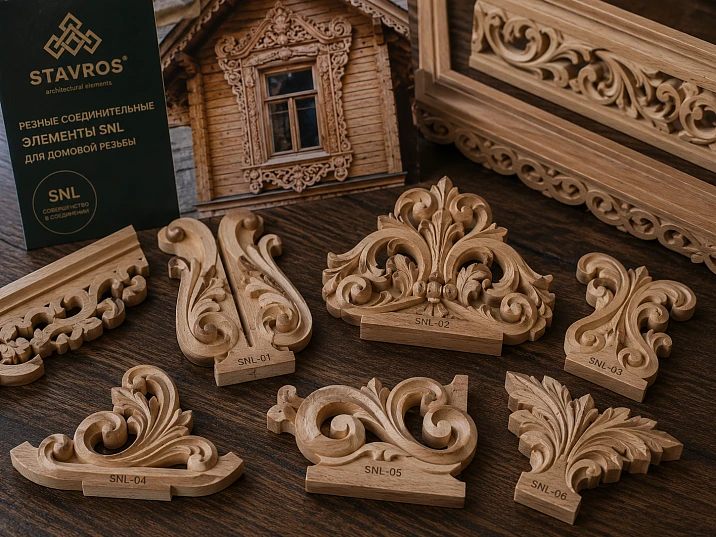
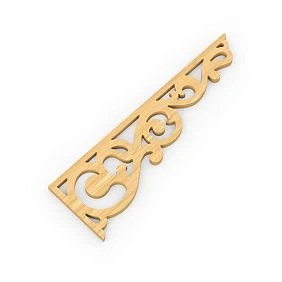
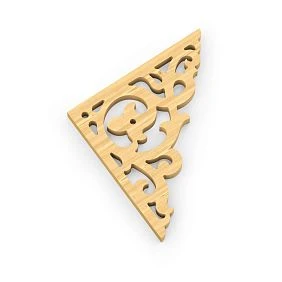
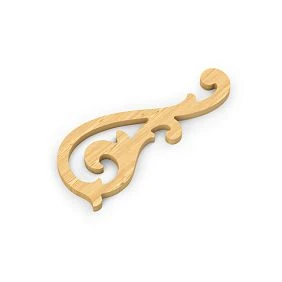
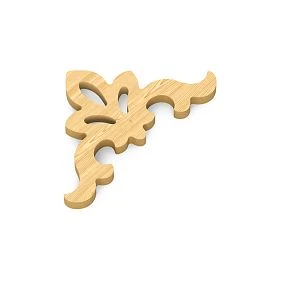
In the STAVROS house carving The SNL series is represented by several items with different shapes, ornaments, and sizes. These are finished wooden products — not stencils, not templates, not blanks. They are complete facade decor, ready for installation.




How is a connecting element different from a casing, bracket, and overlay
Before choosing an SNL, it's important to understand its place in the house carving system. Four different types of elements — four different roles.
Our factory also produces:
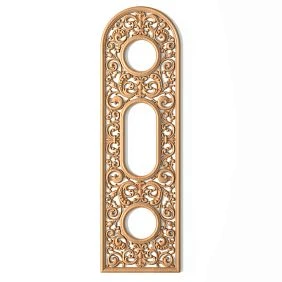
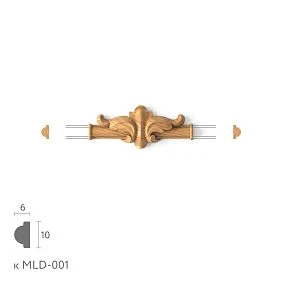
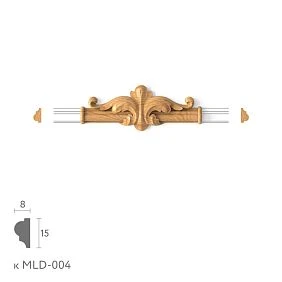
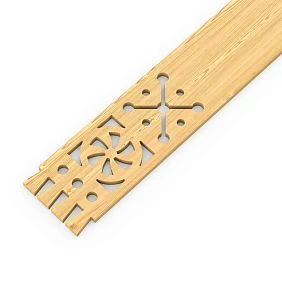
Casing — frame
Carved Mouldings — the main linear element of window and door framing. They run along the perimeter of the opening, create vertical and horizontal lines, and set the scale of decor across the entire facade. The casing is the foundation. Long, rhythmic, linear.
Get Consultation
Bracket — support and accent
A bracket in house carving works as a cantilever: it supports an awning, canopy, cornice, or the top rail of a casing. A bracket is an element with visual weight. It should look like a structural support, even if it only serves a decorative function.
Overlay — decorative insert
A carved overlay is a flat or relief decorative element that is installed on a surface: on a board, panel, shutter, or wall section. The overlay creates an ornamental accent on the surface without structural context.
SNL element — connection, joint, completion
A connecting element is neither the first, nor the second, nor the third. It works at a point. At a corner point. At a joint point. At a transition point. Where two casings meet, where a corner transition requires completion, where a vertical meets a horizontal — that's where an SNL is needed.
It can be compared to a keystone in an arch: it is small in area, but it is what visually holds the entire structure together. Without it — a gap. With it — a system.
Where to use carved connecting elements in house carving
The scope of application of SNL elements is wider than it seems at first glance at the catalog.
At the joints of carved architraves
The most obvious application: the place where a vertical architrave meets a horizontal one. In traditional house carving, this corner can be designed in different ways — a 45° joint, a butt joint, a corner square. A carved connecting element for the architrave joint is a ready-made solution that turns a technical node into a decorative accent.
A square or rectangular SNL element is installed at the corner point, covering the joint and creating a visual "lock" for the framing. This is both technically sound and aesthetically refined.
At the corners of the window framing
Every window has four corners. In classic house carving, all four are designed symmetrically. SNL elements at the corners of the window framing create a clear rhythm and completeness: each window on the facade looks like a finished module, not a random set of boards.
On the facade of a wooden house
Carved decor for the facade of a wooden house — it's a system. On a single facade, there can be dozens of connection points: corners of casings, transitions between vertical and horizontal elements, joints when several windows are placed in a row. SNL elements ensure visual connectivity of the entire facade.
On the veranda and terrace
Open parts of the house — veranda, terrace, porch — are areas where carving is especially visible. It is here that house carving works to its full potential: carved posts, railings, arch frames, canopies. Connecting elements on the veranda and terrace tie these details into a single architectural program.
A feature of the veranda: it is often seen at an angle, not strictly frontally. This means that the joints of casings and corners of the framing are especially visible. SNL elements here solve the problem of neat finishing of nodes from any viewing angle.
In door and furniture decor
The SNL connecting element is not only for facade work. It is also used in interior work: on door panels, on furniture facades, on panel inserts in the interior. Where wooden carving is built from several parts — molding, casing, overlay — SNL covers the joints and creates completeness.
In the interior in Russian style
The Russian style in the interior is experiencing a notable revival. A wooden house with open log walls, with carved elements on the piers, with decor in the spirit of a Russian izba — here SNL elements made of pine are natural as a continuation of the facade theme. They transition from the street into the house and create a unified ornamental narrative.
How to beautifully close the joint of casings
Here is a question that craftsmen and homeowners across the country ask. The joint of casings is the place of greatest technical vulnerability in the window framing system. And at the same time — the point of greatest decorative potential.
Why a joint cannot be left random
Any joint is a visual accent, whether you like it or not. The eye automatically looks for transitions and boundaries. An untreated joint reads as an installation error: "something is wrong here." A joint with a connecting element reads as an intentional design decision.
This is the difference between "a house under renovation" and "a house with character."
How an SNL element closes a joint
The principle of operation is simple. The vertical trim runs along the side of the window. The horizontal one runs along the top or bottom. They meet at the corner point. If you simply join them at 45° or butt them together, you get a carpentry joint. If you install an SNL element at the corner point, covering both ends of the trims, you get a decorative node.
The connecting element at the same time:
-
Hides the installation transition and the ends of the trims.
-
Creates a visual accent — a "lock" or "rosette" at the corner point.
-
Connects the vertical and horizontal rhythm of the ornament into a single system.
-
Ensures the corner is sealed when properly installed with sealant.
How to choose an SNL for a specific joint
The main parameter is the width of the casing. The SNL element must cover both ends, so its size should be no less than the width of the casing on each side.
Example: casing width 70 mm — the corner SNL element must be at least 70×70 mm (square) or 70×100 mm (rectangular with vertical accent).
How to choose an SNL by shape: square, rectangle, vertical accent
In the solid wood carving STAVROS several shapes of connecting elements are presented. Let's break down their logic.
Square elements
Square SNLs are the most versatile shape. They evenly cover the corner joint in both directions, create a symmetrical accent, and work well with casings of the same width.
SNL-2 — one of such elements. Square shape with ornament, a universal assembly point for window framing and facade decor.
Square elements are appropriate at window corners, in the centers of decorative frames, as accent inserts between horizontal and vertical casings.
Rectangular elongated elements
Rectangular SNL — for cases where the vertical and horizontal architraves have different widths, or when a longer accent is needed. The elongated element visually connects a larger range of ornamental space.
SNL-3 — rectangular shape with expressive carved relief. Works well in central positions of the upper horizontal of the window architrave.
Elements with vertical accent
Some SNL elements have a vertically oriented ornament. This makes them natural in positions where the accent needs to be "raised" — for example, in the center of the upper horizontal or at the junction of two vertical architraves.
SNL-9 — an example of such an element with an elongated shape that emphasizes the vertical rhythm.
Large elements for facade accent
On a large facade — with wide windows, with high framing — larger connecting elements are needed. A small SNL on a large window will be "lost." A large element creates a powerful accent and matches the scale of the architecture.
SNL-11 и SNL-13 — elements with a larger cross-section for facade work on a larger scale.
Small elements for detailing
Small SNL — for delicate detailing: furniture facades, door trims, small window openings, interior panels.
SNL-15 — a smaller version suitable for delicate joints and interior use.
Selection principle by shape
| Shape | Application | Position |
|---|---|---|
| Square | Corner joint of equal trims | Four corners of a window |
| Horizontal rectangle | Center horizontal, top crossbar | Center of the top board |
| Vertical rectangle | Vertical accent, vertical break | Center of side post |
| Large element | Large facades, tall windows | Accent points |
| Small element | Furniture, doors, small windows | Joints in delicate decor |
Material: why pine is suitable for house carving
The SNL STAVROS series uses pine. This is not a random choice — it is a traditional and technologically justified material for house carving.
Pine is a traditional material for Russian house carving
Historically, pine was the main wood for decorating wooden houses in Russia: window frames, gable boards, friezes, balusters — all of these were carved from pine. The reason is simple: pine is a common, easy-to-work, lightweight species that, with proper painting and protection, lasts for decades outdoors.
House carving from pine is not a compromise, but a adherence to tradition.
Pine accepts paint well
For facade decor, this is critically important. Pine has a smooth surface that accepts varnish, enamel, stain, and impregnation well. With proper priming and painting, an SNL element made of pine lasts outdoors without deformation.
Pine is lightweight and strong in the right cross-section
For installation at height or in hard-to-reach places, lightweight material matters. The pine SNL connector does not create excessive load on the fastening and does not overload the structure.
Pine creates the right facade aesthetics
There is an intuitive feeling of a "correct" wooden house. Pine carving, painted white with a dark outline or in ochre, "sounds" like a Russian house, like a terem, like an izba in a good sense — without parody, with character. This is exactly the aesthetic that SNL elements create in the system of wooden facade decor.
How to assemble a house carving kit with SNL elements
A separate connecting element is a part. House carving is a system. Let's break down what it consists of and how SNL fits into the kit.
Basic window framing kit
For one window, a standard kit includes:
-
Vertical trims — two side posts along the window length.
-
Horizontal trim — top crossbar (sometimes also bottom).
-
SNL connecting elements — four corner elements and, if necessary, a central element on the top horizontal.
-
Brackets or carved inserts — if there is a canopy or top decorative finish.
It is the SNL elements that complete this kit and transform it from a set of parts into a window framing.
Extended facade kit
The same logic applies to the entire facade, but the scale is larger. In addition to window frames, SNL elements are used:
-
At the corners of the general facade decor.
-
At the intersection points of horizontal and vertical moldings.
-
As accent inserts on long horizontal friezes.
-
In the decoration of the pediment and cornice.
How to calculate the number of SNL elements
For each window with four corner joints — 4 SNL. If a central element on the top horizontal is additionally used — +1. On a facade with six windows — at least 24–30 SNL elements.
Additionally, consider: with a non-standard layout involving intermediate posts or decorative horizontals, the number of connection points increases.
What else is needed for a complete set
-
Carved Mouldings — main moldings.
-
Carved decor in the catalog of house carving — inserts, friezes, under-eaves.
-
Wooden moldings for connection — moldings, cornices.
-
Primer, paint or antiseptic impregnation for finishing.
How to choose the size of the connecting element
This is the most practical question when choosing SNL. And the most common source of errors.
First reference: the width of the casing
The width of the connecting element on each side should be no less than the width of the casing. The logic is simple: the element must completely cover the end of the casing, otherwise the joint will be visible.
If the casing is 80 mm wide — the minimum size of a square SNL: 80×80 mm. If the casings are of different widths (for example, 80 mm vertical and 100 mm horizontal) — a rectangular element of 80×100 mm or larger is needed.
Second reference: window scale
Small window (e.g., 600×900 mm) — a connecting element of 80×80 mm will be proportionate. Large window (1200×1500 mm and above) — a larger element is required, otherwise it will be "lost" in scale.
Proportion rule: the SNL element should not occupy more than 15% of the height of the vertical casing. That is, with a casing height of 900 mm — the maximum vertical size of the element is about 135 mm.
Third guideline: overall facade rhythm
Multiple windows on the facade — all connecting elements must be the same size. Uniformity of size creates rhythm. Variation in size destroys it.
Fourth guideline: decor thickness
The thickness of the SNL element should match the thickness of the casing. If the casing protrudes from the facade plane by 20 mm, and the SNL by 10 mm, a difference will occur. Check these parameters in product cards.
Installation of carved connecting elements: what to check before installation
SNL installation is the final stage of assembling the window framing. An error here can only be corrected by dismantling. Therefore — preparation first.
Step 1: dry layout
Before any glue and fasteners — a complete dry layout. Lay out all casings and SNL elements on the ground or on a table in the configuration in which they will be installed. Check:
-
Do the dimensions match (SNL overlaps the ends of the platbands).
-
Is the ornament oriented correctly (vertical/horizontal).
-
Is the overall configuration symmetrical (left and right platbands are mirrored).
Only after ensuring the layout is correct — proceed to installation.
Step 2: Surface Preparation
The surface to which the elements are attached must be:
-
Dry — the moisture content of the facade wood must not exceed 18–20%.
-
Clean — free of dust, dirt, old paint in the attachment areas.
-
Flat — especially at the SNL attachment points.
Step 3: priming and painting
Key question: paint before or after installation? Professional answer — both options make sense, but the optimal scheme is as follows:
-
Apply the first layer of primer and the first layer of paint before installation: this treats the ends and hard-to-reach areas that will be inaccessible after installation.
-
Apply the final layer of paint after installation: this covers joints, seams, and attachment points, giving the surface a uniform color.
Step 4: fastening
For attaching carved connecting elements made of pine to a wooden facade, the following are used:
-
Galvanized self-tapping screws are the primary method. They are screwed in so that the head is slightly recessed — then it is covered with putty and paint.
-
Wood mounting glue provides additional fixation across the entire contact surface. It is especially important on SNL elements: their small area requires a reliable connection to the surface.
-
Dowels — for installation on thick wooden structures.
Step 5: Sealing joints
After installation, seal the joints between SNL and trim with acrylic facade sealant. This protects against moisture, which otherwise penetrates the joints and destroys the wood from within. The sealant is applied in a thin strip, smoothed with a finger or spatula, and after drying, painted to match the main coating.
Step 6: final inspection
After complete installation and painting, inspect from a distance of 3–5 meters (the distance of a passerby's gaze). It is at this distance that the final appearance of the facade is visible. Evaluate:
-
Symmetry.
-
Color unity at the joints.
-
Rhythm of elements on all windows.
-
Are there any protruding ends or uncovered gaps?
Mistakes when purchasing carved connecting elements SNL
Each of these mistakes comes from practice. Not from theory.
Taking one element without calculating the entire composition
“I’ll order one sample, take a look” — understandable logic. But if in the end a different quantity, a different size is ordered, or it turns out that mirror pairs are needed — time is lost and the installation process is disrupted. It’s better to do a full calculation before the first order.
Mixing different ornaments
One SNL with an acanthus ornament, another with a geometric one, a third with a floral one. This creates visual chaos on the facade. All connecting elements on one facade must be from the same series or at least from the same stylistic range.
Not taking into account the thickness of the trim
SNL is thinner than the trim — a step appears. SNL is thicker — it protrudes unnaturally forward. Check the thickness in the cards of both elements before ordering.
Choosing too small an element for a large window
A small SNL on a large window looks like a coin on a door. The scale must match the scale of the opening.
Forgetting about pairing and symmetry
If a window has four corners, you need four identical SNLs. Two identical and two different ones — that's not design, that's a mistake.
Not checking the material and wood species
For facade work, pine with the correct moisture content is important. Elements made from raw wood will shrink, crack, and deform after installation. Clarify the specifications with the supplier.
Buying stencils instead of ready-made decor
Search queries for house carving often return stencils and templates — "draw it yourself." But if you want ready-made wooden facade decor, that's a fundamentally different product. STAVROS carved wooden decorative elements These are ready-made products for immediate installation, not blanks for self-carving.
Installation errors: a separate topic
In addition to selection errors, there are installation errors.
Installation on a damp facade. If the facade wood is damp, the adhesive will not bond properly, and over time the element will come off.
Fastening only with adhesive without mechanical fixation. On the facade, exposed to rain and temperature changes, adhesive alone cannot handle it. Mechanical fixation with at least one self-tapping screw is required.
Lack of joint sealing. Water seeps into the joints and destroys the wood. Sealant is not an option, but a necessity.
Not allowing the adhesive to dry before painting. Paint over uncured adhesive bubbles. Allow full curing time.
Where to buy carved connecting elements SNL for house carving
Buy house wood carving in full assortment — in the STAVROS catalog. Here is the SNL series with different shapes and sizes:
-
SNL-2 — square element for corner joints
-
SNL-3 — rectangular element with horizontal relief
-
SNL-9 — elongated vertical accent
-
SNL-11 — large element for facade solutions
-
SNL-13 — medium-sized accent element
-
SNL-15 — delicate small format for doors and furniture
Carved architraves for a complete set — in the section carved casings. Full range of wooden carved decor — in the section of carved decor STAVROS.
Contact us to confirm shipping to your destination. Showrooms in Moscow and St. Petersburg. Consultation on the configuration of facade decor — upon request.
About the company STAVROS
STAVROS is a St. Petersburg manufactory of wooden decor, founded in 2002. Over more than two decades of work, the company has evolved from a restoration production to a full-fledged manufactory with an assortment of thousands of items: from carved architraves and connecting elements to furniture overlays, moldings, brackets, and carved shelves.
The SNL series is part of a large program STAVROS house carving, in which each element is designed not separately, but as a system. This means that SNL elements are initially coordinated in thickness, ornament style, and proportions with the platbands and other details of the same catalog.
Choosing decorative carved wooden elements STAVROS, you get not a scattered set of parts, but tools for assembling a cohesive look — whether it's the facade of a wooden house, an interior in Russian style, or a door decor with character.
FAQ: answers to the most popular questions
What is a carved connecting element SNL?
This is a decorative wooden part of house carving, which is installed at corner points and joints of platbands. It covers installation transitions and creates a decorative accent in the window framing system or facade decor.
How does SNL differ from a platband?
A platband is a long linear framing element. SNL is a point detail for joints and corners. They work together: the platband forms lines, SNL completes their connections.
What wood are SNL elements made from at STAVROS?
From pine. The traditional material of Russian house carving, optimal for facade work: lightweight, easy to paint, stable with proper protective treatment.
How many SNL elements are needed for one window?
At least 4 — one for each corner of the frame. If there are additional decorative elements (central accent on the horizontal, intermediate posts) — more.
Can SNL be used inside a house?
Yes. Some items in the SNL series are used for door and furniture decor, as well as in interiors in the Russian style with wooden finishing elements.
How to choose the size of SNL for the casing?
The width of the SNL on each side must be at least the width of the casing. The thickness must match the thickness of the casing. The scale must correspond to the size of the window and the overall rhythm of the facade.
How to attach an SNL element?
Wood mounting glue + galvanized self-tapping screws (heads are countersunk, covered with putty and paint). After installation, seal the joints with facade acrylic sealant.
Can I order SNL for a specific size?
STAVROS accepts custom orders. If the standard sizes of the SNL series do not fit your project, contact the manager to arrange a custom product.