





























































Article Contents:
- What is a carved wooden icon: volume, material, meaning
- What makes a carved icon an object, not a reproduction
- Carving techniques in icons
- Where carved icons are used: eight scenarios
- Home iconostasis
- Church
- Chapel and prayer room
- Office
- Country house
- Memorial gift
- Church decoration and Orthodox interior
- Memorial and commemorative places
- How a carved icon differs from a printed one: objectivity versus flatness
- Printed icon
- Carved wooden icon
- How to choose the size of a carved icon: scale and placement
- Small icons: 100×150 mm — 150×200 mm
- Medium icons: 200×300 mm — 300×400 mm
- Large icons: 400×500 mm and larger
- The rule of space
- How to choose the subject of a carved icon: guidelines without unnecessary dogma
- For home iconostasis
- For a gift
- For church and chapel
- For Office
- Material: which wood to choose for a carved icon
- Oak
- Oak
- Ash
- Linden
- Spruce
- Carving, relief and detailing: how to assess the quality of execution
- Clarity of contour lines
- Depth of Relief
- Background detailing
- Neatness of corners and transitions
- Symmetry of the halo
- Absence of rough chips
- Covering of carved icon: varnish, tinting, patina, wax
- Natural wood without coating
- Toning + varnish
- Patina
- Wax
- Gilding
- Carved icon and carved cross in one style: unified church space
- Additional elements of church wooden decor
- What to check before buying a carved icon: checklist
- By product
- By context
- By set
- Mistakes when choosing a carved icon: ten pitfalls easily avoided
- Mistake 1. Choosing an icon only by photo
- Mistake 2. Buying an icon without considering the placement location
- Mistake 3. Not checking the quality of the carving
- Mistake 4. Mixing different wood shades
- Mistake 5. Choosing overly decorative carving for a strict interior
- Mistake 6. Not checking the coating
- Mistake 7. Forgetting about the wall mount
- Mistake 8. Not considering the combination with the cross
- Mistake 9. Board too thin for a large product
- Mistake 10. Buying without a delivery allowance
- How to care for a wooden carved icon
- FAQ: answers to main questions about carved wooden icons
- STAVROS: a wooden icon as a product with character and history
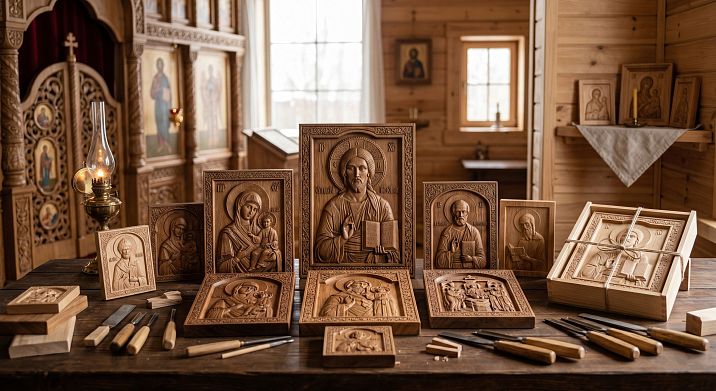
Wood remembers the master's hands. This is not a metaphor — it's the physics of the material: every cut leaves a trace, every curve of the relief casts a shadow, every layer of tinting reveals the texture in a new way. That's why a carved wooden icon is not a reproduction of an image, but the creation of a three-dimensional object that lives in space differently than a flat image.
When people say "icon," many imagine a board with painting or a paper image in a frame. A carved wooden icon is different. It's relief, texture, volume. It's light that falls on the surface differently in the morning and evening hours. It's an object you want to examine up close: how the halo is carved, how the background is built, how the master handled the transition between the figure and the frame.
This article is a practical guide to choosing a carved icon: for home, for a church, for a chapel, for a memorable gift. Without theological disputes, without excessive pathos — honestly and specifically about what is important to know before purchasing.
What is a carved wooden icon: volume, material, meaning
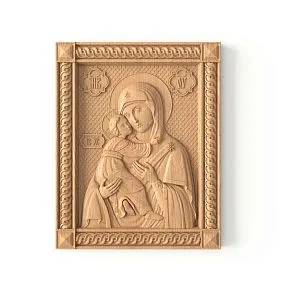
Carved icon is an image made using the technique of relief wood carving. Unlike a painted icon, where the image is created with paints on a flat surface, a carved icon is created with a tool: the contours of the figure, folds of clothing, halo, background — all of this is a three-dimensional relief carved from a solid piece of wood.




What makes a carved icon an object, not a reproduction
A flat printed icon reproduces the image — accurately, but without a material dimension. A carved wooden icon exists in three dimensions: it has background depth, relief height, sharpness or softness of lines. When side light falls on it — shadows appear, which place accents in the image differently.
This makes a carved wooden icon an object that has both image and materiality simultaneously. Wood feels warm to the touch. It has a scent — subtle, barely perceptible, especially in freshly processed solid wood. It lives in space differently than glass, metal, or paper.
Our factory also produces:




Carving techniques in icons
Low-relief carving. The figure is slightly raised above the background, contours are clear, relief is 3–8 mm. This is the most common technique: enough detail for an expressive image, and the piece is not too massive.
High-relief carving. Relief depth is 10–30 mm or more. The figure stands out significantly from the background, deep shadows appear, and the image gains sculptural quality. Used for large church icons and significant pieces.
Openwork (through) carving in the background. The icon's background is cut through — creating a lace effect. More often used in decorative elements around the image, less frequently in the image itself.
Combined carving. A combination of techniques: low-relief background + high-relief figure + openwork frame. This is the most labor-intensive and expressive option.
Get Consultation
Where carved icons are used: eight scenarios
A carved wooden icon is a versatile object. It fits in a variety of spaces.
Home iconostasis
A home iconostasis is a prayer corner in a residential house. A carved wooden icon here is the central object: it sets the scale, style, and tone of the entire shelf. Next to it — Carved crossicon shelf, lampada
For a home iconostasis — medium-sized icons (200×300 mm — 300×400 mm): expressive enough, does not overload the space.
Temple
In a temple, a carved wooden icon can take a place in the iconostasis, on a lectern, at the entrance, in a side chapel. For temple space — large icons: from 400×500 mm and above. High-relief carving, expressive detailing. The image should be readable from a distance of 3–5 meters.
Chapel and prayer room
A chapel or prayer room in a country house or on the premises of an enterprise — a more intimate space than a temple. A medium or large icon installed on a special shelf or in a shrine. Here, a carved wooden icon is especially organic: wood creates warmth and composure.
Office
In a study, a carved icon is installed above the workplace, on a bookshelf, or in a special niche. This is not just a decorative element — it is a personal symbol and guide. For a study — small or medium-sized icons with neat carving, in dark tinting or under varnish.
Country house
In a country house with a wooden interior — timber walls, wooden beams, wooden floor — a carved icon made of solid wood organically fits into the overall context. Light wood in natural tinting, or a restrained darkened surface under wax — such an icon lives in the interior of a country house as part of its character.
Memorable gift
A carved wooden icon is one of the most significant gifts for important events: wedding, baptism, name day, anniversary. This is not a mass-produced souvenir — it is a product with the soul of material and craftsmanship.
Church decoration and Orthodox interior
Wooden church decor — niches, icon cases, stands, crosses, iconostasis elements — form a unified system. In it, the carved icon occupies a central place. All elements are made of the same material, with the same tinting.
Memorial and commemorative sites
A carved icon is installed at memorial sites: on graves, in chapels on the territory of military burials, near worship crosses. For open spaces — an icon in an icon case with protective glass and wood treatment against moisture.
How a carved icon differs from a printed one: three-dimensionality versus flatness
This is not a question of 'what is better' — it is a question of the different nature of the two objects.
Printed icon
A printed icon is a high-quality reproduction. Its advantages: accurate color reproduction, accessibility, wide selection of subjects, ease of handling. For most home iconostases, printed icons in wooden frames are a complete solution.
Carved wooden icon
Wooden carved icon — another dimension. It is an object that has:
-
Volume. The relief is readable live: lines, shadows, height of the figure above the background
-
Material. Wood is a living natural material with smell, texture, warmth of the surface
-
Uniqueness. Even a mass-produced carved icon bears traces of processing that make each item slightly different from another
-
Durability. Solid wood, with proper care, lasts for decades without loss of quality
-
Weightiness. Literally — and figuratively: it is an object into which labor and material have been invested
For churches, chapels, significant home iconostases, and gifts — a carved icon from solid wood is a more serious choice. It is not a replacement for a painted icon — it is a different genre in wooden art.
How to choose the size of a carved icon: scale and placement
The size of an icon is not a matter of taste, but of space. The icon must be readable in the place where it stands.
Small icons: 100×150 mm — 150×200 mm
For personal space: bedside table, desk, travel bag (travel icons). For a gift that is easy to hold and examine up close. Carving on small icons is more delicate, with less relief depth.
Medium icons: 200×300 mm — 300×400 mm
Optimal size for a home iconostasis, study, prayer corner. Well readable from a distance of 1.5–2 meters. Carving is expressive, detailing is full.
Large icons: 400×500 mm and larger
For a church, chapel, church interior, large hall of a country house. Readable from a distance of 3–6 meters. High-relief carving, large elements that do not get lost in the space.
Rule of space
The icon should not "sink" into the wall and should not "press" on the shelf. For a home corner with a shelf width of 40 cm — an icon 20–25 cm wide. For a Temple niche 80 cm wide — an icon 40–50 cm. Proportion: icon width = 50–60% of the width of the space where it stands.
How to choose the subject of a carved icon: guidelines without unnecessary dogma
Choosing a subject is a personal decision. But there are a few practical guidelines.
For a home iconostasis
Traditionally, in a home iconostasis, the central place is occupied by images of the Savior and the Mother of God. Nearby are icons of the heavenly patrons of family members. For a country house, images associated with the protection of the home and family are organic.
For a gift
When choosing an icon as a gift, it is important to know the person's name (for a personalized icon) or a significant event (for a wedding — the image of Peter and Fevronia or the Savior with the Mother of God). A universal gift is a medium-sized image of the Mother of God or the Savior with neat carving.
For a church or chapel
The choice of subject for a church space is coordinated with the rector or the person responsible for the decoration. A wooden carved icon for a church must comply with the iconographic canon: correct iconography, traditional composition.
For an office
In an office, images associated with wisdom, justice, and protection are often placed. A small icon in a dark tint is organic next to bookshelves, wooden panels, and dark furniture.
Material: which wood to choose for a carved icon
The choice of wood species affects the quality of carving, appearance, durability, and the product's behavior in the interior.
Beech
A dense, homogeneous species with a fine-grained structure. Beech is the best material for an icon with fine detailing: the carving is clear, the edges of the lines are sharp, without fuzz. The color of beech is light cream, neutral, and accepts any tint well. Under dark varnish or patina, beech creates the image of an "antique product."
Beech is stable in residential conditions and does not crack under normal humidity.
Oak
Expressive texture with large pores and a characteristic fiber pattern. Oak is a prestigious, durable material. An icon made of oak in a natural tint looks monumental and solid. Dark oak creates the image of a solemn, "cathedral" product.
Oak is heavier than beech — this is taken into account when choosing a method of wall mounting. For large oak icons, reliable fastening is mandatory.
Ash
Lighter than oak, with straighter grain. It lends itself well to carving, creating an expressive surface pattern in natural tinting. For a country house in light colors, ash is organic.
Linden
Traditional material for icon painting. Light, soft, and easily worked with tools. For hand carving, it is one of the preferred materials. White color, neutral texture. Ideal for tinting or gesso (primer for icon painting). Less durable compared to oak and beech under conditions of humidity fluctuations.
Spruce
Affordable, light, aromatic. Acceptable for budget items. Disadvantage: resinousness (may seep through the coating), coarser texture, holds fine carving less well. Undesirable for formal and significant items.
| Species | Detailing | Tinting | Durability | Weight | Status |
|---|---|---|---|---|---|
| Beech | Excellent | Any | High | Medium | Classic |
| Oak | Good | Expressive | Very High | Heavy | Premium |
| Ash | Good | Expressive | High | Medium | Above average |
| Linden | Excellent | Neutral | Medium | Lightweight | Tradition |
| Spruce | Satisfactory | Limited | Medium | Lightweight | Budget |
Carving, relief, and detailing: how to assess the quality of execution
The quality of a carved icon is determined by the quality of the carving. This is the main thing to look at when purchasing.
Clarity of contour lines
The contour of the figure — whether it be the face, garments, or halo — should be clear, without blurred transitions or stepped errors. A rough contour line is a sign of insufficient tool precision or speed of work.
Relief Depth
The relief must be sufficient to create shadows. For a medium icon (200×300 mm), the background depth is 5–15 mm, and the height of the central figure above the background is 8–20 mm. A relief that is too shallow (1–3 mm) is perceived as engraving, not carving.
Background detailing
The background of the icon can be smooth, textured, or with ornamental chasing. In any case, it must be neat: without traces of hasty processing, without uneven depressions.
Neatness of corners and transitions
Internal corners (folds of garments, transitions between the halo and the figure) are the most challenging part of carving. This is where the master's skill is evident: a clean cut without chips or fuzz indicates a precise tool and a skilled hand.
Symmetry of the halo
The halo is a circular element above the figure's head. It must be perfectly symmetrical and of uniform width. Asymmetry of the halo is a clear sign of low quality.
Absence of rough chips
There should be no accidental chips on the surface that are not part of the intended relief. Small traces of the chisel on the background are normal, but sharp accidental gouges are not.
Coating of the carved icon: varnish, tinting, patina, wax
The coating determines the final character of the product — its "mood" and durability.
Natural wood without coating
For interiors in the wabi-sabi style, for products made of linden in traditional technique, for icons that are planned to be covered with gilding or gesso later. Unfinished wood gradually darkens — this is a natural process that adds nobility.
Disadvantage: without coating, wood is more vulnerable to dirt, grease, and moisture.
Tinting + varnish
The most common coating for wooden carved icons. The tinting compound gives the desired shade — from light honey to dark walnut. The varnish fixes the tint and protects the surface. Glossy varnish is more solemn, matte is calmer and more natural.
Patina
Patina creates an aging effect: dark shades in the recesses of the relief, lighter ones on the protrusions. This enhances the readability of the volume and creates the image of an "antique" product. For classic interiors and church decoration, patina is appropriate and expressive.
Wax
Wax coating is the softest and most natural. The wood breathes, the surface is matte, the hand glides softly over it. For a country house, for icons in an interior with natural materials, wax is the optimal coating.
Disadvantage: requires periodic renewal (every 2–3 years).
Gilding
Separate category: Carved icon with a gilded halo or background. Gold leaf is applied to a special primer (varnish or poliment). Creates a solemn, "iconostasis" image. For churches and significant gifts — gilding is appropriate.
Carved icon and carved cross in the same style: a unified church space
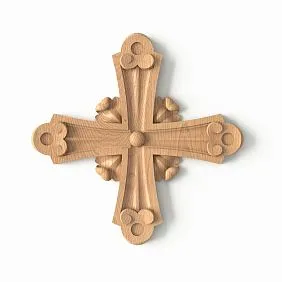
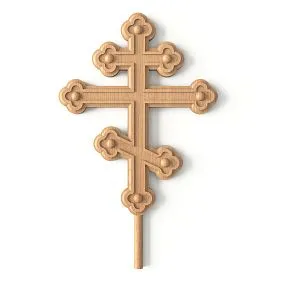
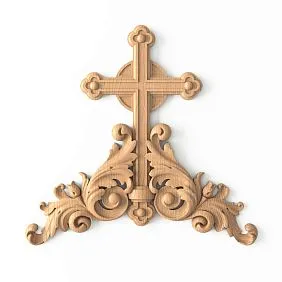
Carved cross — a natural companion to the carved icon. They form a pair: vertical and image.
For a home iconostasis: the cross is placed next to the icon or above it. Important: the cross and icon must be made of the same material and in the same tint. Different wood species or different tint shades destroy the unity.
For a chapel: the cross — above the entrance or above the lectern, the icon — in the central place. A large oak cross in a dark tint + an icon of the same size with patina create a space with character.
For a gift: cross + icon as a set — a substantial, memorable gift for a wedding, baptism, or anniversary.
In the of church decor made of wood both icons and crosses are presented — in coordinated styles and tints. This allows you to choose a set without worrying about compatibility.
Additional elements of church wooden decor
The icon and cross are organically complemented by:
-
Solid wood icon shelf with matching stain
-
Wooden lamp stand
-
Icon case (glazed wooden box-frame for an icon) — especially important for expensive items and damp rooms
-
Wooden decorative elements — overlays, profile frames made of wooden trim around the prayer corner
All these elements together create a prayer space, not a collection of disparate objects.
What to check before buying a carved icon: a checklist
Before making a purchase decision — go through this list.
About the product
-
Size matches placement (use proportion rule)
-
Wood species specified and suitable for usage scenario
-
Carving quality: clear lines, neat corners, even background, symmetrical halo
-
Relief depth: sufficient for readability of the image from the intended distance
-
Finish: matches desired appearance and placement conditions
-
No chips, cracks, or uneven toning
By context
-
Icon subject matches purpose: home, church, gift, office
-
Toning coordinated with toning of other wooden elements in the space
-
Carving style — classic, ornamental, or minimalist — fits the interior
-
A method for wall mounting is provided (loop, groove, bracket)
Per set
-
Is a cross planned? Check compatibility
-
Is a shelf needed? Specify dimensions
-
Is a kiot needed — for protection from dust or moisture
Mistakes when choosing a carved icon: ten pitfalls easily avoided
Mistake 1. Choosing an icon only by photo
A photo does not convey the depth of relief, the actual tint color, or surface quality. If possible, view the item in person or request additional photos from different angles and under side lighting.
Mistake 2. Buying an icon without considering the placement location
A large icon 400×500 mm on a narrow shelf of a home iconostasis 30 cm wide — visual imbalance. A small icon 100×150 mm in a large church niche — will be lost. The icon size always depends on the location.
Mistake 3. Not checking the quality of the carving
It is not enough for the icon to have the "correct" image. The quality of execution is important: clarity of lines, detail refinement, neatness of corners. Rough carving does not add value to the product.
Mistake 4. Mixing different wood shades
A dark oak icon + a light pine cross + a reddish pine shelf under varnish = a chaos of shades. All wooden elements of the prayer corner should be in the same tint.
Mistake 5. Choosing overly decorative carving for a strict interior
An openwork, ornamentally overloaded icon in a strict minimalist office is a style conflict. For strict interiors, carving should be restrained, with clean lines and moderate detailing.
Mistake 6. Not checking the coating
Matte varnish or glossy? Wax or tint? This affects durability and care. Gloss in a home iconostasis can look excessive, especially under daylight.
Mistake 7. Forgetting about wall mounting
A wooden icon is an item weighing from 0.5 to 5 kg or more (for large oak products). It must be securely held on the wall. Check: does the item have a hanging loop, and is it designed for the weight of the specific icon?
Error 8. Not considering the combination with the cross
Icon without carved cross — is complete. But if a cross is planned nearby, it's better to select them together from the same catalog. Different series may have different frame profiles and different relief depths — and together they won't look like a set.
Error 9. Board too thin for a large product
For a large icon from 400 mm and above, the base thickness should be sufficient: 25–40 mm. A thin base (12–15 mm) for large icon boards is prone to deformation.
Error 10. Buying without a delivery margin
Wooden carved products require careful packaging. When ordering, check how the product is packaged and whether there is a protective layer for the relief surface.
How to care for a wooden carved icon
Proper care is the key to the product's longevity.
Humidity. Optimal humidity for wooden products is 40–60%. Excessive dryness (in winter with central heating) can cause microcracks. A humidifier in the room is preventive.
Dust. Remove with a soft brush (flat brush or dusting brush). Do not use wet wipes with chemical compounds — they can damage the varnish or tint.
Light. Direct sunlight gradually fades the tint. For valuable items — avoid direct lighting, use soft diffused or warm artificial light.
Varnish and wax. Wax coatings are renewed every 2–3 years: rub furniture wax with a soft cloth, then polish. Varnish coatings do not require renewal — only dusting.
Mechanical damage. Small chips on the relief can be restored if desired: a tinting marker of a suitable shade + a thin layer of varnish. For serious damage — contact a specialist.
FAQ: answers to main questions about carved wooden icons
What is a carved icon?
Carved icon — it is a three-dimensional image made using the technique of relief carving from solid wood. Unlike a painted icon, it is created with a tool, not a brush — and exists not only as an image but also as a three-dimensional material object.
How is a carved icon different from a regular printed one?
The main difference is in three dimensions. A carved icon has volume, relief, shadows, and wood texture. A printed icon is flat. A wooden icon made from solid wood is more durable, more significant as a gift, and creates a different visual presence in the space.
How to choose a carved icon for the home?
Determine the location: where the icon will stand, at what height, in what interior. Choose a size — medium (200×300 mm) suits most home iconostases. Coordinate the tint with other wooden elements in the room. Pay attention to the quality of the carving.
Is a wooden carved icon suitable for a church?
Yes. Wooden carved icon For a church — a traditional solution. Church spaces require large icons with high relief and iconographically accurate depiction. The subject is coordinated with the rector.
What size of carved icon should I choose?
Small (100–150 mm) — for personal space and as a gift. Medium (200–300 mm) — for a home iconostasis. Large (400 mm and more) — for a church, chapel, large hall.
What wood are carved icons made from?
Traditionally — from linden, beech, oak, ash. Beech — for precise detailing, oak — for status and durability, ash — for light interiors, linden — for hand carving and traditional icon painting practice.
Can a carved icon be given as a gift?
Yes. A carved wooden icon is one of the most meaningful gifts for baptism, wedding, name day, anniversary. It is an item with material value and spiritual meaning — unlike mass-produced souvenirs.
How to care for a wooden carved icon?
Wipe dust with a soft brush. Avoid direct sunlight. Maintain humidity at 40–60%. Renew wax coatings every 2–3 years. Do not wash with wet chemical agents.
Can I choose a carved cross and an icon in the same style?
Yes. In the catalog of church decor made of wood are presented and Carved crosses, and icons. Choose from one section of the catalog — this way the tinting and carving style will be coordinated.
Where to buy a carved wooden icon?
In the STAVROS catalog — section of church decor made of wood: carved icons, Carved crosses and elements for decorating a prayer space from solid wood. Full assortment — on glavnoj stranitse STAVROS.
STAVROS: a wooden icon as a product with character and history
A carved wooden icon is not a mass-produced item made quickly and without attention to detail. It is a product where every parameter matters: wood species, relief depth, line precision, coating quality, size according to the location.
When everything is assembled correctly, the icon lives in the space for decades, losing neither form nor character. Wood ages beautifully: the tinting acquires a noble depth, the surface becomes warmer to the eye. This is what paper and plastic lack — and what only solid wood has.
STAVROS offers carved wooden icons, Carved crosses and a full range of church decor from solid wood — for home, church, chapel, prayer room, and for those seeking a meaningful gift made of real wood. Also in the catalog — Carved wooden decoration for the interior: everything that creates a space with character and depth.
STAVROS — because wood, infused with craftsmanship, becomes more than just a material.