Article Contents:
- Tall skirting board PLT-004 160×16 mm: what exactly you can buy now
- PLT-004 made of MDF 160×16×2600 mm
- PLT-004 beech / MDF / beech veneer 160×16×2400 mm
- PLT-004 oak / MDF / oak veneer 160×16×2400 mm
- Why wood versions of PLT-004 cannot be called solid wood
- When it makes more sense to place one order
- When phased purchase is safer
- Why the solution differs for MDF and veneered PLT-004
- Natural veneer pattern is not equal to printed decor
- Why the shade should be evaluated after the chosen finish
- What to approve by sample before ordering the full volume
- Why absolute identity of natural pattern cannot be promised
- Covering enamel and color repeatability
- What is more important to check when reordering
- Why the paint code should be saved with the specification
- Price of the PLT-004 itself
- How lengths of 2400 and 2600 mm change the number of whole planks
- Cost of extra planks
- Re-packaging and delivery with multiple orders
- When savings at the first stage turn into additional expenses
- Why 48 linear meters do not mean 20 identical planks
- Separate cutting map for each room
- Which leftovers from the first stage will be useful in the second
- Where the joint is especially noticeable
- When one extra full plank is more useful than a 10% reserve
- Stage 1. Bedroom
- Cutting MDF 2600 mm
- Cutting version 2400 mm
- Stage 2. Living room
- For 2600 mm
- For 2400 mm
- Stage 3. Hallway
- MDF 2600 mm
- Execution 2400 mm
- Summary result
- Is the final measurement of all rooms completed
- Are doors and built-in furniture already installed
- Are the areas behind the cabinets resolved
- Is the finish determined
- Is there a safe storage place for long planks
- Repeat order passport PLT-004
- Why you need to keep length remainders
- Why a photo doesn't replace a physical sample
- What to do if the first room is already done without a passport
- Why a long item should not just be placed in a random corner
- When to unpack
- Why you cannot store near wet processes
- How to protect the decorative profile and edges
- Built-in furniture is possible
- The material is still being chosen
- 160 mm was not tried on in the room
- There is no proper storage place
- Different rooms require different profiles
- Mistake 1. Save only the name PLT-004
- Mistake 2. Order the second stage of "the same oak" without a sample
- Mistake 3. Not accounting for the leftovers from the first room
- Mistake 4. Buying the whole apartment based on a preliminary perimeter
- Mistake 5. Always adding exactly 10%
- Mistake 6. Storing the entire order in the renovation area
- Error 7. Comparing options only by the price of one plank
- Error 8. Painting the next stage "approximately the same"
- Step 1. Determine the material
- Step 2. Divide rooms into ready and undetermined
- Step 3. Check the height of 160 mm
- Step 4. Take final lengths
- Step 5. Build a cutting map
- Step 6. Assign balances
- Step 7. Calculate total cost
- Step 8. Check storage conditions
- Step 9. Approve sample for natural finish
- Step 10. Choose strategy
- Can I buy PLT-004 for the whole apartment at once?
- What is the size of the tall plinth PLT-004?
- What is the length of PLT-004 made of MDF?
- What is the length of the oak veneer version?
- Is PLT-004 made of oak solid wood?
- Can I buy the same PLT-004 a few months later?
- Can the shade of the veneered skirting board differ?
- How to order a wooden skirting board for several rooms?
- How much spare wooden skirting board should I buy?
- What is more profitable — one large order or several small ones?
- How to store planks 2400–2600 mm long?
- Where to buy the tall PLT-004 skirting board?
- How to find out the current price of PLT-004?
- Do I need to buy skirting board behind built-in wardrobes?
- Can I use leftovers from the first room in the second one?
- Is it worth buying one whole spare plank?
- Can I first buy MDF for the bedroom and order the hallway later?
- What to do if the required finish is not available later?
- Why can't you just divide the total footage by 2400 or 2600?
- Can I order PLT-004 before installing the doors?
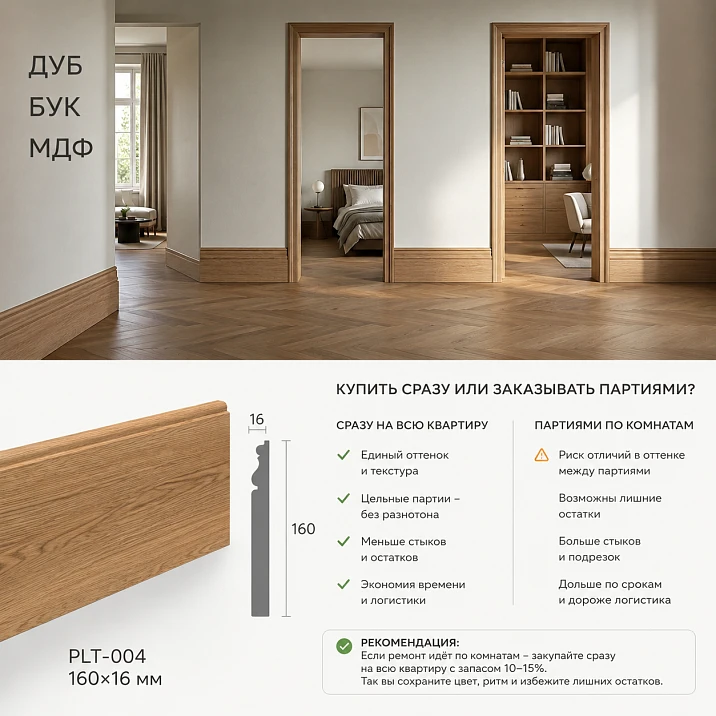
The bedroom is almost ready: walls are painted, flooring is laid, doors are installed, and the plinth can be mounted. The living room will be ready in a month, and the hallway even later. The profile is already chosen: tall PLT-004 160×16 mm. At this point, the question is not "which plinth is better," but a much more practical task: buy the entire volume for the apartment at once or order only the first room and purchase the remaining planks as the renovation progresses.
Both options have strong points. A single order reduces the risk that wood elements from different stages will noticeably differ in tone after finishing, allows you to secure the availability of the required finish in advance, and avoids returning to the purchase after a few weeks. But this scheme requires precise measurements of all rooms, immediately increases the budget, and creates a separate task of storing long planks of 2400 or 2600 mm in an apartment where construction work is still ongoing.
Staged purchasing is more convenient if the layout or built-in furniture is still changing, the final dimensions of the next rooms are not determined, and there is no safe place to store long items. At the same time, it shifts some risk to the future order: the price may change, the required finish may temporarily be out of stock, and natural veneer and solid wood of the decorative part are not obliged to repeat the pattern of the previous delivery like printed decor.
Therefore, there is no universal answer "always buy the entire plinth at once." For PLT-004, the decision depends primarily on the finish. MDF for covering paint is more tolerant of staged purchases if the article, size, processing quality, and painting system are preserved. The oak or beech version with veneer and visible wood texture requires stricter control of the sample, finish, and order repeatability.
Cutting must be considered separately. The same 40–50 linear meters of baseboard may require a different number of whole pieces 2400 and 2600 mm long. Therefore, ordering PLT-004 only by the total linear meters is incorrect: first, specific sections are calculated, then they are distributed across standard planks, and only after that is the quantity determined.
If the profile has already been selected and the dimensions verified, buying the tall baseboard PLT-004 160×16 mm is better according to a specific specification. But before ordering, four things should be decided: how many rooms are truly ready for the final measurement, what material and finish will be used, where to store the stock, and which leftovers from the first stage could be useful in the second.
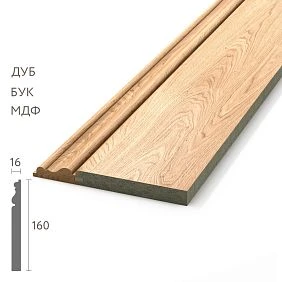
Tall baseboard PLT-004 160×16 mm: what exactly can be purchased now
PLT-004 is a tall profiled baseboard 160 mm high and 16 mm thick. For renovation planning, it is especially important that the same profile is offered in several versions, but the length of the products and their construction differ.
| Execution | Size | Practical significance |
|---|---|---|
| MDF | 160×16×2600 mm | Convenient for covering paint; cutting is done from 2600 mm planks |
| Beech / MDF / beech veneer | 160×16×2400 mm | Natural wood surface; cutting from 2400 mm |
| Oak / MDF / oak veneer | 160×16×2400 mm | Natural oak texture; finish and order repeatability are important |
At the time of checking, the PLT-004 card shows a price of 2630 ₽ for MDF 160×16×2600 mm, 7790 ₽ for the beech/MDF/beech veneer version 160×16×2400 mm, and 9640 ₽ for oak/MDF/oak veneer 160×16×2400 mm. MDF is indicated as in stock in Saint Petersburg, wood versions have a lead time of 5–10 days. Before purchasing, the price, availability, and lead time must be checked again.
These differences directly affect the answer to whether to buy everything at once. A mistake of one extra MDF plank and a mistake of one extra oak plank have completely different costs. Therefore, the more expensive the finish, the less reason there is to use the rough formula "perimeter plus 10%."




PLT-004 made of MDF 160×16×2600 mm
The MDF version has a standard length of 2600 mm. This is more important than it might seem. The buyer pays not for an abstract linear meter, but for a whole plank. Therefore, with the same finished perimeter, the number of items is determined by how the lengths of walls, openings, and short sections fit into 2600 mm.
MDF also has another advantage specifically in the context of phased renovation. If the entire baseboard is painted with an opaque enamel of one color, the visual repeatability of the surface is determined primarily by maintaining one profile and the same preparation and painting system. The natural wood grain is not part of the final appearance.
This does not mean that after six months you can order any similar tall baseboard. For a repeat phase, you need to keep the PLT-004 article number, the 160×16 mm cross-section, the version, finishing data, and an actual sample of the finished surface. But managing the repeatability of the result here is easier than in the case of natural oak.
Our factory also produces:


PLT-004 beech / MDF / beech veneer 160×16×2400 mm
The beech version has a length of 2400 mm and a combined construction. PLT-004 in this variant cannot be correctly called a "baseboard made entirely of solid beech."
The lower part of the profile is made of deeply milled MDF and faced with wood veneer. The upper decorative part is made of solid wood. This is fundamental for understanding the finish.
With a transparent or semi-transparent finish, two natural surfaces work visually at once: the veneer and the solid wood of the decorative part. Therefore, a repeat order after several months requires not only matching the article number, but also controlling how the new batch will look after the chosen tinting, oil, varnish, or other coating system.
Get Consultation
PLT-004 oak / MDF / oak veneer 160×16×2400 mm
The oak version also has a length of 2400 mm and a combined construction: MDF with oak veneer in the lower part and solid wood in the upper decorative profile.
This is not a product defect or a reason to automatically look for a solid wood alternative. The buyer simply needs to calculate, order, and finish the product that actually exists, not a conditional "solid oak baseboard."
If the oak texture remains visible, finishing issues are especially important when ordering for the entire apartment. Natural wood allows for differences in tone and grain even within a single order. Therefore, the goal of purchasing the entire batch is not to get twenty absolutely identical planks, but to be able to see the material at once, distribute the products among rooms, and apply finishing using one technology.
Why wood finishes of PLT-004 cannot be called solid wood
The incorrect wording "PLT-004 entirely made of solid oak" creates several wrong expectations at once.
First, the buyer may expect that the entire height of 160 mm will have a uniform solid wood structure. In reality, the large lower part is veneered MDF.
Second, a mistaken idea about material repeatability arises. Veneer is a natural material, not a printed film with a fixed pattern. The solid wood of the upper part also has a natural texture.
Third, incorrect description prevents properly coordinating the finish. The behavior of the veneered surface and solid wood during tinting should be checked on a real sample of the finished product.
Therefore, in the specification it is better to use the exact name of the finish: beech / MDF / beech veneer or oak / MDF / oak veneer.
Buy a wooden baseboard at once or order by rooms: what the decision actually depends on
If the apartment is renovated in stages, the decision to purchase should be made not according to the calendar, but according to the degree of project certainty.
The phrase "the living room will be ready in a month" by itself says nothing about whether its baseboard should be included in today's order. Much more important is something else: whether the finished lengths are known, whether the built-in furniture is approved, whether doors and trims will change the length of straight sections, whether the finish is chosen, and whether there is a proper place for storage.
When it makes more sense to place one order
One order is rational if all rooms can already be turned into a final specification.
This means that each wall has a finished length, openings are known, locations of built-in wardrobes, baseboard endings, external and internal corners, as well as the scheme of joining to door trims and furniture.
This option is especially significant for beech and oak PLT-004 with visible wood finish. The more natural surface there is and the more strongly the rooms are connected by open doors, the more useful it is to have the entire volume at once.
The planks can be laid out before installation, compared with each other, and more calm-patterned items can be distributed to long view walls, while more active ones to short sections or less noticeable areas.
When purchasing by rooms, such overall sorting will no longer be possible: the first room will be finished earlier, and the next one will have to be assembled from material from another order.
One order also reduces the risk that the next stage will coincide with a temporary absence of the required finish. But this advantage only works with the correct quantity.
Buying 30 planks "approximately for an apartment" for the sake of one batch is worse than ordering 22–23 items according to a proper cutting map. The surplus of expensive oak profile can completely destroy the savings from one delivery.
When is phased purchasing safer
Ordering by rooms is more reasonable if the next part of the apartment has not yet reached the stage of final measurement.
For example, the hallway does not yet have the final thickness of wall panels, the living room is discussing a built-in library, and the bedroom is already completely finished.
In this situation, buying the entire apartment creates more risk in terms of quantity than benefit from a single batch.
The phased scheme is especially convenient for MDF under covering enamel. If the profile and painting technology are preserved, the external result can be repeated through the paint code, sample, and the same application method.
It is also safer if there is no proper place to store long materials. Planks 2400–2600 mm long cannot be treated like boxes of tiles that can be placed in any free corner. The material requires a dry room and flat placement.
If the apartment continues to undergo wet processes, plasterers are working nearby, building materials are constantly being moved, and the baseboard will have to be moved from room to room for two months, the risk of damage may be higher than the risk of future reordering.
Why the solution differs for MDF and veneered PLT-004
In the MDF version, the future appearance is determined by the covering finish. If two deliveries have the same profile and the same preparation, the difference can be controlled by a single painting technology.
For veneered beech and oak, the natural surface remains part of the design. Tinting can bring the overall color closer, but it does not turn different veneer sheets and different sections of solid wood into printed decor.
That is why for an apartment with oak doors, oak PLT-004, and open transitions between rooms, one order usually has more arguments than for white MDF.
If the profile has not been selected yet, it is more useful to open the section to buy wooden baseboard and compare neighboring models. If PLT-004 has already been approved, returning to a wide selection makes sense only if a real conflict is detected.
Why repeatability of finish is important for oak and beech PLT-004
Natural wood has no "repeat pattern" command.
Even products of the same species may have differences in shade, grain direction, and texture intensity. Therefore, the buyer's goal is not to demand impossible absolute identity, but to properly manage natural variability.
Natural veneer pattern is not equal to printed decor
Printed decor reproduces a pre-defined image. With veneer, the pattern is formed by real wood.
On one slat, the grain may be calmer, on another — more active. The top decorative solid profile adds another natural zone.
After a transparent or semi-transparent coating, all this becomes a visible part of the product.
Therefore, for a large order, it is useful to lay out the planks before installation and look at them side by side.
If the living room has a long free wall of 5.2 m, two or three adjacent planks should be perceived as one composition. They can be selected from the total volume.
With phased purchasing, the first room will already be installed, and for the next one you will have to choose from a new order.
Why the shade should be evaluated after the chosen finish
Untreated oak and oak after tinting are visually different surfaces.
One area may absorb the dye more strongly, another more calmly. Oil, varnish, stain, and the degree of matteness change the depth and contrast of the fibers.
Therefore, comparing only an untreated plank from the first delivery with an untreated plank from the second is not enough.
If the project involves a semi-transparent finish, a test stain is needed.
For a repeat order, it is useful to save:
-
coating manufacturer;
-
the exact product name;
-
shade code;
-
primer;
-
number of layers;
-
gloss level;
-
application method;
-
physical sample of the result.
In two months, this will allow repeating the technology rather than recalling 'we had some warm oak.'
What to approve on the sample before ordering the full volume
Before purchasing a significant quantity of wood PLT-004, you need to verify that the chosen finish actually delivers the expected result.
On the sample, evaluate how noticeable the transition is between the veneered lower part and the solid upper profile, whether the shade matches the doors and flooring, and whether the tall 160-millimeter profile becomes too heavy after dark tinting.
The same sample should be viewed under daylight and evening lighting.
A warm lamp can noticeably change the perception of oak. If the interior is mainly used in the evening, approving the color only by the window during the day can lead to unexpected results after installation.
Why absolute identity of natural grain cannot be promised
If the client requires the oak baseboard in all rooms to look like the same printed pattern, the task is set incorrectly.
Even purchasing one large volume does not turn natural wood into serial printing.
One order gives another advantage: all the material can be viewed, distributed, and finished at the same time.
"One batch" is a way to reduce uncertainty and gain more control. It is not a promise of absolute matching of every fiber.
High MDF baseboard PLT-004: when phased purchasing is simpler
The MDF version of PLT-004 often makes a phased strategy more manageable.
The reason is not only the cost. After opaque painting, the high baseboard is perceived as an architectural profile, not as a display of natural texture.
Therefore, the main task of a repeat order is to reproduce the geometry and the paint finish.
Opaque enamel and color repeatability
If the bedroom is finished now, and the hallway in two months, you can order MDF for the bedroom, paint it, and lock in the technology.
For the next stage, a new PLT-004 is finished using the same system.
But one RAL or NCS number may not be enough.
The result is affected by the paint base, manufacturer, primer, gloss level, and application method.
If the first batch was painted with matte enamel by spraying, and the second batch was painted with a roller using a different enamel of the same number, the difference may be noticeable through an open doorway.
Therefore, color repeatability is repeatability of the process, not just the numbers in the catalog.
What is more important to check when reordering
For MDF, it is worth keeping:
-
article PLT-004;
-
size 160×16×2600 mm;
-
execution;
-
date of the first order;
-
exact name of the primer;
-
exact name of the enamel;
-
color code;
-
gloss level;
-
application method;
-
photo of the finished profile;
-
a short physical sample, if any remains.
If the next stage is done by another team, such a set is especially important.
The phrase "paint it like in the bedroom" is not a technical specification.
Why the paint code should be saved together with the specification
Baseboard is a finishing product, but ordering, painting, and installation are often distributed among different people.
The manager sells the profile, the painter is responsible for the coating, the designer approves the color, and the installer receives the finished parts.
If paint data exists only in old designer correspondence, it has to be recovered after a few months.
Therefore, a reorder passport should combine product and finishing information.
Price of a wooden baseboard: one large order versus three small ones
The cost of PLT-004 affects the purchasing strategy more than the abstract desire to "not overpay".
At the time of inspection, one MDF plank 2600 mm costs 2630 ₽, beech version 2400 mm — 7790 ₽, oak version 2400 mm — 9640 ₽.
The difference between one extra MDF plank and one extra oak plank is significant.
Therefore, there is no point in treating the stock of all versions equally.
The price of the PLT-004 itself
Let's imagine that the final apartment layout requires 21 MDF planks.
21 × 2630 = 55 230 ₽.
If conditionally 21 oak/MDF/oak veneer items were needed:
21 × 9640 = 202 440 ₽.
This is not a comparison of materials on the principle of "what is better," because real layouts of 2400 and 2600 mm can yield different quantities.
Here another thing is visible: an extra MDF plank is 2630 ₽, an extra oak one is 9640 ₽.
The higher the price of the whole product, the more important it is to abandon an uncontrolled percentage of stock.
How the length of 2400 and 2600 mm changes the number of whole planks
Let the clean total area of the apartment be 48 m.
simple arithmetic:
48 / 2,6 = 18,46.
The minimum is 19 MDF planks.
48 / 2,4 = 20.
The minimum is 20 planks of wood finish.
But this is only a theoretical minimum.
If the apartment contains many sections of 2500 mm, MDF 2600 mm can be used almost entirely, while 2400 mm will require an additional joint each time.
If the main sections have a length of 2320–2350 mm, on the contrary, a 2400 mm plank will be used very efficiently.
Therefore, not only the total length matters, but also the geometry of each section.
Cost of extra planks
The universal 10% of twenty planks is two more planks.
For MDF:
2 × 2630 = 5260 ₽.
For the oak finish:
2 × 9640 = 19 280 ₽.
If the map already shows that all sections are closed with twenty planks, and only one whole spare is enough for repairs, buying two extra just for the sake of a percentage is not necessary.
The reverse situation is also possible.
The mathematical minimum may be twenty pieces, but without the twenty-first plank, two joints end up on the main view walls.
Then the extra plank is needed not "just in case," but for a proper cutting layout.
Repeated packaging and delivery with multiple orders
Card PLT-004 indicates the addition of a rigid packaging frame for safe transportation.
With multiple separate orders, you should not automatically multiply the current packaging cost by the number of stages: the specific conditions of each shipment need to be confirmed with the manager.
But repeated logistics must be taken into account.
Three stages can mean three acceptances, several transports, and repeated organization of unloading.
On the other hand, one large order requires storage space and often several internal moves around the apartment.
If the baseboard is moved from the bedroom to the living room, then to the hallway over two months, the organizational risk also has a price.
When saving at the first stage turns into additional expenses
The scenario looks economical: buy eight slats for the bedroom now, the rest later.
In a month, nine slats for the living room are needed, then five more for the hallway.
Each stage is delivered separately, the finisher re-adjusts the paint color, and the leftovers from the first stage are forgotten to be included in the next map.
There is also the opposite mistake: buy twenty-five slats at once, and then find out that the built-in wardrobe covers six meters of wall and two expensive oak slats were not needed at all.
Real savings only appear after a technical and organizational calculation at the same time.
You need to count not meters, but slats PLT-004 2400/2600 mm
The linear meter is convenient for a preliminary budget estimate, but poorly suited for the final order.
The slat has a fixed length, and each necessary segment must be obtained from a specific product.
Why 48 linear meters do not mean 20 identical slats
Let's imagine two apartments with the same clean length of baseboard — 48 m.
In the first one, there are many long walls of 4.8–5 m each. Joints are practically inevitable, and the remnants need to be distributed among short sections.
In the second apartment, there are many partitions of 900–1500 mm, niches, and doors.
The total length is the same, but the cutting layout is completely different.
Moreover, the second apartment may require either less waste or more — it all depends on whether short pieces can be combined within a single plank.
Therefore, the length is used as a control sum. The order is formed by the cutting map.
A separate cutting map for each room
For phased renovation, it's better to keep the map by rooms.
| Room | Section | Finished length | Visibility | From which strip | Remainder | Purpose of the remnant |
|---|---|---|---|---|---|---|
| Bedroom | A1 | 2480 мм | High | MDF No. 1 | 120 мм | Waste |
| Bedroom | A2 | 1960 мм | Medium | MDF No. 2 | 640 мм | Reserve |
| Living room | B1 | 2350 мм | High | Oak No. 1 | 50 мм | Waste |
| Corridor | C1 | 1180 мм | High | Remainder | — | — |
Such a statement connects different stages of renovation.
If after the bedroom a whole piece of 1220 mm remains, it can be immediately reserved for the hallway, where there will be a partition wall of 1180 mm.
Without a map, the same piece easily ends up in the trash.
Which leftovers from the first stage will be useful in the second
A useful leftover has three properties:
-
sufficient length;
-
correct material;
-
specific future application.
Just a pile of scraps in the pantry is not a reserve.
Suppose after the bedroom there are left:
-
1180 mm;
-
640 mm;
-
310 mm;
-
one whole plank.
If there are sections of 1120 and 590 mm in the corridor, the first two remnants may be useful.
The 310 mm piece may have no application.
The whole plank remains a full repair reserve.
For oak, texture and finish are additionally considered.
Where the joint is especially noticeable
The most sensitive are:
-
a long free wall opposite the entrance;
-
area with side directional lighting;
-
dark oak profile with an active pattern;
-
place next to another floor or wall panel seam;
-
joint in the center of a short partition wall, where it has nowhere to visually "hide".
Areas behind furniture, curtains, in deep niches, and near natural architectural boundaries are less critical.
Therefore, the best cutting layout is not always the one where waste is minimized to the last centimeter.
When one additional whole plank is more useful than a reserve of "10%"
Sometimes it is wiser to buy one whole spare plank than a few percent of random material.
A whole product allows:
-
redo a mistaken cut;
-
replace the damaged plank;
-
save material for future local repair;
-
cover an unexpected long section.
But this is not a universal rule either.
For expensive oak flooring, you need to compare the cost of the reserve with the likelihood of its use and the ability to store the product properly for several years.
Example: an apartment is renovated in three stages
Consider an apartment where the bedroom is finishing now, the living room in five weeks, and the hallway even later.
Instead of one artificial number "37 meters," we break down each stage into real sections.
Stage 1. Bedroom
After excluding the door and built-in wardrobe, four sections are needed:
-
4120 mm;
-
3560 mm;
-
2870 mm;
-
1740 mm.
Net length:
4120 + 3560 + 2870 + 1740 = 12,290 mm, or 12.29 m.
MDF cutting 2600 mm
Wall 4120:
2600 + 1520.
Wall 3560:
2600 + 960.
Wall 2870:
2600 + 270.
Last section:
The main three segments of 2600 mm require three planks.
Extensions 1520 + 960 = 2480 mm fit into one 2600 mm plank, leaving 120 mm.
1740 + 270 = 2010 mm fit into another plank.
We get 5 MDF planks.
Source material:
5 × 2600 = 13,000 mm.
For the clean line of 12,290 mm, 710 mm of distributed remainder is left.
Cutting layout of 2400 mm
4120 = 2400 + 1720.
3560 = 2400 + 1160.
2870 = 2400 + 470.
Plus a separate section of 1740.
The three main planks go to 2400 mm.
1720 + 470 = 2190 mm — another plank.
1160 and 1740 do not fit together: 2900 mm.
So, they require two more slats.
Total — 6 slats of 2400 mm.
The same bedroom yielded 5 MDF slats and 6 wood-finish slats.
The reason is not a 'larger oak reserve', but the standard length and combination of specific segments.
Stage 2. Living room
Required sections:
-
5180 mm;
-
4210 mm;
-
3260 mm;
-
1960 mm;
-
880 mm.
Total net footage:
15,490 mm, or 15.49 m.
For 2600 mm
5180 = 2600 + 2580.
4210 = 2600 + 1610.
3260 = 2600 + 660.
Plus 1960 and 880.
Three strips go as the main 2600.
A segment of 2580 practically takes up another strip.
1610 + 660 = 2270 mm — another one.
1960 requires the next strip.
The remainder of this strip, 640 mm, no longer covers 880 mm, so another element is needed.
That makes 7 MDF strips.
For 2400 mm
5180 = 2400 + 2400 + 380.
4210 = 2400 + 1810.
3260 = 2400 + 860.
Plus 1960 and 880.
Four planks go to the main lengths.
1810 + 380 = 2190 mm — another one.
1960 — another one.
860 + 880 = 1740 mm — another one.
In total, also 7 planks of 2400 mm.
That's why you can't say: "2600 is always more advantageous than 2400." In this specific living room, the quantity turned out to be the same.
Stage 3. Corridor
Sections needed:
-
2860 mm;
-
2320 mm;
-
1480 mm;
-
1210 mm;
-
940 mm;
-
690 mm.
Total length:
9500 mm, or 9.5 m.
MDF 2600 mm
2860 = 2600 + 260.
2320 is a separate piece.
1480 + 940 = 2420.
1210 + 690 + 260 = 2160.
That makes 4 MDF strips.
Version 2400 mm
2860 = 2400 + 460.
2320 is almost a full strip.
1480 + 690 = 2170.
1210 + 940 = 2150.
The 460 extension does not fit into either the remainder of 2170 or the remainder of 2150.
Without other remainders, a fifth element is needed.
But if after the bedroom or living room a piece longer than 460 mm of the same finish and style remains, the hallway can be covered with four new planks plus the existing remainder.
This is the real value of inter-stage accounting.
Summary result
| Stage | Net length | MDF 2600 | Version 2400 |
|---|---|---|---|
| Bedroom | 12.29 m | 5 slats | 6 slats |
| Living room | 15.49 m | 7 slats | 7 slats |
| Corridor | 9.50 m | 4 strips | 5 without suitable remainder / 4 with remainder |
| Entire apartment | 37.28 m | 16 planks | 18 without transferring remainders / 17 with successful use of remainder |
For MDF:
16 × 2630 = 42,080 ₽ at the price at the time of check.
For oak finish with 17 planks:
17 × 9640 = 163 880 ₽.
With 18 planks:
18 × 9640 = 173 520 ₽.
One correctly saved remainder in this conditional example can remove an entire oak plank from the next order.
This is much more important than a formal discussion about taking 5 or 10% of the margin.
Buy PLT-004 immediately: what to check before paying for the entire batch
A large order becomes rational only after a control walkthrough of the apartment.
Is the final measurement of all rooms completed
The architectural plan does not replace the final measurement.
The length of the baseboard is affected by:
-
wall leveling;
-
wall panels;
-
door portals;
-
built-in furniture;
-
real internal and external corners;
-
places where the baseboard should end.
If a 20 mm thick panel appears later in the corridor, the length of the adjacent section will change.
If the cabinet becomes built-in from wall to wall, several meters of PLT-004 may disappear from the specification altogether.
Are the doors and built-in furniture already installed?
The height of PLT-004 is 160 mm. This is a large profile that noticeably interacts with door trims and furniture plinths.
If the trim has not been selected yet, at least an accurate design of the joint is needed.
Otherwise, the baseboard is purchased along the entire wall, and then it turns out that near the door a different transition or additional cutting is required.
Are the areas behind the cabinets resolved?
Buying a baseboard behind a built-in cabinet is not automatically necessary.
If the cabinet completely covers the wall and has its own plinth, the hidden section of PLT-004 may not be needed.
But if the furniture is removable or may be rearranged in the future, the situation changes.
Therefore, each such section should be marked on the plan, rather than decided by the rule "a baseboard is never needed behind a cabinet."
Is the finish defined
For MDF, an approved color and a covering paint system are required.
For oak and beech — a decision on whether the wood texture should remain visible and what type of finish is used.
If the client is still choosing between white enamel and natural oak, buying the entire volume is premature.
First, a sample is needed.
Is there a safe storage place for long planks
Material for the entire apartment may wait several weeks for installation.
If the only option is to lean twenty long profiles against the wall near the radiator and constantly move them due to work, a large order loses part of its advantages.
Ordering tall baseboards by room: what data must be saved
Phased purchasing only works with good project memory.
Relying on the phrase "need the same as in the bedroom" after two months is not acceptable.
A reorder passport is needed.
Re-order passport PLT-004
| Field | What to record |
|---|---|
| Article number | PLT-004 |
| Cross-section | 160×16 mm |
| Finish | MDF / beech-MDF-veneer / oak-MDF-veneer |
| Length | 2600 / 2400 mm |
| Quality | as in the first order |
| Finish | exact finishing system |
| Color | manufacturer + code |
| Gloss level | matte / satin / other |
| Application method | e.g., spraying |
| Order date | Date |
| Order number | Room number |
| Quantity | Number of planks |
| Remains | length of each useful piece |
| Sample | where it is stored |
| Room | where the batch is mounted |
Such a passport seems redundant only until the first repeat order.
Then it saves time and eliminates most questions.
Why you need to keep track of length remainders
The entry "two pieces left" is useless.
You need to record:
-
1180 mm;
-
640 mm;
-
310 mm.
It is advisable to label the material and the room.
When calculating the next stage, suitable leftovers are used first, and only then is the number of new full planks determined.
Why a photograph does not replace a physical sample
The phone camera changes white balance, exposure, and saturation.
A photograph is useful for general documentation, but poorly suited for precise shade comparison.
If the oak or beech finish is critical, a short physical sample of the finished surface is more valuable than a photograph.
What to do if the first room has already been done without a passport
The data can be recovered.
Find the order number, measure the leftovers, photograph the labeling, clarify the coating name with the painter, and keep a short piece.
It is better to do this now, rather than on the day of the second order.
How to store PLT-004 if you buy the entire baseboard before the renovation is finished
Storage is a full-fledged part of the purchase decision.
If the material is purchased for the entire apartment, it may remain on site for weeks.
Wood and MDF products should be kept in a dry indoor area, protected from water, prolonged direct sunlight, excessive heat, and sudden temperature changes.
For long profiles, a flat horizontal placement with proper support along the length is preferable.
Why a long item should not simply be placed in a random corner
The problem is not only the vertical position, but the lack of proper support.
A plank of 2400–2600 mm, leaning on one end and a wall, can remain under its own weight in an awkward position for a long time.
Additionally, the bottom end is easily damaged during constant rearrangements.
It is more reliable to prepare a flat horizontal area or a shelving unit.
When to unpack
There is no need to open all packages just out of curiosity.
Upon receipt, a standard incoming inspection is performed:
-
article number;
-
execution;
-
sizes;
-
quantity;
-
absence of transport damage.
After inspection, the material is again protected from construction dust and mechanical damage.
Why you cannot store it near wet processes
Plastering, screeding, and other wet work increase the humidity in the room.
This is a poor environment for wood and MDF.
If the apartment is still actively drying out after such processes, it is better to either arrange a separate proper room or not bring in the entire volume too early.
How to protect the decorative profile and edges
PLT-004 has a pronounced upper decorative profile.
Do not load it with bags, tiles, tools, or other heavy materials.
The planks should not constantly rub against decorative surfaces.
Built-in furniture is possible.
A future library, wardrobe, or kitchen unit can remove several meters of PLT-004 from the project.
The material is still being chosen.
If the client has not decided whether they need white MDF or natural oak, samples are made first.
160 mm was not tried in the room.
The height of 160 mm is significant.
In a narrow corridor, it may be perceived completely differently than in a render of a large living room.
A simple cardboard template 160 mm high helps to see the real scale before purchasing.
There is no proper storage place
If a long item has to be kept among wet processes and moved daily, it is better to synchronize deliveries with renovation.
Different rooms require different profiles
It is not worth spreading PLT-004 across the entire apartment just for formal unity.
A narrow corridor, technical room, or other architectural node may objectively require a different size.
When one order of PLT-004, on the contrary, is rational
A strong scenario for a large order looks like this:
- all rooms are measured with finished surfaces;
- doors and built-in furniture are defined;
- the height of 160 mm is verified;
- Cutting map is ready;
- material approved;
- Finish checked on sample;
- Useful remnants distributed;
- Storage place prepared;
- Installation will start in the foreseeable future.
In such a project, one order gives real advantages.
The 850 mm remnant from the living room is immediately assigned to the 810 mm wall in the hallway.
For oak, planks can be distributed by visibility.
Finishing can be done in a single cycle.
Logistics do not have to be organized at every stage.
Errors during phased purchase of high plinth PLT-004
Error 1. Save only the name PLT-004
Reason: it seems that one article number is enough.
Consequence: the material, length, surface quality, and finish are forgotten.
How to avoid: keep a reorder passport.
Error 2. Order the second stage of "the same oak" without a sample
Reason: the wood species is perceived as a fixed color.
Consequence: after finishing, the new surface may differ.
How to avoid: keep a physical sample and the finish technology.
Error 3. Do not take into account the leftovers from the first room
Reason: trims are automatically considered waste.
Consequence: at the next stage, an extra plank is purchased.
How to avoid: measure and label useful leftovers.
Mistake 4. Buy the entire apartment based on the preliminary perimeter
Reason: you want to secure the material in advance.
Consequence: after furniture installation, part of the expensive products remains extra.
How to avoid: distinguish between budget estimation and final cutting.
Mistake 5. Always add exactly 10%
Reason: the percentage is easy to use.
Consequence: either an expensive surplus, or still a shortage of a specific length.
How to avoid: count in planks.
Mistake 6. Storing the entire order in the repair area
Reason: there is no separate room.
Consequence: risk of moisture, contamination, and mechanical damage.
How to avoid: arrange storage before ordering or purchase in stages.
Mistake 7. Comparing options only by the price of one plank
Reason: the difference between 2400 and 2600 mm is forgotten.
Consequence: incorrect conclusion about the cost of the entire project.
How to avoid: compare the cost of the full cutting map.
Mistake 8. Painting the next stage "approximately the same"
Reason: finishing system is not recorded.
Consequence: color or gloss differs.
How to avoid: save the exact technology.
What to send to the manager to order PLT-004 without recalculation
A good request should allow understanding the order without additional guesswork.
Basic structure:
PLT-004 → execution → 160×16×2400/2600 mm → quality → quantity → rooms → finish → deadlines → delivery.
For MDF:
PLT-004, MDF, 160×16×2600 mm, required quality, 16 slats, bedroom/living room/hallway, covering paint. Please confirm the current price, availability, and delivery conditions.
For the oak finish:
PLT-004, oak/MDF/oak veneer, 160×16×2400 mm, 17 slats. Finishing with visible wood texture is planned. Please confirm the current configuration, production time, cost, and suitable execution for the selected finish.
If the order is a repeat, add:
- number of the first order;
- date;
- photo;
- finish data;
- dimensions of useful remnants.
After the final measurement, you can order plinth PLT-004 already as a specific number of products, not as approximate footage.
Where to buy wooden plinth after comparing options
If PLT-004 is chosen, size 160×16 mm is verified in the interior, material is approved and cutting is ready, the logical next step is the specific product card.
If the profile is still being compared, it is better to open the section to buy wooden baseboard and look at neighboring sizes and patterns.
If trim, moldings, or cornices are being selected along with the skirting board, the general catalog is useful wooden skirting boards and moldings.
The broad category and the PLT-004 card solve different tasks. The catalog helps you choose. A specific product card is needed when the choice has already been made.
Practical algorithm: buy PLT-004 immediately or order by rooms
Step 1. Determine the material
If you need MDF under enamel, phased ordering is easier to control.
If you need oak or beech with visible texture, the value of a one-time purchase increases.
Step 2. Divide rooms into ready and undefined
For each, set a status:
can be finally measured or the size will still change.
Step 3. Check the height of 160 mm
Make a full-size template.
Especially check:
- corridor;
- Doors;
- cabinets;
- radiators;
- low partition walls;
- furniture plinths.
Step 4. Take final lengths
Not "room perimeter 15 meters", but individual segments.
Step 5. Build a cutting map
For MDF — from 2600 mm strips.
For oak/beech — from 2400 mm.
Step 6. Assign leftovers
Each useful leftover must have a possible application.
Step 7. Calculate the total cost
Count the actual whole strips of the specific execution.
Separately account for finishing, delivery, and storage.
Step 8. Check storage conditions
If there is no proper place to store the entire order, this is a serious argument for phasing.
Step 9. Approve the sample for the natural finish.
Do not order a large volume of oak based only on a photo.
Step 10. Choose a strategy
Buy the entire volume if the project is stable, the cutting layout is ready, the finish is approved, and storage is organized.
Order by rooms if the following areas continue to change and the risk of excess material is higher than the risk of reordering.
FAQ
Can I buy PLT-004 for the entire apartment at once?
Yes, if all rooms already have sufficiently accurate final dimensions, the material and finish are selected, there is a cutting map, and proper storage space.
For oak or beech versions with visible texture, one additional order allows distributing all the material across rooms at the same time.
What is the size of the tall baseboard PLT-004?
The cross-section of PLT-004 is 160×16 mm.
MDF length is 2600 mm.
Wood finishes beech/MDF/beech veneer and oak/MDF/oak veneer — 2400 mm.
What is the length of PLT-004 made of MDF?
2600 mm.
This exact length should be used in the MDF cutting map.
What is the length of the version with oak veneer?
2400 mm.
Is PLT-004 made of oak solid wood?
No.
The lower part is made of deep-milled MDF with wood veneer, and the upper decorative profile is made of solid wood.
Can I buy the same PLT-004 again after a few months?
Yes, if the required version is available. However, natural wood from a new batch does not have to exactly match the pattern of the previous one.
Therefore, it is necessary to keep the exact specification and a sample of the finish.
Can the shade of a veneered skirting board differ?
Yes.
Natural veneer and solid wood have natural differences.
Tinting helps even out the overall color, but it does not turn wood into printed decor.
How to order a wooden skirting board for several rooms?
Take the finished lengths for each room, create a cutting map, and provide the manager with the execution, size, quantity, and finishing requirements.
How much spare wooden skirting board should you buy?
There is no universal percentage.
You need to account for cutting, complexity of cuts, joint placement, and the need for a repair reserve.
What is more profitable — one large order or several small ones?
For a finished project with natural wood finishing, one order is often more rational.
For a changing layout and MDF under enamel, phased purchasing may be more accurate.
How to store planks with a length of 2400–2600 mm?
In a dry room, protected from water, overheating, and mechanical damage, with normal even support for the long profile.
Where to buy the tall baseboard PLT-004?
If the model is already selected — in the PLT-004 card.
If the profile is still being compared — first in the baseboards section.
How to find out the current price of PLT-004?
Check the card immediately before ordering.
The price in the article is indicated only at the time of verification and should not be perceived as permanent.
Do I need to buy a baseboard behind built-in wardrobes?
Not always.
If the area is completely and permanently closed by a built-in structure, the profile may not be needed.
If the furniture can be disassembled or rearranged, the solution is different.
Can the leftovers from the first room be used in the second?
Yes, if the finish, execution, and required length match.
For oak or beech, it is also advisable to check visual compatibility.
Is it worth buying one whole spare plank?
Sometimes this is more rational than a percentage reserve.
It can come in handy in case of a cutting error or future repairs.
But for expensive wood finishes, its cost and long-term storage conditions need to be considered.
Can I first buy MDF for the bedroom and order the hallway later?
Yes.
For this scenario, you need to save the data for PLT-004 and the full painting technology.
What to do if the required finish is later out of stock?
First, clarify the production time for the original item.
Do not automatically replace PLT-004 with another similar profile for just one room.
Why can't you simply divide the total footage by 2400 or 2600?
This only gives a theoretical minimum.
The formula does not show whether all specific segments can be obtained from this quantity.
Can PLT-004 be ordered before door installation?
Only if the junction points and dimensions are already precisely known.
If door trims are still being selected, it is better not to finalize the order.
Conclusion: buy the tall baseboard PLT-004 at once or by room
For PLT-004, there is no universal rule that "one batch is always better."
If the apartment is fully measured, the 160×16 mm profile is checked in all rooms, the cutting plan is made, the finish is approved, and the material can be stored properly, a single order is a strong strategy.
For oak and beech PLT-004 with visible natural texture, it additionally allows working with the entire set of products simultaneously and better distributing planks across feature walls.
If the renovation is truly done room by room, and the next rooms are still changing, phased purchasing may be more accurate.
This especially applies to MDF under covering enamel.
Then the reorder passport, inventory tracking, and preservation of the full painting technology become mandatory.
The main mistake is choosing a strategy based only on the total number of linear meters.
PLT-004 is purchased in planks of 2400 or 2600 mm. Each plank must have a place in the cutting plan. The more expensive the finish, the more valuable such calculation is.
Before the final purchase, it makes sense to check Materials and product quality, if a wood finish is chosen, and tips for finishing wooden baseboardsif the finish is done separately.
After that, the order no longer looks like "need about forty meters of high baseboard."
It turns into a normal technical specification:
PLT-004 → specific execution → 160×16×2400/2600 mm → number of whole planks → rooms → cutting map → finish → deadlines → delivery.