













































Article Contents:
- When the ceiling becomes a key part of the interior
- Three situations where the ceiling must work
- Which panels are suitable for ceiling scenarios
- MDF for painting: geometry visible from top to bottom
- Solid oak: a living ceiling
- Types of constructions: closed, open, floating
- How ceiling molding works together with slats
- Cornice as an architectural frame
- Ceiling rosette: vertical accent
- Frieze and border: horizontal lines above slats
- Coffered ceiling: slats inside frames
- Lighting schemes and compositions
- Scenario one: diffused light from gaps
- Scenario two: spotlights in the system
- Scenario three: floating backlight behind the substrate
- Combination with ceiling molding: light accents on relief
- Slat orientation: spatial play
- Slat pitch and width: scale that defines character
- Which rooms benefit the most
- Living room with high ceiling: monumentality under control
- Bedroom: silence overhead
- Study and library: dark ceiling for concentration
- Kitchen: accent ceiling over the work area
- Restaurant and cafe: atmosphere and acoustics
- Hallway and entrance: first impression from above
- Mistakes in scale, spacing, and height
- First mistake: too wide slat in a low room
- Second mistake: adhesive installation without a frame over a large area
- Third Error: Installation Without Acclimatization
- Mistake four: cables not laid before installation
- Mistake five: uncoordinated cornice
- Mistake six: molding more complex than slats
- Mistake seven: identical pitch and width of slats in rooms of different heights
- Installation requirements: the essentials in brief
- Coordinated system: ceiling as part of the whole
- FAQ: Answers to Popular Questions
- About the Company STAVROS
The ceiling is the surface thought of last. The floor is chosen over months, walls are discussed with the designer, furniture is arranged and rearranged. And the ceiling? White paint, a stretch fabric without a single accent—that's it. This is precisely what those who understand exploit: whoever takes control of the ceiling takes control of the entire interior.
Slatted panels for the ceiling paired with moldings on the ceiling made of polyurethane is not just a decorative technique. It is an architectural solution that changes the perception of space in the most literal sense: it changes its scale, its acoustics, its lighting environment, and its emotional atmosphere. The ceiling ceases to be a neutral background and becomes the main architectural statement of the room.
This article is a detailed breakdown of how exactly such a system is built: from choosing the type of slatted ceiling to the lighting scheme, from selecting the cornice profile to installation mistakes that cannot be corrected after the work is completed.

When the ceiling becomes a key part of the interior
Ask yourself: what do you see when you lie on the sofa or recline in an armchair? The ceiling. It is the largest continuous surface in a person's field of vision at rest. This is physiology, not design theory.
A white ceiling without character in this position works as a void — the gaze has nothing to latch onto, the space doesn't feel complete, it seems 'unclosed from above.' People feel this intuitively, often not understanding what exactly bothers them: the interior seems good, but something is missing. What's missing, as a rule, is the ceiling.
Batten panels for ceilingsgive the gaze support — rhythm, relief, direction. Ceiling molding adds structure and architectural accents to this rhythm. Together they create what in professional circles is called a 'closed space': a room that reads as a cohesive architectural volume, not as a box with furniture.


Three situations where the ceiling must work
A high ceiling without an accent. A room with a ceiling higher than 3 meters and without an architectural solution above feels like an uninhabited warehouse. A slat system with a large pitch and warm lighting 'lowers' the ceiling psychologically, creating coziness without physically losing height.
Open floor plan without partitions. When the kitchen, dining room, and living room are one space, ceiling zones become a zoning tool. A slatted ceiling over the dining area,Ceiling moldingin the form of a cornice, marking the boundary of the living room zone — these are architectural dividers without physical walls.
Standard height of 2.7 meters in a modern apartment. Here, ceiling slat panels work differently: narrow slats with a wide gap visually 'raise' the slab, integrated lighting forms a second light layer, and a room with standard height begins to feel more spacious than the neighboring one with the same height but without such a solution.
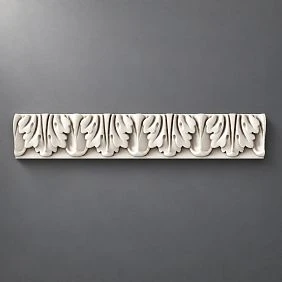
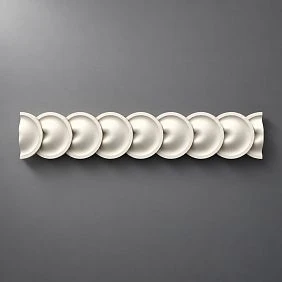
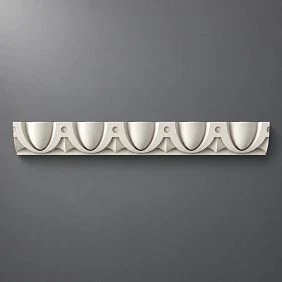
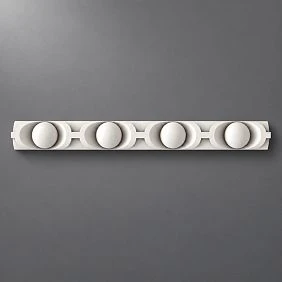
Our factory also produces:
Which panels are suitable for a ceiling scenario
Ceiling installation is fundamentally different from wall installation. Gravity works against the mounting, the viewing angle changes the perception of every defect, and the temperature under the ceiling is higher than at floor level. All this imposes higher demands on the material.
Get Consultation
MDF for painting: geometry visible from top to bottom
MDF with a density of 780–850 kg/m³ is the optimal material for ceiling systems in most applications. Why is high density fundamentally important for ceilings?
Looking up from below under any lighting, especially side lighting, instantly reveals the slightest deviations in the panel's flatness — a 1–2 mm deflection that is unnoticeable on a wall becomes a visible defect on the ceiling. Dense MDF maintains perfect straightness during temperature changes (temperature under the ceiling is on average 3–5°C higher), does not deform from the heat of built-in lights, and maintains its geometry for decades without warping.
An additional advantage of MDF specifically for ceilings is its lightness. With equal dimensions to solid wood, MDF is lighter, which reduces the load on the frame and ceiling structure. For large areas (from 20–25 sq.m), the weight difference of the system becomes significant for the structure.
The color freedom of an MDF ceiling is complete: any RAL or NCS. A white ceiling (RAL 9010 or 9003) is a classic, visually raising the space. Dark anthracite or graphite is an architectural boldness, reducing the perceived height and creating intimacy. An accent color is a non-standard solution for spaces with a pronounced character. And in any of these casesCeiling moldingpolyurethane is painted in the same tone, creating a unified monochrome system.
Solid oak: a living ceiling
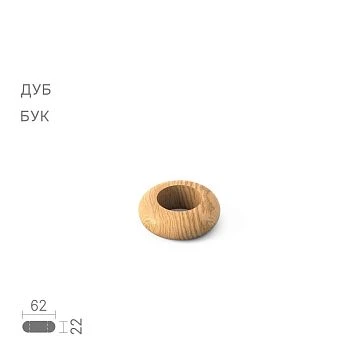
Slatted panels made of solid oak on the ceiling are a solution of a fundamentally different class. Wood overhead affects a person at the level of natural instinct: shelter, protection, refuge. This is not a metaphor — psychophysiologically, wood above is perceived differently than wood to the side.
Under diffused light from the gaps, oak slats reveal the wood grain pattern from the bottom plane — in a way not visible under any other lighting. The natural 'ornament' of each slat is unique and non-static: it changes depending on the viewing angle and light source. This is a living ceiling, not an imitation of a living one.
For ceiling applications, oak must be kiln-dried to 8–10% moisture content. Unseasoned solid wood will begin to deform faster under the ceiling due to temperature fluctuations than on a wall. Toning options range from natural honey to deep tobacco and graphite gray, preserving the natural grain.
Types of constructions: closed, open, floating
A closed slatted ceiling features slats placed tightly together with no gaps. It creates a monolithic wooden or painted surface with thin joint lines. It best conceals utilities and load-bearing structures. Suitable for living spaces where surface cleanliness is important and there is no need to integrate lighting into the plane.
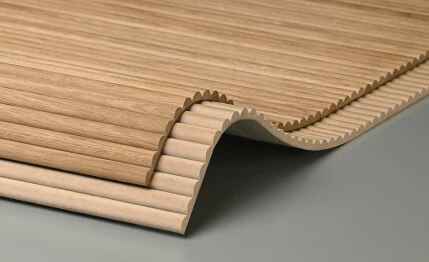
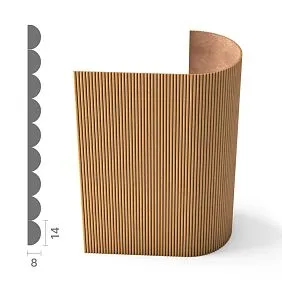
An open slatted ceiling features slats with a calculated gap of 15–60 mm. The gaps serve as a channel for light flow, a space for LED strips or spotlights, and a technical area for cables. The most popular type in modern design. It is here thatSlatted panels for the ceilingthe full potential is revealed: light, acoustics, and texture work together.
A floating slatted ceiling features slats with a wide gap (40–80 mm) and backlighting behind the substrate. Only light is visible between the slats—the substrate is not seen. The slats visually 'float' in a luminous space. A monumental effect for living rooms with high ceilings. When using warm light (2700 K), it creates an almost theatrical effect of a golden sky.
How molding works on the ceiling together with slats
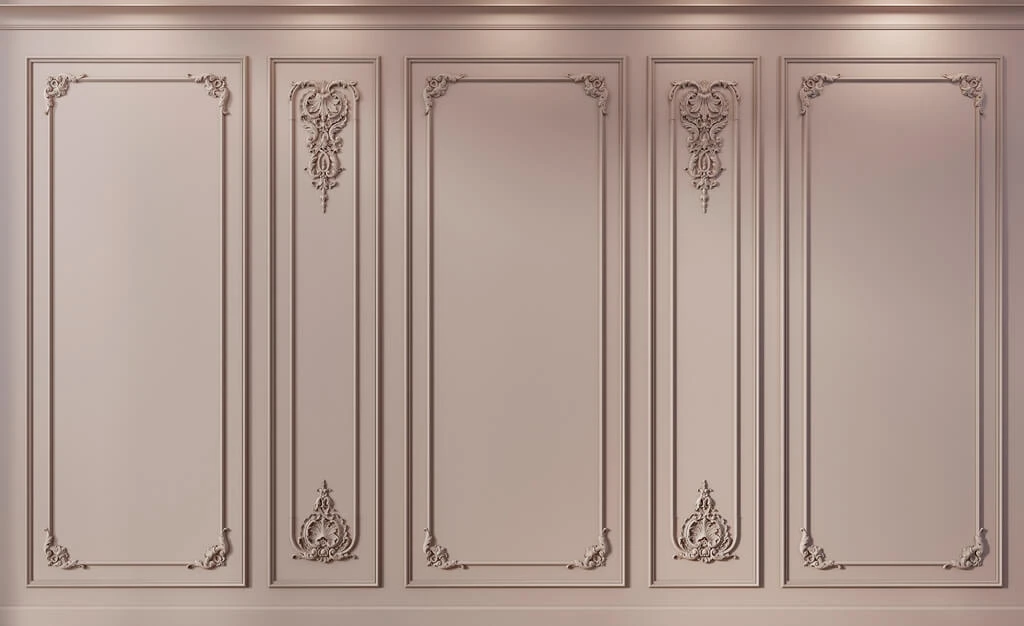
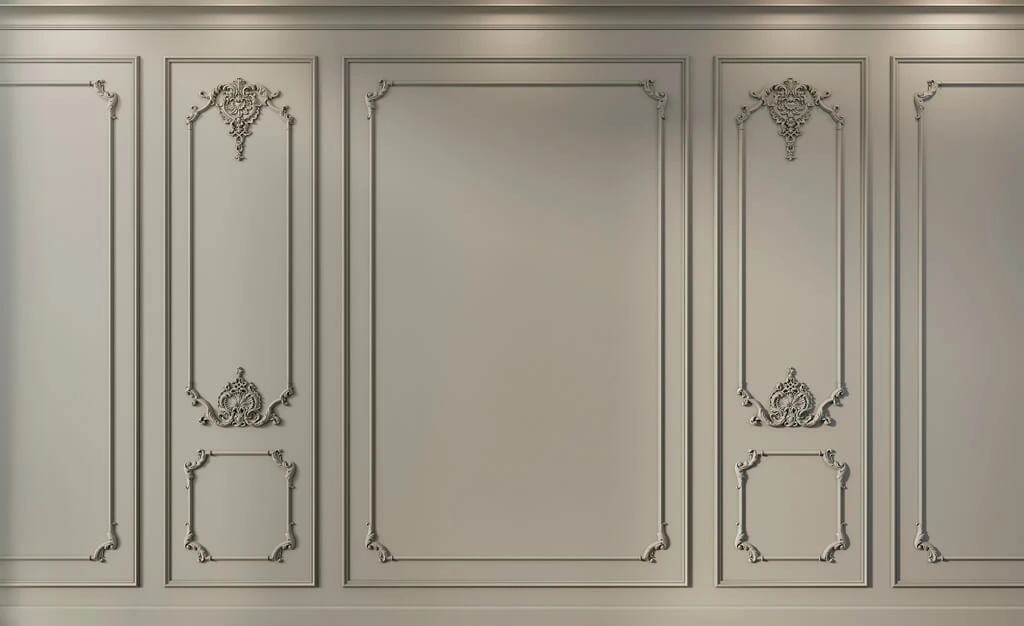
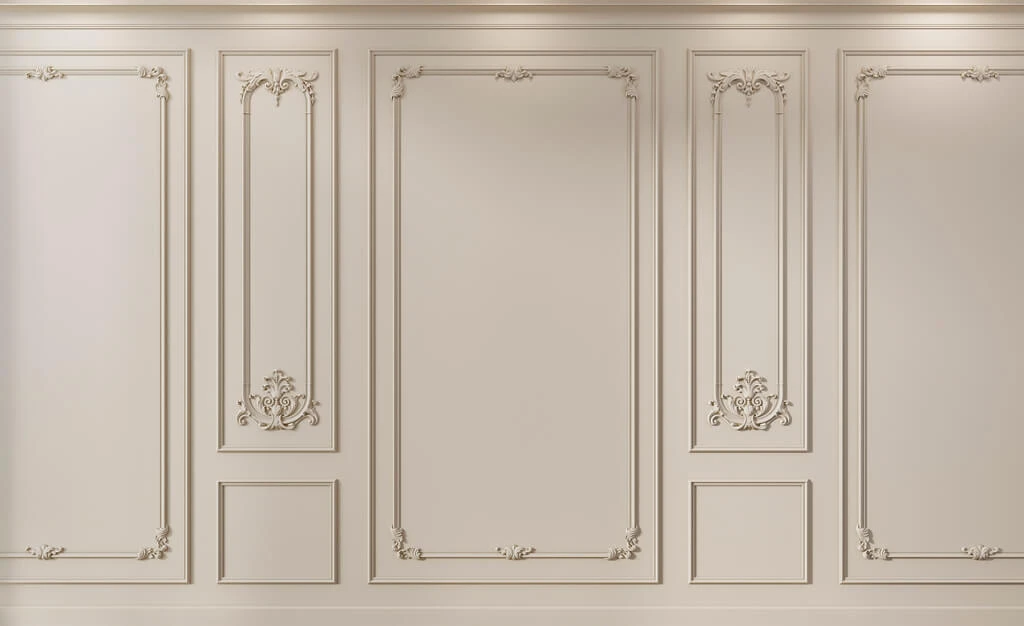
This is where it gets really interesting. Slatted panels create rhythm and texture. Molding creates structure and accents. These are two different types of architectural expression—they do not compete but complement each other, each working at its own level.
Cornice as an architectural frame
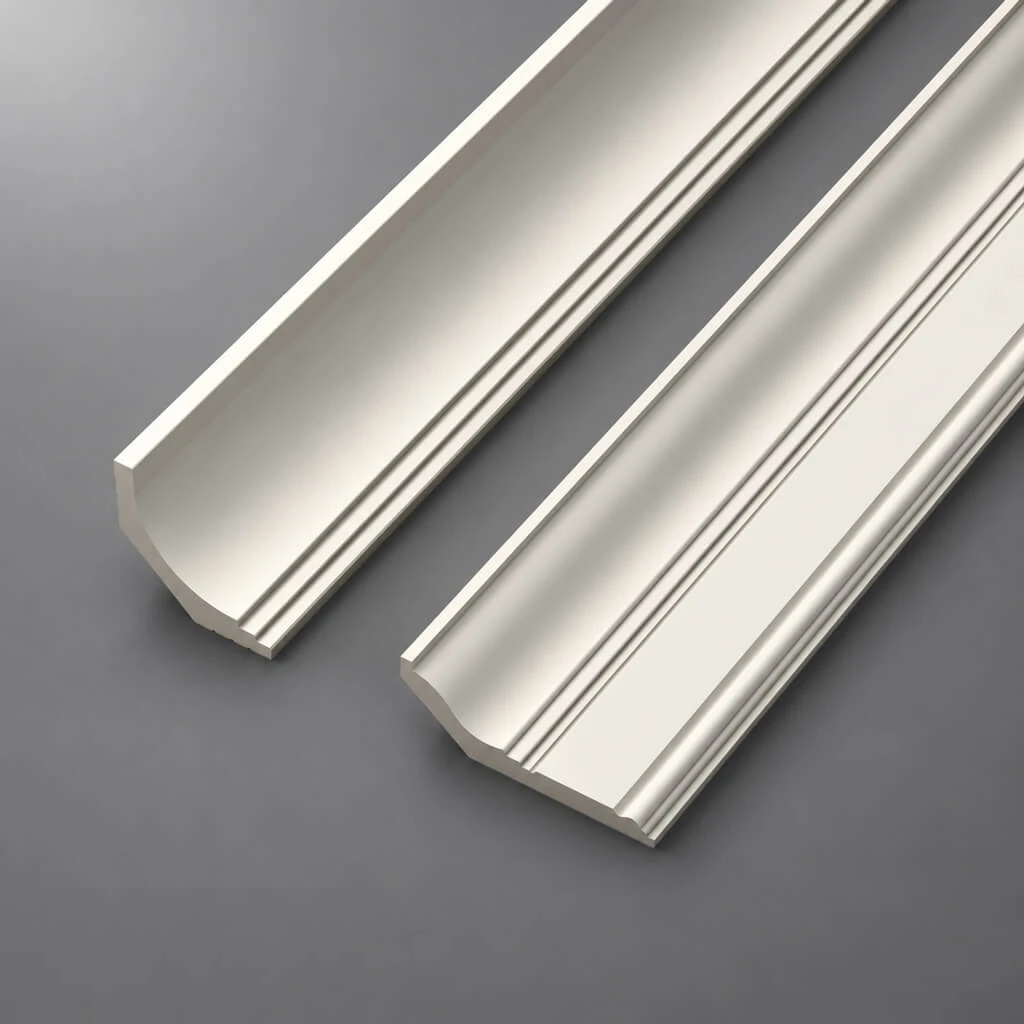
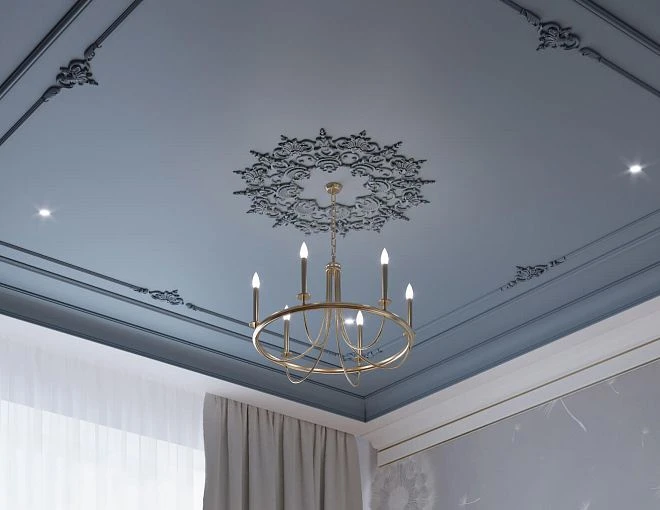
A polyurethane ceiling cornice is a perimeter element that separates the ceiling plane from the walls. It is not a decorative 'add-on'; it is an architectural boundary that gives the system completeness. Without a cornice, a slatted ceiling at standard height looks unfinished: the slats end abruptly at the wall, and the transition appears awkward.
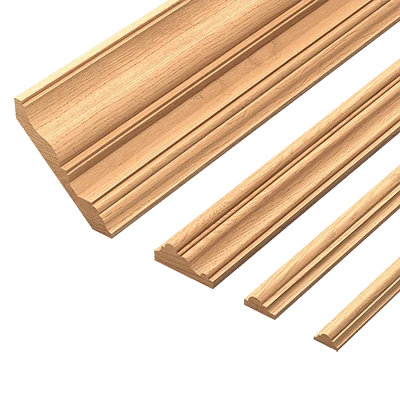
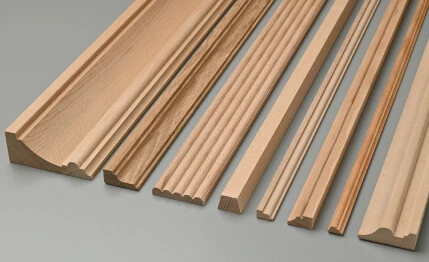
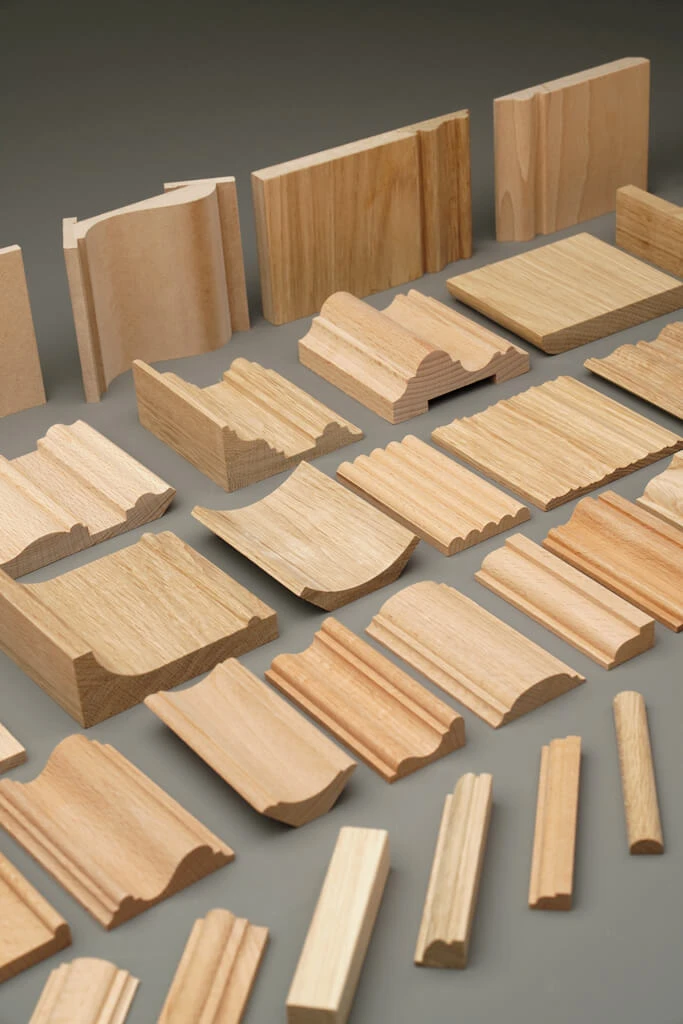
ceiling moldingIn the form of a cornice with a classic profile (cavetto, fillet, ovolo) transforms this transition into an architectural event. If the cornice and battens are painted in the same tone, the ceiling with battens and cornice reads as a unified monolithic system. If the cornice is contrasting (white on dark battens or dark on light ones), it works like a picture frame, visually highlighting the ceiling plane as a separate architectural element.
Cornice height for ceiling application: 60–90 mm for modern classic, 90–130 mm for neoclassical, 40–60 mm for minimalist solutions. The wider the battens and the more complex their pattern, the richer the cornice profile can be: the system will handle the complexity.
Ceiling rosette: vertical accent
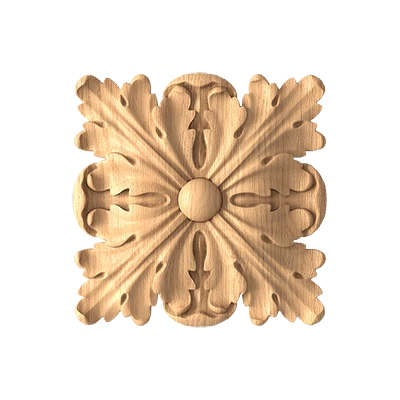
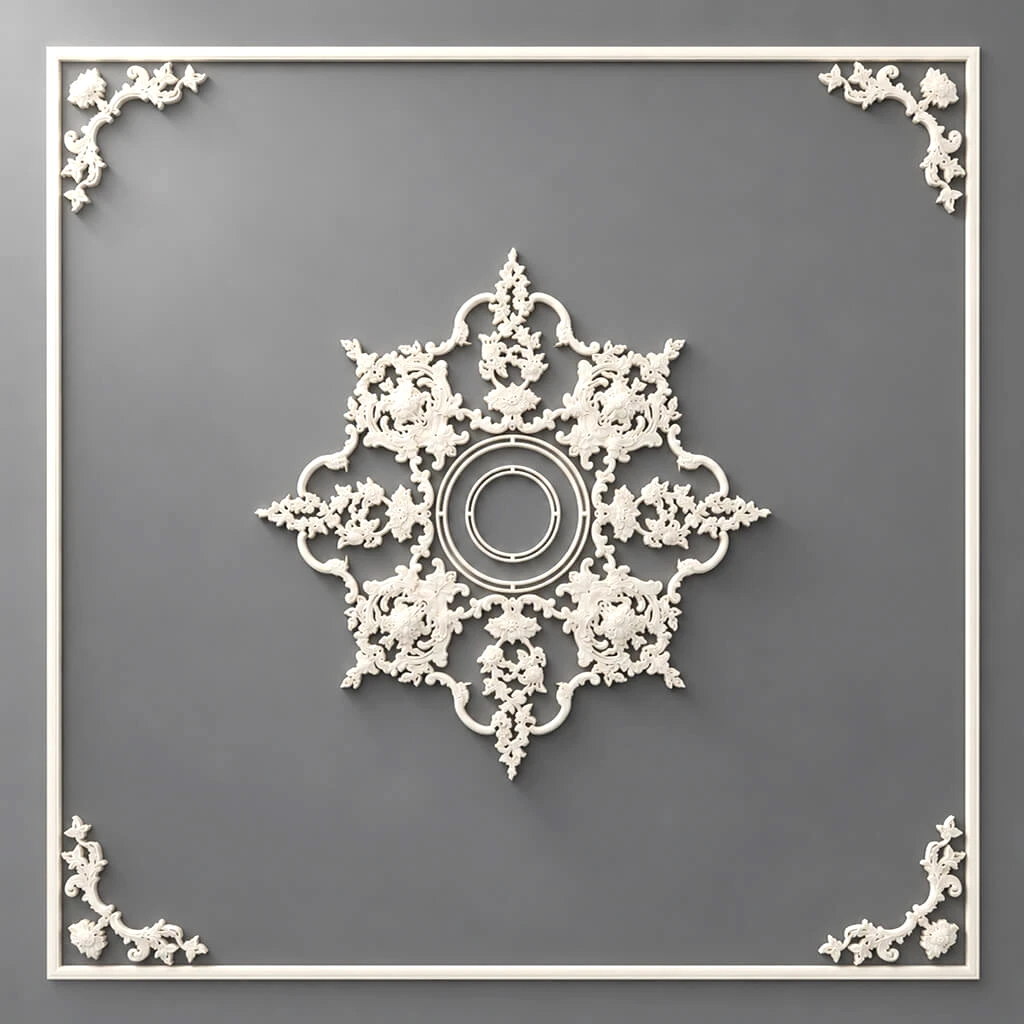
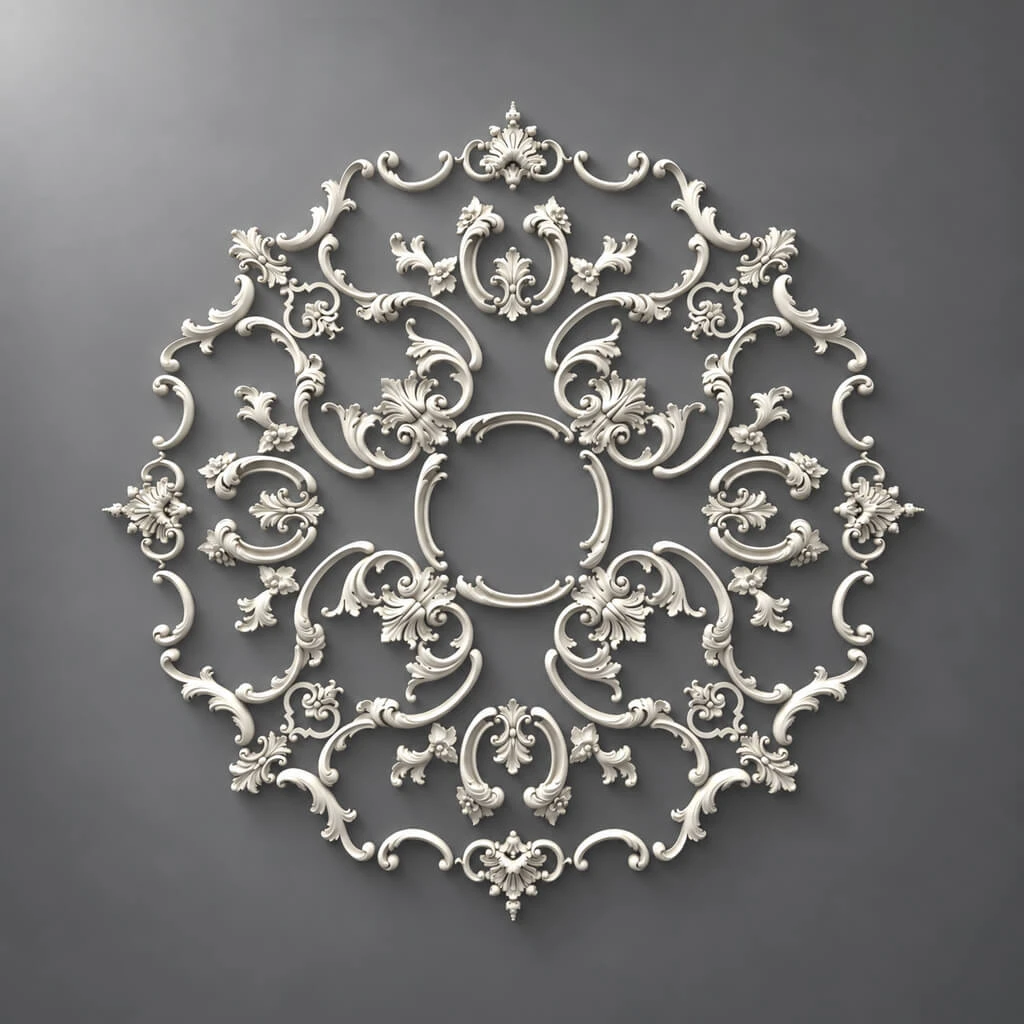
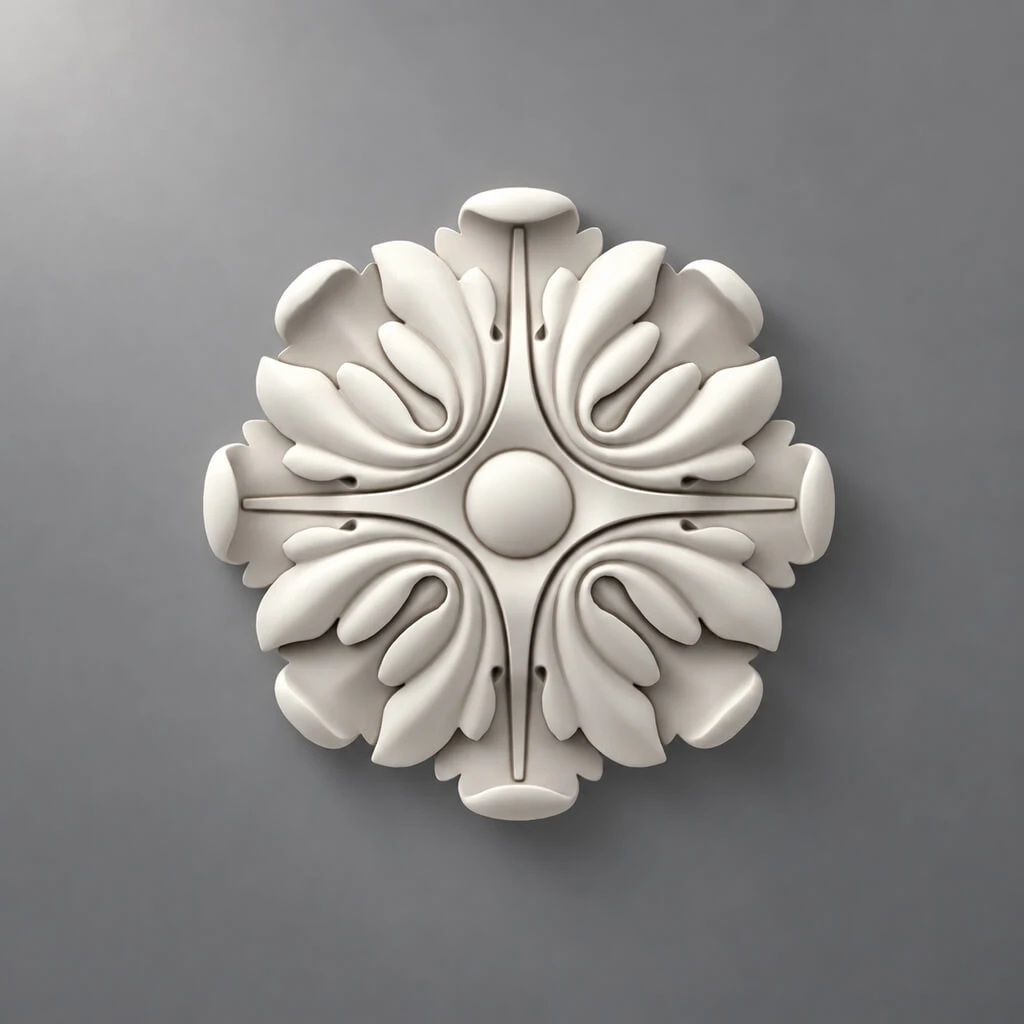
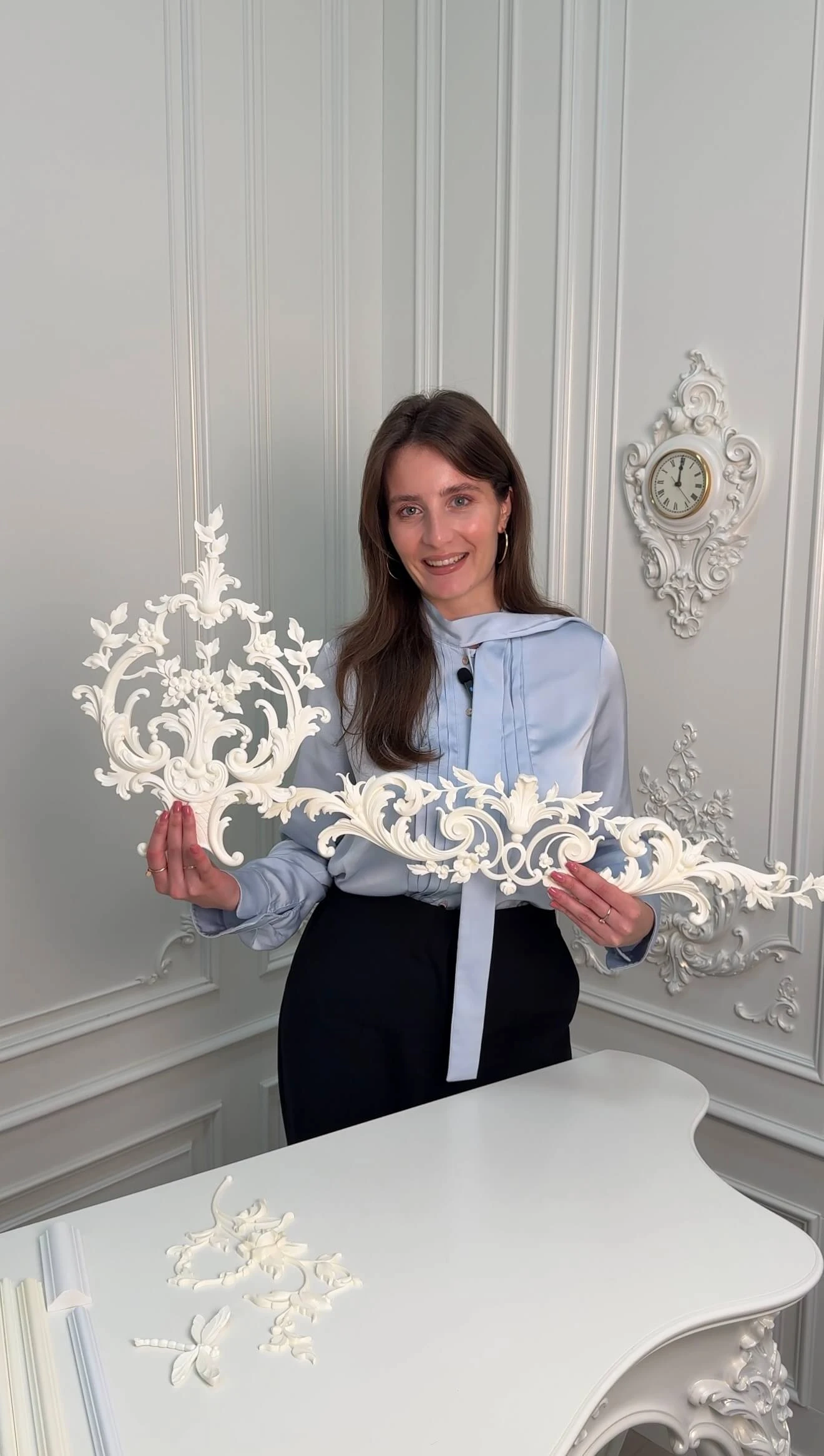
A polyurethane ceiling rosette is the central element of the ceiling, a focal point. In classical and neoclassical systems, the rosette marks the center of the room and serves as the base for a chandelier. In a modern interpretation, the rosette works differently: not as a historical ornament, but as a geometric accent.
The combination of a rosette plus an open batten ceiling is a non-obvious pairing that, when executed correctly, yields a strong result. The rosette interrupts the uniform rhythm of the battens at the central point, creating a semantic accent without disrupting the overall system. It is especially expressive when the rosette is painted to match the color of the battens—its form becomes visible only through the relief and shadows from the built-in lighting.
Frieze and border: horizontal lines above the battens
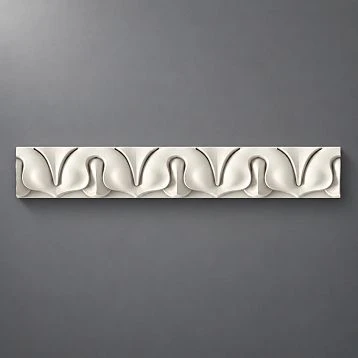
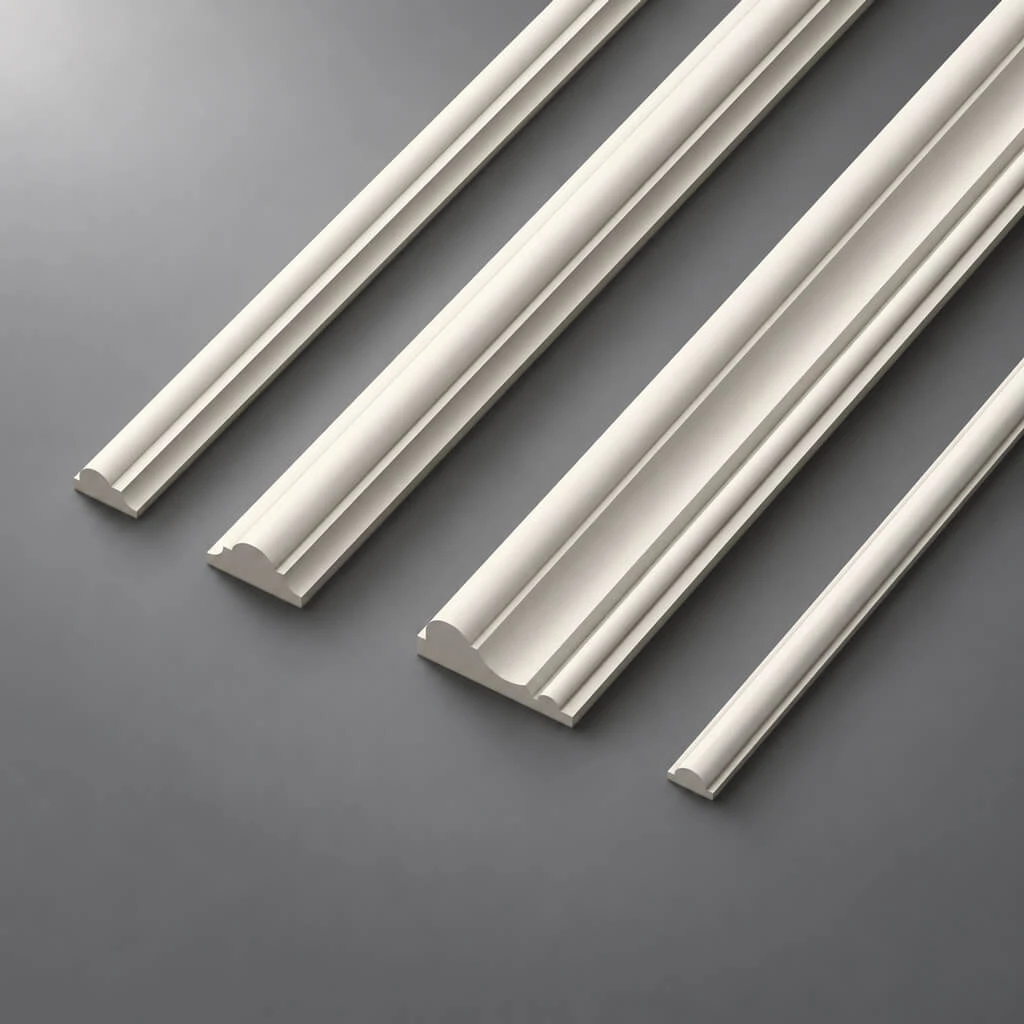
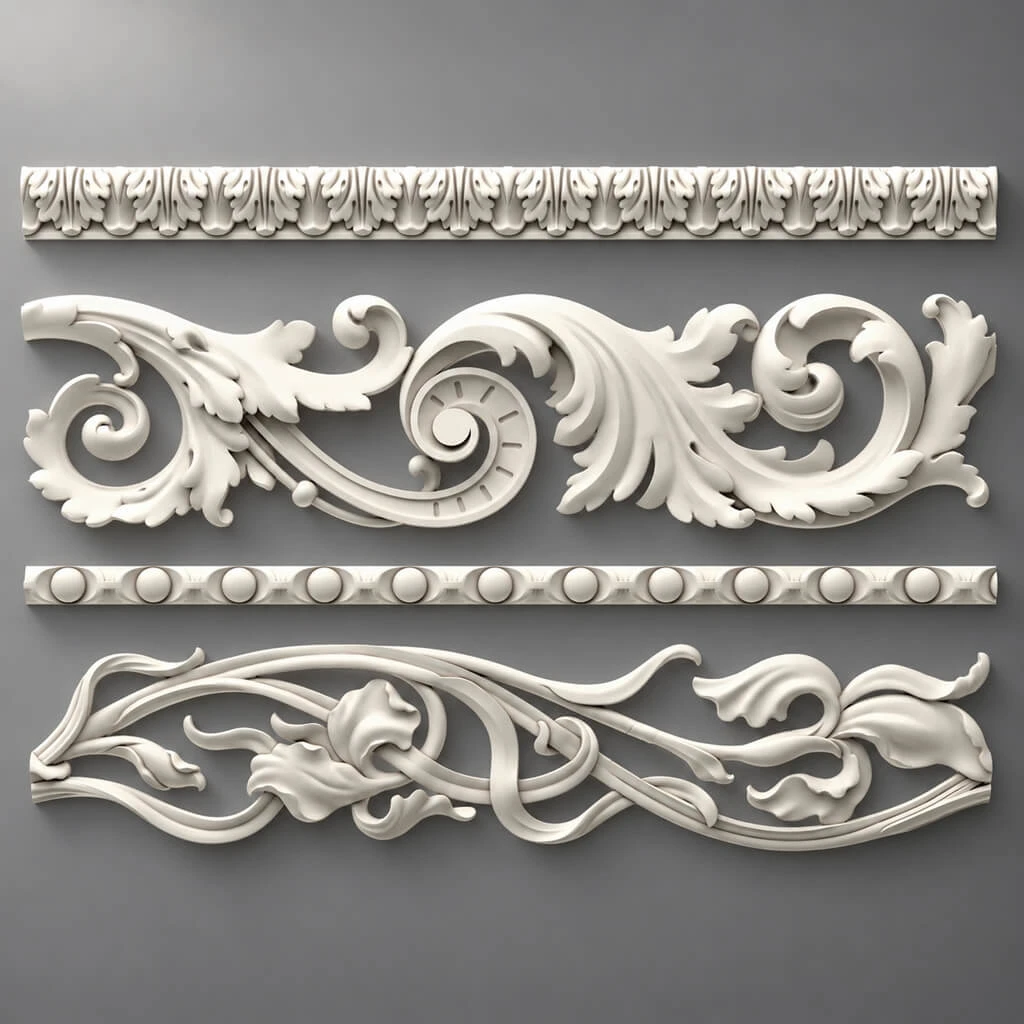
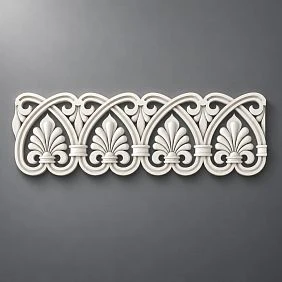
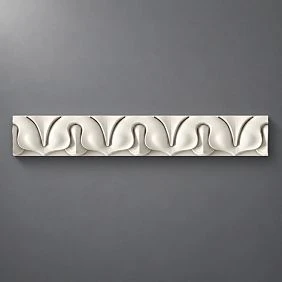
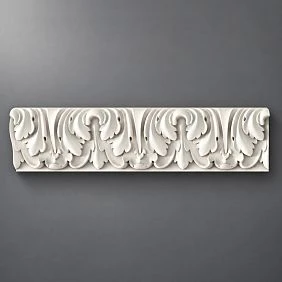
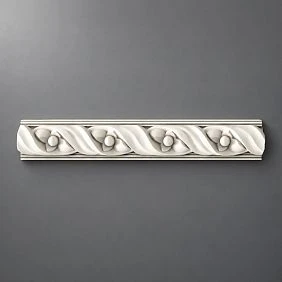
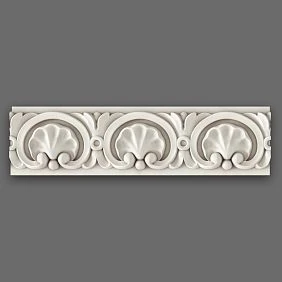
A polyurethane ceiling frieze is a strip of decorative ornament along the perimeter of the ceiling between the cornice and the batten plane. In neoclassical projects, this is a particularly effective technique: the batten field is 'wrapped' in architectural ornament, like a page in a historical book with margins featuring engravings.
For contemporary interiors, a smooth geometric border works instead of an ornamental frieze: a 30–50 mm strip with a rectangular or stepped profile. It structures the ceiling without excessive decorativeness and works well in styles from Art Deco to modern minimalism.
Coffered ceiling: battens within frames
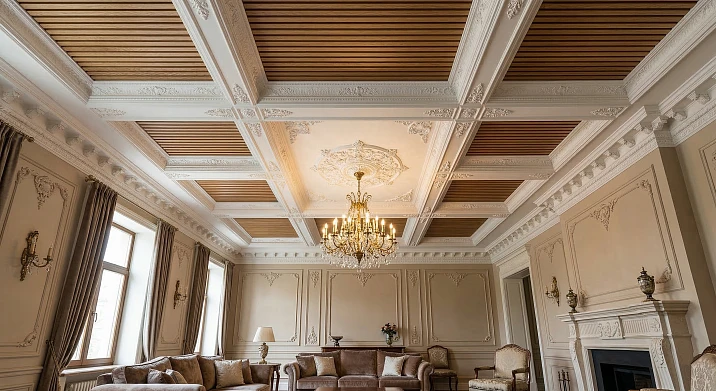
One of the most impressive ceiling solutions that combines batten panels and ceiling molding is the coffered system. Polyurethane molding frames divide the ceiling into rectangular coffered fields, each containing a fragment of the batten plane. This is a direct reference to historical coffered ceilings, which have symbolized architectural perfection since the times of Ancient Rome.
In the modern version: the slatted ceiling is installed as a continuous field, then polyurethane molding-frames are glued onto the slats at 600–900 mm intervals, forming a grid of coffers. The entire system is in a single tone. Result: a ceiling with two levels of relief that looks like an expensive architectural element made from one material with one tool—paint.
Lighting schemes and compositions
Lighting in a slatted ceiling system is not an auxiliary element, but a structural one. It must be planned simultaneously with the choice of panel type and slat spacing—before production, not after installation. This is an ironclad rule, the violation of which leads to one of the most common and irreparable mistakes.
Scenario one: diffused light from gaps
LED strip is mounted in the gaps on the substrate before the panel is attached to the frame. Wires are hidden in the technical space. Light is directed downward—across the entire ceiling area, evenly, without shadows from the slats.
Result: the ceiling glows on its own, the slats are dark silhouettes against a glowing background. With a wide gap and warm-toned oak slats under 2700 K light—the effect of a shimmering natural 'sky'. This scenario is ideal for bedrooms and living rooms, where soft, non-task, atmospheric light is important.
Scenario two: recessed spotlights in the system
Recessed mini-spots with a diameter of 35–50 mm are mounted in the substrate in gaps or between slats. Cable routes are in the frame. Control via dimmer or smart home system.
Each spot is a directional lighting accent: on a painting, on a work area, on a furniture element. When combined with diffused LED strip, two-level lighting is achieved: background light across the entire plane plus accent 'points' in the right places. This is a professional lighting scheme implemented without a single visible wire.
Scenario three: floating backlighting behind the substrate
For a wide floating ceiling: The LED strip is mounted directly on the load-bearing slab—behind the panel backing. Light passes through wide gaps from below. The backing is not visible—only glowing strips between the battens. The battens visually detach from the ceiling and 'float'.
This scenario requires precise calculation of batten spacing and gap width: if the gap is too narrow, light does not pass through sufficiently; if too wide, the backing becomes visible at sharp angles.
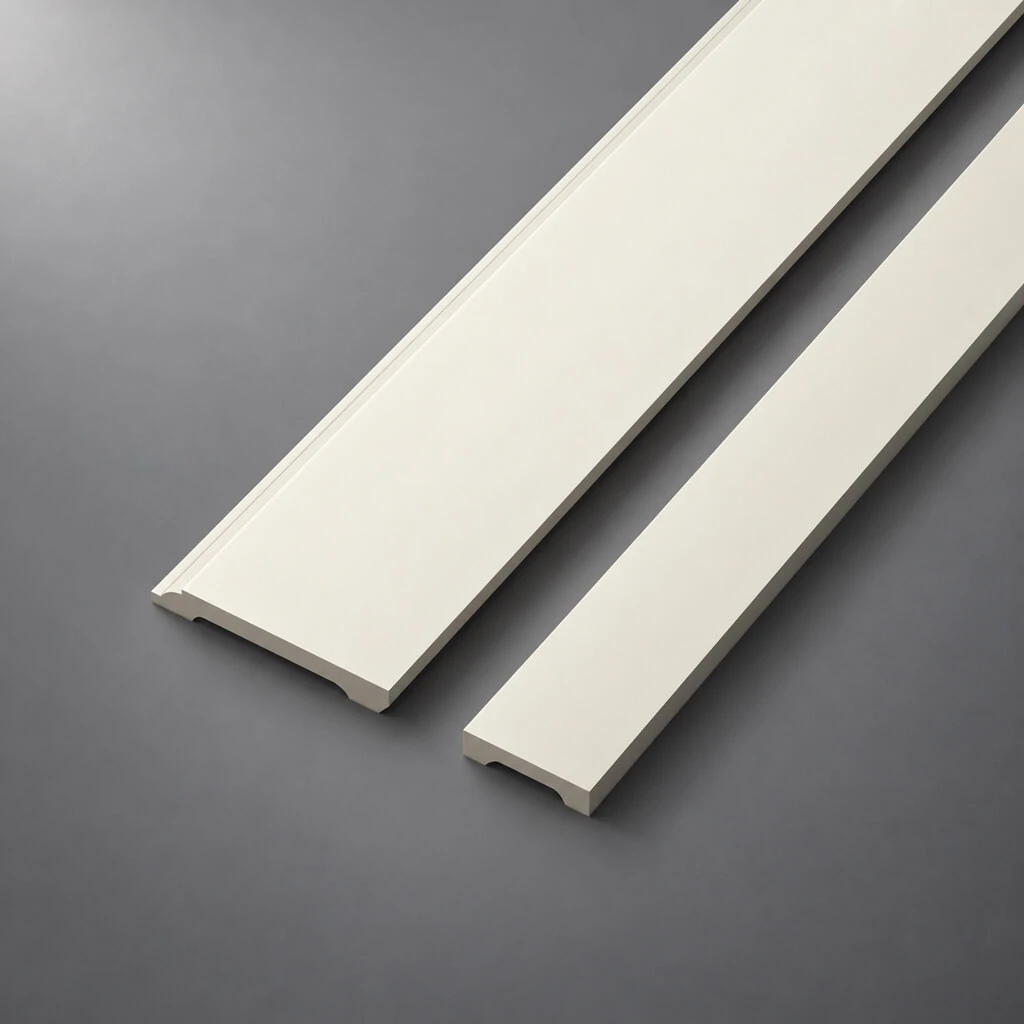
Combination with ceiling molding: light accents on the relief
Polyurethane cornice with bottom lighting (LED behind perimeter molding) is one of the most striking lighting techniques in a ceiling system. Light directed upward along the wall creates a soft 'halo' around the room perimeter, while the cornice with a relief profile receives beautiful side lighting that emphasizes the profile shape.
A rosette under a directed spot light aimed directly at it—the volumetric relief of the ornament becomes visible in the finest details. A rosette painted to match the ceiling color 'emerges' from the plane only through light and shadow—a subtle and sophisticated technique.
Batten orientation: spatial play
Ceiling batten panelsoffer what no other ceiling solution does—the ability to control the perception of a room's shape through pattern orientation.
Battens along the long axis of the room—'stretch' the space, visually lengthening it. The eye moves along the battens toward the far wall, making the room feel longer than it is.
Battens across the room—'widen' the space. A short room with transverse battens appears squarer and more spacious.
Diagonal slats — dynamics, kinetics, movement. They work in lofts, restaurants, non-standard spaces. They require precise perimeter trimming calculations and more complex installation, but the result is unexpected and powerful.
Slat orientation — a decision made considering the room layout, furniture placement, and lighting scenarios. Slats directed 'towards' the main relaxation area or an accent wall create perspective — the space 'invites' you to a specific point.
Slat spacing and width: the scale that defines the character
Ceiling slat spacing — one of the most important design variables, affecting not just 'how the ceiling looks,' but how the entire room is perceived. It's subtle but very effective.
| Batten width | Gap | Effect | Recommended spaces |
|---|---|---|---|
| 12–18 mm | 30–45 mm | Lightness, the ceiling 'recedes' upward | Low rooms up to 2.7 m |
| 20–30 mm | 20–35 mm | Balanced rhythm, universal | Standard height 2.7–3.0 m |
| 30–50 mm | 15–25 mm | Massiveness, coziness, 'low vault' | High rooms from 3.2 m |
| 50–80 mm | 10–15 mm | Wooden plane, emphasis on the material | Spaces with high ceilings |
The table is a guideline, not a standard. The final decision is always checked in the actual room: a laser level and a measuring tape as a mock-up for battens is a quick way to 'feel' the rhythm before production.
Which rooms benefit especially
Living room with a high ceiling: monumentality under control
A living room with a ceiling higher than 3.2 meters is a space that needs a ceiling batten system the most. Without an architectural solution overhead, such a room feels uninhabited.Batten panels for ceilingsOak with a wide spacing in a floating or open type + a cornice and rosette made of polyurethane in the same tint — this is a solution that simultaneously 'brings the ceiling closer' psychologically and preserves its physical height.
It is in the living room that the most saturated composition is appropriate: floating battens over the central relaxation area, a coffered frame around the perimeter made of polyurethane moldings, a rosette in the center for the chandelier. All in a unified tone.
Bedroom: silence overhead
In the bedroom, the ceiling is the last thing a person sees before sleep and the first after waking up. An oak batten ceiling with a semi-circular profile and soft diffused 2700K light from the gaps — this is a solution that properly 'encloses' the space above the bed.
A special technique for the bedroom: a fragmentary batten ceiling only over the sleeping area — a 'canopy' of battens without backing, floating above the headboard. It visually defines the relaxation zone within a large space and creates a feeling of a natural shelter — intimacy without physical isolation.
ceiling moldingIn the bedroom — a minimalist cornice 50–70 mm without ornament, matching the battens in tone. No overload: the goal is silence and coziness, not a showcase of decorative possibilities.
Study and library: dark ceiling for concentration
In the study, slatted panels for painting in a dark tone work as a concentration tool. The dark ceiling absorbs scattered visual noise, reduces the sense of volume overhead, and focuses attention on the work surface in front of the person.
Dark green (RAL 6028), anthracite (RAL 7021), dark indigo blue — all of these on the ceiling in the study look confident and unconventional. A cornice with a classic profile in the same tone frames the system. With spotlights in the gaps, directed at the desk, a functional lighting scheme is integrated into the architecture.
Kitchen: accent ceiling over the work area
Over the kitchen island or dining table — a local slatted ceiling as an architectural accent. MDF matching the kitchen furniture or in a contrasting accent RAL. Pendant lights passing through gaps in the substrate — maximally organic lighting integration. A polyurethane cornice around the perimeter of the local ceiling marks the zone boundaries.
Technical requirement for the kitchen: only MDF with a moisture-resistant coating (2-component varnish or polyurethane paint). Oak with open oil finish over the cooking area is impractical: grease particles penetrate the wood pores.
Restaurant and cafe: atmosphere and acoustics
In a commercial space, a slatted ceiling solves two tasks that usually conflict simultaneously: aesthetic (atmosphere, establishment's image) and functional (noise reduction). Oak with a warm tint under 2700–3000 K light creates an atmosphere of coziness and natural warmth — exactly what a restaurant needs. Acoustic filling in the frame (mineral wool 50–100 mm) reduces reverberation by 15–30% — guests can hear each other without raising their voices.
Ceiling molding in a restaurant: a frieze or border along the perimeter, marking a VIP zone or bar counter. No overload with ornament — only an architectural boundary that divides the space by function.
Corridor and hallway: the first impression from above
In a narrow hallway or entryway, a slatted ceiling works more powerfully than in any other room—precisely because the space is limited and the gaze is inevitably directed upward. Slats running across a narrow hallway visually widen it. Built-in warm LED lighting provides soft, welcoming illumination that greets anyone entering.
A polyurethane cornice along the perimeter of the hallway transforms a simple technical passage into an architecturally designed route. With a cornice height of 50–70 mm and a unified tone with the slats, the hallway gains a dignity it usually lacks.
Mistakes in scale, spacing, and height
Mistakes in a slatted ceiling system are a special kind of design miscalculation. On a wall, much can be hidden with furniture, paintings, or decor. On a ceiling—nothing and never. The ceiling is constantly and inevitably exposed to view.
First mistake: slats too wide for a low room
Slats 50–80 mm wide with narrow gaps in a room 2.5–2.6 meters high create a pressing effect of 'wooden ceiling looming.' The space feels compressed. Solution: narrow slats 12–18 mm with wide gaps of 35–45 mm—and the same height begins to feel comfortable.
Second mistake: adhesive mounting without a frame over a large area
A panel larger than 4–5 sq.m without a frame is held only by adhesive. This risks detachment—especially with building vibration, temperature fluctuations, or humidity changes. A fallen panel on the ceiling is not just a ruined interior. A frame made of CD 60×27 mm metal profiles on hangers spaced 300–400 mm apart is a mandatory requirement for any serious ceiling installation.
Third mistake: installation without acclimatization
48–72 hours horizontally with slats facing down at room temperature and humidity—a mandatory step before installation. Panels brought in from the cold or from storage with a different microclimate begin to deform after installation: slats bend, the backing warps. On the ceiling, this defect is visible under any lighting and cannot be fixed without complete dismantling.
Fourth mistake: cables not laid before installation
All cable runs—LEDs, spotlights, electrical wiring—must be laid in the frame before installing the first panel. After that, access to the technical space is closed. Running cables after installation without dismantling the system is impossible. This is a basic rule that is violated in every third non-professional installation.
Mistake five: uncoordinated cornice
A polyurethane cornice, chosen as 'approximately the same size' after installing a slatted ceiling, almost always looks alien. The proportions of the cornice must correspond to the width of the slats and the pitch: thin slats require a light cornice, wide massive slats require a large profile. A mismatch in scale destroys the system.
Mistake six: molding more complex than the slats
The more complex the slatted pattern on the ceiling, the simpler the molding should be. And vice versa: with minimalist slats, the cornice and rosette can be richer. The competition of two complex systems for the viewer's attention creates visual chaos. One should be the 'sound,' the other the 'pause.'
Mistake seven: identical pitch and width of slats in rooms of different heights
Parameters of a slatted ceiling that work perfectly in a living room with a 3.2-meter ceiling will create a oppressive effect in a bedroom with a 2.7-meter ceiling. Design always begins with measuring the height and area of the specific room—and calculating the pitch and width of the slats according to these parameters.
Installation requirements: briefly about the main points
Detailed instructions for installing slatted panels yourselfare available on the websiteHere are the key parameters for the ceiling system:
-
Frame: CD profile 60×27 mm, spacing of load-bearing profiles — 300–400 mm. Each panel module must rest on at least three profiles;
-
Frame horizontality: laser level is mandatory. Tolerance — 1–2 mm per meter;
-
Panel fastening: adhesive plus finishing nails Ø1.2–1.6 × 30–35 mm through the underlay into the profile. Adhesive only — not allowed;
-
MDF underlay edges: primed or covered with edge film — especially critical for ceilings where moisture condensation is higher;
-
Module joints: slats are aligned continuously. Factory step accuracy ≤ 0.5 mm — a mandatory condition.
Coordinated system: ceiling as part of a whole
Slatted ceiling paired withmoldings on the ceiling— is only part of the architectural whole. Maximum result is achieved when the ceiling system is coordinated with the other elements:
-
Slatted wall panels in the same tint or tone create a 'wrapping' natural effect;
-
Wall cornices and moldings are coordinated in profile and tone with the ceiling cornice;
-
Solid wood or MDF baseboards in the same tone as the system complete the vertical line from ceiling to floor;
-
Wooden interior elements — stair balusters, furniture overlays, door trims — support the overall material theme.
When all elements are produced within one manufacturer's system, matching tones are guaranteed. This is fundamentally important: there is nothing worse than 'oak on the ceiling' and 'oak on the wall' of the same color from different factories, where this color differs by half a tone.
FAQ: Answers to popular questions
Can slatted panels be installed on a ceiling by oneself?
Yes, with basic construction skills. A detailed step-by-step guide is on theDIY slatted panel installation page. The main things are the frame, acclimatization of panels, and pre-laying of cables.
How much does a slatted ceiling reduce the room height?
Frame plus underlay plus slat: 50–100 mm depending on the design. With a standard height of 2.7 m, the ceiling drops to 2.6–2.65 m. Narrow slats with wide gaps and warm lighting visually compensate for this reduction.
Is ceiling molding compatible with an oak slatted ceiling?
Fully compatible provided tonal consistency. The polyurethane cornice is painted in the same tone as the oak tint — for a monochrome system. Or in contrasting white — for a two-tone scheme. A polyurethane rosette in the center of the oak ceiling is a historically impeccable and convincingly modern solution.
What type of slatted ceiling is better for a room with a height of 2.5 meters?
Open type with slats 15–18 mm wide and a 35–45 mm gap. Orient slats along the long axis. Warm light 2700 K from below through the gaps. This solution visually 'raises' the ceiling by 15–20 cm.
Is acclimatization needed before installation?
Mandatory: 48–72 hours horizontally with slats facing down at the temperature and humidity of the installation room. On the ceiling, slat deformation is more noticeable than on the wall and cannot be corrected without dismantling.
How to integrate lighting into a slatted ceiling with molding?
Three levels: LED strip in the gaps (general diffused light), spotlights in the gaps (accent light), lighting behind the polyurethane cornice (perimeter halo on the walls). All wiring — before installing the first panel.
What cornice profile is suitable for a ceiling with thin slats in a Scandinavian style?
Minimalist rectangular cornice 40–55 mm without ornament, matching the slats' tone. A simple profile does not compete with the thin slatted rhythm but frames it with dignity.
Can slatted panels be used on a bathroom ceiling?
Yes, subject to two conditions: only MDF with moisture-resistant paint (2-component varnish) or oak with waterproof varnish; only frame mounting on galvanized profile. Closed type is preferable to open type due to lower risk of moisture penetration into the technical space.
About the company STAVROS
Ceiling architectural system is one of the most demanding objects in terms of material quality. Any geometry defect, instability of spacing, or poor-quality drying of solid wood on the ceiling manifests itself fully and without the possibility of concealment. That is why the choice of manufacturer for ceiling systems has a direct and significant impact on the final result.
STAVROS is a full-cycle Russian manufacturer working with wood and MDF in finishing and furniture systems.Batten panels for ceilingsMDF with a density of 750–850 kg/m³ from European suppliers; solid oak with climatic drying to 8–10% moisture content; spacing accuracy control ≤ 0.5 mm — these are not marketing claims, but production standards that are critical specifically for ceiling applications.
ceiling moldingPolyurethane items — cornices, rosettes, moldings, friezes — are produced in the same system as slatted panels. One program, coordinated proportions, compatible tinting. This means that a polyurethane cornice and oak slats will be ordered from the same place and arrive with the same color calibration — no surprises during installation.
STAVROS offers over 4000 models in 39 product groups. Professional consultation on ceiling system calculation is free before placing an order. Shipment from one unit, delivery across all of Russia. Create a ceiling that will be the strongest part of your interior — with materials that meet this task precisely.