











































































Article Contents:
- What is visual noise in interior design — and why it occurs
- What tasks do slatted panels solve in modern interiors
- First function: surface structuring
- Second function: zoning without partitions
- Third function: accentuation without loud decor
- Fourth function: acoustic improvement
- Where polyurethane decor is appropriate: precise application zones
- Ceiling perimeter: cornice as an architectural necessity
- Wall moldings: frames as architectural punctuation
- Door and window trims: the beginning and end of a line
- Ceiling rosettes: where they are needed and where they are not
- How to combine linear and relief finishes: principles without exceptions
- The principle of hierarchy: one speaks, the other remains silent
- Principle of scale correspondence
- Principle of tonal unity
- The principle of stylistic purity
- Slat panels in Smolensk: what to consider when purchasing
- What to check when receiving an order
- Slat panels for apartments: zonal logic
- Living room: architectural accent without overload
- Bedroom: minimum irritants, maximum coziness
- Hallway and corridor: rhythm as a spatial tool
- Kitchen: balance of aesthetics and practicality
- Slatted panels for the home: when scale changes the rules
- High space: slats as architectural ribs
- Staircase and hall: zoning vertical space
- House facade: slatted panels on the exterior
- Slatted panels in the office: when requirements differ
- Reception and meeting room: status through material
- Open space work area: acoustics and rhythm
- How to evaluate geometry, coverage, and relief: buyer's checklist
- For slatted panels
- For polyurethane decor
- Combination errors: analysis of real scenarios
- Error: too many dominants at once
- Error: slats and molding in different style registers
- Error: price over compatibility
- Error: slatted panel without framing
- Error: Ignoring lighting
- Types of slatted panels: brief material navigator
- STAVROS: uncompromising finishing partner
- FAQ: answers to popular questions about slatted panels and decor in Smolensk

Smolensk is a city with deep history and vibrant modernity. Here they build and restore, renovate old apartments with non-standard heights and new buildings with standard layouts. And everywhere - the same question: how to create an interior that looks cohesive, confident, without visual chaos? How not to overload the space with details that compete with each other instead of working as an ensemble?
The answer lies in the right combination of two tools: the linear texture of slatted panels and the architectural relief of polyurethane decor. When these two elements are chosen consciously, the interior reads as a unified statement. When chosen randomly, you get what designers call 'visual noise': every detail screams on its own, and no one hears anyone else.
This article is written for those looking for slatted panels in Smolensk and wanting to understand how to organically incorporate them into an interior.Polyurethane DecorHere you'll find specific logic, real-life examples, practical criteria. No fluff, no clichés, no repetition of what's written on the packaging.



What is visual noise in interior design — and why it occurs
Before discussing finishes, we need to understand the concept in the title. Visual noise is a state of space with too many equally significant stimuli. The eye has nothing to latch onto because everywhere is equally 'interesting'. The brain gets tired processing signals and switches to anxiety mode. That's why you want to leave such apartments quickly — even if they're expensive and have 'everything'.
Where does visual noise come from? From three sources:
Excess of competing textures. Wooden slats on the wall, stone tiles on the floor, textured plaster on the ceiling, an ornamental rug. Each element demands attention. Together they create a battle for the eye.
Lack of hierarchy. There's no primary and secondary. Everything is decorative at once. The eye doesn't know where to look first.
Style mismatch. Slatted panels in the spirit of Scandinavian minimalism next to Baroque cornices. A loft-style brick wall and a classic polyurethane medallion on the ceiling. This isn't 'eclecticism' — it's confusion.
Slatted wall panelsandPolyurethane DecorWhen combined incorrectly, they can themselves become a source of visual noise. When combined correctly — they eliminate it. Let's figure out exactly how.




What tasks do slatted panels solve in modern interiors?
A slatted panel is not just 'pretty wood on the wall.' It has a specific set of functions, and understanding these functions is the first step to using the material correctly.
Our factory also produces:




First function: structuring the surface
A smooth wall is a blank canvas. It's good when there are few such canvases. But if all four walls in a room are equally smooth and the same color, the space becomes faceless. A slatted panel introduces structure: it breaks up the monotonous plane into rhythmic vertical or horizontal elements, creating visual activity without decorative overload.
Slatted panels in interior designThey work as architectural texture—not a pattern, not an ornament, but rhythm. And it is rhythm, unlike ornament, that does not tire.
Get Consultation
Second function: zoning without partitions
Open-plan layouts are a trend that has come to Russian apartments seriously and for the long term. But open space requires visual zoning: where is the living room, where is the dining area, where is the workspace? There's no wall—so zoning is created by other means.
Wooden slat panelsOn one wall of the open space, they immediately define a zone. This works more subtly and elegantly than multi-colored wall painting—and does not require physical separation.
Third function: accentuation without loud decor
An accent wall is a cliché but still effective technique. The problem is that most people achieve it through color: painting one wall a bright tone. This is crude and short-lived—after two years, you want to repaint.
slatted panels for wallsThey create emphasis through texture and material, not through color. This is softer, more durable, and timeless. Wood on an accent wall reads as an architectural solution, not a designer's whim.
Fourth function: acoustic improvement
This is the functional aspect that is rarely discussed but is important for real-life living in an apartment. Slats with gaps absorb some sound—especially if acoustic material is laid behind them. The difference is noticeable in living rooms, studies, and meeting rooms. This is especially relevant for new builds in Smolensk with thin interior partitions.
Where polyurethane decor is appropriate: precise application zones
Polyurethane decor for interiors— this is not a synonym for 'classical' or 'rich' style. Modern polyurethane decor can be geometrically strict, minimalist, completely neutral in style. It can be integrated into a Scandinavian interior, neoclassical, or a modern loft—the only question is which specific profile to choose.
Ceiling perimeter: cornice as an architectural necessity
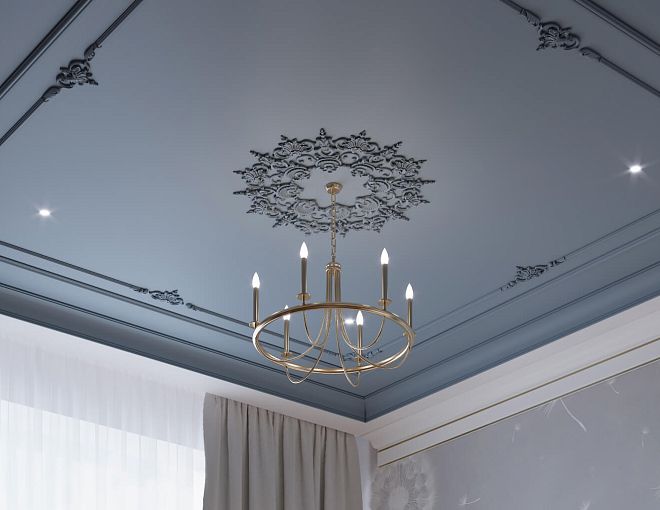
The most logical place for polyurethane decor is the ceiling perimeter. This is not a tribute to tradition but a functional solution: the cornice conceals the technological joint between the ceiling and wall, masks possible cracks from building settlement, and creates a horizontal line that visually raises the ceiling.
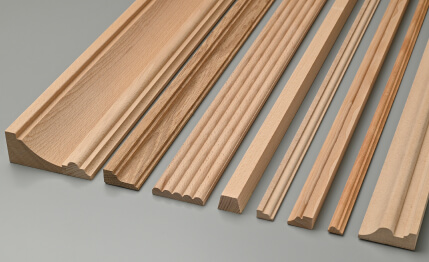
Polyurethane Decor in the form of cornices is available in a huge range of profiles—from a thin geometric molding of 40 mm to a monumental multi-level cornice of 200+ mm. The choice depends on ceiling height and style. The rule: the height of the cornice should not exceed 1/25–1/30 of the ceiling height. For a 2.6 m ceiling—a cornice up to 85–100 mm.
Wall moldings: frames as architectural punctuation
Moldings on walls are frames that create a 'paneled' wall structure. In a classic interior, they imitated expensive wood paneling. In a modern one—it's simply a geometric accent that adds depth and rhythm to the wall.
Molding frames work especially well paired withslatted wall panels. The logic is: the lower third of the wall is a slatted panel, above the molding along the top edge is a wall with frames made of thin profile. This creates a two-level wall structure without excessive complexity.
Door and window casings: the start and end of the line
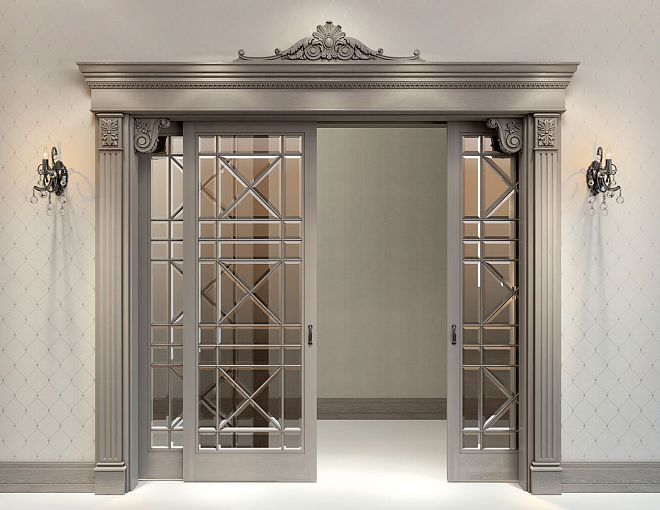
A casing is the boundary of an opening. With it, the opening looks like a finished architectural element. Without it, it's a hole. This sounds categorical, but any experienced designer will confirm it.
to buy polyurethane decorin the form of casings makes sense simultaneously with ordering slatted panels. They should be from the same tonal register—warm white cornice and warm white casing, or both neutral. Mixing warm and cool white in one room is a common mistake that stands out in final photos.
Ceiling rosettes: where they are needed and where they are not
A ceiling rosette is an accent that organizes the center of the ceiling. It is appropriate when a chandelier hangs in the center—then the rosette creates a finished 'frame' around it. It is NOT appropriate with spot lighting without a central chandelier, on a slatted ceiling (the rosette disrupts the rhythm of the slats), in rooms with ceilings below 2.5 m.
If in your Smolensk house or apartment the ceiling is 2.7–3 m and there is a classic chandelier—a rosette with a diameter of 40–55 cm will add completeness. If the ceiling is a standard 2.5 m—make do with a cornice.
How to combine linear and relief finishes: principles without exceptions
A slatted panel is a linear texture. Polyurethane decor is relief. These are two different surface 'languages,' and they require a skillful dialogue. Here's how this dialogue is built.
The principle of hierarchy: one speaks, the other is silent.
In every room, it must be decided: what is primary—the slats or the decor? If the primary slatted wall—the decor should be a delicate background: a thin cornice, a simple molding, no rosettes. If the primary decorative ceiling with cornice and frames—the slatted panel should be restrained: light, narrow slats, a small area.
Violating this principle is the number one cause of visual noise in interiors with combined finishes.
The principle of proportional correspondence
The thickness and relief of the cornice must correspond to the scale of the slat. A wide 120 mm slat requires a cornice from 90 mm. A thin 50 mm slat—a cornice no more than 60–70 mm. A mismatch creates a feeling that 'something is off,' which is hard to explain in words but immediately visible to the eye.
The same logic works for moldings: frames on the wall must be proportional to the wall height and the size of the slatted zone. Small frames on a tall wall—fussiness. Huge frames on a low wall—pressure.
Principle of tonal unity
Slats and decor must exist in the same tonal register. This doesn't mean 'the same color'—it means 'the same tonal temperature.'
-
Warm wood (oak, ash in amber tones) + warm white decor = harmony.
-
Cool gray wood + neutral white or gray decor = harmony.
-
Dark espresso + soft milky decor = contrast, but controlled.
-
Warm wood + cool white decor = conflict.
Wooden slat panelsSolid oak in a warm tone and a polyurethane cornice in 'pure white' is a conflict that kills the harmony of the interior. Check the tone of samples in person.
The principle of stylistic purity
Slatted panels have their stylistic 'affiliation': Scandinavian, modern, loft, eco. Polyurethane decor has its own: classic, neoclassical, art deco, modern classic. There are points of intersection—that's exactly where the combination works. But crossing 'pure' loft with 'pure' baroque stucco is not eclecticism, it's a design mistake.
Safe combinations:
-
Modern classic: warm oak slats + geometric cornice + thin frame moldings.
-
Neoclassical: slats with a dense rhythm + classic cornice with a profile + architraves with a small ornament.
-
Scandinavian: white or light MDF slats + minimalist rectangular plinth-cornice + no rosette.
Slatted panels in Smolensk: what to consider when buying
Smolensk is not a metropolis, but it's not a province in terms of the availability of quality finishing materials. Today, most Smolensk buyers make a conscious choice in favor of ordering online from the manufacturer with delivery—this provides access to the full range, a systematic approach, and quality control at the production level.
For those looking to buy slatted panels in Smolensk, it's important to understand one key point: the local construction materials market offers what is profitable to bring to the region—that is, standard, mass-produced items. Unique wood species, non-standard formats, special coatings—these are always available online and through direct orders.
What to check when receiving an order
When the ordered slatted panels arrive in Smolensk, before installation, be sure to check:
The geometry of each slat. Place the slat on a flat surface—it should lie flat without gaps, not twist, and not sag. A twisted slat will create waves on the finished surface during installation.
Uniformity of tone. Arrange several slats side by side. The tone should be uniform within the batch—without visible jumps in saturation or shade. This is especially important forslatted panels made of MDFwith decorative film.
Integrity of the coating. Check each slat for chips, scratches, or film peeling at the ends. Minor damage at the ends is acceptable if the end will be hidden in a groove or under molding. Damage on the front surface is grounds for a claim.
Completeness of additional elements. Ensure that the order includes a starter profile, corner strips, and a finishing slat.installation of slatted panels on the wallwithout additional elements results in an unfinished look in corners and along the perimeter.
Slat panels for apartments: zonal logic
An apartment is a multi-level space where each room has its own character, tasks, and limitations. A slat panel works differently depending on the zone.
Living room: architectural accent without overload
Slatted panels in the living room interior— typically, one accent wall. Behind the sofa or behind the TV. Not three walls, not two — one. This rule of limitation helps avoid visual noise: the wood occupies its zone and doesn't try to take over the entire space.
What works in the Smolensk living room:
-
Warm-toned oak slat, width 80–100 mm, floor to ceiling — behind the relaxation zone.
-
Cornice made ofpolyurethanearound the perimeter 90–110 mm in warm white — frames the entire ceiling, including the slat zone.
-
The remaining walls — neutral light finish, without active patterns.
-
Slatted panels with lighting— if desired, hidden LED strip in the gaps behind the sofa will add depth.
What doesn't work: dark slats on all walls + heavy ornamental cornice + large ceiling rosette. These are three competing accents in one space.
Bedroom: minimum irritants, maximum coziness
slatted panels in the bedroomfollow a simple principle: less is more. One wall, a warm tone, a dense rhythm of slats — this is enough to make the bedroom a warm, enveloping space.
Polyurethane decor in the bedroom is delicate. A 60–80 mm cornice with a simple profile, without ornament. No rosettes — spot lighting in the bedroom is preferable to a central chandelier. If there is a niche above the headboard — molding as a frame for the niche creates a beautiful architectural accent.
Hallway and corridor: rhythm as a spatial tool
The hallway in most Smolensk apartments is a narrow, often dark corridor.Slatted panels in the hallway interiorhere solve a spatial problem: vertical slats along the long axis of the corridor visually lengthen the space, speed up the gaze, and create a perspective effect.
The color of the slats in the hallway is critical: dark slats in a narrow corridor will make it even darker. Choose light tones — milky, bleached ash, gray-white MDF. A polyurethane cornice along the upper perimeter of the corridor is mandatory: it 'raises' the ceiling and creates a sense of greater volume.
Kitchen: balance of aesthetics and practicality
Slatted panels in the kitchenin a kitchen-living room — a popular solution for Smolensk apartments with combined spaces. Here, slats can designate the 'living room' zone in an open plan, leaving the kitchen area without wood.
If shelves do appear in the kitchen area — only moisture-resistant options.Lath MDF Panelswith film coating or WPC — for kitchen areas without direct steam exposure. Solid wood without protective varnish above the sink is a risk that will inevitably materialize.
Slat panels for the home: when scale changes the rules
A country house or private house in Smolensk — a different scale, different possibilities. High ceilings of 3 m or more, large room areas, verandas, stairwell spaces — all this opens up options that are simply impossible in an apartment.
High space: slats as architectural ribs
In a house with a 3.5 m ceiling, slat panels from floor to ceiling are a powerful architectural solution. Here, slats transform from decoration into a structural element: they establish the vertical rhythm of the entire space, organize it, and impart scale.
Polyurethane Decorin a high space also changes: the cornice can be 150–200 mm with a profile, the rosette diameter 70–90 cm — all this works precisely with a high ceiling. In an apartment, such sizes would feel oppressive. In a country house, they create a palatial feeling — in a good sense.
Staircase and hall: zoning vertical space
The stairwell in a private house is a space of continuous movement. Slat panels along the staircase flight create dynamism, 'guide' the gaze upward, and mark the path. This is one of the most expressive techniques in private home interiors.
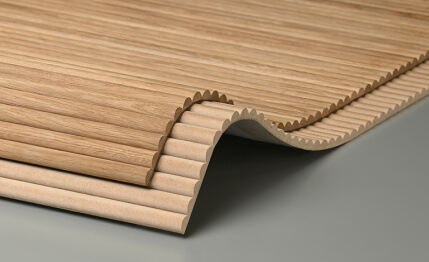
soft slat panelsare especially relevant here: if the staircase flight has a curvilinear outline or a sloped ceiling above it — flexible slats follow this geometry without breaks.
House facade: slatted panels on the exterior
Slatted Façade PanelsFor Smolensk houses — that's a separate story. The climate of central Russia: snowy winters, wet springs, summer heat, intense ultraviolet. For the facade — only thermally modified wood, WPC, or treated larch. Interior MDF won't survive outdoors.
Slatted panel on the facadeCreates a modern look for a private house: horizontal slats of dark thermally modified wood on a light facade — it's restrained elegance that never goes out of style.
Slatted panels in the office: when the requirements are different
Office interior is not home comfort. Here the tasks are different: to create an environment that sets the mood for work, gives status to the company, doesn't distract or tire.Wall finishing with slatted panelsIn the office works exactly according to this logic.
Reception and meeting room: status through material
The reception is the first space a client or partner sees. Here the material speaks about the company before words do.Wooden slat panelsSolid oak on the wall behind the reception desk — it's a silent statement about quality, solidity, attention to detail.
Polyurethane DecorIn the office interior — is delicate. A cornice of strict profile along the ceiling perimeter, no rosettes or ornaments. Clean geometry — the language of business.
Open space work area: acoustics and rhythm
Open workspaces suffer from acoustics: sound travels, concentration decreases. Slatted panels with acoustic filling are not just decor, but a real improvement to the acoustic environment. Slats with gaps absorb some sound, reducing reverberation in the room.
For an open office work area:slatted wall panels for interior finishingon one of the long walls, light tone, medium rhythm. This adds both aesthetics and function.
How to evaluate geometry, coating, and relief: buyer's checklist
Before confirming your order — go through this checklist.
For slatted panels
-
☑ Slat geometry — straight, without twisting.
-
☑ Exact dimensions (length, width, thickness) match the stated ones.
-
☑ Coating is even, without bubbles or drips.
-
☑ Tone is uniform within the batch.
-
☑ Additional elements are included in the order.
-
☑ Material is suitable for the application area (moisture-resistant for kitchen/bathroom).
-
☑ 10–15% surplus added to the calculated volume.
For polyurethane decor
-
☑ Material density — not too light, not hollow-sounding when tapped.
-
☑ Pattern is clear, without blurred edges.
-
☑ Tone matches the tone of the slatted panels (verified with physical samples).
-
☑ Profile matches the style and scale of the room.
-
☑ Element length is sufficient for runs without unnecessary joints.
Combination errors: analysis of real scenarios
Error: too many dominants at once
Slatted wall + ornamental cornice + textured plaster on adjacent wall + patterned laminate flooring. Each element is good on its own. Together — four competing voices. The eye cannot relax.
Solution: leave one active zone — the slatted wall. Everything else — neutral. Cornice — strict, plaster — smooth, floor — solid color.
Mistake: slats and molding in different stylistic registers
Rough loft slats made of brushed dark wood + classic cornice with egg-and-dart and ogee. This is not eclecticism — this is a stylistic contradiction. Rough texture requires an equally rough boundary, not an elegant classical profile.
Solution: for dark brushed slats — a straight geometric cornice without ornament, in a dark or neutral tone.
Mistake: price over compatibility
Bought slats from one supplier, cornice — from another where it was cheaper. Ended up with two 'whites' that turned out to be completely different in real conditions. Warm cornice next to cool slats — a visible conflict.
Solution: order slats and decor from one supplier with in-person sample checks. Saving on decor results in loss on rework.
Mistake: slatted panel without framing
Installed a slatted wall, stopped. Without a cornice, without molding along the edges — the slats 'hang' in emptiness. The top and bottom edges look unfinished.
Solution:to buy polyurethane decoras molding along the top and bottom edges of the slat zone — minimally sufficient framing for any style.
Error: ignoring lighting
Good slats, proper cornice — but the lighting is ceiling-mounted, directed downward. Shadows between the slats are not discernible, the texture 'dies'. The space looks flat.
Solution: considerSlatted panels with lighting— hidden LED strips in the gaps transform even the simplest slat construction.
Types of slat panels: a brief navigator through materials
Many people looking for where to buy slat panels in Smolensk face an abundance of options and get confused by the terminology. Brief navigator:
| Material | What it's suitable for | Features |
|---|---|---|
| Oak solid wood | Living room, study, hallway | Prestigious, durable, requires oil |
| Solid ash | Bedroom, living room | Lighter than oak, pronounced texture |
| Thermowood | Bathroom, sauna, facade | Moisture-resistant, dark tone |
| MDF with film | Hallway, bedroom, children's room | Stable, affordable, rich palette |
| MDF for painting | Anywhere a specific color is needed | For any paint, exact color |
| WPC (Wood-Plastic Composite) | Kitchen, bathroom, facade | Moisture-resistant, does not rot |
| Larch | Facade, sauna, balcony | Natural moisture resistance |
Detailed breakdown of all types — in the articleTypes of slat panels.
STAVROS: uncompromising finishing partner
When a Smolensk buyer is looking for where to buy slatted panels and polyurethane decor as a unified system — STAVROS is exactly the supplier that operates precisely within this logic.
STAVROS is a manufacturer with a full range:Rafter panelssolid wood from various species, MDF in a wide range of coatings and formats, plus a complete line ofpolyurethane decor— cornices, moldings, trims, rosettes, pulls. All in one place, with guaranteed tonal and stylistic consistency.
Delivery to Smolensk — a viable option for any project. Order samples in advance, compare under your own lighting, form a systematic order.slatted wall panels for interior finishingSTAVROS and polyurethaneinterior decor— these are two elements of a single architectural system, created with an understanding of how they work together.
Pogonazh iz massivaSTAVROS — skirting boards, architraves, additional elements — covers all spatial transitions, providing that very completeness which distinguishes a professional interior from an amateur one.
STAVROS is not just a catalog. It is a system in which every element is considered from the perspective of the whole. Because an interior without visual noise is not a happy accident, it is the result of a systematic choice.
FAQ: answers to popular questions about slatted panels and decor in Smolensk
Is it possible to order slatted panels with delivery to Smolensk online?
Yes. Manufacturers work with delivery across all of Russia, including Smolensk. It is recommended to order samples before the main order — this allows you to check the tone and quality under your lighting.
What polyurethane decor should I choose for light-colored MDF slatted panels?
A neutral or warm white cornice with a simple geometric profile. For Scandinavian style — a rectangular moulding 50–70 mm without ornament. For modern classic — a profile with a soft ogee 80–90 mm.
How to avoid visual noise when combining slatted panels and mouldings?
Follow the principle of hierarchy: one element is the accent, the second is the background. If the slatted wall is the main element, the decor should be delicate. Maintain tonal unity and proportional correspondence.
Are additional elements needed when installing slatted panels?
Absolutely. A starter profile along the bottom edge, a finishing profile along the top, and corner strips for external and internal corners. Without them, the installation looks incomplete.
Which slatted panels are suitable for wet rooms in Smolensk?
For bathrooms — thermowood or WPC with confirmed moisture resistance. For the kitchen in an area without direct contact with steam — moisture-resistant MDF with film coating.
Can different wood species of slatted panels be combined in one room?
Yes, provided there is tonal unity. Oak and ash of the same shade on different surfaces — works. Different species in different tonal registers in one room — conflict.
What is the price of slatted panels and polyurethane decor?
The price depends on the material, format, and coating. MDF is the most affordable option. Solid oak is more expensive but more durable and prestigious. Polyurethane decor, with a comparable visual result, is significantly cheaper than gypsum stucco. Check current prices in the STAVROS catalog.