



























Article Contents:
- Kitchen as a testing ground for finishing materials
- Kitchen zoning: where slatted panels work and where they don't
- Work area: backsplash above the countertop
- Dining table area
- Decorative wall in the kitchen-living room
- Lower part of the wall under the countertop
- Kitchen ceiling
- Materials for slatted panels in the kitchen: an honest breakdown of each option
- Moisture-resistant MDF with lacquer coating
- Solid wood with hard wax oil
- MDF veneered
- Thermowood
- What to avoid in the kitchen
- Slatted panels for the kitchen: style concepts
- Scandinavian kitchen with wooden slats
- Eco-style kitchen: natural wood as a manifesto
- Modern classic: MDF for painting
- Loft and industrial style in the kitchen
- Open-plan kitchen-living room: unity through slats
- Slatted panels for the kitchen: parameters that determine the result
- Slat Width
- Gap between kitchen slats: practical aspect
- Height of slatted panel in kitchen
- Load-bearing base: color matters
- Lighting for slatted panels in kitchen: scenarios and solutions
- Backlighting behind slats: warm diffused light
- Sliding ceiling light
- Built-in light above countertop
- Combining slatted panels with kitchen set
- Slats and white kitchen set
- Slats and dark kitchen set
- Reiki and Wooden Facades
- Slatted Wall and Backsplash
- Practical Scenarios: Slatted Panels in Kitchens of Different Formats
- Small Kitchen up to 8 m²
- Kitchen-Living Room 20–30 m² with Open Layout
- Kitchen with High Ceilings (from 3.0 m)
- Country House: Kitchen with a View of Nature
- Installation of Slatted Panels in the Kitchen: Features
- Moisture Protection for Ends and Joints
- Ventilation gap
- Fasteners in High-Humidity Areas
- Ventilation and Electrical Integration
- DIY Slatted Panels for the Kitchen
- Care for slatted panels in the kitchen
- Slatted Panel Prices for the Kitchen: Range and Selection Logic
- Slatted Panels for the Kitchen: Comparison with Alternatives
- FAQ: answers to key questions about slatted panels for the kitchen
- About the Company STAVROS

The kitchen is a place where life literally boils over. Here, people boil, fry, steam, chop, and laugh. It smells of coffee in the mornings and of stewed meat with herbs in the evenings. The kitchen is the only room in the house where the walls take daily hits from steam, oil splatters, spice aromas, and accidental touches from wet hands. And it's precisely here that most people make the same mistake: they choose a finish that looks beautiful on installation day and appears worn out within just two years.
Slatted panels for the kitchen are a different story. This is a conscious choice of a surface that isn't afraid of kitchen conditions, doesn't lose its appearance under intensive use, and at the same time transforms a functional space into an architecturally expressive one. A kitchen with a slatted wall isn't just 'beautiful.' It's smart, practical, and long-term.
But — and this 'but' is crucial — slatted panels for the kitchen require a competent choice of material, application zone, and finish. Placing wood right next to the stove without protection is a mistake. Using MDF without a moisture-resistant finish above the sink is also a mistake. This article is a complete, honest, and professional guide on where, which, and how.

The Kitchen as a Testing Ground for Finishing Materials
Before talking about specific solutions, let's establish this: the kitchen is the most aggressive living space in terms of conditions for finishes. Let's break down what any surface in the kitchen faces.
Steam and Humidity. Cooking is a constant release of steam. When boiling water, boiling, stewing — humidity in the stove area and above the sink increases sharply. The wall behind and above the stove takes on condensation with every use. A material not designed for moisture swells, loses its shape, and pulls away from the wall.
Grease and splatter. Frying creates an aerosol of tiny fat particles that settle on all surfaces within a 1–2 m radius of the stove. Accumulated grease is a layer of contamination that polymerizes over time and becomes practically insoluble if not cleaned promptly. The finishing material must be easy to clean.
Temperature fluctuations. Areas near the stove experience localized heating; other parts of the kitchen remain at normal temperature. For materials with a high coefficient of thermal expansion, this creates mechanical stress.
Chemicals. Cleaning a kitchen involves detergents with elevated pH or alkaline components. The surface must withstand contact with them without losing its coating.
Mechanical contact. The wall above the countertop and near the sink is a zone of constant tactile contact. A chair pushed against the wall, inventory brushing against the surface — scratches, impacts, chips.
It is precisely these conditions that determine which type ofslatted panels for the kitchenis suitable for a specific zone — and which is excluded.




Kitchen zoning: where slatted panels work and where they don't
The kitchen is not a uniform space. In terms of finishing, it consists of several fundamentally different zones with different requirements.
Our factory also produces:


Work zone: backsplash above the countertop
The area between the countertop and upper cabinets is the most aggressive. Direct splashes, grease condensation, steam exposure, chemical cleaning agents daily.
A slatted wood panel in this zone is excluded as a primary material. Solid wood and standard MDF will deteriorate here within 2–4 years. For the backsplash — tile, glass, glass mosaic, porcelain stoneware. These are the only materials that withstand the backsplash zone without limitations.
However: a slatted panel can be used as a decorative framing element for the backsplash — slats on the sides of the tiled backsplash, slats under the upper cabinets above the direct steam exposure zone, slats on walls not involved in the cooking area. And this is a common design solution in modern kitchens.
Get Consultation
Dining table area
The wall next to the dining area, behind the table and chairs — these are completely different conditions. Moderate mechanical contact, occasional splashes during meals — that's all. HereSlatted wall panelsmade of MDF or solid wood work fully and without limitations.
The wall behind the dining table is the architectural backdrop for one of the most significant home scenarios: shared meals. A slatted panel on this wall creates a warm, expressive backdrop — especially under evening lighting.
Decorative wall of the kitchen-living room
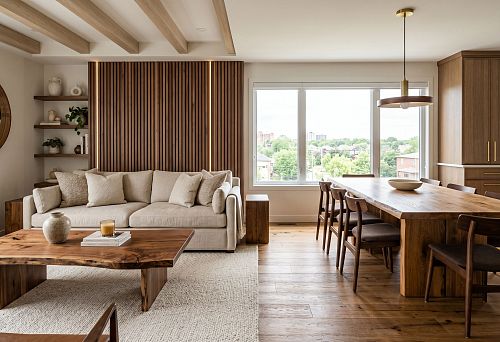
In open-plan layouts where the kitchen is combined with the living room — the kitchen wall is visible from the living room. Here, the slatted panel works as an architectural linking element between the two zones: kitchen functionality and living room comfort. This is the ideal zone fordecorative slatted panelsmade of MDF or wood.
The lower part of the wall under the countertop
Below the countertop is a closed area with limited moisture access. Here, a slatted panel in the lower tier of the wall can be used as a decorative element, forming a transition from the furniture to the wall.
Kitchen ceiling
Batten panels for ceilingsIn the kitchen, it's a more complex topic. With good ventilation and an extractor hood that compensates for grease condensation, a slatted ceiling made of moisture-resistant MDF with a lacquer finish above the dining area is possible. Above the stove, it's only possible with a powerful extractor hood with a grease filter.
Materials for slatted panels in the kitchen: an honest breakdown of each option
Moisture-resistant MDF with lacquer coating
This is the most practical choice for kitchen conditions. Moisture-resistant MDF is produced with the addition of hydrophobic components (paraffin emulsions), reducing water absorption to 8–10% under 24-hour exposure (compared to 30–35% for standard MDF). Density is 780–850 kg/m³.
slatted MDF panelWith a two-component polyurethane lacquer coating (UV-cured), this is a surface with a hardness of 2H–3H on the pencil hardness scale, chemical resistance to household cleaning agents, and easy maintenance: a damp microfiber cloth is sufficient.
Key parameters for the kitchen:
-
Moisture resistance: class not lower than MR (moisture resistant)
-
Coating: two-component polyurethane or melamine lacquer
-
Slat thickness: at least 16–18 mm
-
Emission class: E0 or E1
Solid wood with hard wax oil
Solid wood for the kitchen is suitable for the dining table area and decorative walls outside the zone of direct steam and grease exposure. Oak or ash with hard wax oil provides a surface resistant to moderate moisture exposure, provided stains are removed promptly.
Oil coating penetrates the wood fiber—even if moisture gets in, the wood won't warp instantly. The key condition: moisture must not stand on the surface for more than a few minutes. Wipe it quickly, and the surface stays fine.
Wooden slat panelsOak near the dining table with an oil finish creates an authentic, warm, living backdrop that cannot be replicated with synthetic materials. With regular oil renewal every 1–2 years, durability reaches 20–30 years.
Veneered MDF
A stable base of moisture-resistant MDF carries a natural wood veneer. A compromise between authenticity and practicality: natural wood grain pattern with precise industrial geometry and reduced water absorption of the base. For the kitchen dining area, it offers the optimal balance of characteristics.
Thermowood
After heat treatment at 190–230°C, the wood acquires fundamentally different properties: water absorption decreases by 2–3 times compared to the original, and bio-resistance is maximized. Thermowood for a kitchen slat wall is a material capable of performing in more humid conditions than regular solid wood. A dark, rich tone (from caramel to charcoal) is achieved without additional stain.
What to Avoid in the Kitchen
Standard (non-moisture-resistant) MDF in high-humidity areas swells and loses shape. PVC battens are practical in terms of moisture resistance, but the synthetic nature of the surface looks inorganic in a warm, lively kitchen space; when heated, they emit a specific odor. Laminated battens with LDPE film—under long-term exposure to moisture and temperature, the film peels off from the ends.
Batten Panels for the Kitchen: Style Concepts
The kitchen is a space with character. A batten wall here is not a neutral background but an active participant in the style. Let's consider the main concepts.
Scandinavian Kitchen with Wooden Battens
The most popular trend in modern residential design. White or light gray MDF or veneer battens on the wall behind the dining table. Wooden table, wicker chairs, metal lamps with matte black finish. Backsplash—white metlakh tiles with thin charcoal grout. The battens here are another element of naturalness and material honesty.
Batten parameters: width 40–60 mm, gap 12–15 mm, vertical orientation. Tone—white tint on MDF or ash veneer.
Kitchen in Eco-Style: Natural Wood as a Manifesto
Solid oak with clear oil—honey-amber tone. Wooden batten panels on the dining area wall echo the wooden countertop,wooden floor baseboardand possibly the wooden fronts of the lower cabinets. Green plants in pots, ceramic dishes, linen textiles. A kitchen that 'breathes' natural.
In this styleSlatted wall panel— not an accent, but an organic part of a unified wooden kitchen world. Important: tonal unity. Battens, countertop, floor — in the same tonal range with an acceptable contrast of 1–2 steps.
Modern classic: MDF for painting
Paintable lath panelsmade of moisture-resistant MDF in matte enamel — in the color of the kitchen fronts or in a harmonizing neutral tone. Gray-green, warm beige, dusty blue — a tonal scheme where the battens become part of the kitchen's color concept. Battens with a chamfer — a slight bevel on the edge — add a classic touch without excessive ornamentation.
Loft and industrial style in the kitchen
Dark battens — anthracite, charcoal, dark gray — on the wall behind the dining area. Concrete floor or large-format cement-look tiles. Metal light fixtures with exposed incandescent bulbs. Brick backsplash.
Wooden battens made of thermowood or MDF under anthracite — a brutal, assertive character. This style requires boldness and confidence: there are no half-measures here. Either a completely dark batten wall with proper lighting — or nothing.
Open-plan kitchen-living room: unity through battens
In an open plan, a batten panel serves as an architectural 'translator' between zones. MDF battens on the kitchen wall in the same tone and parameters as the battens in the living room — create a unified visual language for the space. The kitchen and living room cease to be two different rooms and become a single zoned space with internal logic.
Batten panels for the kitchen: parameters that determine the result
The parameters of a slatted kitchen structure are of particular importance—here, every decision carries functional consequences.
Slat width
30–50 mm: frequent rhythm, an 'active' surface. Visually enriches the space in small kitchens. In a long galley kitchen with vertical slats—creates a dynamic rhythm.
50–80 mm: universal range. The wood grain is discernible with veneer or solid wood. The rhythm is pronounced but not aggressive.
80–120 mm: wide slats for spacious kitchens with high ceilings. Each slat is an independent decorative element with a clearly readable texture.
Gap between slats in the kitchen: the practical aspect
In the kitchen, the gap is not only a visual solution but also a practical matter. Dust and grease aerosol settle in the gap. A narrow gap (8–12 mm) is easier to clean; a wide gap (20+ mm) requires regular cleaning inside the gap with special narrow vacuum attachments.
For the kitchen, the recommendation is clear: a gap of no more than 16–18 mm. This is sufficient for an expressive shadow pattern and is easy to keep clean.
Height of the slatted panel in the kitchen
Three main options:
Full height from floor to ceiling. The most expressive result. Suitable for a blank wall in the dining area. Requires moisture-resistant material for the entire height.
Panel scheme: from the floor to a height of 1.0–1.2 m or up to the countertop level. The lower slatted panel is a practical, cleanable zone.
Upper tier: from the countertop level (90–95 cm) to the ceiling. Slats in the area above the work surface, bypassing the backsplash zone. Often used in combination with a tile backsplash: slats frame the tile from above and create a unified vertical composition.
Supporting base: color matters
In the kitchen, the supporting base behind the slats is not a hidden technical element, but a visible detail through the gap. A dark supporting base with light slats provides maximum depth and expressiveness. A base matching the slats creates a monolithic, unified surface with soft segmentation. A contrasting base gives an accent, graphic character.
Lighting for slatted panels in the kitchen: scenarios and solutions
In the kitchen, lighting is not only about design but also function. A slatted wall, with proper lighting, doubles its expressiveness.
Backlighting behind the slats: warm diffused light
LED strip on the supporting base behind the slats — warm light at 2700 K emerges from the gaps and creates soft diffused lighting. In the kitchen dining area, this is a magnificent evening scenario: a meal under soft side lighting that emphasizes the relief of the slatted wall.
Gliding ceiling light
Ceiling spotlights at a 30–45° angle to the slatted wall visually maximize the emphasis on volume. The slats cast pronounced shadows — the wall looks sculptural. With a single, unidirectional spotlight, this solution is beautiful in a living room; for the kitchen, it's better to use two oppositely directed light sources for evenness.
Built-in lighting above the countertop
A slatted structure above the work area can incorporate built-in linear lights into the gaps — illuminating the work surface from beneath the slats. Functionally: eliminates shadows from upper cabinets. Aesthetically: creates a 'glowing rib' effect on the structure.
Combination of slatted panels with kitchen cabinetry
A slatted wall in the kitchen does not exist in isolation — it always interacts with the kitchen cabinetry, backsplash, and floor.
Slats and white cabinetry
White fronts + wooden slats in a warm tone — a classic and foolproof technique. The slats add warmth to a sterile white interior without compromising its lightness.
Slats and dark cabinetry
Anthracite or dark blue fronts + light slats in a milky or beige tone — a striking contrast. The slats 'lift' the dark cabinetry, preventing the space from feeling heavy.
Slats and wooden fronts
The most challenging option to execute. Wood on the fronts + wood on the slats — a risk of 'overloading' with wood if the tones match. The principle: one wood species, but different tones. Light oak on the fronts + oak with a dark stain on the slats. Or vice versa. Tonal contrast connects the materials without creating monotony.
Slatted wall and backsplash
Tile backsplash in the tone of the supporting base behind the slats — a visual connection of two different materials through color. Dark tile backsplash + dark base behind the slats with light slats — a unified vertical tonal axis from the countertop upward.
Practical scenarios: slatted panels in kitchens of different formats
Small kitchen up to 8 m²
The main task is not to make a small space feel smaller. Rules for a small kitchen:
-
Light slats (white, cream, light beige) — reflect light and visually expand
-
Vertical direction — raises the ceiling
-
Narrow gap (10–12 mm) — the surface appears more spacious, doesn't look fragmented
-
Supporting base — slightly darker than the slats, but not contrasting
-
Only one slatted wall — an accent wall, opposite the entrance or behind the dining table
Wall finishing with slatted panelsIn a small kitchen, restraint and calculation are required: one proper slatted wall yields better results than four questionable ones.
Kitchen-living room 20–30 m² with an open layout
Here, slatted panels work as a zoning tool. The wall separating the kitchen and dining areas is slatted. The slats visually mark the boundary without creating a physical barrier.
In an open layoutWall slat panels in interiorset the material tone for the entire space: ash slats in the dining area, the same ash on the ceiling element above the living room sofa area — a unified architectural language across different horizontal levels.
Kitchen with high ceilings (from 3.0 m)
A high ceiling is an architectural gift that requires appropriate finishing. Floor-to-ceiling slats on an accent wall — a monumental vertical. Slats 80–100 mm wide with a 20 mm gap — each slat reads as an architectural element, not an ornament.
Slatted panels for the ceilingabove the dining area of a kitchen with a high ceiling — creating a 'canopy' over the table. A lowered slatted ceiling above the dining group with high main ceilings is a classic architectural zoning technique.
Country house: kitchen with a view of nature
In a country house, the slatted kitchen wall and exterior slatted facade panels can be made from the same material — thermowood or larch with oil. Inside and outside — one material, one rhythm. The boundary between the house and nature becomes porous, blurred — and this is ideal for country-style living.
Installing slatted panels in the kitchen: specifics
installation of slatted panelsIn the kitchen has its own specifics, which is important to consider before starting work.
Moisture protection of ends and joints
All ends of MDF slats are the highest risk area. MDF absorbs water through the end 5–10 times more intensively than through the front surface. Mandatory: sealing all ends with moisture-resistant varnish or silicone sealant at the junction with the backsplash, countertop, and baseboard. An unsealed end in a wet area will deteriorate within 1–2 years.
Ventilation gap
When installing on a frame between the wall and the supporting base of the slatted structure — a ventilation gap of 10–15 mm. Air circulation prevents condensation and mold growth on the back side of the structure.
Fasteners in humid areas
Fastening elements — stainless steel or galvanized. Ordinary black screws in kitchen humidity conditions oxidize — and leave rusty streaks on the MDF surface through cracks in the coating.
How to install slatted panelsIn the kitchen correctly: hidden fastening through stainless steel clips — the front plane of the slat remains clean; all mechanical elements are hidden in the gap and protected from contact with humid air.
Integration of ventilation and electrical
Before installing the slatted structure — complete wiring of hidden electrical (sockets, switches, LED strips, lighting) and ventilation ducts. After installing the slats, access to hidden utilities is impossible without dismantling.
Sockets are moved to the final depth of the structure — socket box extensions of 18–25 mm depending on the thickness of the battens and slats.
DIY Batten Panelsin the kitchen
Self-installation in the kitchen is possible with strict adherence to moisture protection rules. Critical stages for DIY:
-
Moisture-resistant MDF type — check when purchasing, do not make a mistake
-
Sealing all ends — before and after installation
-
Ventilation gap — between the wall and the structure
-
Stainless steel fasteners — without exceptions
Care for slatted panels in the kitchen
The kitchen requires regular care for any surface. Slatted paneling is no exception, but it's not a difficult task either.
Daily or as needed: microfiber cloth along the slats, neutral detergent (pH 6–8). No aggressive chemicals, no abrasive sponges.
Grease film: cloth with a small amount of kitchen surface detergent. For lacquered MDF — any kitchen cleaner without chlorine. For oiled wood — special cleaners based on natural solvents.
Gaps between slats: once a week – vacuum with a soft narrow attachment. Once a month – a damp narrow brush or a special crevice attachment. A 12–16 mm gap is cleaned conveniently; a 20+ mm gap requires a bit more attention.
Coating renewal: MDF lacquer coating – every 5–8 years with intensive use. Wood oil coating – every 1–2 years, apply a thin layer of oil to the cleaned surface.
Prices for slatted panels for the kitchen: range and selection logic
| Segment | Material | Finish | Price (slat + installation) |
|---|---|---|---|
| Base | Moisture-resistant MDF 16 mm | Factory matte enamel | 2200–3500 RUB/m² |
| Medium | Moisture-resistant MDF 18 mm, oak veneer | Oil or varnish | 4500–7000 RUB/m² |
| Premium | Solid oak or thermowood | Hard oil or lacquer | 8000–18000 rub./m² |
| Commercial | Modular MDF system | RAL enamel | 3000–5000 rub./m² |
Important principle: saving on coating quality in the kitchen means paying twice. A 2nd-class lacquer coating will peel off in 3 years under kitchen chemical conditions. A high-quality two-component polyurethane lacquer lasts 10–15 years without renewal.
Slatted panels for the kitchen: comparison with alternatives
| Parameter | MDF slatted panel | Tiles | Wallpaper | Paint |
|---|---|---|---|---|
| Moisture resistance (not an apron) | High (moisture-resistant MDF) | Maximum | Low | Medium |
| Mechanical strength | High | High | Low | Low |
| Visual volume | Maximum (relief) | Moderate | Flat | Flat |
| Ease of cleaning | High | High | Low | Medium |
| Renewability | Repainting without disassembly | Demolition only | Re-gluing | Repainting |
| Service life | 15–30 years | 30+ years | 5–10 years | 5–8 years |
| Acoustics | Absorption | Reflection | Neutral | Reflection |
FAQ: answers to the main questions about slatted panels for the kitchen
Can slatted panels be used in the kitchen?
Yes, in areas away from direct exposure to steam and grease: dining area, decorative wall, side sections of the kitchen. Not recommended for the backsplash area above the stove and sink.
Which slatted panels to choose for the kitchen?
Moisture-resistant MDF with two-component lacquer coating is the most practical choice. Solid oak or ash with hard wax oil — for the dining area with proper care conditions.
How often should gaps between slats be cleaned in the kitchen?
Weekly cleaning with a vacuum cleaner and a narrow nozzle is sufficient. With a 12–15 mm gap and high-quality lacquer coating, grease condensation is easily wiped off with a damp cloth.
Slatted panels in the kitchen — is it fire-safe?
MDF and solid wood are flammable. Slatted panels are not permissible above the stove area due to fire safety considerations. The minimum distance from open flames and heating surfaces is 60–80 cm.
Can an MDF slatted panel in the kitchen be painted a different color?
Yes. Sanding with 180–220 grit, priming, applying a new matte or gloss enamel. Repainting without dismantling is one of the key advantages of MDF over tile.
Are slatted panels in the kitchen an expensive luxury?
Average budget — 4500–7000 rub./m² including installation. An accent wall behind the dining table — 8–12 m² of surface. Total 36,000–84,000 rub. for a result lasting 15–20 years. For comparison: repainting the same wall every 5 years — comparable costs without the architectural result.
Is a special frame needed for slatted panels in the kitchen?
Yes. A wooden frame made of antiseptic-treated 40×50 mm timber or metal profile. Mandatory with a ventilation gap behind the load-bearing base — to prevent condensation.
How to combine slatted panels with a tile backsplash?
The slats are mounted above the level of the top edge of the backsplash. The joint is finished with a metal or wooden molding. Tonal connection: the load-bearing base behind the slats — in the tone of the backsplash grout.
About the company STAVROS
A kitchen where you want to cook and spend time — that's not a design accident. It's the result of the right material choice and professional production. STAVROS creates precisely such solutions.
STAVROS is a Russian manufacturer of wooden architectural elements for interiors with a full production cycle. Precision CNC equipment, strict quality control, a wide range of wood species and finishes. For kitchen spaces in the STAVROS catalog:Slatted wall panelsmade from moisture-resistant MDF and solid oak;MDF Slatted Wall Panelwith lacquer finishes for wet areas;Wooden slat panelsmade from oak and ash with oil finish;slatted modular wall panelfor commercial kitchen spaces;Batten panels for ceilingsabove the dining area;Wooden baseboardmade from solid wood to match slatted panels;Pogonazh iz massiva— moldings, cornices, trims for final framing;Furniture Handlesmade from natural wood in a unified material language with a slatted wall;Classic Furniturefor comprehensive kitchen projects.
STAVROS works with private clients, designers, and developers. Consultation on material selection for a specific kitchen area, finish samples, delivery, and professional support at every stage. A kitchen deserves the best material. Choose STAVROS.