










































































Article Contents:
- Short answer: RPU-005 works better not "on every slat," but as a separate accent in a calm field
- What is RPU-005 and why two sizes solve completely different tasks
- RPU-005 characteristics that need to be checked before the project
- Scheme one: slatted field — smooth insert with one RPU-005 — slatted field
- Scheme two: several smooth strips with small RPU-005
- Scheme three: wide smooth panel inside a slatted wall
- What to put in one cart
- Is RPU-005 a ceiling rosette?
- What sizes does RPU-005 have?
- Which size is better for a slat wall?
- Can the RPU-005 be installed directly on a slat panel?
- Why leave a smooth insert?
- Should the smooth insert match the size of the socket?
- Can multiple smooth inserts be made?
- How many small sockets should be used?
- Can one RPU-005 60 mm be used on a large wall?
- When is it better to choose the RPU-005 160 mm?
- Will a large socket suit a narrow hallway?
- Can two RPU-005 160 mm be placed?
- Can three RPU-005 60 mm be used vertically?
- Is molding needed around a smooth field?
- When is molding useful?
- Can the socket be painted to match the wall color?
- Can the RPU-005 be made contrasting?
- Can the RPU-005 be combined with wooden slat panels?
- What is better for a classic interior — 60 or 160 mm?
- What is better for a modern interior?
- Can the RPU-005 be used on furniture next to a slat wall?
- Can a socket be installed on a door?
- Are smooth fields from floor to ceiling needed?
- Can a square panel be made with RPU-005 160 mm?
- Can small sockets be installed in a horizontal row?
- What glue is needed for RPU-005?
- Can a socket be mounted on an already painted wall?
- What to do if the slat wall is already fully assembled?
- Is it worth dismantling the panels for RPU-005?
- Where to buy RPU-005?
- Where to see other decorative sockets?
- Where to choose slat panels?
- Where to see other polyurethane molding for the wall?
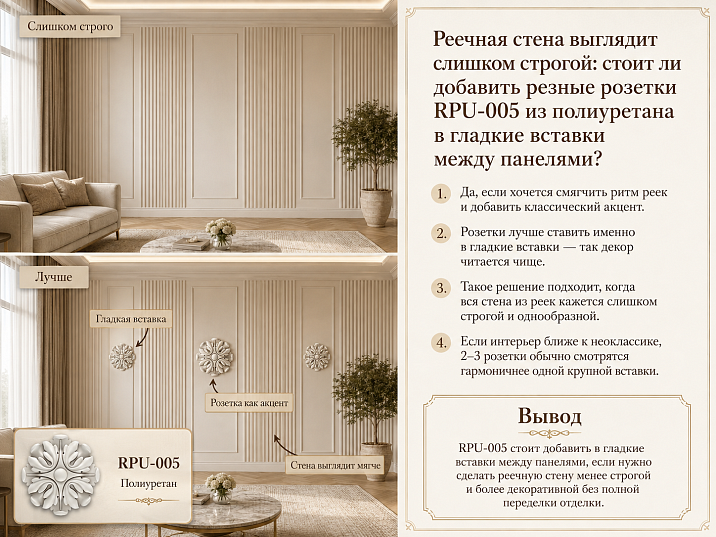
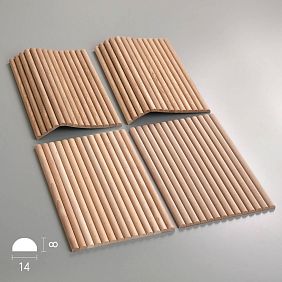
Slatted wall panels for interior finishing they work well where the interior needs a clear vertical rhythm. They assemble a large surface, create a repeating relief, change the light and shadow, and allow moving away from a plain smooth wall. But this advantage has a downside: if the entire surface from edge to edge becomes slatted, the composition can sometimes turn out too strict. There is rhythm, there is texture, but there is no point where the eye wants to linger.
In such a case, it is not necessary to add another panel or complicate the layout of the slats themselves. You can go in the opposite direction: leave small smooth fields between the slatted zones in advance and place carved decorative rosettes RPU-005 made of polyurethane in them.
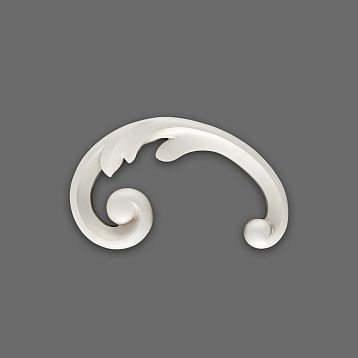
This is a completely different technique. The slats continue to be responsible for the vertical and geometry. The smooth field gives the surface a pause. And RPU-005 becomes a local ornamental accent — small in size 60 × 60 × 12 mm or more noticeable in size 160 × 160 × 30 mm.
That is why the question here does not come down to choosing between “60 or 160 mm.” First, you need to understand whether a slatted wall needs such a pause at all, how many smooth inserts to leave, where they should be located, whether one large rosette will work better than several small ones, and whether the wall will turn from strict to overloaded.
If you answer these questions before buying the panels, RPU-005 can be included in the composition very precisely. If the slatted wall is already assembled, the idea does not necessarily have to be discarded, but first you will have to determine whether there is a suitable smooth surface or whether it makes sense to change only a local section.

Short answer: RPU-005 works better not “on every slat,” but as a separate accent in a calm field
If the slat wall seems too monotonous, the desire to add ornament is understandable. The mistake begins when one tries to mechanically repeat the decorative rosette after each slat.
RPU-005 should not depict another element of the rhythmic grid.
Its task is different.
The rosette can:
-
mark the center of a smooth insert;
-
complete a small decorative panel;
-
connect the slat wall with classic furniture;
-
make the transition between two textured areas calmer;
-
create a separate point in the console area;
-
work in pairs on both sides of the compositional axis;
-
form a neat repeat of small rosettes 60 mm.
Therefore, the most predictable scheme looks like this:
slat field → smooth insert → RPU-005 → smooth insert or next slat field.
That is, the rosette does not directly compete with the frequent vertical texture, but gets its own background.
This is especially important for the 160 × 160 × 30 mm variant. Such an RPU-005 is perceived not as a small detail, but as a full-fledged decorative medallion.




What is RPU-005 and why two sizes solve completely different tasks
Carved decorative rosette RPU-005 is available in two sizes:
-
60 × 60 × 12 mm;
-
160 × 160 × 30 mm.
The material of both versions is polyurethane.
On paper, it seems the difference is only in scale. On the wall, they are two completely different tools.
The 60-millimeter socket is small.
It works at close range.
It can be used as:
-
a rhythmic point;
-
a small center for a frame;
-
an accent in a narrow smooth strip;
-
a repeating element;
-
a small furniture or door detail.
The 160-millimeter version is 2.67 times larger in width and height. The area of its front field increases even more relative to the smaller variant.
This is already a real medallion.
It can hold:
-
a separate wall panel;
-
a central field above the console;
-
a composition between two slatted zones;
-
a large frame;
-
a furniture facade;
-
a door decorative field.
And the depth also changes: 12 mm versus 30 mm.
Therefore, the 160-millimeter RPU-005 interacts with light much more actively and protrudes noticeably above the base.
Our factory also produces:



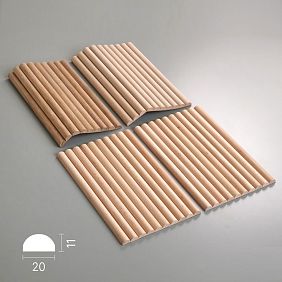
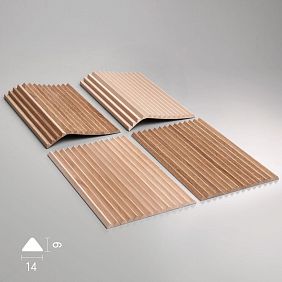
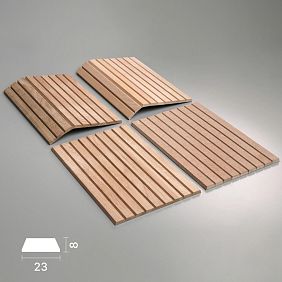
RPU-005 characteristics to check before the project
| Parameter | Small variant | Large variant | What this changes |
|---|---|---|---|
| Product type | Carved decorative rosette | Carved decorative rosette | both belong to the same model |
| Article number | RPU-005 | RPU-005 | size is selected in the product card |
| Material | Polyurethane | Polyurethane | one product group |
| Width | 60 мм | 160 мм | the small one works as a dot, the large one as a medallion |
| Height | 60 мм | 160 мм | affects the size of the smooth field |
| Thickness | 12 мм | 30 мм | the large version is noticeably more voluminous |
| Main role in this article | Rhythmic accent | Compositional center | should be chosen based on the task, not just the wall area |
| Product card | buy RPU-005 socket 60 × 60 mm | order decorative rosette RPU-005 made of polyurethane | before ordering, the selected modification is verified |
After this table, it becomes clear why the topic should not be reduced to the phrase "for a small wall take 60 mm, for a large one — 160 mm."
A huge slatted area is possible, where several small RPU-005 work better.
And vice versa: on a relatively compact wall, one large rosette can become an ideal center.
Not just the size of the room is chosen.
The role of the element is chosen.
Get Consultation
Why a fully slatted surface sometimes starts to seem too strict
The slat is built on repetition.
One line.
Next.
Another one.
Same step.
Same direction.
On a small area, such a system is perceived expressively.
On a large wall, the rhythm gradually turns into a background.
This is not a drawback of the panels. This is a property of a repeating pattern.
If the interior is built in a minimalist logic, such a background may be exactly what is needed.
But if nearby there are:
-
a classic console;
-
framed furniture facades;
-
mirror of complex shape;
-
upholstered furniture with a plastic silhouette;
-
cornice;
-
decorative handles;
-
carved wooden decor,
a strict slatted wall sometimes turns out to be too rational for the rest of the space.
Adding even more slats is pointless.
A different scale needs to be introduced.
The RPU-005 rosette does this very economically: instead of a new large texture, a small or medium ornamental center appears.
A smooth insert is not an empty space that was forgotten to be covered with panels
This is a fundamental point.
If a person plans in advance wall finishing with slatted panels, psychologically they want to fill the entire area with the chosen material.
Leaving a piece of smooth wall seems like a loss.
In fact, it is the empty plane that sometimes makes the composition more expensive and complex.
Rhythm becomes noticeable only next to a pause.
If the slats run without stopping, they gradually turn into an ordinary background.
When after 500–800 mm of relief a smooth vertical strip appears, the eye notices the boundary of textures again.
And if inside a calm field there is an RPU-005, the pause turns into a deliberate decorative block.
Therefore, a smooth insert is not the absence of finishing.
It is a separate compositional material, even if it is made from the same wall and painted in the same color.
What happens if you place RPU-005 directly on frequent slats
Visually, this can be imagined.
Vertical lines run under a round or ornamental shape. The rosette creates a different relief on top of the existing one.
But two problems immediately arise.
The first is technical.
The slatted surface is not a continuous smooth plane. Which part of the back side of RPU-005 actually contacts the protruding areas depends on the profile of the specific panel.
The second is visual.
The ornament of a small 60 mm rosette is easy to lose on a frequent texture. Even a 160 mm medallion can be perceived worse if vertical lines actively pass through its pattern.
Therefore, the idea of the article is built not around "gluing a rosette on top of slats," but around a more manageable technique — creating a separate smooth field for it.
60 mm: a small rosette should work with rhythm, not scale
The size 60 × 60 × 12 mm is interesting to apply in a series.
One small RPU-005 on a huge wall is easy to lose.
But several identical points can continue the idea of repetition, but in a completely different way.
Slats give a linear rhythm.
Sockets give a point rhythm.
For example, you can make three narrow smooth vertical fields and place one small RPU-005 in each.
Or one wide smooth strip, inside which small sockets are arranged vertically.
Or repeat the decorative element on several furniture facades next to the slatted wall.
But the repetition should be limited.
Five or six sockets sometimes look like a system.
Twenty can already turn the surface into an ornamental grid, which is a completely different design task.
160 mm: not a dot, but a full-fledged wall medallion
The 160 × 160 × 30 mm version is perceived differently.
It doesn't need to be multiplied to be noticeable.
One large RPU-005 can work:
-
above the console;
-
in the center of a smooth panel;
-
between two vertical slatted sections;
-
above the door frame;
-
in a furniture composition;
-
on the central axis of the hallway;
-
in the decorative field next to the mirror.
The 30 mm thickness enhances the effect.
With side lighting, large relief creates noticeable chiaroscuro.
Therefore, the background around such a rosette is best left fairly calm.
If you place many other ornamental elements nearby, the main value of the 160-mm version—its ability to be an independent center—disappears.
What smooth insert is needed for RPU-005 60 mm
If the small rosette is 60 × 60 mm, it does not mean that a smooth square area of 60 × 60 mm is sufficient.
The element requires surrounding space.
Imagine a vertical strip 200 mm wide.
RPU-005 occupies only 60 mm of it.
There remains 70 mm on each side with central placement.
The rosette reads calmly.
Now let's reduce the field to 100 mm.
Only 20 mm remains on each side.
The composition becomes much denser.
Both options are physically possible, but the visual character differs radically.
Therefore, the size of the smooth insert is determined not only by the decor's dimensions, but also by the desired "density" of the wall.
What field is needed for RPU-005 160 mm
With the large version, the principle is the same, but the error is more noticeable.
A field width of 200 mm will leave only 20 mm around the socket.
The medallion will almost fill the entire smooth insert.
With a width of 300 mm, 70 mm remains on each side.
At 400 mm — 120 mm each.
The wider the smooth zone, the more the RPU-005 is perceived as a precious standalone object rather than a detail sandwiched between slats.
But you cannot mechanically strive for maximum indents.
If the entire wall is small, an overly wide smooth insert will destroy the very idea of slat cladding.
You need to find a proportion between the two surfaces.
Three main wall layouts
Layout one: slat field — smooth insert with one RPU-005 — slat field
The clearest option.
It is especially good for a large 160 mm outlet.
The smooth central strip becomes the axis.
The slat panels are positioned symmetrically on the sides.
In the center — a decorative medallion.
This scheme works well:
-
behind the console;
-
in the hallway;
-
in the bedroom;
-
in a small hallway;
-
on the wall between two doors.
Scheme two: several smooth strips with small RPU-005
Here, a size of 60 mm is used.
For example:
slat zone;
narrow smooth strip with RPU-005;
slat zone;
another smooth strip;
slats again.
This creates a complex vertical rhythm.
The main thing is not to make too many smooth strips.
Scheme three: a wide smooth panel inside a slatted wall
The slats surround a large rectangle.
Inside you can place:
-
one RPU-005 160 mm;
-
a pair;
-
several small 60-millimeter sockets;
-
socket and molding frame.
This is the most "architectural" scheme.
One large or several small: comparing not millimeters, but the character of the wall
| Solution | What it provides | When especially appropriate | Main risk |
|---|---|---|---|
| One RPU-005 60 mm | small point | narrow panel, furniture, compact zone | Will get lost on a large wall |
| Several RPU-005 60 mm | rhythmic repetition | series of smooth inserts | too many will create fragmentation |
| One RPU-005 160 mm | pronounced medallion | center of the wall, console, panel | may be too active in a small field |
| Two RPU-005 160 mm | Symmetrical pair | two identical zones | requires very precise geometry |
| 160 mm + molding frame | finished classical center | neoclassical wall | risk of overloading the relief |
| Only slats | Pure geometry | Minimalism, modern interior | may seem too monotonous |
| Only a smooth field without a socket | calm pause | when the texture has enough contrast | decorative accent is absent |
This table shows: "more" does not mean "better."
Sometimes one RPU-005 160 mm can do more than eight small ones.
Sometimes it's the opposite — a large medallion will be too literal, while three small dots add exactly as much classical plasticity as needed.
Why you shouldn't place a small RPU-005 in the center of a huge smooth field
Imagine a smooth insert 800 mm wide and two meters high.
In the very center — a 60 × 60 mm socket.
From a great distance, it almost disappears.
It feels as if the element was chosen at the wrong scale.
This is an important rule: the size of the decorative field and the size of the decor must have a clear relationship.
If the field is huge, you can:
-
use RPU-005 160 mm;
-
reduce the field itself;
-
add a frame;
-
make a series of small elements;
-
choose a different type of stucco decor.
You shouldn't expect a 60-millimeter rosette to perform a task for which it is physically too small.
Why the large RPU-005 should not fill a smooth insert almost entirely
The reverse mistake is also common.
Field 180 × 180 mm.
Rosette 160 × 160 mm.
10 mm remains on each side.
Technically, everything fits.
Visually, the medallion is squeezed.
Especially if protruding slats start right next to it.
It's better to give the ornament a little "breathing room."
There is no universal margin size that fits all walls, so the exact spacing needs to be checked with a mockup.
You should start the project not with the outlet, but with large zones.
The design order greatly affects the result.
Bad sequence:
-
liked the RPU-005;
-
buy it;
-
then look for a place;
-
cut the slat layout for decor.
More professional:
-
we measure the wall;
-
place furniture;
-
we define the slat zones;
-
highlight smooth fields;
-
choose the role of the decorative rosette;
-
we compare 60 and 160 mm;
-
after that we order the items.
Thus, RPU-005 becomes part of the wall's architecture, not an addition to the existing texture.
First furniture, then slats, then outlets.
This rule is especially useful for the living room and bedroom.
Why can't you start with just the wall?
Because after installing furniture, the visual center of the room changes.
The console sets its own axis.
The bed sets its own.
The sofa sets its own.
The TV sets its own.
If a smooth field with RPU-005 is in the geometric center of the wall, but the furniture is shifted by 400 mm, the composition may look wrong.
Therefore, the center of the decorative field is more often tied to a functional object rather than to the mathematical center of the room.
Console zone: one of the best scenarios for RPU-005 160 mm
Imagine a wall in a hallway or living room.
At the bottom, there is a console.
On the sides, there are vertical decorative slatted wall panels.
In the center, a smooth vertical strip remains.
At the top — RPU-005 160 × 160 mm.
Why does this work?
The console provides horizontal support.
The slats create a vertical rhythm.
The outlet forms a compact ornamental center.
The three elements perform different functions and do not directly compete.
If you add a mirror, you need to decide what becomes the main focus — the mirror or the RPU-005.
It is not necessary to use both accents simultaneously.
Entryway: a small socket can turn out to be stronger than a large one
The entryway is often narrow.
Here, the 160-millimeter RPU-005 can end up too close to the viewer.
A person walks literally a meter from the wall.
The large relief becomes active.
In a narrow smooth insert, the 60 mm version sometimes works better.
Especially if you repeat it:
-
on two symmetrical panels;
-
over two identical furniture facades;
-
on several doors.
In the hallway, scale is judged not by a photo from the other end of the room, but from the actual walking distance.
Living room: one large RPU-005 is better than a dozen small details
A large living room allows the 160 mm size to be used more freely.
For example, the wall behind a console 3–4 meters wide.
Slat fields are located on the sides.
The center is smooth.
One large RPU-005 works almost like decorative print.
If you add many small elements, the wall may lose scale.
For a spacious room, it is often more advantageous to increase the size of one accent than to increase the number of details.
The wall behind the sofa: the outlet should be tied to the composition, not hanging randomly above the furniture.
The sofa forms a long horizontal line.
Behind it are vertical slats.
A smooth insert can be located:
-
strictly in the center of the sofa;
-
between two slatted panels;
-
in the side part of an asymmetric composition.
RPU-005 160 mm works well in the center of a small smooth field.
Several RPU-005 60 mm can form a horizontal row, but here it is easy to return to excessive regularity.
If the slats already produce frequent repetition, an additional horizontal row of dots may be redundant.
Therefore, it's better to start with a single element.
Bedroom: a smooth field helps avoid overloading the wall behind the headboard
The wall behind the bed almost always contains a lot of visual information.
Available:
-
the headboard itself;
-
nightstands;
-
wall sconce;
-
textile;
-
possibly, moldings;
-
slats.
If you also place RPU-005 directly on the slatted relief, textures start to layer.
A calmer option:
slatted zone on the left;
smooth central part;
slat zone on the right.
In the center, you can place one RPU-005 160 mm or a pair of small 60-millimeter sockets.
This way, the bedroom retains its decorative appeal but does not turn into a collection of reliefs.
In the bed area, one large socket does not necessarily have to be located above the very middle of the headboard
Symmetry is a good tool, but not an obligation.
If the interior is modern and asymmetrical, the smooth field can be shifted.
For example:
on the left, a wide slatted zone;
on the right, a narrow one;
between them a vertical smooth panel with RPU-005.
The main thing is that the offset is supported by furniture, light, or other architecture.
Random asymmetry looks like a mistake.
Deliberate — like a project.
TV zone: RPU-005 must be used with particular caution.
The TV is a large black rectangle.
A carved polyurethane rosette is a small ornamental medallion.
They belong to different visual languages.
This does not prohibit the combination, but requires a clear role.
RPU-005 can:
-
be located in a separate side smooth field;
-
be part of the decorative composition of the console;
-
be used on the adjacent wall panel.
An attempt to place an outlet right next to the screen just to fill the empty space looks worse.
In the TV zone, empty space is often more useful than extra decor.
A small wall section: it is not necessary to completely cover it with slats
Let's imagine a wall section 700 mm wide.
You can cover it with slatted wall panels for interior wall finishing completely.
But you can do it differently.
On the edges — two narrow slat strips.
In the center — a smooth field.
In it — RPU-005 160 mm.
This will result in a vertical decorative panel.
In terms of materials, it is more complex than just slats, but significantly more interesting compositionally.
Long corridor: small RPU-005 can create stopping points
In a long corridor, a continuous slat wall enhances the perspective.
Sometimes too much.
The rhythm leads the eye into the distance.
Small smooth inserts with RPU-005 60 mm can break this perspective into several stages.
But here, quantity matters.
If an insert appears every 500 mm, the wall becomes restless.
If two or three points are distributed across key areas — near the mirror, console, or door group — the composition is perceived as meaningful.
Study: a single outlet can connect a modern wall with classic furniture
The study is an interesting environment for such a blend.
For example:
modern dark slats;
classic writing desk;
leather armchair;
restrained polyurethane decor.
A smooth insert with RPU-005 creates a transition between two styles.
In this case, it is better not to make the rosette contrastingly bright.
The ornament can be revealed with chiaroscuro and a close color.
Thus, it does not turn into a historical quote but works as an architectural detail.
Commercial interior: repeating small rosettes requires discipline
In a salon, restaurant, hotel, or showroom, several identical smooth inserts can be used.
For example, on a long wall:
slat field;
RPU-005;
slat field;
RPU-005;
slat field.
On a large area, repetition looks more convincing than in a small room.
But any mismatch in height becomes noticeable.
If the project involves several identical zones, first assemble one standard module:
-
width of the slat field;
-
width of the smooth insert;
-
height of the center RPU-005;
-
distances to the floor and ceiling.
After that, repeat the system.
Two RPU-005 160 mm: when symmetry is truly justified
Two large medallions can work on a wall if they have two equal zones.
For example:
-
two wall sections;
-
two doors;
-
two identical niches;
-
two furniture blocks;
-
two smooth panels on the sides of the central mirror.
If both outlets are located next to each other on one small field, the question arises: why are there two of them?
There is no need to create pairing just because two items look "richer" than one.
Symmetry should reflect the architecture.
Three small RPU-005: how not to turn a wall into buttons
Three elements of 60 mm can be placed vertically in a narrow smooth insert.
For example:
upper;
central;
lower.
This creates an interesting alternative to one large medallion.
But you need to choose the distance correctly.
If the rosettes are placed too close together, they merge into a single ornamental column.
If too far apart, they start to seem like random dots.
It's better to check the gap sizes on a full-size template.
Four small rosettes: square composition
In a wide smooth field, four RPU-005 60 mm rosettes can be arranged in a square.
This technique is already closer to a decorative panel.
It makes sense if there is a frame or other base around it that unites the four points.
Without a unifying structure, they may look like four randomly glued elements.
That is, as the number of small rosettes increases, the need for a system grows.
There is no need to repeat RPU-005 with the same spacing as the battens.
This is a very important mistake.
If vertical battens run at a certain spacing, there is a temptation to subordinate the decorative rosettes to it.
But then RPU-005 ceases to be a contrast and becomes just another element of the same grid.
It is much more interesting to work with a different scale.
Battens are a frequent rhythm.
Smooth inserts are a rare one.
Sockets are even rarer points.
Thus, the wall gains several levels of perception.
Color: the calmest option is to unify the wall and RPU-005
If slat panels for painting and a smooth surface are finished in one color, RPU-005 can also be made monochrome.
Then the design is built almost entirely on depth.
A smooth wall reflects light evenly.
Slats create frequent vertical shadows.
RPU-005 — local complex chiaroscuro.
The color is one in this case.
This option suits those who fear that carved decor will make the wall too classical.
Contrast socket: small size can become much more active
RPU-005 60 mm seems small.
But make it golden on a dark wall — and the visual role will change dramatically.
The same goes for a black socket on a light background.
Contrast increases the significance of an element.
Therefore, small size does not automatically mean a calm effect.
If a strong color contrast is planned, first make a mockup.
Sometimes 60 mm is more than enough.
Large RPU-005 in the color of the slats, but on a smooth field
A very interesting technique.
The rails and the rosette have the same color.
The background of the smooth insert is different.
In this case, RPU-005 visually belongs to the slatted part of the wall, although it is physically located on a calm surface.
This results in a connection without direct overlap of the two reliefs.
This works especially well if the rails have a painted, rather than a pronounced wood surface.
Wooden slatted surface and polyurethane socket: do not try to make them identical at all costs
If the panels retain a natural wood texture, there is no need to imitate it on the polyurethane socket at any price.
It is much more honest sometimes to make RPU-005 part of a smooth painted area.
Then the materials exist in their roles:
wood or wood texture — as a linear background;
polyurethane — like molded ornament.
This can look more convincing than an attempt to visually dissolve the difference in materials.
Light can make RPU-005 twice as noticeable
Especially the 160 × 160 × 30 mm variant.
30 mm of relief means noticeable depth.
With side lighting, one part of the ornament is illuminated, the other goes into shadow.
Therefore, before making a final decision, you need to look at the direction of light:
-
where the window is;
-
where the sconce is;
-
whether there is a track;
-
where the evening light comes from.
If a smooth insert is located next to a side light source, a large socket can become one of the most expressive objects on the wall.
If the light is strictly frontal and diffused, the relief will be calmer.
Do not place RPU-005 randomly next to a switch
A small socket in scale is sometimes close to an electrical frame.
If the RPU-005 60 mm and the switch are nearby, the viewer may perceive them as two equal small objects.
This creates visual confusion.
It is better to either increase the distance or tie the socket to a different axis.
The same applies to a thermostat, sensor, or small wall control panel.
A socket above a console and a switch on the side is a normal composition if the axes are different.
There is no need to strive to remove all technical elements from the wall.
The main thing is that they do not participate in the same decorative grid randomly.
RPU-005 can be strictly in the center of the console.
The switch is near the doorway.
Then the eye understands the roles.
Should the smooth field be framed with a molding?
Not necessarily.
Sometimes a direct transition:
slats → smooth surface
looks modern and clean.
But if the interior is closer to neoclassicism, a frame can help.
To do this, you can look at Moldings made of polyurethane.
A thin profile can:
-
emphasize a smooth insert;
-
separate it from the slat relief;
-
combine RPU-005 with classic wall architecture.
But if the socket itself is small, 60 mm, a too massive molding can completely overwhelm it.
Frame plus RPU-005 160 mm — already a full-fledged wall panel
Let's imagine a rectangular molding frame 800 mm high and 500 mm wide.
In the center — RPU-005 160 mm.
On the sides — slat panels.
This is no longer just a "rosette between slats."
This is a full-fledged decorative wall system.
This is where a general catalog is useful, where you can You can buy ready-made stucco matching the Baroque style. Calculate the quantity: linear meters of cornices and moldings, number of rosettes, pilasters, consoles, corner elements. Add a ten to fifteen percent allowance for trimming. and select elements of one composition.
But you need to increase the amount of molding carefully.
If there is an active frame, a large rosette, and active slats, a fourth type of relief will almost certainly be superfluous.
Slat panels for painting provide the most flexible base for a mixed wall
If panels intended for subsequent painting are chosen, it becomes possible to visually combine smooth and slatted zones.
You can create:
-
everything in one color;
-
slats darker;
-
smooth inserts darker;
-
sockets contrasting;
-
only RPU-005 in a different tone.
This is a convenient tool.
But the color should be chosen after the geometry.
A very beautiful palette won't save the wrong size of smooth inserts.
If the panels are already purchased, smooth fields can still be included in the layout
Purchasing material doesn't mean that the entire volume needs to be installed consecutively.
Lay out the wall on paper.
Determine:
-
panel width;
-
number of modules;
-
position of the smooth insert;
-
position of RPU-005.
Perhaps some panels simply won't be needed in the central section.
It's much easier to change the layout before installation than after.
If the slat wall is already fully installed
Then first you need to decide how much you really lack an ornamental accent.
Don't start with dismantling.
Make a paper mockup of RPU-005.
For the small variant — 60 × 60 mm.
For the large one — 160 × 160 mm.
Hold it against the wall at the intended location.
If the element is barely readable on a textured background, that's an argument for a smooth insert.
If it looks interesting, you can further assess the technical feasibility of placement.
Can the smooth insert be left only partially?
Yes.
It doesn't have to go from floor to ceiling.
For example, you can make a smooth rectangular panel inside a solid slat wall.
Inside it — RPU-005.
That is, the slats run around:
from the left;
on the right;
from the top;
from the bottom.
The effect of an inserted picture is achieved.
This scheme is more complex in terms of joints, but can be much more interesting than a vertical smooth strip.
Square insert for RPU-005 160 mm
Since the large socket itself is close to a square format of 160 × 160 mm, a square field naturally suits it.
For example:
300 × 300 mm;
400 × 400 mm;
500 × 500 mm.
These are not mandatory standard sizes, but options for visual fitting.
Each gives a different amount of free space around.
A square field works especially well as a single medallion among vertical slats.
Vertical insert for several RPU-005 60 mm
For small sockets, an elongated strip makes more sense.
For example, a narrow vertical zone one to two meters high.
Inside, there are two or three decorative centers.
This way, the rhythm of small dots becomes independent.
But the quantity needs to be limited.
The more sockets there are, the less each one is perceived as a separate ornament.
Horizontal insert: a rarer but interesting scenario
The slat wall is vertical.
If you make a horizontal smooth strip across it and place several RPU-005 60 mm in it, a strong contrast of directions emerges.
This option can be attached:
-
to the console height;
-
to the top line of the sofa;
-
to the door panels;
-
to a wall panel of a different type.
But a horizontal strip visually reduces the wall height more than a vertical insert.
Therefore, with a low ceiling, it needs to be handled more carefully.
Do not turn RPU-005 into a replacement for a furniture handle without a separate task
Since the small socket has a size of 60 mm, it is easy to imagine it on the facade next to a handle.
But a decorative socket and furniture hardware perform different functions.
If RPU-005 is used on furniture, not needed
What to put in one basket
| What to look at | Role in the project | When needed | What to look at |
| RPU-005 | Decorative center | Always | size 60 or 160 mm |
| Decorative polyurethane rosettes | comparison of neighboring models | if RPU-005 does not match the scale | size and pattern |
| Rafter panels | main texture area | if the wall is still being designed | panel type, dimensions, finish |
| Moldings made of polyurethane | framing of smooth fields | if a transition between textures is needed | width and profile |
| Polyurethane moldings | additional composition elements | for a complex wall | not to overload the relief |
| Mounting and finishing materials | installation preparation | after choosing the base | compatibility of the specific composition |
The kit must be assembled in this exact order.
First, geometry.
Then the decorative element.
Then additional items.
Installing a smooth insert is easier to control than installing on a slatted relief.
This is one of the practical reasons to leave a smooth field.
You have a single plane.
The center of RPU-005 is easy to mark.
You can check the horizontal and vertical relative to the edges of the insert.
Contact with the base is clearer.
However, the selected mounting material must still match the specific surface and instructions.
You cannot assume that any adhesive automatically suits any paint, MDF, plaster, or other base.
To choose, you should open Mounting and finishing materials and check the specific composition.
The large RPU-005 is better to mark along two axes
For the 160-millimeter version, it is not enough to put a pencil dot "approximately here."
Mark:
- the vertical axis of the smooth insert;
- the horizontal axis of the socket.
The intersection point is the center.
Then check the four extreme points:
from the left;
on the right;
from the top;
from the bottom.
This is especially important if vertical slats are nearby: they immediately show any displacement.
The small RPU-005 in a series needs to be marked all at once
If three 60 mm sockets are used, you cannot install the first one and place the next two "by eye."
Apply immediately:
- common axis;
- center of each socket;
- distances between them.
Even a difference of a few millimeters in a regular series can be more noticeable than a similar deviation of a single element.
When repeating on several smooth surfaces, use one template
Suppose the wall has four identical inserts.
Make a position template RPU-005.
Transfer it to each one.
This way all medallions will be:
- at the same height;
- at an equal distance from the edges;
- in the same system.
This is especially useful for commercial interiors and long walls.
Mistake #1: placing a socket in every free gap
A decorative element doesn't have to fill the emptiness.
An empty field is also part of the composition.
If there are five smooth strips between panels, it doesn't mean you need five RPU-005.
Sometimes one central one is enough.
Mistake #2: choosing 60 mm just because a small socket is "safer"
A too-small element on a large wall can look random.
Safer doesn't always mean smaller.
Sometimes a large 160mm RPU-005 makes the composition calmer because it replaces many small details with a single center.
Mistake #3: using 160mm in a too narrow field
If the ornament almost touches the battens, it looks cramped.
Make a template and compare several insert sizes.
Mistake #4: placing a rosette directly on an active batten texture without a visual try-on
The ornament can simply get lost.
This is especially relevant for 60mm.
Mistake #5: designing smooth fields without furniture
After installing a wardrobe or sofa, part of the composition may be hidden.
Mistake #6: using many slats, many moldings, and many rosettes at the same time
Each type of relief requires space.
If everything works at the same time, the eye stops understanding the hierarchy.
Mistake #7: mechanically repeating small RPU-005 at equal short intervals
The wall starts to look like a decorative grid.
If that wasn't the goal, reduce the quantity.
Mistake #8: making all inserts identical just for the sake of symmetry
Sometimes it makes sense to make the central field wider than the side ones.
Symmetry of elements does not always mean the same width for all zones.
Mistake #9: first ordering panels for the entire wall, then remembering about smooth inserts
If the idea for RPU-005 already exists, incorporate it into the layout in advance.
Mistake #10: perceive the smooth field as savings on panels
This is the wrong motivation.
A smooth insert is needed for the composition.
If it appears only to reduce the amount of material, the size may turn out to be random.
Mistake #11: forget about the 30 mm thickness of the large variant
RPU-005 160 mm protrudes noticeably.
Next to a thin frame, mirror, or furniture facade, this must be taken into account.
Mistake #12: use a socket where the interior actually needs a simple pause
Sometimes the solution is simpler.
It is enough to leave a smooth insert without molding.
Not every break in a slatted surface needs to be decorated.
Who the RPU-005 idea between slatted panels suits
It is especially interesting if:
- the slatted wall seems too modern for the rest of the interior;
- separate classic accents are needed, but not continuous molding;
- there is already framed furniture;
- you want to combine geometry and ornament;
- the project allows smooth inserts;
- one central decorative zone is needed;
- the slatted surface occupies a large area;
- we want to add a rhythm of a different scale;
- a monochrome complex wall is planned.
Who is better off leaving only slats
Do not add RPU-005 if:
- the interior is deliberately minimalist;
- the slatted wall is small and already expressive;
- there are many other decorative elements nearby;
- there is no logical place for a smooth insert;
- the furniture has a very active texture;
- we want exclusively linear geometry;
- smooth fields break the wall into too small parts.
Who will suit only one RPU-005 160 mm
This solution is especially good for:
- central console zone;
- one large smooth panel;
- wall between two symmetrical slatted sections;
- large furniture composition;
- a decorative medallion in the hallway.
Who will suit several RPU-005 60 mm
Small size is good if:
- rhythmic points are needed;
- smooth inserts are narrow;
- walls are several and the motif needs to be repeated;
- one large medallion seems too classic;
- the decor should reveal itself up close.
Practical example: a 3000 mm wall with one central RPU-005
Suppose the wall width is 3000 mm.
We want to make a central smooth insert of 500 mm.
Remaining for slats:
3000 − 500 = 2500 mm.
With symmetry:
1250 mm of rack zone on the left;
1250 mm on the right.
In the center of the field, 500 mm, we place RPU-005 160 mm.
A significant smooth space remains around.
The result is a clear scheme:
1250 mm of rails → 500 mm of smooth field → 1250 mm of rails.
For a large room, this can be a very clean solution.
The same wall with a small RPU-005
If you place a 60 mm socket in the same 500 mm, it becomes significantly less noticeable.
To restore the scale, you can:
- reduce the smooth insert;
- use three small elements;
- add a thin frame;
- leave one small one as a deliberately delicate accent.
That is, the product size affects the architecture of the entire area.
Practical example: three smooth fields
Wall 3600 mm.
Instead of one center, we make three narrow inserts of 200 mm each.
Between them and along the edges are slatted sections.
Each insert has one RPU-005 60 mm.
This option creates:
- a large rhythm of panels;
- a medium rhythm of smooth strips;
- a small rhythm of sockets.
It is more complex, but can work well on a long wall.
The main thing is not to add several more types of decor on top of this.
Practical example: two large sockets on the sides of the mirror
The center of the wall is occupied by a mirror.
On both sides are smooth panels.
In each RPU-005 160 mm.
Further — slatted fields.
This results in a five-part composition:
slats;
medallion;
mirror;
medallion;
slats.
For a classic or neoclassical living room, the scheme can be very expressive.
But a significant wall width is required.
Practical example: small hallway
Wall 1200 mm.
It is not worth covering it with many sections.
You can create:
800–900 mm of slatted zone;
the remaining part — smooth;
in it one RPU-005 60 mm.
An asymmetric composition is visually lighter than three or four narrow vertical strips.
Practical example: panel above the dresser
Dresser width 1400 mm.
On the wall behind it — slatted panels.
In the center, a smooth rectangle is left.
In it one RPU-005 160 mm.
As a result, the outlet refers not to the entire wall, but specifically to the furniture group.
This is an important principle: decor can have a local owner.
It is not necessary to tie it to every square meter of the finish.
Practical example: two doors and a slatted wall between them
Between the doors there is a wide slatted zone.
On the walls themselves nearby, small smooth fields remain.
In each one, you can repeat RPU-005 60 mm.
The outlet becomes a unifying motif, while the central slatted surface remains strict.
That is, the decorative element does not necessarily have to be physically inserted inside the panels. Sometimes it is better to place it nearby.
How to understand that the wall is already overloaded
Move to the entrance of the room.
Try to name the main element of the wall within three seconds.
If you can't, and your gaze jumps between:
- slats;
- sockets;
- moldings;
- mirror;
- wall lamp;
- furniture;
it means there are too many objects or they compete.
A good complex wall doesn't have to be simple, but it must have a hierarchy.
For example:
the main object is a mirror;
slat panels are the background;
RPU-005 is a small support.
Or:
the main object is RPU-005 160 mm;
a smooth insert is the field;
slats are the framing.
If all three claim first place, the composition becomes heavy.
What is better: to buy more slat panels or add RPU-005
The answer depends on what exactly is missing.
If the slat zone is too narrow and visually gets lost, additional panels are needed.
If the area itself is sufficient, but the rhythm is too monotonous — a new panel will only continue the same logic.
Then RPU-005 provides a different quality.
Therefore, before buy slat panels for walls for interior finishing beyond the initial calculation, look at the wall as a composition.
Perhaps it doesn't need more slats.
It needs a pause.
How to buy RPU-005 without size errors
The first step is to open the RPU-005 card.
The second is to choose 60 or 160 mm.
The third is to make a template.
Fourth — check the template inside the smooth field.
Fifth — only after this determine the quantity.
If no option fits, it's better to open the entire section and choose decorative polyurethane rosettes, than to change the wall architecture for the sake of one model.
What to check before ordering panels
If the wall is only planned, note:
- total width;
- furniture placement;
- width of each slat field;
- width of smooth inserts;
- size of RPU-005;
- height of the socket center;
- color;
- need for a molding frame;
- electrical layout;
- type of panels.
After that, you can place the order.
What to check before ordering RPU-005
If panels are already selected:
- which socket size is suitable;
- how many smooth fields;
- how many elements are required;
- is there space in depth;
- does the socket conflict with the switch;
- what will the relief look like in evening lighting;
- is the base suitable for installation;
- is an additional profile needed.
FAQ: RPU-005 in composition with slatted panels
Is RPU-005 a ceiling rosette?
RPU-005 is considered a decorative carved polyurethane rosette that can be used not only on the ceiling. The model card allows application on walls, furniture, doors, and other interior surfaces.
What sizes are available for RPU-005?
Two: 60 × 60 × 12 mm and 160 × 160 × 30 mm.
Which size is better for a slat wall?
For small rhythmic accents, 60 mm is more interesting. For a separate central medallion, 160 mm is better. The final choice depends on the size of the smooth field and the entire wall.
Can RPU-005 be placed directly on a slat panel?
Visually, this option can be considered, but the technical feasibility depends on the profile of the specific panel and the contact area. In this composition, a smooth field remains a more predictable solution.
Why leave a smooth insert?
It gives the ornament a calm background, separates it from the frequent slat pattern, and allows for a more precise composition.
Should the smooth insert match the size of the rosette?
No. Free space is usually required around RPU-005, the amount of which is determined by the wall design.
Can I make several smooth inserts?
Yes. This scheme is especially well suited for RPU-005 60 mm, when sockets work as repeating points.
How many small sockets should I use?
As many as the architectural scheme provides. You shouldn't fill every free field of RPU-005 just for the sake of repetition.
Can I use one RPU-005 60 mm on a large wall?
Yes, if you need a very delicate accent. But at a long distance, a small socket may visually get lost.
When is it better to choose RPU-005 160 mm?
When you need a standalone medallion — for example, above a console or in the center of a large smooth field.
Will a large socket suit a narrow hallway?
Possibly, but it must be checked with a full-size template from the actual walking distance.
Can two RPU-005 160 mm be placed?
Yes, if the composition has two equal zones: two niches, two piers, two doors, or two identical panels.
Can three RPU-005 60 mm be used vertically?
Yes. This can become a rhythmic accent in a narrow smooth insert. The distances between the rosettes should be marked out in advance.
Is a molding needed around the smooth field?
Not necessarily. In a modern interior, a clean boundary between the slats and the smooth wall often looks expressive enough.
When is a molding useful?
When you need to more strongly separate the smooth panel or tie the RPU-005 to the classical architecture of the wall. You can look at Moldings made of polyurethane.
Can the rosette be painted in the wall color?
As a design scenario — yes. Monochrome helps reveal the relief through light and shadow without additional color noise. The specific finishing system should be chosen taking into account the materials used.
Can the RPU-005 be made contrasting?
Yes. But contrast significantly increases its visual weight, so it is especially important to choose the right size and position.
Can the RPU-005 be combined with wooden slat panels?
As a design solution, yes. In this case, it is not necessary to try to visually imitate wood with the polyurethane rosette: you can use the contrast of materials.
What is better for a classic interior — 60 or 160 mm?
The style itself does not determine the size. You need to take into account the area of the smooth field, furniture, viewing distance, and the number of other ornamental elements.
What is better for a modern interior?
A small amount of decor usually works more calmly: one large rosette in monochrome or several very dosed small accents.
Can the RPU-005 be used on furniture next to a slat wall?
Yes, if the dimensions and construction of the facade are suitable. This is an interesting way to continue the decorative motif without cutting the slat surface itself.
Can a rosette be installed on a door?
Such a scenario is also possible if the dimensions and design of the door leaf match.
Are smooth fields from floor to ceiling needed?
No. You can make a local square, rectangular, vertical, or horizontal insert.
Can a square panel be made with RPU-005 160 mm?
Yes. A large rosette is well suited for such a scenario if enough free field remains around it.
Can small rosettes be placed in a horizontal row?
Yes, if the horizontal rhythm is related to furniture or another architectural line. On a low wall, such a belt should be checked especially carefully.
What adhesive is needed for RPU-005?
The mounting compound is selected based on the specific substrate and the manufacturer's instructions. View Mounting and finishing materials can be found in the corresponding section of the catalog.
Can a socket be mounted on an already painted wall?
The possibility depends on the strength of the coating and the requirements of the chosen mounting material. A weak or peeling coating is not a reliable base.
What to do if the slatted wall is already fully assembled?
Make a paper mock-up of RPU-005 on the finished surface. If the ornament gets lost, consider a local smooth field. If it looks good, separately assess the technical feasibility of installation.
Is it worth dismantling the panels for RPU-005?
Not automatically. First, you need to make sure that the socket really improves the composition enough to justify the rework.
Where to buy RPU-005?
In the card, you can buy carved socket RPU-005 and choose one of two sizes.
Where to see other decorative sockets?
In this section you can buy polyurethane rosettes and compare different models.
Where to choose slat panels?
The catalog features slatted panels for interior wall finishing.
Where to see other polyurethane molding for the wall?
For a comprehensive project, you can open the general catalog and You can buy ready-made stucco matching the Baroque style. Calculate the quantity: linear meters of cornices and moldings, number of rosettes, pilasters, consoles, corner elements. Add a ten to fifteen percent allowance for trimming..
The slat wall already seems too strict: how to make the final decision
Before ordering, ask yourself four questions.
First:
are there too many slats, or does the wall really lack ornament?
If the problem is only an excess of vertical pattern, perhaps a smooth field is enough even without RPU-005.
Second:
need one point or a repeat?
One — look at 160 mm.
A slight rhythm — try 60 mm.
Third:
Where is the owner of the composition?
Console?
Bed?
Mirror?
Door?
The wall itself?
RPU-005 must be tied to a real object or axis.
Fourth:
Can you calmly explain why there is a smooth insert on the wall?
If yes, the scheme is already starting to work.
If it looks like a randomly missing piece of panels, the proportions need to be changed.
When it's worth leaving only slat panels
This is also a full-fledged solution.
You don't need to add stucco decor just because it exists.
If decorative slatted wall panels already create sufficient rhythm, the interior is modern, the furniture is minimalist, and smooth inserts break the integrity, so RPU-005 can be omitted.
Good design is not measured by the number of decorative categories.
When RPU-005 changes the wall for the better
The socket is especially useful when you need to connect two aesthetics.
On the one hand, a modern vertical rhythm of slats.
On the other, a more plastic classical decor.
RPU-005 becomes a small transitional element between them.
A size of 60 mm makes this transition delicate.
160 mm makes it noticeable.
A smooth insert helps the two languages not to clash directly.
That is why, during a new renovation, it is wiser to first design the fields and then order the panels.
Commercial route: what to open at STAVROS in order
The first step is RPU-005.
Look at both sizes.
Move them to the wall.
If none fit, open Decorative polyurethane rosettes.
After selecting the medallion, calculate the smooth insert.
Only then determine the final area and buy slat panels for walls for interior finishing based on the finished layout.
If a frame is required, proceed to moldings.
If the interior system is more complex, open the general section where you can ordering polyurethane molding decor.
And at the very end, choose mounting materials for specific substrates.
This way, the cart reflects the project rather than being randomly formed after purchase.
RPU-005 between slat panels: key takeaway
A slat wall doesn't have to be entirely slatted.
Sometimes it's the smooth pause that turns a repeating relief into a true composition.
RPU-005 is interesting because it allows such a pause to be decorative, but doesn't require introducing another major finishing system.
The small size of 60 × 60 × 12 mm is suitable for point rhythm, small inserts, and repeating accents.
The large 160 × 160 × 30 mm can become a standalone wall medallion and hold a central smooth field without additional rosettes.
But the most important thing is not the size.
The key is hierarchy.
Slat panels should remain the foundation.
The smooth field should provide the pause.
RPU-005 should work as an ornamental center.
If all three roles are distinguishable, even a fairly complex wall looks assembled.
If sockets are placed in every gap, each surrounded by a frame, and continued with several more types of molding, the original merit of the slat surface—its clear rhythm—will be lost.
Therefore, before purchasing carved decorative rosette RPU-005 first make one smooth insert at scale, at least in a sketch. Try two templates in it: 60 and 160 mm. Look at the wall with furniture and from a real distance. Only then choose the quantity.
STAVROS company allows you to assemble such a composition not from random parts, but from coordinated product groups: choose slatted panels for walls, compare and buy polyurethane decorative rosettes, if necessary, add Moldings made of polyurethane and match Mounting and finishing materials.
If the slat wall seems too strict, do not rush to add more slats. Perhaps it needs the exact opposite approach: a bit of smooth surface and one well-placed carved RPU-005.