
















































































Article Contents:
- NPU-173 is a large carved overlay, not a small decorative piece
- Three sizes of NPU-173
- Don't forget to simulate the thickness
- Height of the slat protrusion
- Width of the protrusion itself
- Repeat spacing
- Width of the recess
- Overall flatness
- Position of panel joints
- 800 × 176 × 30 mm
- 900 × 198 × 34 mm
- 1000 × 220 × 38 mm
- Sharp boundary
- Transition through the molding
- Without a frame
- Vertical moldings on the sides
- Full frame
- Kit table
- Mistake 1. Thinking that the overlay can be placed on any textured surface
- Mistake 2. Leaving a smooth field exactly the size of the overlay
- Mistake 3. Buying the meter version without a mockup
- Mistake 4. Considering 30–38 mm an insignificant depth
- Error 5. Not accounting for the background in the ornament cutouts
- Error 6. Centering relative to the wall, forgetting about the furniture
- Error 7. Buying panels before choosing NPU-173
- Error 8. Adding molding automatically
- Error 9. Considering glue a replacement for a proper base
- Error 10. Trying to preserve the original design at any cost
- Is NPU-173 a molding?
- Is NPU-173 a trim piece?
- Is NPU-173 a slat panel?
- What sizes are available for NPU-173?
- What material is NPU-173 made of?
- Can NPU-173 be installed on a wall?
- Can it be placed on furniture?
- Is NPU-173 suitable for a door?
- Can NPU-173 be installed directly on slat panels?
- Why is a smooth field considered more predictable?
- Should the smooth field be made exactly to the size of NPU-173?
- How do I know which size to choose?
- How do the sizes differ besides width and height?
- Can I choose the largest NPU-173 just because the wall is wide?
- Where is the best place to put NPU-173 on a slatted wall?
- Can the slats be left behind the ornament?
- What looks better: slats behind the overlay or a smooth background?
- Is a molding needed between the slats and the smooth field?
- Can a full frame be made around NPU-173?
- What to do if the slat wall is already ready?
- Do I need to remove all the panels?
- Can I make a separate platform on top of the slats?
- Can I simply fill the gaps between the slats with glue?
- What Adhesive to Use?
- Can NPU-173 be mounted on a painted wall?
- Can NPU-173 be made in the same color as the slats?
- What about a contrasting color?
- What is better behind the headboard of the bed?
- Will NPU-173 be suitable for a TV wall?
- Where can I see other overlays if NPU-173 is too large?
- Where can I see overlays of a similar shape?
- Where can I buy slat panels if the wall is not yet finished?
- What should I check right before ordering the NPU-173?
- 1. Is the NPU-173 really needed on this particular wall?
- 2. Which of the three sizes fits?
- 3. How does it look against a slat background?
- 4. Is there a suitable support surface?

The slat wall has already been chosen, and sometimes even fully installed. The vertical rhythm turned out expressive, but in the center of the composition you want to add a completely different accent — not another slat, not a molding, and not a continuation of the same texture, but a large classical ornament. The catalog features the carved decorative overlay NPU-173 made of polyurethane, and here the main practical question arises: was it necessary to leave a smooth spot in advance, or can such an overlay be ordered later and installed directly on top of the finished slats?
There is no single universal answer here. NPU-173 is a fairly large decorative element. The model is available in three sizes at once: 800 × 176 × 30 mm, 900 × 198 × 34 mm, and 1000 × 220 × 38 mm. This is not a small point detail that is almost independent of the base geometry. The overlay has significant width, its own relief, and noticeable area, so what exactly it will rest on becomes part of the project.
If the slat surface is still only being designed, the most predictable option is to leave a smooth decorative field for NPU-173 in advance. In that case, the overlay gets a clear plane, and the slats become a frame or background around it.
If the slat wall is already finished, the situation is not hopeless. But you cannot proceed from the principle "polyurethane decor is light, so we will glue it onto anything." First, you need to look at the actual profile of the slats, measure the protrusions, intervals, and understand what contact area the back side of the decorative element will get.
That is why buy the carved overlay NPU-173 better after checking not only the width of the wall, but also the base itself.

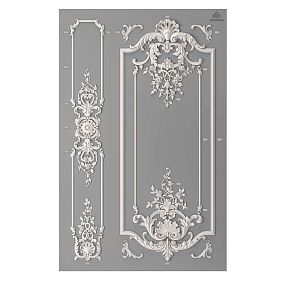
NPU-173 is a large carved overlay, not a decorative trifle
The first thing to do before discussing installation is to correctly imagine the scale of the product.
In the photo on the card, any stucco molding appears smaller than on a real wall. A smartphone or monitor screen destroys the sense of scale. A person sees a beautiful ornament and mentally places it between the slats, not noticing that the minimum version of NPU-173 is 800 mm wide.
That's already 80 centimeters.
The medium one is 900 mm.
The maximum is a full meter.
The height also varies: from 176 to 220 mm. And the relief reaches from 30 to 38 mm depending on the chosen size.
Therefore, NPU-173 cannot be considered a small overlay that is easy to find a free spot for after the renovation is already finished. In the central part of the wall, it can become one of the main visual objects.




Three sizes of NPU-173
| Option | Size, mm | What changes in the composition |
|---|---|---|
| Small | 800 × 176 × 30 | suitable for a more compact central field |
| Medium | 900 × 198 × 34 | requires a noticeable width and free space around it |
| Large | 1000 × 220 × 38 | a meter-long decorative composition that becomes a strong architectural accent |
| Material of all variants | Polyurethane | refers to polyurethane molded decor |
| Product type | Carved decorative overlay | not a molding, not a trim, and not a slat panel |
| Shape | Crown | the model is included in the corresponding group of decorative overlays |
| Main product | decorative overlay NPU-173 | the exact size is selected before designing the mounting field |
The sizes cannot be perceived as three nearly identical options.
Between 800 and 1000 mm in width, there is a 200 mm difference. On a furniture facade, this is a huge value. On a wall, the difference is also clearly noticeable, especially if a smooth field should remain around the overlay.
The relief thickness also increases. The maximum version protrudes more than the minimum one, so its interaction with slats, frames, and adjacent elements needs to be assessed separately.
Our factory also produces:



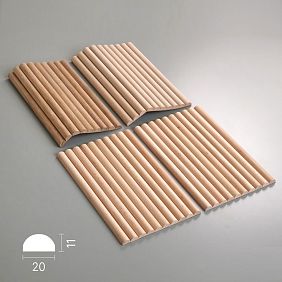
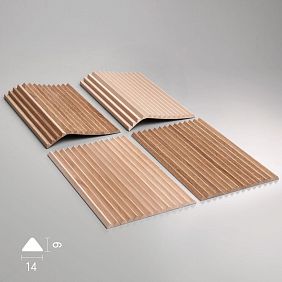
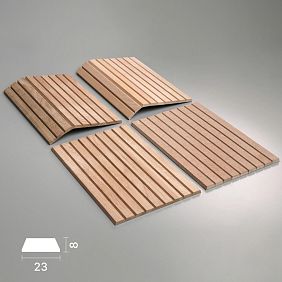
The most important point: the overlay needs not just a wall, but a clear supporting plane
The buyer often looks only at the front side.
But when asked, “Can the NPU-173 be installed directly on top of the slats?” it is more interesting to look at the wall from the side.
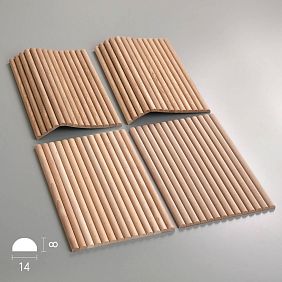
What is a slatted surface?
It is an alternation of protruding parts and recesses. The specific geometry depends on the chosen slat panel for interior wall finishing.
If you apply a large overlay to such a relief, its back side may come into contact not with a solid plane, but only with the tops of individual slats.
And here begins the real technical challenge.
You need to understand:
-
how many slats will be under the overlay;
-
what area they provide for contact;
-
whether they protrude evenly;
-
whether there are deep gaps between them;
-
whether the edge of the overlay will visually "hang" over the recesses;
-
whether the chosen installation method can work on such a base;
-
whether an intermediate smooth base is required.
Without answering these questions, reliable installation cannot be promised just because both products are intended for interior decor.
Get Consultation
Why a smooth field is the most predictable option
Let's imagine that the slat wall is not yet assembled.
You already know that you want NPU-173 in the center.
Instead of first covering the entire area with slats and then applying a large ornament over the relief, you can do it differently: leave a smooth plane in the desired zone and stop the slat texture around it.
What does this give?
Firstly, the overlay gets a proper base.
Secondly, its contour is better readable.
Thirdly, the slats do not show through open areas of the ornament as a random background.
Fourthly, you can pre-select the proportions of the smooth field relative to the specific size of NPU-173.
Fifthly, it is easier to establish symmetry.
In this case, the smooth field is not a "passage into the slat wall," but a separate architectural zone.
This is exactly how it should be designed.
The smooth platform should not equal the size of the overlay itself.
This is one of the most likely mistakes.
Suppose NPU-173 with dimensions of 800 × 176 mm is selected.
The buyer thinks:
"So, I'll leave a smooth rectangle 800 × 176 mm."
No.
Then the edge of the overlay will almost coincide with the edge of the smooth zone, and any slight deviation will be noticeable.
In addition, a decorative element usually requires air around it.
You need to decide how much smooth space to leave:
-
from the top;
-
from below;
-
from the left;
-
from the right.
The larger the overlay, the more important these margins are.
Sometimes a narrow margin is enough, because the NPU-173 must literally connect two slatted parts.
Sometimes you need a wide smooth center where the carved element can "breathe."
Therefore, the field size is calculated after selecting a specific NPU-173, not based on the general word "overlay."
Paper template — a mandatory check before ordering
This is one of those rare cases where a sheet of paper or painter's tape can save more than a long consultation.
Make three rectangles:
800 × 176 mm;
900 × 198 mm;
1000 × 220 mm.
If a full paper template is inconvenient, mark the dimensions with painter's tape on the wall.
Step back a few meters.
Then place the furniture.
Turn on the regular lighting.
Look from the doorway.
You will very quickly see what scale works.
On a large empty wall, 800 mm may seem surprisingly compact.
On a narrow slatted panel, a meter-long overlay, on the contrary, can take up almost the entire width.
Don't forget to simulate the thickness.
For a full check, it's useful to consider not only the width and height.
NPU-173 has a depth of:
-
30 mm;
-
34 mm;
-
38 mm.
If there is a mirror, door frame, or furniture nearby, mentally add this protrusion.
A large carved element exists not only frontally. It forms a real volume.
First option: a smooth field inside a slatted wall
This is the most manageable scheme.
Vertical slats run on the left and right.
A smooth section is left in the central part.
The NPU-173 is installed on it.
Compositionally, three layers are obtained:
slatted texture → calm field → carved center.
This order is especially good when the overlay is complex in pattern.
The rails do not have to compete with it directly under the ornament.
The smooth surface creates a pause.
And the NPU-173 itself becomes the center.
This method can be used:
-
behind the sofa;
-
above the console;
-
behind the headboard;
-
in the TV composition;
-
in the hallway;
-
on the large wall of the stair hall;
-
in a commercial interior.
If the slat wall is only planned, this scheme should be checked first.
The second option: NPU-173 between two separate slat fields
There is a similar but more expressive scheme.
Instead of one continuous wall, two independent slat panels are made.
A wide smooth vertical axis remains between them.
NPU-173 is placed inside this axis.
The result is almost classical symmetry:
slat panel — overlay — slat panel.
This is especially interesting for:
-
a double bed;
-
a symmetrical console area;
-
a wide wall with a central mirror;
-
a classic living room;
-
a hallway;
-
an area with paired lamps.
Here, NPU-173 does not compete with the relief at all.
On the contrary, two slatted surfaces become a side background for the central ornament.
The third option: place NPU-173 directly on the slats
This is the scenario that requires the most verification.
It can be visually interesting.
Imagine vertical slats, and on top of them — a large horizontal decorative crown. Geometric stripes run behind the floral ornament and create a strong contrast.
The problem is not the idea.
The problem is the base.
If the overlay touches only individual protrusions, you need to make sure that the chosen design actually allows such installation.
Therefore, before purchasing, it is necessary to do what the buyer often does not do: take a profile of the slatted surface.
Not a photo.
Not the overall width of the panel.
But the actual dimensions of the relief.
What dimensions to take from an already finished slat wall
If the panels are already installed, several parameters will be needed.
Protrusion height of the slat
How much does the front part protrude relative to the groove?
Width of the protrusion itself
This surface can potentially become part of the support.
Repeat spacing
How often are the protrusions spaced?
Width of the groove
A large gap means that part of the back plane of NPU-173 will remain without direct contact.
Overall flatness
Are all slats on one line?
Position of panel joints
Will the center of the overlay fall on the joint of two panels?
After these measurements, you can move on to the actual layout.
Why the size 1000 × 220 × 38 mm is especially demanding on the base
The larger the decorative element, the less you want to improvise.
The NPU-173 version, 1000 mm wide, passes through a significant part of the slat wall.
It potentially crosses a large number of slats and gaps.
Its relief reaches 38 mm.
In a frontal view, this is a powerful decorative composition.
That is why the base for a meter-long overlay must be designed with particular care.
If a small element is installed imperfectly, the defect sometimes remains local.
If a meter-long crown is tilted, does not fit tightly, or visually "hangs" over the relief, it is noticed immediately.
Three sizes — three different wall scales
800 × 176 × 30 mm
The most compact option.
It fits in more easily:
-
into the central furniture composition;
-
above the console;
-
into a relatively narrow smooth field;
-
between two small slatted sections.
But the word "compact" here is relative: 800 mm is still a noticeable width.
900 × 198 × 34 mm
Intermediate size.
It is already approaching a meter and requires a wider wall.
Very interesting for a symmetrical composition where large margins remain around it.
1000 × 220 × 38 mm
Maximum variant.
This is already an independent architectural accent.
On the wall, it is best perceived almost as a small carved panel.
The choice between the three versions should be determined not by price or the desire to "take more," but by the scale of the space.
How to calculate the width of a smooth field
Suppose you are choosing an NPU-173 with a width of 900 mm.
You want to leave 150 mm of smooth field on each side.
It turns out:
900 + 150 + 150 = 1200 mm.
This means the central smooth zone should have a width of about 1200 mm within the chosen scheme.
If you leave 250 mm on each side:
900 + 250 + 250 = 1400 mm.
The visual effect is already completely different.
The first option is denser.
The second one is calmer.
Such a simple calculation should be done before installing the slat panels.
It is much more useful than the advice to "leave some space around the trim."
Where to end the slats relative to the smooth field
There are two main approaches.
Sharp boundary
The slats end with a vertical line, and a smooth surface begins beyond it.
This creates a modern, clean transition.
It is especially good if:
-
the edge of the panel looks neat;
-
The transition is thoughtfully designed;
-
The interior does not require an additional frame.
Transition via molding
A separate profile appears between the slatted surface and the smooth field.
It creates an architectural boundary and can help connect the modern texture of the slats with the classic NPU-173.
For such a task, you can look at polyurethane moldings for designing the transition.
But the molding cannot be added automatically.
Sometimes it makes the composition neater.
Sometimes it creates a third active relief and overloads the wall.
Why do the slats behind the openwork pattern change the design of NPU-173?
This is not just an installation issue.
Even if technically attaching the overlay over the slats is possible, a visual problem remains.
In the open areas of the carved ornament, the background will be visible.
If the background is smooth, the eye reads the silhouette of the overlay clearly.
If vertical slats run behind, additional lines appear inside each open section.
The pattern becomes more complex.
Sometimes this is very striking: strict vertical geometry shows through the classic ornament.
But sometimes the pattern gets lost.
Therefore, before purchasing, it is useful to do a photomontage or at least hold a printed silhouette against a photo of the wall.
The background behind the overlay is part of NPU-173, although physically it is not included in the product.
Carved decor has an interesting feature: the voids in the pattern work no less than the material itself.
The base is visible through them.
This means the buyer is actually choosing not just the overlay.
They are choosing a combination:
NPU-173 + background.
The background can be:
-
a smooth painted wall;
-
a slat panel;
-
a contrasting surface;
-
a furniture facade;
-
Door leaf.
The same NPU-173 on each of these bases will look different.
That is why the question of whether to leave a smooth area or glue slats is both technical and artistic.
When slats behind NPU-173 really look interesting
There are scenarios where direct visual overlay is justified.
For example, a very strict monochrome slatted surface and an overlay of the same color.
Then the reliefs do not conflict in color.
Vertical lines become the background, and the floral pattern becomes the foreground.
Another option is a contrasting overlay on calm slats.
Here, NPU-173 reads much stronger.
But the more active the color contrast, the more noticeable any editing sloppiness.
And one more condition: the background should not be too fragmented.
If the slats themselves have an active wood texture, a strong color contrast, and a frequent pattern, the carved crown may get lost.
When a smooth background will almost certainly be better
If NPU-173 is the main decorative center of the wall, a calm background usually helps it.
Especially:
-
in a classic interior;
-
in neoclassicism;
-
above the console;
-
in a symmetrical area;
-
between two sconces;
-
above the headboard;
-
in composition with molding frames.
The smooth field allows the ornament to be read as a whole.
The slats do not disappear — they simply move to the side and work as a contrasting texture.
This is a good example of how fewer slats can make a slat wall more interesting.
A slat wall does not have to be filled from corner to corner
This is an important principle.
The query "wall finishing with slat panels" sometimes makes one perceive the panel as wallpaper: you chose the material — so you cover everything.
But an accent composition can consist of different planes.
For example:
600 mm of slats;
1200 mm of smooth central field;
600 mm slats.
And inside the central part — NPU-173.
Or vice versa:
wide slatted field on the right;
smooth zone on the left;
the overlay is offset from the center.
Modern interior does not require symmetry in all cases.
Therefore, the smooth spot for decor should not be considered an "unfinished part" of the wall.
If the wall is already fully assembled, do not start with dismantling
Suppose the entire area is already covered with panels.
NPU-173 was liked later.
The first desire is to remove part of the slat trim and make a smooth field.
But this is not always the first step.
First, you need to evaluate four options:
-
installation on an existing surface;
-
creating a local base over it;
-
removal of part of the panels;
-
abandoning NPU-173 in favor of another decor.
Which one is more rational depends on the specific slat system.
There is no need to destroy a finished wall before the dimensions and layout are checked.
Make a full-size template directly on the slats
If the wall can no longer be easily changed, the template is especially useful.
Mark the external dimensions of the selected NPU-173 option directly on the slatted surface.
For the 1000-millimeter model, get a rectangle:
1000 × 220 mm.
Check:
-
how many slats the zone crosses;
-
where the panel joints are;
-
whether the overlay hits the switch;
-
how it looks relative to the furniture;
-
whether too many vertical lines remain inside the pattern.
After that, you can decide whether a smooth background is needed.
An overlay between two slat fields often looks more expensive than an overlay over the entire wall.
The reason is not the cost of materials.
The reason is hierarchy.
When the entire wall is uniformly slatted and a carved object appears on top, both reliefs work simultaneously.
When a separate smooth field is allocated for NPU-173, the interior gets a sequence:
background;
border;
accent.
The eye understands the composition faster.
The complex ornament does not dissolve.
This effect is especially noticeable with side lighting.
The slats create frequent vertical shadows.
NPU-173 — a larger, more plastic light-and-shadow effect.
Mixing textures helps each one stand out.
Slat wall behind the sofa: NPU-173 should be aligned not to the center of the wall, but to the furniture
Let's imagine a wall four meters wide.
The sofa is not exactly centered, but shifted by 300 mm.
Where to place NPU-173?
Geometrically — in the center of the wall?
Compositionally — above the sofa?
In most cases, the decorative element should relate to the object with which it forms a group.
Therefore, first find the axis of the sofa.
Then try on three sizes of NPU-173.
If the sofa is wide, a meter-long overlay may look natural.
If it is compact, 800 mm is often sufficient.
After that, they decide how the slatted surface is built around it.
Behind the headboard of the bed, a smooth field is especially justified.
The bedroom is one of the scenarios where directly applying complex reliefs easily turns into overload.
Already available:
-
vertical slats;
-
fabric or wood headboard;
-
lighting fixtures;
-
textile;
-
nightstands.
If you add a large carved crown over the entire slatted wall, you get another active layer.
The smooth central zone helps calm the composition.
You can leave slats on the sides of the bed and make a calm field with NPU-173 above the headboard.
Thus, the classic decorative motif becomes the main one, and the slats work as a background.
The TV zone is the most controversial scenario for NPU-173
The TV itself takes up a lot of visual space.
A large black rectangular plane and a carved decorative crown belong to completely different visual languages.
They can be combined, but only intentionally.
For example, NPU-173 is placed above the TV as the top finish of a large decorative frame.
Or below it, if the composition resembles a portal.
It is much worse to accidentally hang a carved element next to the screen just because there is free space left on the slat wall.
In the TV zone, it is especially useful to first put together a frontal sketch.
A console and a mirror are a natural composition for NPU-173
Here, the carved overlay gains a clear architectural role.
Below is a console.
Above is a mirror.
NPU-173 can:
-
finish the mirror at the top;
-
be located above it;
-
connect the composition with the molding frame;
-
occupy a separate field between the slat panels.
If the mirror already has a rich carved frame, an additional NPU-173 may be unnecessary.
If the frame is simple, the crown can become the main classical motif.
On the door, NPU-173 is checked quite differently
The product card allows the use of the decorative overlay on door and furniture surfaces, but the door imposes its own limitations.
You need to measure:
-
the width of the door leaf;
-
work area;
-
panels;
-
handle position;
-
trim;
-
opening direction.
A version with a width of 1000 mm for a standard door leaf may physically not match the size.
Therefore, you cannot choose a larger modification just because it looks more impressive on the wall.
For a door, 800, 900, and 1000 mm are especially important as actual dimensions, not as conditional size names.
On a furniture facade, every centimeter is even more critical.
Suppose a cabinet facade is 900 mm wide.
Can an NPU-173 with a width of 900 mm be installed?
Formally, the dimensions match.
In practice, almost certainly a margin is needed.
On the facade, there are edges, frames, hinges, handles, and structural zones.
Therefore, the width of the product should not automatically equal the width of the door.
You need to measure the free decorative field.
For furniture, you can open the entire section and Buy decorative polyurethane overlays only after comparing several models, if NPU-173 turns out to be excessively large.
The "crown" shape: why it matters for placement
NPU-173 belongs to the group of decorative overlays of the "crown" shape.
The name itself suggests the natural compositional position.
Such an element works well as a top finish:
-
panels;
-
furniture composition;
-
doors;
-
mirrors;
-
central decorative field.
This does not mean there is only one way to install. But the form has a visual direction.
Therefore, before rotating, non-standard placement, or using in an unusual orientation, it is better to evaluate the entire pattern.
You can view adjacent products in the section polyurethane overlays in the shape of a crown.
NPU-173 in the color of a smooth wall: the most architectural option
Let's imagine a central smooth field of light color.
NPU-173 is painted in the same or a similar tone.
The rails on the sides can also be monochrome or have a different texture.
In this scenario, the decorative overlay does not look like an applied image.
It is revealed through its own relief.
The deeper the model — and for different sizes this is 30, 34, or 38 mm — the more noticeable the chiaroscuro.
This approach is especially good for neoclassicism and calm modern interiors with individual classical details.
NPU-173 in the color of the slat panels
Another way is to tie the overlay specifically to the slats.
Then the smooth central field can have one color, and the slatted surface and NPU-173 another.
This creates an interesting connection between the two reliefs.
But it only works with a well-thought-out palette.
If the colors are too contrasting, the overlay may visually separate from the base more than desired.
It's better to check a small color mockup.
Contrasting NPU-173: striking, but alignment requirements become stricter
Dark overlay on a light wall.
Golden on dark.
Light on a deep color.
Contrast turns NPU-173 almost into a graphic sign.
Then even a slight deviation relative to the furniture axis, smooth field, or adjacent panels becomes noticeable.
Therefore, the contrasting option needs to be marked out especially carefully.
If you're unsure about the wall's geometry, a monochrome scheme forgives more.
How to use molding around a smooth field
Sometimes changing the texture alone is not enough.
For example, a slatted surface ends, a smooth field begins, and the transition seems too abrupt.
You can add a frame made of polyurethane moldings.
It serves two functions.
The first is to create a clear boundary.
The second is to stylistically connect the carved NPU-173 with the more austere slats.
But the frame should remain secondary.
If NPU-173 itself is richly ornamented, a too complex molding will create competition.
Do you need to make a full frame around NPU-173
Not necessarily.
There are three schemes.
Without a frame
The smooth field itself serves as the background.
Suitable for modern and transitional interiors.
Vertical moldings on the sides
They separate the smooth central axis from the slats.
The overlay is placed on top or in the center.
Full frame
NPU-173 becomes part of a classic panel.
This is the most decorative option.
Which one to choose depends on the style of the wall, not on the fact of buying the overlay itself.
What is better during a new renovation: first NPU-173 or first panels
It is better to start with a project, and within it both items.
The selection order is as follows:
-
determine the total width of the wall;
-
choose the place for furniture;
-
decide where the slats are needed;
-
choose the size of NPU-173;
-
calculate the smooth field;
-
resolve the issue of moldings;
-
choose the installation scheme;
-
only after that, order the quantity of slat panels and the decorative element.
This is more efficient than first buy slat panels for walls for interior finishing, covering the entire space, and then looking for where to place the meter-long overlay.
What to do if the slat panels have already been ordered
It is not necessary to change the order.
Lay out the panels on the wall in the project and see if you can exclude some modules from the central area.
Sometimes a smooth field can be formed without additional purchases — just by changing the layout.
If the panels are not installed yet, now is the most convenient time to adjust the composition.
If they are already installed — you need to move on to checking the finished relief.
Direct mounting on battens: what questions to ask the installer
Don't ask:
"Can it be glued?"
A too general question almost always gets a too general answer.
Better to ask:
-
which specific parts of the panel will the overlay rest on;
-
what percentage of the back surface will actually get support;
-
whether an intermediate platform is required;
-
how the edge will be finished;
-
how to check the horizontal level;
-
whether a preliminary dry fit can be done;
-
how the selected mounting material interacts with the specific substrate.
So the conversation moves from the realm of "probably possible" into the realm of the project.
Why mounting adhesive cannot automatically be considered a solution to any geometric problem
Adhesive joins surfaces.
But if the surfaces barely touch, the issue cannot be resolved just by increasing the amount of compound.
The adhesive layer cannot be viewed as a universal way to fill deep gaps between slats and simultaneously create a proper support plane for a large decorative element.
So first, geometry.
Then, the mounting material.
You can view in the catalog Mounting and finishing materials and only after that, check the instructions for the specific compound.
When an intermediate smooth platform can save a finished slat wall
Let's say you don't want to dismantle the panels.
But the NPU-173 doesn't fit well directly.
Theoretically, you could consider a separate intermediate base that creates a flat surface for the decorative element.
However, it:
-
material;
-
thickness;
-
size;
-
mounting method;
-
edge finishing
needs to be designed for a specific wall.
This is not a universal standard NPU-173 kit, so a ready-made recipe cannot be given without the actual structure.
From a design perspective, such a platform can even be an advantage: it creates a separate background for the overlay.
Where such a platform should end
A bad option is exactly along the NPU-173 contour.
Then from some angles a random boundary will be visible.
It is better to either make the base completely hidden structurally, or turn it into a deliberate decorative field.
That is, we return again to the same principle:
not to mask the technical necessity, but to turn it into wall architecture.
Slat panels for painting give a particularly interesting scenario
If used slatted panels for interior wall finishing in the version designed for further painting, it becomes possible to combine several textures with one color.
For example:
smooth field;
slats;
NPU-173;
molding.
All elements are visually brought together by a common palette, but interact with light differently.
This allows making a fairly complex wall without a sense of clutter.
But the same color does not negate differences in materials and preparation technologies. Each substrate is treated according to the requirements of the chosen finishing system.
Wooden slats and white NPU-173: a classic contrast of materials
If the slats retain a wood texture and NPU-173 is painted in a light color, the contrast is stronger.
This option clearly shows the difference in languages:
wood — vertical and natural;
stucco — ornamental and plastic.
But the central background becomes critically important.
A white overlay on top of an active wood slat surface may lose part of the pattern in open areas.
On a smooth background, its silhouette is usually read more clearly.
Why for an NPU-173 with a width of 1000 mm it is sometimes worth making the field noticeably wider than a meter
A large part needs air.
If the overlay takes up exactly the entire width of the central zone, it looks cramped.
Let's imagine an NPU-173 with a width of 1000 mm and a field with a width of 1100 mm.
Only 50 mm remains on each side.
Now let's increase the field to 1400 mm.
We get 200 mm.
The second option usually looks calmer.
But on a small wall, an additional 300 mm may turn out to be too big a loss of slat texture.
Therefore, you need to find a balance between the scale of the decor and the area of the panels.
Why you can't choose NPU-173 only by the width of the sofa
Sofa 2400 mm wide.
It seems: a meter-long overlay would be more logical than an 800-millimeter one.
But nearby there may be sconces, paintings, a high ceiling, or a narrow slatted panel.
The size of the decorative element is determined by the entire composition.
Furniture is one of the reference points, but not the only one.
It's better to compare three mockups on one photo of the interior.
If you want two NPU-173s, first ask why
A large overlay is already a strong accent.
Two can work:
-
above two identical doors;
-
on two symmetrical panels;
-
in paired furniture facades;
-
on opposite sections of a large wall.
But two NPU-173 side by side only because the wall is long can overload the composition.
Sometimes one large version of 1000 mm is better than two of 800 mm.
In which cases to choose 800 mm
The 800 × 176 × 30 mm version is especially interesting:
-
for a relatively small central field;
-
above a compact console;
-
in a furniture composition;
-
where you need to leave more air around;
-
when the meter version seems excessive.
It is not "junior" in quality or purpose.
This is a different scale.
When 900 mm turns out to be the sweet spot
The size 900 × 198 × 34 mm works well where 800 mm already seems modest, and a meter dominates too much.
This could be:
-
a medium-width wall;
-
central panel;
-
area above the dresser;
-
Wide
table of the set
What to look at Why When required What to check NPU-173 main carved accent Always option 800, 900, or 1000 mm Polyurethane decorative appliques compare neighboring models if NPU-173 is large or does not match the style size, shape, pattern crown-shaped overlays compare elements of similar compositional form for the top completion of a panel, door, or furniture proportions relative to the base Rafter panels form a rhythmic basis for the wall if the wall is still being designed profile, material, dimensions of the selected model Moldings made of polyurethane to frame the edge of the smooth field when a transition without a frame looks unfinished the width and relief of the profile Polyurethane moldings to assemble a broader decor system for a comprehensive project Don't overload the composition Mounting and finishing materials to select a mounting solution After determining the base compatibility of the specific composition Ten mistakes when combining NPU-173 and a slat wall
Mistake 1. Assuming that the overlay can be placed on any textured surface
The very fact that the NPU-173 is made of polyurethane does not negate the requirements for the base.
First, the actual contact is checked.
Mistake 2. Leaving a smooth field exactly the size of the overlay
Compositions almost always need fields or a separate well-thought-out border.
Mistake 3. Buying a meter-long version without a mockup
1000 mm on screen and 1000 mm on the wall are perceived completely differently.
Mistake 4. Considering 30–38 mm as insignificant depth
On the wall, such relief is clearly visible, especially in side light.
Mistake 5. Not taking into account the background in the ornament cutouts
Vertical slats will be part of the visible pattern if the panel is placed directly above them.
Mistake 6. Centering relative to the wall, forgetting about furniture
Sometimes the axis of a sofa or console is more important than the geometric center of the room.
Mistake 7. Buying panels before choosing NPU-173
If a smooth field is needed, it's better to know this before installing the entire wall.
Mistake 8. Adding molding automatically
A frame is not always useful. Sometimes it overloads an already complex relief.
Mistake 9. Considering glue a replacement for a proper base
The mounting compound does not fix poor geometry by itself.
Mistake 10. Trying to preserve the original design at any cost
If the layout shows that NPU-173 doesn't fit, it's better to choose a different overlay than to redo the entire wall for the sake of an article.
Another common mistake is to finish the wall first and then choose all the decor.
Slat panels are very self-sufficient.
After installing them, there's a temptation to "add something classic."
But the large NPU-173 requires architectural space.
It works best when it's planned not at the end, but within the structure of the composition.
If the wall is still being designed, look at two categories simultaneously: Buy slatted panels for wall finishing и Buy decorative polyurethane overlays.
This makes it easier to immediately understand where one material ends and another begins.
Who should leave a smooth field in advance
This option is especially suitable if:
- NPU-173 has already been selected before repair;
- the overlay should become the main center;
- the maximum size is used;
- the slatted relief is deep;
- we want to clearly show the ornament;
- the interior is built on symmetry;
- molding framing is planned;
- the background surface should be monochromatic;
- the wall can be designed before panel installation.
Under such conditions, a smooth field almost always provides more control.
Who might be interested in installing over battens
This option should be considered when:
- the batten wall is already finished;
- removing the panels is undesirable;
- the relief geometry provides suitable support areas;
- the overlay of two textures is visually appealing;
- the overlay pattern reads well against the batten background;
- the technical solution is confirmed after a trial fit.
The key word here is consider, not automatically apply.
Who NPU-173 might not suit at all
Sometimes the best solution is a different product.
NPU-173 may be redundant if:
- the slat zone is very narrow;
- the interior is minimalist;
- there is already complex carved decor;
- there is little free space above the furniture;
- even 800 mm is too wide;
- a small point overlay is needed;
- a regular linear border is required;
- a smooth field cannot be formed, and direct mounting on slats is inconvenient.
Then it's better to look at the whole section carved polyurethane overlays and choose a different scale.
Practical scenario: a 3000 mm wall and NPU-173 800 mm
Suppose the central overlay is 800 mm.
We want to leave 200 mm of smooth space on each side.
Width of the central field:
800 + 200 + 200 = 1200 mm.
Remaining for rails:
3000 − 1200 = 1800 mm.
With symmetry — 900 mm of slatted surface on the left and right.
It turns out a very clear scheme:
900 mm battens;
1200 mm central field;
900 mm battens.
This can already be transferred to the real plan.
The same wall with a meter-long NPU-173
Now we take 1000 mm.
We keep 200 mm margins.
Central zone:
1000 + 400 = 1400 mm.
Remaining for rails:
1600 mm.
800 mm per side.
There is less slat texture, and the central classic accent becomes larger.
Which layout is better?
There is no universal answer.
But this clearly shows why the NPU-173 size affects not only the decor itself, but the entire wall layout.
Practical scenario: the slat wall is already fully finished
For example:
wall width — 3200 mm;
panels are installed from corner to corner;
a console is in the center;
I want NPU-173 900 mm.
First, mark 900 × 198 mm.
Then, see how the decorative element crosses the slat pattern.
After that, check the base profile.
If the visual combination is successful and technically a suitable support can be provided, direct installation can still be considered.
If the pattern is lost or the fit is unsatisfactory, two routes appear:
a local smooth field;
another overlay.
You don't need to start with dismantling.
Practical scenario: two slat zones on the sides of the bed
Here, the smooth center is especially organic.
Suppose:
bed width — 1800 mm;
central field — about 1400 mm;
NPU-173 — 1000 mm;
The slats are arranged in separate vertical zones on the left and right.
The overlay can be placed above the headboard.
The result combines three types of surfaces, but they do not overlap each other:
bed textile;
smooth background with carved decor;
slats on the sides.
This is significantly calmer than placing everything on top of one relief.
Practical scenario: a door between slat panels
The slats run on both sides of the doorway.
NPU-173 is considered as a decorative finish for the top of the door.
In this case, there is no need to glue it to the slats at all.
You can use the smooth area above the door leaf or door composition.
This scheme particularly well shows why you don't need to force two materials to physically overlap if they can be linked compositionally.
Practical scenario: a cabinet against a slat wall
The cabinet is already in front of the slat surface.
NPU-173 can be placed:
- on the cabinet facade;
- on the wall above it;
- in the central smooth field nearby;
- on a separate upper furniture part.
And only one of the options involves direct interaction with the slats.
Therefore, always ask a broader question:
does the overlay really need to be on the slatted surface?
Sometimes there is a more convenient surface nearby.
How to buy NPU-173: first size, then color, not the other way around
The buyer often starts:
"I want a white crown."
But the first choice should be geometric.
First:
800, 900, or 1000 mm.
Then:
where it is located.
Then:
what the base is.
Then:
whether there is a smooth field.
And only after that:
color and finish scheme.
This significantly reduces the chance of buying a beautiful part for which it is impossible to find the right place.
The current price also depends on the size
At the time of preparing the material, the three variants have different prices, so the economic calculation cannot be made based on the wording “NPU-173 costs from 13,640 ₽” and assume that any version will cost exactly that amount.
The minimum variant starts at the stated lower price, while larger configurations cost more.
Before ordering, you need to open the NPU-173 product page and check the current price for the specific size version.
This is especially important if you are comparing two projects:
a small overlay on ready-made rails;
a large overlay in a specially formed smooth field.
The cost of the overlay itself is not the cost of the solution
If an already finished wall needs to be redone, other work is added to the price of the decor.
If a smooth field is planned in advance, the project may turn out to be simpler.
If a frame is needed, moldings appear.
If a separate base over the slats is required, that is also part of the project.
Therefore, you should compare not the "price of NPU-173" with the "price of slatted panels," but two finished wall scenarios.
Where to buy NPU-173 and what to open before placing an order
The shortest purchasing sequence looks like this.
First, open carved overlay NPU-173.
Choose one of three sizes.
Make a full-size template.
Determine where it is placed.
Check the base.
If the dimensions do not fit, go to the section where you can Buy decorative polyurethane overlays.
If you need the specific shape of the top finish, compare carved polyurethane overlays in the shape of a crown.
If the slat wall section has not been selected yet, open slatted wall panels for interior finishing.
If the project becomes more complex than a single overlay, you can You can buy ready-made stucco matching the Baroque style. Calculate the quantity: linear meters of cornices and moldings, number of rosettes, pilasters, consoles, corner elements. Add a ten to fifteen percent allowance for trimming. as elements of a unified decorative system.
FAQ: NPU-173 and slat wall
Is NPU-173 a molding?
No. NPU-173 is a carved decorative overlay made of polyurethane. Moldings belong to a different product group and primarily work as linear profiles.
Is NPU-173 a linear profile?
No. The model belongs to decorative overlays, not linear profile products.
Is NPU-173 a slat panel?
No. A slat panel forms a repeating surface, while NPU-173 is a separate carved decorative accent.
What sizes are available for NPU-173?
Three: 800 × 176 × 30 mm, 900 × 198 × 34 mm, and 1000 × 220 × 38 mm.
What material is NPU-173 made of?
made of polyurethane.
Can NPU-173 be installed on a wall?
Yes, that is one of the application scenarios for the decorative overlay. The specific mounting scheme should be chosen based on the substrate.
Can it be placed on furniture?
The model can be used in furniture decor, but you need to check the dimensions of the facade, the working area, the location of the handles, and the base construction.
Is NPU-173 suitable for a door?
This scenario is possible if the dimensions and construction of the door leaf match. Special attention should be paid to the width, since even the minimal version is 800 mm.
Can NPU-173 be installed directly on slatted panels?
This scheme can only be considered after checking the actual profile of the slatted surface and the contact area. It is not possible to universally promise compatibility with any slatted panel.
Why is a smooth field considered more predictable?
It creates a clear plane for a large overlay, allows the ornament to be shown more clearly, and allows the margins around the product to be controlled in advance.
Does the smooth field need to be made exactly to the size of NPU-173?
No. In most compositions, additional margins around the overlay or a separate frame need to be considered.
How do I know which size to choose?
Transfer all three options — 800 × 176, 900 × 198, and 1000 × 220 mm — to the wall using painter's tape or a paper template. Compare with the furniture and the width of the slat zone.
How do the sizes differ besides width and height?
The depth of the relief also changes: 30, 34, and 38 mm, respectively.
Can I choose the largest NPU-173 just because the wall is wide?
You shouldn't. A large wall doesn't always require the largest decorative element. You need to consider the furniture, the free space, and the richness of other textures.
Where is the best place to put NPU-173 on a slat wall?
The most understandable options are a central smooth field, a section between two slat zones, or a specially designed decorative axis. Direct placement over the slats requires separate verification.
Can I leave the slats behind the ornament?
Visually, this technique is possible, but vertical lines will be visible through the open parts of the carved pattern. Before ordering, it's better to make a mockup.
Which is more beautiful: slats over an overlay or a smooth background?
It depends on the task. A smooth background shows the ornament more clearly, while slats create a more complex layering of two reliefs.
Is a molding needed between the slats and the smooth field?
Not necessarily. It is only needed when it helps to define the border. See Moldings made of polyurethane it after determining the entire composition.
Can a full frame be made around NPU-173?
Yes, as a designer composition, if the dimensions and style of the wall allow it. The main thing is not to overload the ornament with additional active profiles.
What to do if the slatted wall is already finished?
First, make a full-size template of NPU-173 on the existing surface, then check the slat profile, and only after that decide whether dismantling, a separate smooth area, or direct installation is needed.
Do all panels need to be removed?
No. Even if it is decided to form a smooth field, the issue usually relates to a local area. The scale of rework is determined by the design of the specific wall.
Can a separate platform be made on top of the battens?
Such a design option can be considered, but the material, thickness, and method of fastening the platform must be selected based on the actual wall structure.
Can the gaps between the battens simply be filled with glue?
The installation compound should not be considered a universal replacement for a properly prepared support surface. First, the geometry of the base needs to be assessed.
Which glue should I use?
The specific installation material is selected based on the base and the instructions of the compound itself. View Mounting and finishing materials can be found in a separate section of the catalog.
Can NPU-173 be installed on a painted wall?
This depends on the strength of the existing coating and the requirements of the chosen installation compound. Peeling paint does not become a reliable base just because the surface looks smooth.
Can NPU-173 be made in the same color as the battens?
As a design technique — yes. A single color helps tie together different reliefs. The finishing technology should be selected considering each material.
What about a contrasting color?
That's also possible. But contrast more strongly emphasizes dimensions, centering, and any installation deviations.
What works best behind the bed headboard?
Often a smooth central field with NPU-173 and slatted zones on the sides works well. But the solution depends on the bed size, headboard, and lighting.
Will NPU-173 suit a TV wall?
It may work as part of a broader composition, but the TV itself is a strong geometric center. The position of the carved element needs to be coordinated with the screen and furniture.
Where can I see other overlays if NPU-173 is too large?
Open the section polyurethane decorative overlays and compare products of a different scale.
Where can I see overlays of a similar shape?
In the section polyurethane overlays in the shape of a crown You can compare elements of the corresponding shape.
Where can I buy slat panels if the wall is not yet finished?
In the catalog you can buy slat panels for walls for interior finishing and immediately plan their layout taking into account the smooth zone.
What should I check right before ordering NPU-173?
The specific model size, width and height of the working area, base relief, position relative to furniture, background option, and mounting scheme.
The slat wall is already finished — does that mean it's too late for NPU-173?
No.
It's just that the sequence of actions becomes different.
When the renovation hasn't started yet, you can freely design the smooth section.
When the panels are already installed, the existing surface is examined first.
This is not worse — just the number of restrictions is greater.
First, apply the template.
If NPU-173 is visually really needed, only then explore the technical side.
Sometimes after the template it turns out that decor is not needed at all: the slat wall is already self-sufficient.
And this is also a useful result.
How to make a final decision without endless doubts
Reduce the task to four questions.
1. Is NPU-173 really needed on this particular wall?
If there is no clear compositional purpose, do not add it just to fill the space.
2. Which of the three sizes fits?
Checked with a full-size mockup.
3. How does it look against a slatted background?
If the ornament gets lost, a smooth section is needed.
4. Is there a suitable support surface?
If not, a different base scheme is designed.
After that, the solution becomes almost mechanical.
Smooth spot or mounting over slats: the final choice
If the slatted wall is still being designed, the most manageable scheme is to choose the NPU-173 size in advance and provide a smooth decorative field for it. The slats can be placed on the sides, used as bottom or side texture, separated from the central zone by a molding, or left with a clean straight border. The main thing is that the overlay gets a proper compositional and mounting surface.
If the slatted wall is already installed, there is no need to automatically consider the project ruined. First, mark the selected NPU-173 directly on the surface. See how the vertical slats read through the ornament. Then measure the profile of the slatted finish and assess which parts of the base the decorative element will actually rest on.
If the scheme is convincing both visually and technically, direct placement can be further developed.
If not, it is better to create a separate smooth field or choose a different overlay.
Do not force a meter-long decorative crown to adapt to a random surface just because the panels are already purchased.
The purchase should start not with the cart, but with the chosen base.
Before order decorative overlay NPU-173 made of polyurethane, fix five things in the project:
size of NPU-173;
size of the smooth field or slat area;
axis of the composition;
character of the background behind the ornament;
method of preparing the base.
After this, it becomes clear how much slat surface is actually needed and whether additional moldings are required.
If the panels are still being selected, open slatted panels for interior wall finishing with the ready-made central field layout.
If a different scale of decor is needed, first check out decorative polyurethane overlays, rather than changing the entire wall architecture for a single item.
If you need comprehensive stucco decor — frames, additional profiles, or other elements — you can go to the general catalog and You can buy ready-made stucco matching the Baroque style. Calculate the quantity: linear meters of cornices and moldings, number of rosettes, pilasters, consoles, corner elements. Add a ten to fifteen percent allowance for trimming., assembling the composition as a whole.
NPU-173 and slat wall: which layout ultimately looks the most professional
A wall with more decorative elements does not necessarily look more professional.
A professional look is one where it's clear why each element is exactly where it is.
Slats should be responsible for rhythm and background.
NPU-173 is for the large carved accent.
A smooth surface, if used, is for a pause between two textures.
Molding is for the border, if it's really needed.
When these roles aren't mixed, even a complex wall reads easily.
When all reliefs are layered on top of each other without hierarchy, expensive materials can look like a random assortment.
That's why for a large NPU-173 ranging from 800 to 1000 mm, the base question is fundamental.
For a new project, it's wiser to leave a suitable smooth zone in advance.
For an existing wall, first check the actual profile of the slats and make a mockup.
Sometimes it turns out that the overlay works perfectly on top of the existing texture.
Sometimes — that it needs a calm background.
And sometimes it becomes clear that the interior doesn't need NPU-173 at all.
This is the normal choice.
STAVROS company allows you to go through it sequentially: first look at NPU-173 in all three sizes, then compare if necessary Polyurethane decorative appliques и crown-shaped overlays, after which coordinate the composition with plank panels and choose Mounting and finishing materials.
If the decision is made before installing the panels, a smooth field under NPU-173 is the most predictable and compositionally clean path. If the slat wall is already assembled, there's no need to abandon the idea or immediately glue decor on top of it: first a full-size template, then check the relief and support plane, and only after that — order and installation.