








































































Article Contents:
- Why the choice between MDF and wood affects the entire interior
- What is an MDF baseboard that looks like wood
- What's inside and outside
- Available decors
- Even geometry as the main advantage
- What is a natural wooden baseboard
- Structure and Properties
- Finishing and final coatings
- MDF baseboard that looks like wood: when it's the right choice
- For laminate with a wood imitation
- For modern and minimalist interiors
- Where stability is needed
- MDF baseboard matching door color
- Wooden baseboard: when natural wood is irreplaceable
- Natural parquet requires a natural baseboard
- Classic and Neoclassical Interiors
- Country houses and wooden interiors
- Possibility of restoration and color change
- How to choose a shade: oak, gray oak, wenge, ash, light wood
- Baseboard in floor color
- Baseboard matching door and trim color
- Baseboard matching furniture color
- Contrasting skirting board
- Light oak: delicacy and versatility
- Dark shades: power and risk
- What to choose for laminate, parquet, and engineered wood flooring
- Under laminate
- For block parquet and parquet board
- For engineered board
- When the baseboard is better calmer than the floor
- What to choose for doors and architraves: table of options
- White doors and wood-look baseboard: a working contrast
- Wooden doors and wooden baseboard: a material dialogue
- Installation, corners, and joints: what's important to know about each material
- MDF baseboard: precision from the first try
- Wooden baseboard: possibility for refinement
- Corners: MDF requires precision, wood allows adjustment
- Wide baseboard: when a large height is needed
- Additional elements of wooden design
- Wooden slat
- Wood molding
- Molded products: a complete system
- Mistakes when choosing a wood-look baseboard
- MDF baseboard vs wooden baseboard: final comparison
- What to buy for a finished interior
- FAQ: Answers to Popular Questions
- About the Company STAVROS
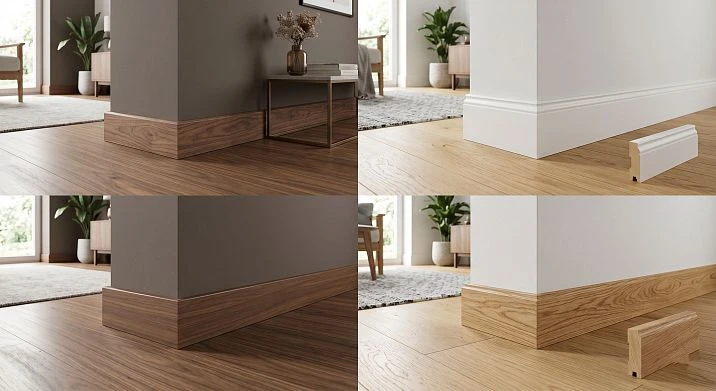
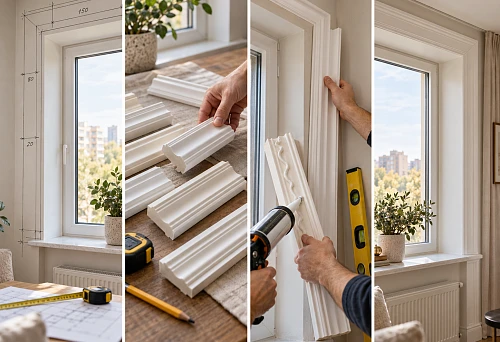
A question that arises for everyone involved in finishing: should you take an MDF baseboard with a wood look — smooth, stable, with a decorative coating — or choose a natural wooden baseboard with a live texture and genuine material? Both options provide a "wooden" lower contour. But these are different products with different application scenarios, different installation requirements, and different behavior in the interior.
A baseboard is not just a decorative strip covering the gap between the wall and the floor. It is a visual connecting element that ties the floor, walls, doors, and furniture into a single picture. If its shade is random, its profile is alien, and the material does not echo the other surfaces — even expensive parquet loses half its value, and designer doors look out of place.
This article is a detailed breakdown of what an MDF skirting board with a wood finish is, how it differs from natural wood, when to choose each option, and how to select the shade and profile to match your specific floor, doors, and furniture.
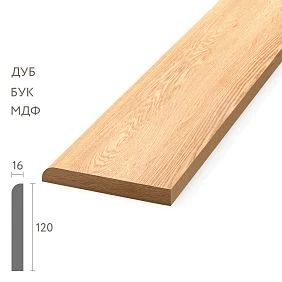
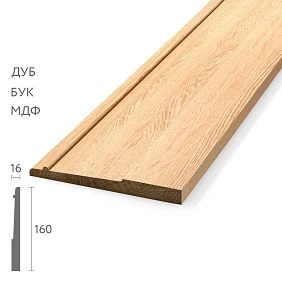
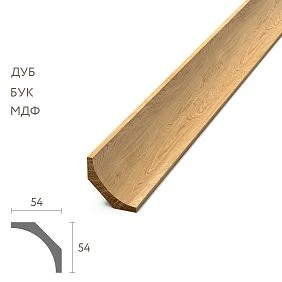
Why the choice between MDF and wood affects the entire interior
The skirting board is the only element that touches two surfaces at once: the floor and the wall. And it is what closes the lower visual contour of the entire room. As your gaze moves across the room, it inevitably passes through this contour — especially in long hallways, spacious living rooms, and bedrooms with low furniture.
That is why a poorly chosen skirting board creates a feeling of "something is off" that is hard to put into words but is felt intuitively. A skirting board that is too dark in a small room visually "weighs down" the space. A wood-look skirting board in a cool tone next to warm parquet creates color dissonance. A wenge wood skirting board with white doors and light walls creates too aggressive an accent on the floor line.
And conversely: the right skirting board works subtly but powerfully. It connects a warm floor with neutral walls, echoes the wooden elements of doors or furniture, and creates a sense of wholeness and completion — exactly the feeling for which a renovation is undertaken.

What is an MDF skirting board with a wood finish
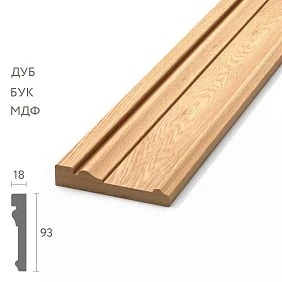
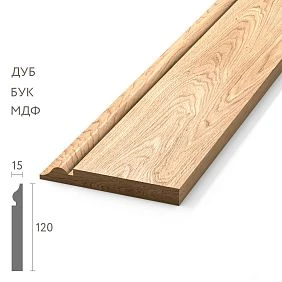
An MDF skirting board with a wood finish is a strip made of dense MDF base, covered with a decorative film featuring a wood grain pattern. The decorative layer is applied using a full wrapping method: the front side, side edges, and shaped profile are all covered. The result is the appearance of wood with the engineering advantages of MDF.
Our factory also produces:
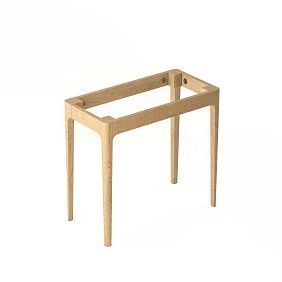
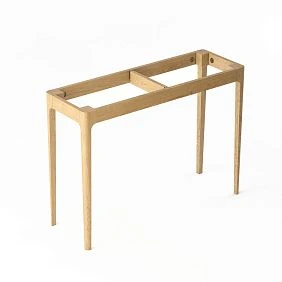
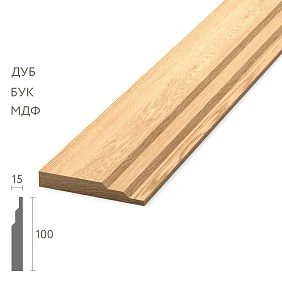
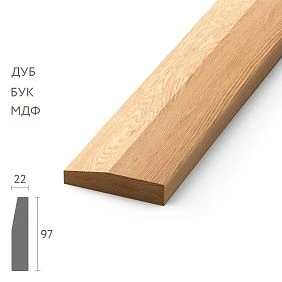
What's inside and out
The base is MDF class E1 with a density of 820–850 kg/m³. This is denser than most softwoods. It does not delaminate, does not deform with changes in humidity within normal living conditions, has no knots or internal stresses — all the things that cause natural wood to "move" with the changing seasons.
The decorative layer is a laminated PVC film with photo-printed natural textures: oak, ash, walnut, wenge. Modern technologies allow creating coatings with embossing that mimics wood pores — when visually inspected from a distance of 1–1.5 m, it is almost impossible to distinguish such a skirting board from natural wood.
Get Consultation
Available decors
The most popular options:
-
MDF skirting board oak (natural, honey, bleached) — the most popular decor for laminate or engineered wood flooring in oak shades
-
MDF skirting board gray oak — for modern interiors with gray floors and light walls
-
MDF skirting board light oak — for Scandinavian and minimalist spaces
-
MDF skirting board ash — for light natural interiors without accents
-
MDF skirting board wenge — for dark floors and contrasting solutions
-
MDF walnut skirting board — a warm, rich shade for classic and neoclassical interiors
Important detail: each manufacturer of laminate, parquet board, and engineered board has its own "signature" decor shades. Skirting board manufacturers aim to replicate the most popular ones. When choosing, it's important to compare samples in person, not rely on the name.
Even geometry as the main advantage
MDF is an engineered material with zero internal stress. Planks from the same production run are identical in geometry: straight, without bends, with uniform thickness along the entire length. This is critical for installation: the skirting board fits without gaps, corners align precisely, and joints along the length are minimal.
Unlike natural wood, MDF does not react to seasonal humidity changes with expansion or shrinkage. Once installed, it remains unchanged.
What is a natural wooden skirting board
Wooden baseboard — a plank carved from solid wood. Most often it is oak, beech, pine, ash, or larch. Each plank is unique in pattern: annual rings, pores, fiber texture — none of this repeats on two adjacent planks, even from the same batch.
This is the main difference from MDF: living material versus engineered. Living means tactilely warm, visually organic, noble in origin. But "living" also means more demanding in terms of operating conditions.
Structure and properties
Solid wood has a directional fiber structure. This is what makes wooden skirting boards vulnerable to humidity: wood absorbs and releases water vapor, slightly expanding and contracting. In living spaces with normal humidity (40–60%), this movement is minimal, but with long planks along a 4–5 meter wall, it can be noticeable.
On the other hand, solid wood is the only material that can be sanded and repainted an unlimited number of times. If the skirting board is scratched, faded, or the interior color changes, a wooden skirting board can be restored in place. MDF with a laminated film does not offer this possibility.
Finishing and top coatings
wooden baseboard can be sold:
-
In its 'pure' form (without top coating) — for self-staining or painting
-
Coated with oil or wax — for a natural look with open pores
-
Coated with varnish — glossy or matte finish
-
White primed — for further painting in any color
The ability to self-stain is a significant advantage when matching a specific parquet: the tinting oil is mixed to the desired shade and applied to the baseboard, achieving an exact match with the floor.
MDF baseboard imitating wood: when it's the right choice
There are situations where An MDF skirting board with a wood finish — it's not a compromise, but an optimal solution. Let's analyze them honestly.
Under laminate with wood imitation
Laminate is also MDF with a decorative layer. By its nature, it is identical to MDF skirting board with a wood finish. Placing a natural wooden skirting board next to such flooring means mixing a living material with its imitation in the same space. The eye notices this: the wood texture on the floor is "printed," while on the skirting board it is "living" — a mismatch.
An MDF skirting board in the same decor as the floor is an architecturally honest solution. One material nature, one surface character, an identical shade. The lower contour of the room reads as a single whole.
For modern and minimalist interiors
Scandinavian style, minimalism, modern classic — all tend toward clean geometry, smooth surfaces, calm colors. The living texture of natural wood with the individual pattern of each plank can be "too intense" in such an interior. A smooth, uniform MDF skirting board surface in a "light oak" or "gray oak" decor is a perfect fit.
Where stability is needed
Kitchens (not near the sink), high-traffic hallways, rooms with unstable temperatures — MDF is preferable to natural wood here. The lack of reaction to humidity means the skirting board will not dry out, swell, or pull away from the wall.
Under MDF skirting board in the color of the doors
Doors in oak, ash, walnut — and a skirting board in the same decor. Matching an MDF oak skirting board to a door is easier than tinting a wooden skirting board to match a specific door decor. Manufacturers offer a wide palette of decors covering most popular door shades.
About how to choose Which MDF Skirting to Choose for a specific type of floor and interior, detailed in a separate guide.
Wooden baseboard: when natural wood is irreplaceable
There are scenarios where only natural Wooden baseboard gives the correct result. And it's not about snobbery, but about the logic of materials.
Natural parquet requires a natural baseboard
Parquet blocks, engineered wood flooring with natural veneer, solid wood flooring — these are living surfaces with individual patterns, tactile warmth, and unique character. Placing an MDF baseboard with a "printed" wood pattern next to such a floor is like wearing a haute couture tie with a polyester suit. The mismatch in the nature of materials is felt.
A natural wooden baseboard next to natural parquet is organic. One material, one world, one conversation about nature and time.
Classic and Neoclassical Interiors
In a classic interior, details matter. Profiled cornices, wooden architraves, wooden doors with solid casings, oak floors — this entire ensemble requires a baseboard that is part of the same "breed". wooden baseboard with a figured profile made of solid oak — that's the one.
Classic does not tolerate substitutes. But a wooden baseboard in a classic interior "lives" and gains value together with the entire space.
Country houses and wooden interiors
Wood in the interior of a country house is not decor, it is a principle. Wooden beams, walls lined with clapboard or timber, wooden stairs, solid wood furniture — there is no place for imitation film here. A wooden baseboard made of pine, larch, or oak is the only honest choice.
Possibility of restoration and tone change
If in 10 years you decide to repaint the interior or change the wall color, a wooden baseboard can simply be sanded and re-toned or repainted. MDF with laminate will have to be completely replaced.
This is especially important in houses built 'to last for centuries,' where finishes are changed gradually, not all at once.
How to choose a shade: oak, gray oak, wenge, ash, light wood
The shade of the baseboard is the most subtle issue. A 10% difference in tone creates either harmony or a sense of randomness.
Skirting Board in Floor Color
The simplest and most foolproof method. The baseboard is chosen as close as possible to the shade of the flooring. The result is that the lower contour 'continues' the floor, visually expanding it.
Nuance: 'close' does not mean 'slightly darker' or 'slightly lighter.' A slight mismatch in shade, when two similar but still different colors stand next to each other, is worse than an obvious contrast. Either an exact match or a deliberate contrast.
Baseboard matching the color of doors and trim
The second classic technique: the baseboard matches the color of the door leaf and architraves. For doors in oak — MDF skirting board oak the same shade. This forms a "frame" of the doorway, extended down along the perimeter of the room.
This technique is especially effective in rooms with multiple doors: a uniform shade of doors and baseboard creates a framing system that unifies all walls.
Baseboard matching furniture color
A rare but very precise technique: the baseboard is chosen to match the dominant shade of the furniture. This works in rooms where furniture is the main element of the interior — for example, in a library with wooden shelves or a dining room with a massive wooden table.
Contrasting baseboard
Intentional contrast: a dark baseboard on a light floor or a light one on a dark floor. This is a designer accent that emphasizes the horizontal line of the lower part of the wall. Works in bold interiors where there is no room for random details.
Example: white walls, light ash parquet, MDF baseboard in wenge or wooden baseboard in dark stain. The lower contour of the room becomes an expressive graphic element.
Light oak: delicacy and versatility
MDF baseboard light oak or MDF baseboard oak 80 80 mm high — the most versatile solution. Light oak does not compete with the walls, does not weigh down the space, and harmonizes with most floors and doors in a neutral palette.
In small rooms, bedrooms, children's rooms — a light wood-look baseboard preserves a sense of lightness and air.
Dark shades: strength and risk
MDF baseboard in wenge, dark walnut, mocha — these are strong shades that require a confident hand. In a large, spacious room with a high ceiling, a dark baseboard adds weight and grounding. In a small room, it visually narrows it from below, creating a feeling of crampedness.
Rule: dark baseboard — for large rooms, high ceilings, and spaces where the floor is also dark.
What to choose for laminate, parquet, and engineered wood flooring
Each type of flooring requires its own approach when choosing a baseboard.
Under laminate
Laminate is MDF or HDF with a decorative layer. Pairing it with a wood-look MDF baseboard is the most organic: one type of material, one type of surface. Choose a baseboard in the same decor as the floor: "natural oak", "light oak", "ash", "walnut" — depending on the laminate model.
Important: decors with the same name from different manufacturers can differ significantly. Compare actual samples, not photos.
For solid wood parquet and parquet board
Natural parquet is a living material with a unique pattern. Here, it is logical with a classic profile creates a sense of solidity, reliability. from a similar or close wood species. Oak parquet — oak baseboard. Ash parquet — ash baseboard or in ash tones.
If an exact match is not possible — choose a lighter shade: a light baseboard next to a darker parquet looks more elegant than the opposite. Or — a deliberate contrast: a white wooden baseboard with any parquet.
By the way, a white wooden baseboard is a primed or white enamel-painted solid wood. It is neat, neutral, and works with any natural floor.
For engineered board
Engineered wood flooring is a multi-layer construction with natural veneer on the surface. It is closer in nature to parquet than to laminate. Both options look equally organic with it: MDF baseboard in the corresponding decor, and Wooden baseboard with a board-like tint.
The decision is made based on the overall interior style: modern/minimalist — MDF, classic/natural — solid wood.
When the baseboard should be calmer than the floor
If the floor is "active" in pattern — a pronounced wavy parquet pattern, contrasting veins in stone, a large laminate pattern — it is better to choose a calmer baseboard. A neutral light oak or even a white baseboard. Two active patterns next to each other (floor + baseboard) create visual noise.
What to choose for doors and architraves: options table
| Doors | Trim | Optimal skirting board |
|---|---|---|
| White | White | White MDF or white wood |
| Natural oak finish | Oak finish | MDF oak skirting board / wood oak skirting board |
| Light oak finish | White | MDF light oak or white skirting board |
| Wenge finish | Wenge finish | MDF wenge skirting board / dark wood |
| Natural wood (solid) | Wooden | Wooden skirting board (same material) |
| Hidden (without casings) | No | Straight MDF baseboard for painting |
| Gray | Gray | MDF baseboard gray oak |
White doors and wood-look baseboard: a working contrast
One of the most pressing questions: can you install MDF baseboard with a wood finish when you have white doors? The answer is yes, provided the choice is deliberate. White doors + wood-look baseboard is a contrast between the 'architectural frame' and the 'warm base.' Neutral walls, white doors, wooden floor, baseboard continuing the floor up the wall — there is logic.
The main condition: the baseboard color should echo the floor, not the doors. Then the baseboard 'belongs' to the floor, and the white doors to their own level. If the baseboard matches the door color (white) while the floor is dark, the floor and baseboard become 'disconnected,' which looks visually disjointed.
Wooden doors and wooden baseboard: a material dialogue
Solid wood or veneer wooden doors paired with solid wood baseboard create an ideal ensemble. Both elements speak the same language of natural wood. Even if the shades differ slightly, it is acceptable because natural wood always varies within the same species.
A completely different story is when the baseboard is 'oak-look' (MDF) and the door is 'oak-look' (laminate). Here, two wood surrogates must match perfectly in shade, otherwise the difference is immediately noticeable. So if both doors and baseboard are MDF with a decorative finish, aim for an exact match of samples.
Installation, angles and joints: what's important to know about each material
Installation is the practical side of choice. And here MDF and wood behave differently.
MDF baseboard: precision from the first cut
MDF baseboard requires an accurate cut right away. The laminated coating doesn't allow you to "finish" the cut after installation — you can't touch up or sand the film. Therefore:
-
Only a fine-tooth blade (80+ teeth)
-
Test cut on a scrap piece
-
Check the wall angle before cutting
-
Painter's tape along the cut line on baseboards with white or light decor
The ends at doorways need to be primed and painted — gray MDF in the cut is unacceptable next to any decor.
Details on proper installation of MDF baseboard — in a separate guide.
Wooden baseboard: possibility of refinement
Wooden baseboard is more "forgiving" during installation. The cut can be sanded, the end can be coated with the same oil or varnish as the surface. A slight mismatch at the end is covered with a tinting compound matching the tone.
When working with solid wood, it is important to consider the direction of the grain when cutting: sawing across the grain gives a cleaner cut than sawing along it. A fine-toothed blade is mandatory here as well.
Corners: MDF requires precision, wood allows for finishing
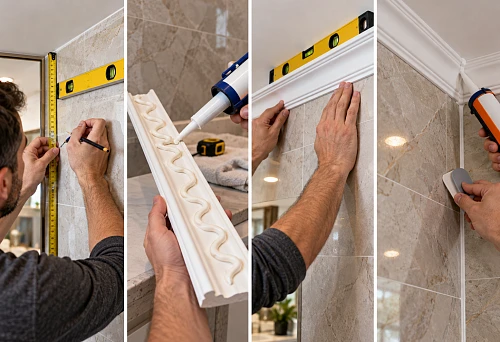
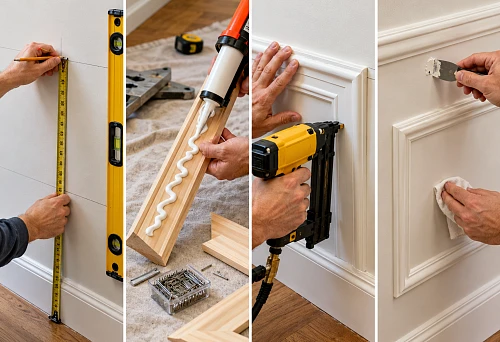
Internal and external corners are the most complex joints when installing any baseboard. For MDF baseboard with wood finish a 45° cut is made strictly according to the measured angle: the actual wall angle is divided by 2, set on the miter saw.
For wooden baseboard, the same technique, but after installation, finishing with fine sandpaper (P240–P320) and touch-up with a tinting compound is possible.
On external corners, both materials benefit from the application wooden corner piece. It hides the ends and the vulnerable joint point, adds decorativeness, and simplifies installation on non-standard corners.
About the nuances of working with corners of wooden baseboard — cutting at 45° and joining in non-standard situations — there is a separate article.
Wide baseboard: when a large height is needed
The height of the baseboard is a separate issue. For classic interiors with high ceilings, the optimal choice is Wide Wooden Skirting Board a height of 100 mm or more with a pronounced profile. Such a baseboard creates an architectural "step" between the floor and the wall, emphasizing the scale of the room.
For small apartments with ceilings of 2.5–2.7 m, a baseboard of 60–80 mm is suitable. It is delicate, does not overload the lower part of the wall, and looks equally good in both MDF and solid wood versions.
Additional elements of wooden design
The baseboard is an important, but not the only decorative element of the lower tier of the interior. When the choice is made in favor of a wooden theme (MDF with wood finish or solid wood), it is important to select the remaining elements in a coordinated manner.
Wooden slat
wooden plank — a thin decorative strip made of solid wood. It is used as a dividing element between zones, decorative framing of panels, or a horizontal belt on the wall. In combination with a wooden baseboard and wooden architraves, it creates a complex but cohesive system of wooden interior framing.
In modern interiors, wooden slats are actively used to create "slatted" panels — vertical or horizontal. A baseboard in the same wood shade completes this ensemble from below.
Wooden molding
wooden molding — a profiled decorative strip. In a classic interior, moldings are used to frame doorways, create coffered ceilings, and divide walls by height. Paired with a wooden baseboard, a molding made of the same solid wood forms a cohesive architectural system.
Molding products: a complete system
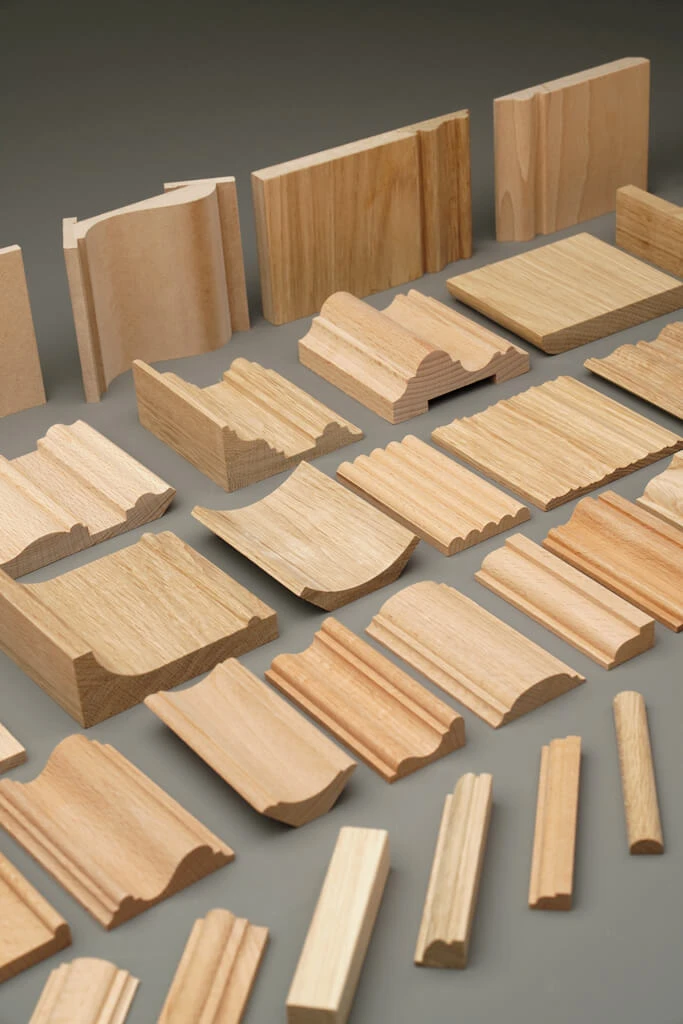
Trimming Items made of solid wood — this is the entire range of linear decorative elements: baseboards, corners, slats, moldings, cornices, architraves. Purchasing all elements of wooden design from one manufacturer guarantees material and shade consistency. This is critical in wooden interiors, where a mismatch in tone between two "natural" elements looks careless.
Mistakes when choosing a baseboard for wood
Eight situations that turn a good idea into a bad result:
1. Take a skirting board "roughly matching oak" without comparing it to the floor. "Oak" is too broad a concept. Honey oak, bleached oak, gray oak, natural oak are different shades that don't go together side by side. Always compare samples in person under the same lighting as in the room.
2. Mixing several wood shades. Laminate "walnut", doors "oak", skirting board "ash" — three different woods in one room create chaos. Choose one wood theme and stick to it.
3. Installing MDF with a wood finish next to natural parquet without checking. Even a close shade of MDF film next to the live texture of parquet can look "plastic". Check in person: hold the skirting board sample against the floor near a lit wall.
4. Choosing a skirting board that is too dark in a small room. A dark skirting board in a small space visually shrinks it from below, creating a "box" feeling. In small rooms, use a light or neutral skirting board.
5. Ignoring the color of doors and architraves. The skirting board is not chosen in isolation from the doors. If the architraves are white and the skirting board is dark walnut, the gap at the doorway will be sharp and unattractive.
6. Choosing a profile without considering the furniture. A massive classic skirting board profile next to minimalist cube furniture creates a style conflict. The skirting board profile should echo the profiles of furniture fronts and doors.
7. Not considering the height of the skirting board for specific furniture. If low furniture will be placed along the wall, the skirting board behind it won't be visible. The height of the skirting board only matters where the wall is exposed. In niches behind furniture, you can use a more modest option.
8. Buying different batches of MDF skirting boards hoping they match. The same decorative name from different batches may have a slight difference in shade. Buy all the required quantity of skirting boards at once, from the same batch.
MDF skirting board with wood finish vs wooden skirting board: final comparison
| Parameter | MDF skirting board with wood finish | Solid wood skirting board |
|---|---|---|
| Material | MDF + decorative film | Natural wood (oak, beech, pine) |
| Appearance | Uniform, printed texture | Natural, unique grain |
| Stability | High (does not react to moisture) | Medium (may move with humidity changes) |
| Restoration possibility | No | Yes (sanding, repainting) |
| Matching laminate | Ideally | Possible, but more difficult |
| Matching parquet | Possible | Ideally |
| Installation | Requires precise cut immediately | Allows refinement |
| Optimal style | Modern, minimalist | Classic, natural, countryside |
| Price | Affordable | Higher |
What to buy for a finished interior
an MDF skirting board with a wood finish is — for modern interiors, under laminate, under MDF doors, in shades of oak, ash, walnut, wenge, gray oak.
MDF skirting board oak — the most popular decor. Suitable for most floors in oak shades.
Wooden baseboard — for natural interiors, under parquet, under wooden doors, for classic and country houses.
Wide Wooden Skirting Board — for high ceilings and grand interiors where the lower tier needs architectural expressiveness.
Wooden corner bracket — for finishing external corners and ends of doorways. Hides joints and vulnerable points.
wooden plank — for slatted panels, horizontal belts, and decorative framing. Combined with a wooden baseboard, it creates a unified wooden system.
wooden molding — for classic interiors, framing openings, and creating coffered elements.
Trimming Items — a full range of wooden linear elements from one manufacturer: guaranteed material and tone matching.
More about MDF skirting board sizes and profile options for different room types — in a separate comprehensive guide.
FAQ: Answers to popular questions
Which is better: MDF baseboard with wood finish or wooden baseboard?
It depends on the floor and interior style. For laminate and modern apartments — MDF with wood finish: more stable, more precise in geometry, easier to match with doors. For natural parquet, in classic and country interiors — solid wood baseboard: living texture, material organicity, possibility of restoration.
Which baseboard to choose for oak laminate?
MDF baseboard in the same decor: "natural oak", "light oak", "bleached oak" — depending on the laminate shade. Be sure to compare samples in person, do not rely on photos.
Is MDF baseboard suitable for parquet?
Technically — yes. But visually, a natural wooden baseboard next to real parquet is more organic. MDF with wood film next to real parquet can sometimes create a feeling of "real vs imitation". The exception is if the shade is matched very precisely and the parquet has a uniform pattern.
How to choose a skirting board for wooden doors?
Ideally, a wooden skirting board made of the same material or a similar species. If the doors are MDF with a wood-like decor, use an MDF skirting board in the same decor. Key point: compare actual samples near the door block in neutral daylight.
Should the skirting board match the floor or the doors?
Both options work. A skirting board matching the floor visually extends the floor up the wall. A skirting board matching the doors creates a unified framing system for doorways. The choice depends on what is more important: connecting the floor with the walls or creating a unified door system.
Can you combine an MDF skirting board with a wood finish and white doors?
Yes, this is a practical and popular combination. White doors + wood-finish skirting board — the skirting board 'belongs' to the floor, the doors to their own level. The main condition: the color of the skirting board should harmonize with the floor, not clash with the white doors.
When is it better to choose a natural wooden skirting board?
When the interior features natural parquet, solid or veneered furniture, solid wood doors, wooden cornices or moldings. In classic, neoclassical, and country-style interiors. When the ability to restore and change the tone is important.
How to avoid mistakes with the oak shade?
One rule: only real samples. Bring a piece of laminate or skirting board to the site, place it against the floor near a window in daylight. Assess the match. A difference barely noticeable under artificial light can be obvious in daylight. And always buy the entire required volume from the same batch.
About the company STAVROS
Wood in the interior is not just a material. It is a decision about what the space should be: lively or geometric, warm or cold, classic or modern. The right baseboard is part of that decision.
STAVROS produces baseboards and decorative items from natural solid wood (oak, beech, pine) and high-quality MDF with a decorative coating. The company's assortment includes a wide selection of wood-look baseboards: from light oak to dark wenge, from compact 60 mm to stately 150 mm. All products are manufactured on in-house lines, with geometry and coating quality control at every stage.
STAVROS is not just baseboards. Wooden corners, slats, solid wood moldings, linear products — a complete system of wooden design from a single manufacturer with a consistent level of quality and coordinated dimensions.
buy MDF skirting board wood-look, Wooden baseboard solid wood, clarify MDF skirting board price per meter — all this is in the catalog on the website. Consultation on selecting the shade, profile, and configuration for a specific project is also available there.