Article Contents:
- What L and R mean in stucco decor: figuring it out once and for all
- How not to confuse the direction
- Why you can't buy two identical 'L' pieces
- Why one detail decorates, but a pair creates an interior
- The axis principle in interior design
- Where paired stucco looks especially expensive
- Mirror: from a piece of furniture to an architectural element
- Bed headboard: light classic without heaviness
- Door portal: a frame that elevates an opening to the rank of architecture
- Fireplace: a strict center with two guards
- Furniture facades: custom furniture for pennies
- Birds L/R: a living example of how a pair turns into a scene
- NPU-492L and NPU-492R: a large pair with expressive relief
- NPU-493L and NPU-493R: medium scale, universal character
- NPU-494L and NPU-494R: for a nautical theme and bathroom
- NPU-497L and NPU-497R: a delicate accent for narrow areas
- Small paired elements: when delicacy is more convincing than scale
- NPU-476L and NPU-476R: a carved pair of medium format
- NPU-477L and NPU-477R: a compact pair for furniture and small areas
- How to combine paired moldings with trim: a frame that changes everything
- Molding + L/R + center: a formula for any room
- Scale of molding relative to overlays
- How to avoid mistakes when buying L/R overlays: five real mistakes
- Mistake 1: buying only one side
- Mistake 2: confusing the direction
- Mistake 3: taking small decor for a large wall without a frame
- Mistake 4: not considering the relief for furniture
- Mistake 5: mixing incompatible styles in one area
- Ready-made purchase scenarios: what to take and where to place
- Scenario 1: mirror in the bedroom or hallway
- Scenario 2: headboard of the bed
- Scenario 3: door portal
- Scenario 4: furniture facade
- How to paint paired polyurethane moldings: five working strategies
- Strategy 1: monochrome matching the wall color
- Strategy 2: white on a dark background
- Strategy 3: patina on the relief
- Strategy 4: matching the furniture color
- Strategy 5: gold accents, detailed
- How to buy a pair of stucco moldings and not end up with random decor
- Frequently asked questions about paired L/R stucco moldings
- About the company
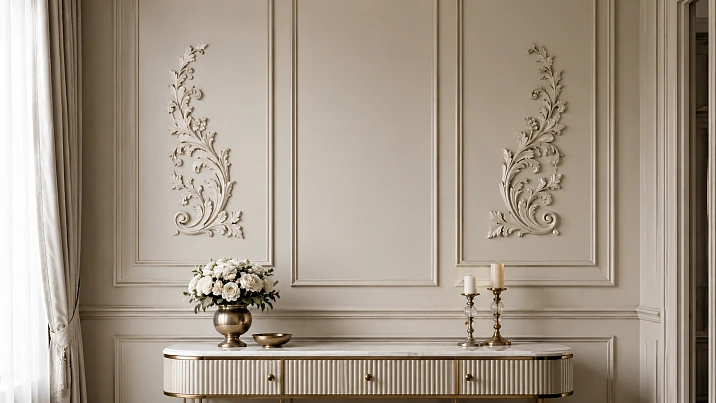
There is a moment when working with an interior when something clicks — and the space ceases to be just "well-finished" and becomes truly complete. Most often, this moment is not related to expensive furniture or rare materials, but to symmetry. To the fact that what is on the left is the same as what is on the right. That two details form an axis. That the decor is arranged not randomly, but according to a rule. This is what makes paired stucco molding — the left and right overlay, working together. This is not just decoration, it is architectural punctuation: two neat brackets, between which meaning appears — a mirror, a bed, a fireplace, a doorway, or simply a flawlessly assembled wall.
If you have ever noticed that in one interior the stucco molding looks like it was "slapped on", while in another it seems like it was always there, the difference is almost always in one thing: in the first case, the decor was chosen on the principle of "liked it", in the second — on the principle of "paired, symmetrical, in a system". Decorative polyurethane stucco molding, when used correctly, turns an ordinary wall into an architectural statement. And Buy Molded Decoration correctly means thinking immediately in pairs, not as a single element.
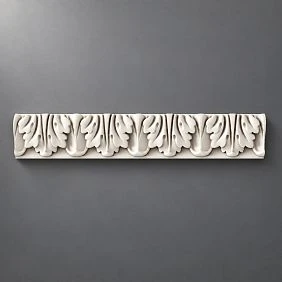
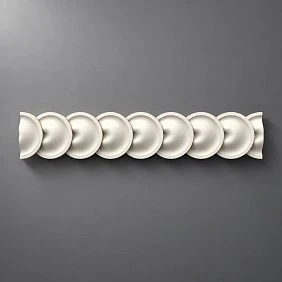
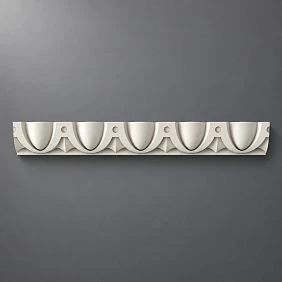
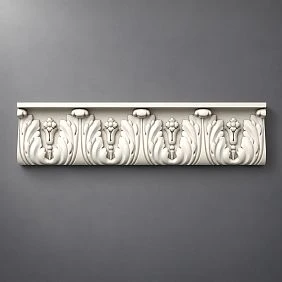
What L and R mean in stucco decor: figuring it out once and for all
The abbreviations L and R are deciphered simply: L — left; R — right. But behind this simplicity lies a fundamentally important thing. The left and right decorative overlays are not copies of each other, but mirror elements. If you look at them with the front side facing you, the ornament, figure, or relief on the L-element is an exact mirror image of the R-element. The bird on the left overlay looks to the right, the bird on the right — to the left. They are turned towards each other — and it is in this turning that the very axis is born, which makes the interior alive.
That is why when purchasing polyurethane decorative overlays for symmetrical zones — mirrors, portals, headboards, doorways — you should always order both positions: L and R. A single overlay bought "as a test" almost never gives the intended result. Because the concept was paired — but the execution turned out to be half-hearted.




How not to confuse the direction
A simple rule: imagine that the center of your composition is a mirror, fireplace, or headboard. The left overlay is installed to the left of the center, and its decor (bird, ornament, curl) "looks" inward, i.e., to the right — toward the center. The right overlay is installed to the right, and its decor "looks" to the left — also toward the center. If both figures face the center — the composition is correct. If they "fly apart" in different directions — L and R are mixed up somewhere.
A second way to check: take a photo of your L overlay, mirror the photo — and you will get what R should look like. If the product cards match — the pair is selected correctly.
Our factory also produces:
Why you cannot buy two identical "L"
This is a common mistake by buyers: they see a beautiful element, order two pieces of the same position. On the wall, you get not symmetry, but movement in one direction — as if both decorations are trying to fly out of the frame. This is especially noticeable for a mirror: the left bird looks to the right, and the second "left" also looks to the right — as a result, there is no center, no axis, no sense of completeness for which it was all started. The correct Polyurethane moldings always involves understanding how the element is oriented in space.
Get Consultation
Why one detail decorates, but a pair creates an interior
Remember how earrings work. One earring is oddness or a deliberate artistic technique. Two — a complete look. The same goes for sconces on either side of a headboard, columns on either side of a portal, pilasters along the edges of a wall. Pairing is not a whim of classicism; it is a principle built into human perception: symmetry is read as order, order is read as intentionality, intentionality is read as quality.
One stucco element on the wall is decor. Beautiful, perhaps even very beautiful. But it remains an object, accidentally attached to the surface. A pair L/R is already architecture. It sets an axis, fixes the center, creates zone boundaries. A wall with a pair of overlays and a molding frame between them is a panel. A mirror flanked by a pair of overlays with birds is an almost finished composition from a palace interior, only without the palace price. That's why Buy molding correct means thinking immediately in terms of a system, not a separate element.
The principle of the axis in the interior
In classical architecture, the axis is an invisible line of symmetry around which the space is organized. Every palace hall has an axis: usually it's the line from the entrance door to the main window or fireplace. Everything located along this axis works to strengthen it. A pair of elements on either side of the axis — columns, sconces, pilasters, overlays — not only decorates the wall but literally "holds" the axis, making it visible and tangible.
In a modern interior, this principle works the same way, just on a smaller scale. The axis above the headboard is a vertical line of symmetry held by two overlays on the sides. The axis above the fireplace portal is horizontal, held by a mascaron in the center and a pair of overlays on the sides. The axis of the mirror in the hallway is the same story. Decorative stucco in the L/R format is a tool for working with axes, not just a "beautiful detail."
Where paired stucco looks especially expensive
There are several scenarios where a pair of L/R polyurethane overlays provides maximum visual effect with minimal investment. It is at these points that decor ceases to be decor and becomes architecture.
Mirror: from a piece of furniture to an architectural element
An ordinary mirror in a standard frame is a functional object. A mirror flanked by a pair of overlays with birds or ornament is already an integrated architectural accent, part of a well-thought-out wall. That's why stucco decor for mirror — one of the most popular requests among those who are engaged in independent interior design.
The principle is simple: a pair of L/R overlays are installed on the sides of the mirror — symmetrically, at the same height. The decor of the overlays faces the mirror (inward). If you add a molding frame around the perimeter of the mirror and a pair of overlays at the top corners, you get a full-fledged mirror panel that looks like a product "from a workshop." At the same time, the cost of the entire system is several thousand rubles.
Bed headboard: light classic without heaviness
Headboard is the most noticeable area of the bedroom. It is what catches the eye when entering the room, and it sets the overall character of the space. Heavy wooden headboards, soft panels with carriage stitching, forged structures — all this is good, but requires either budget or installation. A pair of L/R overlays above the bed is a light, elegant alternative: they create the same symmetry and accent, but cost many times less and are installed in an hour.
Both large pairs with expressive relief (for bedrooms with high ceilings and spacious rooms) and delicate small-format overlays (for standard apartments where you don't want to "overload" the bedroom with classics) work well. Polyurethane wall molding in the version of a pair above the headboard — this is a solution that works both in neoclassicism and in modern interiors with a neutral palette.
Door portal: a frame that elevates the opening to the rank of architecture
An ordinary door opening is just a hole in the wall with a frame and casing. A door portal with paired overlays on the sides and an accent element on top is already an architectural statement. In classic interiors, every door was designed this way. In modern ones, one or two key doors (for example, to the living room or study) are enough to give the interior the necessary degree of "palatialness."
Paired overlays for the portal can be placed in two ways: vertically on the sides of the door frame (like pilasters, only decorative) or horizontally above the opening — symmetrically on both sides of the central element. Both options work, but require precise calculation of scale relative to the height and width of the opening.
Fireplace: a strict center with two guards
The fireplace area is traditionally the main architectural accent of the living room. The fireplace itself is already a dominant feature, and the task of decor is not to compete with it, but to enhance its significance. Paired L/R overlays on either side of the fireplace portal work exactly like this: they "hold" the portal, fix its boundaries, and turn the hearth from an interior item into a true architectural object.
Here, size matters: the overlays must be proportionate to the portal, not get lost against its background. For fireplaces of standard height (120–140 cm), overlays 25–40 cm high with a pronounced relief work well. Above the portal on the axis of symmetry — a mascaron or central decorative element, on the sides — a pair L/R. This is a three-part system familiar from the entire history of European architecture — from Renaissance mansions to Soviet "Stalinkas."
Furniture facades: custom furniture for pennies
A kitchen set, wardrobe, chest of drawers in the hallway — standard furniture with flat facades looks like store-bought furniture. The same furniture with paired decorative overlays on the doors looks like custom joinery work. The difference in perception is colossal. The difference in cost is minimal.
For furniture facades, small-format overlays with delicate relief are used: no deeper than 15–20 mm so the doors close properly. Pairing works on two levels here: left and right overlays on one door (symmetrical along the vertical axis) or mirrored overlays on two adjacent doors (when they face each other along the horizontal axis). Buy decorative polyurethane overlays for furniture means radically updating its appearance in one evening.
Birds L/R: a living example of how a pair turns into a scene
If you choose one motif that best demonstrates the power of paired stucco — it's birds. A bird in flight itself carries movement, direction, energy. But one flying bird is a vector without a counter-vector, force without balance. Two birds facing each other — that's already a dialogue, a scene, a complete story. They hold the space between them — and it is in this space that everything needed fits: a mirror, a lamp, a painting, or simply a beautifully painted wall.
Paired decorative overlays with birds are one of the most sought-after items in foam decor made of polyurethane. This is understandable: the bird is a universal image that fits into classic, neoclassical, art deco, modern interiors with natural motifs, and even some versions of minimalism, if the relief is restrained enough.
NPU-492L and NPU-492R: a large pair with expressive relief
Molded decor NPU-492L и NPU-492R — this is a pair with clearly defined wings and pronounced silhouette plasticity. Price 1,490 rubles per piece, total set — 2,980 rubles. This size is clearly readable from a distance of 3–4 m, making the pair suitable for living rooms, bedrooms with high ceilings, hallways with an accent wall. They are installed above the headboard, on the sides of a mirror, symmetrically around a fireplace portal, on pilasters on either side of a doorway.
Painting: in the color of the wall — for a restrained "architectural" effect; white on a dark background — for maximum visual accent; in gold patina — for classic interiors with a warm palette. This is the pair chosen when you want a result that is immediately noticeable.
NPU-493L and NPU-493R: medium scale, universal character
Molded decor NPU-493L и NPU-493R — 1,430 rubles per piece, set 2,860 rubles. A slightly smaller format compared to the 492 pair, but the same level of detail. This option is more universal: suitable for standard apartments with ceilings of 2.5–2.8 m, for medium-sized mirrors, for large-format furniture facades (tall cabinets, side panels of beds). If the 492 pair is a "palatial" gesture, then the 493 is a "boutique hotel" accent: refined but not loud.
NPU-494L and NPU-494R: for nautical theme and bathroom
Molded decor NPU-494L и NPU-494R — 1,290 rubles per piece, set 2,580 rubles. Overlays with a curved silhouette, perfectly suited for a nautical theme: bathroom, country house by the water, restaurant with a marine concept. Polyurethane is completely moisture-resistant, making this pair ideal for wet rooms. On the sides of a mirror in the bathroom, above the bathtub, in shower niches — this is a ready-made designer trick that costs several times less than custom tile mosaics or expensive frames.
NPU-497L and NPU-497R: a delicate accent for narrow areas
Molded decor NPU-497L и NPU-497R — 1 010 RUB per piece, set 2 020 RUB. Small format for narrow piers, door trims, small furniture fronts. Precision in selection is important here: a small pair will get lost on a large empty wall. But the same pair in a molding frame with spot lighting works like a jewelry detail. This is an option for those who want a 'hint' rather than a 'statement'.
Small paired elements: when delicacy is more convincing than scale
There is a misconception that an expensive interior necessarily means large decor. In fact, it is often a small detail, placed precisely and in pairs, that makes the strongest impression. Because it shows intentionality: the person knew what they were doing. They didn't just 'hang something pretty'—they created a system.
Small-format paired overlays work especially well on furniture: cabinet doors, dresser drawers, side walls of shelving units. Here, the relief should not be deep—8–15 mm is enough for the detail to be readable but not interfere with functionality. In a standard apartment, this technique turns an IKEA cabinet into 'almost designer' furniture that guests notice.
NPU-476L and NPU-476R: carved pair of medium format
Molded decor NPU-476L и NPU-476R — 1 360 RUB per piece, set 2 720 RUB. A carved overlay with a detailed ornament that works well both as an independent pair on the wall and in a molding system. Suitable for areas of moderate size: bedrooms, studies, hallways with an accent wall. The relief allows for interesting light play with side or directional lighting.
NPU-477L and NPU-477R: compact pair for furniture and small areas
Molded decor NPU-477L и NPU-477R — 980 RUB per piece, set 1 960 RUB. One of the most affordable options for paired polyurethane stucco in the line. At the same time, the quality of detailing is in no way inferior to larger items. Ideal for furniture fronts: kitchen cabinet doors, dresser drawers, display cabinet doors. Installed symmetrically—either on one door or on two adjacent ones. buy decorative moldings in this format means investing a minimum and getting a maximum of noticeable effect.
How to combine paired stucco with moldings: a frame that changes everything
Molding is a frame. Paired stucco is an accent. Individually they are good, together they are architecture. It is the combination of a molding frame and a pair of L/R overlays that turns an ordinary wall into a deliberate interior composition.
The principle of operation is simple: Moldings made of polyurethane — cornices, friezes, architraves — create a rectangular or arched frame on the wall. Inside this frame is the central element: a mirror, a painting, a painted rectangle of contrasting color, a lamp, or simply a beautifully painted surface. Along the edges of the frame, symmetrically, is a pair of L/R overlays. The decor faces inward, toward the center. Done: the wall has become a panel.
Molding + L/R + center: formula for any room
Here is how this formula works in specific rooms:
Bedroom
— a molding frame above the headboard, inside which is a painted surface or textured wallpaper, with a pair of birds on the sides. This replaces a soft headboard and costs significantly less with the same visual impact. Living room — a horizontal frame made of molding above the sofa, with decorative rosettes at the corners of the frame and paired overlays on the sides. The wall above the sofa ceases to be "empty" and becomes the main accent.
Hall and hallway
— a vertical frame with a pair of overlays on the sides and a central mirror or console underneath. The hallway acquires a "palatial" scale even in a standard apartment. Study
— a strict rectangular frame with a pair of symmetrical overlays, inside which is a painting or a color rectangle. Classic study finishing, often seen in executive office interiors.Decor for Molding — additional corner sockets, keystones, and decorative joint elements complete the system and eliminate the problem of corner joints of moldings, making the frame truly finished.
Scale of the molding relative to the overlays
One of the most important parameters when selecting a system is matching scales. A thin molding 20–30 mm wide does not 'hold' a large overlay with deep relief — it will look like an element breaking out of the frame. Conversely, a wide cornice 80–100 mm with a massive profile will overwhelm small delicate overlays of small format.
Rule: the height of the molding profile should be approximately 1/3 of the height of the overlay. For overlays 15–20 cm, moldings with a profile of 50–70 mm are suitable. For small-format overlays 8–12 cm, moldings 25–35 mm are suitable. Polyurethane wall decor in a system with moldings, it is necessarily selected taking into account this ratio — otherwise the composition falls apart.
How not to make a mistake when buying L/R overlays: five real mistakes
Over years of working with interior decor, a consistent list of mistakes that buyers make again and again has accumulated. Let's analyze each one — with an explanation of how to avoid it.
Mistake 1: buying only one side
The most common one. The buyer sees a beautiful product card — and takes one element, planning to 'buy the second one later' or simply not understanding that a pair is needed for their idea. On the wall, there is one overlay that looks random and 'unfinished'. Rule: if the location implies symmetry — order L and R simultaneously, in one order, from the same batch.
Mistake 2: confusing the direction
A customer orders L, thinking it's the overlay needed on the right. Or they don't understand the difference and pick at random. On the wall, the bird faces away from the center, not toward it — and all symmetry is broken. Rule: before ordering, draw a wall diagram, mark the center and sides, determine which overlay is needed on the left (L) and which on the right (R). This takes three minutes and completely eliminates errors.
Mistake 3: taking a small decor for a large wall without a frame
A small pair of overlays on a large empty wall — they are like drops on a white sheet. They don't fill the space, only highlight its emptiness. Rule: if the wall is large (from 4–5 m²), either enlarge the pair of overlays or fit them into a molding frame that will "hold" the decor and give it scale.
Mistake 4: not accounting for relief on furniture
An overlay with a deep relief of 30+ mm, installed on a cabinet door, will prevent the door from closing or catch on adjacent elements. For furniture, relief is a critical parameter. Rule: for furniture facades, choose overlays with a relief of no more than 15–20 mm; for walls, any relief based on the desired visual effect.
Mistake 5: mixing incompatible styles in one area
Birds, butterflies, fish, and a lion mascaron — each of these motifs is good in its own niche. But if you gather them all in one small area without a unified concept, the result will be visually chaotic. Rule: in one area (headboard, fireplace wall, mirror zone), use one motif or closely related motifs — birds + floral ornament, or fish + marine ornament, or lion + acanthus. Don't mix zoology without a concept.
Ready-made purchase scenarios: what to take and where to place
Here are four specific scenarios with a list of what to buy — so you don't have to guess, but act precisely.
Scenario 1: mirror in the bedroom or hallway
Task: turn an ordinary mirror into an architectural element.
What to buy:
-
Pair of L/R overlays (e.g., NPU-493L + NPU-493R)
-
Molding around the mirror perimeter (or a ready-made molding frame)
-
Mounting acrylic adhesive
-
Paint in wall color or mirror frame color
Placement principle:
overlays — on the sides of the mirror at the same height as the mirror center, decor inward, i.e., toward the mirror. Distance between the overlay edge and the mirror frame — 5–10 cm.Buy stucco decor for the mirror can be immediately in the required pair — taking into account the mirror size, select the overlay scale.
Scenario 2: bed headboard
Task: create an accent wall behind the bed without a headboard or instead of a heavy upholstered panel.
What to buy:
-
Pair of birds L/R (NPU-492L + NPU-492R for large format or NPU-497L + NPU-497R for delicate)
-
Moldings for a rectangular frame above the bed
-
Decorative corner elements for the frame
-
Glue, primer, paint
Placement principle:
Frame made of moldings — 20–30 cm wider than the bed width, 40–60 cm high. A pair of overlays — inside the frame, at the top corners or on the sides, facing the center. The center of the frame can be painted in a contrasting color — immediate effect.Polyurethane wall molding in this scenario — the basis of the entire system.
Scenario 3: door portal
Task: turn a standard doorway into an architectural portal.
What to buy:
-
Pair of medium format L/R overlays
-
Molding or pilaster decor on the sides of the door frame
-
Central accent above the door (maskaron, keystone, or horizontal molding)
-
Glue and paint
Placement principle:
overlays — on the sides of the door frame, at a height of 160–180 cm (level of the upper third of the door). Pilaster moldings — from the floor to the top of the frame. Central element — along the axis of symmetry above the door, on the architrave or directly above the frame.you can buy polyurethane molded decoration for a door portal, it's better to buy as a set — with moldings and pilaster elements from the same line, so that the scale and style match.
Scenario 4: furniture facade
Task: turn a standard cabinet or dresser facade into furniture that looks custom-made.
What to buy:
-
A pair of small-format overlays L/R (NPU-477L + NPU-477R)
-
Decorative corner moldings for the frame on the door
-
Mounting adhesive
-
Paint in the color of the facade
Placement principle:
on each door — a rectangular frame of moldings along the perimeter of the facade (indent from the edge 2–3 cm), inside the frame at the top corners — decorative overlays. Painting — in the color of the facade or with a light patina matching the hardware tone.buy polyurethane furniture decor today you can do it without big investments — and the result completely transforms the appearance of the furniture.
How to paint paired polyurethane moldings: five working strategies
Painting is the final and one of the most important stages of working with decorative moldings. It determines how the overlay will be perceived in the interior: as an independent accent or as an organic part of the wall.
Strategy 1: monochrome matching the wall color
The overlays are painted in the exact color of the wall. The relief is revealed only through the play of light and shadow — in the morning and evening, as the lighting direction changes, the decor 'appears' and 'disappears'. Effect: subtle, intelligent, aristocratic. This is the technique used in expensive projects where 'hidden luxury' is desired. Suitable for neutral palettes: white, cream, light gray, beige.
Strategy 2: white on a dark background
Classic contrast: snow-white overlays on a deeply painted wall — dark blue, emerald, graphite, ink. This is a 'museum' presentation: the decor reads as an independent object, like a sculpture against a background. Maximum visual impact at minimal execution cost. Works well in bedrooms, studies, hallways.
Strategy 3: patina on the relief
Application of a decorative compound with metallic pigment (gold, bronze, silver, copper) over dried base paint. Dry brush method: a brush with a minimal amount of compound is run over the protruding parts of the relief, leaving the recesses dark. The result is an 'aged metal' effect that works well in classic, neoclassical, art deco, and any interiors with a 'historical' character.
Strategy 4: match the furniture color
For furniture facades, overlays are painted strictly to match the furniture color — so they are perceived as an originally intended structural element, not as a "stuck-on decoration." At the same time, hardware (handles, hinges) can be selected to match the patina of the overlays — then the furniture looks like a unified design concept.
Strategy 5: gold applied selectively, on details
If you want luxury but fear overloading — gild only the tips of bird wings, only the upper third of a mascaron relief, only the "peaks" of the ornament. The rest — match the wall color or white. This way, gold works as an accent, not as a carpet. This is a subtle technique that requires precision in execution but delivers an impeccable result.
Read more about installation and finishing painting technology in the articles about installing polyurethane stucco molding и about installing polyurethane molding.
How to buy paired stucco molding and not end up with random decor
Before purchasing, it's important to follow three steps that turn a set of beautiful items into a well-thought-out system.
Step one: determine the location.
Is it a mirror, headboard, portal, fireplace, door, or furniture facade? Each location has its own placement logic and requirements for the scale and relief of the overlays. Step two: determine the axis.
Find the center of your zone and draw a diagram. The left overlay is to the left of the axis, with the ornament facing inward. The right one is to the right, also facing inward. Without this step, buying L and R becomes guesswork. Step three: choose the system.
Overlays + molding + paint is a complete set for one zone. Moldings are selected by scale relative to the overlays (1/3 of the overlay height), paint is chosen based on the selected painting strategy.You can buy ready-made stucco matching the Baroque style. Calculate the quantity: linear meters of cornices and moldings, number of rosettes, pilasters, consoles, corner elements. Add a ten to fifteen percent allowance for trimming. correctly means ordering a set, not a single part. Exactly so Decorative stucco turns from a random decoration into part of the interior architecture. Choose a paired molded decoration made of polyurethane in the decorative overlays section — and start with a pair, not a single overlay.
Frequently asked questions about paired L/R stucco
What do L and R mean in stucco decor?
L is the left decorative overlay (from English left), R is the right (right). These are not identical elements, but mirror images: the ornament or figure on the L-overlay is an exact reflection of the R. They are used as a pair to create symmetrical interior compositions — around a mirror, headboard, portal, fireplace, or doorway.
Is it necessary to buy both parts — L and R?
If the area you are designing involves symmetry (mirror, bed, fireplace, door), then yes, definitely. One overlay without a pair looks incomplete and disrupts visual order. A single element is only appropriate as a central accent (mascaron, rosette) or in a deliberately asymmetrical author's composition.
Where does paired stucco look best?
The best areas are the mirror (on the sides, with decor inward), the headboard (above the bed, symmetrical to the axis), the fireplace portal (on the sides of the hearth), the doorway (at the level of the upper third of the door), furniture facades (at the upper corners of the doors). In each of these places, the L/R pair creates an axis of symmetry that instantly enhances the perceived quality of the interior.
Can polyurethane stucco be painted after installation?
Yes, this is one of the main advantages of polyurethane. The surface is sanded (grit 180–220), primed, and painted in any color with acrylic or latex paint. It can be repainted an unlimited number of times. Polyurethane does not absorb paint deeply and does not peel the coating with proper preparation.
What to combine with paired overlays?
The best combination is with polyurethane moldings, which create a frame around the composition. Additionally — Decor for Molding (corner rosettes, keystones), ceiling rosettes, pilaster decorative elements. All of this forms a unified architectural system where L/R overlays are the accent, and moldings are the context.
What to buy together with paired stucco?
Standard set: a pair of L/R overlays + molding around the perimeter of the zone + decorative corner elements + mounting acrylic adhesive + primer + paint. Sandpaper is added for furniture. For wet rooms — moisture-resistant acrylic sealant for joints.
How to calculate the amount of molding for a frame?
Measure the perimeter of the zone (width × 2 + height × 2). Add 10–15% for trimming corner joints. If the corners are straight — joints at 45°, if arched — flexible molding or composite trimming will be required.
How much does it cost to buy paired stucco molding?
Range: from 1,960 RUB (NPU-477L + NPU-477R) to 2,980 RUB (NPU-492L + NPU-492R) per pair set. Frame molding adds from 500 to 2,000 RUB depending on the perimeter and profile width. Total complete set for one zone — from 2,500 to 5,000 RUB, which is significantly cheaper than any alternative with a comparable visual effect.
About the Company
The entire range of paired items moldings from polyurethane — L/R overlays, moldings, cornices, decorative rosettes, pilaster elements — these are STAVROS products, a Russian manufacturer of decorative polyurethane items with many years of experience and professional expertise in interior decor.
STAVROS produces items with precise relief, verified geometry, and detailing that is not lost during painting and does not blur during use. All products are made of high-quality polyurethane, which is not afraid of moisture, does not deform under temperature fluctuations, and allows repeated repainting. The assortment is regularly updated with new items, including paired collections with animal, ornamental, and plant motifs.
Order paired stucco decor, Moldings made of polyurethane и Wall Decor from STAVROS can be delivered throughout Russia — from one piece, without a minimum order, with consultation on selecting a pair and system.