










































































Article Contents:
- NPU-491 and NPU-496: two different ways to decorate the same facade
- Don't start with quantity: first decide whether the facade should have one center
- First measure the free decorative field, not the entire facade
- Make two templates: 105 × 94 mm and 46 × 46 mm
- NPU-491 — when one lotus is truly stronger than several small flowers
- One large smooth facade
- Central facade among several
- Paneled facade
- Chest of drawers with one main facade or door
- When you don't want to count intervals
- Vertical row on a tall door
- Horizontal row on a wide front
- Symmetrical pair
- Repetition on several drawers
- Decor of a narrow front
- One NPU-491 on each
- One NPU-496 on each
- Two NPU-496 on each
- One NPU-491 at the junction of the visual composition
- Option A
- Option B
- What is the difference between NPU-491 and NPU-496?
- Which overlay is larger?
- Which one is thicker?
- How much does NPU-491 cost?
- How much does NPU-496 cost?
- What is cheaper: one NPU-491 or two NPU-496?
- And three NPU-496?
- How much do four NPU-496 cost?
- What is better for one large cabinet door?
- What is better for a small door?
- Can one NPU-496 be installed instead of NPU-491?
- Can several NPU-491 be installed?
- How many NPU-496 is better to install — two or three?
- What distance should be between NPU-496?
- How to calculate the total height of three NPU-496?
- Can the NPU-496 be placed horizontally?
- And vertically?
- Can you make a square out of four NPU-496 units?
- Does the NPU-491 have to be placed strictly in the center?
- Can the NPU-491 be placed above a furniture handle?
- Can the NPU-496 be positioned around a handle?
- What is better for a dresser with four drawers?
- What is better for two identical doors?
- What is better for a three-door wardrobe?
- Do all facades need to be decorated the same way?
- Can NPU-491 and NPU-496 be used simultaneously?
- Can the overlays be painted to match the facade color?
- Which looks calmer — one NPU-491 or three NPU-496?
- What to do if NPU-491 seems too large?
- What if one NPU-496 seems too small?
- Do I need to buy several NPU-496 units for fitting?
- Is a paper template sufficient?
- What should I use to attach NPU-491 and NPU-496?
- Do I need to buy glue before choosing the quantity?
- Where can I see other overlays if none fit?
- Does NPU-491 belong to the floral ornament?
- Does NPU-496 belong to the round overlays category?
- What should be determined first before purchasing?
- How to understand that there is too much NPU-496?
- How to understand that one NPU-491 is enough?
- What is more profitable for four doors?
- What if each of the four doors needs three NPU-496s?
- How to place an order without extra overlays?

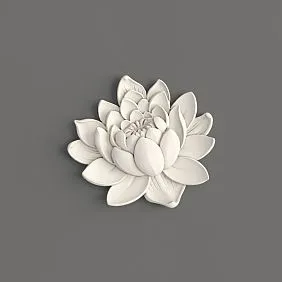
The facade is already chosen: a smooth door of a wardrobe, dresser, nightstand, or other cabinet furniture. You want to add a floral relief, but not turn the entire surface into a complex stucco composition. And here two completely different solutions arise. You can install one decorative overlay NPU-491 in the shape of a lotus, measuring 105 × 94 × 17 mm, and get one noticeable central accent. Or you can take several compact overlays NPU-496, measuring 46 × 46 × 18 mm, and build the rhythm yourself: two, three, four, or more small floral dots.
In the photo, both models look like floral stucco decor. On a furniture facade, they work fundamentally differently.
NPU-491 itself creates a compositional center. It needs to find one convincing place: in the center of the door, inside a panel, on the axis of a tall facade, or in the center of a paired furniture composition. After that, the question of quantity is often solved very simply: one facade — one overlay.
NPU-496, on the contrary, is interesting precisely for repetition. One flower 46 × 46 mm can become a small accent, but two, three, or four allow creating a vertical rhythm, a horizontal row, a symmetrical group, or repetition across several facades. Here the buyer gets more freedom, but with it comes additional work: you need to determine the distance between elements, the overall field of the composition, and the exact quantity of the product.
Therefore, choosing between NPU-491 and NPU-496 only by the principle of "which flower is prettier" is wrong. First, you need to answer another question:
do you want a single decorative center or a repeating floral rhythm?
And only after that measure the facade and assemble the basket.

NPU-491 and NPU-496: two different ways to decorate the same facade
Let's start with the confirmed dimensions.
| Parameter | NPU-491 | NPU-496 |
|---|---|---|
| Type | Decorative overlay in the shape of a lotus | Compact decorative flower overlay |
| Material | Polyurethane | Polyurethane |
| Width | 105 мм | 46 мм |
| Height | 94 мм | 46 мм |
| Thickness | 17 мм | 18 мм |
| Format | One pronounced floral motif | Small repeating floral motif |
| Current price per 1 pc. | 1 370 ₽ | 560 ₽ |
| Typical selection logic | Central accent | Rhythm of several elements |
Prices are indicated at the time of article preparation and should be checked directly in product cards before placing an order.
At first glance, NPU-491 is simply "larger," and NPU-496 is "smaller." But for furniture, this is too primitive a comparison.
NPU-491 has more than twice the width: 105 mm versus 46 mm. At the same time, the difference in thickness is almost absent — 17 mm for NPU-491 and 18 mm for NPU-496. That is, the small NPU-496 cannot automatically be considered less embossed just because it is smaller in width and height. Its decorative mass is smaller in area, but the element itself remains voluminous.
Therefore, on the facade, what differs primarily is the scale of the pattern and the method of repetition, not just the depth of the relief.
If you need a single flower that immediately reads as the center, the first candidate is NPU-491.
If you want the eye to move between several small colors, it makes more sense to check NPU-496.
After selecting the first scenario, you can buy a decorative overlay NPU-491. For the second, you first need to determine the number of NPU-496 and only then assemble the order.




Don't start with the quantity: first decide whether the facade should have one center
Let's imagine a regular cabinet door.
It has a simple rectangular shape and a fairly large free field.
If you place one NPU-491 approximately on the facade's axis, the eye immediately gets a clear composition:
door;
central vertical;
lotus.
Explaining why the decor is exactly there is almost unnecessary. One large motif organizes the plane by itself.
Now let's replace it with three NPU-496.
New questions arise:
do they go vertically or horizontally;
are the intervals the same;
where does the group begin and end;
at what height the middle flower is;
whether the center of the group coincides with the center of the door;
whether the flowers are too far apart;
are they too close together.
That is, several small overlays are not a simpler option. Sometimes it is even more complex compositionally.
That is why the decision "NPU-496 is cheaper, I'll take three" is not enough.
Three small flowers are already a separate layout.
Our factory also produces:


First, we measure the free decorative field, not the entire facade.
The furniture door has an external dimension.
But not all of this area is necessarily available for the overlay.
It may contain:
frame;
a panel;
milling;
handle;
the lock;
another decorative element;
the border of an adjacent element;
an existing molding.
Therefore, it is more useful to measure not just the width and height of the facade, but the free field within which floral decor can actually be placed.
Suppose the door is 500 mm wide.
Inside the decorative frame, the free field is only 320 mm.
It is exactly 320 mm that needs to be compared with NPU-491 or the NPU-496 group.
This is especially important for several small flowers. One NPU-496 takes up only 46 mm. But four elements with intervals may require significantly more space than the size of one part suggests.
Get Consultation
Make two templates: 105 × 94 mm and 46 × 46 mm
For the first selection, the actual product is not even needed.
Cut out from thick paper:
one rectangle 105 × 94 mm;
several squares 46 × 46 mm.
The first represents the dimensions of NPU-491.
The second ones are NPU-496.
Of course, paper will not show the flower outline and the actual relief. But for checking the scale, this is sufficient.
First, place one large template.
See how confidently it occupies the facade.
Then remove it and lay out two small ones.
Then three.
Then four.
Very quickly it will become clear which solution actually suits the furniture.
Often the buyer comes to a conclusion not by the ornament, but by the geometry itself: on a small facade, one NPU-491 already looks complete, while four NPU-496 create unnecessary fuss. On a long door, on the contrary, one lotus may seem too local, whereas three small flowers beautifully elongate the vertical.
NPU-491 — when one lotus is truly stronger than several small flowers
The first scenario — one compositional center is needed.
This is the most natural task for NPU-491.
One large smooth facade
On a wide door of a wardrobe, dresser, or nightstand, one element measuring 105 × 94 mm requires no additional explanation.
It becomes a decorative focal point.
Especially if the rest of the surface is calm enough.
Central facade among several
Let's imagine a wardrobe with three doors.
The middle door is the compositional center.
Instead of three identical overlays on each, you can decorate only the central one with NPU-491.
This gives the furniture an accent without turning it into a repeating floral pattern.
Paneled front
If there is a free central field inside the frame, one lotus is convenient to place exactly there.
Here, a large overlay can support the existing symmetry.
A dresser with one main facade or door
If the furniture consists of a large central element and several smaller ones, NPU-491 can be used where a main decorative motif is needed.
When you don't want to count intervals
One element is significantly easier to place.
Need to check:
the center;
height;
the free margin;
adjacent parts.
There is no need to calculate the rhythm between several identical flowers.
That is why order the NPU-491 overlay made of polyurethane especially convenient for a project where a single finished plant accent is needed.
NPU-496 — when one small flower is not the main thing, but repetition is the design
NPU-496 measures only 46 × 46 mm, but its strength lies precisely in the possibility of repetition.
One element — a small floral dot.
Two — a pair.
Three — rhythm.
Four — already a noticeable system.
Therefore, NPU-496 should be considered not just as a "reduced alternative to NPU-491."
This is a different tool.
Vertical row on a tall door
Three small flowers can be arranged along a single vertical axis.
Then the eye moves from top to bottom, and the tall door receives a repeating botanical rhythm.
Horizontal row on a wide facade
On a wide drawer or door, several NPU-496 can work horizontally.
This solution is fundamentally unavailable to a single NPU-491 without adding other elements.
Symmetrical pair
Two small overlays can be placed to the right and left of the central axis.
The center remains a free field.
Repeat on several boxes
Instead of a group of three flowers on one facade, you can place one NPU-496 on each of three identical drawers.
This is another type of rhythm — no longer within a single plane, but across the entire piece of furniture.
Decor of a narrow facade
46 mm is easier to fit into a small free space than NPU-491, which is 105 mm wide.
But even here, you cannot choose automatically: height, relief, and the number of repeats still affect the result.
If a compact layout suits the furniture better, you can buy a decorative overlay NPU-496 after determining the quantity.
One NPU-491 versus one NPU-496 is not the most useful comparison
If you place only one of each side by side, the conclusion will be obvious:
NPU-491 is larger.
NPU-496 is more compact.
But the buyer's task is more interesting.
More often you need to compare:
1 × NPU-491
с
2 × NPU-496;
3 × NPU-496;
4 × NPU-496.
Then it becomes clear that different ready-made compositions are being compared.
How much different composition options cost
At current prices:
NPU-491 — 1,370 ₽ per 1 pc.
NPU-496 — 560 ₽ per 1 pc.
We get:
| Composition | Quantity | The cost of the overlays themselves |
|---|---|---|
| One NPU-491 | 1 | 1 370 ₽ |
| One NPU-496 | 1 | 560 ₽ |
| Two NPU-496 | 2 | 1 120 ₽ |
| Three NPU-496 | 3 | 1 680 ₽ |
| Four NPU-496 | 4 | 2 240 ₽ |
| Five NPU-496 | 5 | 2 800 ₽ |
| Six NPU-496 | 6 | 3 360 ₽ |
This is the cost of the decorative elements themselves at the current price, without installation and finishing materials.
The table shows a very important thing.
Two NPU-496 are cheaper than one NPU-491.
But three NPU-496 already cost more than one NPU-491.
So, the idea that "a small overlay = a cheaper composition" does not always work.
If four small flowers are required for the facade, the product part of the order is 2,240 ₽ versus 1,370 ₽ for one large lotus.
But again, you can't compare only money.
Four small flowers create a completely different pattern.
The price of one part says nothing about the price of the facade.
This is the same principle that works with linear moldings, trim, and other modular systems.
NPU-491 is more often a standalone center.
NPU-496 is a module.
Therefore, the buyer should consider the finished facade.
For example:
Option A — one central NPU-491: 1,370 ₽;
Option B — a vertical of three NPU-496: 1,680 ₽;
Option C — four NPU-496 at the corners of the decorative field: 2,240 ₽.
Only after this can we talk about the budget.
Three NPU-496: how to determine the total length of the composition
Each overlay has a height of 46 mm.
If three elements go vertically, without gaps they would occupy:
3 × 46 = 138 mm.
But in a real composition, there will likely be some free space between them.
The exact interval cannot be assigned universally — it depends on the facade and the intended pattern.
Formula for three elements with the same gap G:
H = 3 × 46 + 2 × G.
For example, only as a mathematical illustration, not a manufacturer's recommendation:
with G = 30 mm:
138 + 60 = 198 mm;
with G = 50 mm:
138 + 100 = 238 mm;
at G = 70 mm:
138 + 140 = 278 mm.
It turns out that three small flowers can form a vertical composition about 200–280 mm high, depending on the intervals you choose.
And here's where it gets interesting: in the common area, three NPU-496s can take up much more space than one NPU-491 with a height of 94 mm.
Four NPU-496s vertically
Formula:
H = 4 × 46 + 3 × G.
Without gaps:
184 mm.
If, purely to illustrate the calculation, G = 40 mm:
184 + 120 = 304 mm.
So four small flowers turn into a long vertical motif.
On a tall cabinet, this can look very convincing.
On a low door, it's too stretched out.
Therefore, the number of elements cannot be chosen without considering the facade size.
Two NPU-496 can take up less or more than NPU-491 — it depends on the layout.
Two flowers side by side without a gap give 92 mm in total width.
This is less than the width of NPU-491, which is 105 mm.
But add a distance between them — and the pair becomes wider than the large lotus.
For example, just as an arithmetic example:
46 + 40 + 46 = 132 mm.
That is, two small elements can form a wider composition than one large one.
This is another reason not to use the words "small" and "large" without understanding the layout.
There is no correct distance between NPU-496 for all facades
Don't look for a universal number:
30 mm;
50 mm;
70 mm.
The manufacturer does not have one mandatory interval that automatically makes the composition correct on any furniture.
The distance depends on:
door width;
height;
number of flowers;
the presence of a frame;
handles;
other decor;
the overall style of the furniture.
Therefore, the intervals are selected on the layout.
This is where paper squares 46 × 46 mm are especially useful.
The cheapest way to test the NPU-496 is to cut out six templates at once.
One template will not show the advantages of this model.
Cut out six squares of 46 × 46 mm.
Now you can try:
one;
two;
three;
four;
two rows of two;
three vertically;
three horizontally;
a pair on two adjacent facades.
Within ten minutes, it becomes clear whether you need a repeating composition at all.
If out of six templates you constantly want to keep only one, it might be better to compare it directly with the NPU-491.
If, on the contrary, one flower seems like a random dot, but three form a good rhythm, NPU-496 reveals its advantage.
NPU-491 on a wide facade: checking whether a single lotus gets lost
One large element is not necessarily sufficient for any width.
Imagine a very wide door or the central facade of a large cabinet.
105 mm may look confident up close, but from a distance the lotus will remain a fairly local accent.
This is not a mistake if that is exactly the effect needed.
But if you want to fill more horizontal space, several NPU-496 units give more freedom.
For example, you can build a symmetrical group.
The main thing is not to turn empty space into a problem in itself. The facade does not have to be covered with decor from edge to edge.
NPU-491 on a narrow facade: the 105 mm width becomes the main filter
On a door, for example, 250 mm wide, one NPU-491 will take up a noticeable share of the entire surface.
On a 600 mm facade, the same 105 mm will be perceived much more calmly.
These are mathematical examples of scale, not recommendations for the minimum width of furniture.
For 250 mm:
105 / 250 = 42% of the width.
For 600 mm:
105 / 600 = 17.5% of the width.
The difference is huge.
That is why the same NPU-491 can look large on a small door and very delicate on a large one.
NPU-496 on a narrow facade gives more freedom, but the quantity quickly brings back the scale.
A single flower 46 mm wide is easier to place on a narrow door.
But if you put three vertically, the composition becomes longer.
If two are placed side by side, the overall width increases.
Therefore, the compact size of an individual element does not guarantee the compactness of the entire group.
This kind of thinking is especially important before ordering several pieces.
One NPU-491 on each cabinet door
Let's imagine a cabinet with four identical doors.
You can buy four NPU-491 and place one lotus on each.
This results in a clear repetition:
lotus — lotus — lotus — lotus.
The cost of four elements at the current price:
4 × 1 370 = 5 480 ₽.
This is already a separate compositional system.
We need to check whether the large floral motif is becoming too frequent.
Perhaps, on the four doors it is better to use NPU-496.
And perhaps one large lotus on each facade is exactly what creates the needed solemnity.
The answer will be given by a mockup of all four doors, not just one element.
Three NPU-496s on four door panels
Now a different scenario.
Three small flowers on each door.
Total:
12 NPU-496.
Cost:
12 × 560 = 6 720 ₽.
So this option is more expensive than four NPU-491s.
And visually much richer.
Each door panel gets its own vertical chain.
Instead of four large centers — twelve repeating flowers.
This is a completely different character of furniture.
One NPU-491 only on the central door
If the cabinet has three doors, you can highlight the center with one overlay.
Quantity:
Cost:
1 370 ₽.
The outer facades remain smooth.
This scheme is especially good if the middle door itself differs in size or role.
If all three are completely identical, a single center can also work because its central position explains it.
One NPU-496 on each of the three doors
Another way:
three identical small flowers;
one on each facade.
Cost:
3 × 560 = 1 680 ₽.
This is only slightly more expensive than one NPU-491, but the pattern is distributed across the entire furniture.
Here the buyer chooses between:
centralization — one large lotus in the middle;
rhythm — three small flowers across the three doors.
Here is the real difference between the products.
Dresser with several drawers: NPU-496 gets a natural advantage
The dresser has several horizontal fronts, and each of them can become a separate step of the vertical rhythm.
For example:
four drawers;
one NPU-496 on each;
all centers are on the same vertical axis.
This results in four flower points from top to bottom.
Cost:
4 × 560 = 2 240 ₽.
NPU-491 on each drawer may be excessively large, especially if the fronts are low.
But one NPU-491 can be placed on the upper or central large facade, if the dresser construction allows.
A dresser with two wide doors: NPU-491 again becomes a strong candidate.
If instead of many small drawers there are two large doors, the situation changes.
One NPU-491 on each — a clear symmetrical composition.
Two lotuses:
2 × 1 370 = 2 740 ₽.
Two NPU-496:
1 120 ₽.
Four NPU-496, two per door:
2 240 ₽.
Six NPU-496, three each:
3 360 ₽.
Now the choice depends not only on the budget, but also on whether you need one large center on each door or a longer floral rhythm.
Tall cabinet door: don't be afraid of empty space around NPU-491
There is a common mistake: if the facade is tall, you want to fill the entire vertical with decor.
But a single lotus measuring 105 × 94 mm can work beautifully precisely because of the empty field.
The free plane enhances the accent.
If you add a few more flowers at the top and bottom just because "there's plenty of space," the composition may become less expressive.
Therefore, the first layout for a tall door is a single NPU-491.
Only if it really gets lost, move on to the NPU-496 group.
Tall door and three NPU-496: when rhythm beats center
If the facade is very elongated, three small flowers can emphasize its verticality better than one almost round central motif.
Arrange the three templates along one axis.
Vary the distances.
First, gather them closer together.
Then stretch them apart.
Photograph both options.
There is no need to memorize the impression. In a photo, it is easier to see how proportional the group is to the entire door.
Wide drawer: horizontal group NPU-496
This is a scenario where NPU-496 differs especially from NPU-491.
Three small flowers can be arranged horizontally.
Formula for total width with equal spacing G:
W = 3 × 46 + 2 × G.
With a conditional G = 50 mm for mathematical illustration only:
138 + 100 = 238 mm.
On a wide box, such a group can create a central horizontal composition.
NPU-491 will give one motif 105 mm wide.
That is, one product concentrates the gaze, the other stretches it horizontally.
Four NPU-496 in a 2 × 2 square
Another possibility that a single NPU-491 does not have.
Four small flowers can be assembled into a square group.
But here it is especially important not to place elements too close just for compactness.
First, lay out the templates on the facade.
Check whether they read as four separate flowers or turn into a visually tangled block.
A universal gap cannot be assigned here either.
NPU-491 inside a molding frame
If the facade is already divided by molding, one lotus can easily become the central motif of the inner field.
Here you need to measure:
the width of the frame inside;
height;
the actual free field.
Do not compare 105 × 94 mm with the entire outer facade.
Compare with the inner rectangle.
If NPU-491 takes up too large a share, NPU-496 may become more delicate.
Several NPU-496 inside the frame: do not turn the field into "wallpaper"
Small repeating elements provoke filling the entire area.
Two on top.
Two on the bottom.
Two more in the center.
But a furniture facade is not necessarily a surface for a continuous pattern.
The more NPU-496, the more the composition turns from an accent into an ornamental grid.
This could be intentional.
But it must be intentional, not a consequence of small flowers being cheap per piece.
The handle and the decorative overlay should have different roles.
If there is a handle on the facade, it already creates a functional and visual point.
NPU-491 or the NPU-496 group should not accidentally collide with it.
Before ordering, measure:
where the handle is;
what area the hand occupies;
how much free space remains.
There is no need to set a universal mandatory indent — it depends on the specific furniture.
But a paper template will immediately show whether the composition is becoming too dense.
One NPU-491 above the handle
This can create a clear vertical axis:
lotus;
handle;
center of the facade.
If two elements do not compete and have enough space, the layout looks natural.
But if the handle itself is large and decorative, NPU-491 can become the second main accent.
Then the compact NPU-496 can be calmer.
Several NPU-496 around the handle is a dangerous zone for overload.
Small flowers can easily be used as an ornament around the hardware.
But the handle must remain comfortable.
If the palm constantly touches the relief, the composition ceases to be purely decorative.
Therefore, such a layout is first modeled with paper templates and checked with actual opening.
A handleless facade gives more visual freedom, but does not eliminate the function
On push-to-open or other systems without a visible handle, the surface appears completely free.
However, it is pressed by hand.
Therefore, NPU-491 or several NPU-496 cannot be placed without considering the actual working area.
The logic is the same: function first, then decor.
If a detailed separate analysis of this specific issue is needed, it requires its own product article; here we do not turn the comparison of NPU-491 and NPU-496 into general material about hardware.
NPU-491 and NPU-496 on paired doors
Two identical doors provide several strong patterns.
One NPU-491 on each
The most straightforward option.
Two large lotuses create symmetry.
Cost:
2 740 ₽.
One NPU-496 per door
A more delicate pair.
Cost:
1 120 ₽.
Two NPU-496 per door
Four elements in total.
Cost:
2 240 ₽.
This results in an elongated or paired pattern on each door.
One NPU-491 at the junction of the visual composition
If two doors are perceived as a single pair, you can look for an option where each facade gets its own decor. Placing one overlay physically across the joint of two sliding doors, of course, cannot be considered a standard mounting scheme. Therefore, the central accent should belong to a specific facade or be repeated symmetrically.
This is an example of why the furniture function sets the boundaries of the composition.
Three doors: a large center or three small repeats
This is one of the best scenarios for a direct comparison.
Option A
One NPU-491 on the central door.
Cost — 1,370 ₽.
The result is one strong center.
Option B
One NPU-496 on each door.
Cost — 1,680 ₽.
Result — a uniform rhythm of three flowers.
The price difference is small.
The difference in character is huge.
That is why the question "what is more profitable" is almost meaningless here without choosing a composition.
Four doors: when a small repeat can be easier
Four NPU-491 cost 5,480 ₽.
Four NPU-496 — 2,240 ₽.
If one element per facade, small flowers are more than twice as cheap.
But the NPU-491 is significantly larger.
Therefore, on four narrow doors, four lotuses may be overly active, while four NPU-496 are just right.
On four very large facades, everything may be the opposite.
Do not use price as an argument instead of scale
NPU-496 is cheaper per piece.
This is a fact.
But three or four elements quickly change the final cost.
NPU-491 is more expensive than one NPU-496, but often requires only one piece per facade.
Therefore, you need to choose in the following order:
-
composition;
-
quantity;
-
cost.
And not:
-
price per piece;
-
an attempt to come up with a design for it.
Floral ornament NPU-491: why one lotus requires free space
The lotus is read as an independent motif.
If you surround it with many other small details, the central effect is lost.
Therefore, NPU-491 is especially useful where there is enough calm surface around.
And this is not emptiness that must necessarily be filled.
This is the background against which the relief is read.
If this is the character needed for the furniture, you can look at others as well polyurethane overlays with floral ornament within the same product logic.
The round NPU-496 works well as a module
The size of 46 × 46 mm makes it close to a compact round decorative dot.
That is why it repeats well.
If such geometry suits the facade, there is a separate section in the catalog of round polyurethane overlays, where you can compare other formats.
But it makes sense to move there only after answering the question: why didn't NPU-496 fit?
Too small?
Too large?
Not the right ornament?
Need a different center?
The catalog should continue the solution, not start a new endless search.
Do not confuse "round" and "single"
A round shape does not mean that NPU-496 is intended only for single placement.
On the contrary, compact round elements easily form a repeat.
Similarly, NPU-491 can be used multiple times.
Category names describe geometry and ornament, but do not prescribe a single layout.
The composition is determined by the facade.
Thickness 17 and 18 mm: an unexpected comparison
One might assume:
NPU-491 is larger in width and height, so it must protrude more from the facade.
But confirmed dimensions show otherwise.
NPU-491:
17 mm.
NPU-496:
18 mm.
That is, a small flower is even 1 mm thicker in maximum size C.
This is a good example of why relief cannot be assessed only by frontal size.
The small overlay still remains three-dimensional.
If you place five NPU-496s, you get five separate relief points, not a barely visible flat pattern.
Paper will not show thickness — a dry fitting is needed after purchase.
Templates help choose the quantity and placement.
But they are flat.
After receiving the product, apply the actual NPU-491 or NPU-496 to the facade without final attachment.
Check:
how the shadow falls;
how much the element protrudes;
whether a group of several flowers becomes too embossed;
how the furniture looks from the side;
whether the decor interferes with using the handle.
Only after this, fix the final scheme.
Overlay color: matching the facade or an independent accent
Product cards allow painting decorative elements, so NPU-491 and NPU-496 can be included in the furniture color concept.
But the specific painting system should be chosen considering the actual facade and materials used.
Compositionally, there are two basic approaches.
The first is to make the overlay close in color to the facade.
Then the main role is played by relief and light and shadow.
The second is to highlight the flower.
Then even a small NPU-496 becomes more noticeable.
It is especially important to consider this with multiple elements: four contrasting flowers create a much more active pattern than four elements in the color of the facade.
One NPU-491 in contrast — a strong center
If the color differs from the facade, the size of 105 × 94 mm starts to work even more actively.
On a calm door, this can be striking.
On a facade that already has a contrasting handle, frame, and other details, the lotus can turn out to be an unnecessary center.
Therefore, first check the composition in a monochrome layout, then in color.
A few contrasting NPU-496 quickly turn into a pattern.
One small flower — a dot.
Three — rhythm.
Six is almost an ornamental grid.
Color enhances this effect.
Therefore, if the idea is delicate furniture decor, the number of NPU-496 should be limited consciously.
There is no rule of "no more than three."
There is a rule: each next element should improve the composition.
The simplest test: remove one flower
We have collected four NPU-496 patterns.
Now remove one.
Did it get worse or better?
If better, the fourth was unnecessary.
Remove another one.
If the composition fell apart, bring back the third.
This is a very practical way to determine the quantity without theory.
It also works with NPU-491 on multiple facades.
If you're unsure between two and three NPU-496
Don't decide by price.
The difference is 560 ₽.
Look at the rhythm.
Two elements create a pair.
Three — they get a center.
An odd number has a middle point that is easy to align with the facade axis.
A pair has a free central space.
These are different compositional properties.
Two NPU-496: when the center is better left empty
A pair works well if the center contains:
handle;
a keyhole;
another decorative motif;
or you just want to avoid a single central point.
Placing two flowers symmetrically can emphasize the width of the facade.
But the distance between them is determined by the actual door, not by a universal formula.
Three NPU-496: the clearest rhythm
Three elements are very convenient for building an axial composition.
One becomes central.
Two become top and bottom, or left and right.
This makes achieving symmetry easier.
That is why three NPU-496 can be stronger than two even on a small facade, if there is enough space.
Four NPU-496: already a full-fledged system
Four can be arranged:
vertically;
horizontally;
in a square;
at the corners of the inner decorative field.
Each option radically changes the furniture.
Therefore, four NPU-496 need to be designed, not just "add another flower."
Five and six NPU-496s: checking whether the accent has turned into filling
Quantities above four are quite possible on a large facade or a large group of furniture.
But here the structure needs to be set especially strictly.
For example:
five vertically;
two rows of three;
repeat across multiple boxes.
If the structure is not obvious at first glance, there are likely too many elements or the arrangement is random.
One NPU-491 and NPU-496 together: possible, but that's already a third scenario
The article compares two paths, but they are not necessarily mutually exclusive.
NPU-491 can be the main lotus.
NPU-496 — with small auxiliary flowers.
For example, a large center and two small accents.
But such a project is already more complex.
Need to check:
scale;
hierarchy;
symmetry;
total area;
cost.
If you want a simple answer before buying, first choose between pure scenarios:
one NPU-491
or
group NPU-496.
Only combine them if one of them is truly insufficient.
Don't assemble a bouquet just because the products are floral.
Plant themes alone don't guarantee that several different overlays will look good together.
One lotus plus five small flowers can turn out to be too literal and busy a composition.
Furniture doesn't have to turn into a botanical panel.
Sometimes a single floral motif works stronger than a whole set.
Wardrobe in the bedroom: one NPU-491 often looks calmer.
A large wardrobe surface handles one relief center on each chosen door well.
If the bedroom already has patterned textiles, a decorative headboard, and active wallpaper, many NPU-496s can add unnecessary repetition.
But if the furniture itself is very simple, three small flowers on a tall door can beautifully elongate it.
Again, the environment decides
If NPU-496 seems too small, you don't have to immediately add five more
First, try NPU-491.
One large center can solve the problem much more cleanly than increasing the number of small flowers.
This is the point of a direct product comparison.
How not to confuse the size of a single overlay with the size of the composition
Write down separately:
product size;
size of the entire layout.
For NPU-491 they often almost coincide: one piece — one composition.
For NPU-496, these are different numbers.
For example:
product — 46 × 46 mm;
composition of three — conditionally 46 mm wide and 238 mm high with your chosen interval of 50 mm.
This approach immediately makes the calculation clearer.
How many NPU-496 to order reasonably: there is no single correct number
Two facades can be the same size but require different quantities.
One has a handle and a frame.
The other has a clean surface.
Therefore, the number is determined by the layout.
Practical algorithm:
make six templates;
start with one;
add the second;
third;
fourth;
stop where the next one no longer improves the facade.
After that, multiply the quantity by the number of identical doors.
Example: three identical facades, with two NPU-496 each
For one door:
2 pcs.
For three:
6 pcs.
Price:
6 × 560 = 3 360 ₽.
Now let's compare with three NPU-491:
3 × 1 370 = 4 110 ₽.
The difference:
750 ₽.
But again, the final pattern is completely different.
Example: two facades, three NPU-496 each
Total:
6 pcs.
Price:
3 360 ₽.
Two NPU-491:
2 740 ₽.
In this case, large lotuses are cheaper.
Therefore, the phrase "small NPU-496 — an economical option" without specifying the quantity misleads the buyer.
Example: four facades, one flower each
NPU-496:
4 × 560 = 2 240 ₽.
NPU-491:
4 × 1 370 = 5 480 ₽.
If there is one element per door, small flowers are indeed significantly cheaper.
So the cost depends on the pattern itself.
What to buy together with decorative overlays
Once the layout is approved, the cart becomes quite simple.
| What to buy | When required | Purpose |
| NPU-491 | If one large floral center is selected | Main decorative accent |
| NPU-496 | If a repeat of small flowers is selected | Rhythmic composition |
| Additional overlays of the same article | For multiple facades or a group | Repetition of the approved scheme |
| Installation materials | After checking the base | Installation of polyurethane decor |
| Materials for finishing | If provided by the project | Including the overlay in the furniture color system |
For fastening, you don't need to buy a random universal compound just because it happens to be at home. After determining the surface, you should select suitable Mounting and finishing materials and verify the requirements for the specific base.
Do not plan installation until the quantity is approved
First, the composition.
Then, the product.
After that, the materials.
If today you are thinking about four NPU-496, and tomorrow after the mockup you choose one NPU-491, the order scheme changes.
Mounting solutions should not dictate the design.
Painting to match the facade color: a strong way to blend the overlay with the furniture
If you want the molded decor to look like part of the door itself, it makes sense to consider a unified color scheme.
Then one NPU-491 is perceived as a facade relief, not as a separate glued-on piece.
The same applies to NPU-496.
Several flowers in the furniture color create a light-and-shadow rhythm without additional color noise.
But the specific paints, primers, and preparation sequence must match the actual furniture finish and project materials. A universal system for all facades cannot be invented.
Contrast painting requires fewer
This is not a strict rule, but a useful principle for fitting.
If NPU-496 differs greatly in color from the facade, even a single element becomes more noticeable.
Three contrasting flowers can be perceived as a much more active composition than three monochromatic ones.
Therefore, the final quantity is better checked with an idea of the color in mind.
What not to do from scratch if ready-made NPU-491 and NPU-496 are available
If a floral relief is needed, there is no need to cut out identical flowers yourself, make molds, or assemble a pattern from random pieces.
Ready-made overlays already have a fixed geometry.
This is especially important for NPU-496.
If four identical flowers are required on the facade, the ready-made product ensures repetition of the same motif. Reproducing several identical reliefs independently is significantly more difficult.
The DIY task here is not about making the flower, but about something else:
correctly measuring the facade;
choosing the scale;
make templates;
mark the axes;
determine the quantity;
prepare the base;
mount and finish the ready elements.
How to mark one NPU-491
For one large element, marking is relatively simple.
Determine the vertical axis of the facade.
Determine the desired height of the center of the overlay.
Apply the template.
Step back.
If the facade is paired, place the second template on the adjacent door.
Check all the furniture.
Only after this, transfer the position to the actual part.
How to mark three NPU-496
An additional task appears here.
Determine the axis.
Place the central template.
Then the top and bottom.
First, achieve an equal interval.
After this, look at the overall height of the group.
If it is too stretched, reduce the distances.
If the "bouquet" is too dense, increase it.
Don't look for the perfect interval in millimeters before you've seen the facade.
How to transfer the same layout to multiple doors
After approving the first composition, record the actual coordinates.
For example:
center of the group by width;
height of the central point;
distances between elements.
On the remaining identical facades, repeat measurements, not the position "by eye".
This is especially important for multiple NPU-496. A small error in each element quickly accumulates and makes the vertical row crooked.
What to do if the doors differ slightly in size
Do not copy one layout automatically.
On the wide facade, NPU-491 may look good.
On the adjacent narrow one, it may be too large.
Perhaps the furniture design itself implies different accents.
But before mixing NPU-491 and NPU-496, check whether it is simpler to highlight only one group of doors.
Not every door necessarily needs to be decorated.
Polyurethane molding for furniture works better when it has a hierarchy.
Central facades can be decorative.
Secondary ones can be smooth.
Two pencil cases with overlays.
Boxes — none.
Such a system often looks more meaningful than full filling.
If you need to view a wider assortment, buy polyurethane overlays you can do it in the general category, but it's better to go there already with a known task: you need a center, a small repeat, a round shape, or a floral motif.
How not to turn the comparison of NPU-491 and NPU-496 into a general article about stucco molding
We don't need to detail the history of polyurethane, list all types of cornices, or explain what a molding is.
The buyer is already much closer to placing an order.
He needs to resolve five specific questions:
- one large flower or a group of small ones;
- does the chosen pattern fit on the facade;
- how many parts are required;
- how much does a finished composition cost;
- how to check the layout before installation.
If these questions are resolved, the article fulfills a commercial purpose.
Mistake No. 1. Choosing only by a photo of the ornament
A beautiful lotus in close-up says nothing about its scale on the door.
The same applies to NPU-496.
Real templates are needed.
Mistake No. 2. Thinking that NPU-496 is twice as small as NPU-491 in everything
In frontal size, it is significantly more compact.
In thickness, on the contrary, NPU-496 has 18 mm versus 17 mm for NPU-491.
Therefore, the small flower remains three-dimensional.
Mistake No. 3. Buying NPU-491 for a small facade without trying it on
105 × 94 mm can take up too noticeable a share of the surface.
First, the paper.
Then, the order.
Mistake No. 4. Buying four NPU-496 at once because they are small
Four flowers are already a full-fledged composition.
First, lay out four templates and compare them with two and three.
Mistake No. 5. Considering NPU-496 always the cheaper option
One costs less.
Three cost 1,680 ₽ — already more expensive than one NPU-491 at 1,370 ₽.
Consider the finished layout.
Mistake #6. Choosing quantity based on empty space
Free area doesn't have to be completely filled.
Sometimes emptiness makes a single lotus more expressive.
Mistake #7. Placing several NPU-496 with different random intervals
If the rhythm is intended to be uniform, distances should be controlled by marking.
By eye, the sequence quickly "drifts".
Mistake #8. Assuming the same interval suits any facade
There is no universal number.
Choose it according to the layout of the specific door.
Mistake #9. Not considering the handle
A beautiful composition may turn out to be inconvenient to use.
First, the functional area is checked.
Mistake #10. Adding NPU-496 around NPU-491 just because both products are floral
Compatibility of motifs does not mean they need to be used simultaneously.
First, check the clean version with one product.
Mistake #11. Making every facade equally decorative
Furniture can have a center and secondary surfaces.
You don't have to buy overlays for all doors.
Mistake #12. Mixing NPU-491 and NPU-496 only because of different facade widths
This can result in an inconsistent set.
First, develop a common system.
Mistake #13. Painting before the final fitting
First, verify the position and quantity.
Finishing is the next stage.
Mistake #14. Gluing the first element and designing the rest based on it
First, dry-lay the entire group.
Then final fixation.
Mistake #15. Not looking at the furniture from a distance
Large relief and repetition of small flowers are perceived completely differently from a normal distance.
Mistake #16. Not accounting for thickness
The paper template is flat.
The actual decor protrudes by 17–18 mm.
A dry fitting of the actual product is mandatory before the final decision.
Mistake #17. Trying to make NPU-491 visually smaller by shifting it to the corner
If the scale is not suitable, it is better to check NPU-496 rather than hide the large motif at the edge.
Mistake #18. Adding a fifth flower just because there is a free area left
Each new element should improve the structure.
If it does not improve it, it is unnecessary.
Error #19. Ordering an exact number before checking all identical facades
On one door the composition may work, on the adjacent one the handle or frame will be in a different place.
Check the entire group.
Error #20. Making conclusions based only on price
Cheaper in terms of components does not always mean better for furniture.
Decor is bought for the result on the facade.
Who NPU-491 suits better
NPU-491 should be the first candidate if you need:
one pronounced floral center;
lotus as an independent motif;
decor of a large smooth door;
central accent of a three-door wardrobe;
one overlay inside a furniture panel;
simple basket without calculating multiple intervals;
a calmer composition with a single floral object.
NPU-491 is especially logical when you like its pattern and have no desire to turn the facade into a repeating pattern.
Who NPU-496 suits better
NPU-496 is more interesting if you need:
compact flower;
vertical or horizontal rhythm;
repeat on several boxes;
decoration of narrow facades;
a couple of small accents instead of one center;
three or four identical elements within a large plane;
the ability to independently change the length and structure of the composition.
After approving the layout, you can order NPU-496 for the furniture facade already in the calculated quantity.
Who is better not to buy any article yet
If the facade has not been measured yet.
If the position of the handle is unknown.
If the furniture frame is not installed.
If you haven't decided yet whether the decor will be contrasting.
If you want one large lotus, five small flowers, and a few other overlays at the same time.
In such a situation, it's too early to choose a product.
First, the composition.
A ten-minute algorithm for choosing between NPU-491 and NPU-496
Take a sheet of paper.
Cut out:
one template 105 × 94 mm;
four templates 46 × 46 mm.
Glue the large one to the center of the facade with masking tape.
Step back.
Take a photo.
Take it off.
Place two small ones.
Take a photo.
Place three.
Take a photo.
Place four.
Take a photo.
Now compare four photos in a row.
Don't ask:
"Which is richer?"
Ask:
"Which scheme looks as if it was intended when designing the furniture itself?"
Usually the answer comes quite quickly.
How to place an order after selecting NPU-491
Let's say four identical doors.
But the lotus is needed only on the two central ones.
Specification:
NPU-491 105 × 94 × 17 mm — 2 pcs.
The cost of the overlays themselves at the current price:
2 740 ₽.
Next, suitable mounting and finishing materials are added.
Such an order is clear.
How to place an order after selecting NPU-496
For example:
three tall facades;
each with three flowers.
Specification:
NPU-496 46 × 46 × 18 mm — 9 pcs.
Cost:
9 × 560 = 5 040 ₽.
After this, there is no risk of ordering six and then realizing that nine are needed for three doors.
Where to look for alternatives if both sizes do not fit
If NPU-491 is too large, and NPU-496 is too small or does not match the pattern, you can go to the general catalog and continue the selection.
For a wide selection, there is a section where you can You can buy ready-made stucco matching the Baroque style. Calculate the quantity: linear meters of cornices and moldings, number of rosettes, pilasters, consoles, corner elements. Add a ten to fifteen percent allowance for trimming..
But you should not search abstractly.
Write down the reason for rejection:
something between 46 and 105 mm is needed;
a different shape is needed;
a more elongated motif is needed;
need not a flower;
need a flatter composition.
Then the catalog becomes a decision-making tool, not an endless feed of pictures.
Polyurethane molding for furniture is primarily about scale
A search query can lead to hundreds of decorative elements.
But furniture requires especially strict proportions.
On a wall, a large ornament may look local.
On a door, the same 105 mm can take up a significant part of the facade.
Therefore polyurethane molding in an online store should be selected after actual measurement of the furniture.
Article number — at the end.
Size — at the beginning.
FAQ: NPU-491 or NPU-496 for furniture facade
How is NPU-491 different from NPU-496?
NPU-491 is a larger polyurethane decorative lotus-shaped overlay measuring 105 × 94 × 17 mm.
NPU-496 is a compact flower measuring 46 × 46 × 18 mm.
The main difference for furniture is one pronounced center versus the ability to create a repeat pattern from several small elements.
Which overlay is larger?
In width and height, NPU-491 is significantly larger.
Its dimensions are 105 × 94 mm versus 46 × 46 mm for NPU-496.
Which one is thicker?
According to the confirmed size, the NPU-496 is 18 mm, and the NPU-491 is 17 mm.
That is, a small flower is not automatically flatter.
How much does the NPU-491 cost?
At the time of writing the article, the current price is 1,370 rubles per unit.
Before ordering, it needs to be checked in the product card.
How much does the NPU-496 cost?
The current price at the time of preparing the material is 560 rubles per unit.
What is cheaper: one NPU-491 or two NPU-496?
One NPU-491 is 1,370 rubles.
Two NPU-496 are 1,120 rubles.
By item value, two small elements are cheaper.
And three NPU-496?
3 × 560 = 1 680 ₽.
That's already more expensive than one NPU-491.
How much do four NPU-496 cost?
2 240 ₽.
What's better for one large cabinet door?
If you need one center, first try NPU-491.
If you want an elongated rhythm or several floral points, check NPU-496.
What's better for a small door?
The size of NPU-496 is easier to fit into a compact field, but the final choice depends on the proportions of the facade.
Make templates of both sizes.
Can one NPU-496 be installed instead of NPU-491?
Yes, if a small single accent looks proportional.
But on a large facade, it may turn out to be too localized.
Can several NPU-491 be installed?
Yes, for example, one on each of several identical facades.
But the large motif will repeat quite actively, so first lay out the templates on all the furniture.
How many NPU-496 is better to install — two or three?
There is no universal number.
Two create a pair and leave a free center between them.
Three provide a central point and convenient symmetry.
The choice depends on the facade.
What distance should be between NPU-496?
There is no mandatory universal interval.
Choose it according to the paper layout of the specific furniture.
How to calculate the total height of three NPU-496?
If the gap between adjacent flowers is G:
H = 3 × 46 + 2 × G.
This formula allows you to check your own layout.
Can NPU-496 be placed horizontally?
Yes, if such a direction corresponds to the proportions of the facade and the entire furniture composition.
And vertically?
Yes.
For a tall facade, three or four small flowers can create a pronounced vertical axis.
Can you make a square from four NPU-496 units?
Such a composition can be considered.
Be sure to first make four paper templates and check the total area of the group.
Must NPU-491 be placed strictly in the center?
There is no universal requirement.
But for a single lotus, the central position is a logical first scheme for fitting.
Any offset must be compositionally justified.
Can NPU-491 be placed above the furniture handle?
Such a position can be considered if there is a comfortable working area around the handle and the decor looks harmonious.
Check this on the actual facade.
Can the NPU-496 be placed around the handle?
Possibly, but it is necessary to check usability and not overload the small area with many details.
What is better for a chest of drawers with four drawers?
One NPU-496 on each drawer can create a good vertical rhythm.
But if the chest of drawers has one large central facade, NPU-491 may also be appropriate.
What is better for two identical doors?
It is possible to have one NPU-491 or NPU-496 on each door, or a more complex group of small elements.
Make two copies of the selected template and evaluate the pair as a whole.
What is better for a three-door wardrobe?
Two options are very strong:
one NPU-491 on the central door;
one NPU-496 on each of the three doors.
They create a completely different composition.
Should all facades be decorated the same way?
No.
You can highlight only the central or largest doors.
The amount of decor should follow the furniture's architecture.
Can NPU-491 and NPU-496 be used simultaneously?
Such a composition can be considered, but it is significantly more complex.
First, check whether the task can be solved with one of the two products without additional mixing.
Can the overlays be painted in the color of the facade?
Product cards allow coloring.
The specific preparation and painting system must match the actual facade and selected materials.
Which looks calmer — one NPU-491 or three NPU-496?
This depends on the facade and color.
But overall, one element concentrates the decor in a single point, while three create a repeating rhythm. Therefore, the character of the composition differs even with a similar occupied area.
What to do if NPU-491 seems too large?
Don't try to necessarily shift it toward the edge.
First, check one or several NPU-496.
And if one NPU-496 seems too small?
Try two or three elements or compare with NPU-491.
Do you need to buy several NPU-496 at once for fitting?
Before purchasing, you can make paper templates 46 × 46 mm.
This allows you to check the quantity for free.
Is a paper template enough?
For selecting the area — yes.
For assessing the actual relief — no.
Before final fixation, a dry fitting of the actual overlay is useful.
What to use to attach NPU-491 and NPU-496?
You need to use mounting materials suitable for polyurethane decor and the specific facade base.
Do not assign one compound for all furniture coverings without testing.
It's better to first approve the composition and base, then assemble the mounting part of the basket.
Where can I see other overlays if none fit?
In the general category of STAVROS polyurethane overlays.
If a floral motif is needed, the corresponding section is useful; for round shapes, there is a separate category.
Does NPU-491 belong to the floral ornament?
Yes, the model features a lotus flower motif and is present in the catalog of polyurethane overlays with floral ornament.
Does NPU-496 belong to round overlays?
Yes, the compact model 46 × 46 mm is present in the category of round polyurethane overlays.
What should be determined first before purchasing?
Do I need to buy glue before choosing the quantity?
Size of the free decorative field and nature of the future composition:
one center or repetition.
After that, the quantity is much easier to calculate.
How to know if NPU-496 has become too many?
Remove one template.
If the composition has become cleaner and nothing has been lost, the extra element was indeed unnecessary.
How to know if one NPU-491 is enough?
If after installing the template the facade looks complete and the empty space around it is perceived as normal background, there is no need to add other flowers.
What is more advantageous for four doors?
If one overlay per door:
four NPU-491 cost 5,480 ₽;
four NPU-496 — 2,240 ₽ at current prices.
But products differ in scale, so price should not be the only criterion.
And what if each of the four doors needs three NPU-496?
A total of 12 elements will be required.
12 × 560 = 6 720 ₽.
This is already more expensive than four NPU-491.
How to place an order without unnecessary overlaps?
Make a layout of all the furniture, not just one facade.
For each group of doors, write down the selected article number and quantity.
Only after that, add everything to the total cart.
What to ultimately choose: one NPU-491 or several NPU-496
The right question here is not "which decorative overlay is prettier."
Both models have their own purpose.
NPU-491, sized 105 × 94 × 17 mm, is primarily a single prominent floral center. The lotus can be given free space, placed on the facade axis, repeated on a pair of doors, or used to highlight the central panel.
NPU-496, sized 46 × 46 × 18 mm, is a compact flower that is especially interesting when repeated. Two create a pair. Three create a rhythm with a center. Four allow for a more complex layout. Placing one NPU-496 on several drawers can form a vertical sequence across the entire piece of furniture.
Neither option is automatically more "correct."
There is a simple test.
If you covered the facade with a single paper rectangle of 105 × 94 mm and immediately saw a complete composition, don't overcomplicate it. NPU-491 likely solves the task with one detail.
If one large center seems too static, and two or three small squares of 46 × 46 mm create a good rhythm, it makes sense to switch to NPU-496 and count the quantity.
And be sure to count not the price per piece, but the price of the finished layout.
One NPU-491 is 1,370 rubles.
Two NPU-496 are 1,120 rubles.
Three — 1,680 ₽.
Four — 2,240 RUB.
Therefore, a small element does not always mean a smaller basket.
STAVROS company allows solving this task within a single catalog of polyurethane molded decor: choose a large floral motif NPU-491, a compact round NPU-496, or, if both scales do not fit, move to other decorative overlays.
But before moving to the catalog, do what no product card will do for you.
Measure the facade.
Cut out one large template.
Cut out several small ones.
Compare the center and rhythm.
Remove the excess.
Look at the furniture from a normal distance.
And only after that order the specific quantity.
Then NPU-491 or NPU-496 will look not like separately purchased beautiful flowers that were later attempted to place on the furniture, but like decor intended for this facade from the very beginning.