










































































Article Contents:
- One ornament instead of a large set: what exactly you are buying
- NPU-507 in numbers
- In the center of a molding frame on the wall
- On one accent door
- On the facade of a dresser or wardrobe
- On a decorative panel or portal
- Two cabinet doors
- Two wall sections
- Two panels
- Inside a separate frame
- Above a console or dresser
- On a free wall section
- As part of a more complex wall
- One wide facade
- Two identical doors
- Four cabinet doors
- Overlay and frame on the facade
- Make a full-size flat template
- Don't forget about 18 mm
- Living Room
- Bedroom
- Entry Hall
- Office
- Walk-in closet
- Commercial interior
- What makes sense to consider nearby
- Situation 1. "I have an empty wall, but I don't need a ceiling socket"
- Situation 2. "I want to decorate two identical cabinet doors"
- Situation 3. "I need decor for a regular interior door"
- Situation 4. "I like the whole RPU.VRS-001, but it's too big for my room"
- Mistake #1. Looking only at the photo
- Mistake #2. Measuring the whole wall instead of the installation spot
- Mistake #3. Forgetting about thickness
- Mistake #4. Buying four NPU-507 instead of RPU.VRS-001
- Mistake #5. Ordering eight parts when only one is needed
- Mistake #6. Placing the overlay flush against the molding
- Mistake #7. Not accounting for the door handle
- Mistake #8. Buying the same quantity based on the number of facades
- Mistake #9. Mixing too many patterns
- Mistake #10. Ordering first, then designing
- Can I buy just one NPU-507 without purchasing the RPU.VRS-001?
- How many NPU-507 units are included in the RPU.VRS-001?
- What is the size of the NPU-507?
- Will a single NPU-507 fit a furniture facade?
- Can the NPU-507 be installed on a door?
- What is better for two cabinet doors — one or two overlays?
- Can I use four NPU-507 units in my own composition?
- How does the NPU-507 differ from the NPU-508?
- Can the NPU-507 be combined with moldings?
- How can I tell if the NPU-507 is too large for my wall?
- Do I need to buy NPU-507 as a pair?
- Can I just order four NPU-507 instead of RPU.VRS-001?
- What to choose if I like both NPU-507 and NPU-508?
- Will NPU-507 fit a small door?
- Can I buy one NPU-507 first and then add a second one later?
- How to calculate the number of NPU-507 for four furniture fronts?
- Where can I see other decorative overlays?
- What to do if I like NPU-507, but 392 × 336 mm is too much?
- Do I need to consider the 18 mm thickness on a regular wall?
- Can NPU-507 be used as ceiling molding separately from the rosette?
- What to check right before placing an order?
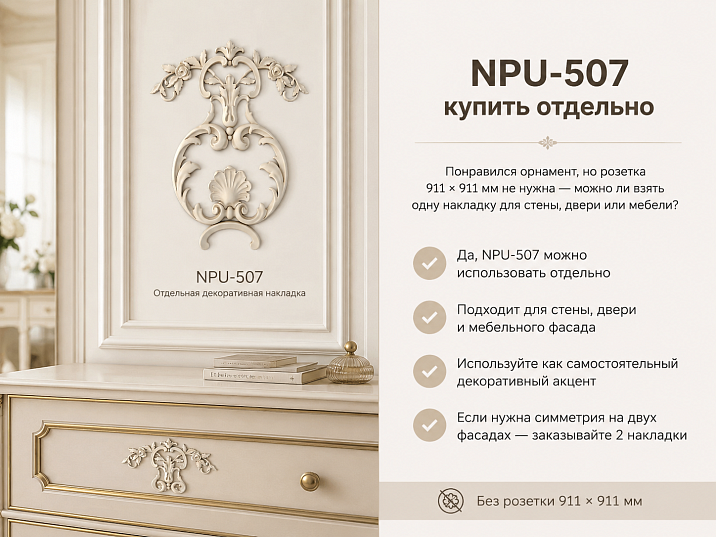
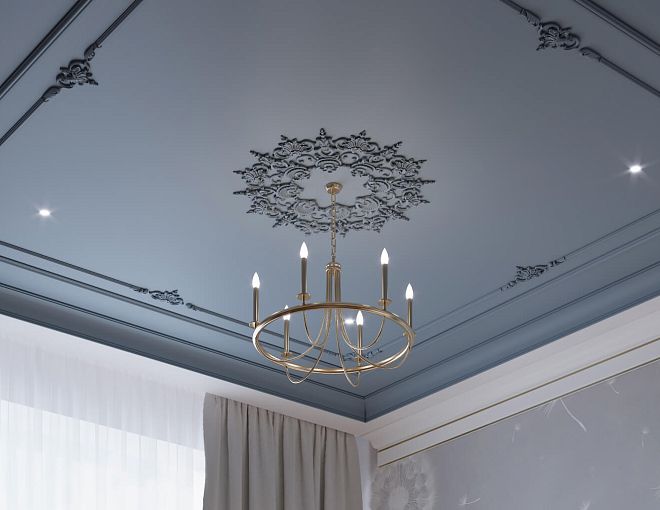
Did you like the expressive ornament from the large ceiling composition, but the rosette itself, almost a meter wide, is not needed in the interior? In the case of NPU-507, this is not a reason to give up the pattern. Polyurethane molding NPU-507, measuring 392 × 336 × 18 mm, is an independent decorative overlay, not a part that can only be purchased within a ready-made set. It can be considered separately for a wall, furniture facade, door, decorative panel, or portal.
This is where an important difference arises between "seeing the composition" and "buying the right element." As part of the ceiling rosette RPU.VRS-001, the NPU-507 overlay works together with NPU-508: for the full composition measuring 911 × 911 × 18 mm, four NPU-507 and four NPU-508 are used. But if you specifically like the character of NPU-507 — the floral ornament with roses, leaves, a shell, and volutes — buying eight pieces for the sake of one motif is completely unnecessary.
You can buy stucco decor NPU-507 separately and build a completely different composition around it: one large overlay inside a molding frame, a pair on symmetrical doors, two elements on opposite pilasters, or repeating decor on furniture facades. The point of such a purchase is not to reduce RPU.VRS-001. It is an independent way to use the same expressive ornament on a different scale and on a different surface.
This approach is especially useful for a buyer who is looking for polyurethane decor for the interior but does not want to start with an abstract choice of "classical molding in general." Here there is a specific model, exact size, and a clear task: determine whether one NPU-507 fits your specific installation location and how many pieces are really worth ordering.

One ornament instead of a large set: what exactly you are buying
NPU-507 is more convenient to perceive not as "one-eighth of a rosette," but as a complete, independent decorative element. Its dimensions are 392 × 336 × 18 mm. That is, it is already a fairly large relief that can work independently and does not require mandatory proximity to NPU-508.
For the buyer, this is a fundamental point. In the catalog Relief Decoration includes many elements of different scales and characters. Some are reasonably used only as a small addition to a frame or molding, while others read well on their own. NPU-507 belongs precisely to the second scenario: its area and richness of pattern allow the overlay to become the main decorative center of the chosen area.
The ornament is built vertically. It features floral and plant forms, roses, leaves, a shell, and volutes. This is not a small rosette button or a thin insert that dissolves within a larger design. Therefore, first you should look not at the overall size of the room, but at the specific surface where the overlay is intended to be installed.
For example, a wall may be large, but the molding frame itself may be relatively narrow. Or a door may be tall, yet the free space between panels, handle, and the upper part of the leaf is limited. Similarly with furniture: a cabinet may occupy an entire wall, while the width of one door is only a small part of the overall composition.
Therefore, the question "will NPU-507 fit?" is better immediately translated into a more precise one:
is there a free zone on the chosen surface not only measuring 392 × 336 mm, but also sufficient in scale for a relief with a thickness of 18 mm?
This is much more useful than choosing decorative molding only based on a beautiful photo.




NPU-507 in numbers
| Parameter | Confirmed data | What this means when choosing |
|---|---|---|
| Article number | NPU-507 | You need to check this specific model, not just rely on a similar pattern |
| Type | Decorative overlay | Can be used separately from a large composite composition |
| Material | Polyurethane | Finishing and mounting materials should be selected taking into account the material and base |
| Size | 392 × 336 × 18 mm | Before purchasing, check the width, height, and relief protrusion |
| Nature of the Pattern | Roses, leaves, shell, volutes | The ornament is noticeable and requires sufficient free space around it |
| Construction | Vertical composition | Especially convenient for doors, elongated panels, and vertical decorative fields |
| Application | Walls, furniture facades, doors, panels, portals | One model can solve several interior tasks |
| Connection with RPU.VRS-001 | Used as part of a large composition | For independent use, purchasing a full rosette is not necessary |
| Quantity in RPU.VRS-001 | 4 pcs. | Four NPU-507 units are only part of the original eight-element system |
| Full RPU.VRS-001 | 911 × 911 × 18 mm | This is already a different product scenario — a large ceiling composition |
The table shows the main point: the purchase decision depends not on where the buyer first saw the NPU-507, but on the task. If a standalone decorative overlay is needed, a single piece makes sense. If a large ceiling pattern around the central area is needed, then the conversation moves to the full RPU.VRS-001.
Our factory also produces:




There is no need to mentally divide the RPU.VRS-001 into eight parts
A large composite composition can easily create the false impression that all its elements exist only together. Especially if the buyer first sees the NPU-507 already installed next to the NPU-508.
But the principle of kit decor works differently. Individual parts can be standalone products, and the finished system appears through a certain quantity, rotation, and mutual arrangement of these elements.
The RPU.VRS-001, sized 911 × 911 × 18 mm, uses eight overlays:
-
4 × NPU-507;
-
4 × NPU-508.
This means that four identical NPU-507s by themselves do not yet turn into an RPU.VRS-001. In the original composition, four overlays of a different pattern and proportions work between them.
For the buyer, this opens up much more possibilities than simply purchasing a ready-made set. You can choose only the NPU-507 motif. You can look at the NPU-508 separately. You can assemble your own repeating pattern. And if you need a finished large ceiling center, it is more reasonable to go directly to purchasing the ceiling rosette RPU.VRS-001.
There is no "correct" quantity in itself. The correct quantity is determined by the surface and the intent.
One overlay is a standalone accent.
Two is a pair.
Four is a repeat or a symmetrical system.
Four NPU-507s plus four NPU-508s is already a specific complete composition of RPU.VRS-001.
That is why before ordering it is more reasonable to first decide what result you want to achieve, and only then count the details.
Get Consultation
When one NPU-507 is truly enough
It is sometimes psychologically difficult for a buyer to order a single decorative piece. There is a feeling: since the product is large and ornate, it must necessarily work in pairs or as a set. In the case of NPU-507, this is not so.
One overlay is especially appropriate where a natural center already exists.
In the center of a molding frame on the wall
Imagine a large rectangular frame. Without internal decor, it emphasizes the proportions of the wall, but its middle may seem empty. Filling the field with many small elements is not necessary. One NPU-507 can become the central point of the composition.
At the same time, you should not bring the frame close to the edges of the relief. The ornament needs free space around it. The calmer the surrounding plane, the easier the leaves, roses, shell, and volutes are read.
This scenario is especially useful if you want to get an expressive wall but not turn it into a continuous panel. Here, decorative stucco becomes not a background, but a single object accent.
If the frame design is still being planned, you can simultaneously look at what Buy polyurethane molding for building lines around the central element. Only the dimensions of the future frame should be determined taking into account the actual 392 × 336 mm of NPU-507.
On one accent door
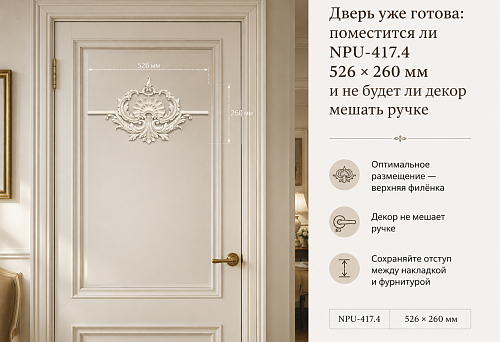
A door does not have to have a paired leaf for the relief decor to look meaningful. If the panel is wide enough and the construction leaves a free field in the upper or central part, one vertical overlay can become the main decorative motif.
Here, the height of 392 mm is especially important. Before purchasing, you should measure not the entire door, but specifically the area where the overlay will be placed. You need to consider the location of panels, handle, lock, and other protruding parts.
The thickness of 18 mm also matters. On a wall, such a relief is perceived differently than on a constantly used door. The overlay should not be placed where it could be regularly bumped by a hand when opening.
On the facade of a dresser or cabinet
One large furniture facade often looks empty even after painting and installing hardware. Adding a dozen small details is not the only way to solve the problem. One large decorative overlay can give a more cohesive result.
On furniture, alignment with the facade axis is especially important. A slight offset that is almost unnoticeable on a wall can stand out on a cabinet door due to clear vertical and horizontal boundaries.
Therefore, before order NPU-507 made of polyurethane, it is useful to make a simple template measuring 392 × 336 mm and apply it to the facade. Even a regular sheet of paper of the appropriate size will show whether the chosen decor is too large.
On a decorative panel or portal
Here, one overlay can work as the top of the composition, a central medallion, or a vertical accent. Especially if the panel itself already has a frame structure and additional relief is needed only in one place.
The main mistake is viewing NPU-507 as a universal "patch" for any empty surface. This is a large ornament. It needs scale, sufficient field, and a clear connection with the geometry of surrounding details.
Two NPU-507: when true pairing appears
Two identical elements create a different effect. A single overlay creates a center, a pair creates a relationship between two areas of space.
This option is especially natural for furniture and architecturally symmetrical surfaces.
Two cabinet doors
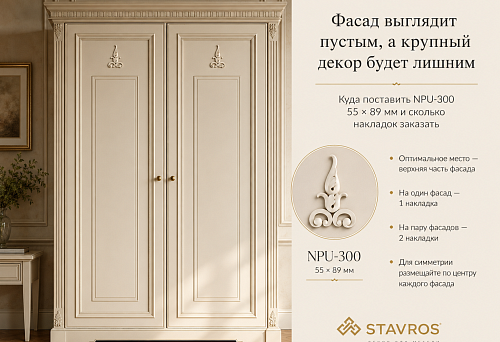
If the cabinet has two identical hinged doors, placing one NPU-507 on each creates a clear pair. But before ordering two pieces, you need to check not the overall size of the cabinet, but each door separately.
Especially critical:
-
facade width;
-
free field height;
-
distance to the handle;
-
position of panels or moldings;
-
line between the two doors;
-
Same installation height.
If an overlay fits on one door, but on the second the handle position or structural elements differ, symmetry may not work out.
Two wall sections
A pair of identical narrow sections on either side of a door, mirror, fireplace portal, or central panel is another scenario for two NPU-507 units. Here, the ornaments do not compete with each other but support the central architectural axis.
The main thing is to check the distance between the pieces. If two large reliefs end up too close, the wall will become visually dense. If they are too far apart and there is no connecting element between them, the pairing will be lost.
Two panels
Decorative wall panels or two symmetrical inserts can share the same center. This is a good option for an interior that needs repetition, but a large single rosette is not suitable either in terms of placement or purpose.
With this approach, it is useful to review the entire section in advance decorative elements made of polyurethane, because neighboring pieces sometimes help connect large overlays with the frame system.
Four NPU-507 units are already a composition, but not yet RPU.VRS-001
With four identical elements, there is a temptation to repeat the seen ceiling rosette. But it is important not to mix two different tasks.
If you place four NPU-507 around the center, you get an independent repeating system. It can be interesting in its own way. However, this will not be the original RPU.VRS-001, because in the full composition between the NPU-507, four NPU-508 are used.
This difference must be understood before placing an order. Otherwise, the buyer may order four parts, expecting to get a finished pattern from the card of the large rosette, but when laying them out, find empty gaps.
Four NPU-507 are worth buying when you consciously want to work with the repetition of one ornament:
-
four identical furniture panels;
-
four cabinet doors;
-
four decorative wall fields;
-
a symmetrical composition around a central object;
-
repeating elements in a large room;
-
your own author's layout.
In such cases, before purchasing, it is convenient to lay out the composition to scale, at least in a drawing. The size of one part is known, so you can understand in advance the overall scope of the future design.
You don't need to wait for installation to find out that four overlays take up more space than seemed from the photo.
NPU-507 or NPU-508: similar role, but different impression
A buyer who liked RPU.VRS-001 naturally encounters two article numbers at once. It is impossible to see the difference just by the name. Here it is more useful to compare the sizes and the nature of the pattern.
| Criterion | NPU-507 | NPU-508 |
|---|---|---|
| Size | 392 × 336 × 18 mm | 369 × 419 × 18 mm |
| Material | Polyurethane | Polyurethane |
| Overall plasticity | Floral, more compact ornament | Wider, openwork in character pattern |
| Self-application | Yes | Yes |
| Walls | Yes | Yes |
| Furniture | Yes | Yes |
| Door and portal compositions | Yes | Yes |
| As part of RPU.VRS-001 | 4 pcs. | 4 pcs. |
| What to check | Free field 392 × 336 mm and vertical pattern position | Free field considering size 369 × 419 mm and broader nature of composition |
There is no task here to determine which overlay is "better." The choice depends on which field needs to be filled.
NPU-507 is more convenient where a compact vertical motif is needed. NPU-508 has different proportions and may work better in a wider decorative field.
If after viewing the large rosette, the second pattern attracts more, you can separately buy the stucco decor NPU-508, without purchasing RPU.VRS-001 as a whole.
And if you like both ornaments and there is a sufficiently large surface, it makes sense not to choose between them anymore, but to consider them as elements of one system.
NPU-507 on the wall: first determine the field, not the room style
One of the most common mistakes when choosing decorative stucco is starting with a discussion about style: whether it is classic or not, whether the ornament suits the interior, whether it is solemn enough.
In practice, a simpler question arises earlier: where to physically place a part measuring 392 × 336 × 18 mm?
The wall can be styled in several ways.
Inside a separate frame
This is the most straightforward scenario. The molding defines the outer geometry, and NPU-507 gets its field inside.
First, the location of the overlay itself is determined, then the frame dimensions. Not the other way around. If the frame is made too small, the floral pattern will feel cramped. A frame that is too large without support from other elements can also look empty.
Therefore, it is useful to experiment not with millimeter precision, but with proportions: cut out a template of NPU-507 from paper or cardboard, attach it with painter's tape, and step back a few meters.
It is the viewing distance that often reveals what is not visible when measuring with a tape measure.
Above the console or dresser
If the furniture itself forms a horizontal base for the composition, a single overlay can be positioned along the central axis above it.
Here, it is advisable to check the connection not only with the wall, but also with the width of the furniture. A too-narrow console under a large ornament and, conversely, a long dresser with a small single center create different impressions.
NPU-507 is quite large, so it does not need to be surrounded by many additional shapes just to fill the wall.
On a free wall section
A narrow wall section between openings is a more complex place. A size of 336 mm on one side already requires checking the free width. It is not enough for the part to literally "fit." You need a margin of empty surface on the sides.
That is why Polyurethane decor for interiors should be chosen not only based on the product photo, but also on the specific dimensions of the architectural field.
As part of a more complex wall
If the wall is already divided by moldings, panels, or vertical lines, the NPU-507 can become the main element of only one of the fields. The remaining sections do not have to fully repeat it.
This way, the interior gains hierarchy: the central zone is richer, the side zones are calmer.
This is often more convincing than uniformly saturating every square of the wall with decor.
On a door, the NPU-507 should be evaluated not by the width of the panel, but by the working area
A door panel seems like a simple rectangular surface, but there is less free space on it than it appears at first glance.
There is a handle. There may be panels. There is a lower zone that is easier to bump into. There is an upper part that is visually connected to the height of the opening. Therefore, placing the overlay requires a preliminary layout.
For NPU-507, the vertical position is especially natural. But this does not mean that it can simply be placed in the center of any door.
Before ordering, check four things.
First is the actual width of the free field.
Not only 336 mm for the part itself is needed. There must be background around it.
Second is the height.
392 mm is a noticeable size. On a low panel, the overlay may conflict with its boundaries.
The third is the handle.
A relief with a thickness of 18 mm should not be located where the hand passes every time the door is opened.
Fourth is the existing pattern of the door leaf.
If the door already has complex panels, grooves, and applied moldings, an additional large floral ornament must be integrated into this geometry.
A good practical test is a photo of the door taken straight from the front with a scaled rectangle of 392 × 336 mm overlaid on it. Such a mockup won't convey the full relief, but it will immediately show whether the size of the overlay conflicts with the handle and panels.
If the dimensions fit, you can buy decorative overlay NPU-507 already for a specific location, not "approximately on the door."
Furniture facade: a large overlay requires a precise axis
On furniture, the tolerance for compositional error is smaller than on a large wall. The reason is simple: the facade itself has rigid boundaries. The top, bottom, left, and right edges are close to the decorative element, so any offset is easier to notice.
NPU-507 can be used on facades of cabinets, dressers, and other furniture, if the surface dimensions allow placing the part without visual and physical conflict with the hardware.
One wide facade
Here a single center is possible. Before ordering, determine:
-
facade width;
-
height;
-
a free field without a handle;
-
the central vertical axis;
-
the desired height of placement;
-
distance from the overlay to the edges.
Particular care should be taken with facades where the handle is already installed. You don't need to buy decor first and then try to find a place for it among the existing hardware.
Two identical doors
This is a natural scenario for two NPU-507. But identical facades require identical marking.
It's convenient to make a single template with a mark for the center and height. Then both overlays can be positioned identically relative to the top or bottom edge.
Four cabinet doors
Various compositional solutions are possible here. All four overlays can be at the same height. The central two can form the main pair, while the outer facades remain calmer. You can use NPU-507 only on the two inner doors.
You don't have to buy four pieces just because there are four doors. In furniture, a good result is often achieved not by full repetition, but by a clear hierarchy.
Overlay and frame on the facade
If a furniture facade is decorated with a molding, first decide where the NPU-507 is. Then build the frame around it.
When a customer first chooses a random molding and makes a narrow inner frame, large decor has to be "squeezed" into the remaining space. It is better to design the other way around: main ornament → free field → frame → hardware.
To select adjacent solutions, you can Buy Molded Decoration from the same product group and choose parts so that they don't compete in scale.
Decorative panels and portals: NPU-507 as a centerpiece, not a filler
In panel and portal compositions, a large overlay often works best not in the geometric center of the entire structure, but in the semantic center of a specific section.
For example, a vertical portal may have a wide upper part. Then NPU-507 is placed above the main plane and completes it. In a decorative panel, the overlay can be placed within the upper field, while the lower part remains calm.
Why is this important? Because a large relief doesn't need to be repeated in every free space.
If the portal already has profiles, moldings, corner pieces, and other ornaments, four more large overlays can overload the design. Sometimes one NPU-507 ties the composition together better than a whole set of additional figures.
For such projects, it's useful to look not only at the individual product card but also at the entire range polyurethane decors. The point of viewing a category is not to add as many details as possible, but to be able to compare scales and choose neighboring elements consciously.
Size 392 × 336 × 18 mm: how to understand it without a professional drawing
Numbers are clear on the screen, but they are not always well felt in a real interior.
392 mm is almost 40 cm.
336 mm is more than 33 cm.
18 mm is almost 2 cm of relief protrusion.
This alone shows that NPU-507 is not one of the barely noticeable decorative inserts.
Make a full-size flat template
You don't need to print a complex pattern. For a first decision, a rectangle of 392 × 336 mm is enough.
Cut it out of paper, cardboard, or folded sheets. Secure it in the place of the intended installation.
Then evaluate the surface from the point where you will most often see it.
For a wall — from the opposite part of the room.
For a cabinet — from a normal usage distance.
For a door — from the hallway or the room.
Such a test does not replace fitting the actual relief, but it shows the scale well.
Don't forget about the 18 mm
A flat template does not convey thickness. On the wall, the protrusion is perceived calmly, but next to a handle, furniture edge, or walkway area, these 18 mm already need to be physically accounted for.
Therefore, the second stage after the flat layout should be checking the surrounding objects.
Isn't anything opening nearby?
Doesn't the hand pass through?
Won't the decorative element be right at the edge?
Doesn't the surface touch the adjacent door?
Such questions are more important than abstract reasoning about whether the ornament fits "by style."
The free space around the ornament is more important than the absolute size of the wall
Let's say the wall is three meters wide. That doesn't mean NPU-507 will definitely look proportional.
If there's a tall cabinet in the middle of the wall, a door nearby, an air conditioner above, and the free area between items is only 45 cm, a large overlay will be cramped.
Conversely, a relatively small area can be a good spot if there are calm boundaries and a clear frame around it.
Therefore, the size of the surface should be considered in two stages.
First, the physical: whether the product fits.
Then, the compositional: whether air remains around it.
This logic is useful when choosing any polyurethane products, but it is especially important for a large overlay.
What to choose for different rooms
The same NPU-507 can be used differently not because the material changes properties from room to room, but because the function of the surface changes.
Living room
Here, large wall compositions, zones above a console, decorative fields near a portal, and symmetrical wall sections are most natural.
One NPU-507 is suitable for a central frame. Two — for paired sections. If a more developed pattern is desired, you can add molding geometry or consider combining with NPU-508.
Bedroom
The overlay can be used in a decorative wall composition, on furniture, or in symmetrical panels.
Special attention should be paid to the wall behind the headboard. There is already a large object — the bed. NPU-507 should not compete with it through random placement. It is better to tie the relief to the overall axis of the furniture.
Hallway
Here, free surfaces are often narrower, and the viewing distance is shorter. Therefore, a large ornament needs to be tried on especially carefully.
One overlay on a door or wall panel can be more convincing than several.
Cabinet
If the interior is built on calm geometry, NPU-507 can work as a single decorative detail. A good scenario is a panel or frame aligned with the central axis of a table, bookcase, or door.
Wardrobe
The main object is the facades. Here, paired or repeating layouts are especially interesting.
But four doors do not automatically mean buying four overlays. First, it is worth determining whether the same decor is needed on each facade or whether it is enough to decorate only the central pair.
Commercial interior
In a showroom, salon, reception area, or other representative space, a large relief can help highlight individual architectural zones.
For repeating panels, the quantity is calculated based on the number of identical fields. Before ordering a batch, it makes sense to test the layout on one section and only then scale the solution.
Polyurethane overlay and color: finishing can change the perception of the relief
The material of NPU-507 is polyurethane. But the word "polyurethane" itself does not answer the question of how exactly the decor should look after installation.
The relief can be perceived completely differently depending on the surface color and the chosen finish.
If the overlay and the base are painted in similar tones, attention shifts from the outline of the product to the light and shadow of the ornament itself. This approach is suitable when you want to make the decor part of the architecture of a wall or facade.
Contrast highlighting, on the contrary, shows the external shape and every curve more strongly. But at the same time, visual activity increases. On a large model 392 × 336 mm, contrast requires especially careful application.
Before painting, you need to check the recommendations for specific materials, surface preparation, and the chosen composition. Do not automatically transfer finishing technology from wood, MDF, or another base to a polyurethane part.
If you are simultaneously selecting Polyurethane Decor for adjacent areas, it is useful to determine the overall finishing scheme in advance. Then the large NPU-507 and small additional elements will be perceived as one system.
Molding around NPU-507: the frame should support, not crowd
The combination of a large overlay and a rectangular frame seems simple. That is why it is easy to make a mistake here.
The first mistake is making the inner field almost equal to the dimensions of NPU-507. Then the ornament looks like an object that accidentally does not fit into the frame.
The second is making the field huge and leaving one element in the middle without any connection to the overall geometry.
The third is choosing too active a profile that starts to compete with the floral relief.
There is no ready-made universal distance between NPU-507 and the molding. It depends on the size of the entire field, the position on the wall, and the width of the profile. But the principle is clear: there should be free space between the complex ornament and the frame.
If the project involves simultaneously to buy molding for several zones, first assign roles:
-
NPU-507 — main relief;
-
molding — geometric boundary;
-
additional elements — support;
-
free surface — background.
When all four roles are mixed, the interior becomes heavy. When they are separated, even a rich classical ornament looks cohesive.
What to buy together with NPU-507
The most obvious answer is "another NPU-507". But it is not always correct.
The accompanying purchase depends on the task.
If you are installing two identical doors, a pair is indeed needed.
If you are making one wall frame, a second large ornament may not be needed at all.
If you want to reproduce the full RPU.VRS-001, you need not additional four NPU-507, but the original composition — four NPU-507 and four NPU-508.
If you are creating your own wall composition, moldings or other decorative elements may be needed.
What makes sense to consider nearby
| What to add | When this is needed | Why | What to Check |
|---|---|---|---|
| Second NPU-507 | Two doors, two panels, two leaves | Create a mirror or paired composition | Uniformity of fields and installation height |
| Two more NPU-507 | Four repeating surfaces | Build a system of four identical motifs | Overall size and distance between parts |
| NPU-508 | Need to combine two ornament styles or move towards RPU.VRS-001 | Supplement NPU-507 with another part of the original composition | Size 369 × 419 × 18 mm and future layout |
| RPU.VRS-001 | Need a full-fledged ceiling center 911 × 911 mm | Obtain a finished composition | Actual size of the ceiling field |
| Moldings | NPU-507 is installed inside the frame | Create a geometric boundary | Inner field size and profile |
| Other polyurethane elements | Additional decor needed | Connect the central overlay with the surrounding design | Do not overload the surface |
| Installation materials | After approval of the base and installation scheme | Secure the element | Material compatibility and manufacturer recommendations |
If you need to assemble not just one item, but a system, it is more useful to go from the main part outward. First, the NPU-507 and its position. Then the quantity. Then the frame. After that, additional elements and mounting materials.
This way, the purchase becomes manageable, rather than turning into a set of randomly liked items.
NPU-507, NPU-508, or a whole RPU.VRS-001: a short selection matrix
| Your task | Rational option |
|---|---|
| Need one large floral ornament | 1 × NPU-507 |
| Two identical doors or panels | 2 × NPU-507 |
| Four identical decorative fields | 4 × NPU-507 |
| Prefer a different pattern from the original rosette | NPU-508 |
| Want to combine two types of overlays | NPU-507 + NPU-508 with pre-layout |
| Need a finished ceiling design 911 × 911 mm | RPU.VRS-001 |
| Need a relief inside a rectangular wall frame | NPU-507 + matching molding |
| Need decor on one furniture front | 1 × NPU-507 after checking dimensions |
| Don't know which pattern to choose | First compare the actual dimensions of NPU-507 and NPU-508 |
This table shows why the topic is not reduced to the question of "set or single piece." Between them, there are several quite independent scenarios.
How not to confuse a separate overlay and a ready-made rosette
The names NPU-507 and RPU.VRS-001 look like designations from one product system, so a buyer may decide that the first item is just a spare part for the second.
Better to remember a simple difference.
NPU-507 is a separate decorative overlay measuring 392 × 336 × 18 mm.
RPU.VRS-001 is a large composite composition measuring 911 × 911 × 18 mm, consisting of four NPU-507 and four NPU-508.
Therefore:
-
for a wall, you can buy one NPU-507;
-
for a pair of facades — two;
-
for an author's repeat — the quantity you need;
-
for an exact reproduction of RPU.VRS-001, the full original composition is required.
This difference is especially useful when placing an order. You should not order four NPU-507 expecting to get that same 911 × 911 mm rosette.
Conversely, there is no need to buy the full set if you only need one motif on furniture.
Practical selection: five real customer situations
Situation 1. "I have an empty wall, but I don't need a ceiling rosette"
Start with one NPU-507.
Make a template 392 × 336 mm. Find the center of the future composition. Assess the distance to furniture, doors, and wall boundaries.
If one piece seems too lonely, don't rush to buy a second one. Perhaps the surface lacks not another ornament, but a frame structure.
In that case, first look at moldings, then reassess the layout.
Situation 2. "I want to decorate two identical cabinet doors"
Here, a pair of NPU-507 looks logical.
The main checks are the width of each door leaf, the position of handles, and the same mounting height.
If the doors are narrow, the 336 mm size may be critical. Don't order a pair until you've tried the template on at least one door.
Situation 3. "Need decor for a regular interior door"
One overlay may fit if there is enough free space.
Check whether the relief falls into the hand area. Align it with the panels. Verify the 18 mm thickness relative to nearby parts.
For a door, it is especially important not to confuse "fits" with "is conveniently placed."
Situation 4. "I like the entire RPU.VRS-001, but it is too large for my room"
It is not necessary to mechanically reduce the original scheme.
Choose which
When NPU-507 may be unnecessary
An honest choice sometimes ends with rejecting the selected product.
NPU-507 may not fit if the free field is too small. A part measuring 392 × 336 mm cannot be visually reduced by color alone.
It can also be redundant on a facade where complex carving, many panels, an active handle, and additional overlays are already present.
On a narrow door, the problem can be different: the product physically fits, but the edges of the ornament end up too close to the boundaries of the door leaf.
If a small finishing element for the molding is needed, NPU-507 may also be too large. Then it is wiser to look at decorative polyurethane elements other sizes.
And finally, if the buyer wants exactly a large ceiling pattern as in the image of RPU.VRS-001, a separate NPU-507 will not replace the entire system.
Mistakes that are better to detect before ordering
Mistake No. 1. Looking only at the photo
A large ornament in a big interior photo may seem small.
The solution is simple: remember the actual dimensions — 392 × 336 × 18 mm — and make a template.
Mistake No. 2. Measuring the entire wall instead of the installation spot
The phrase "the wall is three meters, so it will fit" says almost nothing.
You need to measure the specific decorative field between furniture, openings, frames, and other objects.
Mistake No. 3. Forgetting about the thickness
18 mm is the third dimension that is easy to miss.
On a flat wall, it doesn't create the same problem as near a door handle or a moving furniture front.
Mistake No. 4. Buying four NPU-507 instead of RPU.VRS-001
Four NPU-507 units are not equal to the original socket. It additionally uses four NPU-508 units.
If you need the full pattern, you need to compare the order with the actual composition.
Mistake No. 5. Ordering eight parts when only one is needed
The reverse situation is no less common. The buyer likes one floral motif, but perceives the product only through a photo of a large composition.
First, determine the task. If it's one facade or one wall frame, a full set may be completely unnecessary.
Mistake #6. Placing the overlay flush against the molding
Large relief needs background around it. A tight frame visually compresses the ornament.
Mistake #7. Not accounting for the door handle
Even a correct position relative to the center of the door can be inconvenient to use.
Move your hand the way you usually open the door and check the chosen spot.
Mistake #8. Buying the same quantity as the number of facades
Four cabinet doors do not automatically require four overlays.
Sometimes the central pair looks more convincing than a fully repeating system.
Mistake #9. Mixing too many ornaments
If several large overlays with a different pattern, a complex molding, and active hardware are used next to NPU-507, the main idea gets lost.
It's better to designate one leading element.
Mistake #10. Ordering first, designing later
For large decorative elements, the reverse order is more correct:
place → size → quantity → adjacent parts → finishing → order.
This avoids the situation where an already purchased item has to be adapted to an unsuitable surface.
Preparation for installation begins before the purchase
Installing a decorative overlay is the final stage. Most important decisions are made earlier.
First, the base must be clear and accessible. Then the exact installation point is determined. After that, the layout is checked, and only then are mounting materials selected, taking into account the surface and the manufacturer's recommendations.
One should not assume in advance that the same mounting method is equally suitable for a wall, a door, and a furniture facade.
Different bases require different preparation.
In addition, on doors and furniture, not only fixation is important, but also the operational zone. The decor should not interfere with the movement of the leaf, the operation of the handle, or come into contact with adjacent elements.
Before final installation, it is useful to check the position of the part again without glue. If the composition consists of two or four elements, it is reasonable to mark out the entire group at once.
This makes it easier to notice the difference in height and distances.
How many NPU-507 to order: calculation without excess stock
For a single decorative element, the calculation is usually simpler than for linear molding. Here, you don't need to calculate linear meters.
You need to count based on the number of pre-defined installation locations.
One frame — one NPU-507.
Two symmetrical doors — two.
Four identical panels — four.
But if the project is large, don't automatically multiply the number of elements by the number of all possible surfaces.
First, separate mandatory locations from possible ones.
For example, there are six wall frames in a room. This doesn't mean you need six NPU-507. Perhaps one central frame should be an accent, and the rest will remain only with molding.
Or the cabinet has four doors, but decor is only needed on the two central ones.
Such a calculation saves not only the budget. It helps preserve the hierarchy of the interior.
A separate detail or a ready-made set: what is the real difference
Comparing "one NPU-507 versus RPU.VRS-001" may seem like a matter of price, but in fact the main difference is purpose.
A separate overlay gives freedom. You choose the surface, quantity, and placement yourself.
The ready-made RPU.VRS-001 sets a pre-formed composition of 911 × 911 × 18 mm with a specific set of elements.
| Criterion | Separate NPU-507 | RPU.VRS-001 |
| Task | Independent ornament | Finished large composition |
| Size | 392 × 336 × 18 mm | 911 × 911 × 18 mm |
| Number of parts | From 1 by task | 8 elements in the original scheme |
| Where especially convenient | Wall, door, furniture, panel, portal | Large ceiling area |
| Freedom of layout | High | The original composition is already defined |
| Do I need to add NPU-508 | No, if a standalone NPU-507 is used | Yes, the original composition includes 4 NPU-508 |
| Main check | Size of the specific location | Size of the entire ceiling composition |
Therefore, you should choose not "what is cheaper" or "what is bigger", but what result is needed after installation.
When it is already better not to assemble from parts, but to choose RPU.VRS-001
There is a boundary after which independent layout loses its meaning.
If you like exactly that large composition shown as RPU.VRS-001, and there is a ceiling field of at least the required scale for it, there is no need to reinvent the scheme from individual parts.
Here it is more reasonable to buy the ceiling rosette RPU.VRS-001 and work with the original system.
Individual NPU-507 units are especially valuable in another case: when you like a specific ornament, but you need not a rosette, but a new independent decorative scenario.
It is this boundary that makes the choice clear.
If you want to repeat a ready-made composition, choose a ready-made composition.
If you want to use its fragment as an independent decorative object, choose NPU-507 separately.
How to approach ordering NPU-507 from STAVROS
Before placing an order, there is no need to put together a complex technical specification. It is enough to check several parameters sequentially.
First — the article number.
Make sure that NPU-507 is selected.
Second — the size.
392 × 336 × 18 mm should fit the actual installation location.
Third — the quantity.
It is determined by the number of specific decorative fields, not by the size of the RPU.VRS-001 kit.
Fourth — adjacent elements.
If moldings, NPU-508, or other overlays are planned, they need to be checked against the overall layout before ordering.
Fifth — the base and finishing.
Mounting materials and surface preparation are selected based on the specific base and future finishing.
If the task goes beyond a single part, it is useful to first open the general catalog, where you can buy polyurethane decor together with suitable adjacent elements, or compare polyurethane decor of different shapes and sizes.
Thus, the order turns not into a search for "something similar," but into the selection of a specific system.
Why NPU-507 is interesting specifically as a standalone purchase
In large interior compositions, a single detail sometimes gets lost behind the overall impression. The buyer sees the entire rosette, but in fact, they are drawn to one specific part of the pattern.
With NPU-507, this effect is especially useful: a favorite floral motif can be taken out of its original context and used where a full system would be inappropriate.
On the wall, it becomes an independent centerpiece.
On furniture, it becomes a decorative facade element.
On the door, it becomes a vertical ornament.
On the panel, it becomes part of the architectural division.
On the portal, it becomes a finishing relief.
And only when necessary does it return to its original role as an element of RPU.VRS-001.
This approach shows why polyurethane molding is interesting not only with ready-made catalog compositions. Individual pieces allow designing decor from a specific surface without purchasing a larger set without practical need.
FAQ: answers before purchasing NPU-507
Can I buy just one NPU-507 without purchasing RPU.VRS-001?
Yes. NPU-507 is considered a standalone decorative overlay measuring 392 × 336 × 18 mm. If you need a single ornament for a wall, door, furniture, panel, or portal, purchasing the full RPU.VRS-001 is not required.
Before purchasing a single piece, check the free field and make sure the relief scale fits the specific surface.
How many NPU-507 are included in RPU.VRS-001?
The original composition RPU.VRS-001 includes four NPU-507 and four NPU-508.
Therefore, four NPU-507 by themselves do not reproduce the full rosette.
What is the size of NPU-507?
The size of NPU-507 is 392 × 336 × 18 mm.
When fitting, consider all three values. The first two determine the occupied field, the third — the relief protrusion above the base.
Will a single NPU-507 fit a furniture facade?
It may fit if the facade has sufficient free space.
Before ordering, you need to measure the width and height of the door leaf, check the handle position, and make sure the overlay will not be too close to the edges.
It is better to use a full-size template 392 × 336 mm.
Can the NPU-507 be installed on a door?
Yes, such an overlay can be used for a door if the dimensions and position allow it.
Pay special attention to the handle area and other protruding elements. The decor should not fall into the constant working area of the hand.
What is better for two cabinet doors — one or two overlays?
If the facades are identical and a symmetrical composition is intended, it's more natural to use two NPU-507s — one for each door.
But this is not a mandatory rule. Sometimes it's enough to decorate only the central or most visible part of the furniture. The choice depends on the entire cabinet composition.
Can four NPU-507 units be used in a custom composition?
Yes, if the project is specifically designed for repeating four identical elements.
Just don't consider such a layout as an equivalent of RPU.VRS-001. In the full socket, four NPU-508s are additionally used.
How does NPU-507 differ from NPU-508?
First of all, in size and pattern character.
NPU-507 has dimensions of 392 × 336 × 18 mm and a more compact floral composition. NPU-508 is 369 × 419 × 18 mm and is perceived as wider and more openwork.
Both models can be used independently.
Can NPU-507 be combined with moldings?
Yes, such a scenario is especially suitable for wall and furniture frames.
First determine the position of NPU-507, and then calculate the frame. It is advisable to leave sufficient free space between the relief and the molding so that the details do not look cramped.
How to understand if NPU-507 is too large for my wall?
Make a template of 392 × 336 mm and temporarily attach it to the chosen place.
It is better to evaluate from a normal viewing distance, rather than standing close to the wall. If there is almost no free space around the template, it is worth reconsidering the location or choosing a different decor size.
Do I need to buy NPU-507 as a pair?
No. Buying in pairs only makes sense for symmetrical surfaces — two doors, two facades, two panels, or wall sections.
For one accent frame or one furniture facade, a single piece is enough.
Can I just order four NPU-507 instead of RPU.VRS-001?
You can order four NPU-507 for your own composition, but it will not be the original RPU.VRS-001.
For a full system measuring 911 × 911 × 18 mm, eight elements are used: four NPU-507 and four NPU-508.
What to choose if you like both NPU-507 and NPU-508?
First, compare them at the scale of the specific location.
If you need one decorative field, you can choose the model whose proportions best suit the surface. If the composition is large, the two models can be considered together.
If you specifically need the ready-made pattern RPU.VRS-001, it makes sense to buy the full system.
Will NPU-507 fit a small door?
This depends not on the definition of a "small door," but on the actual free space.
You need to place a 392 × 336 mm template on a photo or directly on the panel and check whether there is space left to the edges, panels, and handle.
Can I first buy one NPU-507 and then add a second one later?
Yes, if the project allows for the composition to develop.
However, with a pre-planned symmetrical pair, it is more convenient to determine both installation locations at once to evaluate the result as a whole.
How do I calculate the number of NPU-507 units for four furniture fronts?
First, decide whether all facades should be designed identically.
If yes, four pieces will be needed. If only the central block is the main focus, two may be sufficient. The quantity is calculated based on the chosen composition, not automatically by the number of doors.
Where can I see other decorative overlays?
To compare sizes and shapes, you can open the section that presents molded decoration made of polyurethane.
It is useful to compare not only the pattern but also the dimensions: sometimes a neighboring model better matches the actual width of the door or furniture facade.
What to do if you like the NPU-507, but 392 × 336 mm is too much?
Do not try to squeeze a large ornament into a small field.
It is better to look at other decorative polyurethane elements and choose a model that will leave normal margins around the relief.
Do I need to consider the 18 mm thickness on a regular wall?
Yes, although on the wall this parameter is usually less critical than on a door or furniture.
Thickness affects the prominence of the relief and the proximity to frames, edges, and other protruding details. On moving facades, it must be taken into account without fail.
Can the NPU-507 be used as ceiling molding separately from the rosette?
The choice depends on the specific ceiling composition and the placement of the element.
If you need a finished large central pattern, it is more rational to consider RPU.VRS-001. For a non-standard custom layout, the separate NPU-507 should first be positioned to scale on the ceiling field and the entire composition checked.
What to check right before placing an order?
The minimum list consists of five items:
- article NPU-507;
- size 392 × 336 × 18 mm;
- quantity;
- installation location;
- neighboring elements and the future layout.
If the project is complex, it is additionally worth determining the finish and installation method for the specific base in advance.
NPU-507 separately or a large rosette: the solution is actually simple
If you liked the NPU-507 ornament specifically, you don't need to automatically buy the entire 911 × 911 mm composition. The standalone overlay measuring 392 × 336 × 18 mm allows you to use the same expressive floral motif on a wall, furniture, door, panel, or portal, and order exactly as many pieces as the specific surface requires.
One NPU-507 creates a center. Two provide symmetry. Four allow you to build a repeating signature system. And when you need the original large ceiling pattern, you should move to RPU.VRS-001 with its full set of four NPU-507 and four NPU-508.
Before ordering, don't rely only on the photo. Make a 392 × 336 mm template, check the free space, the 18 mm thickness, the position of handles and adjacent parts, and then determine the actual quantity.
This is exactly how STAVROS allows you to approach stucco decor not as a purchase of a random decoration, but as a constructor for a specific interior solution. You can choose a separate piece, assemble a pair, connect the overlay with moldings, or move to a finished rosette — and buy only what the project actually requires.