
































Article Contents:
- A solid wood leg is a material, not a construction
- Two ways to get a wooden furniture support
- Ready-made formed leg
- Composite system
- Ready-made leg
- KON-010 kit
- Oak
- Oak
- Mistake 1. Treating "solid wood" as a separate construction type
- Mistake 2. Always calling a finished leg "one-piece"
- Mistake 3. Assembling a load-bearing support from random decorative modules
- Mistake 4. Comparing the price of one leg with the price of one module
- Mistake 5. Choosing the height after manufacturing the cabinet
- Mistake 6. Not assembling a trial set
- Mistake 7. Not saving the composition of the modular system
- Mistake 8. Using a modular system where it adds nothing
- What does “solid wood furniture legs” mean?
- How does a ready-made furniture leg differ from a composite one?
- Which is more cost-effective — a ready-made leg or a set of wooden components?
- When is it better to use a modular support?
- Can a furniture leg be assembled from a wooden construction kit?
- What is easier to reproduce in a small furniture series?
- How to calculate the height of a composite leg?
- What to choose — oak or beech?
- When are unfinished legs needed?
- Where to buy solid wood furniture legs?
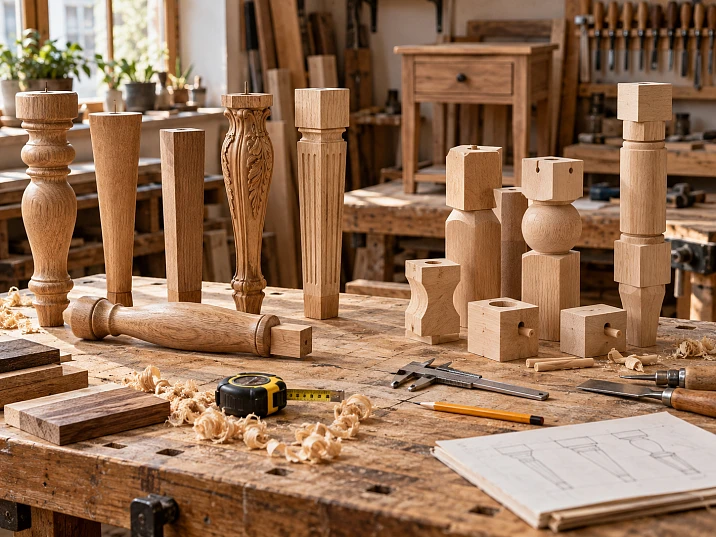
Page description: How to choose solid wood legs for furniture: a ready-made wooden support or a modular composite system. Comparison of geometry, height, assembly, finishing, and STAVROS furniture legs.
Four identical furniture legs can be obtained in two fundamentally different ways. The first is to choose a ready-made formed support with a predetermined height and profile. The second is to assemble a leg from several pre-made wooden elements when the project needs its own composition, rhythm, and proportion.
Both solutions can be made of solid wood.
Therefore, the phrase "solid wood leg" by itself says nothing about the construction. It only answers the question of what material the part is made from. A leg can be ready-made geometric, turned, carved, or composite.
For a furniture maker, another question matters more: does the project need a ready-made fixed geometry or the freedom of a composite system?
If simple repeatability and four identical supports are needed, a ready-made leg is often more rational. If the appearance is built from several volumes and a custom composition is required, a modular system is more interesting.
But the second option carries more responsibility: you need to control the composition, height, assembly, fastening, and repeatability.
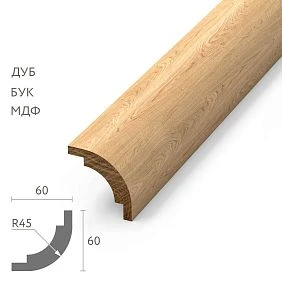
A solid wood leg is a material, not a construction
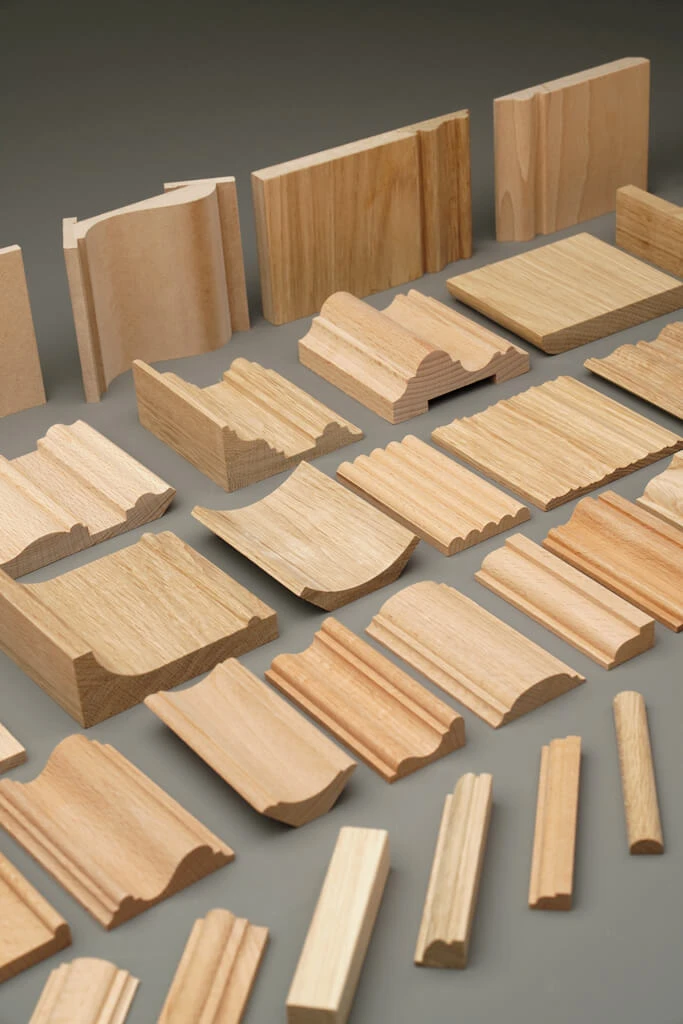
The phrase "solid wood legs for furniture" covers very different products.
Solid wood can include:
- straight geometric legs;
- turned supports;
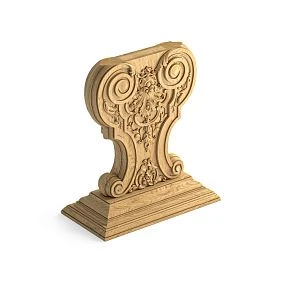
- carved legs;
- shaped supports;
- modular decorative systems;
- individual wooden modules.
They may be made of the same material — oak or beech — but have completely different production logic.
For example, the ready-made leg MN-187 already has a specific height and profile.
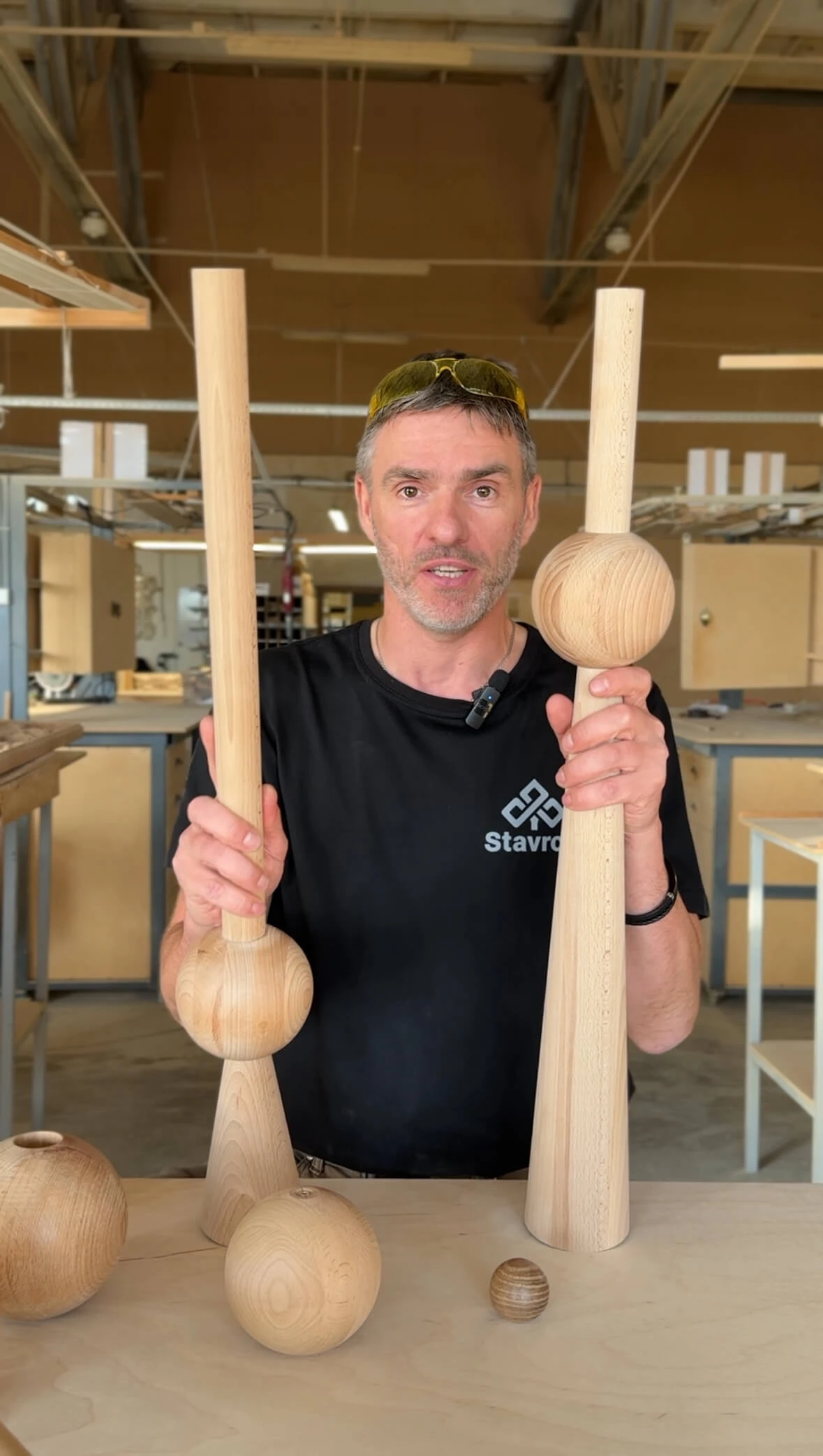
The KON-010 set follows a different idea: one leg is assembled from a wooden core and several shaped elements.
Externally, both solutions can serve the same role — furniture supports.
But for the designer, the purchaser, and the assembler, these are different products.

Two ways to get a wooden furniture leg
Our factory also produces:
Ready-made formed leg
The craftsman receives one finished part.
It already has defined:
- height;
- width;
- profile;
- decorative geometry;
- article number;
- Material.
For four identical legs, it is usually enough to specify one SKU and a quantity of four pieces.
This option is easier to design and replicate.
Get Consultation
Composite system
The leg is assembled from several pre-made wooden parts or from a ready-made kit.
The craftsman gains more freedom in composition.
You can work with:
- different volumes;
- a sequence of elements;
- rhythm;
- height;
- a combination of rounded and geometric shapes.
But each additional detail means one more position, joint, and potential point of failure.
When a ready-made leg is more practical
A ready-made support is especially convenient when the furniture does not require an individual leg composition.
A typical case is four identical legs for:
- a table;
- console;
- nightstands;
- of a chest of drawers;
- a cabinet;
- a small series of identical furniture.
Here, the value of a ready-made part lies in its predictability.
You know in advance:
- height;
- outer dimension;
- the material;
- shape;
- quantity.
Once a model is approved, there is no need to reassemble the leg from multiple components each time.
This is especially convenient for reordering.
A ready-made leg reduces the number of decisions
Let's imagine a console.
The project needs a support 740 mm high.
If a ready-made item with this height is selected, the designer can immediately attach the cabinet to it.
In the working documentation, a single line appears.
If the support is composite, however, you need to additionally define:
- composition of elements;
- assembly order;
- final height;
- axis;
- joints;
- fixation method;
- quantity of each component.
If the project does not need the individuality of a composite structure, this work becomes unnecessary.
Category of solid wood legs STAVROS
Main section solid wood furniture legs convenient for a scenario where a pre-formed support is needed.
There you can select:
- geometric legs;
- turned;
- carved;
- other ready-made furniture supports.
If the project has already determined the required height and shape type, it is usually easier to search among ready-made legs rather than starting with individual modules.
An unpainted leg — a ready-made geometry with its own finish
from STAVROS open boundless possibilities for designers, furniture makers, and anyone striving to create unique high-quality furniture. occupy a convenient intermediate position.
The shape already exists.
The craftsman does not need to create the profile from scratch.
But he determines the final appearance himself.
You can choose:
- enamel;
- stain;
- oil;
- varnish;
- tinting;
- patina.
For custom furniture this is convenient, because the ready-made support can be included in the overall finish system of the carcass.
For example, a beech leg can be painted with the same enamel as the fronts.
Leave the oak one under clear oil.
MN-187: ready-made geometric support
Geometric furniture leg MN-187 measures 740 × 80 mm.
It is available in beech and oak.
For a production project, its main advantage is the completeness of the geometry.
The craftsman does not assemble the profile from separate parts.
Does not calculate the height from the sum of modules.
Does not set each volume separately.
In the specification, one SKU and the required quantity are enough.
For four legs:
MN-187 — 4 pcs.
If the shape works for you, it's a very straightforward system.
MN-124: ready-made turned leg
Furniture leg MN-124 measures 720 × 160 × 100 mm.
It is also available in beech and oak.
Here, another reason to buy a ready-made part is clearly visible.
The difficulty isn't just the wood.
You need to achieve an identical turned profile on several supports.
If a workshop needs four identical legs, making them yourself means:
- setting up the machining;
- repetition of a single geometry;
- dimensional control;
- sanding;
- verification of uniformity.
A ready-made leg shifts this part of the work to the manufacturer.
The craftsman remains free in finishing and installation.
MN-040: when the complexity lies in the carved geometry
Carved Furniture Leg MN-040 available in several sizes.
The card shows, for example:
- 650 × 56 × 88 mm;
- 740 × 64 × 100 mm;
- 900 × 78 × 122 mm.
Material — beech or oak.
In such a product, the cost of making it yourself cannot be assessed solely by the price of the blank.
Need to consider:
- carved geometry;
- repeatability;
- machining of small transitions;
- sanding;
- machine time;
- possible defects.
If only one small batch is required, a ready-made carved leg can be far more rational.
When a composite leg is more interesting than a ready-made one
A composite system is needed not because it is “more complex and therefore better.”
Its point is freedom of composition.
It is especially interesting when the project requires:
- a distinctive silhouette;
- unusual sequence of volumes;
- visual rhythm;
- author's proportion;
- combination of rounded and straight forms;
- the ability to change part of the system without fully developing a new leg.
In such a design, the craftsman does not turn each element from scratch.
He designs the support from already finished parts.
STAVROS wooden construction set
Section wooden construction set is precisely built on the modular principle.
Instead of a scheme:
timber → processing → complex support
you can use another:
ready-made wooden elements → composition → assembly → finishing.
For a small joinery workshop, this is an interesting intermediate option.
There is no need to produce every complex volume yourself.
But the external result can still be designed.
KON-010: kit for one composite leg
Furniture leg set KON-010 measures 730 × 120 × 34 mm and is available in beech and oak.
The kit includes a wooden axis and shaped constructor elements for assembling one decorative leg.
This is no longer a random set of parts.
The composition is formed as a kit.
It is on KON-010 that the difference between the two approaches is clearly visible.
Finished leg
For example, MN-187.
This is a single formed part.
KON-010 set
This is a system that still needs to be assembled.
The height and external character are known, but the construction consists of several components.
Why a set is better than a random collection of modules
Modularity is easy to understand too broadly.
One might see individual KN pieces and decide that any several elements can be assembled into a load-bearing furniture leg.
That cannot be claimed.
If the manufacturer confirms a specific set, that is one scenario.
If we are dealing with separate decorative elements, that is a different matter.
A furniture support is not only about its appearance.
It must work in a real structure.
Need to consider:
- axis;
- connection;
- support assembly;
- attachment point to the furniture;
- stability;
- the allowable load for the specific project.
Therefore, ready-made kits and individual decorative modules cannot automatically be considered interchangeable.
KN-008: a modular component, not an automatically ready-made leg
Geometric figure KN-008 measures 150 × 96 × 96 mm and has a 34 mm hole.
It is produced from beech and oak.
The product is designed for installation on a corresponding wooden axle or another structure of suitable diameter.
This element clearly demonstrates the principle of a modular construction system.
However, KN-008 by itself should not be called a full-fledged furniture leg.
This is a component.
Its role is determined by the overall system.
KN-011: a different character of the module
Geometric figure KN-011 — a cube measuring 105 × 105 × 105 mm with a 34 mm hole.
It is also available in beech and oak.
If KN-008 is elongated along the axis, KN-011 forms a more austere cubic accent.
For a designer, this means that the same construction principles can produce compositions of different character.
But again: visual compatibility does not automatically mean a confirmed load-bearing scheme.
The support structure must be provided for by the project.
Ready-made leg vs. modular system: comparison
| Criterion | Ready-made pre-assembled leg | Modular system |
|---|---|---|
| Geometry | predefined | formed by a kit or system |
| Number of items | usually one | one for a ready-made kit or several for individual components |
| Designing | Simpler | requires more decisions |
| Repeatability | High | depends on the accuracy of the specification and assembly |
| Freedom of form | limited to the catalog | Higher |
| Assembly | Minimal | additional |
| Risk of configuration error | Below | Higher |
| Repeat order | Simpler | requires exact preservation of composition |
| Change of proportions | a different SKU must be selected | sometimes the system composition can be changed |
| Finishing | depends on the selected version | usually specified by the project |
The table does not imply that one method is better.
They solve different tasks.
Don't compare only the price of wooden parts
For a finished leg, calculate:
cost of the leg + finishing + fastening + installation.
For a composite system:
cost of components + assembly + joints + labor + finishing + fastening + installation.
If a set consists of several elements, a low price for an individual module does not yet mean a low-cost finished support.
Both systems need to be brought to the same point of comparison:
a fully assembled leg ready for installation.
Only after that is the comparison fair.
When modularity truly saves money
A modular system is especially interesting if the same component library is used in several furniture models.
For example, a workshop produces:
- a console;
- a table;
- a high side table;
- a decorative cabinet.
Some modules are identical.
Only the sequence or one accent element changes.
Then there is no need to develop four completely different complex legs.
You can work with a common system.
But for this, the composition of each variant must be fixed within the workshop.
When modularity creates unnecessary complexity
Let's imagine the simplest order.
Four legs of standard height are needed.
The shape is known.
A repeat order is possible.
In such a situation, a composite system may add:
- extra items;
- assembly;
- additional connections;
- more time for inspection;
- more opportunities to mix up parts.
If modularity does not provide a visual or structural advantage to the project, a ready-made leg is simpler.
This is exactly where you shouldn't overcomplicate furniture just for the sake of the modular principle.
The height must be determined before choosing the system
The leg height affects the entire piece of furniture.
The total height of an item is made up of the body, the support, and the top element.
Let's imagine a console.
A total height of 850 mm is needed.
If the tabletop and body together account for 120 mm, about 730 mm remains for the support.
This immediately points to solutions like KON-010 with a height of 730 mm or another suitable ready-made leg.
But if you first choose a beautiful 900 mm support and then try to fit it into the project, the entire piece of furniture will change proportions.
Therefore, the correct sequence is as follows:
- overall height of the furniture;
- body height;
- required support height;
- ready-made leg or modular system;
- check the mounting.
Ready-made height and modular height — different risks
For a ready-made leg, the height is set by the product card.
For example, MN-187 — 740 mm.
If this height does not fit, you need to choose another model or change the project.
For a modular system, the height depends on the set of components.
This gives more freedom, but requires verification.
You cannot add up the dimensions of parts by visual inspection alone.
You need to take the actual assembly scheme into account.
If a ready-made KON-010 kit is used, its final size is already clear.
If the workshop changes the composition, the final height must be confirmed again.
Four identical legs are more important than one beautiful prototype
A single support may look perfect.
But furniture requires a complete set.
For a table, chest of drawers, or console, four identical elements are usually needed.
This means what matters is not only the beauty of a single part, but also repeatability:
- heights;
- profile;
- positions of the modules;
- finishes;
- fastenings.
For a series, the task is multiplied.
If ten identical consoles are produced, 40 legs are already needed.
A ready-made support greatly simplifies such repeatability.
A modular system can also be repeatable, but only if the composition and assembly are strictly fixed.
Oak or beech
The choice of wood species in this article is secondary compared to the support structure.
But the material still affects the finish.
Beech
Often considered for:
- enamel;
- opaque finish;
- furniture where the wood grain is not the main feature.
Oak
It is interesting if you need to preserve:
- texture;
- oil finish;
- stain;
- clear varnish;
- tinting.
But oak can be stained, while beech can be left under a clear finish.
The decision is made by the specific project.
Unfinished leg or a ready-made finish
After choosing the construction, the next question arises — the finish.
If you need your own color system, these are convenient Unpainted legs.
The craftsman receives the finished geometry but defines the appearance himself.
If in the general category furniture legs there is already a suitable version, you can use it.
But this choice comes after the main decision of the article:
a ready-made formed leg or a composite system.
The fastening must be considered together with the support
It is not enough to simply choose a beautiful leg from a photo.
You need to understand how it connects to the furniture.
For ready-made legs, the following are usually checked:
- the upper mounting part;
- stud;
- the plate;
- a threaded insert;
- the support area;
- position relative to the cabinet.
For a composite system, the question of assembly itself is added.
Therefore, the fastening cannot be left until the last day.
It is part of the support structure.
Trial support before the full series
If the system is new, it makes sense to assemble one leg first.
This is especially true for the composite option.
Check:
- final height;
- actual external dimension;
- visual proportion;
- assembly;
- mounting;
- finish;
- position under the furniture.
After that, you can already order a set for the entire series.
For four ready-made legs, this stage is simpler.
For a modular system, it is especially useful because an error in one composition is then repeated on all supports.
How to record a ready-made leg in the specification
Entry:
wooden legs — 4 pcs.
too vague.
Better:
MN-187, beech, 740 × 80 mm, 4 pcs., for enamel
Or:
MN-124, oak, 720 × 160 × 100 mm, 4 pcs., for clear tint
This way, a repeat order is clear to another craftsman.
How to record a composite support set
For a ready-made set, it is enough to specify:
KON-010, beech, 730 × 120 × 34 mm, 4 sets
If the set composition has been changed, this is no longer enough.
Then the actual list of modules must be saved separately.
For example:
- axis;
- first figure;
- second figure;
- separating element;
- upper module.
Otherwise, in six months it will be difficult to replicate the same leg.
Common Mistakes
Mistake 1. Treating “solid wood” as a separate type of construction
Solid wood is a material. The construction can be ready-made or composite.
Mistake 2. Calling a ready-made leg necessarily “one-piece”
From a product page, it is not always possible to assert that the part was cut from a single solid piece of wood.
More accurate: a ready-made formed leg.
Mistake 3. Assembling a load-bearing support from random decorative modules
Visual compatibility of elements does not automatically confirm the load-bearing structure.
Mistake 4. Comparing the price of one leg with the price of one module
A composite system consists of several parts and requires assembly.
Mistake 5. Choosing the height after manufacturing the cabinet
The support directly affects the overall height of the furniture.
Mistake 6. Not assembling a test kit
An error in the sequence or height is then repeated on all four legs.
Mistake 7. Not saving the composition of the modular system
A repeat order turns into a new design process.
Mistake 8. Using a modular system where it provides no benefit
If a standard regular leg is needed, extra assembly only complicates the product.
Where to buy solid wood furniture legs
For ready-made supports, the main section is used solid wood furniture legs.
For custom painting — from STAVROS open boundless possibilities for designers, furniture makers, and anyone striving to create unique high-quality furniture..
If the project is based on a modular principle, you can explore wooden construction set.
For a ready-made composite composition — Furniture leg set KON-010.
It is better to choose after the following are known:
- required height;
- type of furniture;
- number of supports;
- desired geometry;
- finishing method;
- mounting scheme.
Quick selection guide
| Situation | What is more often rational |
|---|---|
| Four identical legs of standard height are needed | ready-made formed leg |
| A small series without complex assembly is needed | ready-made leg |
| A turned or carved shape from the catalog is needed | ready-made leg |
| A custom composition of several volumes is required | composite system |
| One set of modules is used in several furniture models | Modular system |
| Simple repeatability for reordering is needed | ready-made leg |
| Need custom finishing | unpainted version of any suitable solution |
| Individual modules are used without a confirmed support scheme | additional design verification is required |
What to choose in the end
A ready-made formed leg is better where simplicity, repeatability, and straightforward reordering are valued.
A composite system is more interesting where the support composition itself is part of a custom design project.
But modularity comes at a cost.
She adds:
- more details;
- more assembly operations;
- more specification requirements;
- more control.
Therefore, you shouldn't choose a composite leg just because it seems more individual.
If a ready-made article fully solves the task, this is often the most rational path.
If there is no ready-made silhouette and the project truly requires its own geometry, the modular principle gives the workshop freedom without the need to turn each complex shape by hand.
The correct sequence is as follows:
furniture height → required support → ready-made or composite system → material → finish → fastening → test piece → full order.
Frequently Asked Questions
What does “solid wood furniture legs” mean?
These are legs and supports made from natural wood. The expression itself does not define the construction: a leg can be a ready-formed or composite one.
How does a ready-made furniture leg differ from a composite one?
A ready-made leg arrives as a single formed part with a given geometry. A composite support is assembled from several elements or a ready-made kit.
Which is more advantageous — a ready-made leg or a kit of wooden elements?
For a standard small series, a ready-made support is usually simpler. A kit becomes more interesting when a custom composition is needed or a modular system is used across several projects.
When is it better to use a modular support?
When the appearance of the leg is built from several volumes, a special rhythm is required, or the workshop wants to create different variants based on a single system of components.
Can a furniture leg be assembled from a wooden construction kit?
A modular system can only be used taking into account the purpose of specific parts and the design of the project. Any random combination of modules cannot be considered an automatically ready load-bearing leg.
What is easier to reproduce in a small furniture series?
Usually a ready-made formed leg with a single article number. A modular support can also be reproduced, but its composition and assembly must be precisely fixed.
How to calculate the height of a composite leg?
It is necessary to proceed from the actual assembly scheme and the dimensions of specific components. Simple visual addition is not enough if the connection of elements changes the final size.
What to choose — oak or beech?
Beech is often used for opaque painting. Oak is especially interesting for oil, stain, and transparent finishes. But the choice depends on the specific project.
When are unpainted legs needed?
When a workshop wants to independently specify the color, tint, oil, lacquer, or another finishing system.
Where to buy solid wood furniture legs?
Ready-made wooden legs and supports are collected in the STAVROS catalog. For modular solutions, there is a wooden constructor section and ready-made kits, including KON-010.