








































































Article Contents:
- What counts as small wholesale when buying wooden furniture legs
- How a small purchase differs from a one-time buy
- Example: four cabinets and two spare legs
- What an exact order line should look like
- Geometric legs
- Turned legs
- Carved legs
- When standardization is not beneficial
- When beech is the rational choice
- When to choose oak
- Why you should not mix materials within a set
- Unpainted legs
- Pre-finished legs
- Project reserve and maintenance stock
- Example of calculating fasteners for sixteen supports
- Why strength cannot be determined by wood species alone
- What to do with an unsuitable part
- How to account for directional carved supports
- Repeat batch and differences in natural wood
- How to tell that a model is worth making a workshop standard
- Is buying eight legs considered small wholesale?
- Do I need to buy spare legs?
- Can one SKU be used for different pieces of furniture?
- Can legs from different batches be mixed?
- When should the received batch be checked?
- Should fasteners be included in the same order?
- What should I do if one leg is damaged?
- How can I repeat an order of wooden legs after a few months?
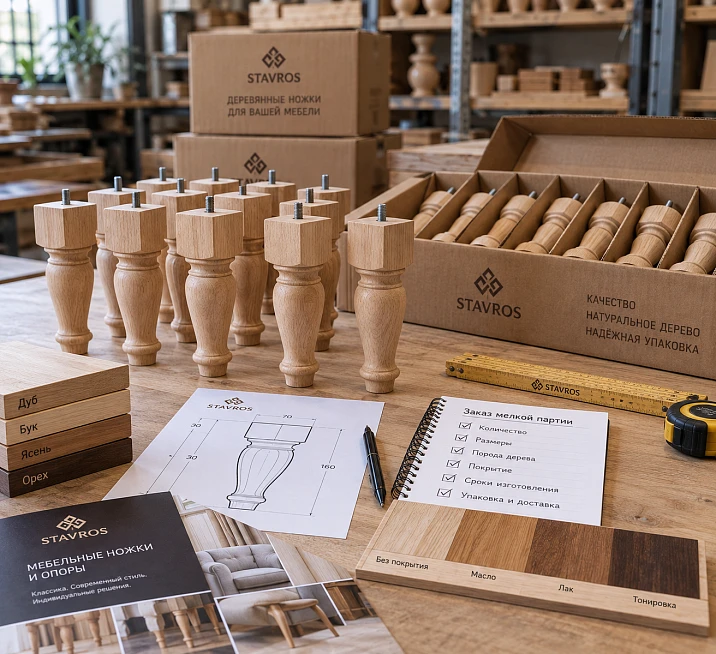
A workshop received an order for four identical cabinets. Each requires four wooden legs 180 mm high. Sixteen in total. It would seem enough to choose a preferred model, specify the quantity, and arrange delivery.
Problems begin when it turns out that a single SKU is produced in several sizes, in beech and oak, and sometimes also with different surface preparation. If one unsuitable piece appears among the sixteen parts, the production of the fourth cabinet may come to a halt. Three correct legs will not replace a complete set.
When buying furniture legs in small wholesale, the main task is to obtain not just the required quantity of parts, but several identical, pre-agreed sets for specific furniture.
To do this, the workshop needs to determine the exact specification of the support, calculate the quantity, account for mounting and finishing, organize incoming inspection, and keep records for reordering.
This approach is especially useful for small manufacturers that produce from one or two pieces up to a small series of chests of drawers, wardrobes, cabinets, tables, or upholstered furniture.

What counts as small wholesale when buying wooden furniture legs
For a small furniture workshop, small wholesale is primarily a production task. The workshop needs identical parts for several pieces of furniture at once, but there is no need to purchase hundreds of supports and create a large stock.
For example, a joinery production facility received an order for three chests of drawers. Each chest of drawers is mounted on four wooden legs. Twelve identical supports are needed, and they must match a single project.
Another example is four bedside cabinets for a hotel. Here, sixteen legs will be required. If the cabinets are to be produced additionally several months later, it is advisable to keep accurate records of the model used in advance.
Quantity alone does not determine the legal or commercial terms of a wholesale sale. Different suppliers may have different minimum order quantities, discounts, and ordering methods. Therefore, it cannot be stated that buying eight or twelve legs is automatically considered wholesale.
For a furniture maker, something else matters far more: how accurately an order can be repeated and compatible components obtained.




How a small purchase differs from a one-time buy
When someone buys four legs for their own cabinet, they mainly evaluate the appearance, dimensions, and ease of installation.
A workshop producing a furniture series additionally addresses several questions:
-
Do all the supports belong to the same size variant?
-
Does the material match?
-
Can the same mounting scheme be used?
-
Do the parts differ in surface preparation?
-
Will the finish turn out the same?
-
Can the same model be ordered again?
-
How to organize kits for individual items?
-
Should a reserve be provided for damage or subsequent repair?
Even for a series of four chests of drawers, these questions have practical significance. An error in one component affects the delivery date of the finished furniture.
Our factory also produces:
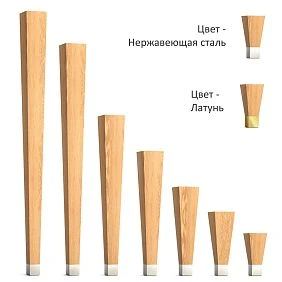
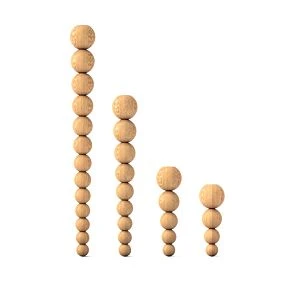
How many legs to order for a small furniture series
The calculation starts with the design of the furniture item, not with the number of parts in the package.
Number of legs = number of furniture items × number of supports per item + a justified reserve.
The last term is calculated separately. A universal reserve of 10 or 15 percent should not be set for any batch of wooden supports.
| Production order | Supports per item | Base requirement | What else to check |
|---|---|---|---|
| 2 bedside tables | 4 | 8 | Height matching |
| 3 chests of drawers | 4 | 12 | Material and finish |
| 4 nightstands | 4 | 16 | Single mounting unit |
| 5 chests of drawers | 4 | 20 | Product configuration |
| 6 benches | 4 | 24 | Structural stability |
| 2 sofas with six supports | 6 | 12 | Location of additional supports |
These are examples of quantity calculation, not universal structural schemes. The actual number of supports is determined by the drawing of the specific furniture.
A long sofa may have additional central legs. In a wardrobe, decorative supports are sometimes combined with hidden adjustable ones. A console may have a special wall-mounting scheme. Therefore, one cannot mechanically count four legs for any item.
Get Consultation
Example: four cabinets and two spare legs
Four cabinets require sixteen supports.
The workshop estimated the reorder lead time and decided to keep two additional legs in case of damage during production.
Calculation:
4 × 4 + 2 = 18 pieces.
In this case, the purchase consists of sixteen working supports and two spare ones. It is not necessary to assemble five sets of four: the fifth item is short by two more legs, and the spare has a different purpose.
After acceptance, the batch is distributed as follows:
-
Cabinet No. 1 — 4 legs.
-
Cabinet No. 2 — 4 legs.
-
Cabinet No. 3 — 4 legs.
-
Cabinet No. 4 — 4 legs.
-
Workshop reserve — 2 legs.
This simple separation helps avoid a situation where a spare part is accidentally included in a product while part of the main set remains in the warehouse.
Why the same SKU does not yet guarantee the same delivery
The model name is only the first level of identification.
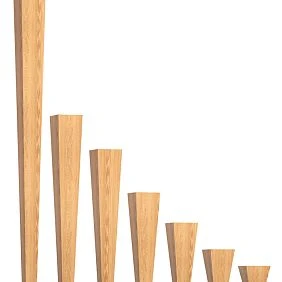
For example, a geometric leg from one series may be produced in heights of 80, 120, 180, or 250 mm. At the same time, different materials are provided for individual size versions.
The entry “MN-146 — 16 pieces” may be insufficient. You need to specify the exact size, material, surface condition, and other version parameters.
In the STAVROS catalog, you can examine several characteristic models.
| Model | Support type | Size examples | What to pay attention to |
|---|---|---|---|
| MN-146 | Geometric | 80 × 60, 120 × 60, 180 × 60 mm | Height, material, orientation |
| MN-145 | Turned | 100 × 44, 150 × 44, 200 × 44 mm | Silhouette, size, application restrictions |
| MN-144 | Carved | Multiple size versions | Curvature, relief, surface preparation |
Before ordering, dimensions and available options must be verified against current product pages and drawings. Size designations for one model must not be transferred to another without verification.
If a model has variants in beech and oak, then two legs of the same height made from different wood species are different versions. With a clear finish, they differ especially noticeably in texture.
What the exact order line should look like
Instead of the entry:
"Wooden legs MN-146 — 16 pcs."
a more complete specification must be used.
For example:
"MN-146; selected version 180 × 60 mm; beech; unfinished; quantity 16 pcs.; finish per project T-04".
Additionally, the mounting diagram, surface requirements, and the number of the approved sample, if any, are recorded.
If one model requires eight oak legs and sixteen beech legs, two separate line items are created.
How to choose the shape of wooden legs for a small batch
For a small purchase, appearance matters no less than size. But you cannot choose a model from a photo without checking its mounting geometry.
The shape of the support affects the silhouette of the item, the distribution of visual weight, and the installation requirements.
Geometric legs
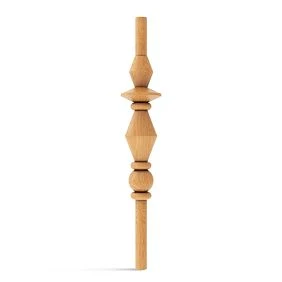
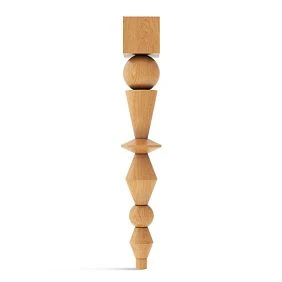
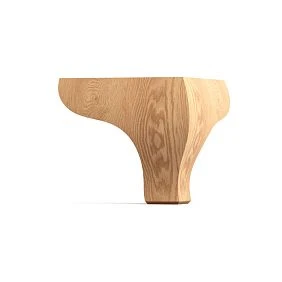
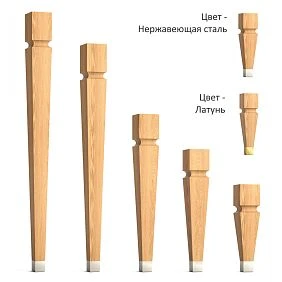
Geometric wooden supports suit furniture where clear lines, straight edges, and calm forms are important.
For a small batch of cabinets, sideboards, or chests of drawers, such models can be convenient due to their repeatable silhouette. However, this does not eliminate the need to check dimensions.
If the leg tapers toward the base or has a pronounced beveled edge, the orientation of each part matters.
Let's imagine a chest of drawers on four tapering legs. If three supports are rotated the same way and the fourth differently, the item may look asymmetrical even if all parts are at the correct height.
Therefore, for geometric legs, the following is checked during acceptance:
-
total height;
-
upper and lower sections;
-
shape of the faces;
-
position of the taper;
-
mounting plate;
-
orientation during installation.
To make a selection, you can use the section geometric furniture legs.
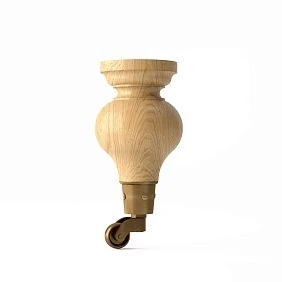
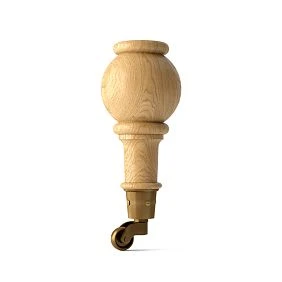
Turned legs
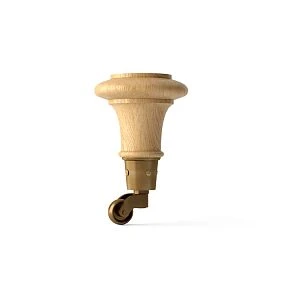
Turned supports have a distinctive silhouette formed by rotating the workpiece during processing.
Such legs are especially prone to discrepancies in height, diameter, and the position of profile transitions.
If two adjacent supports have different shapes of the thickened section, this can disrupt the perception of symmetry.
For a small series, the furniture maker must specify a particular model and size in advance. Similar variants from the same collection must not be mixed based solely on overall height.
However, not every turned leg is suitable for heavy furniture. For example, for MN-145 the manufacturer specifies restrictions on use under light loads, and recommends the long versions for lightweight wall-mounted consoles and coffee tables.
This means that choosing a tall turned leg for a massive table simply because it matches the style is technically incorrect. The entire assembly needs to be evaluated.
Available in the catalog turned wooden furniture legs.
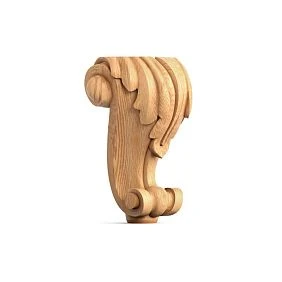
Carved legs
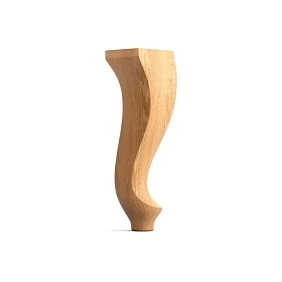
Carved legs are often used in classic furniture, consoles, chests of drawers, and decorative joinery.
Here it is necessary to control not only the dimensions, but also the orientation of the pattern.
On some models, the front side differs noticeably from the side. Therefore, four legs installed without taking the direction of the curve into account can produce an uneven composition.
For carved items, the following are essential:
-
height and width;
-
depth or projection;
-
position of the carved ornament;
-
presence of a directional curve;
-
quality of surface finish;
-
the possibility of identical finishing for all parts.
One should not assume that every curved leg is produced as a separate left and right version. This must be determined by the specific item code.
For the project, you can explore carved furniture legs STAVROS.
One leg model for different pieces of furniture
Small furniture workshops often produce several items in the same style: nightstands, chests of drawers, small cabinets, and consoles.
Using one family of supports helps maintain visual unity.
But two concepts need to be distinguished: identical shape and identical execution.
For example, a nightstand and a chest of drawers may have supports of the same geometric model but of different heights. To the buyer, they look related. For production, these are different parts that must not be accidentally mixed up.
If two items use completely identical supports, their requirements can be combined into a single purchasing position. If even one critical dimension or material differs, a separate line is required.
This approach allows reducing the number of different models in the workshop without sacrificing production precision.
When unification is not beneficial
Attempting to use a single leg model for the entire range sometimes leads to design compromises.
A nightstand, a desk, and a sofa have different operating conditions, heights, load patterns, and mounting schemes.
If the chosen leg fits a nightstand, this does not prove its suitability for a sofa.
Unification is justified only when the requirements of specific products coincide or when a suitable version is provided and tested for each product.
Beech or oak for a small batch of furniture supports
The material must be selected simultaneously with the finishing technology.
If the product will be painted with opaque enamel, the natural wood grain will not become the main decorative factor. However, the species still affects surface preparation and processing technology.
If clear lacquer, oil, or tinting is used, the wood remains visible. In this case, texture matching may be an important condition when selecting a batch.
When it makes sense to choose beech
Beech legs are suitable for many types of furniture and finishing options.
They can be considered when natural wood with a relatively calm texture is required, or when the workshop plans its own opaque paint finish.
But the statement “beech is always better for enamel” is incorrect. The quality of the surface, the preparation of the product, and the chosen coating system must be taken into account.
For a series of four white cabinets, it is more useful to order all sixteen beech legs in one approved specification than to mix different materials just because they should look the same after painting.
When to choose oak
Oak supports are especially appropriate when a furniture project provides for an open natural texture.
For example, for three chests of drawers with oak fronts and a clear finish, legs made of the same material can be selected.
However, even within a single species, wood is never absolutely identical. Shades, grain arrangement, and the visual intensity of the pattern vary.
Therefore, for visible supports it is advisable to presort the parts by compatibility of appearance.
Why materials should not be mixed within a set
Suppose a workshop ordered twelve oak legs for three chests of drawers. Among the received parts, one turned out to be beech.
The size and shape match, but that does not make the part interchangeable.
After applying clear oil, the difference in material may become noticeable, especially if the four legs of the same dresser are in direct view.
The best solution is to identify the mix-up before finishing and agree on a replacement.
If an opaque enamel is planned, the external difference may be less noticeable, but the approved species should still not be changed without approval.
Legs without a finish or with a ready-made finish
A small workshop usually has two options.
The first is to purchase ready-made supports and finish them yourself.
The second is to order products with a suitable ready-made coating, if such an option is available in the range.
Unpainted legs
Uncoated legs allow the supports to be included in the overall furniture finishing system.
This is convenient when the fronts, carcass, and decorative elements must have the same color.
However, before starting the batch, it is necessary to check the surface and perform a trial finish.
If the workshop uses enamel, the primer, sanding, opacity, and the condition of complex areas are checked.
When tinting, the wood color, evenness of absorption, and the final shade after the protective coating are evaluated.
Legs with a pre-finished coating
If the pre-finished coating matches the project, purchasing such parts can reduce the number of production operations.
But before ordering, you need to make sure that the color and gloss level suit the entire furniture piece.
An on-screen image does not allow for a reliable assessment of the actual shade. Differences are especially noticeable under side lighting and when materials with different textures are placed next to each other.
For a small series, it is advisable to first check one part and then coordinate the main supply.
How to determine the required reserve
Whether or not to buy spare legs is a matter of production organization.
There is no universal rule that a certain percentage must always be added to every purchase.
The decision depends on several factors.
Replenishment lead time. If making an additional leg takes longer than the project schedule allows, a reserve may be justified.
Cost of the part. For an inexpensive standard support, keeping a spare is relatively cheap. For a large carved oak leg, it can noticeably increase the budget.
Likelihood of reuse. If the workshop regularly produces identical cabinets, a spare support is highly likely to be useful. For a unique piece, the prospect of reuse is much lower.
Finishing requirements. With a clear finish, a new batch of wood may differ from the original. Keeping a suitable spare part sometimes simplifies repair.
| Strategy | Batch for 4 cabinets | Features |
|---|---|---|
| Without reserve | 16 legs | Minimal costs |
| One spare | 17 legs | Reserve for single damage |
| Two spare | 18 legs | Additional insurance |
| Spare set | 20 legs | Suitable for a repeatable model or service stock |
No single option can be recommended for all workshops. The quantity should be chosen for a specific project.
Project reserve and maintenance stock
The project reserve is needed before furniture handover. It is used when a part is damaged during painting, fitting, or assembly.
The repair stock is retained after the product is delivered to the customer. It may be needed if a leg is damaged during use.
A permanent warehouse stock is the third task. It is intended for the workshop's future projects.
These types of reserve should preferably be accounted for separately.
Furniture leg fastening: what to include in the purchase
A wooden leg by itself is not always a ready-to-install assembly kit.
Depending on the design, mounting plates, studs, threaded inserts, glides, or other connecting elements may be required.
Fasteners must not be ordered solely based on the model's visual similarity to a previously used leg.
It is necessary to check the dimensions of the top plate, the location of the holes, and the permissible installation scheme.
Example of calculating fasteners for sixteen supports
Suppose the project provides for one mounting plate and two connecting screws per leg.
Four cabinets require sixteen legs.
Then you will need:
-
16 wooden supports;
-
16 mounting plates;
-
32 connecting screws.
If the project specifies four screws per plate, the number of screws will already be 64.
This is a conditional calculation example, not a universal fastening requirement.
Components should be selected for the specific design, using suitable furniture hardware.
Why strength cannot be determined by wood species alone
An oak leg does not automatically become suitable for any heavy furniture just because the wood is dense.
Strength and stability depend on the shape, cross-section, connection to the body, direction of forces, and the construction of the item itself.
For tables and upholstered furniture, lateral impacts during use are especially significant.
If the manufacturer does not provide a permissible load for a specific version, one must not independently assign a universal load capacity to it.
Incoming inspection of a small batch: what to check before painting
A single incorrect part can halt the production of an entire item.
Therefore, even a purchase of twelve or sixteen supports must be checked before being sent to the painting shop.
First, the commercial documents are compared with the approved specification.
Then the actual quantity of parts and versions is verified.
After that, the geometry, mounting points, and surface condition are checked.
| Check | What to control | What to do in case of discrepancy |
|---|---|---|
| Article number | Compliance with order | Separate the disputed item |
| Size | Height and critical dimensions | Verify against the drawing |
| Material | Beech, oak, or another agreed option | Do not mix finishes |
| Quantity | Actual number of parts | Record the shortage |
| Geometry | Cross-section, profile, orientation | Form suitable sets |
| Surface | Chips, damage, cracks | Set aside until approval |
| Preparation | Sanding quality | Check the finishing technology |
| Mounting | Assembly area | Verify against the project |
Deviations are assessed according to technical documentation or agreed tolerances. Inventing a single allowable height variation for all wooden legs is incorrect.
What to do with an unsuitable part
If a leg of a different height is found during acceptance, it must not be left in the common box.
Separately specify the project number, item code, and the identified nonconformity.
It is useful to photograph the part next to a measuring tool.
Before a replacement is agreed, irreversible processing that could complicate resolving the issue with the supplier should not be performed.
This is especially relevant for expensive carved supports.
How to assemble identical sets for each piece of furniture
Let's imagine the workshop ordered twenty legs for five dressers.
After incoming inspection, five sets of four parts each need to be formed.
Each set is assigned the number of the corresponding dresser.
| Set | Product | Quantity |
|---|---|---|
| KM-01 | Dresser No. 1 | 4 |
| KM-02 | Dresser No. 2 | 4 |
| KM-03 | Dresser No. 3 | 4 |
| KM-04 | Chest of drawers No. 4 | 4 |
| KM-05 | Chest of drawers No. 5 | 4 |
If the items are finished with clear lacquer or oil, it is useful to take the similarity of the natural grain into account when distributing the parts.
If an opaque enamel is used, geometry, surface preparation, and a consistent technological process come to the fore.
Acceptance cannot be considered complete just because the number of parts matches the count.
Each set must fit its own item.
How to account for directional carved supports
Carved legs sometimes have a distinct front and side.
If the shape is directional, its orientation is best fixed in the installation diagram.
For example, the front legs of a chest of drawers should form a symmetrical composition.
But this does not mean that all such models necessarily have separate left and right versions. The possibility of mirrored use must be determined for each specific product.
Before painting, it is useful to perform a dry assembly of one set.
Reordering furniture legs a month later
The workshop successfully produced four cabinets. A month later, the customer asks for two more of the same.
If the details are not saved, you will have to search for the model again, check the dimensions, and reconstruct the mounting scheme.
Therefore, it is advisable to have a separate entry in the production documentation for each repeatable support.
| Field | What to save |
|---|---|
| Project name | Cabinet T-04 |
| Article number | Exact model from the catalog |
| Size | Approved version |
| Material | Beech or oak |
| Surface preparation | Approved option |
| Finish | Enamel, lacquer, oil, or tint |
| Mounting | Approved scheme |
| Quantity per product | For example, 4 |
| Sample number | If present |
| Link | Exact product card |
| Purchase history | Date, quantity, and delivery number |
A photo of the part can be a useful addition, but it does not replace this information.
Two similar legs may have different mounting plates and heights.
If the manufacturer has changed the design or temporarily does not offer the required material, a replacement is agreed upon separately.
Repeat batch and differences in natural wood
Even an exact article number match does not guarantee that a new batch of oak legs will be visually absolutely identical to the first one.
Wood can vary in shade and grain pattern.
For a clear finish, a test finish should be performed on the new part and the result compared with the approved sample from the previous order.
For opaque painting, the compatibility of the primer and surface preparation are also essential.
How to calculate the real cost of a small batch
The cost of the legs is not the only expense item.
The workshop additionally spends time on incoming inspection, processing, mounting preparation, painting, and assembly.
Therefore, sometimes a cheaper support turns out to be less advantageous.
Suppose one option is cheaper than another by 150 rubles per piece.
For a batch of sixteen legs, the savings at purchase will be:
16 × 150 = 2,400 rubles.
However, the cheap finish requires an additional twelve minutes of processing per part.
Total labor costs:
16 × 12 = 192 minutes, or 3 hours 12 minutes.
If the notional internal labor rate is 700 rubles per hour, the additional labor costs are:
3.2 × 700 = 2,240 rubles.
The initial savings are reduced to 160 rubles — even before accounting for tool wear and possible defects.
All prices in this example are illustrative and are intended solely to demonstrate the method.
For a real project, you should use the current cost of the specific finish and your workshop's own rates.
You need to compare the cost of a leg fully prepared for installation, not just the purchase price.
When it is unprofitable to keep furniture legs in stock
A permanent stock makes sense when the model is used regularly.
For example, a workshop produces several standard types of cabinets and chests of drawers with identical geometric supports.
In this case, the production team already has an approved drawing, a proven fastening scheme, and a finishing card.
But if the furniture is made to order, materials and shapes are constantly changing, creating a large stock may prove irrational.
This is especially true for expensive carved legs and non-standard size versions.
It is better to purchase them for a specific approved project.
How to determine that a model should be made a workshop standard
The basis should be the actual repeatability of orders.
Save the history of purchases and consumption of parts over several projects.
If one model is used regularly and its reserve is depleted quickly, a permanent stock inventory can be considered.
If several spare legs remain unused for a long time, the reserve norm should be reviewed.
Common mistakes when purchasing legs in small wholesale quantities
Mistake one — specifying only the model and quantity.
If a SKU has multiple versions, parts of different sizes or materials may be received. The solution is a full specification for each item.
Mistake two — mixing beech and oak within one batch.
Even if the geometry matches, they can produce different results after a clear finish. The solution is to check the material before sending it to the painting shop.
Mistake three — not accounting for fasteners.
The supports may be delivered on time, but assembly will have to be postponed due to missing plates or connecting elements. The solution is to include fasteners in the procurement list.
Mistake four — sending all parts for painting at once.
After coating is applied, correcting mixed-up items is more difficult. The solution is incoming inspection, kit distribution, and trial assembly.
Mistake five — using a support for the wrong purpose.
A suitable appearance does not confirm sufficient strength. The solution is to check the mounting unit and the furniture's operational requirements.
Mistake six — reordering from a photo.
Visually similar models are not necessarily identical. The solution is to keep the full SKU, dimensions, material, and drawing.
Mistake seven — buying a reserve without calculation.
Extra expensive legs can sit in the warehouse for years. The solution is to assess the reorder lead time, cost, likelihood of reuse, and furniture servicing obligations.
Where to buy furniture legs in small wholesale
It is convenient to choose a small batch of wooden supports starting from the STAVROS furniture legs catalog.
The catalog presents various shapes and designs that can be matched to a specific furniture task.
If the workshop performs the painting itself, it makes sense to look into unpainted wooden legs.
For furniture with pronounced classical decor, carved supports can be considered, while for calmer geometry, corresponding geometric or turned models are suitable.
Before placing an order, you should determine:
-
the exact item code and size;
-
the material of each design;
-
surface condition;
-
the number of legs for each item;
-
the overall project requirement;
-
the need for a reserve;
-
a suitable mounting scheme;
-
possibility of receiving the entire batch;
-
reorder terms.
For professional buyers, it is also useful to review conditions for manufacturers и information about payment and delivery.
If a workshop needs to buy wooden furniture legs in a small batch, it is better to send the supplier an exact specification in advance and confirm the availability of the required quantity of a single finish.
After receiving the order, all that remains is to carry out acceptance, distribute the parts into sets, and start the approved finishing.
This is how a small purchase turns into a manageable production process that can be repeated with the next order.
Frequently asked questions about purchasing wooden furniture legs
Is buying eight legs considered a small wholesale purchase?
For a furniture workshop, this may be a purchase for two identical pieces of furniture. However, the commercial terms of wholesale sales and the minimum quantity are determined by the supplier.
Do I need to buy spare legs?
It depends on the project timeline, availability of reordering, cost of parts, and likelihood of reuse. There is no universal mandatory reserve.
Can one SKU be used for different pieces of furniture?
Yes, if the selected version fits in terms of dimensions, mounting design, and operating conditions. One SKU with different heights should be treated as separate items.
Can legs from different batches be mixed?
After checking dimensions, material, geometry, and finish. For a clear finish, the shade and texture of the wood are also compared.
When should the received batch be checked?
Before drilling, painting, and installation. This allows mismatches to be identified without the cost of irreversible processing.
Should fasteners be included in the same order?
If the design requires separate mounting elements, they must be included in the set. Compatibility and quantity are determined by the drawing.
What should I do if one leg is damaged?
Isolate the part, record the damage, and agree on a possible replacement. Do not attempt to fix it with irreversible treatment before resolving the issue with the supplier.
How can I reorder wooden legs after a few months?
Use the saved specification with the item code, size, material, surface finish option, mounting pattern, and product link. If necessary, additionally compare the new batch with the previously approved sample.