










































































Article Contents:
- Molding without fear: why 'one detail' works better than 'everything at once'
- The fear of 'making it worse' is the main reason for inaction
- What is 'one strong molding point' and how to find it
- Mirror: the most obvious point for the first accent
- Console in the hallway: the place that is seen first
- Sconce by the bed: an accent in the relaxation area
- Wall above the dresser or nightstand: emptiness with potential
- Headboard: an architectural backdrop without built-in furniture
- Chandelier and ceiling rosette: one element for the entire room
- Decorative molding: the most straightforward start
- What is decorative polyurethane molding
- How to choose decorative molding for your first accent
- Molding decor above a mirror: step-by-step breakdown
- Hallway: between the mirror and the ceiling
- Bedroom: above the mirror at the vanity table
- Hall and dressing room: full-length mirror
- Bathroom area outside the wet zone: a delicate accent
- When a single molding decor needs a frame
- What is a molding frame as a mini-system
- How to choose molding for a single frame
- Frame + decor: how to position correctly
- Ceiling stucco as the first accent: one element for the entire room
- Ceiling rosette: the fastest way to a 'luxury ceiling'
- Ceiling molding as the first accent in a room without decor
- How to choose the spot for the first stucco accent: a simple algorithm
- Practical scenarios for the first stucco accent
- Scenario 1: 'I want to try stucco without risk'
- Scenario 2: 'The mirror should look more expensive'
- Scenario 3: "Empty wall behind the dresser"
- Scenario 4: "Chandelier present, ceiling empty"
- Table: which first accent to choose for each zone
- What to avoid with the first accent: five typical mistakes
- About the company
- Frequently Asked Questions
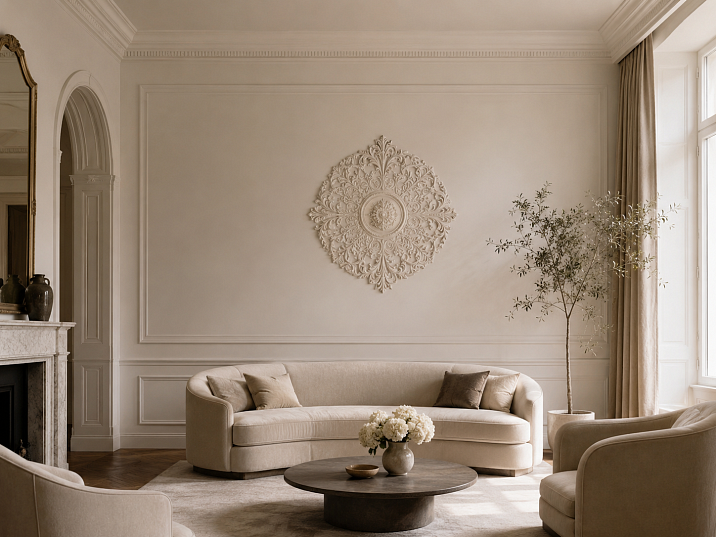
You know what unites most interiors that look expensive but don't scream about it? They don't have everything at once. No stucco on every wall, no ornament on every cornice, no decor above every piece of furniture. Instead, they have one focal point that holds the entire interior — one detail that catches the eye naturally, without hints.
That's what this article is about. Not about how to fill a room with stucco. But about how to choose a single — precise — stucco detail that will instantly elevate the space.
This is good news for those who want to try stucco in interior, but are afraid of overloading the room. Afraid of making the wrong choice. Don't know where to start — with a molding, a decorative overlay, a ceiling rosette, or stucco decor above the mirror.
The answer is simple, though it requires explanation: start with one zone. You don't have to decorate the entire room to make it look more expensive. Sometimes one precise stucco accent is enough: Decorative stucco above the mirror, Relief Decoration in a frame, Moldings made of polyurethane behind the chest of drawers or Ceiling molding under the chandelier — and the interior immediately gets a center, character, and a sense of thoughtfulness.
Let's break down how this works in practice.


Stucco without fear: why 'one detail' works better than 'everything at once'
Before talking about choosing a specific element, it's important to understand the psychology of interior perception. Why limit yourself to one detail at all, if you can immediately make 'everything beautiful'?
Because the eye is not a camera lens that captures everything at once. The eye moves around the room along certain trajectories. It looks for anchor points — places where it can stop, 'read' the detail, and get pleasure.
When there are too many such points, the eye scatters. The room looks cluttered, restless, even if each element is beautiful individually. This is called the 'fair effect': there is a lot of everything, but nothing is remembered.
When there are one or two such points, the eye finds them instantly. Stops. Evaluates. Returns. This is what creates the feeling of 'expensive': not the amount of decor, but its precision.
That is why stucco for accent — this is not a compromise due to budget constraints. It is a principle of good taste. And it is from this perspective that we will talk about choosing the first stucco element.




The fear of "making it worse" is the main reason for inaction
Almost everyone who wants to try Buy molding for their interior goes through the same internal monologue.
"I want decor above the mirror — but what if it turns out tasteless?"
"I'm thinking of installing moldings — but what if it's too old-fashioned?"
"I want a ceiling medallion — but I have an ordinary apartment, maybe it's not for me?"
This is normal. The fear of making a mistake holds you back more than a lack of budget. But here's an important detail: a correctly chosen single element practically doesn't allow you to make a mistake. Because when there is only one detail, it has space. It doesn't compete with anything, doesn't overpower anything. It simply exists — and that is enough.
Our factory also produces:




What is "one strong stucco focal point" and how to find it
A strong stucco focal point is a place in the interior that already attracts the eye. A place where something is happening: a mirror stands, a light fixture hangs, furniture with character is placed, there is a niche or a wall section.
Stucco here doesn't create a focal point from scratch. It enhances the one that already exists. It turns a functional object into an architectural element. It elevates it from the category of "stands/hangs" to the category of "is part of the interior."
Let's consider specific zones — those where one detail works with maximum impact.
Get Consultation
Mirror: the most obvious point for the first accent
A mirror already exists in most rooms — in the hallway, bedroom, dressing room, bathroom area, foyer. And almost always it just hangs. Without framing, without context, without connection to the rest of the interior.
Stucco decor above the mirror — this is the fastest and most striking first solution. One element above the mirror — and the mirror ceases to be just an object. It becomes part of an architectural group. The eye now sees not "a mirror on the wall," but "a mirror with framing," that is — an element of an expensive interior.
The size of the decor above the mirror is approximately 1/3 of the mirror's width. For a 60 cm mirror — decor 18–22 cm. For a 90 cm mirror — 28–32 cm. This is the rule of "not to cover up and not to get lost."
Style: neutral geometric or floral ornament suits most interiors. A strict architectural motif — for minimalist spaces and modern classics.
Console in the foyer: the place that is seen first
The foyer and hallway are the first space a person sees upon entering. A console against the wall — if there is one — is a functional object: to put keys, place a vase, decorate with a flower. But it can be much more.
Decorative stucco molding above the console or stucco decor on the wall directly behind it is a technique that turns the hall into an "interior entrance." A console + mirror + decor above it is already a small architectural theater. The first impression is created in a second, and the stucco detail influences it disproportionately to its physical size.
Sconce by the bed: an accent in the relaxation area
A sconce is both a light source and a decorative element. When a sconce is simply attached to the wall, it works as a lamp. When there is a decorative accent next to it, it becomes part of an interior group.
Stucco molding around the sconce — a small overlay above it or on the sides creates a visual frame for the lamp. This works especially well in the bedroom, where a pair of sconces are symmetrically placed on both sides of the bed. Paired decorative accents above each sconce create symmetry that reads as an architectural solution, not random decor.
The wall above a dresser or nightstand: empty space with potential
This is a very common situation. The dresser stands against the wall. Above it is empty space. Sometimes a painting is hung there. But a painting is an object that can be removed. Wall molding above the dresser is architecture. It becomes part of the wall and creates the feeling that the dresser stands "in its place," not just pushed against the wall.
A good option: molding frame above the dresser with a decorative accent in the center. The frame is slightly wider than the dresser (10–15 cm on each side), height — from the top surface of the dresser to about 40 cm. Inside — one stucco decoration. That's all.
Bed headboard: architectural background without built-in furniture
The wall behind the bed is by definition the accent wall of the bedroom. Your eyes fall on it every morning and evening. Yet most bedrooms have just a bare wall or wallpaper behind the bed — without any architecture.
Decorative stucco for the headboard — one central element along the central axis of the bed — creates an "architectural background" without any built-in furniture. No wooden panel needed, no expensive decorative screen. One overlay or a small system of a molding frame with an accent in the center.
Chandelier and ceiling rosette: one element for the entire room
This is the most "voluminous" accent of all possible first steps. Because Ceiling rosette it is visible from any point in the room — simultaneously. This is the only decorative element that is not tied to one wall or zone, but works for the entire space at once.
If the chandelier looks lonely on an empty ceiling — the rosette solves this in one step. It creates a framing, a center, a "frame" for the light fixture. And the room immediately gets completeness in the upper zone.
Decorative stucco: the most straightforward start
If you have never worked with stucco molding and want to start carefully — Decorative stucco is the most obvious first step. Why?
Because it is a separate ready-made element. Not meters of molding that need to be cut and arranged into a system. Not a cornice around the perimeter. One piece — of a specific shape, specific size, with a clear place of application.
Decorative polyurethane stucco molding is installed using special adhesive. It does not require drilling, leaves no marks on the wall when carefully removed, and is easily painted in any color with acrylic paint.
What is decorative polyurethane stucco molding
This is an overlay decorative element with a relief on the front side and a flat back side. It is made of solid extruded polyurethane — a material that is not afraid of moisture, does not crack with temperature changes, does not deform, and is easy to cut and glue.
Formats:
-
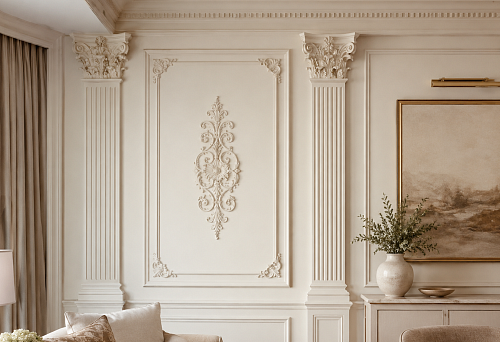
Medallions and rosettes — round or oval elements, often used as a central accent on a wall or inside a frame.
-
Friezes and horizontal strips — linear elements with an ornament, used as a horizontal accent above a mirror, console, or doorway.
-
Corner and segment overlays — for frame corners and as decoration in molding joints.
-
Overlay panels and bas-reliefs are larger elements with an extended ornament.
How to choose decorative stucco for the first accent
By size. The element should not be larger than 1/3 of the surface it is placed on. Above a mirror 70 cm wide — decor up to 25 cm. Inside a frame 60 × 90 cm — decor no larger than 20 × 30 cm.
By style. Geometric motifs — for modern interiors and neoclassicism. Floral ornaments — for classic and Provencal styles. Neutral medallions — are universal.
By relief depth. For a delicate accent — a shallow relief of 5–10 mm. For a more expressive detail you want to make noticeable — a relief of 15–25 mm.
By color. The safest option — matching the wall color or slightly lighter. Tinting creates a shadow that emphasizes the relief. A contrasting color — is riskier, but with the right choice, very effective.
buy decorative moldings You need mounting glue right away. Regular 'liquid nails' does not always provide the necessary adhesion to polyurethane — it's better to use a specialized glue for polyurethane foam.
Stucco decor above the mirror: step by step
This is such a popular and such an effective point for the first accent that we will analyze it separately and in detail.
Mirror in the hallway. Your gaze falls on it every time you enter and leave. This is one of the most 'viewed' surfaces in the apartment — with a small interaction area. That's why Stucco decor above the mirror works with disproportionately high returns.
Hallway: between the mirror and the ceiling
The typical distance between the top edge of a mirror and the ceiling in a standard apartment is 40–70 cm. This space is usually empty. It is here — strictly along the central axis of the mirror — that the decorative element is mounted.
Placement height: the bottom edge of the decor — approximately 5–8 cm above the top edge of the mirror. The center — strictly along the vertical axis of the mirror. This creates a visual connection: the mirror and decor are perceived as a pair, not as two random elements.
Bedroom: above the mirror at the vanity table
A vanity table with a mirror is a functional area that easily transforms into an interior feature. A decorative overlay above the mirror or a horizontal frieze at the level of the mirror's top edge — and the area begins to resemble a boudoir corner from an expensive interior.
An important nuance: in the vanity table area, there is usually artificial lighting (built-in bulbs or sconces on the sides of the mirror). Relief decor with side lighting casts a beautiful shadow — this enhances the effect.
Hall and dressing room: full-length mirror
For a full-length mirror (height 150–180 cm), the decorative accent above it should be slightly larger than for a wall-mounted mirror. The recommended size is 30–40 cm in width. The shape — a horizontal frieze or a wide medallion.
An alternative option for a full-length mirror: not one element above it, but two on the sides — symmetrical overlays at the level of the upper third of the mirror. This creates a 'frame' effect without actual framing.
Bathroom area outside the wet zone: a delicate accent
Polyurethane is moisture-resistant, but for areas with direct water contact (above the sink, near the shower), additional sealing of joints is needed. In the area with a mirror that is not above the sink — for example, in a toilet room or in a bathroom near the entrance — a decorative element above the mirror works perfectly and without special restrictions.
When a single stucco decoration needs a frame
Sometimes one decorative overlay on a large empty wall looks vulnerable. Like a painting without a frame — the detail is there, but it lacks context.
That is exactly when Moldings made of polyurethane they become the right addition. A frame made of molding around decorative stucco is not "starting to do the entire wall." It is just one frame that packages the accent and makes it a full-fledged architectural detail.
What is a molding frame as a mini-system
Four pieces of molding forming a rectangle on the wall. In the center — decorative stucco. Everything is painted in a single color. This is called a "panel accent" — and it makes the wall significantly richer without literally any other changes.
Frame size: for a wall above a chest of drawers — approximately 50–70 cm in width and 40–60 cm in height. For a wall behind a console or above a headboard — it can be wider, up to 90–120 cm.
How to choose molding for a single frame
For a single accent frame, a medium-width molding works best: 30–45 mm. Too thin — it gets lost. Too wide — the frame starts to look like "boiserie" rather than a point accent.
Profile: calm, with slight relief. No ornament needed — the profile shape and its shadow create enough volume.
Buy polyurethane moldings for one frame — this is a very small volume. For a frame 70 × 55 cm, the perimeter = (0.7 + 0.55) × 2 = 2.5 meters. With a cutting allowance — 3.5–4 meters of molding. Plus 4 corner blocks or 45° miter cuts.
Frame + decor: how to position correctly
Decorative stucco inside the frame is placed strictly in the center — both horizontally and vertically. This is fundamental: an offset from center reads as an installation error, not a design technique.
For a horizontal medallion or frieze — the horizontal center aligns with the frame's center. Vertically — slightly above the geometric center (about 1/3 from the top). This is an optical correction: the eye perceives the geometric center as slightly "sagging," so the decor is raised a bit higher.
buy polyurethane moldings and decorative stucco is better ordered together — then you can match the stylistic consistency and check profile compatibility at the selection stage.
Ceiling stucco as the first accent: one element for the entire room
Let's talk about the ceiling separately. Because a ceiling accent is a special case. It works differently than a wall accent.
When you add decor to a wall — it's an accent in one zone. It is seen from a certain direction, at a certain angle. When you add ceiling molding — it's an accent visible from any point in the room, simultaneously, for everyone.
That's why a ceiling element provides the greatest "coverage" with minimal investment.
Ceiling rosette: the fastest way to a "luxury ceiling"
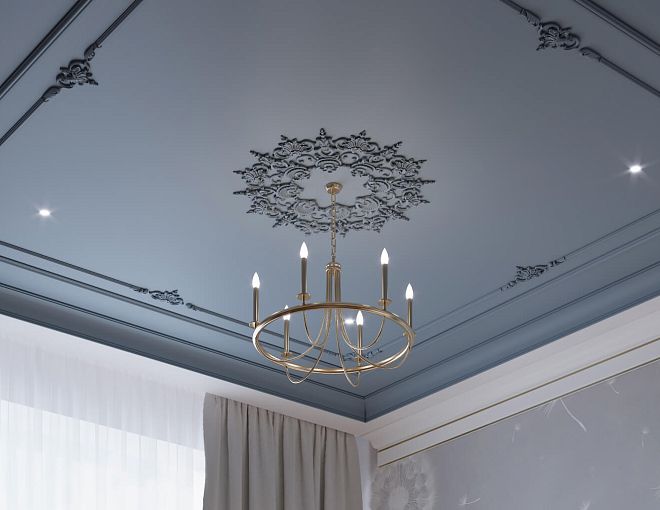
polyurethane rosette under the chandelier — it's one detail that changes the feel of the entire ceiling. Without a rosette, the chandelier hangs "from the ceiling" — technically, but not architecturally. With a rosette, it becomes a central element framed by decor.
It is this transformation — from a "technical suspension point" to a "decorative center" — that creates the feeling of a "luxury ceiling."
How to choose a rosette:
-
Diameter — approximately equal to the diameter of the chandelier's upper part or slightly larger (by 20–30%). For a compact chandelier — a rosette of 200–280 mm. For a large one — from 350 mm.
-
Style — should match the overall spirit of the interior. For modern — minimalist geometric ornament. For classic — floral relief.
-
Profile height — for standard ceilings (up to 2.7 m) — a flat or medium-depth rosette. For high ceilings — you can choose a more voluminous one.
It is mounted with special glue. The chandelier wire is routed through the hole in the center of the rosette. That's it. No complicated installation.
Ceiling molding as the first accent in a room without decor
If there is no decor in the room — no wall moldings, no decorative overlays — a ceiling cornice around the perimeter can be the first step. Not because it's easier, but because the cornice changes the perception of the entire room volume.
With a cornice, the room gets a 'top frame'. The ceiling stops 'hovering' overhead — it gains a boundary. The walls acquire a finish.
Buy ceiling molding For the first step, it's better to use a delicate profile — 40–60 mm wide. This is enough to create an effect, but not so much that it looks heavy.
How to choose a place for the first stucco accent: a simple algorithm
Enough theory — let's get specific. Here is a practical algorithm for choosing a place for the first stucco accent.
Step one: walk around the room and find 'focal points'.
Stand in the doorway and look at the room. Where does your gaze fall first? That is a potential point for an accent.
Step two: is there already some element there?
A mirror, console, cabinet, sofa, bed, lamp. If there is, it's an ideal point. Stucco will enhance what is already working.
Step three: is there space above this element?
The distance from the top edge of the item (mirror, console, headboard) to the ceiling or to the next element should be at least 30–40 cm to accommodate a decorative accent.
Step four: is there side or overhead lighting?
Relief stucco looks best with side or overhead oblique light. An area near a sconce, floor lamp, or built-in spotter is ideal. An area in deep shadow is not the best place for a first experiment.
Step five: will furniture interfere with the decor?
The decor should not be blocked by an open cabinet door, chair back, or curtain. It should be visible with the usual furniture arrangement.
Step six: are there any switches or outlets nearby?
Technical elements near decor are poor aesthetics. The distance from stucco decor to a switch should be at least 15–20 cm.
After these six steps, you will likely have one or two spots. Choose the one that:
-
is more noticeable when entering the room;
-
already has a "partner" — a mirror, a lamp, furniture;
-
is better lit.
Practical scenarios for the first stucco accent
Scenario 1: "I want to try stucco without risk"
This is the first experience. The goal is to make sure that stucco is in principle "your" thing.
What to buy:
-
One decorative molding — of a delicate size, with a neutral ornament.
-
Mounting adhesive for polyurethane.
-
Paint in the color of the wall.
Where to place: above the mirror in the hallway. It's safe, noticeable, and easy to adjust.
What you get: one architectural accent that changes the perception of the entry area. After this experience, it will become clear whether you want to develop the theme further.
Scenario 2: "The mirror should look more expensive"
The task is to turn a functional mirror into an interior element.
What to buy:
-
Relief Decoration above the mirror — along the central axis, about 1/3 of the mirror's width.
-
Paired overlays on the sides — for a full-length mirror or a more representative accent.
-
Thin Moldings made of polyurethane — if you want to add a frame around the mirror.
-
Mounting adhesive.
Result: the mirror transforms from an object into an architectural portal. Works especially well in the hallway and bedroom.
Scenario 3: "Empty wall behind the dresser"
The wall above the dresser is an empty space that needs architectural interpretation.
What to buy:
-
Moldings made of polyurethane for the frame — slightly wider than the dresser.
-
Decorative stucco to the center of the frame.
-
Corner blocks for the frame.
-
Construction adhesive, putty, paint.
Result: the wall above the dresser becomes a panel accent. The dresser now "stands against the wall" rather than just being pushed against it.
Scenario 4: "Chandelier present, ceiling empty"
A ceiling without decor when a chandelier is present is an unfinished story.
What to buy:
-
Ceiling rosette — diameter is chosen to match the chandelier.
-
Ceiling molding — crown molding around the perimeter, if you want more.
-
Construction adhesive, paint.
Result: the ceiling gets a center and perimeter. The chandelier becomes part of the architectural system, not just a light source.
Table: which first accent to choose for each zone
| Zone | Best first element | Development option |
|---|---|---|
| Hallway | Stucco decor above the mirror | Molding frame around the mirror |
| Bedroom (headboard) | Decorative stucco along the central axis | Molding frame behind the bed |
| Living room (behind the sofa) | Molding frame with an accent | Boiserie system |
| Hall (console) | Decor above console | Frame + sconce |
| Ceiling | Ceiling rosette | Perimeter cornice |
| Bathroom area | Stucco decor above the mirror | Frame of moldings |
| Office | Frame with decorative accent | Boiserie on main wall |
What to avoid with the first accent: five common mistakes
Mistake one: element too small. Decor that gets lost on the wall is worse than no decor. One noticeable detail is better than three small ones that 'don't register'.
Mistake two: too complex ornament in a modern interior. A baroque curl in a minimalist bedroom creates a stylistic conflict. The ornament should match the spirit of the interior.
Mistake three: incorrect placement height. Decor nailed too high is "disconnected" from the furniture below it. Too low — looks like it was accidentally glued on. Correct height: the lower edge of the decor is 5–10 cm above the upper edge of the item it is associated with.
Mistake four: contrasting color without experience. White stucco on a blue wall is beautiful only with the right choice of element and style. For a first attempt, it is safer to use the color of the wall or slightly lighter.
Mistake five: two accents next to each other. Two decorative elements on the same wall, placed close together, compete with each other. One loses significance. One accent — one zone. That is the principle.
About the Company
STAVROS — Russian manufacturer and supplier of polyurethane stucco decor. STAVROS company offers a full range for creating point stucco accents and complex decorative systems: Decorative stucco in various sizes and ornaments, Relief Decoration for walls and furniture, Moldings made of polyurethane for frames and panel systems, Ceiling molding и ceiling rosettes.
All STAVROS products are made of solid extruded high-density polyurethane — a moisture-resistant, durable, and easy-to-install material. to buy molding at STAVROS means getting professional consultation, precise selection of elements for a specific task, and fast delivery.
Frequently asked questions
Where to start if you want stucco but don't want to overload the interior?
Start with one zone: a mirror in the hallway, a console in the foyer, a headboard, or a ceiling with a chandelier. For the first step, it's ideal Decorative stucco, stucco decor or a ceiling rosette.
Can you get by with just one decorative stucco piece on the wall?
Yes. One correctly chosen element can become the main accent of the room. The key is the right size, place, and color.
When is a molding needed around stucco decor?
When the decorative overlay is placed on a large empty wall — a frame of molding creates context and makes the accent more complete.
What is better for a first accent: moldings or stucco decor?
If you need an architectural wall structure — moldings. If you need a quick expressive accent at a specific point — Relief Decoration or decorative stucco.
How to paint decorative stucco so it doesn't stand out?
Paint with acrylic paint in the color of the wall — preferably with the same compound used to paint the walls. The relief will remain visible through the shadow, but there will be no color contrast.
Can decorative molding be installed independently?
Yes. Installing decorative polyurethane molding does not require special qualifications. Glue, marking, and fixing until set — this is a one-person job.
What size decor should be chosen above the mirror?
Approximately 1/3 of the mirror's width. For a 60 cm mirror — decor 18–22 cm. The lower edge of the decor is 5–8 cm above the upper edge of the mirror, along the central axis.