Article Contents:
- NPU-309 is a decorative end point, not a technical molding plug
- 66 × 45 × 8 mm: why a small size does not mean automatic compatibility
- Do not confuse the order of dimensions with the mandatory orientation of the cap
- Where to end the molding itself before the slat panels
- Free space between the molding and the first slat: what exactly to measure
- Is NPU-309 needed exactly on the molding axis
- 8 mm relief: why you need to look not only at the facade, but also from the side
- Slat panels already create a vertical rhythm — why add another ornament
- Why a smooth gap between NPU-309 and the slats is often more important than the overlay itself
- Three basic options for finishing the molding
- When two NPU-309 units are enough
- When four NPU-309 units really make sense
- Why one successful pattern cannot simply be multiplied by four
- The molding itself can have a sufficiently beautiful finish
- What to do if there is only about 100 mm between the molding and the slats
- If there is a lot of free space, NPU-309 may also be out of place
- How the width of the molding profile affects the perception of NPU-309
- Color of NPU-309: matching the wall, molding, or slats
- Lighting can turn an 8 mm relief into a strong accent
- Should the molding be continued over slat panels instead of NPU-309
- What to do if the slats protrude forward relative to the smooth wall
- Is it necessary to install NPU-309 at the material joint
- Is a separate frame needed around NPU-309
- Installation after completed renovation: what to check before gluing
- Mistakes that make NPU-309 look like a random patch
- When you should not buy NPU-309
- When NPU-309 really makes the transition better
- How many to buy: 0, 2, or 4 NPU-309
- Practical algorithm for fitting in one evening
- How to understand that the solution turned out intentional, not accidental
- If there are two levels of molding on the wall, first compare their profiles
- Furniture, TV, and door can change the meaning of the molding ending
- Sockets, switches, and other wall elements should not compete with the ending point
- Result: whether NPU-309 is needed at the end of the molding near slatted panels
- FAQ
- What to do if slatted panels have built-in lighting?
- Can NPU-309 be used on a wall with wallpaper instead of paint?
- Is a mirrored right or left version needed for NPU-309?
- What to do if the molding ends near an inner corner of the room and slatted panels?
- Can NPU-309 be used at the end of a vertical molding?
- If one side of the slat insert is closed by a cabinet, is it mandatory to install NPU-309 symmetrically on both sides?
- Do I need to match the color of NPU-309 with the ceiling cornice or baseboard?
- What to do if the first slat has a rounded or complex profile?
- Can I leave NPU-309 only at the upper level and finish the lower molding without it?
- What to do if after painting the wall became more contrasting and the NPU-309 pattern looks different?
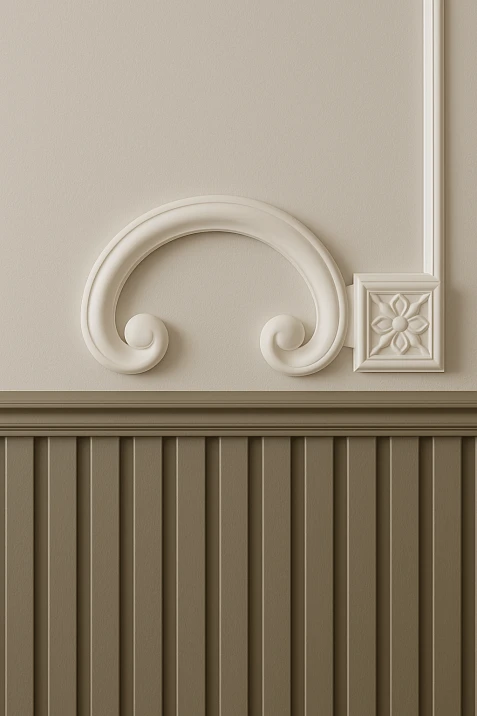
A smooth painted wall section and slat panels can coexist peacefully without additional transition decor. The problem appears when a horizontal molding runs along the smooth plane and ends near the start of the slats. Its end becomes a noticeable point: the line ran along the wall and then simply stopped. There is a natural desire to place a small decorative element at the end and make the transition more intentional.
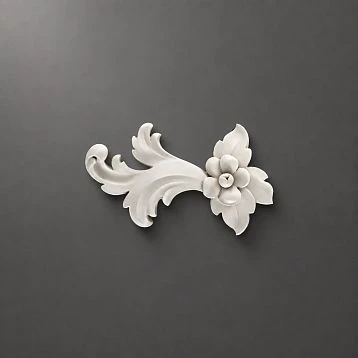
NPU-309 is suitable for such a scale check: it is a compact polyurethane decorative overlay measuring 66 × 45 × 8 mm. At the time of the check, the STAVROS card shows a price of 490 ₽ per piece. But the fact that the overlay is small and inexpensive does not mean it is needed for every molding next to slats. In a modern interior, a clean profile end sometimes looks more convincing than an additional flourish.
Therefore, the decision should be made not based on a product photo, but on the specific wall junction. Four things need to be checked: whether there is enough smooth surface between the end of the molding and the first slat, whether the scale of NPU-309 matches the molding profile, whether its relief conflicts with the active texture of the panels, and whether such a junction repeats on the wall. The latter determines the quantity: 0, 2, or 4 overlays are normal results of the same check.
If after a full-size trial NPU-309 really ties up the end of the line, you can buy decorative overlay NPU-309 66 × 45 × 8 mm. If without it the edge looks cleaner, refusing the purchase here would be an equally sound commercial decision.
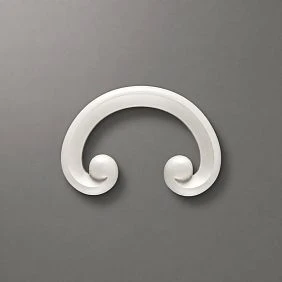
NPU-309 is a decorative endpoint, not a technical molding cap
The first thing to distinguish is the decorative and technical functions. NPU-309 should not be perceived as a mandatory "cap" for any molding. It does not fix a crooked cut, does not mask a poorly prepared profile end, and does not replace a neat finish of the linear part itself. If the molding is cut unevenly, the decorative overlay should not become a way to hide an installation error.
In the composition under consideration, its task is different. The horizontal line of the molding approaches the active vertical texture of the slats. A small overlay can become a visual point after which one system ends and another begins. For this to work, the molding itself must already be correctly installed, and the smooth part of the wall must be prepared as an independent plane.
This important difference changes the way of fitting. There is no need to place NPU-309 over a randomly protruding end of the profile and ask whether it "covers it." First, you need to imagine a finished clean molding, then place the overlay template next to its end and evaluate the new composition as a whole.
If without NPU-309 the line looks finished, the product is not needed. If the end seems too abrupt, and the small semicircular ornament makes the transition intentional, there is a reason to buy. This approach protects against a situation where a decorative element is added only because it exists in the catalog.




66 × 45 × 8 mm: why a small size does not mean automatic compatibility
NPU-309 belongs to compact overlays. That is why on the product card screen it may seem universal: 66 × 45 mm is not a large panel or a massive central decor. On the wall, it is more complex because the size is perceived relative to neighboring elements.
At least four scales need to be compared. The first is the width and relief of the molding itself. The second is the length of the free smooth section in front of the slats. The third is the pitch and prominence of the slat texture. The fourth is the overall wall size and the distance from which a person usually sees this node.
If a thin, calm molding ends next to a small, neat slat panel, the NPU-309 can read as a logical small accent point. If the molding is very narrow and the overlay is visually several times heavier than its profile, the end of the line will suddenly receive too much emphasis. The reverse situation is also possible: on a large wall next to wide, expressive slats of 66 × 45 mm, it may simply get lost.
Therefore, there is no useful rule like "NPU-309 fits all moldings up to N millimeters." It is much more accurate to make a template of 66 × 45 mm, compare it with the actual profile, and evaluate the joint from a typical viewpoint. The size here is initial data for verification, not a ready answer.
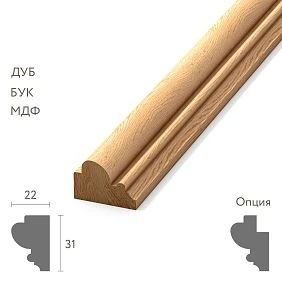
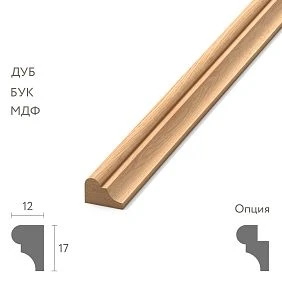
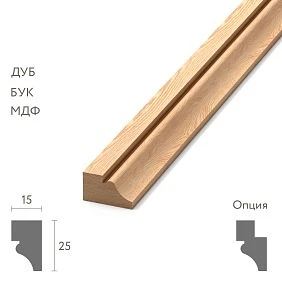
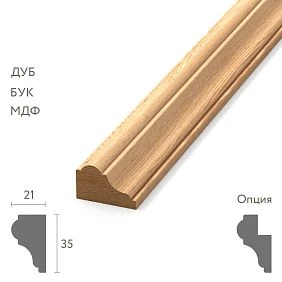
Our factory also produces:
Do not confuse the order of dimensions with a mandatory orientation of the overlay
The product size is specified as 66 × 45 × 8 mm. But from the notation A × B × C, you cannot automatically conclude that 66 mm should always be strictly horizontal on the wall and 45 mm vertical. In a specific composition, the actual orientation of the ornament and how the overlay looks relative to the direction of the molding are important.
For calculating the free field, it is safer to use a condition. If in the chosen orientation along the molding line the overlay occupies 66 mm, it is these 66 mm that need to be compared with the available section. If after rotation or another compositional orientation a different dimension works along the line, the calculation must be redone.
This is especially important at the boundary of slat panels. An error of 20–25 mm on paper can turn a calm pause between the overlay and the first slat into a visual collision. Therefore, first determine the actual position of the template on the wall, then measure the projection it occupies along the required axis, and only then evaluate the remaining free plane.
This sequence seems more cautious than a simple "66 mm horizontally," but it protects against purchasing based on an unconfirmed assumption. For a small decorative element, it is often just a few centimeters of free wall that decide whether the ending looks composed or cramped.
Get Consultation
Where to end the molding itself before the slat panels
Before choosing the NPU-309, you need to resolve a more basic question: where the linear profile ends. If the molding is brought almost flush to the first slat, there may be no free space left for a separate decorative accent point. If it is stopped too early, an empty section appears between the molding and the panels, which itself begins to demand an explanation.
The optimal point cannot be assigned a universal number. It depends on the width of the molding, the spacing of the slats, the depth of the panel, the wall color, the contrast of materials, and whether there is a similar transition on the other side. Therefore, first establish a visually convincing end for the molding itself, and only then check whether an overlay is needed near it.
It is practically useful to make three paper scenarios. In the first, the molding ends on its own and is not accompanied by anything else. In the second, immediately after its end, an NPU-309 appears. In the third, between the end of the profile, the overlay, and the slat zone, separate sections of smooth wall remain. These options need to be photographed from one point and compared not by individual details, but by the entire wall.
If the option without the overlay is already perceived as complete, the NPU-309 should not be added for the sake of "richness." If, however, the end of the molding looks like a random break, the compact decorative point gets a clear function.
The free field between the molding and the first slat: what exactly to measure
The most useful measurement in this topic is not the width of the entire wall, but the clean smooth field between the end of the molding and the beginning of the slat surface. Let us denote it as G. Then, it is necessary to determine how much space the NPU-309 occupies along this same axis in the chosen orientation. Let us denote this value as P.
The basic check is simple:
the remainder of the smooth plane = G − P.
If, for example, from the end of the molding to the first slat there is 100 mm, and in the chosen position the overlay occupies 66 mm along this axis, a total of 34 mm remains. But from this, one cannot yet derive the rule "34 mm is enough" or "not enough." These millimeters need to be distributed between the pause from the molding to the ornament and the pause from the ornament to the slats. How exactly is decided by the layout.
If the result G − P is negative, the overlay in the chosen orientation physically does not fit into the free section without overlapping the molding or the slat surface. This is no longer a matter of taste. If the remainder is positive, a compositional check begins.
The main mistake is turning the conditional example 100 − 66 = 34 mm into a standard. This is not a construction tolerance. On a light, calm wall, a small pause may read normally, but on a contrasting wall next to deep slats, the same figure will give a feeling of tightness. A paper template here is more useful than an invented universal offset.
Is the NPU-309 needed exactly on the molding axis
The first intuitive solution is to align the center of the overlay with the longitudinal axis of the molding. Often this is indeed the most obvious option: the linear profile visually leads to a decorative point, and the eye reads it as a completion. But there is no automatic rule here.
If the NPU-309 ornament is asymmetrical in visual mass or has a pronounced direction of curls, mathematical alignment of centers may look worse than a slight optical offset. The same happens when a deep slat panel is nearby: vertical shadows can visually "pull" the overlay to the side, even though it is geometrically positioned correctly.
Therefore, two axes are checked. The first is geometric: the center or key line of the NPU-309 relative to the molding. The second is visual: how this combination is perceived together with the nearest slats. Stepping back to the usual viewing distance is more important than examining the joint from twenty centimeters away from the wall.
If a slight offset makes the composition calmer, it is acceptable only as a deliberate design choice. If the offset looks like an installation error, it is better to return to precise alignment or abandon the overlay. Compact decor is especially sensitive to such inaccuracies: for a small element, a few millimeters can noticeably change the impression.
8 mm relief: why you need to look not only at the facade, but also from the side
The third dimension of NPU-309 — 8 mm — is easy to underestimate, because in a frontal photo the main interest is drawn by the contours and curls. On a real wall, the depth creates its own shadow and changes the strength of the accent.
If the molding protrudes from the wall less than the decorative overlay, NPU-309 may appear visually as a more "voluminous point" than the line it completes. This is not necessarily bad, but the effect should be desirable. If the molding profile itself has a pronounced relief, 8 mm may, on the contrary, be perceived calmly.
Special attention should be paid when looking from the side of the slat panels. The slats already create an alternation of protrusions, shadows, and vertical grooves. An added relief curl nearby can either softly complete the smooth part or begin to compete with the three-dimensional surface. Checking only strictly from the front does not reveal this.
Take a photo or inspect at an angle from roughly the point where a person enters the room. Then look from the side of the opposite wall. If NPU-309 seems like a neat part of the plane, the depth works. If the small element begins to protrude as a random "bump" in front of the active texture of the slats, a cleaner ending of the molding without the overlay will be stronger.
Slat panels already create a vertical rhythm — why add another ornament
The slatted surface itself is not a neutral background. Frequent verticals form a strong rhythm, especially if the panels contrast with the smooth wall in color or material. A horizontal molding next to them works as another geometric system — a calm line intersects perceptually with the frequent vertical structure.
NPU-309 adds a third language: a small curvilinear ornament. That is why the question is not simply whether the overlay is "beautiful." You need to understand whether a third type of form is needed at a specific transition point.
In an interior with simple furniture, even paint, and a single slatted insert, a small curl can become a precise connecting detail and soften a too-sharp transition from the classic molding line to modern slats. In a room that already has complex cornices, panels, lighting, brass hardware, and decorative objects, the same overlay can become an extra micro-story.
Before ordering, it is useful to temporarily remove the nearest small decor from the wall — posters, wall sconces, shelves — and first assess the base architecture. If NPU-309 is needed even on a clean composition, it has a function. If it looks random without the other items, filling the wall with additional details will not fix the problem.
Why a smooth pause between NPU-309 and the slats is often more important than the overlay itself
The decorative element does not necessarily have to touch either the molding or the first slat. A small free field can be what makes the transition readable. The eye sees a sequence: the linear profile ends, the ornament appears, then air remains, and only after that does another texture begin.
If the overlay is moved flush against the first slat, the curls visually blend with the vertical grooves. If it is placed too close to the end of the molding, it may look like a random thickened part of the profile, although structurally it is a separate element. The task of the template is to find a position where NPU-309 reads precisely as an independent endpoint.
This pause cannot be assigned universal 10, 20, or 30 mm. Perception is affected by the profile scale, color, contrast, and viewing distance. It is better to prepare several painter's marks on the wall and move the template between them.
A good result is recognized not by a number, but by the fact that the eye effortlessly separates three objects: the molding, the overlay, and the slatted panel. If they merge into one visual clump, the distance is too small or the element itself is unnecessary. If the overlay detaches from the molding and starts to "float" in emptiness, the distance is too large or the compositional connection is absent altogether.
Three basic options for ending a molding
To make a decision, it is enough to first compare three fundamentally different scenarios.
Option A — the molding ends without NPU-309. This is not a "unfinished" option by default. In a modern interior, a clean end can be the most precise solution, especially if the slat panels themselves form a strong boundary.
Option B — NPU-309 is placed next to the end of the molding and works along its axis. This scenario is closest to the idea of a decorative endpoint. It is suitable if the scale of the overlay correlates with the profile and a readable smooth zone remains between it and the slats.
Option C — NPU-309 is offset to maintain a more pronounced pause before the slats. Here, the overlay becomes not a literal "cap" of the molding, but a separate accent in the transition zone.
Options should be compared in one photo from the same distance. If the angle changes, the eye will evaluate perspective rather than composition. It is also useful to take a black-and-white shot: without color, it is easier to see where the main visual mass is and whether the small NPU-309 unexpectedly becomes a heavy point next to the rhythm of the slats.
When two NPU-309s are enough
The most natural commercial scenario for a pair occurs when the central slat insert is surrounded by two smooth wall sections, and horizontal moldings approach it from both sides. The composition has two identical endings: left and right.
If both nodes are truly symmetrical in height, molding length, distance to the slats, and surrounding furniture, it is logical to check 2 × NPU-309. At the current price of 490 ₽ per piece, such a set costs 980 ₽. But the quantity of two should follow from the architecture, not from the habit of buying decor in pairs.
There are situations where the central slat zone is symmetrical, but the surroundings are not. For example, on the left there is a cabinet or door, on the right — an empty plane. Then two identical overlays may formally maintain symmetry around the panels, but worsen the balance of the entire wall. Before ordering, you need to look not only at the nearest 30–40 centimeters of the transition, but at the entire composition.
If both endings in a photo from a normal viewpoint are perceived as equal, the pair is justified. If one end is hidden by furniture or visually insignificant, automatic doubling of the item is not needed. In such a case, a single accent is also possible if it is truly connected to the architecture, although the original base scenario of this article is primarily 0, 2, or 4 elements.
When four NPU-309s actually make sense
Four overlays appear not because "the more decor, the richer." They are needed only when the wall scheme itself creates four identical termination nodes.
A typical example: a central slat insert, with smooth sections on both sides, and two horizontal molding lines running across each section. Then the slat zone really has four ends: top left, bottom left, top right, and bottom right. If each of these ends is finished with an NPU-309, the formula is simple:
2 sides × 2 levels = 4 overlays.
At the current price of 490 ₽, that's 1,960 ₽ for four pieces. This calculation is useful because it immediately shows the actual purchase volume, but before placing the order, you need to check the composition with four paper templates.
Here a new risk arises: one NPU-309 may look neat, but four identical curls turn the wall into a repeating ornament. Therefore, the mockup must show the entire quantity at once. You cannot try one piece, decide it fits, and automatically multiply the impression by four.
If four points overload the slat border, a stricter option is possible: leave the moldings clean or use overlays on only one level, if supported by the overall composition. The quantity should be a consequence of the wall pattern, not a goal in itself.
Why one successful template cannot simply be multiplied by four
A single NPU-309 is perceived as an accent. Two identical ones are already a system. Four are a repeating motif. These are three different compositional modes, even though the product remains the same.
When a repeat appears on the wall, the eye begins to check regularity. Differences in molding heights, offsets to the first slat, paint thickness, lighting, and even slight variations in the position of the overlays immediately become noticeable. What looked like an acceptable optical shift in one piece may be perceived as a marking error in four.
Therefore, before purchasing four items, you need to make four full-size templates rather than moving one paper mock-up one at a time. Only simultaneous fitting shows the rhythm. The same rule applies to two overlays, especially if they are on opposite sides of the central slat insert.
This check also helps to understand whether the NPU-309 competes too strongly with the slats themselves. If four small curls form their own rhythm along the border, the vertical panel may lose its role as the main accent. In that case, abandoning the overlays does not make the interior poorer—it restores hierarchy.
The molding itself may have a sufficiently beautiful ending
Before choosing additional decor, look at the actual end of the molding after normal finishing. Some profiles are so laconic that a neat cut and painting already provide a finished line. In this case, NPU-309 does not solve the problem—it creates a new one.
This is especially noticeable in modern interiors, where moldings are used not for historical stylization but as subtle geometric wall marking. A small ornament with curls changes the character of the joint. If the entire interior is built on straight lines and calm planes, this change of language must be deliberate.
If the molding itself has a classic profile and the room already contains other small carved elements, NPU-309 can support the existing system. Then its function is not to mask the end but to repeat the decorative vocabulary of the space.
Before purchasing, it is useful to photograph the end of the molding after primer or final painting without any templates. Then add a paper NPU-309. If the second photo does not make the joint clearer, there is no need to acquire the part. The presence of free space does not mean that this space needs to be filled.
What to do if there is only about 100 mm between the molding and the slats
An area of about 100 mm is a good example of why calculation is required, not an abstract "it will fit." If in the chosen orientation NPU-309 occupies 66 mm along the transition, 34 mm of total free plane remains. These 34 mm must provide two pauses: from the end of the molding to the overlay and from the overlay to the first slat.
Physically, the template can fit. Compositionally, the question remains open. If the molding is wide, the first pause may need to be larger so that the ornament does not seem to be part of it. If the slats are deep and contrasting, the second pause is important so that the curls do not blend with the vertical relief.
Therefore, at 100 mm, you need to make at least three template positions: closer to the molding, in the center of the available section, and closer to the slats. Then look at the entire wall. You should not look for a "correct" distribution of 17 + 17 mm or 10 + 24 mm — such numbers without context have no normative meaning.
If no position gives a calm transition, the conclusion is simple: there is too little free field for this particular composition, even if the product fits geometrically. Then it is better to leave the end of the molding clean or reconsider the very point of its ending before starting installation.
If there is a lot of free field, NPU-309 may also be out of place
A large wall reserve does not guarantee a successful composition. When, for example, a wide smooth strip remains between the molding and the slat zone, a small overlay 66 × 45 mm may lose connection with both objects. It ends up in free space and begins to look like a randomly glued ornament.
In such a case, it is useful to first understand what exactly NPU-309 should complete. If it relates to the molding, keep a visual connection with its end. If it becomes an independent accent of the transition zone, it should have another reason — repetition on the opposite side, connection with the height of furniture, a lamp, or another architectural line.
The larger the free plane, the more dangerous it is to place a small element "approximately in the middle." On a compact section, the geometry itself limits the options. On a large wall, stricter compositional logic is required.
If the template gets lost, you should not automatically look for a larger overlay just to fill the void. Perhaps an empty smooth pause is the correct transition between the horizontal molding and vertical slats. If a different scale is still needed, you can look at classic polyurethane overlays and compare options using the actual template, not a catalog photo.
How the width of the molding profile affects the perception of NPU-309
The overlay should be evaluated alongside a specific profile, not separately. A thin molding and a wider relief molding create completely different relationships with the same NPU-309.
If the profile is very thin, the 66 × 45 mm ornament can become the dominant object. Then the eye perceives not "the molding ended with a decorative point," but "a small overlay got a random tail." For this scenario, frontal and distant checks are especially important.
If the molding is wide and plastic, the NPU-309 may, on the contrary, seem too small. It does not complete the line but dissolves next to a more massive profile. In both cases, the problem is not the quality of the product but a mismatch in scale.
Before purchasing, measure the visible width of the profile on the wall and take a photo with the template attached. Do not try to derive a rigid ratio like "the overlay should be twice as wide as the molding": for ornamental forms, mathematical proportion does not replace visual mass. But measuring helps compare options consciously.
If the profile itself has not been chosen yet, it makes sense first buy polyurethane moldings or at least to determine a specific model, its cross-section, and relief. Selecting an overlay for an abstract "molding in general" is much less reliable.
Color of NPU-309: matching the wall, molding, or slats
Painting can completely change the visual weight of a small overlay. At a size of 66 × 45 mm, a contrasting color can make it more noticeable than a larger but monochrome molding.
The calmest scenario is when the NPU-309, the molding, and the smooth wall are in a similar color. Then the relief is read mainly through light and shadow, not a color spot. This option is suitable when the overlay should complete the line but not compete with the slat panels.
If the overlay is painted together with the molding but differs from the wall, the connection between the linear profile and the decorative point becomes stronger. This is useful when you need to clearly show that the NPU-309 belongs specifically to the molding. However, contrast increases the requirements for alignment and distances—errors become more noticeable.
Painting NPU-309 to match the slats should only be done after an on-site test. This technique visually pulls the ornament toward the slatted surface and can ruin the desired pause between systems. On some walls, this will create a connection; on others, it will feel as if a piece of slats accidentally "jumped" onto the smooth part.
It is best to do color tests on a paper or temporary mockup and evaluate them under daylight and artificial light.
Lighting can turn an 8 mm relief into a strong accent
An overlay with a depth of 8 mm creates a shadow. Under uniform frontal light, the relief may look delicate, but with side lighting, the shadow from the curls noticeably intensifies. The slatted panels nearby make the effect even more complex because they themselves form a series of vertical shadows.
You need to check the wall especially carefully in the evening if there is a sconce, track light, or LED strip nearby. During the day, NPU-309 may almost blend with the painted wall, but in the evening it can become a contrasting decorative point. If there are four such points, the impression changes even more.
A useful test is to attach a template with a thickness close to the actual protrusion, not just a flat sheet of paper. Paper is sufficient for assessing overall size, but for light and shadow, you can use a temporary backing to approximate 8 mm. This does not need to perfectly imitate the ornament; the goal is to see how the volume reacts to the direction of light.
If the relief draws attention away from the slatted surface in the evening, there are three solutions: abandon the overlay, reduce the color contrast, or change the lighting scenario if it is still being designed. Buying decor before checking nighttime lighting is risky precisely in such complex textured junctions.
Should the molding continue over the slatted panels instead of using NPU-309
Sometimes the question about the overlay arises because it was not initially decided whether the molding itself should stop at the slats. There are two fundamentally different architectural approaches: the line breaks before the slatted surface or passes through/over it as a continuous element.
If the molding continues along the slatted area, NPU-309 as an endpoint at that boundary loses its meaning—there is no longer an endpoint here. But the technical feasibility of such a solution depends on the geometry of the panels, the mounting method, and the specific profile. You cannot assume that any molding can simply be glued over any relief.
If the design task is to emphasize the change of material, stopping the molding before the slats is logical. Then NPU-309 can help to frame exactly this moment of break.
It is useful to compare both approaches even before installation. For a broader understanding of combining two systems, you can look at the material how to combine stucco decor and slat panels, but in our joint the solution remains specific: if the molding really ends before the panel, the need for NPU-309 is checked separately.
What to do if the slats protrude forward relative to the smooth wall
The boundary between a smooth plane and a slat panel can have a noticeable depth difference. In this case, the end of the molding and NPU-309 need to be evaluated not only in the frontal projection, but also from the side.
If the slats protrude strongly, they create their own vertical "edge". A small overlay nearby may visually fall into its shadow or appear partially hidden. This is especially noticeable when a person looks at the wall not directly, but walks along it.
There is no need to try to compensate for the difference in material thickness with NPU-309. It remains a decorative element on a smooth surface. If the transition between the bases itself is done carelessly, first the constructive boundary is solved, and only then the decorative ending of the molding.
To check, take a photo at an angle of 30–45 degrees to the wall. A frontal mockup may look perfect, but a side view will immediately show that the overlay is too close to the protruding slats. If the panel relief visually "covers" the ornament, increase the smooth pause or leave the molding without an additional point.
That is why when choosing slat panels for walls for interior finishing it is useful to consider in advance not only their frontal pattern, but also the depth, pitch, and method of finishing next to other wall profiles.
Is it necessary to place NPU-309 at the joint of materials
There is no need to place the overlay directly on the boundary between a smooth wall and a slat panel. Moreover, such installation often worsens the readability of the element: one part ends up on a flat surface, while the other falls onto the relief or into a transition zone.
For NPU-309 in this scenario, it is more logical to have a stable smooth base. Then the product is read as a whole, the mounting surface is predictable, and the ornament does not break along the boundary of two materials.
If the architecture forces placing the element directly at the joint, you must first check whether there is a physical plane for full adhesion. The decorative overlay cannot be considered a bridge that automatically connects surfaces of different depths. Any gap under the product worsens both the appearance and the reliability of the adhesive bond.
The practical conclusion is simple: NPU-309 is tested on the smooth part of the wall next to the end of the molding, not as an overlay on the joint itself. If there is no smooth area for it, this is a strong argument to leave the molding without it or to change the profile placement before installation begins.
Is a separate frame needed around NPU-309
In the node under consideration, an additional molding frame most often changes the very formulation of the task. We are trying to end a horizontal line with a small decorative point before the slats. If another frame appears around NPU-309, this is no longer the end of the molding, but a separate panel.
A frame may be justified in another composition where the smooth part of the wall represents an independent classical field. But then NPU-309 should be evaluated as part of that field, not as an element at the end of a line. Mixing the two logics is dangerous: the small area near the slats quickly becomes overloaded.
Therefore, the simplest option is checked first — molding plus one NPU-309. If it doesn't work due to weak connection, there's no need to automatically add another profile. Perhaps the overlay is simply not needed. If the entire smooth area is initially designed as a frame composition, it's worth selecting the system as a whole and looking Polyurethane decorative appliques already in the context of the overall wall architecture.
The closer the node is to the slatted surface, the more useful the principle of "one function — one element." Slats provide texture, molding provides a line, NPU-309 provides an endpoint. A fourth decorative layer should appear only for a very clear reason.
Installation after completed renovation: what to check before gluing
If molding and slatted panels are already installed, NPU-309 is often purchased as a finishing detail. This is convenient: the entire composition exists in real scale, so the product can be checked before installation. But a finished renovation requires care.
First, assess the base. The overlay should be glued to a stable, prepared surface compatible with the chosen mounting compound. Glossy paint, decorative coating, dirt, or a weak layer may require separate preparation. Don't invent a universal method without considering the specific finish.
Second, protect adjacent molding and slats from glue and subsequent painting. The small element is in a tight node where an accidental mark is especially noticeable.
Third, mark the position using a template before applying the compound. For four overlays, a unified marking system is needed, otherwise small discrepancies will become noticeable as a rhythm disruption.
It's better to select the compound according to manufacturer requirements and the base; separate Mounting and finishing materials allow assembling a solution for a specific task. In the article, it's not the glue name itself that matters, but the sequence: fitting → marking → base check → installation.
Mistakes that make the NPU-309 look like a random "add-on"
The first mistake is installing the overlay because there is "free space" between the molding and the slats. Empty space doesn't have to be filled. The element should have a function of completing the line.
The second is trying on one piece up close. In a close-up photo, the curl may appeal, but from three meters away it may disappear or, conversely, unexpectedly stand out due to contrast.
The third is ignoring the first slat. If the NPU-309 almost touches the vertical relief, the two systems start to argue. The overlay itself may be installed perfectly, but the overall joint remains cramped.
The fourth is not considering the quantity. One overlay and four identical elements create different degrees of decorativeness.
The fifth is using the NPU-309 to mask a poorly trimmed molding. Then the technical error remains, and a decorative layer appears on top as well.
The sixth is painting the overlay in a contrasting color without an evening light check. With a depth of 8 mm, contrast plus shadow can make a small detail dominant.
All these mistakes share one thing: the product is evaluated on its own, not as part of a specific boundary of "smooth wall → molding → pause → slat panel".
When you shouldn't buy the NPU-309
Refusing the overlay is a full-fledged result of this article, not a sign of an unfinished project.
Do not buy NPU-309 if the molding already has a neat self-contained ending. In such a joint, additional ornament does not solve the problem.
Do not buy if there is not enough free smooth surface. Even if 66 × 45 mm formally fits, the lack of air before the first slat makes the transition cramped.
Do not buy if the overlay disrupts the scale. A piece that is too heavy relative to a thin profile, or too small next to a large molding, looks random.
Do not buy if the slat area is already the main accent and there are many other details nearby. Adding another ornamental motif reduces hierarchy.
Do not buy if the axis of NPU-309 cannot be aligned with the molding. A small element that cannot be explained geometrically is quickly perceived as a mistake.
Do not buy if four templates overload the wall, even though one looked good. Quantity changes the composition.
In these cases, it is better to leave the clean line of the molding. If the problem is not in the idea of the overlay itself, but only in the shape or scale of NPU-309, you can Buy decorative polyurethane overlays after a new full-size fitting.
When NPU-309 really makes the transition better
A successful scenario looks quite specific. The molding runs along a calm smooth wall and ends before the slat insert. The end of the profile is technically neat by itself, but visually seems too sharp. Between it and the first slat there is enough smooth surface, and the compact NPU-309 correlates well with the profile.
After installing the template, the line gets a clear endpoint. The overlay does not touch the slats, does not draw attention away, and does not look like a separate wall decoration. When the template is removed, the composition becomes weaker — this is a good diagnostic sign.
Another strong scenario is a repeatable node. If the central slat panel is truly surrounded by two equal smooth sections, two NPU-309s create a controlled pair. With two levels of molding, four elements can form an ordered motif if the wall can handle such decorativeness.
It is important that NPU-309 here does not "decorate emptiness" but performs specific compositional work. It is after such a check that it makes sense order polyurethane molding to assemble the remaining elements into a unified system, rather than adding them one by one without overall logic.
How many to buy: 0, 2, or 4 NPU-309
The final quantity is best determined by the wall layout, not by the desire to "take extra."
| Scheme | Quantity of NPU-309 | Cost at the current price of 490 ₽/pc. | When it fits |
|---|---|---|---|
| The molding ends cleanly, the overlay overloads the transition | 0 | 0 ₽ | additional decor is not needed |
| One level of molding approaches the central slat insert from both sides | 2 | 980 ₽ | Two equivalent endings |
| Two levels of molding fit the slat insert from both sides | 4 | 1 960 ₽ | Four identical nodes truly read as a system |
This table does not mean that one element is forbidden. A single NPU-309 is possible in an asymmetric architecture if only one end of the molding is visually significant. But for the basic symmetric scheme, it is precisely 0, 2, and 4 that provide a clear commercial fork.
Before ordering the quantity, you need to make the corresponding number of templates simultaneously. If four are being tried on, there should be four on the wall. After that, the decision about the basket becomes concrete: not "do I like NPU-309 at all," but "is it needed in each real node."
Practical fitting algorithm for one evening
1. Photograph the wall without overlays. The molding and slat panels should be fully visible.
2. Measure each free section from the end of the molding to the start of the slat zone. Do not assume that the left and right sides are the same.
3. Make templates 66 × 45 mm according to the number of potential points. If you are checking four endings, you need four templates.
4. Determine the actual orientation of the ornament. Only after that compare its projection with the available field.
5. Check three positions: closer to the molding, intermediate, and with a longer pause before the slats.
6. Look at the wall straight on and at an angle. Separately — from the usual entry point to the room.
7. Repeat the check in the evening. The 8 mm relief and slat shadows may change the impression.
8. Compare 0 / 2 / 4 elements at the same scale. Do not evaluate the quantity based on a single template.
9. Determine the color. Matching the wall, the molding, or as a deliberate contrast.
10. Only after this place the order. If the templates work, you can reopen the card and buy NPU-309 in the calculated quantity.
How to understand that the solution turned out deliberate, not accidental
There is a simple final test. A person who does not know the renovation history should perceive NPU-309 as a logical part of the wall architecture. They do not need an explanation like "there was space left here, so we glued the decor."
A deliberate solution usually has four signs. First, the overlay is connected to the axis or end of the molding. Second, there is enough air around it, so the ornament does not collide with the slats. Third, its scale supports the profile rather than overwhelms it. Fourth, the number of elements corresponds to the repeating nodes of the wall.
A random decision has opposite signs: NPU-309 costs about what it turned out to be, one side differs from the other without reason, the distance to the rail is random, and the overlay itself stands out more than all other elements only because of its contrasting color.
This test is more useful than the general question of "beautiful or not beautiful." It forces you to check the cause-and-effect relationship. If every position can be explained by the architecture, the composition usually looks more convincing and does not get boring for longer.
If there are two levels of molding on the wall, first compare their profiles
The scheme "two sides × two levels = four NPU-309" only works when both levels actually form endings similar in scale. In practice, the upper and lower moldings may differ in width, relief, or role in the composition. For example, the upper line may be thin and almost graphic, while the lower one may be noticeably more massive. The same overlay next to them will be perceived differently.
Therefore, four identical templates should be applied not only simultaneously, but also evaluated separately for each level. If NPU-309 convincingly completes the upper molding, this does not prove that it suits the lower one. And vice versa.
Here three results are possible. First, all four endings are equivalent, and four overlays create a neat system. Second, only one level really needs a decorative point; then two overlays may be more logical than four. Third, the profiles are so different that a single NPU-309 does not connect them at all, and clean ends look better.
Such an analysis is more useful than simple multiplication of quantity. It checks not only the number of nodes, but also their type. For repeating decor, the same article should repeat the same architectural task. If the tasks are different, the same solution may look mechanical.
Furniture, TV, and door can change the meaning of the molding ending
A node cannot be evaluated in an empty room if large furniture will be nearby after renovation. A wardrobe, a tall shelving unit, a TV, a door leaf, or a dense curtain can partially cover the end of the molding and NPU-309 from a normal viewpoint. Then the decorative point that looked beautiful on a free wall either disappears or ends up squeezed between several objects.
Before ordering, it is useful to mark the real dimensions of future furniture on the wall with painter's tape. If items are already in place, the template should be tried on with the final arrangement. The entry point into the room is especially important: sometimes one end of the molding is fully visible, while the second is almost always hidden by the door. In such a situation, mechanical symmetry "two sides of the rails" ceases to be the main argument.
This does not mean that the hidden part must necessarily be left without an overlay. If the composition is designed for a frontal view, for example opposite the sofa, symmetry may remain important. But the decision should take into account real usage, not just the wall drawing.
The small NPU-309 has an advantage: the full-size template is easy to move around and check under different viewing scenarios. Spend a few minutes on this before ordering — and it will become clear whether the element will even be visible where you want the decorative effect.
Sockets, switches, and other wall elements should not compete with the endpoint
On the smooth section next to the slat panels, there are often switches, sockets, thermostats, sensors, or wall lights. If the NPU-309 falls into the same small zone, another coordinate system arises. Then even technically free 100–150 mm may not be enough for a calm composition.
You need to check not only direct intersection. The overlay may not touch the switch frame, but stand so close that two small objects begin to be perceived as a random pair. This is especially noticeable with contrasting hardware — black, brass, or graphite.
You should not move an electrical point just for a small decorative overlay if the engineering part has already been done correctly. First, compare the option without the NPU-309. If the clean end of the molding gets along better with the switch and slats, that is a sufficient reason to decline the product in a specific location.
If the overlay is needed, mark out the molding, NPU-309, the first slat, and the frame of the adjacent device simultaneously. Only a full mock-up will show whether there is visual and physical distance between the objects. This is another example of why the decision cannot be made based on the product card in isolation from the real wall.
Conclusion: is the NPU-309 needed at the end of the molding near the slat panels
The NPU-309 is needed not because the molding ends, but only if its end requires a separate decorative point. At 66 × 45 × 8 mm, the overlay is compact enough for a local node, but it still needs to be checked at full scale next to the real profile and the first slat.
First, make sure the end of the molding itself is done neatly. Then measure the smooth field, make 66 × 45 mm templates, determine the orientation, and compare three states: without the overlay, with the NPU-309 at the end, and with a more pronounced pause before the slats. After that, check the entire set — two or four pieces, if the node repeats.
If without NPU-309 the border looks cleaner, you don't need to buy it. If the template turns a sharp break of the molding into a clear finish and doesn't conflict with the vertical rhythm of the slats, the product performs a specific function.
For a symmetrical wall with one level of molding, a reasonable result is 2 pieces for 980 ₽ at the current price. For two levels on both sides of the slat insert — 4 pieces for 1,960 ₽. But price and quantity become important only after a compositional check: first the correct node, then the cart.
FAQ
What to do if the slat panels have built-in lighting?
Check NPU-309 with the lighting turned on at working brightness. Light from the slats can enhance the shadow of the 8 mm relief or, conversely, visually "eat" a small ornament. Do not move the overlay closer to the light line just for visibility: first assess whether a calm, smooth pause is preserved.
Can NPU-309 be used on a wall with wallpaper instead of paint?
Compositionally — yes, if the pattern and texture of the wallpaper do not overload the node. Technically, the mounting method depends on the specific covering and adhesive system. You cannot automatically consider wallpaper a suitable load-bearing base; before gluing, you need to check the recommendations for the selected materials.
Is a mirrored right or left version needed for NPU-309?
NPU-309 in this article is considered as one specific SKU, not an L/R pair. If you need to design two opposite endings, check identical templates on both sides and evaluate the direction of the ornament. Do not create mirroring that does not exist in the real form of the product just for formal symmetry.
What to do if the molding ends near an internal corner of the room and slat panels?
The corner adds another strong vertical boundary. The overlay should be tried on immediately taking the corner into account, because a small ornament may end up squeezed between the end of the molding, the first slat, and the wall junction line. If three boundaries are too close together, a clean end of the profile usually reads calmer.
Can the NPU-309 be used at the end of a vertical molding?
This is already a different compositional scenario. The size and shape of the product allow for a separate full-scale fitting, but the conclusions of this article cannot be mechanically transferred: next to the vertical molding, the axis, the direction of the ornament, and the relationship with the battens change. A new template in the actual orientation is needed.
If one side of the batten insert is closed by a cabinet, is it mandatory to install the NPU-309 symmetrically on both sides?
There is no automatic requirement. First, determine the main view of the wall. If the hidden side is barely involved in the composition, a single overlay may be justified. If the frontal view remains symmetrical and the cabinet does not cover the joint, a pair may look more cohesive. The decision is made by the actual architecture, not by the rule "decor is always paired."
Is it necessary to match the color of the NPU-309 with the ceiling cornice or baseboard?
Not necessarily. The closest semantic connection in this joint is with the molding and the smooth part of the wall. Repeating the color of the cornice or baseboard makes sense only if all the stucco in the room forms a single color system. Otherwise, a distant element should not dictate the local solution.
What to do if the first batten has a rounded or complex profile?
Evaluate not only the distance to its central axis, but the actual visible boundary of the relief and shadows. A rounded batten may visually take up more or less space depending on the lighting. The paper template of the NPU-309 should be viewed under real light and from a side angle.
Can the NPU-309 be left only at the upper level, and the lower molding finished without it?
Yes, if the upper and lower levels perform different compositional functions and the layout confirms this. For example, the upper line may be more decorative, while the lower one is connected to furniture or the height of the panel. If there is no difference, choosing only one level will look random.
What to do if after painting the wall became more contrast and the NPU-309 pattern looks different?
Repeat the fitting after the final color appears. Contrast changes the visual mass and relief, so a decision made on a primed or white wall is not always maintained after dark painting. Before the final purchase, it is better to evaluate a color scenario as close to the final result as possible.