








































































Article Contents:
- What is window stucco molding
- How interior window stucco molding differs from exterior
- Which STAVROS elements to use for window framing
- Moldings for window framing
- PU overlays for decorative accent above the window
- Wall decor around the window
- Cornices for connecting window to ceiling
- Decor for moldings: corner blocks and inserts
- Window stucco molding design schemes
- Simple frame of moldings around the window
- Window opening with upper decorative accent
- Wall with window and symmetrical moldings
- Design of slopes and area around the window opening
- Window plus ceiling cornice: a connected system
- How to choose stucco around the window: an algorithm for those who want results
- How to calculate elements for window framing
- Stucco around the window in different interior styles
- Classicism and Baroque
- Neoclassicism
- Art Deco
- Modern classics and contemporary
- Bedroom: a special approach
- Stucco around narrow, tall, and wide windows: features
- Installation of stucco molding around a window: what's important to know
- Mistakes when choosing stucco molding around a window
- Where to buy stucco molding for window decoration STAVROS
- FAQ: answers to popular questions about stucco molding around a window
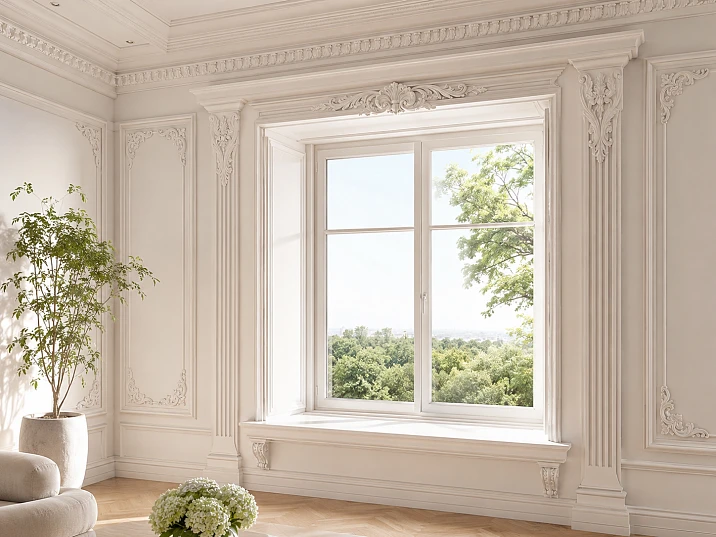
A window is not a hole in the wall. It is an architectural element with a biography. In historical interiors, every window opening was framed as if the house itself was looking through it: molding, pilasters, a keystone above the arch, a decorative frame, a cornice element. Stucco molding around a window turned an ordinary rectangle of a light opening into an independent architectural motif.
Today we are returning to this principle — only with modern materials and without the need to hire a team of plasterers. Stucco molding for windows made of polyurethane, moldings, overlays, cornice elements from STAVROS — this is a complete set for framing a window opening indoors. Without facade themes, without exterior work — only the interior, only the result.
If you are looking for how to decorate a window with stucco molding inside an apartment, house, office, or living room — you have come to the right place. Here, in detail, step by step, and with specific links to polyurethane products from STAVROS.
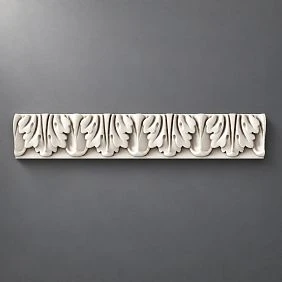
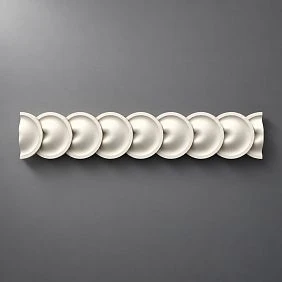
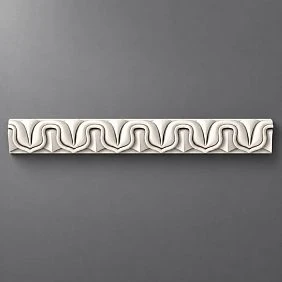
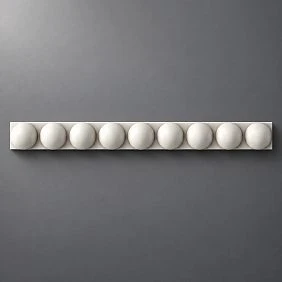
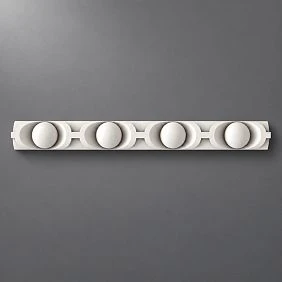
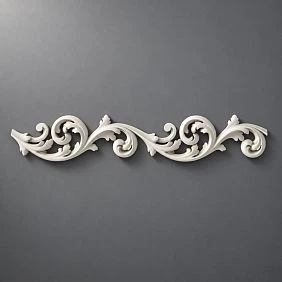
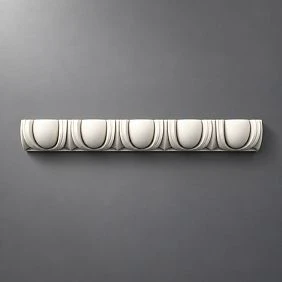
What is stucco molding around a window
Let's start with the most important question that is asked in search thousands of times: what is the stucco molding around a window called?
In classical architecture, the decorative framing of a window opening is called a platband — but this is a general word. In interior decor, stucco molding around a window refers to several different things depending on the complexity of the solution.
A simple frame — one molding profile run along three or four sides of the window opening (two vertical segments + top horizontal + bottom if needed, above the windowsill). This is minimal, but already an architectural gesture.
Decorative framing with an accent — a frame of moldings + an overlay above the top line of the window (keystone, cartouche, medallion). This is already a full-fledged classic architrave.
Wall composition — the window as part of a decorated wall. Molding frames are placed both around the window and on the wall on the sides, creating a unified rhythm. The window ceases to be a "hole" and becomes an architectural detail of the wall surface.
Design with a cornice — linking the window framing with the room's ceiling cornice. Visually, the window and ceiling end up in the same coordinate system.
Stucco around the window always implies interior design. The facade topic is a completely different cluster, different materials, different solutions. In this article, we only talk about the decoration of the window opening from the inside: what is visible from the room, not from the street.




How interior stucco around a window differs from facade stucco
This question arises for many — and it's important to clarify right away.
Facade stucco is mounted outside the building, on the street side of the wall. It deals with atmospheric loads: rain, temperature changes, ultraviolet radiation. Outdoor use requires special materials with appropriate characteristics and specific fastening methods.
Interior stucco around the window is decor in a dry, warm, protected space. Here, STAVROS polyurethane moldings, overlays, and decorative elements work without any restrictions: stable temperature, normal humidity, no mechanical loads from wind and precipitation.
It's also important that facade and interior decor solve different problems. Outside, stucco works for the perception of the building from a distance — a large scale and environmentally resistant materials are needed. Inside, stucco works to create an atmosphere in the room — here, fine relief, delicate scale, and consistency with the interior style are important.
When you choose polyurethane window molding indoors — you work with interior decor. And that's what this entire article is about.
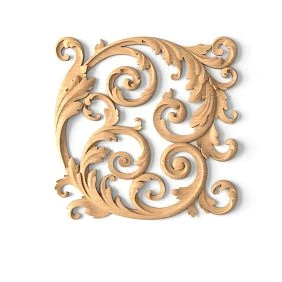
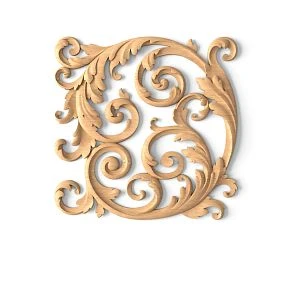
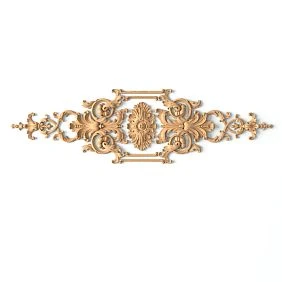
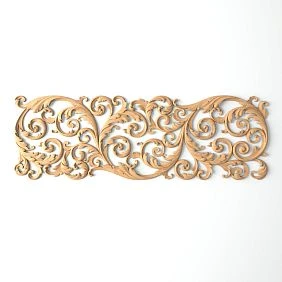
Our factory also produces:
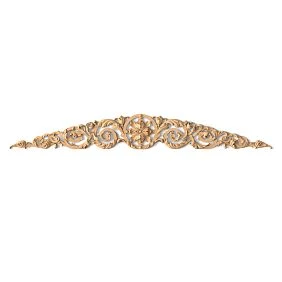
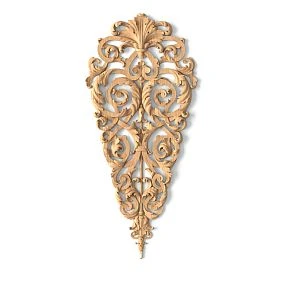
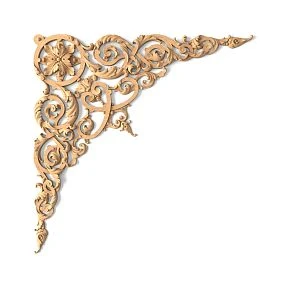
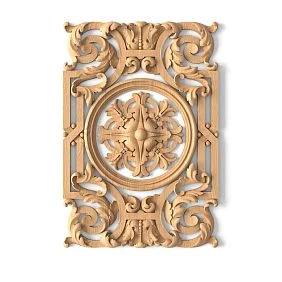
Which STAVROS elements to use for window decoration
No fiction — only real catalog sections with explanations of what each is needed for in relation to a window.
Get Consultation
Moldings for window framing
Polyurethane moldings, cornices, and baseboards is the main tool for creating a frame around a window opening. The molding runs along the window contour, forming a decorative casing. It is a linear profile that is cut to the required length, joined at the corners (cut at 45° or using a corner block), and glued to the wall with mounting adhesive.
For window framing, profiles with a width from 20 to 80 mm are chosen, depending on the window size and interior style. Narrow molding (20–35 mm) — for modern classics and minimalist interiors. Medium (35–60 mm) — for neoclassicism and traditional classics. Wide (60–80 mm) — for high ceilings and formal areas.
Moldings around windows in STAVROS are available in dozens of profiles: from simple rectangular cross-sections to complex profiles with ornamental bands. Current items, sizes, and prices are in the product cards.
PU overlays for decorative accent above the window
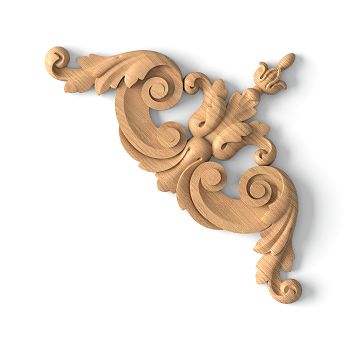
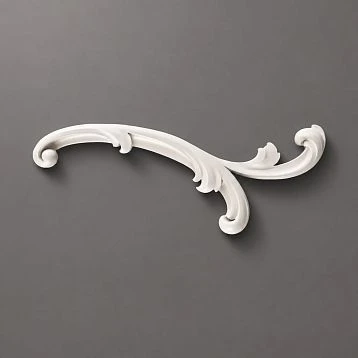
PU overlays are individual decorative elements that are mounted above the top line of the window opening or in the corner areas of the frame. An overlay above the window is an analogue of a keystone in classical arched architecture: a central accent that 'holds' the entire composition.
For window decor, choose overlays of moderate size — not too large (to avoid overloading the opening), but with enough relief to work as an independent element. Guideline: overlay width is 30–50% of the width of the molding profile along the top horizontal.
Overlays for painting offer maximum freedom: white decor on a colored wall is a classic. Decor in the wall color is a delicate volumetric motif that is only visible in oblique lighting. Gold patina on a white molding above a dark blue window is a bold designer accent.
Decor for walls around the window
Polyurethane wall decor is needed when the window becomes part of a wall decorative scheme. Molding frames on the wall on either side of the window, decorative panels, horizontal bands — all of this creates an architectural context in which the window opening looks not like a random rectangle, but like a designed interior element.
For a wall with a window, the "expanding frame" principle works especially well: a narrow molding directly around the window + a wider frame on the wall around it, with a 150–300 mm offset from the window contour. Two-level framing is no longer just a trim, but a full-fledged architectural zone.
Cornices for connecting the window with the ceiling
Polyurethane Crown Molding are used in window design not for the opening itself, but to create a visual connection between the window framing and the ceiling line. When the cornice and moldings around the window are made in the same profile or from the same style series, the window and ceiling end up in a single architectural system. This is what creates the feeling of a "well-designed" interior, rather than a set of separate elements.
Another scenario: a ceiling cornice above the window is used as a base for curtains — a decorative cornice profile hiding the rod or track for drapes. This is both functional and beautiful.
Decor for moldings: corner blocks and inserts
Decor for Molding — corner blocks, decorative inserts at joints, finials. For window framing, corner blocks solve the main joining task: instead of cutting at 45°, a ready-made decorative element with the correct relief is placed in the corner. The result is a clean, neat, professional joint.
The catalog includes corner blocks of different sizes and reliefs — for different molding profiles. It is important to choose a corner block for a specific profile: the geometry and relief height must match, otherwise the joint will look like a mistake, not decor.
Stucco window framing schemes
Five working schemes — from the simplest to a full architectural composition.
Simple frame of moldings around the window
This is the starting point for any framing. One profile, three or four sides, corner joints. About twenty minutes of work for an experienced craftsman — and the window gets a classic look.
Important details of this scheme:
-
The molding should start from the edge of the window opening (or from the casing, if present) with an indent of 10–20 mm — this gives a feeling of a "frame" rather than tight fit
-
Vertical segments go under horizontal ones (bottom corner) or horizontal goes under vertical ones (top corner) — depending on the desired style
-
Corner blocks made of decoration for moldings eliminate the need for precise cutting and add a decorative detail to the corners
This scheme works great in neoclassical, modern classic, Scandinavian classic interiors. Molding 30–45 mm, white or matching the wall color.
for moldings around the window choose profiles with moderate relief: too flat gets lost, too high looks rough on a small window opening.
Window opening with a top decorative accent
Classic scheme with a keystone or central overlay above the window. Molding frame on three sides (without or with the bottom horizontal) + overlay in the center of the top horizontal.
The overlay above the window is the visual "key" to the framing. It communicates the style: a cartouche in Baroque style, a geometric medallion in Art Deco, a simple relief diamond in modern classic.
For this scheme, proportion is important: the overlay should not be more than 3 times wider than the molding profile. Otherwise, it "falls" onto the molding and disrupts the frame rhythm.
Use PU overlays — they are available in different sizes and styles, adhere well, and are easy to paint.
Wall with window and symmetrical moldings
This is a larger-scale scheme where the window is integrated into the overall decorative system of the wall. Molding frames are placed not only around the window opening but also on the wall on either side: one or two frames on each side. The window becomes the central element of the decorated wall.
How it looks: a wall 3.5 m wide with a window in the center. On either side of the window are symmetrical vertical rectangles made of moldings (frames on the wall). Around the window itself is a molding frame. Above the cornice is a ceiling cornice. Everything in the same profile and same color. The result is a wall that is hard to miss.
Polyurethane wall decor — the main tool for side panels. Moldings — for the frame drawing.
The peculiarity of this scheme: it requires precise calculation. The height of the side frames must correspond to the height of the window opening. The width of the side frames is proportional to the distance from the window to the corner of the wall or to the adjacent wall.
Design of slopes and the area around the window opening
Slopes are the side and upper internal planes of the opening: the ends of the wall between the frame and the wall surface in the room. This is an area that is often left simply plastered or painted, and this is a major decorative oversight.
Stucco molding for window slopes in the format of a molding overlay along the perimeter of the slope is a way to clearly visually design the transition from the frame to the wall. A narrow molding (15–25 mm) is glued along the perimeter of the slope — along the top horizontal and two verticals. As a result, the slope acquires completeness, and the window gains an additional level of framing.
Important caveat: for slopes with plastic or wooden panels, the installation issue must be resolved taking into account the base. Polyurethane molding is glued with acrylic mounting adhesive — but the base must be smooth, clean, and durable. On loose plaster or crumbling material, installation will not yield a reliable result. More details in the article How to glue polyurethane molding.
Window plus ceiling cornice: a connected system
The most architecturally competent scheme is when the window framing and the ceiling cornice form a visual vertical connection.
The logic is simple: a polyurethane cornice runs along the perimeter of the ceiling, including the wall with the window. The window framing molding is of the same style and from the same price range. The top horizontal of the window molding visually 'continues' the horizontal of the cornice — even if there is a distance between them.
If the ceiling is low (2.5–2.6 m) and the window is high — the top horizontal of the molding can be at the same height as the bottom line of the cornice. This creates the effect of a single horizontal band that unifies the entire space of the upper wall zone.
For this scheme, see Polyurethane Crown Molding and moldings from the same style range. The STAVROS collections — Classic, Neoclassical — help you select coordinated elements.
How to choose stucco around a window: an algorithm for those who want results
Here is a working plan for selecting decorative window framing that works for any interior.
Step 1. Measure the width and height of the window opening
This is the starting point for all calculations. The width of the opening (not the frame, but the opening in the wall) and the height from the windowsill to the top edge. Write down the numbers: they will be needed to calculate the length of the molding and the proportions of the overlays.
Standard sizes of window openings in residential spaces: width 900–1500 mm, height 1300–1800 mm. For tall windows — 1800–2200 mm.
Step 2. Determine the decoration area
Just a frame around the window itself — or the entire wall with the window? If the wall is small (up to 3 m wide) — a frame is enough. If the wall is wide and the window occupies no more than a third of its area — you should consider a wall composition with side frames.
Step 3. Choose the molding width
Guideline: the molding width should be proportional to the opening size. For a window up to 900 mm wide — molding 25–40 mm. For 900–1300 mm — 40–60 mm. For wide windows from 1300 mm — 50–80 mm. For high rooms (ceiling from 3 m) — you can choose a wider profile.
Step 4. Decide on the top accent
Will there be an overlay above the window? If the interior is restrained — you can do without it. If you want a classic look — an overlay above the center of the top horizontal is mandatory. For corner blocks at molding joints — Decor for Molding.
Step 5. Check symmetry
The window frame should be symmetrical relative to the vertical axis of the window. Check that the decor does not interfere with curtains, curtain rod, windowsill, and nearby furniture. The molding should not cover the window opening mechanism.
Step 6. Choose the style
Classic — profiles with beads, leaves, complex break. Neoclassical — clear geometric profile with moderate relief. Modern classic — smooth molding with a simple chamfer. Art Deco — strict rectilinear profile. The style of moldings around the window should match the style of moldings on other walls of the room.
Step 7. Connect with the cornice and other decor
If the room already has a ceiling cornice or wall moldings — the window frame is chosen from the same style range. For this, it is convenient to use STAVROS collections: Classic ensures stylistic unity of all elements.
Step 8. Go to the catalog and calculate the footage
polyurethane products from STAVROS — starting section. Then — to moldings, overlays, wall decor depending on the selected scheme.
How to calculate elements for window framing
| Task | What to use | Where to go |
|---|---|---|
| Frame around the window | Moldings | Moldings made of polyurethane |
| Accent above the window | PU overlays | PU overlays |
| Corner joints of moldings | corner blocks, decor for moldings | Decor for Molding |
| Wall composition around the window | Decor for Walls | Wall Decor |
| Cornice connection with the ceiling | Cornices | Polyurethane Crown Molding |
| General selection | Polyurethane products | All products |
Calculation of molding footage for window frame:
Frame perimeter = (opening width + 2 × offset) + 2 × (opening height + 2 × offset)
Offset from the edge of the opening — typically 20–40 mm on each side (added to the width and height of the molding frame relative to the opening size).
Example: window 1100 × 1500 mm, offset 30 mm.
-
Frame width: 1100 + 30 × 2 = 1160 mm
-
Frame height: 1500 + 30 × 2 = 1560 mm
-
Perimeter: 1160 × 2 + 1560 × 2 = 5440 mm ≈ 5.5 lm + 15% allowance = about 6.3 lm of molding
If a cornice is added along the wall with the window — it is calculated separately based on the wall length.
Stucco around the window in different interior styles
Style is not a whim, but a system of rules. This is especially important for window decor: a window is a large element, and a mismatch between the framing style and the interior style will be immediately noticeable.
Classical and Baroque
Wide molding with rich relief (acanthus, beads, leaves), a keystone with a lavish overlay above the window, corner blocks with ornamentation. The framing is an independent architectural object.
For living rooms and formal studies with high ceilings (from 3 m). Profile — 60–80 mm. Overlay above the window — 150–200 mm in height. White color or with gold patina. Stylistically coordinate with the Classic collection or Empire collection.
Neoclassicism
Clear profile with moderate relief, without Baroque opulence. An overlay above the window is possible — but laconic, geometric. Corner blocks preferably with smooth or fine detail. Color — white or matching the wall (do not highlight with contrast).
For living rooms and studies with standard ceilings (2.7–3 m). Molding 35–55 mm. Most profiles from the STAVROS molding catalog are suitable.
Art Deco
Geometry, right angles, minimal ornament. Molding with a clear rectangular or trapezoidal cross-section. No cartouche overlays — only geometric inserts. Color: white, black, gold, silver.
For interiors with the characteristic style of the 1920s–1930s. Narrow to medium profile, 25–40 mm.
Modern Classic and Contemporary
One molding along the window contour — without overlays, without corner blocks with relief (or with minimal relief). Color — strictly matching the wall (monochrome scheme). Relief — only due to light and shadow, not due to ornament.
This is a working scheme for apartments with low ceilings and restrained interiors. Profile 20–35 mm, smooth or with a simple chamfer.
Bedroom: a special approach
For the bedroom, window framing with stucco works especially well — provided the decor does not interfere with the curtains. The key point: the molding frame should end before the curtain fabric begins and not overlap the curtain panel when folded.
Stucco around the window in the bedroom is usually more delicate: molding 25–40 mm, without large overlays on top (if there is a curtain rod above the window). However, the side verticals and the lower horizontal (above the windowsill) can be expressive.
Stucco around narrow, tall, and wide windows: features
The size and proportion of the window change everything.
Narrow window (width 600–800 mm) — delicate molding 20–30 mm. A large profile will "eat up" the already small opening. The overlay above the window is small, up to 100 mm in width. Do not make side wall frames: the width of the piers may not be enough.
Tall window (height 1800 mm or more) — this is an ideal object for framing with stucco. The vertical emphasizes the height of the room. Molding 40–60 mm. Long vertical sections require precise joining (possibly with an insert in the middle).
Wide window (width 1500–2000 mm) — the upper horizontal is long, an overlay above the center is mandatory: without it, the long horizontal line looks incomplete. Molding 50–70 mm. Corner blocks are mandatory.
Stucco around a tall window in the living room is one of the most advantageous interior scenarios. Tall window + wide molding + central overlay + connection with the ceiling cornice = a formal living room.
Installing stucco molding around a window: what's important to know
Detailed installation guide — in a separate STAVROS article: installation of polyurethane molding. Here — only key principles as applied to window framing.
Surface preparation. The wall in the molding installation area must be smooth, clean, without peeling paint or loose plaster. Remove dust and grease. A prepared surface ensures the adhesive bonds securely.
Marking. Before installation, draw the molding lines on the wall with a pencil. Check the horizontal level — the window opening is often slightly skewed, and the molding should be level, not following this skew.
Cutting. Molding is cut with a fine-tooth hand saw or a miter saw. 45° angles — if no corner blocks are used. With corner blocks, the molding ends are cut straight (90°).
Adhesive. Acrylic mounting adhesive is the standard choice for polyurethane elements. Apply it to the back of the molding in a zigzag pattern. Press the molding against the wall and hold for 30–60 seconds. More on choosing adhesive — in the article what to glue polyurethane molding with.
Finishing. Fill joints with acrylic sealant or white acrylic putty. After drying, sand with fine-grit sandpaper. Then prime and paint.
Mistakes when choosing stucco molding around a window
Nine mistakes — and each has a solution.
Make the theme facade instead of interior. Facade and interior stucco are different clusters. If you are looking for decor for interior window design, you do not need facade materials. Everything you need is in the section polyurethane products from STAVROS.
Too wide molding for a small window. An 80 mm molding on a 700 mm window is almost a third of the opening width. Window light is "eaten up" by the decor. For small windows, a maximum of 30–40 mm.
Did not account for curtains. A curtain in its folded state takes up 150–250 mm from the edge of the window. The molding frame should either extend beyond this area (attach closer to the wall) or end before it. Otherwise, the curtain will deform the decor or hide it.
Did not connect the window with the wall decor. Molding only around the window on a bare wall is a "patch," not a design. If there is no other decor on the walls in the room, it is better to start with a ceiling cornice and several wall frames, and integrate the window framing into this system.
Used different molding styles. Baroque window molding + Art Deco wall frames = a style disaster. One style, one interior.
Overloaded a narrow wall section. A 300 mm wide wall section between the window and the corner of the wall cannot accommodate a side frame. Do not try to insert decor there—it only creates a feeling of crampedness.
Did not account for ceiling height. For a room with a 2.5 m ceiling, the width of the cornice and molding should be moderate. A wide cornice plus a wide window molding will "eat up" the already limited height.
Did not plan for symmetry. If there are two windows in a room, the decor around them should be identical. Different profiles on different windows in the same room is a serious mistake.
Installation without marking. "By eye," the molding always ends up crooked—wall defect, skewed opening, inaccurate cutting. Pencil marking plus a level is fifteen minutes that will save the entire result.
Where to buy stucco for window design STAVROS
The STAVROS catalog has everything you need for interior window framing. Go to the profile sections:
-
Polyurethane stucco molding (general section) — for general selection and navigation
-
Moldings around the window — basic tool for frame framing
-
PU overlays for decorative accent — accent above the window and corner elements
-
Decor for walls around the window — wall frames and panels for the wall with a window
-
Polyurethane Crown Molding — for connecting the window to the ceiling line
-
Decor for Molding — corner blocks and inserts for clean joints
-
Classic Collection — a stylistically consistent set of elements
-
Collection of neoclassicism — for monumental classical design
Current prices, sizes, and availability — only in product cards. Exact parameters are specified for each item.
FAQ: answers to popular questions about stucco around the window
What is the stucco around the window called?
Decorative framing of a window opening. In classical architecture — a platband. In interior decor, it is most often a molding frame around the window, sometimes with an overlay above the top horizontal and corner blocks at the joints.
Can a window be decorated with polyurethane stucco indoors?
Yes, this is a standard application of polyurethane decor. Moldings, PU overlays, cornices, and wall decor — all of these are used for interior window framing. Polyurethane is lightweight, adheres well, is easy to paint, and does not require complex installation.
What elements are needed to frame a window with stucco?
Minimum set — moldings for the frame. Standard — moldings + overlay above the window + corner blocks. Extended — moldings + overlays + wall decor around the window + cornice for connection with the ceiling.
How many meters of molding are needed for one window?
Calculate the perimeter of the frame: (window width + 2 × offset) × 2 + (window height + 2 × offset) × 2. Add 15% allowance for trimming and joints. For a standard window 1100 × 1500 mm — about 6–6.5 linear meters of molding.
Does window molding interfere with curtains?
If the molding is located closer to the wall than the curtain in its folded state — no. It is important to calculate this in advance: determine where the curtain will be, and mark the molding so that it does not block its movement. As a rule, the molding is installed at a distance of 200–300 mm from the edge of the window — and the curtain is attached even further from the wall.
Do I need to prime the surface before installation?
On smooth painted or plastered walls — as a rule, no. On porous or loose surfaces — recommended. Details on installation — in the article installation of polyurethane molding.
Is this facade stucco?
No. The article is entirely dedicated to interior window opening design — decor from inside the room. Facade stucco is a completely different cluster, different materials, different tasks.
How to connect window molding with moldings on other walls of the room?
Use the same profile or profiles from the same collection. Stylistic unity is the main rule of interior decor. STAVROS collections (Classic, Empire, and others) allow you to select coordinated elements for the entire room.