










































































Article Contents:
- What is a wooden block 40×40 BR-001 from STAVROS
- How the article about 40×40 differs from the article about block 20×20
- When you need exactly a 40×40 block: task analysis
- For lathing under slats and decorative panels
- For which tasks BR-001 40×40 is suitable
- Frame of a decorative panel
- Technical box made of 40×40 block
- Furniture frame
- Decorative open-profile structure
- Bar 20×20 or 40×40: which to choose
- How to choose material: beech or oak for bar BR-001 40×40
- Beech bar 40×40
- Oak bar 40×40
- Sanding: Standard or Prestige
- How to calculate the number of BR-001 40×40 bars
- How to properly store a wooden bar 40×40 before installation
- How to attach a 40×40 bar to a wall
- Mistakes when choosing a wooden bar 40×40
- Where to buy a wooden block 40×40 in Saint Petersburg and Moscow
- About the Company STAVROS
- FAQ: answers to popular questions about the BR-001 40×40 block
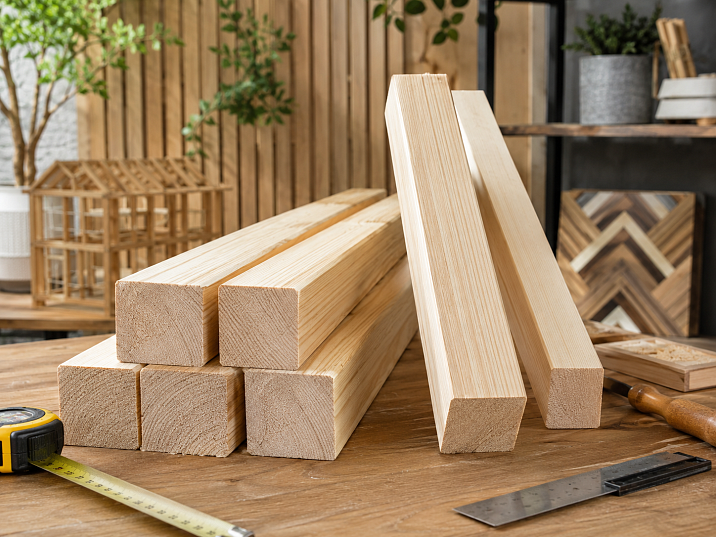
Forty by forty. Four centimeters in each dimension. Square profile, flawless geometry, length two and a half meters. It seems simple. But it is in this simplicity that the fundamental strength lies wooden block 40×40 BR-001: it solves tasks that thin slats and light profiles simply cannot handle.
If you are looking for where buy wooden block 40×40 made of beech or oak with high-quality sanding for a finish coating — you have come to the right place. This article is dedicated to one STAVROS product: the BR-001 block in size 40×40×2400 mm. Not a construction beam. Not a general topic of moldings. Not slats. It is this profile — its parameters, its materials, its application, and the logic of choice.
Read carefully: by the end of the article, you will have a complete understanding of what tasks 40×40 is suitable for, how it differs from 20×20, how to choose the right material and calculate the quantity — and where to place an order without mistakes.


What is the wooden block 40×40 BR-001 from STAVROS
First, the main thing: BR-001 is not a construction beam from a sawmill. It is a furniture and decorative wooden profile made from solid beech or oak with precise processing, calibrated cross-sections, and sanding of Standard or Prestige level. The difference between a construction beam and BR-001 is roughly the same as between sawdust and parquet board: the material is similar, but the purpose, precision, and quality are fundamentally different.
Technical specifications of BR-001 in size 40×40:
| Parameter | Value |
|---|---|
| Cross-section | 40 × 40 mm |
| Length | 2400 мм |
| Material | Beech or oak |
| Sanding quality | Standard / Prestige |
| Re-gluing | For enamel / for tinting |
| Order configuration standard | up to 2 pieces per package |
| Packaging | Rigid packaging frame (390 RUB) |
| Shipping | 3 working days if in stock |
| Made to order | 5–10 business days |
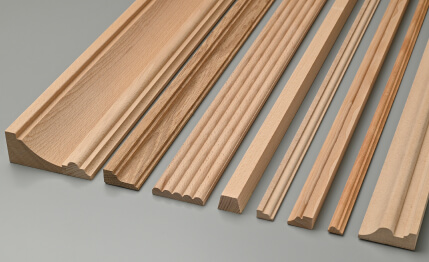
The 40×40 bar belongs to the section solid wood trim in the STAVROS catalog. This is a family of profiles used as structural and decorative elements: they create the base, frame, framework, or visible accent in interior and furniture solutions.
Why BR-001 and not any other bar? Because STAVROS produces it from noble wood species — beech and oak — with precise geometry, uniform cross-section along the entire length, and a surface ready for painting. This is not a "little bar from a hardware store": it is a profile that fits into the structure without adjustment and does not require hours of manual finishing before the final coating.




How the article about 40×40 differs from the article about the 20×20 bar
An honest question — an honest answer. STAVROS already has material about the BR-001 bar in size 20×20×2400 mm. This is a different article, a different search intent, a different audience. They should not be confused — neither for the reader nor for the search engine.
What is the difference between 40×40 and 20×20 as a topic:
-
20×20 is a thin profile. It is used for small furniture layouts, decorative frames, overlay elements, and light decorative lines. It is elegant, delicate, almost weightless in the structure.
-
40×40 is a different weight category. It is a profile for lathing, for frame structures, for slatted walls with real depth, for technical areas where rigidity is needed. It is chosen not because it is 'more liked', but because the task requires exactly this cross-section.
The 20×20 keys in this article are used only in one section — the comparative one. The main focus is always on the 40×40 bar BR-001. Mixing these topics means losing both positions in search.
Our factory also produces:





When exactly a 40×40 bar is needed: task analysis
Before moving on to scenarios, let's establish the principle: 40×40 is chosen when the structure must be rigid, when the profile bears a load, or when the cross-section is visible and should look expressive. This is not just a 'big 20×20' — it is a profile with a different role.
Get Consultation
For lathing under slats and decorative panels
Lathing is an auxiliary structure that is mounted on a wall or ceiling and serves as a base for subsequent fastening of slatted panels, wooden boards, MDF sheets, or other decorative materials. The task of lathing is to level the surface, create an air gap, and provide attachment points at the required spacing.
Why exactly a 40×40 wooden block, not 20×20 or a batten?
Because:
-
Gap depth. 40 mm of lathing depth provides sufficient air gap for ventilation and laying a thin layer of insulation if needed. 20 mm is too little for most decorative tasks.
-
Base rigidity. Battens or wooden panels attached to a thin lathing made of 20×20 profile will "wobble" under mechanical stress. The 40×40 profile holds the load without deflection.
-
Fastening length. Self-tapping screws holding the battens to the lathing go into the block. With a 40×40 cross-section, the "grip" depth is twice as large as with 20×20.
For a slatted wall, the horizontal lathing made of BR-001 40×40 is mounted with a pitch corresponding to the width of the batten used or a multiple thereof. Then wooden battens from the assortment are vertically attached to the lathing of STAVROS wooden battens — this is a complete decorative system.
How to properly install lathing from a 40×40 block:
-
Apply markings on the wall with the required spacing
-
Drill holes in the wall through the block for dowel screws
-
Mount horizontal bars strictly level
-
Check the plane with a taut string or straightedge
-
Attach slats or panels to the bars with self-tapping screws at least 50–60 mm long
What tasks is BR-001 40×40 suitable for
| Task | Why 40×40 is suitable | Link |
|---|---|---|
| Lathing for a slatted wall | Provides depth and rigidity | BR-001 |
| Decorative panel frame | Maintains geometry, does not deform | BR-001 |
| Technical box | Allows hiding engineering elements | BR-001 |
| Furniture frame | Suitable for reinforced solutions | BR-001 |
| Decorative structure | The square profile itself is a design element | BR-001 |
Let's break down each scenario.
Decorative panel frame
A decorative panel is not just an MDF sheet glued to the wall. In professional execution, it is a multi-layer structure: a wooden frame that supports the decorative facade — slatted, veneered, fabric, or combined.
Wooden beam for frame The panel must ensure its flatness and rigidity along the entire perimeter and along the grid of internal ribs. BR-001 40×40 is the correct size for the frame of panels with a height of 100 to 240 cm: its rigidity is sufficient to prevent the panel from warping when humidity changes, and the fastening holds the load at all points.
Frame diagram: perimeter frame made of BR-001 + 1–2 horizontal stiffening ribs along the panel height. For panels wider than 80 cm — an additional vertical rib in the center.
Technical box made of 40×40 beam
A technical box is a structure for hiding engineering communications: pipes, cables, ventilation ducts. In interiors with expensive finishes, the box should not look "construction-like": it is coated with enamel, veneer, or sheathed with slats and is perceived as part of the design.
The frame of such a box is a task specifically for the 40×40 beam. It provides sufficient rigidity so that the box does not deform under temperature fluctuations near pipes, and sufficient cross-section for attaching the cladding. Corner joints of the 40×40 beam, when executed correctly, create a geometrically precise frame without visible deformations.
Furniture frame
The 40×40 beam is used in furniture production where increased rigidity is needed: the frame of a bench body, the base of a sofa platform, the internal frame of a TV cabinet. This is not a facade element — it is a load-bearing structure hidden inside.
From solid wood STAVROS products The BR-001 40×40 beam is one of the most versatile profiles in terms of application. It works both as a visible element and as a hidden structure — depending on the task.
Decorative structure with open profile
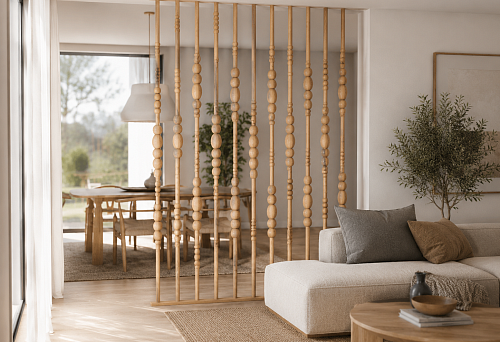
Here, 40×40 acts not as an auxiliary element, but as a visible design accent. Lattice structures made of 40×40 timber — a pergola in the interior, a decorative screen, a zone divider, a frame structure above the bed or along the wall — create an expressive geometric rhythm.
The square profile 40×40 in this context is purity and modernity: no rounding, no carving, only straight lines and right angles. Under tinting or oil, oak BR-001 40×40 in such a structure will look professional and expensive.
Timber 20×20 or 40×40: which to choose
This question is asked often. We answer clearly.
| Parameter | 20 × 20 mm | 40 × 40 mm |
|---|---|---|
| Visual scale | Thin, delicate | Massive, accent |
| Rigidity | Below | Significantly higher |
| Main task | Decorative layouts, frames, overlay elements | Lathing, frame, slatted panels, technical structures |
| Visibility in interior | Delicate line | Expressive profile |
| Structure weight | Lightweight | Heavier |
| Need for fasteners | Smaller | Higher: dowels, self-tapping screws 50–70 mm |
| When to use together | Bar 40×40 — frame, 20×20 — decorative overlays on top | — |
Interestingly, both sizes of BR-001 can be used in one project — but in different roles. Example: slatted wall. Horizontal lathing — BR-001 40×40. Vertical decorative slats — thin profile from section wooden strips. This logic of separating structural and decorative layers is professional and correct.
If the task is to create a frame, lathing, or any load-bearing base — buy a wooden block 40×40If you need a lightweight decorative element, a visible overlay, or a narrow layout — consider 20×20.
How to choose the material: beech or oak for the BR-001 40×40 block
Two materials. Two characters. Two purposes. You need to choose before placing the order — it cannot be changed afterwards.
Beech block 40×40
Beech is a dense, non-porous wood species with a uniform fine-grained structure. These properties make it the ideal choice for one specific task: coating with opaque enamel.
buy a wooden block 40×40 Beech is the right choice if:
-
Your structure will be painted with opaque enamel
-
You need a perfectly smooth surface without pores showing through
-
The project assumes light tones or pastel shades.
-
The structure is hidden inside, and the visible wood texture is not important at all.
Gluing "under enamel" means: the lamellas are glued without matching by color and texture. Tonal differences between lamellas are possible — but they will be hidden under an opaque coating. This is a rational and more affordable option.
Gluing "under tinting" — the lamellas are matched by color and texture. The surface under a translucent coating will be more uniform. This option for beech is relevant in open decorative structures.
Beech under enamel is pure geometry, even color, modern look. For technical zones, frames, and paintable lathing — the best choice in terms of cost and result ratio.
Oak bar 40×40
Oak is a porous species with a large, expressive natural pattern. In a 40×40 mm section, the end of an oak is already a full-fledged visual object: rings, rays, and texture are visible. The surface under oil or tinting works as an expensive material with character.
Buy wooden bar 40×40 made of oak — the right decision if:
-
The structure is open, the bar is visible in the interior
-
Finish coating — tinting, oil, or clear varnish
-
The project assumes a natural, "living" wood aesthetic
-
Context — study, library, relaxation area, expensive interior with an emphasis on natural materials
Oak BR-001 40×40 oiled — one of the best ways to introduce natural wood texture into a modern interior: without pretension and without imitations. Just good material in the right profile.
Important limitation: oak under dense enamel is a more challenging task than beech. Oak's porosity requires multi-layer priming, otherwise the pores "break through" the coating. If you plan an opaque enamel — choose beech. If tinting or oil — choose oak.
Sanding: Standard or Prestige
STAVROS offers two sanding levels for BR-001 40×40.
Standard — machine sanding. The surface is smooth, ready for coating, but minor manual touch-up may be needed before applying the finish. Attractive price for large volumes.
Prestige — hand sanding. All edges and planes of the profile are uniformly worked, including corners and transitions. The product is ready for finish coating without additional processing.
For open decorative structures where the bar is visible — Prestige is recommended. For hidden frames and lathing — Standard is sufficient.
How to calculate the number of BR-001 40×40 bars
An error in quantity calculation is one of the most common and frustrating. One bar short — and the delivery is delayed by a week. Took too many — extra costs. Calculate correctly.
Basic rules:
Length of one BR-001 is 2400 mm (2.4 linear meters).
To calculate the required quantity:
-
Draw a diagram of the structure indicating all elements and their lengths
-
Add up all lengths in linear meters
-
Divide the sum by 2.4 — you get the number of bars without reserve
-
Add 10–15% for cutting, fitting, and inevitable losses
Example calculation for a slatted wall:
Wall 3 × 2.4 m. Horizontal lathing with a pitch of 400 mm.
Number of horizontal rows: 2400 ÷ 400 = 6 rows.
Length of each row: 3000 mm = 3 m.
Total linear meters: 6 × 3 = 18 m.
Number of bars: 18 ÷ 2.4 = 7.5 → round up to 8 pieces.
With a 10% margin: 8 × 1.1 = 8.8 → order 9 pieces.
Rule for corner joints: when making corner joints, account for extra consumption. At each internal corner, a segment equal to the profile cross-section (40 mm) is lost — a small amount at one corner, but with many corners the total adds up.
Don't confuse pieces and length: when the manager asks for the quantity, state it in pieces, not in meters — this eliminates confusion in the order.
Packaging standard: when ordering BR-001 40×40 STAVROS packs up to 2 pieces in one package with a rigid protective frame (390 rubles per package). Consider this when calculating delivery cost.
How to properly store a 40×40 wooden block before installation
Wood is a living material. Before installation, it must acclimate to indoor conditions. Violating this rule leads to structural deformations after assembly.
Storage rules for BR-001 40×40:
-
After receiving, unpack the timber and lay it horizontally in a room with normal humidity (40–60%) and room temperature (18–22°C).
-
Acclimation period: 3–7 days for 40×40 timbers.
-
Do not store near radiators, external walls, or in unventilated niches.
-
Place spacers evenly along the length under the stack of timbers — do not allow the middle to sag.
If you skip acclimation and install immediately after delivery, the timber will gain or lose moisture already in the structure, leading to bending or gaps.
How to attach a 40×40 timber to a wall
Installation rules for BR-001 40×40 lathing — a separate professional topic. Briefly and to the point.
To a brick or concrete wall:
-
Screw dowels with a diameter of 6 mm, anchor part length at least 60 mm
-
Fastening pitch along the bar length: 400–600 mm
-
Preliminary installation of the bar using temporary holders and leveling
To a plasterboard (gypsum board) wall:
-
The metal frame of the gypsum board is insufficient for power fastening of the lathing
-
It is necessary to pre-strengthen the fastening points with embedded elements or mount the lathing directly to the load-bearing wall through the gypsum board
To a wooden structure:
-
Wood screws 5×80 mm or 5×100 mm
-
Corner brackets for reinforced connections
-
PVA glue or special wood glue at joints under pressure
Mistakes when choosing a 40×40 wooden block
Each of them is a real situation that can be prevented.
Mistake 1: Buying construction timber instead of furniture-decorative profile.
Construction pine timber from a sawmill and BR-001 made of beech or oak are not the same thing. Geometry, cross-section uniformity, surface quality, dimensional stability — everything is fundamentally different. For interior tasks, you need exactly BR-001.
Mistake 2: Choosing 20×20 where 40×40 rigidity is needed.
A lathing made of thin 20×20 profile under heavy slatted panels is a recipe for a deformed structure. Do not skimp on the cross-section where it matters.
Mistake 3: Not considering the thickness when calculating the structure depth.
40 mm is the depth created by the block. If sockets, switches, or pipes adjoin the wall, make sure that the 40 mm lathing does not conflict with them. Sometimes a greater depth is needed, and then the block is mounted on stands or a metal profile.
Mistake 4: Not checking the material when ordering — beech or oak.
In the BR-001 card, both materials are available. By default, part of the orders goes to the 'convenient' option. Check that you have selected exactly the material that matches your coating.
Error 5: Using oak under dense enamel without priming.
Oak + opaque enamel without proper priming = pores "break through" the paint. The result is unsightly and requires rework. Either prime thoroughly (3–4 coats with interlayer sanding) or choose beech.
Error 6: Not accounting for the 2400 mm length when cutting.
A 2400 mm bar is 2 meters 40 centimeters. The standard room height is 2.5–2.7 m. One bar does not cover the room height "cleanly". Plan for joints or order a non-standard length for bulk orders.
Error 7: Not allowing for extra material.
10–15% extra is the standard professional approach. Without extra, even one bad cut leaves the project unfinished until the next delivery.
Error 8: Switching from the BR-001 card to the general molding catalog.
To order the specific 40×40 bar, use the direct link: wooden bar 40×40 BR-001. In the general section molding products many other positions — easy to go astray.
Where to buy a wooden block 40×40 in Saint Petersburg and Moscow
STAVROS showrooms operate in two cities. If you want to see the quality of the block in person — touch the sanding, assess the density of the oak at the end — schedule a visit. Addresses and opening hours are on the website in the contacts section.
For regions — delivery across Russia and the CIS via CDEK and DPD. Delivery cost is calculated automatically when placing an order.
Ordering methods:
-
Product card on the website: block BR-001
-
Phone: +7 (800) 555-46-75 (toll-free in Russia)
-
Email: [email protected]
-
Telegram / WhatsApp
Useful sections for additional selection:
-
solid wood trim pieces — cornices, moldings, baseboards, blocks
-
Wooden planks — for finishing over the BR-001 lathing
-
All solid wood products — full catalog
About the company STAVROS
STAVROS is not just a manufacturer of wooden profiles. It is a company with a history that began in 2002 in St. Petersburg: two artists created a small carving workshop, which within a year participated in the reconstruction of the Constantine Palace in Strelna. Then came the Hermitage, the Alexander Palace, the Trinity-Izmailovsky Cathedral, the Sheremetev Mansion, and dozens of other cultural heritage sites.
Today, STAVROS is a production facility in St. Petersburg, showrooms in St. Petersburg and Moscow, over 20 years of work, 264 reviews on the website with an average rating of 5.0, and a principled stance: every product must be made with an understanding of the material, style, and task. The BR-001 40×40 block is part of this philosophy: not a "stock molding," but a profile made from the right wood, properly sanded, and properly packaged.
STAVROS works with orders from 1 piece, meets production and shipping deadlines, and responds to inquiries within 5 minutes during business hours. This is a company trusted by designers, furniture makers, and private clients — and one that respects this trust.
FAQ: answers to popular questions about the BR-001 40×40 block
Where to buy a STAVROS wooden block 40×40?
In the product card: block BR-001. Order from 1 piece, delivery across Russia and the CIS.
Is this a duplicate of the article about the 20×20 block?
No. 20×20 is a lightweight decorative profile. 40×40 is a massive profile for lathing, frames, and decorative structures. Different tasks, different topics.
What are the dimensions of BR-001 in the 40×40 cross-section?
40 × 40 × 2400 mm. Length — 2.4 linear meters.
What to choose: beech or oak?
Beech — for opaque enamel and even painting. Oak — for tinting, oil, and open texture. For hidden frames and lathing — beech, a rational option.
What is gluing "for enamel" and "for tinting"?
"For enamel" — lamellas are glued without color matching, suitable for opaque coating. "For tinting" — lamellas are matched by color and texture, suitable for translucent finish.
How long to wait for an order?
If in stock — 3 business days. Custom production — 5–10 business days.
Can I order a non-standard length?
Yes, for bulk orders. Check with the sales department manager.
How many pieces in one package?
Up to 2 pieces of 40×40 bar in a rigid packaging frame (390 rubles per package).
How to calculate the number of bars for a slatted wall?
Calculate the total length of all rows of lathing in linear meters, divide by 2.4, and add 10–15% margin.
Is it necessary to acclimate the timber before installation?
Yes. 3–7 days at a temperature of 18–22°C and humidity of 40–60% is a mandatory step before installing any wooden profile.
Does STAVROS paint the timbers?
Yes, when ordering products for a total of 150,000 rubles or more.
Can the timbers be used outdoors?
The main BR-001 assortment is intended for interior use. For outdoor work, check conditions with a manager.