Article Contents:
- Short answer: which stucco to buy in Saint Petersburg
- Why polyurethane stucco is suitable for interiors in Saint Petersburg
- What to buy for walls
- Frames made of moldings
- Wall decor behind the sofa
- TV zone design
- Bed headboard decoration
- Piers in the hallway
- Decor for moldings: details that make all the difference
- What to buy for the ceiling
- Ceiling cornice: the perimeter that changes everything
- Socket for chandelier
- Moldings for ceiling frames
- How not to overload the ceiling
- Stucco for classic and neoclassical styles
- Classic Interior
- Neoclassicism
- Modern classicism
- How to choose stucco from a catalog
- Stucco: price in St. Petersburg — what the final cost depends on
- How to calculate stucco for a room
- Where stucco is especially appropriate in an apartment
- Living Room
- Bedroom
- Entry Hall
- Kitchen-living room
- Office
- Mistakes when buying stucco in St. Petersburg
- What to buy together with stucco
- FAQ: Answers to the Most Important Questions
- About the Company STAVROS
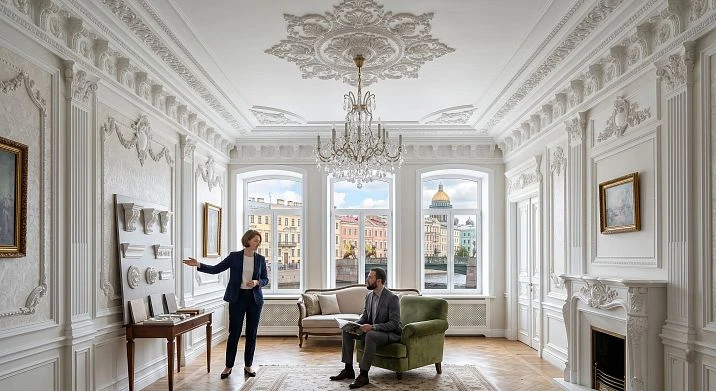
St. Petersburg is a city where architectural decor is not just appropriate, but organic. Here, stucco on building facades is not a luxury, but the norm: it has existed in the urban space for centuries, shaping the special visual code of the Northern Capital. And when a resident of St. Petersburg renovates an apartment, they intuitively gravitate toward decor, toward relief, toward what turns four walls into a space with character. Polyurethane stucco in St. Petersburg is a modern response to this demand: affordable, lightweight, easy to install, excellent for painting, and organic in any classic, neoclassical, or modern-classic interior.
This article is for those who choose decor consciously. Not just "buy something for the ceiling," but select the right elements for a specific task: decorate a wall in the living room, create frames in the bedroom, install a cornice around the perimeter of a kitchen-living room, or set up a ceiling rosette for a chandelier in the hallway. We'll cover everything — from choosing elements to calculating quantities and typical mistakes.

Short answer: which stucco to buy in St. Petersburg
If you have little time, here's a quick task navigator.
-
For walls — Moldings made of polyurethane, PU overlays, Decor for Molding. Molding frames are the most popular wall decoration technique.
-
For the ceiling — polyurethane cornices, chandelier rosettes, ceiling profiles. They are selected based on ceiling height.
-
For neoclassical style — calm moldings with moderate relief, Polyurethane wall decor in the color of the walls. Without complex ornaments.
-
For classical style — expressive cornices, ornamental rosettes, Decorative stucco with relief. Symmetry and richness.
-
For an apartment with low ceilings — thin flat profiles, narrow moldings, no clutter.
-
For a house or cottage — you can use large elements, stucco on the facade and more expressive decorative details.
The main rule that remains in any case: all elements must be selected in a single style. Moldings, cornices, overlays, and rosettes from the same line guarantee that the interior looks designed, not assembled from random parts.




Why polyurethane stucco is suitable for interiors in St. Petersburg
The St. Petersburg climate — humidity, temperature fluctuations, old houses with uneven walls and not the smoothest ceilings. Gypsum stucco in such conditions requires special attention: it is heavy, fragile, poorly tolerates vibration, and takes a long time to dry after installation. polyurethane moldings — a fundamentally different story.
Weight. Polyurethane is 5–7 times lighter than gypsum. A 2-meter profile weighs 200–400 grams — it can be held with one hand during installation. This is important when working with the ceiling: installing a cornice alone is much easier than a heavy gypsum counterpart.
Flexibility. PU elements bend slightly, allowing them to be mounted on uneven surfaces — and uneven walls and ceilings in old St. Petersburg apartments are common. The molding fits tightly to the base, gaps are minimal.
Painting. Polyurethane Polyurethane moldings is supplied white or ready for painting. It is painted with regular water-based paint, acrylic enamel, and can be tinted to any color from the RAL or NCS catalog. Stucco 'in the color of the walls' is a very popular technique in neoclassicism and modern classicism.
Versatility. Types of moldings from polyurethane cover the entire range of tasks: from a thin molding for a wall frame to a massive ceiling cornice, from a simple flat overlay to a relief rosette for a chandelier. In one catalog — all elements for a complete apartment decoration.
Installation. Polyurethane-based adhesive, liquid nails, acrylic sealant — installation requires no special tools or professional skills. Molding is cut with a regular miter saw or fine-tooth hacksaw.
That is why, when residents of St. Petersburg search for buy stucco molding in St. Petersburg for an apartment in a historic building, a new development, or a country cottage — polyurethane becomes the first and often the only choice.
Our factory also produces:
What to buy for walls
Walls are the main field for decorative stucco molding. This is where frames, accents, zones, and visual depth of the interior are created.
Get Consultation
Molding frames
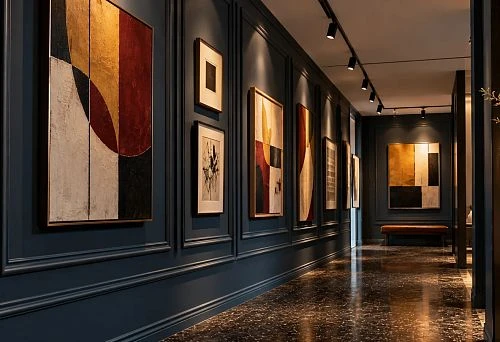
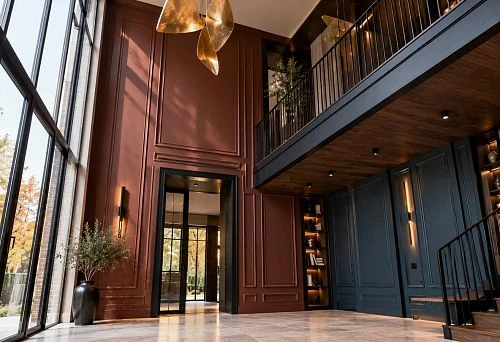
The most common and effective technique is decorative frames made of moldings. Rectangular or square frames on the wall visually "delineate" the plane, adding architecturality and order. The wall ceases to be just a background — it becomes part of the design.
Moldings made of polyurethane for frames are chosen by profile width: narrow (20–30 mm) — for light, calm frames in neoclassicism; medium (40–60 mm) — for more expressive classic frames; wide (from 70 mm) — for accent panels and stately interiors.
Inside the frame, you can leave the wall color — or highlight it with a different shade. The second option creates a more complex visual space: the wall seems to become deeper.
Wall decor behind the sofa
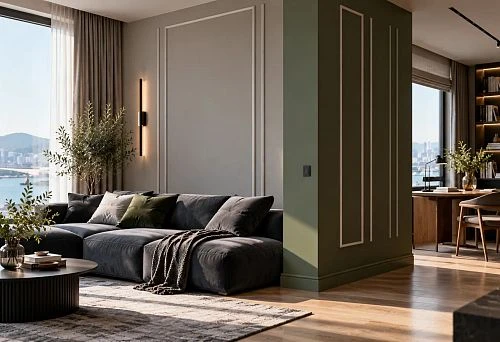
The area behind the sofa in the living room is the first thing a guest sees. It is the most "public" wall in the apartment. Wall molding works most effectively here: a large frame or several frames in a row — and the wall gains character.
For this area, the following work well PU overlays in the corners of the frames — decorative corner elements that complete the frame and add expressiveness. With them, the frame looks like an architectural detail, not just a rectangle of molding.
TV zone design
The TV area is the functional center of the living room. The decor here should work as a frame for the screen: create an accent but not compete with the television. Polyurethane wall decor around the TV — moldings along the perimeter of the niche or symmetrical panels on the sides — adds completeness to the area.
Important: for the TV area, choose elements with moderate relief. Too complex an ornament competes with the screen and visually overloads the area.
Decorating the headboard of the bed
Bedroom Polyurethane wall decor above the headboard — one of the most exquisite techniques. A frame above the bed creates the effect of an architectural niche, making the headboard "framed" — like a picture in a frame. This fundamentally changes the perception of the bedroom: it ceases to be just a room with a sleeping place.
For the headboard, a vertical frame is often chosen, slightly taller than it is wide — it emphasizes the height of the wall and visually "stretches" the ceiling.
Partitions in the hallway
The hallway is the narrowest and most functionally saturated space. Here, molding frames work differently: vertical narrow panels on the walls between the mirror, coat rack, and doors create order in a small space. — everything must correspond to the chosen era. In the hallway, it is always restraint: a narrow profile, a calm relief, a single color with the wall.
Decor for moldings: details that make all the difference
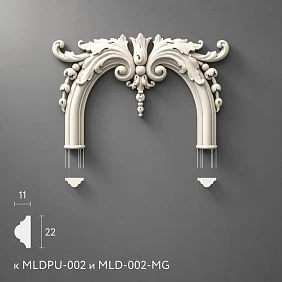
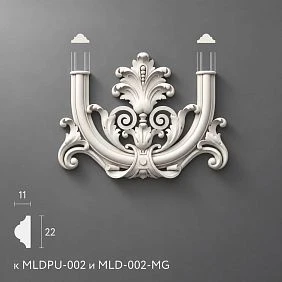
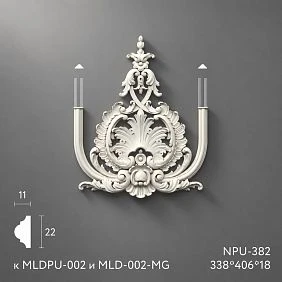
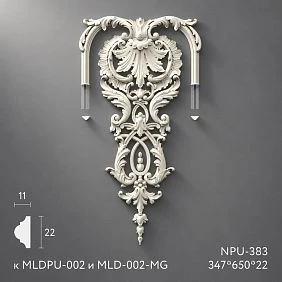
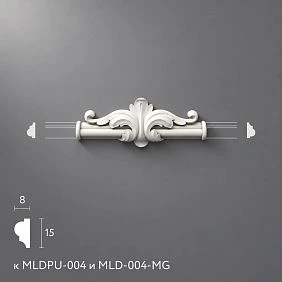
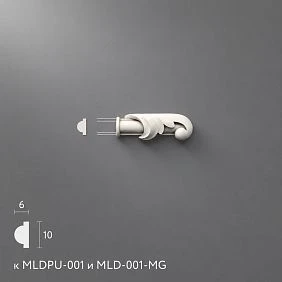
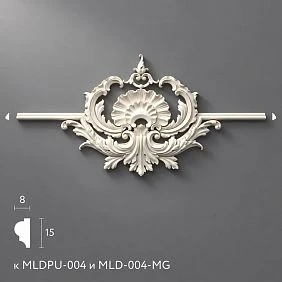
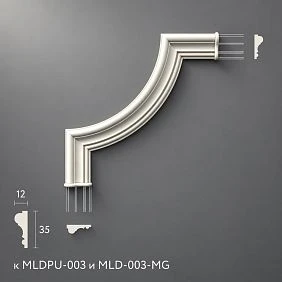
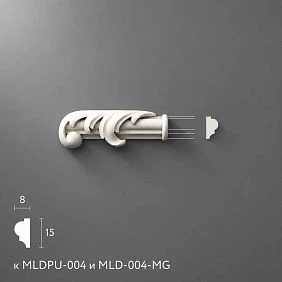
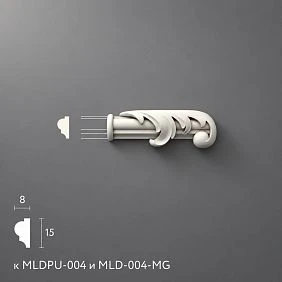
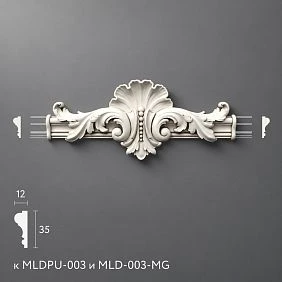
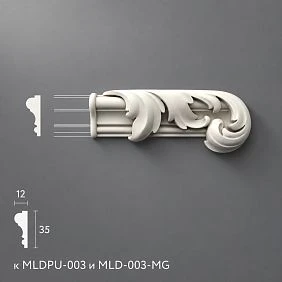
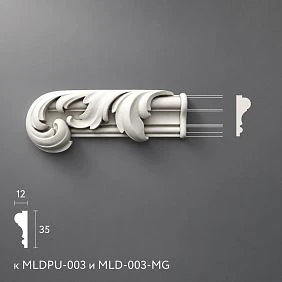
Decor for Molding These are corner and central decorative inserts that are installed at joints and in the centers of frame sides. It is they that turn a simple rectangle of molding into a real architectural detail. Rosettes in the corners, ornamental keystones in the center, decorative inserts — this is the level of detail that distinguishes a designer interior from a standard one.
What to buy for the ceiling
The ceiling is the most underused decorative plane in most apartments. Yet it is the ceiling decor that creates a sense of completeness in the space.
Ceiling cornice: the perimeter that changes everything
A polyurethane ceiling cornice is a horizontal profile that runs along the perimeter of the room at the junction of the wall and ceiling. Its main function is to hide the technical joint and create a visual boundary between the vertical and horizontal planes.
But the cornice does more: it sets the scale for the entire space. A room with a cornice appears taller and more spacious — even if the ceiling hasn't changed. This is an optical illusion created by the horizontal line of decor.
Moldings made of polyurethane For the ceiling, they are selected based on the height of the room. The general rule: the higher the ceiling, the wider the cornice can be. For rooms with a height of 2.5–2.7 m, a cornice width of 50–80 mm is optimal. For rooms from 3 m — 80–120 mm and above.
Socket for chandelier
cornice under the chandelier A decorative rosette that is installed in the center of the ceiling at the point where the light fixture is suspended. It turns a technical opening into a decorative center of the ceiling composition.
The size of the rosette is chosen in proportion to the room area. For a room of 15–20 m² — a rosette with a diameter of 40–60 cm. For large rooms from 30 m² — 70–100 cm. A too small rosette in a large room gets lost. A too large one in a small room overloads the ceiling.
The rosette should match the cornice in style: if the cornice has an ornamental profile, the rosette should also be decorative. If the cornice is laconic, choose a simple rosette with a clean geometric pattern.
Moldings for ceiling frames
Ceiling frames — frames made of moldings directly on the ceiling surface — are a more complex and effective technique. They create "coffers" — rectangular or square panels that visually divide the ceiling into zones.
Ceiling frames are appropriate in rooms with a height of 2.8–3 m: in lower rooms, they "lower" the ceiling. In high rooms, they make the ceiling more lively and architectural, removing the feeling of an empty slab overhead.
How not to overload the ceiling
Stucco on the ceiling is always a matter of measure. A few recommendations:
-
In small apartments and rooms up to 20 m², a cornice around the perimeter and one rosette are sufficient. Frames on the ceiling — only if the height is from 2.8 m.
-
Do not mix different profile styles on the same ceiling. One cornice + one rosette from the same line is a system.
-
For apartments with ceilings of 2.5 m, choose a narrow cornice and a small rosette. A massive cornice "eats up" the height.
-
polyurethane decor should be part of the design, not a random addition.
Stucco for classic and neoclassical styles
Style is the first thing to determine before purchasing any decorative element. And stucco is no exception.
Classic interior
Classic style is richness, symmetry, expressive relief. Decorative stucco in a classic interior, these are cornices with a developed profile: several steps, an ornamental band, a smooth frieze. These are rosettes with petal ornament, acanthus, or egg-and-dart ornament. These are wall overlays — cartouches, medallions, consoles — that create point decorative accents.
In classic decor, there is never "too much" — provided it is subordinated to a single stylistic idea. Symmetry is mandatory: wall frames are identical in size, the cornice is continuous around the entire perimeter, the rosette is exactly in the center of the room.
For a classic interior, choose moldings catalog with an emphasis on ornamental profiles and decorative overlays. Large cornices, complex rosettes, and rich — everything must correspond to the chosen era. with historical relief.
Neoclassicism
Neoclassicism works differently. Here, stucco is not the main character, but a supporting element. Calm moldings with a simple profile, frames in the color of the walls, a thin cornice without ornament or with very moderate relief. The rosette under the chandelier is neat, geometric, without complex ornament.
Neoclassicism loves monochrome: Stucco SPB matching the wall color creates relief without color contrast. The wall looks textured, voluminous, and refined — but not loud. This is the highest level of decorative work: when stucco is present but doesn't "shout" about its presence.
Decor for Molding in neoclassicism, a minimalist one is chosen: simple corner elements without intricate carving. At most — a light geometric pattern.
Modern classic
This style is for those who love order, purity of forms, and moderate decor without references to historical periods. Minimum ornament, maximum line purity. Flat or slightly profiled molding. Cornice with a simple rectangular profile. Rosette with concentric rings instead of petals.
In modern classicism Polyurethane moldings works as an architectural accent, not as ornamental decoration. Stucco structures the space — divides the wall into zones, marks boundaries — but does not decorate in the literal sense.
Here, the connection of stucco with other interior elements is especially important: baseboard, door trims, furniture facades. All details must speak the same language — the language of pure, confident geometry.
How to choose stucco from a catalog
Buying stucco from a catalog is a skill. Let's break down an algorithm to help avoid mistakes.
Step one: define the task. What exactly needs to be decorated — a wall, ceiling, building facade, doorway? Each task requires its own type of element. For a wall — molding and overlays. For a ceiling — cornice and rosette. For a facade — special facade elementsFor openings — trims and architraves.
Step two: choose the element type. Molding — for frames and lines. Cornice — for the ceiling perimeter. Rosette — for the ceiling center under the chandelier. Overlay — for spot decor. Decor for Molding — for corner and center inserts.
Step three: check the size. molding catalog The width, profile height, and element length are always specified. Compare these dimensions with your room's parameters — not by eye, but with a tape measure in hand. An 80 mm wide molding looks completely different with a 2.5 m ceiling versus a 3.2 m ceiling.
Step four: evaluate the profile and relief. In the online catalog, pay attention to the end cross-section of the profile — it shows how the molding will look on the wall. A smooth curved profile — a softer look. A stepped straight profile — stricter and more modern. Ornamental — classic.
Step five: match everything in one style. If the cornice is ornamental — the wall moldings should also be from the classic line. Decorative inserts — in the same character. Mixing styles within one space destroys integrity.
Step six: calculate the quantity. Molding length for frames = perimeter of each frame. Cornice length = room perimeter + 10% allowance for joints and corners. Overlays are counted individually. Add a 10–15% allowance for cutting and correcting installation errors.
Step seven: consider painting and installation. Polyurethane elements are mounted with glue — special PU glue or liquid nails. Paint is applied after installation: first primer, then two coats of paint. Joints are sealed with acrylic sealant before painting.
Stucco molding: price in St. Petersburg — what the final cost depends on
The question of price always arises when planning renovations. The specific figures depend on many factors, and understanding this logic helps to properly form a budget.
Element type. A simple molding costs less than a cornice with a developed profile. A rosette is more expensive than a pad. The more complex the shape, the higher the price.
Profile size. The width and height of the profile directly affect the material consumption during production and, accordingly, the cost. A molding 100 mm wide costs noticeably more than a 40 mm wide molding from the same line.
Relief complexity. Ornamental profiles with fine relief are more difficult to produce — this is reflected in the price. Smooth or simple profiles are cheaper.
Number of linear meters. The larger the room perimeter or the total length of moldings, the more linear footage is needed. For a room 4×5 m, the perimeter is 18 linear meters for just one cornice.
Number of frames. Each frame is 4 molding segments plus corner joints. Three frames on a wall — that's already 12 segments with precise corner cuts.
Presence of rosettes and pads. Each piece element is counted separately — and their number in a complex interior can be significant.
Allowance for trimming. When joining corners, some material goes to waste. A 10–15% allowance is a necessity, not extravagance.
Installation and painting. If the work is done by a craftsman, this is a separate budget item. For DIY installation, consider the cost of glue, sealant, primer, and paint.
To get a real picture of the final expenses — buy polyurethane molding in St. Petersburg it should be after the exact calculation, not before it. Calculate each position — and the cost of the decor will be quite reasonable.
How to calculate molding for a room
Calculation is what separates a successful renovation from the situation 'two meters of molding short'. Here is a simple and reliable algorithm.
1. Measure the walls and ceiling. The length and width of the room are the basis of all calculations. Write it down: for example, 4.2 × 5.6 m, ceiling height 2.7 m.
2. Decide where the decor will be. The whole room or one accent wall? The entire ceiling or just the cornice? The total footage depends on this decision.
3. Calculate the perimeter of the frames. If three frames are planned on the wall behind the sofa (5.6 m) — draw them on paper with dimensions. For example, three frames 1.2 × 0.9 m. Perimeter of each: (1.2 + 0.9) × 2 = 4.2 m. Three frames = 12.6 m of molding.
4. Calculate the ceiling cornice. Room perimeter: (4.2 + 5.6) × 2 = 19.6 m. Plus 15% reserve = 22.5 m.
5. Add a rosette. One piece under the central chandelier — the diameter is selected based on the room area.
6. Add decor for moldings. 4 corner elements per frame: 3 frames × 4 elements = 12 corner pieces.
7. Check stylistic unity. All elements should be from the same line or from stylistically compatible series.
Total for our example: ~23 m of cornice, ~14 m of molding for frames, 12 corner inserts, 1 rosette. Precise calculation — clean installation.
Where stucco is especially appropriate in an apartment
Different rooms — different tasks. Let's break down each zone separately.
Living Room
Living room — the main space of the apartment, and decor here works at full power. The wall behind the sofa with frames of polyurethane moldings — a classic. A ceiling cornice around the entire perimeter is mandatory. A rosette under the chandelier — if the chandelier is central. TV zone with polyurethane wall decor around the niche perimeter — for a more complex interior.
In the living room, you can afford the most expressive elements: a large cornice, an ornamental rosette, rich PU overlays on the accent wall. It is here that stucco produces the greatest effect.
Bedroom
Bedroom requires a balance between decorativeness and tranquility. Here stucco works more quietly: a frame above the headboard, a thin cornice around the perimeter, a neat small rosette under the chandelier or sconces. Profile — calm, without complex ornament. Color — matching the walls.
cornice under the chandelier in the bedroom — a small rosette 30–50 cm, with a simple geometric pattern. In a neoclassical bedroom, it creates a point of completeness without overload.
Entryway
The hallway is the most challenging space for molding. It is narrow, functionally dense, and every extra detail here "works against you." The task of molding in the hallway is to create order without adding crampedness.
Vertical narrow moldings on the walls between the mirror, coat rack, and doors are the right solution. A thin cornice along the top of the walls, if the height allows. Decor for Molding — minimal, only corner elements.
Kitchen-living room
The open space of a kitchen-living room requires zoning — and molding helps create it. A cornice around the perimeter of the entire room visually unites two functional zones into one architectural space. Moldings on the wall of the living room area — while the kitchen area can remain without wall decor.
The transition between zones is often marked by a change in profile or a break in the cornice — this creates a subtle visual boundary.
Office
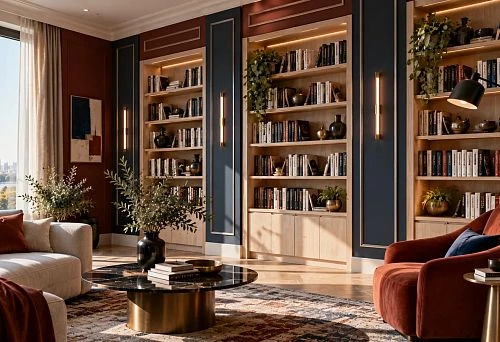
A study is a space for concentration and status. More expressive profiles, dark furniture, and classic polyurethane decor with character. Tall bookcases pair well with a cornice at the level of their top shelf — this creates a visual horizontal line in the space.
The wall behind the desk or the area with a map and shelves is decorated with molding frames — this adds a sense of "studiness" to the study, if you will: a feeling of a well-thought-out, lived-in workspace.
Mistakes when buying molding in St. Petersburg
Mistakes in choosing molding mean rework, extra costs, and ruined mood. Here is the most honest list.
Choosing stucco only from photos. A photo doesn't convey the real scale. A molding that looks elegant in a photo may turn out unexpectedly massive in your hands. Always check the dimensions in the description and imagine them in the context of your room.
Not checking element sizes. A cornice 120 mm wide and a cornice 60 mm wide are fundamentally different things with a ceiling of 2.5 m. Always check the width, profile height, and element length.
Buying moldings without calculating the quantity. 'I'll take about twenty meters, that'll be enough' is not a plan. Accurate calculation along the perimeter of the frames, with a 10–15% margin, is the only correct approach.
Not considering ceiling height. A wide cornice in a low room visually 'lowers' the ceiling. A rosette with a diameter of 80 cm with a ceiling of 2.5 m is overload.
Mixing different decor styles. An ornamental cornice in a Baroque spirit + minimalist moldings in Scandinavian style is a style conflict that cannot be hidden by painting.
Forgetting about painting. Polyurethane elements are white out of the box, but this is 'technical white' that differs from the white of walls and ceilings. Without painting, the stucco looks unfinished.
Not counting corners and trimming. Each corner of the room is two cuts of molding at 45 degrees. Waste during trimming can amount to 15–20% of the linear footage. Calculate in advance.
Buying too large decor for a small apartment. A large ornamental cornice in a 12 m² room creates a feeling of pressure, not luxury. The scale of the decor should match the scale of the space.
Not linking stucco with furniture and baseboard. Stucco is part of the system. If the baseboard is plastic and technical, and the walls have classic ornamental frames, the interior looks inconsistent.
What to buy together with stucco
Full interior design is rarely limited to one type of element. Here's what is bought together with stucco during renovation.
Moldings made of polyurethane — for walls and ceiling frames, cornices and baseboards. Main linear element.
PU overlays — for accent wall decor, medallions, cartouches and accent elements.
Decor for Molding — corner and center inserts that complete frames and give them a finished look.
Polyurethane wall decor — standalone decorative elements for accent areas: TV area, area behind the sofa, hallway.
Rosettes — for the ceiling under the chandelier, in the same line as the cornice.
Polyurethane cornices — ceiling perimeter decor, the main architectural element of the upper part of the room.
Polyurethane moldings linear — baseboards, pilasters, door and window trims. Everything that creates vertical and horizontal architectural lines.
Installation adhesive, acrylic sealant, primer, paint — without them, installation cannot be completed.
Ready-made sets wall decor — for those who want to save time on selection: everything needed for one area in one set.
FAQ: answers to the most important questions
Where to buy polyurethane stucco molding in Saint Petersburg?
Buy stucco molding in SPb best in a store with a wide catalog, where all types of elements are presented: moldings, cornices, overlays, rosettes and Decor for Molding. It is important that all elements are from the same line — this guarantees stylistic unity.
Which stucco molding to choose for an apartment in SPb?
For an apartment with ceilings up to 2.7 m — a thin cornice 50–70 mm wide, moldings for wall frames 30–50 mm wide, a small rosette. For an apartment with ceilings from 3 m, you can choose more expressive profiles. Buy polyurethane stucco molding SPb — a choice that suits both new buildings and old housing stock.
What to buy for neoclassicism?
For neoclassicism — Moldings made of polyurethane with a smooth profile and moderate relief, Polyurethane wall decor in the color of the walls, simple corner inserts, a neat ceiling rosette. Without ornamental overload.
What does the price of stucco depend on?
Depends on the type of element, profile size, complexity of the relief, number of linear meters and piece elements. Molding price also depends on the order volume: with a large linear footage, the cost per unit element decreases.
Can polyurethane stucco be painted?
Yes. Decorative stucco made of polyurethane perfectly accepts water-based paint, acrylic enamel, and any other interior coatings. Before painting — primer. Paint in the color of the walls or ceiling creates the effect of monolithic architecture.
How long does polyurethane molding last?
Properly installed and painted polyurethane moldings lasts for decades. The material does not rot, does not dry out, is not afraid of moisture. The only threat is mechanical impacts, which can leave dents in soft polyurethane.
Is professional installation necessary?
No. Installation of PU stucco is accessible for DIY: glue, cutting with a miter saw, sealant. With basic skills in working with finishing materials, installing moldings and cornices around the perimeter of a room will take one day.
About the company STAVROS
Saint Petersburg deserves decor with history and character — and that is exactly what STAVROS offers. A Russian manufacturer with a wide range polyurethane products: moldings, cornices, baseboards, overlays, wall and molding decor, rosettes — all in one place, all in a single line.
STAVROS produces polyurethane moldings for interiors of any scale: from a small apartment in a St. Petersburg building to a country cottage with high ceilings and facade decor. The catalog features elements for classic, neoclassical, and modern classic styles — with different profiles, sizes, and levels of decorativeness. Buy polyurethane moldings in Saint Petersburg from STAVROS means getting products manufactured with precision, ready for installation and painting, tested in real interiors of St. Petersburg apartments and houses.