Article Contents:
- Short answer: first the room number, then the bird — and only after checking one typical door decide the fate of the entire batch
- NPU-497R "Bird": confirmed characteristics and boundaries of the new task
- NPU-497R: confirmed characteristics and what they mean specifically next to the room number
- Frontal dimension 115 × 65 mm is local decor
- We do not assign the 115 and 65 mm axes in the order of the digits
- Why this article does not duplicate general materials about hotels and "stucco with animals"
- The room number must be read first: how to check visual hierarchy before purchasing NPU-497R
- Five-second test
- The "quiet field" works stronger
- Repeatability matters more than the beauty of a single door: how to turn NPU-497R into a system, not random decor
- Exceptions need to be defined in advance
- Batch calculation: how to count NPU-497R without a made-up universal stock
- Is a reserve needed
- Decision table: whether to place NPU-497R at every room zone or not
- Final decision tree
- Can the NPU-497R be placed directly on the license plate?
- Will the NPU-497R be suitable for an apartment hotel or a guest house?
- Is it necessary to place the bird on the doors of utility rooms?
- Can the NPU-497R be placed near the suite number, but not at standard rooms?
- If the numbers are applied directly to the wall, is a separate smooth plate needed for the NPU-497R?
- Can the NPU-497R be used at each door if the numbers themselves have different colors?
- What to do if a sconce is located directly above the number?
- Can the bird be placed above the number on the same axis?
- If the hotel has 40 rooms, is it enough to test just one door?
- Do I need to buy a 10% spare?
- Can the NPU-497R be painted to match the color of the brass number plate?
- Should the NPU-497R be installed on the side of the door opposite the room number?
- Can the NPU-497R be used near the room number if there is a "Do Not Disturb" sign nearby?
- Do I need to consider whether the door opens inward or outward?
- Can the bird be used on doors in accessible environments?
- If the bird is barely visible from a distance, is that a problem?
- Can the NPU-497R be installed on a slatted panel using a separate smooth backing?
- Is the NPU-497L needed on the opposite side of the corridor?
- Can the NPU-497R be used only at the entrance to the floor, rather than at the rooms?
- How can I tell if the bird truly adds a "boutique" character, rather than just complicating the wall?
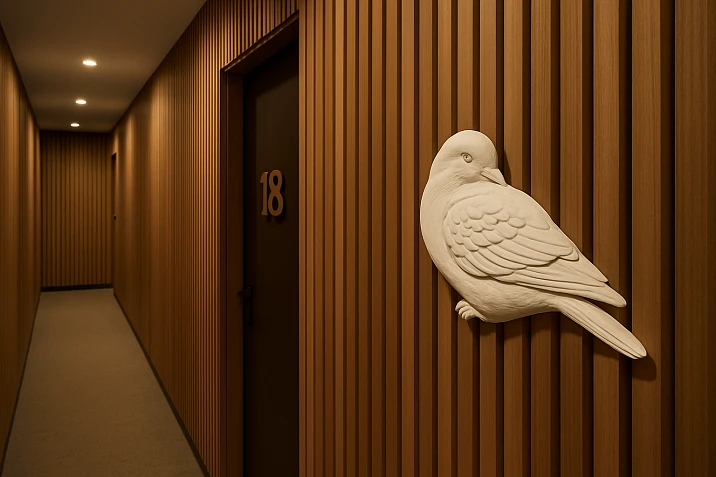
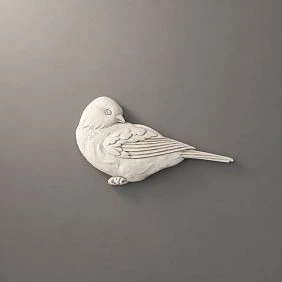
Short answer: first the room number, then the bird — and only after checking one typical door should you decide the fate of the entire batch.
In a hotel corridor, a decorative plate near the door should not become a second navigation sign. The guest walks down the corridor not to admire the ornament: they need to quickly find the right room, understand where the door is, read the numbers, and not confuse neighboring rooms. Therefore, the decorative plate NPU-497R "Bird" only makes sense as a secondary permanent accent that makes a standard room numbering area more distinctive, but does not impair navigation.
At the time of verification, the STAVROS card for NPU-497R indicates one size 115 × 65 × 13 mm, polyurethane material, and a price of 1,010 ₽ per piece. The product is made in the shape of a sitting bird; the manufacturer classifies it as a decorative plate and allows its use on walls and in interior compositions.
For a boutique hotel, this immediately turns into a B2B solution.
If 12 room numbering zones are being decorated and the prototype is confirmed, the base batch is 12 NPU-497R units. At the current price, the cost of the plates themselves is:
12 × 1 010 = 12 120 ₽.
For 20 room numbering zones:
20 × 1 010 = 20 200 ₽.
But this arithmetic is only useful after one key step: first test one typical door and one room number plate at a 1:1 scale.
Before ordering the entire batch, you need to find out:
-
whether the room number remains the first object the guest reads;
-
whether there is a calm, smooth field next to the room number plate, rather than only deep vertical slat relief;
-
whether the frontal dimension of 115 × 65 mm looks too small or, conversely, too cramped next to a specific plate;
-
doesn't the 13 mm relief make the bird too noticeable in side light;
-
doesn't the decor conflict with the sconce, sensor, card reader, doorbell button, fire safety marking, or other mandatory information;
-
can the chosen position be repeated identically on all doors;
-
is the very idea of the bird justified by the boutique hotel's style.
If after checking one typical door the number reads faster than the bird, the area looks cohesive and the scheme can be repeated throughout the corridor, buy the decorative overlay NPU-497R "Bird" makes commercial sense.
If the number plate itself is already an expressive object and the bird creates a second focal point, the correct result is 0 NPU-497R for number zones, even if the overlay itself is liked.




NPU-497R "Bird": confirmed characteristics and boundaries of the new task
Our factory also produces:
NPU-497R: confirmed characteristics and what they mean specifically near the room number
| Parameter | Confirmed value |
|---|---|
| Article number | NPU-497R |
| Type | Decorative polyurethane overlay |
| Motif | sitting bird |
| Size A × B × C | 115 × 65 × 13 mm |
| Material | Polyurethane |
| Price at time of check | 1 010 ₽/pcs. |
| Application | walls and interior compositions |
| Finish | allowed by the manufacturer |
| Made to order | the card indicates an average delivery time of 3–7 days |
Get Consultation
Frontal dimensions 115 × 65 mm — this is local decor
NPU-497R should not be perceived as a standalone hotel room sign. Its scale is much closer to a small decorative sign.
This is important because there is already an object near the door that holds informational priority — the room number.
The bird can:
-
support the room number zone;
-
add individuality;
-
connect a smooth insert with the natural texture of the slats.
But it should not:
-
replace numbers;
-
look like a navigation pictogram;
-
hinder reading the number;
-
create the impression that "the bird means a specific floor or room category" if such a system does not actually exist.
The 13 mm relief needs to be checked with light and by passing by.
13 mm is a small depth compared to large stucco decor, but next to a flat number plate it is noticeable.
Side light creates a shadow.
When passing close by, the relief becomes tactilely perceptible.
On the narrow wall section near the door, even a small volume can affect the overall density of the composition.
We do not assign axes 115 and 65 mm in numerical order.
The card indicates A × B × C = 115 × 65 × 13 mm, but the order of letters cannot be automatically converted into "width × height × depth" without cross-checking the drawing and the actual orientation of the product.
Therefore, the geometric conclusions of the article are drawn safely:
-
Frontal dimensions — 115 × 65 mm in the orientation shown on the card/drawing;
-
Relief — 13 mm.
When marking the prototype, the orientation must be verified against the actual image of NPU-497R.
Why this article does not duplicate general materials about hotels and "stucco with animals"
STAVROS already has several broader pages.
One covers decor for hotels and guesthouses in general.
The other one is dedicated to stucco decor for the hotel: lobby, rooms, corridors, walls, moldings, and the overall composition.
A separate article about stucco with animals explains the range of birds and other motifs and helps choose decorative overlays as an artistic type.
These pages do not solve a narrow task:
should one NPU-497R be repeated next to each room number plate in an already finished slat corridor, without reducing navigation readability?
This is where new practical value emerges.
Need to check:
-
one standard door unit;
-
information hierarchy;
-
repeatability;
-
series cost;
-
maintenance;
-
door variability;
-
situations where some room numbers have a different wall or equipment;
-
the “all batch / partial batch / none” decision.
This task is not an extended retelling of the product card and does not replace the general material about decor for hotels and guesthouses.
Navigation hierarchy: room number first, decorative bird second
The room number should be read first: how to check the visual hierarchy before purchasing NPU-497R
The room number zone has at least four possible layers:
-
room number;
-
decorative overlay;
-
light;
-
equipment — card reader, sensor, button, “do not disturb” sign, or other information.
If all four layers are equally contrasting, the guest gets not an expressive composition, but a small visual knot that has to be deciphered.
Five-second test
Photograph a typical door with a number plate.
Add a full-size mockup of NPU-497R.
Show the frame to a person who doesn't know the project for a few seconds.
Ask:
What room number did you see?
If the answer comes immediately, the bird remains secondary.
If a person first notices the bird, then the sconce, then looks for the numbers, the hierarchy needs to be fixed.
Color should not make the bird more noticeable than the number without a reason.
A contrasting white bird on a dark wall next to small dark numbers will almost certainly become the main focal point.
The monochrome NPU-497R in the color of the smooth insert will work through shadow and relief and usually competes less with the number.
The size of the digits is not adjusted to fit the bird.
If after adding the NPU-497R you have to enlarge the license plate just so it can 'win' again, the decorative element is already having too strong an influence.
First, check whether it is better to:
-
move the bird;
-
reduce contrast;
-
move it to an adjacent field;
-
or abandon it altogether.
Smooth license plate area and placement geometry next to rails
On a rail or on a smooth field: why the license plate area works better as a separate calm node.
Slat panels create a frequent vertical rhythm.
The number plate and the bird have a completely different geometry.
If both elements are placed directly on the deep relief, three risks arise.
Risk 1. The number loses readability.
The digits appear against a background of many vertical lines and shadows.
Risk 2. The bird loses its contour.
The small form of 115 × 65 mm can visually fragment.
Risk 3. Installation becomes more complicated.
The number and the overlay require a stable base.
If behind them there is only an alternation of protrusions and recesses, the composition and fastening require separate technical development.
The "quiet field" works more strongly
In a hotel corridor, it is useful to specifically highlight the number zone:
-
a smooth painted insert;
-
a flat panel;
-
a small partition wall;
-
an area where the slats end.
Then the architecture reads sequentially:
slat wall → smooth number zone → numbers → secondary bird.
This is especially useful in a long corridor where the same scheme repeats many times.
If the panels themselves are still being selected, you can separately buy slat panels for walls for interior finishing and pre-plan quiet zones near the doors. But if the corridor is already finished, redoing the entire wall for the NPU-497R is not rational.
Prototype of one door: scale 115 × 65 mm, volume 13 mm, and real-world operation
Template 115 × 65 mm: why test one door first rather than the entire floor.
For a serial project, the cost of an error is multiplied by the number of doors.
Therefore, the first physical order should be as close to the prototype as possible, not to the full batch.
Flat template.
Print the NPU-497R at a 1:1 scale.
Do not just use a rectangle of 115 × 65 mm: the bird shape visually occupies space differently.
Volumetric mock-up.
After a successful flat fitting, add 13 mm of depth.
Foam board or spacer pads are sufficient.
You need to understand:
-
shadow;
-
proximity to the passage;
-
adjacency to the sign;
-
tactile visibility.
What should be on a standard door.
The layout is checked together with the entire assembly:
-
number;
-
wall sconce;
-
with the lock;
-
reader;
-
peephole;
-
the casing;
-
the door handle;
-
the rails;
-
smooth insert.
If the bird looks good only on a "clean" wall without real equipment, the test is incomplete.
Why one prototype saves more than it costs.
For 20 doors, a batch of NPU-497R at the current price is 20,200 ₽ just for the overlays.
If after installation it turns out that the bird interferes with the number plate or looks small, you will have to fix the serial solution.
Therefore, a mockup of one door is not an extra design stage, but protection against scaling up an error.
Seriality and door typology: how to repeat one technique without chaos
Repeatability matters more than the beauty of a single door: how to turn NPU-497R into a system, not random decor
A boutique hotel differs from a private interior in that one successful composition is almost always repeated.
If the bird is at number 201, it is logical to expect the same logic at 202, 203, and beyond. Otherwise, the guest begins to read the decor as information:
-
one door has a bird;
-
another does not;
-
at the third bird on the right;
-
at the fourth on the left.
If these differences are not related to navigation, they create false signals.
A typical node must be reproducible.
Before serial ordering, the following must be fixed:
-
position of the number;
-
position of NPU-497R;
-
the distance between them;
-
position relative to the casing;
-
color;
-
direction of the bird;
-
light;
-
type of base.
It is not necessary to translate everything into a complex working project, but a unified installation card is needed.
Exceptions need to be defined in advance
In a real hotel, some doors may differ:
-
corner door;
-
door next to the elevator lobby;
-
room near the stairs;
-
room with a technical door nearby;
-
narrower wall section;
-
additional sensor.
For them, one of the options needs to be decided:
-
preserve NPU-497R and adapt the location;
-
abandon the overlay on a specific door;
-
change the entire standard assembly before ordering.
Why “on some doors it looks nice, on some it’s hit or miss” is a bad strategy.
A repeating corridor is especially sensitive to random differences.
A guest sees a series of doors almost simultaneously.
Even small offsets become more noticeable than in individual rooms.
Therefore, the series must either be systematic or not use NPU-497R as a repeating motif at all.
One NPU-497R or an L/R system: when you don’t need to double the decor
Left and right bird: why NPU-497L cannot automatically be turned into a mandatory pair.
STAVROS has a mirror/pair version of NPU-497L. But the main goal of this article is one NPU-497R per number zone.
A paired scheme can be an alternative, but it should not automatically double the cart.
When one R is stronger.
If the number zone is narrow and already contains:
-
digits;
-
light;
-
equipment,
one bird provides a compact decorative accent.
When a pair might make sense.
If there is a wide smooth panel near the door and the interior is deliberately built on symmetry.
Then you can separately compare:
-
one R;
-
one L;
-
pair L/R;
-
without birds.
But this is already a different compositional system.
Why a pair can weaken navigation.
Two birds create a much more pronounced artistic center.
The room number between them risks being perceived as part of a decorative emblem, rather than as a quick navigation sign.
For a hotel corridor, this is not always useful.
Commercial conclusion.
There is no need to buy NPU-497L "just in case" only because a mirrored version exists.
First, one standard scheme is approved, then the batch is calculated specifically according to it.
Batch and budget: quantity, stock, and real B2B expenses
Batch calculation: how to count NPU-497R without a made-up universal stock
The basic formula is simple:
Quantity of NPU-497R = number of numbered zones where the standard node is approved.
If all doors are being processed:
| Number of numbered zones | NPU-497R | Cost at 1,010 ₽/pc. |
| 8 | 8 | 8 080 ₽ |
| 12 | 12 | 12 120 ₽ |
| 16 | 16 | 16 160 ₽ |
| 20 | 20 | 20 200 ₽ |
| 24 | 24 | 24 240 ₽ |
| 30 | 30 | 30 300 ₽ |
This is one calculation shown as a table, not a series of repeated arithmetic examples.
Is a reserve needed
Cannot be assigned universally:
-
+5%;
-
+10%;
-
+1 piece per floor.
The stock depends on the project.
It can be reasonable if:
-
the object is far from the supplier;
-
the final painting is individual;
-
a later replacement must exactly match the series;
-
installation is carried out simultaneously on a large object;
-
the owner wants to have a reserve in case of damage.
If there are no such reasons, it is not necessary to automatically increase the order.
Better one reserve after approval than ten extra before the prototype.
First, you need to make sure that the scheme is needed by the hotel at all.
Stock is counted after, not instead of, a design check.
The batch price is not the only B2B expense: consider painting, marking, and installation.
The buyer may mistakenly consider the budget only as:
quantity × 1,010 ₽.
For a real hotel property, there are other items.
Preparation and painting.
If the NPU-497R must match the wall or sign color, you need:
-
primer/preparation according to the chosen technology;
-
finish;
-
labor;
-
color matching control.
Installation.
A repeatable node requires:
-
a template;
-
marking;
-
the same height;
-
position control.
Prototype.
A separate trial door is also part of the process.
Replacement.
If one overlay is damaged, it is important to know in advance whether the color and position can be restored.
Why this is not an argument to refuse.
Serial production, on the contrary, allows you to refine the technology once and repeat it.
But the budget should reflect the entire assembly, not just the price of the polyurethane product itself.
Color, license plate material, and light: what determines a bird's visibility
Color NPU-497R: monochrome, contrast, and connection with the license plate.
Color determines whether the bird will be perceived as an architectural relief or as a separate pictogram.
In the color of the wall.
The calmest option.
NPU-497R is read primarily through shadow.
This works well if:
-
the license plate is already contrasting;
-
the slat wall is active;
-
the corridor is narrow;
-
the light is directional.
Thus, the bird supports the overall character but does not intercept the navigational function.
In the color of the number.
A more cohesive, but also more noticeable solution.
If the numbers are brass and the bird also becomes brass-colored, the two objects begin to be perceived as a single decorative sign.
This can be beautiful.
But we need to check whether the number becomes part of the emblem.
In the color of the slats.
If the slat panels are wooden or dark, a bird on a smooth light field in a similar shade creates a connection with the main material.
But a polyurethane overlay does not become wooden just because of painting.
It is better to support:
-
tone;
-
temperature;
-
contrast,
rather than imitating natural wood texture without necessity.
A contrasting white bird on a dark wall.
A very noticeable option.
For a boutique hotel with a graphic interior, it may be justified.
For a room-number zone with small digits, it is risky.
Before a serial order, they compare not 'beautiful/ugly', but:
-
what is read first;
-
how quickly the room number is found;
-
whether the contrast is repeated dozens of times too intrusively.
Light in a hotel corridor: 13 mm of relief work differently under sconces, linear lighting, and general ceiling light.
The corridor is rarely lit evenly.
Near each door there may be:
-
wall sconce;
-
number lighting;
-
linear light;
-
ceiling downlights;
-
light from a niche.
Therefore, NPU-497R needs to be tested in a real lighting scenario.
Light from above.
Creates a shadow under the relief.
The bird becomes more voluminous, but not necessarily contrasty.
Side light from a wall sconce.
May enhance the 13-millimeter depth more than expected.
Especially if the bird is to the side of the number.
Light from the slat.
If the slatted wall is already illuminated, it has its own shadow pattern.
The NPU-497R is best placed on a calm field to avoid mixing two systems.
Illumination of the license plate itself.
If the number glows or is illuminated separately, that is already a strong accent.
The bird is often better made monochrome.
Check at night.
During the day, the boutique hotel may have natural light from the lobby.
At night, the corridor is completely dependent on artificial lighting.
Therefore, the standard layout should be viewed in at least two modes:
-
daytime;
-
evening/night.
Functional door zone and corridor operation
Sconces, sensors, readers, and mandatory signs: the decorative zone starts only after the functional one.
The room door is not a pure interior canvas.
Nearby may be located:
-
electronic card reader;
-
call button;
-
sensor;
-
evacuation information sign;
-
accessibility marking;
-
service labeling;
-
the sconce.
All these elements have functional priority over NPU-497R.
First, the equipment map.
Before the mockup, you need to make a simple plan:
-
what each door has;
-
what repeats;
-
what is found only in individual rooms.
Then the decorative field.
Only the remaining stable zone can be considered for the bird.
Why this is important for the series.
If half of the doors have a sensor on the right, and the other half do not, placing the NPU-497R "to the right of the number" may be unreproducible.
Then it is better to look for:
-
the other side;
-
the upper zone;
-
a separate smooth insert;
-
or abandon the repeating decor.
Do not move equipment for the sake of a bird without necessity.
If for one trim piece you have to change the logical position of a reader or a sconce, the decor starts to control the engineering part.
This is the reverse priority.
Cleaning and maintenance: what happens to a small relief in a hotel corridor.
The corridor is cleaned regularly.
Staff walk along the doors with:
-
with a cart;
-
with a vacuum cleaner;
-
with cleaning equipment;
-
with linen.
13 mm of relief doesn't look like a big protrusion, but the location still needs to be chosen considering the work.
Do not place in the zone of constant contact with the cart.
Especially on the lower part of a narrow wall section.
Do not place where hands frequently touch.
For example, right next to the card reader.
Consider dust.
Fine carved relief requires more careful wiping than a smooth wall.
Color affects maintenance.
On a dark matte surface, dust may be more noticeable.
On a very light one, handprints.
Serial production intensifies the requirements.
A single decorative bird can be easy to maintain.
Twenty identical overlays are already a separate recurring operation for housekeeping.
Therefore, the place should be not only beautiful but also convenient for maintenance.
Narrow corridor and 13 mm: when a physical protrusion really matters.
In a wide corridor, 13 mm hardly affects passage.
In the narrow area near the doorway, the situation is different.
Especially if:
-
guests are coming with suitcases;
-
staff is pushing a cart;
-
the door opens outward;
-
the wall section is very narrow.
A volumetric model is needed even at a small depth.
Flat paper will not show:
-
bag touching;
-
shadow;
-
proximity to the trim;
-
the door's trajectory.
Check the movement.
With the mockup, you need to:
-
walk with a suitcase;
-
open the door;
-
pass a cleaning cart;
-
check the adjacent handle and the door frame trim.
When 13 mm is definitely not a problem.
If the bird is located:
-
on a protected wall;
-
above the zone of accidental impacts;
-
away from the door leaf trajectory;
-
not near equipment.
But this is determined by the object, not by a universal figure.
Style and meaning: when the bird motif supports the hotel concept
Boutique hotel styles: where the bird looks organic, and where it turns into a random detail.
The bird motif is not neutral in itself. Even a small NPU-497R adds imagery. In one interior, it is a plus; in another, it is an extra meaning.
Natural modern interior.
If the corridor already has:
-
wood;
-
stone;
-
calm natural shades;
-
botanical motifs;
-
soft light,
the bird is perceived naturally.
In this scenario, the NPU-497R can become a small "living" counterpoint to the strict vertical slats.
Neoclassicism.
A carved overlay can also be appropriate, especially if the hotel already has:
-
moldings;
-
profiled doors;
-
brass;
-
classic wall sconces.
Here, the bird does not look like the only stucco detail.
Art Deco.
The possibility depends on the finish.
A contrasting metallic bird can support the decorative quality, but it is important not to make the number area too literal.
Strict minimalism.
The riskiest scenario.
If the corridor is built on:
-
hidden doors;
-
fine typography;
-
an even light rhythm;
-
neutral rails,
NPU-497R becomes a noticeable stylistic quote.
It can only work as a deliberate contrast.
If the task is to "liven up the corridor a bit," it is often stronger to leave the numbering area without the bird.
Themed hotel.
If the concept is related to nature, a garden, a forest, travel, birds, or a specific region, the motif acquires additional meaning.
But even here, there is no need to turn the NPU-497R into a navigation code if this is not provided for by the system.
A bird as a symbol: why you don't need to invent a navigational meaning for it after installation.
A small image easily acquires a false function.
For example, staff begin to explain:
-
a bird on the right is standard;
-
a bird on the left is luxury;
-
two birds is a family room.
If this system was not originally designed, confusion arises.
Decor and navigation are different levels.
NPU-497R may be a recurring brand-specific part.
But the number, room category, and evacuation route must remain in a clear information system.
If you want to make birds part of the navigation.
This is already a separate project.
You need to determine:
-
rules;
-
legend;
-
repeatability;
-
distinctness;
-
compatibility with numbers and text;
-
clarity for foreign guests.
One interior article cannot declare a decorative item as a ready-made navigation system.
The best base scenario.
The same NPU-497R on all regular numbered doors without additional semantic code.
Then the guest perceives the bird as part of the design, and the number as information.
How to position the NPU-497R relative to the number plate without a universal "correct distance".
You cannot assign one mandatory indentation:
-
50 mm;
-
80 mm;
-
120 mm.
It depends on the size of the number plate itself, the wall margin, and neighboring elements.
First, define the visual block.
The bird and the number can be perceived:
-
as one composition;
-
as two separate objects.
For a small boutique hotel, both approaches are possible.
If this is one composition.
The NPU-497R should be close enough for the eye to associate it with the number zone.
But not so close that the relief touches the plate or turns the digits into part of the ornament.
If these are two objects.
The bird can be moved to a neighboring smooth field.
Then the number remains completely independent.
Use the template instead of the standard digit.
Make three versions on one door:
-
bird closer;
-
medium interval;
-
The bird is further away.
Remove them from the point of movement along the corridor.
There is no need to build a series of arithmetic calculations. Visual hierarchy is what matters here.
To the left or right of the number: the direction of movement along the corridor may be more important than symmetry.
NPU-497R has a directional image — the bird is not an abstract circle.
Therefore, the placement side affects the composition.
View in the direction of movement.
The guest more often sees the door at an angle.
If the bird is hidden by the casing or sign, a beautiful frontal layout does not help.
Doors on both sides of the corridor.
It may be tempting:
-
put R on the left;
-
and L on the right.
This is an interesting idea, but it automatically turns the project into a system of two part numbers.
If the goal is to buy only NPU-497R, first check whether one orientation can look fine on both sides.
Don't change the part number for the sake of false symmetry.
If one side of the corridor requires a mirrored solution, it's better to honestly acknowledge that on the prototype.
Then the choice is different:
-
R everywhere;
-
L/R by sides;
-
without birds.
The main article preserves the base R scenario, while the mirrored version remains an alternative.
Doors of different widths and different wall sections: a typical node must withstand real deviations.
In an old or renovated boutique hotel, doors may not be perfectly identical.
Differences include:
-
width of the trim;
-
partition;
-
position of sconces;
-
sign height;
-
distance to the corner.
Do not design only for the most convenient door.
Choose at least three:
-
typical;
-
the tightest;
-
the most non-standard one.
What the decision changes.
If the NPU-497R only fits on a standard door, and a third of the numbering zones require improvisation, serial acceptance is weak.
If the scheme withstands even a tight wall section, the system is stable.
A partial batch is possible, but it must have logic.
For example, the bird is used only on one floor or in a wing with identical architecture.
This is better than chaotic presence on individual doors.
When to refuse NPU-497R: limitations, mistakes, and more suitable alternatives
When it's better not to buy the NPU-497R: eight situations where the number plate should remain the only accent.
1. The number plate is already large and decorative.
If the plate itself has:
-
a complex shape;
-
lighting;
-
a brass contour;
-
an ornament,
NPU-497R often becomes a second center without a new function.
2. The slat wall is already very active.
Contrasting slats, backlighting, and complex texture create enough rhythm.
An additional bird can weigh down the number zone.
3. There is a lot of equipment near the door.
Wall sconces, sensors, readers, buttons, and service markings already occupy the field.
4. The prototype shows that the number is read more slowly.
This is sufficient reason to refuse.
Navigation is more important than ornament.
5. The standard element cannot be repeated on most doors.
If each door requires a new position, the series loses its meaning.
6. The bird is not related to the hotel's style.
A liked individual product does not have to suit a specific object.
7. A mirrored pair is needed for the composition to work at all.
Then the task no longer matches the original scheme of "one R near the number."
L/R needs to be designed separately.
8. Without the bird, the corridor looks calmer.
An empty smooth field next to the room number can be a useful pause between active rack sections.
Zero items is a full-fledged commercial solution.
Errors in serial ordering of NPU-497R: cause, consequence, and verification method.
Error: ordering the entire batch based on a pretty render.
Why it happens: in the visualization, one door looks convincing.
Consequence: real sconces, sensors, and light change the composition.
Verification: physical mockup of a typical door.
Solution: batch only after a prototype.
Error: considering the bird as part of the room number.
Why it occurs: elements are placed close together.
Consequence: the number is harder to read.
Check: five-second test.
Solution: increase visual independence or remove the bird.
Mistake: gluing directly onto deep rails.
Why it occurs: wanting to preserve a continuous finish.
Consequence: the outline crumbles and the base becomes more complex.
Check: real mockup on rails and on a smooth surface.
Solution: calm number zone.
Mistake: automatically ordering L for every R.
Why it occurs: the mirrored version is perceived as a mandatory set.
Consequence: the budget doubles, and the navigation node becomes too decorative.
Check: compare one R and a pair.
Solution: do not increase the quantity without a separate task.
Mistake: considering all doors as identical.
Why it occurs: the corridor plan looks regular.
Consequence: on corner and narrow wall sections, installation has to be changed.
Check: audit all door types.
Solution: typology before ordering.
Mistake: choosing color on a small sample in the workshop.
Why it occurs: the shade seems neutral on its own.
Consequence: in the corridor, the bird becomes too contrasting.
Check: paint sample directly next to the slats and numbers.
Solution: approve the color on site.
Mistake: not accounting for cleaning.
Why it occurs: 13 mm seem insignificant.
Consequence: the plates are placed where they are regularly bumped.
Check: walk the housekeeping route.
Solution: move higher/to the side or abandon.
Mistake: using the bird only on "pretty" doors.
Why it happens: you want to keep successful points.
Consequence: the guest perceives the difference as a hidden code.
Check: view the entire corridor as a series.
Solution: either a clear system, or a local technique in a separate zone that does not imitate navigation.
From prototype to order: decision table, algorithm, and real scenarios
Decision table: whether to install NPU-497R at each numbered zone or not
| Condition | What this means | Solution |
| The number is read first | hierarchy preserved | continue |
| The bird is more noticeable than the numbers | decor draws attention away |
change and NPU-497R should not visually compete with directional and mandatory signs. At the end of the corridor. The last door is often visible frontally from a distance. A small bird 115 × 65 mm can almost disappear at a distance. This is not a problem if the number remains the main element. The problem is if the design relies on the bird as a noticeable final accent. At the corner. The door may be visible at a very sharp angle. Then the actual visibility of NPU-497R differs from the beautiful frontal render. At least one boundary prototype. Before a serial order, besides the standard door, it is worth checking the most complex one. If the scheme withstands it without improvisation, the probability of a stable series is higher. A number plate made of brass, wood, glass, or acrylic: NPU-497R must account for the material of the existing sign. Not all numbers look the same. Brass plate. Already has high decorative appeal and light contrast. It is wiser to make the bird calmer. Wooden plate. Can pair well with a slat wall. NPU-497R then becomes the third material. To avoid complicating the composition, it can be painted in the color of a smooth wall. Glass or acrylic. Give a modern character. A carved bird can be an interesting contrast, but requires stylistic confidence. Drawn or stuck-on numbers. This is the most minimalist option. Here, NPU-497R automatically gains greater visual weight. Glowing numbers. The bird should almost always be secondary. Otherwise, two light/contrast centers arise. The essence of the test. There is no "ideal bird color for a hotel." It needs to be compared with the actual material of the room, not with the general wall color. What happens if the room number plate changes after a few years. A boutique hotel updates its interior. Room number plates can:
NPU-497R, glued to the wall, will remain a permanent part of the assembly. Why this matters now. If the bird is placed too close to a specific sign and depends on its shape, a future replacement may disrupt the composition. A more flexible layout. A small independent zone between the number and the bird allows the sign to be changed later without removing the molding. When integration is justified. If the hotel precisely designs the bird and the number as a single long-term emblem. But this is already a more rigid system. Commercial conclusion. For a typical boutique hotel, it is more useful for the NPU-497R to support a room number zone, but not depend on a specific sign contour. Can the NPU-497R be positioned above the number, below it, or to the side. The three positions give different hierarchies. Above the number. The bird becomes, as it were, a 'crowning' element. This is more decorative. Suitable if:
Below the number. The risk is higher. The lower zone is often closer to:
Also, the bird may be visually perceived as an extension of the sign. from the side. The most natural scenario for a single NPU-497R. The bird and the number can have a clear hierarchy. But you need to check:
There is no universal position. First, all three are prototyped on only one typical door. After selection, one position is fixed for the series. What to do if you like the bird, but it is too noticeable in the number zone. It is not necessary to immediately give up the product. There are several sequential steps. Reduce contrast. Make the NPU-497R in the color of the wall. Increase the distance from the number. If the field allows, the bird ceases to be perceived as part of the navigation plate. Move it to an adjacent smooth wall. For example, to a local decorative insert in the corridor. Then NPU-497R remains part of the interior theme, but is not repeated at every door. Use only in one public area. For example:
But it is important not to turn a single bird into an unclear navigation sign. Choose a different motif. If the problem is not the contrast, but the bird imagery itself, you can look at decorative polyurethane overlays with animals or a more neutral decorative element. Entire corridor: slat rhythm, perspective, and hotel photosHow does the NPU-497R interact with the long rhythm of slat walls. Slat panels already create repetition. In a long hotel corridor, this rhythm is amplified by perspective: vertical lines recede into the distance and become almost a graphic system. The NPU-497R adds a second repetition — one bird at each door. When two rhythms work together. if:
Then the architectural rhythm and the decorative rhythm do not conflict. When overload begins. if:
The guest receives too many repeating objects. One corridor — one hierarchy. It is useful to determine which repetition is the main one. Most often:
If the NPU-497R reaches the second level, the interior may become too thematic. Checking the perspective. It is not enough to look at just one door. You need to stand at the beginning of the corridor and see at once:
What looks beautiful up close may turn into too frequent a pattern in perspective. Boutique hotel or regular hotel: when a decorative bird is justified precisely by the format of the property. The word "boutique" in the topic matters not just for the beauty of the headline. A boutique hotel usually builds a more individual interior language. It may have:
In this format, NPU-497R is easier to justify as part of the object's character. In a standard hotel. The main tasks of the corridor are often:
An additional bird may be optional. In a boutique hotel with an intimate atmosphere. A small detail can work to create an impression. Especially if the guest sees it not as a separate item, but as part of the overall design language. But "boutique" does not mean "the more decor, the better." If the corridor already has:
NPU-497R may be redundant. How to check that the bird does not look like a childlike or thematic pictogram. The bird image can be perceived in different ways. In a natural interior — as a delicate detail. In another context — as an illustrative icon. What increases the risk of a "pictogram" look.
What makes it more architectural.
Test without explanations. Show the photo to a person and do not say that it is a boutique hotel. If he perceives the bird as part of the wall — good. If he asks what it means, there is a risk of a false navigational function. If the numbers have different names, not just digits. Some boutique hotels use:
Then NPU-497R can enter into an additional semantic connection. The room "Nightingale" and the bird. Such a node becomes almost thematic. This can be a deliberate technique. The number "Rose" and a bird. The connection is already less obvious. If each number has its own name. The same NPU-497R ceases to be an individual symbol and becomes a common decorative signature. This is normal if that's how it's intended. Do not use the bird as a promise of an individual storyline. If each number has a unique theme, the same bird on all doors can even weaken the differences. Then it is better:
Photos of the corridor and hotel marketing: the serial bird should work well not only in person. A boutique hotel sells its interior through photographs. The corridor appears:
In a perspective shot. Many NPU-497R can create a beautiful rhythm or visual noise. In a large frame of the door. The bird reads well. On a mobile screen. A small overlay can almost disappear. This is not a problem if it is not a marketing center. There is no need to enhance the bird for the photo. If for the frame you have to:
but in real life this worsens navigation, priority should remain with the actual corridor. Installation, repair and future rebrandingFor a serial hotel project, installation must be evaluated together with future maintenance. It is important not only to glue the NPU-497R at the first stage, but also to understand how to restore one damaged unit, repeat the color after local wall repair, and replace the number plate without dismantling the entire composition. The more independent the bird is from the specific room number shape and the better the finish is documented, the more sustainable the solution over the hotel's service life. Installation materials: first the base, then the basket. NPU-497R is a polyurethane overlay. But the walls near the rooms can be:
It is impossible to assign one universal adhesive without testing. What to know before installation.
After that, you can proceed to the section materials for installation and finishing. Why this is especially important in a hotel. Damage to one wall is a local problem. An error on 20 identical doors is systemic. Therefore, it is better to refine the technology on a prototype together with the design. Order configuration: what is really needed along with the NPU-497RWhat to buy together with the NPU-497R and what should not be added automatically. If the prototype is approved, the basic specification looks simple: 1 × NPU-497R for each approved numbered zone. But additional items should only appear based on a real task. Installation materials. Purchased after verifying the basis. Paint or finish. Needed if the bird must match:
It's better to do one physical color sample than to approve a color from a screen. NPU-497L. It is not a mandatory addition to R. The second bird. It is not needed just for symmetry. Another animal motif. If the bird itself doesn't fit, you can go to the section decorative polyurethane overlays with animals and re-check the motif and scale. General polyurethane molding. If the project shifts toward frames, moldings, or another system, it is more useful You can buy ready-made stucco matching the Baroque style. Calculate the quantity: linear meters of cornices and moldings, number of rosettes, pilasters, consoles, corner elements. Add a ten to fifteen percent allowance for trimming. after the new planning, rather than expanding the set around NPU-497R. Five real boutique hotel scenarios and different commercial results. Scenario 1. 12 identical doors, light slats, small black numbers. A bird in the color of the wall. the room number remains the main element. The smooth field near the door is repeated. Result: after the prototype, a batch of 12 pieces is logical — 12,120 ₽ for the overlays themselves. Scenario 2. 20 doors, dark slats, brass glowing numbers and sconces. The number zone is already very active. The brass bird makes the knot even more complex. Result: compare monochrome; if it also adds no value — 0 pieces. Scenario 3. Two wings of 8 numbers each, one natural, the other minimalist. In the natural wing, the bird works. In the minimalist one, it looks random. Result: partial systematic batch of 8 pieces, not chaotic 16. Scenario 4. 16 numbers, but four doors are by the elevator and have a different knot. If the remaining 12 form an independent architectural group, a batch of 12 is possible. If all 16 are visible as a single row, the difference may look like an error. Result: it determines the overall look of the corridor, not the ease of installation. Scenario 5. The numbers have large decorative plaques. NPU-497R physically fits, but adds a second artistic sign. Result: 0 — the number plate already does the decorative work. These scenarios differ not in numbers, but in the reason for the decision: plate activity, wing heterogeneity, stylistics, architectural group. Final decision treeDoes NPU-497R have a clear role — secondary decor near the number? No → 0. Yes → continue. Does the room number remain the first element to be read? No → change the composition or 0. Yes → continue. Is there a smooth stable field? No → another location or 0. Yes → continue. Is a frontal layout of 115 × 65 mm appropriate? No → another scale. Yes → continue. Do the 13 mm not conflict with light, passage, and equipment? No → another position or 0. Yes → continue. Is the typical node repeated on most doors? No → separate group system or refusal. Yes → continue. Does the bird style match the hotel? No → another motif or 0. Yes → continue. Did the prototype survive real-world use and evening light? No → fix before the batch. Yes → calculate the actual quantity and order. Final recommendation: the batch starts not with the number of doors, but with one approved numbered unit.NPU-497R — a small decorative polyurethane overlay in the shape of a bird. The current STAVROS card confirms 115 × 65 × 13 mm and a price of 1,010 ₽/pc. For a boutique hotel, its strong scenario looks like this:
Only after this can the quantity truly be equated to the number of numbered zones being processed. If the prototype fails at least one critical point, there is no need to purchase a batch just because "one bird looks nice in the render." For a serial hotel interior, one tested door is worth more than twenty untested overlays. A prototype of one door should survive at least a few operational cycles, not just a photo shoot. For a hotel property, it is useful not to limit oneself to a five-minute fitting. The mock-up can be left on a standard door for several days in a reversible form. What real operation will show. During this time, the following will pass through the numbered zone:
It will become clear:
What to ask the staff. Not "does the bird like it". Better:
What to ask yourself after a few days. If the layout is removed, the room number area became:
If nothing is lost after removal, the batch is optional. If the characteristic but unobtrusive accent disappears, NPU-497R indeed performed a separate function. Placement on a door and placement on a wall are different tasks. The card allows decorative interior applications, but the article primarily considers the wall next to the room number. Why? Movement appears on the door. The panel opens and closes. Need to consider:
On the wall, the node is more stable. The bird remains motionless. The number plate is also more often located on a stable plane. This is simpler for serial installation and control of uniform positioning. When a door can still be an option. If the number is applied directly to the panel and the design is deliberately built as a single composition. Then you need to check separately:
This is a different technical task, so the wall-mounted scheme cannot be automatically transferred. What to do if the smooth number area is already very narrow. It happens that a small vertical strip remains between the trim and the slats. The NPU-497R may physically fit, but that doesn't mean it's a good composition. The main object is the number. First, the sign must fit freely. Then the equipment. If there's also a reader there, it has functional priority. The bird gets the remaining field only last. This is where the mistake often occurs:
No. If the bird ends up squeezed:
it looks like a random addition. A rational alternative. Leave a narrow number zone only for navigation, and use the NPU-497R:
Damage to one cover plate after a few years: why a serial project must be maintainable. A hotel interior has a long life cycle. Even if the installation is done carefully, one of the overlays may be:
What is important to preserve. For the series, it is useful to record:
Why a spare is sometimes justified. If a complex custom color is used, one spare part can simplify repairs. But this is not a universal rule. If the spare was not purchased. It is important that the decor can be replaced without redoing the entire number zone. Do not design a system where one lost bird destroys the entire corridor. If the absence of one NPU-497R makes the door "wrong" and a replacement cannot be obtained quickly, the serial decorative system is too fragile. When another decorative trim is better than NPU-497R. The bird may not fit for several reasons. Wrong motif. The hotel has no natural or thematic concept. Incorrect scale. 115 × 65 mm is too small for the specific panel. Incorrect direction. R-orientation does not work for most doors. Too expressive a theme. The room area requires more neutral decor. Then it is more useful to look not only at the animal filter, but at the entire section. polyurethane decorative overlays. Choosing a different SKU needs to be started over:
Do not assume that any small decor will automatically fit into place on NPU-497R.
Repair, repainting, and rebranding: will the NPU-497R remain convenient in a few years? A boutique hotel rarely keeps its room numbering zone unchanged for the entire lifespan of the building. What changes:
Therefore, it is useful to evaluate the NPU-497R not only in the current project, but also as a permanent physical relief that can survive several cosmetic updates. Monochrome is easier to adapt. If the bird is initially perceived as part of the wall, during future repainting it can be incorporated into the new color scheme using the proven finishing technology. This is more flexible than a complex custom metallic finish, which may be difficult to replicate precisely after a few years. Rigid attachment to the plate reduces flexibility. If the NPU-497R closely "hugs" a specific number format, a new plate of a different size will disrupt the composition. Independent positioning provides more freedom. Rebranding may change the meaning of the bird. Today, the natural motif aligns with the hotel's concept. After a change in corporate style, it may become less appropriate. For a single decorative element, this is not a disaster, but for a batch of 20–30 pieces, the change affects the entire corridor. What to record in the operational documentation. Even for a small hotel, it is useful to keep:
Thus, future repairs do not turn into an attempt to restore the series "by eye." Floor color coding: the bird must not accidentally interfere with already working navigation. Some hotels differentiate floors by color. For example:
Number plates, carpet, or walls already help the guest navigate. NPU-497R in the color of the wall. The most neutral scenario. The bird changes shade with the floor, but does not become a separate code. The same contrasting bird on all floors. It works as a permanent brand element. This is possible if it does not compete with the main color code. Different bird color by floor. Such a technique automatically gives it navigational value. If this was not intended, it is better not to create an additional system. The main rule. NPU-497R can support existing navigation, but should not accidentally create a second parallel logic that no one explains to guests.
Service doors and corridor repetition: how not to blur the numbered zone system. In a hotel corridor, next to guest rooms, there are often doors:
If NPU-497R is used as a repeating element specifically near guest numbered zones, do not automatically apply it to every door just for visual symmetry. Why this matters. The guest reads the repeating decorative motif as part of the system. If the bird appears both at room 205 and at the service door, the boundary between the guest and service areas becomes less clear. When the service door can be decorated in the same way. Only if it is deliberately disguised into the general row, and all mandatory service markings retain priority. Such a decision depends on the specific project. When it is better to leave it without the bird. If the service door must be quickly distinguishable from the room number. Then the absence of NPU-497R becomes a useful distinction, not an "undecorated" surface. What to check in the overall view. Take a perspective shot where the following are visible simultaneously:
If the system is readable without explanations, everything works. If you have to explain why some doors have a bird and others don't, you need to simplify the logic. FAQCan the NPU-497R be mounted directly on the license plate?This is a different design: the overlay becomes part of the plate itself, not the wall. You need to separately check the plate material, mounting, readability of the digits, and the possibility of replacing the number. For a serial hotel, it's more flexible to keep the NPU-497R and the number visually connected but technically independent. Will the NPU-497R suit an apartment hotel or a guest house?Yes, if the task is the same: repeated numbered zones, clear navigation, and a small decorative accent. In a small guest house, the series is shorter, so you can allow more individuality, but checking one typical door is still useful. Do you need to put a bird on the doors of technical rooms?Usually not, if the NPU-497R is used specifically as a decorative motif for guest room numbering areas. It is better not to mix technical doors with the system if this could create a false impression that there is also a room behind them. Can the NPU-497R be placed next to a suite room number, but not at standard rooms?Yes, if it is a deliberate and understandable design system. But then the bird begins to mark the room category. It is necessary to check whether it is perceived by the guest as a functional symbol without explanation. For simple decor, it is better not to create hidden categories. If the numbers are applied directly to the wall, is a separate smooth plate needed under the NPU-497R?Not necessarily. The main thing is that the numbers are well readable and the bird has a stable background. If the wall itself is smooth and the slat rhythm ends nearby, an additional plate may be unnecessary. Can the NPU-497R be used at every door if the numbers themselves have different colors?Technically possible, but multi-colored numbers already create a strong repeating code. The bird should be especially calm. It is better to check a monochrome in the color of the wall to avoid adding a second color system. What to do if the sconce is located directly above the number?Check the shadow. The 13-millimeter relief can produce a noticeable side or bottom shadow if the NPU-497R is placed close to the light fixture. First, a volumetric mock-up in evening mode is needed, not a universal offset. Can the bird be placed above the number on the same axis?It is possible if the number remains the primary element in terms of readability. This position makes the NPU-497R a more decorative "crowning" element, so in a strict corridor it may be more noticeable than side placement. If a hotel has 40 rooms, is it enough to test just one door?One door is not enough if there are different architectural types in the corridors. At minimum, a typical unit and a boundary one are needed: the narrowest, corner, or equipped. The goal is not the number of tests, but checking significant differences. Is it necessary to buy a 10% spare?There is no universal percentage. The margin depends on logistics, finishing, possible replacement timelines, and project requirements. For a batch of 40 pieces, it is better to decide on the reserve after the prototype and approval of the finish. Can the NPU-497R be painted to match the color of the brass room number plate?Such a design can be considered if the chosen finishing system allows achieving the desired shade. However, metallic finish increases the visibility of the bird. If the numbers must remain the main element, compare the metallic option with a monochrome one. Is it worth placing the NPU-497R on the opposite side of the door from the room number?This may reduce competition with the numbers, but creates a wider visual unit. It is necessary to check whether the number and the bird are perceived as one composition or look randomly spaced apart. Can the NPU-497R be used near the room number if there is a "Do Not Disturb" sign nearby?If it is a temporary hanging sign on the handle, the conflict may be minimal. If there is a permanent information module on the wall, its zone has priority. The bird must not hinder reading of service information. Should the door opening inward or outward be taken into account?Yes. Especially with outward opening or a very narrow wall. The volumetric mockup should be checked at full door travel and with the actual handle. Wall decor cannot be assumed to be automatically outside the trajectory. Can the bird be used on doors of rooms with accessible environment?Only if it does not interfere with mandatory accessibility and navigation elements. The order and requirements for such markings depend on the project and applicable standards. NPU-497R must remain purely secondary decor. Is it a problem if the bird is barely visible from a distance?Not necessarily. Its role may be intended for close viewing near the door. If the designer expects NPU-497R to create a noticeable rhythm throughout the corridor, the small scale may be insufficient. Can NPU-497R be placed on a slat panel via a separate smooth backing?Such a composition can be considered if the backing itself looks architecturally justified and has stable mounting. If the smooth area is created only for the small bird and disrupts the slat rhythm, it is better to find another location. Is NPU-497L needed on the opposite side of the corridor?Not automatically. First, the basic scenario with R is checked. If the bird's direction is visually inconvenient on one side, then L/R are compared as a separate system. Can the NPU-497R be used only at the entrance to the floor, and not near the rooms?Yes, then it ceases to be part of the room number series and becomes a general interior accent. This may be the best solution if there is little space near the doors or the navigation is already expressive enough. How can you tell that the bird truly adds a "boutique" character, rather than just complicating the wall?Compare identical photos of a standard door with and without the NPU-497R. If the bird adds a recognizable detail, but the number is read just as quickly and the corridor remains calm, the function exists. If without it the composition is cleaner and clearer, the decorative addition is not justified. |